On (4, k) - Regular Fuzzy Graphs
B.Shanmugaraj#1 G.chandrasekar#2S.Meena Devi#3 Department of Mathematics
Sri Kaliswari College, Sivakasi,
Abstract
In this paper, we define d4-degree and total d4- degree of vertex in fuzzy graphs. Further we study (4, k)-
regularity and totally (4, regularity of fuzzy graphs and the relation between (4,K)- regularity and totally (4, k)-regularity.
Keywords: Regular fuzzy graphs, total degree, totally regular fuzzy graph, d4 degree of a vertex in graphs.
I. INTRODUCTION
In 1965, Lofti A.Zadeh[3] introduced the concept of a fuzzy subset of a set as a method for representing the phenomena of uncertainty in real life situation. Azriel Rosenfeld introduced fuzzy graphs in 1975[3], which is growing fast and has numerous applications in various fields. Nagoor Gani and Radha [2] introduced regular fuzzy graphs, total degree and totally regular fuzzy graphs. Alison Northup [1] studied some properties on (2, k)- regular graphs in her bachelor thesis. N.R Santhi Maheswari and C. Sekar introduced d2 of a vertex in graphs [4] and (3, k)-
regular fuzzy graphs[5] are introduced S. Meena Devi and M. Andal. In this paper, we define d4- degree of a vertex
in fuzzy graphs and total d4-degree total d4- degree of vertex in fuzzy graphs and introduce (4, k) - regular fuzzy
graphs, totally (4, k)-regular fuzzy graphs.
We present some known definitions and results for a ready reference to go through the work presented in this paper.
II. PRELIMINARIES
Definition 2.1: For a given graph G, the d4-degree of a vertex v in G, denoted by d4(v) means number of vertices at
a distance two away from v.
Definition 2.2: A graph G is said to be (4, k)- regular(d4-regular) if d4(v)=k, for all v in G.
We observe that (4, k)- regular and d4-regular graphs are same.
Definition 2.3: A fuzzy graph denoted by G:( 𝜎, 𝜇 ) on graph G*:(V, E) is a pair of functions( 𝜎, 𝜇 ) where 𝜎 : V→[0,1] is a fuzzy subset of a non empty set V and 𝜇 : V×V→[0,1] is a symmetric fuzzy relation on 𝜎 such that for all u, v in V the relation 𝜇 (u, v)= 𝜇 (uv) ≤𝜎(u) Λ𝜎(v) is satisfied.
A fuzzy graph G is complete if 𝜇 (u, v)= 𝜇 (uv) =𝜎(u) Λ𝜎(v) for all u, v ЄV, where uv denotes the edge between u and v.
Definition 2.4: Let G:(𝜎, 𝜇) be a fuzzy graph. The degree of a vertex u is dG(u)= u≠vμ(uv) for uvЄ E and
𝜇 𝑢𝑣 = 0 , for uv not in E; this is equivalent to dG(u)= uvЄEμ(uv).
Definition 2.5: The strength of connectedness between two vertices u and v is 𝜇∞ (u,v)= sup{ 𝜇K
(u, v)/ k= 1,2,3…..} where 𝜇K
(u, v)= sup{ 𝜇(u,u1) Λ𝜇 (u1u2) Λ … … ………. Λ 𝜇(uk-1 v) / u,u1,u2 ,….. uk-1, v} is a path
connecting u and v of length k}.
Definition 2.6: Let G:(𝜎, 𝜇) be a fuzzy graph on G*:(V,E). If d(v)= k for all v ЄV, then G is said to be regular fuzzy graph of degree k.
Definition 2.7: Let G:(𝜎, 𝜇) be a fuzzy graph on G*:(V, E). The total degree of a vertex u is defined as td(u)= ∑μ(u, v)+𝜎 u = d u + 𝜎 u , uvЄE.
If each vertex of G has the same total degree k, then G is said to be totally regular fuzzy graph of degree K or k-totally regular fuzzy graph.
If each vertex of G has not the same total degree k, then G is said to be totally irregular fuzzy graph.
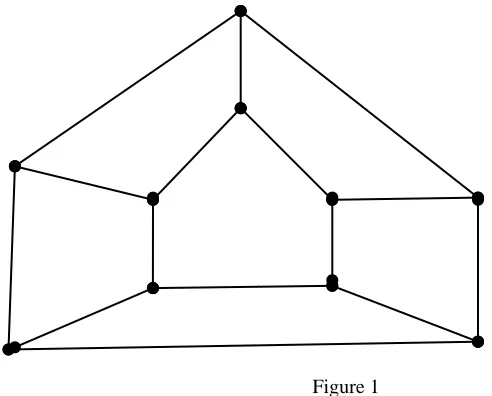
Definition 2.8: Snark graph is a graph in which every vertex has three neighbours. Example 2.9:
Figure 1
III. d4-DEGREE AND TOTAL d4-DEGREE OF A VERTEX IN FUZZY GRAPHS
Definition 3.1: Let G:(𝜎, 𝜇) be a fuzzy graph .The d2-degree of a vertex u in G is d4(u)= ∑μ4(uv) , where ∑μ4(uv)
=sup{𝜇(uu1) Λ 𝜇(u1u2) Λ 𝜇(u2u3) Λ 𝜇(u3v): u, u1, u2, u3, v is the shortest path connecting u and v of length 4}. Also
𝜇 𝑢𝑣 = 0, for uv not in E.
The minimum d4-degree of G is 𝛿4(G)= Λ{d4(v):vЄV}.
The maximum d4-degree of G is ∆4(G)= ⋁{d4(v):vЄV}.
Example 3.2: Consider G* : (V, E), where V={ u1, u2, u3, u4, u5,} and E={ u1u2, u2 u3, u3u4, u4 u5, u5 u1`}. Define G
:(𝜎, 𝜇) by 𝜎(u1)= 0.3, 𝜎(u2)= 0.4, 𝜎(u3)= 0.5, 𝜎(u4)= 0.6, 𝜎(u5)= 0.7, and 𝜇(u1u2)= 0.3, 𝜇(u2u3)= 0.4, 𝜇(u3u4)= 0.3,
𝜇(u4u5)= 0.2, 𝜇(u5u1)= 0.1.
Figure 2 u1 (0.3)
u2(0.4)
0.3
0.4 u3(0.5)
(0.5) 0.3
u4 (0.6) 0.2
u5 (0.7)
Here, d4(u1) = { 0.3 𝛬 0.4 𝛬 0.3 𝛬 0.2} + { 0.1 𝛬 0.2 𝛬 0.3 𝛬 0.4}
= 0.2 + 0.1 =0.3.
d4(u2) = { 0.4 𝛬 0.3 𝛬 0.2 𝛬 0.1} + { 0.3 𝛬 0.1 𝛬 0.2 𝛬 0.3}
= 0.1 + 0.1 =0.2.
d4(u3) = { 0.3 𝛬 0.2 𝛬 0.1 𝛬 0.3} + { 0.4 𝛬 0.3 𝛬 0.1 𝛬 0.2}
= 0.1 + 0.1 =0.2.
d4(u4) = { 0.2 𝛬 0.1 𝛬 0.3 𝛬 0.4} + { 0.3 𝛬 0.4 𝛬 0.3 𝛬 0.1}
= 0.1 + 0.1 =0.2.
d4(u5) = { 0.1 𝛬 0.4 𝛬 0.4 𝛬 0.3} + { 0.2 𝛬 0.3 𝛬 0.4 𝛬 0.3}
= 0.1 + 0.2 =0.3.
Example 3.3: Consider G* : (V, E), where V={ u1, u2, u3, u4, u5, u6} and E={ u1u2, u2 u3, u3u4, u4 u5, u5 u6, u6
u1`}. Define G :(𝜎, 𝜇) by 𝜎(u1)= 0.7, 𝜎(u2)= 0.8, 𝜎(u3)= 0.9, 𝜎(u4)= 0.8, 𝜎(u5)= 0.7, 𝜎(u6)= 0.6 and 𝜇(u1u2)= 0.5, 𝜇(u2u3)= 0.7, 𝜇(u3u4)= 0.6, 𝜇(u4u5)= 0.4, 𝜇(u5u6)= 0.3, 𝜇(u6u1)= 0.2.
Figure 3
d4(u1) = sup{ 0.5 𝛬 0.7 𝛬 0.6 𝛬 0.4, 0.2 𝛬 0.3 𝛬 0.4 𝛬 0.6}
= sup {0.4, 0.2} =0.4
Here, d4(u2) = sup{ 0.7 𝛬 0.6 𝛬 0.4 𝛬 0.3, 0.5 𝛬 0.2 𝛬 0.3 𝛬 0.4} u1 (0.7)
0.5
u2 (0.8)
0.7
u3 (0.9)
0.6
u4 (0.8)
0.4 u5 (0.7)
0.3 u6 (0.6)
= sup {0.3, 0.2} =0.3
d4(u3) = sup{ 0.6 𝛬 0.4 𝛬 0.3 𝛬 0.2, 0.7 𝛬 0.5 𝛬 0.2 𝛬 0.3}
= sup {0.2, 0.2} =0.2
d4(u4) = sup{ 0.4 𝛬 0.3 𝛬 0.2 𝛬 0.5, 0.6 𝛬 0.7 𝛬 0.5 𝛬 0.2}
= sup {0.2, 0.2} =0.2
d4(u5) = sup{ 0.3 𝛬 0.2 𝛬 0.5 𝛬 0.7, 0.4 𝛬 0.6 𝛬 0.7 𝛬 0.5}
= sup {0.2, 0.4} =0.4
d4(u6) = sup{ 0.2 𝛬 0.5 𝛬 0.7 𝛬 0.6, 0.3 𝛬 0.4 𝛬 0.6 𝛬 0.7}
= sup {0.2, 0.3} =0.3
Definition 3.4: Let G:(𝜎, 𝜇) be a fuzzy graph on G*:(V, E). The total d4-degree of a vertex u Є V is defined as
td4(u)= ∑μ4(uv) +𝜎(u)=d4(u) +𝜎(u)
The minimum td4-degree of G is t𝛿4(G)= Λ{d4(v):vЄV}.
The maximum td4-degree of G is t∆4(G)= ∨{d4(v):vЄV}.
Example 3.5: Consider G* : (V, E), where V={ u1, u2, u3, u4, u5,} and E={ u1u2, u2 u3, u3u4, u4 u5, u5 u1`}. Define G
:(𝜎, 𝜇) by 𝜎(u1)= 0.5, 𝜎(u2)= 0.6, 𝜎(u3)= 0.5, 𝜎(u4)= 0.6, 𝜎(u5)= 0.5, and 𝜇(u1u2)= 0.3, 𝜇(u2u3)= 0.4, 𝜇(u3u4)= 0.3,
𝜇(u4u5)= 0.2, 𝜇(u5u1)= 0.1.
Figure 4
Here, td4(u1) = { 0.3 𝛬 0.4 𝛬 0.3 𝛬 0.2 } + { 0.1 𝛬 0.2 𝛬 0.3 𝛬 0.4}+𝜎(u1)
=0.3+0.5=0.8
td4(u2) = { 0.4 𝛬 0.3 𝛬 0.2 𝛬 0.1} + { 0.3 𝛬 0.1 𝛬 0.2 𝛬 0.3}+𝜎(u2)
=0.2+0.6=0.8
u1 (0.5)
u2(0.6)
0.3
0.4
u3(0.5)
(0.5) 0.3
u4 (0.6)
0.2 u5 (0.5)
td4(u3) = { 0.3 𝛬 0.2 𝛬 0.1 𝛬 0.3} + { 0.4 𝛬 0.3 𝛬 0.1 𝛬 0.2}+𝜎(u3)
=0.2+0.5=0.7
td4(u4) = { 0.2 𝛬 0.1 𝛬 0.3 𝛬 0.4} + { 0.3 𝛬 0.4 𝛬 0.3 𝛬 0.1}+𝜎(u4)
=0.2+ 0.6=0.8
td4(u5) = { 0.1 𝛬 0.4 𝛬 0.4 𝛬 0.3} + { 0.2 𝛬 0.3 𝛬 0.4 𝛬 0.3}+𝜎(u5)
=0.3+0.5=0.8.
IV. (4, K)-REGULAR AND TOTALLY (4, K)-REGULAR FUZZY GRAPHS
Definition 4.1: Let G:(𝜎, 𝜇) be a fuzzy graph on G*:(V, E). If d4(v)= k for all vЄV, then G is said to be (4, k)-
regular fuzzy graph .
Example 4.2: Consider G* : (V, E), where V={ u1, u2, u3, u4, u5,} and E={ u1u2, u2 u3, u3u4, u4 u5, u5 u1`}. Define G
:(𝜎, 𝜇) by 𝜎(u1)= 0.3, 𝜎(u2)= 0.4, 𝜎(u3)= 0.5, 𝜎(u4)= 0.6, 𝜎(u5)= 0.7, and 𝜇(u1u2)= 0.3, 𝜇(u2u3)= 0.4, 𝜇(u3u4)= 0.3,
𝜇(u4u5)= 0.6, 𝜇(u5u1)= 0.3.
Figure 5
Here, d4(u1)=0.6, d4(u2)=0.6, d4(u3)=0.6, d4(u4)=0.6, d4(u5)=0.6.
G is (4, 0.6) - regular fuzzy graphs.
Definition 4.3: If each vertex of G has the same total d4-degree k, then G is said to be totally (4, k)-regular fuzzy
graph.
Example 4.4: Consider G* : (V, E), where V={ u1, u2, u3, u4, u5,} and E={ u1u2, u2 u3, u3u4, u4 u5, u5 u1`}. Define G
:(𝜎, 𝜇) by 𝜎(u1)= 0.3, 𝜎(u2)= 0.3, 𝜎(u3)= 0.3, 𝜎(u4)= 0.3, 𝜎(u5)= 0.3, and 𝜇(u1u2)= 0.1, 𝜇(u2u3)= 0.1, 𝜇(u3u4)= 0.1,
𝜇(u4u5)= 0.1, 𝜇(u5u1)= 0.1.
u1 (0.3)
u2(0.4)
0.3
0.4
u3(0.5)
(0.5) 0.3
u4 (0.6)
0.6 u5 (0.7)
Figure 6
Here, td4(u1)=0.5, td4(u2)=0.5, td4(u3)=0.5, td4(u4)=0.5, td4(u5)=0.5.
G is totally regular fuzzy graph.
Example 4.5: Consider G*: (V, E), where V={ u1,u2,u3, u4, u5, u6, u7, u8, u9, u10} and E={ u1u2,u2u3,u3u4,u4u5, u5u6,
u6u7, u7u8, u8u9, u9u10, u10u6, u1u7, u2u8, u3u9, u4u10}. Define G :(𝜎, 𝜇) by 𝜎(u1)= 0.3, 𝜎(u2)= 0.3, 𝜎(u3)= 0.3, 𝜎(u4)=
0.3, 𝜎(u5)= 0.3, 𝜎(u6)= 0.3, 𝜎(u7)= 0.3, 𝜎(u8)= 0.3, 𝜎(u9)= 0.3, 𝜎(u10)= 0.3, and 𝜇(u1u2)= 0.2, 𝜇(u2u3)= 0.2, 𝜇(u3u4)=
0.2, 𝜇(u4u5)= 0.2, 𝜇(u5u6)= 0.2, 𝜇(u6u7)= 0.2, 𝜇(u7u8)= 0.2, 𝜇(u8u9)= 0.2, 𝜇(u9u10)= 0.2, 𝜇(u10u6)= 0.2, 𝜇(u1u7)=
0.2, 𝜇(u2u8)= 0.2, 𝜇(u3u9)= 0.2, 𝜇(u4u10)= 0.2, 𝜇(u5u1)= 0.2,
Here td4(u1) = sup{0.2⋀0.2⋀0.2⋀0.2, 0.2⋀0.2⋀0.2⋀0.2, 0.2⋀0.2⋀0.2⋀0.2, 0.2⋀0.2⋀0.2⋀0.2}+𝜎(u1)
= sup{0.2, 0.2, 0.2, 0,2} +0.3
= 0.5
td4(u2) =0.5, td4(u3) =0.5, td4(u4) =0.5, td4(u5) =0.5, td4(u6) =0.5, td4(u7) =0.5,
td4(u8) =0.5, td4(u9) =0.5, td4(u10) =0.5.
G is totally regular graph.
Example 4.6: Non regular fuzzy graphs which is (4, k) - regular.
In example 4.2, we have G is (4, 0.6) regular fuzzy graph but not regular graph.
Theorem 4.7: Let G: (𝜎, 𝜇) be a fuzzy graph on G*: (V,E). Then 𝜎 is constant function iff the following conditions are equivalent:
(1) G: (𝜎, 𝜇) is (4, k)- regular fuzzy graph.
(2) G: (𝜎, 𝜇) is totally (4, k+c)- regular fuzzy graph. Proof: Suppose that 𝜎 is constant function. Let 𝜎(𝑢)=c, constant for all u Є V.
u1 (0.3)
u2(0.3)
0.1
0.1
u3(0.3)
(0.5) 0.1
u4 (0.3)
0.1 u5 (0.3)
Assume that G: (𝜎, 𝜇) is a (4, k)- regular fuzzy graph. Then d4(u)=k for all u ЄV.
So t4d(u)= d4(u)+ 𝜎(u) for all uЄV.
⟹ td4 (u)= K+c for all uЄV.
Hence G: (𝜎, 𝜇) is totally (4, k+c)- regular fuzzy graph. Thus, (1) ⟹(2) is proved.
Suppose G: (𝜎, 𝜇) is totally (4, k+c)-regular fuzzy graph. Then td4(u)= k +c for all uЄV.
⟹d4(u)+ 𝜎(u)=k+c for all u ЄV.
⟹d4(u)+ 𝑐 =k+c for all u ЄV.
⟹d4(u)=k for all u ЄV.
Hence G: (𝜎, 𝜇) is a ( 4, k)- regular fuzzy graph. Thus, (2) ⟹(1) is proved.
Hence (1) and (2) are equivalent.
Conversely it is assume that (1) and (2) are equivalent.
Suppose that 𝜎 is not constant function.
Then 𝜎(u)≠𝜎(w), for at least one pair u, w Є V. Let G: (𝜎, 𝜇) be a (4,k)- regular fuzzy graph. Then , d4(u)= d4(w)=k
.
So, td4(u)= d4(u)+ 𝜎(u)=k+ 𝜎(u) and td4(w)= d4(w)+ 𝜎(w)=k+ 𝜎(w).
Since 𝜎(u)≠𝜎(w)implies K+ 𝜎(u)≠ 𝐾 +𝜎(w)
⟹ td4(u) ≠ td4(w) .
So, G: (𝜎, 𝜇) is not totally (4, k)- regular fuzzy graph, Which is contradiction to our assumption. Let G: (𝜎, 𝜇) be a totally (4, k)-regular fuzzy graph.
Then, td4(u)= td4(w) .
⟹d4(u)+ 𝜎(u)= d4(w)+ 𝜎(w).
⟹d4(u)- d4(w)= 𝜎(w)- 𝜎(u) ≠0.
⟹d4(u) ≠ d4(w).
So, G: (𝜎, 𝜇) is not (4, k)- regular fuzzy graph, Which is contradiction to our assumption. Hence 𝜎 is constant function.
Proof: Let G be (4, k1)-regular and totally (4, k2)-regular fuzzy graph.
Then d4(u)= k1 and td4(u)=k2 for all uЄV.
Now, td4(u)=k2, for all uЄV.
⟹d4(u)+ 𝜎(u)= k2, for all uЄV.
⟹k1+ 𝜎(u)= k2, for all uЄV.
⟹ 𝜎(u)= k2 - k1, for all uЄV.
Hence 𝜎 is constant function.
REFERENCES
[1] Alison Northup, A study of semi-regular graphs, Bachelor thesis, Stetson University (2002)
[2] A.Nagoor Gani and K. Radha, On Regular Fuzzy Graphs, Journal of physical sciences, 12(2008), 33-40.
[3] A.Rosenfelt, Fuzzy Graphs, In: L.A.Zadeh, K.S.Fu, M.Shimura, Eds, Fuzzy sets and their applications, Academic press(1975),77-95.
[4] N.R.Santhi Maheswari and C.Sekar, On (r,2,r(r-1))-regular fuzzy graphs International Journal of Mathematics and Soft Computing,
2(2)(2012), 25-33.