http://dx.doi.org/10.22161/ijeab/2.2.52 ISSN: 2456-1878
Effect of Irrigation Levels on Yield Performance
of Black Cumin
Karim M.
1*, R.M. Himel
2, J. Ferdush
3, M. Zakaria
41*Corresponding author, Department of Horticulture, Bangabandhu Sheikh MujiburRahmanAgricultural University,
Bangladesh, Gazipur. E-mail: [email protected] Tel: +8801725435158
2 Scientific Officer, Bangladesh Tea Research Institute, Srimongol, Bangladesh
3 Scientific Officer, Bangladesh Jute Research Institute, Dhaka, Bangladesh
4Professor, Department of Horticulture, Bangabandhu Sheikh MujiburRahman Agricultural University, Gazipur, Bangladesh.
Abstract— An experiment was conducted in the experimental field of Horticulture Department, Bangabandhu Sheikh MujiburRahman Agricultural University (BSMRAU), Salna, Gazipur during the period from 20 November, 2012 to 12 April, 2013 to determine the optimum level of irrigation for better yield and quality of black cumin. There were six different irrigation levels (I1 - no irrigation, I2 - three irrigation, I3 - four irrigation,
I4 - six irrigation, I5 - eight irrigation and I6 - ten
irrigation). Results revealed that the number of primary branches (6.33), secondary branches (11.84), tertiary branches (6.29), number of capsule per plant (18.64), capsule length (1.89 cm), diameter of capsule( 1.05 cm), number of seed per capsule (107.8), fresh seed yield per plant (3.84g), dry seed yield per plant (3.26g), 1000 seed weight (2.40g) and seed yield (1.77 t/ha) were observed maximum in I6(ten irrigation).
Keywords— Black cumin, capsule, irrigation, seed, yield.
I. INTRODUCTION
Black cumin (Nigella sativa L.) is an annual aromatic
plant native to Southwest Asia and the Mediterranean region. Presently, it is cultivated in various parts of the world, including Asia, the Middle East and North Africa. Seed of black cumin contain about 21% protein, 35% carbohydrates and 35-38% plant fats and oils [1]. It contains all essential amino acids and rich source of vitamins and minerals [2, 3]. Total cultivable area of Bangladesh is 14.86 million hectare but only 56 percent of cultivable area under irrigation coverage [4].
North-with an average yield of 1.04 t/ha [6]. The yield is low compared to Iran(1.71- 2.1 t/ha)[7]. In farmers field of some places of Bangladesh, yield is 1.19 to 1.48 t/ha [8]. Black cumin is an annual plant, originally grown in arid and semi-arid regions[9]. One third of the world lands are classified as arid and semi-arid region and the remains are faced with water seasonal or local fluctuations[10]. Availability of water rather than land is the main constraint on agricultural production in arid and semi-arid environments [11]. Some studies shown that, the black cumin is able to tolerate moderatelevels of water stress [11, 12].Some researchers have focused on response of black cumin to different irrigation intervals [12, 13] and irrigation scheduling based on developmental stage [11]. Moreover, deficit irrigation is one way of maximizing water use efficiency (WUE) for higher yields per unit of irrigation water applied where crop is exposed to a certain level of water stress either during a particular period or throughout the entire growing season [14]. The cost of irrigation pumping and inadequate irrigation capacity as well as limited water sources is among the reasons that force many farmers in the region to reduce their irrigation
applications. Irrigation scheduling based on
http://dx.doi.org/10.22161/ijeab/2.2.52 ISSN: 2456-1878
2.1. Treatments of the experiment:
The experiment consisted of six treatments: I1 = No irrigation I2 = Three irrigationI3 = Four irrigation I4 = Six irrigation I5 = Eight irrigation I6 = Ten irrigation
2.2 Design and layout:
The field experiment was laid out in Randomized Complete Block Design (RCBD) with three replications. The whole experimental area was divided into three blocks which represented replication. The treatments were randomly allotted in each replication.
2.3. Plant material:
Exotic variety of black cumin was used as plant material. 2.4. Collection of data:
Data were collected from the inner rows of each plot to avoid the border effect. The following seed yield and yield contributing parameters were observed.
2.5. Number of branches per plant:
The primary, secondary and tertiary branches per plant were counted at the time of harvesting. Ten randomly selected plants from each plot were used for counting number of primary, secondary and tertiary branches. 2.6. Length of capsule:
A slide calipers was used to measure the capsule length in centimeter. Ten randomly selected capsules were taken from each plot to take average length of capsule.
2.7. Capsule diameter:
A slide calipers was used to measure the capsule diameter in centimeter. Ten randomly selected capsules were taken from each plot to measure average diameter of capsule. 2.8. Number of seeds per capsule:
Ten randomly selected capsules were taken from each plot and average seeds per capsule were counted.
2.9. Number of capsule per plant:
Ten randomly selected plants were taken from each plot and average capsules per plant were counted.
2.10. Fresh seed yield per plant:
Fresh seed yield per plant was calculated from the total fresh weight of seed often randomly selected plants dividing by ten.
2.11. Dry seed yield per plant:
Dry seed yield per plant was calculated from the total sundried weight of 10 randomly selected plants dividing by ten. Moisture content of seed was about 10%.
2.12. 1000 seed weight:
Thousand seeds of randomly selected 10 samples were weighted and its averages were taken with the help of an electric balance.
2.13. Seed yield:
The mature seeds of all plots were harvested, cleaned and dried. First plot yield was obtained in kg by the help of electric balance. Then plot yield was converted into t/ha. 2.14. Statistical analysis:
The recoded data on different parameters were statistically analyzed and partitioning the variance with the help of “MSTAT-C” software. The difference between treatment means was compared by Duncan’s Multiple Range Test (DMRT).
III. RESULT AND DISCUSSION
3.1. Number of branches per plant:
http://dx.doi.org/10.22161/ijeab/2.2.52 ISSN: 2456-1878
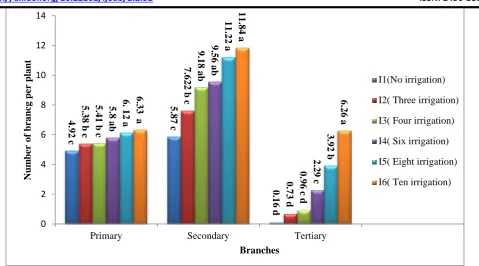
Fig.1: Effect of irrigation on the number of branches per plant.
3.2. Length & diameter of capsule:
The effect of irrigation on the length of capsule was found significant (Table 1). The maximum capsule length (1.89cm) was recorded in I6 which was statistically similar to I5 and I4. The minimum capsule length (1.13cm) was observed in I1 (No irrigation) which was statistically similar to all except I6.
The effect of irrigation on the diameter of capsule was found significant (Table 1). The maximum capsule diameter (1.05cm) was recorded in I6 which was statistically similar to I5, I4 and I3. The .minimum capsule diameter (0.78cm) was observed in I1 which was similar to I2, I3 and I4. The diameter of capsule increased with the increasing of irrigation number.
3.3. No. of capsule per plant & no. of seed per capsule: The effect of irrigation on the number of capsule per plant was also found significant (Table 1). The highest number of capsule (18.64) was observed in I6 (Ten irrigation) which was statistically different from others. The lowest number of capsule (10.42) was found in I1 which was
statistically at par with I2 and I3. Number of capsule increased with the increasing number of irrigation. The higher number of irrigation facilitated the plant to produce more branches resulting more capsules per plant. The effect of irrigation on the number of seed also found significant (Table 1).The plants treated with I6 produced maximum number of seed (107.8) closely followed by I5 (97.48). The minimum number of seed (81.77) was observed in I2 which wasstatistically identical to I1 (87.07), I3 (84.62) and I4 (85.81). The number of seed increased with the increasing of irrigation. Due to less irrigation during the growing period caused a decrease of water use efficiency, biomass and number of seeds. And drought that occurred in the late growing season affected seed filling. Decrease in number of seeds per capsule and seeds per plant in water stress conditions can be the result of water shortage during the seed filling stage that shortens the flowering [17]. Irrigation had a significant effect on number of follicles per plant [11].
Table. 1: Effect of irrigation on capsule length, diameter, number of capsule per plant and seed per capsule in black cumin.
4 .9 2 c 5 .8 7 c 0 .1 6 d 5 .3 8 b c 7 .6 2 2 b c 0 .7 3 d 5 .4 1 b c 9 .1 8 a b 0 .9 6 c d 5 .8 ab 9 .5 6 a b 2 .2 9 c 6 . 12 a 1 1 .2 2 a 3 .9 2 b 6 .3 3 a 1 1 .8 4 a 6 .2 6 a 0 2 4 6 8 10 12 14
Primary Secondary Tertiary
Num ber o f bra ncg per pla nt Branches I1(No irrigation)
I2( Three irrigation)
I3( Four irrigation)
I4( Six irrigation)
I5( Eight irrigation)
http://dx.doi.org/10.22161/ijeab/2.2.52 ISSN: 2456-1878
Means bearing same letter (s) in a column do not differ significantly at 5% level of probability by DMRT.
3.4. Fresh and dry seed yield per plant (g)
Fresh seed yield per plant is an important yield contributing character varied significantly due to different genotypes. The effect of irrigation on fresh seed yield per plant was found significant (Fig.2). The plants irrigated ten times (I6) showed maximum fresh seed yield (3.84g) which was statistically identical to I5 (3.53g). The minimum fresh seed yield (1.86g) was observed in I1 which was statistically similar to I2. The supply of
sufficient water from the soil due to more irrigation might have helped in maintaining better substrate for photosynthetic activities in the leaves. It is well known fact that proper supply of moisture help in maintaining high photosynthetic rate and turgidity, which could increase the cell elongation and its multiplication at much faster rate resulting higher seed yield per plant.
The effect of irrigation on dry seed yield per plant was also found significant (Fig.2). The maximum dry seed yield (3.26g) was recorded in I6 which was statistically similar to I5 (3.00g). The minimum dry seed yield (1.45g) was observed in I1 which was statistically identical to I2.
Fig. 2: Effect of irrigation on fresh & dry seed yield per plant.
3.5. 1000 seed weight (g)
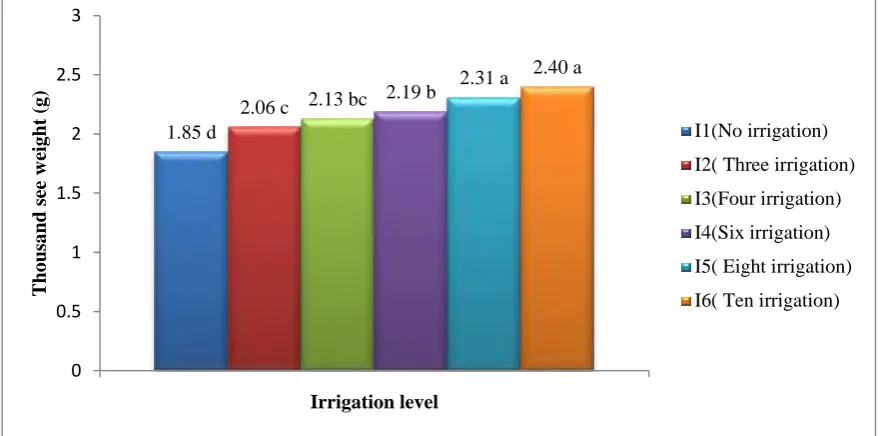
Thousand seed weight is an important yield contributing character. The effect of irrigation on 1000 seed weight was found significant (Fig. 3). The maximum 1000 seed weight (2.40g) was recorded in I6 (Ten irrigation) which
was statistically similar to I5 (2.31g) and the minimum 1000 seed weight (1.85g) was observed in I1 (No irrigation). The results were similar to those of [11, 18] where significant difference in 1000 seed weight was reported in different irrigation treatments for black cumin.
Fig.3: Effect of irrigation on 1000 seed weight.
1
.8
9
c 1.4
5
d
2
.1
9
c 1.59
c
d
2
.3
5
bc 1.97
bc
2
.8
b 2.32
b
3
.5
3
a
3
a
3
.8
4
a 3.26
a
0 0.5 1 1.5 2 2.5 3 3.5 4 4.5
Fresh Dry
Seed
w
eig
ht
per
pla
nt
(g
)
Seed Yield
I1(No irrigation)
I2(Three irrigation)
I3(Four irrigation)
I4(Six irrigation)
I5(Eight irrigation)
I6(Ten irrigation)
1.85 d
2.06 c 2.13 bc 2.19 b
2.31 a 2.40 a
0 0.5 1 1.5 2 2.5 3
T
ho
us
a
nd
s
ee
w
eig
ht
(g
)
Irrigation level
I1(No irrigation)
I2( Three irrigation)
I3(Four irrigation)
I4(Six irrigation)
I5( Eight irrigation)
http://dx.doi.org/10.22161/ijeab/2.2.52 ISSN: 2456-1878
3.6. Seed Yield
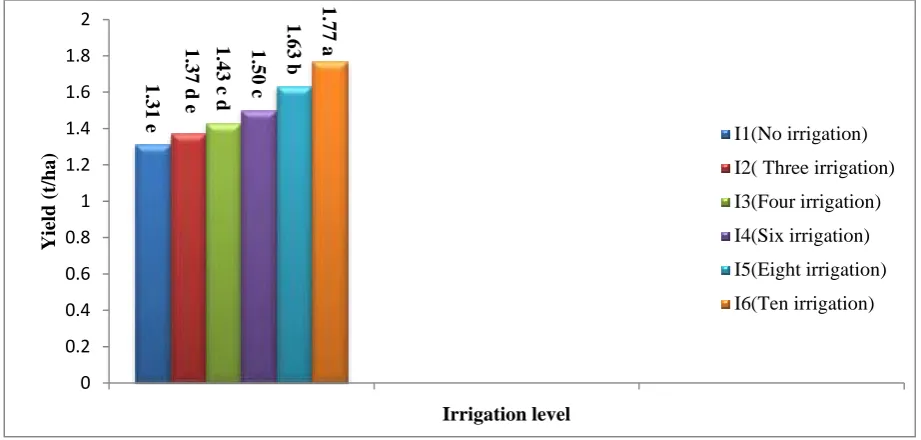
Seed yield per hectare varied significantly due to influence of irrigation (Fig. 4). The highest seed yield (1.77 t/ha) was found in I6 (Ten irrigation) which was statistically different from others. The minimum seed yield (1.31 t/ha) was observed in I1 (No irrigation). Reduced yield as impact of stress mainly is due to shortening of plant growth stages [17]. Yield of black cumin per hectare increased with increase of irrigation which was similar to results obtained by [19, 20, 21, and 22]. All of them reported to have an increasing yield with increase in irrigation water supplied. The yield and growth characters were maximum at 0.8 IW/CPE (fiveirrigation) [23]. It was due to higher physiological
activities favoring higher nutrient uptake and
photosynthesis which might be responsible for formation
of more photosynthesis under this treatment resulting more yields. Besides, improvement in physical, chemical and microbial environment of soil, it might have also increased the availability of nutrients and water. The supply of sufficient water from the soil might have helped in maintaining better substrate for photosynthetic activities in the leaves. It is well known fact that proper
supply of moisture help in maintaining high
photosynthetic rate and turgidity, which could increase the cell elongation and its multiplication at much faster rate. Drought stress made changes in photosynthetic pigments and components [24] damaged photosynthetic apparatus [25] and diminished activities of Calvin cycle enzymes, which are important causes of reduced crop yield.
Fig. 4: Effect of irrigation level on seed yield.
The result revealed that almost all the parameters studied significantly influenced by different level of irrigation, the highest primary branches (6.33), secondary branches (11.84), tertiary branches (6.26) at 75 DAS were found in I6 (Ten irrigation) and lowest was found in I1 (No irrigation).
The maximum capsule length (1.89 cm), capsule diameter (1.05 cm), number of capsule per plant (18.64), number
irrigation) produced maximum number of primary branches, number of secondary branches, number of tertiary branches, capsule length, capsule diameter, number of capsule per plant, number of seed per capsule and seed yield per hectare. Similar type of experiment may be conducted in different Agro-Ecological Zones (AEZs) to confirm the results.
1
.3
1
e
1
.3
7
d e
1
.4
3
c
d
1
.5
0
c
1
.6
3
b
1
.7
7
a
0 0.2 0.4 0.6 0.8 1 1.2 1.4 1.6 1.8 2
Yield
(t
/ha
)
Irrigation level
I1(No irrigation)
I2( Three irrigation)
I3(Four irrigation)
I4(Six irrigation)
I5(Eight irrigation)
http://dx.doi.org/10.22161/ijeab/2.2.52 ISSN: 2456-1878 food plants in Jordan. (Electronic Version)” Plant
Foods for Human Nutrition, 1999, 54: 285–
294.https://www.ncbi.nlm.nih.gov/pubmed/1079833
9
[3] M. Tierram, “Nigella sativa, commonly known as "Love in the Mist": A beautiful Middle Eastern herb
with many uses” 2005.
http://www.planetherbs.com/articles/nigella.htm
[4] BBS, “Statistical Year Book of Bangladesh”. 27th ed. Bangladesh Bureau of Statistics.Planning division, Ministry of Planning.Gov. of the People’s Republic of Bangladesh, 2007, pp. 91-92.
[5] M. Rahman,“Country report: Bangladesh. ADBI
-APO Workshop on climate change and its impact on agriculture” 2011, Seoul, Republic of Korea.
[6] Anonymous, “Annual spices production report” 2012, Dept. of Agricultural Extension, Khamarbari , Dhaka.
[7] B. Abdolrahimi, P. Medhikhani and A. H. G. Tappe,
“The effect of harvest index, yield and yield
components of three varieties of black seed (Nigella
sativa) in different planting densities” International Journal of AgriScience, 2012, 2(1): 93-101.
https://www.researchgate.net/publication/23379304 5
[8] Anonymous,“Cultivation method of BARI Kalojeera 1”.Publication no. folder 10, 2007, BARI, Gazipur. [9] L. D'Antuono, F. A. Moretti and F. S. Lovato,.“Seed
yield, yield components, oil content and essential oil
content and composition of Nigella sativa L. and
NigelladamascenaL.” Industrial Crops and Products,
2002, 15(1):
59-69.http://www.sciencedirect.com/science/article/pii/
S0926669001000966
[10]J. D. Beweley and J. E. Krochko, “Physiological plant ecology & water relation and carbon assimilation" Springer-Verlag, New York, 1982, pp. 23-24.
[11]M. Bannayan, F. Nadjafi, M. Azizi, L. Tabrizi and
M. Rastgoo, “Yield and seed quality of
Plantagoovata and Nigella sativa L. under different irrigation treatments” Industrial Crops and Products,
2008, 27(1):
11-16.https://www.researchgate.net/publication/222696
644
[12]F. S. Mozzafari, M. Ghorbanli, A. Babai and M.
Faramarzi, “The effect of water stress on the seed oil of Nigella sativa” Journal of Essential Oil Research,
2000, 12(1): 36-38.
http://www.tandfonline.com/doi/abs/10.1080/10412 905.2000.9712036?journalCode=tjeo20
[13]A. Babai, “Study the effect of water stress on phenology, quantity and quality characteristics
essence and oil seed of black cumin (Nigella sativa
L.)” 1995, An unpublished MS Thesis of Plant Science. Faculty of Science, Islamic Azad University of Tehran.
[14]M. English and S. N. Raja, “Perspectives on deficit irrigation” Journal of Agricultural Science, 1996,
32: 1–14.
[15]M. Bannayan, F. Nadjafi, M. Rastgoo and L.
Tabrizi, “Germination properties of some wild medicinal plants from Iran” Seed Technology, 2006,
28(1): 80-86. https://www.jstor.org/stable/23433359
[16]J. H. Bouton, S. L. Albercht and D. A. Zuberer,
“Screening and selection of plants for root associated bacteria nitrogen fixation”. Field Crop
Research, 1985, 11(2): 131-140.
https://www.researchgate.net/publication/24041222 3
[17]H, Nassiri, M. Seghatoleslami, G. Mousavi and A.
Ebrahimi,“Effect of irrigation and planting date on yield and water use efficiency of ajowan (Carumcopticum)” Annual Review & Research in
Biology, 2014, 4(12): 1968-1979.
http://connection.ebscohost.com/c/articles/95812074
[18]H. Ghamarnia, Z. Jalili and S. Daichin, “The effects of saline irrigation water on different components of
black cumin (Nigella sativa L.)” International
Journal of AgriScience, 2012, 2(10): 915-922.
https://www.cabdirect.org/cabdirect/abstract/201233 58088
[19]H. Hiraoka, V. Sasiprapa and W. Piyawongsombon,
“Irrigation effect on maize and soyabean” Technology Bulletin, 1976, 20: 28-34.
[20]R. Lazarov, A. Mekhandzhieva and S. Ugrchinski,
“Irrigation of maize with reduced irrigation norms” International Journal of Agriculture and Crop
Sciences, 1976, 13(4): 40-50.
[21]D.C. Karlen and C. R. Camp, “Row spacing, plant population and water management effects in the
Atlantic coastal plains” Agronomy Journal, 1985,
77(3): 393-398.
https://dl.sciencesocieties.org/publications/aj/abstrac ts/77/3/AJ0770030393?access=0&view=pdf
[22]W. V. Averbeke and J. N. Marais, “Maize response
to plant population and soil water supply. I. Yield of
grain and total above ground biomass” South
African Journal of Plant and Soil, 1992, 9(4):
186-192.https://www.researchgate.net/publication/25596
3840
[23]R. Lakpale, G. K. Shrivastava and R. S. Tripathi,
“Effect of irrigation schedule on growth, yield and
economics of spice crops” Indian Journal of
410-http://dx.doi.org/10.22161/ijeab/2.2.52 ISSN: 2456-1878
415.https://www.researchgate.net/publication/29268
4032
[24]F. Anjum, M. Yaseen, E. Rasul, A. Wahid and S.
Anjum, “Water stress in barley (Hordeumvulgare
L.). I. Effect on chemical composition and chlorophyll contents” Pakistan Journal of
Agricultural Science, 2003, 40: 45–49.
http://agris.fao.org/agris-search/search.do?recordID=PK2003000832
[25]J. Fu and B. Huang, “Involvement of antioxidants and lipid peroxidation in the adaptation of two
cool-season grasses to localized drought stress”
Environmental and Experimental Botany, 2001
45(2): 105–114.