This document has been help foster conversations about the creation of an enterprise-wide
analytics strategy. The topics discussed should help Retailers identify opportunities in
customer interaction, store operations and supply chain activities that advanced and
predictive analytics can add value to.
1. Business and Functional Requirements
To start with, this section describes some of the business and functional requirements of the
retail industry, and offers examples of how Predictive Analytics can help those
industry-specific needs.
Retailers who run promotions on wrong product combinations or whose offers to customers
are poorly targeted will waste effort, money, and lose the opportunity to motivate customer
behaviour. Maximizing profitability in the retail segment requires deep understanding of
customer preferences and product sales patterns. When selecting which products to offer,
retailers are challenged with balancing inventory costs against lost sales opportunity if
desired products are not available. To maximize return on marketing investment (ROMI),
retailers must design promotions that match shopper preferences and behaviours at the
same time as building customer value and loyalty.
Approaches typically focus on using existing data more effectively, gaining better visibility
into information with fewer IT resources. With the proliferation of multi-channel shopper
engagement, the ability to offer effective and appealing customer self-service capabilities is
also critical. This provides both an opportunity to better serve and enhance the customer
experience, but at the same time provides a deluge of high detail, high volume and fast
velocity data. A blessing and a curse! Retail marketers and customer loyalty executives seek
to understand customer preferences and buying patterns, improve their ability to develop
effective promotions, and boost marketing conversion rates per unit-spend.
Retailers have a dynamic and complex operational environment where Advanced Analytics
repeatedly adds significant value.
2. Predictive Analytics Approaches
So, the question is, as the customer has most of the control, how could Retailers make
better use of technology and the volume, velocity and variety of data which can now be
captured?
Let’s look at some examples of how retailers can adopt Advanced Analytics to gain
competitive or operational advantage. In this first example we will see how, using the most
universal sources of data in combination with some simple analytical techniques allows
merchandizers, marketers and store operations staff to make better decisions about how to
manage their product range.
With association modelling, advanced predictive algorithms automatically find product
combinations that drive increased sales, and thus ensure that marketing offers are tailored to
each customer's needs and preferences, increasing revenues and return on marketing
spend.
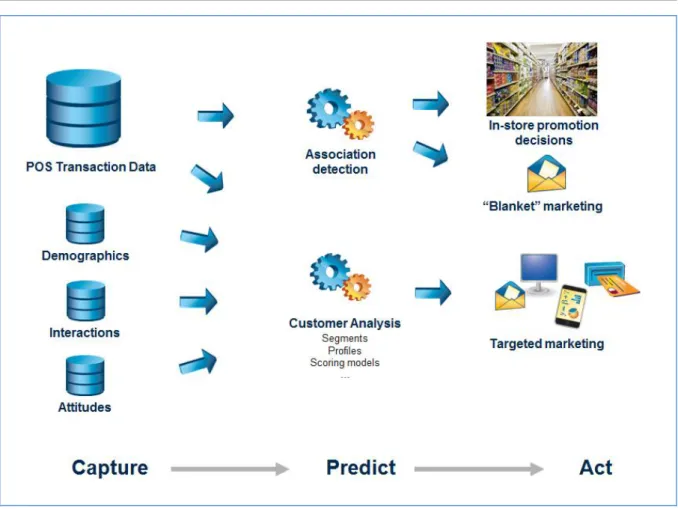
Predictive models examine point-of-sale data from all customers, across all channels, to
reveal which combinations of products tend to be purchased or browsed together. By
examining these associations, retailers can determine which joint offers, of pairs or sets of
products, are most likely to generate additional sales. This approach can provide certain
in-store deployment capabilities, such as posting discounts when products are purchased
together. Although this approach certainly provides several advantages, the effectiveness of
it is entirely dependent upon customers entering the store and physically seeing the offers
that are displayed. When this information is combined with other customer data such as
demographics, behaviour, interactions and attitudes, and of course context data such as
their current browsing history, purchasing patterns can be matched to customer profiles and
enable the targeting of specific offers to specific customers. This second level of predictive
modelling can then identify which items should be included as a recommendation or in a
promotional brochure to be sent to a customer. Channel delivery preference (postal mail,
email, and so on) can also be expressly given or can be assigned using the channel with the
highest probability of action. Customer loyalty programs are often a key source of this type of
individual customer data, as are customer satisfaction surveys or website activity. The retail
market-basket analysis solution is depicted in Figure 1 below.
Figure 1: Analytical process, retail market basket analysis
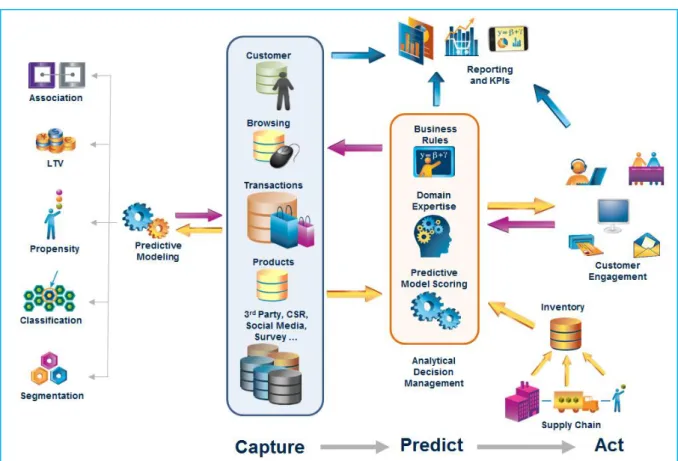
In this next example, we can see the approach used to determine the next best action for a
customer. Customers effortlessly use multiple channels for researching, purchasing,
recommending and discussing products. Retailers can gain data from this, but, using
appropriate analytics and deployment techniques, can harness these interactions with much
greater utility than before. The data volumes, and the velocity of change mean “spreadsheet
analytics” can’t cope, or keep pace with, the scope and context of customer interactions.
Customers expect consistency between channels (mobile, web, call centre, loyalty
communications) due to expectations about technology but also as a payback for providing
so much data. Predictive Analytics provides a backbone to understanding customer profiles,
customer interactions/behaviours and helps put that insight into action – where it counts –
into the systems the customer has cause to use. Traditional “customers who bought this
product also bought these products” misses a huge opportunity to make the most of all data
available – both historic and also contextual. Using a mix of customer segmentation and
profiling, along with more deep rooted Life Time Value and RFM analyses, context data
about the interaction at that moment, combined with propensity modelling means much more
relevant offers/recommendations can be created or if required, more personalized
customizations to the interactions can be instigated. Putting the customer at the centre of the
conversation requires analytics to be much more responsive than elemental product
Figure 2: Analytical process, next best action
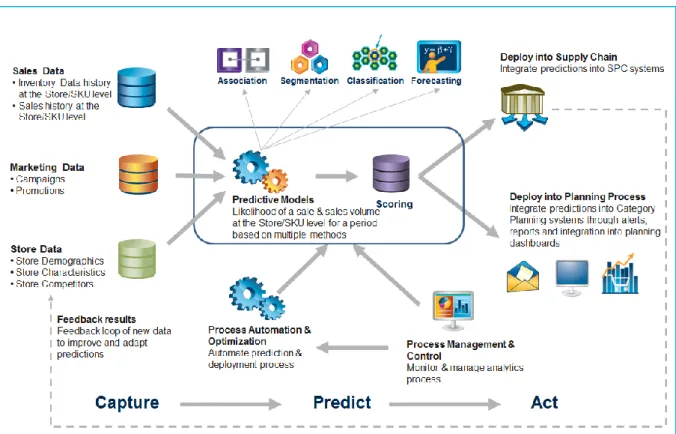
Assortment Planning solutions predict the optimum stock levels and assortments at the
store, category, or even SKU level (even in volatile environments) to maximize resources,
increase inventory turnover, and increase customer satisfaction. This approach gives
demand forecast predictions about sales volumes at a particular store, and helps ensuring
the items are available, or equally importantly not to over-stock where sales are unlikely.
This approach includes techniques such as demand-based store clustering, new and
existing SKU sales forecasts, category-space allocation, association modelling (market
basket), and assortment optimization and rationalization. Using predictive models, stores
can determine how many assortments (store clusters) are needed for each product category.
Clustered assortments allow for grouping of similar stores together to maximize customer
traction and lower the demands on the supply chain. These clusters are demand-based,
rather than demographic based, where the actual demand for key product SKUs is revealed,
helping stores to more easily identify which products to stock. However, if appropriate, using
exactly the same methodology, forecasting can be done at the individual store level for the
lowest level of assortment planning. The models also forecast unit sales for new and existing
SKUs. Products are divided into attributes and assigned relative importance, and models
identify key predictors for arriving at an accurate forecast. Predictive capability essentially
makes it possible to look beyond historical sales as indicators of future ones. The retail
assortment planning solution is depicted in Figure 3 below.
3. Enterprise-wide Adoption of Predictive Analytics
The example approaches presented above are not, by any means, the full extent of retail
analytics which can be enhanced by using Predictive Analytics. The following lists out some
other areas where competitive advantage can be gained by deploying predictive analytics
into a retailer’s operations and systems.
To keep the document to a usable length, you will see that each area has a few discrete
examples of analytics activities. Not every Retailer has opportunities to attempt all of these
topics, and due to the nature of the operational systems, the business model and of course
the availability of data, will not be able to approach them in exactly the same way as other
retailers. So, when reviewing each area, try to convert the examples to relevant operations
and business processes To help you do that, each of these topics should be reviewed from
the Capture-Predict-Act perspectives. In particular think of the sources of data, the types of
predictions being made and the moments where the predictions are going to be turned into
action (deployed).
Topic Examples Deployment
Customer Modelling
Calculation of Life Time Value (LTV)
Using transactional data, in combination with demographics and third party data, to generate a forward looking estimate of future potential worth of each customer across a specific time horizon. For example, given the historic spending patterns and the rates of change, what is the likely spend of each customer over the next year. Scores can be used as inputs to other modelling activities to decide what the next best action could be.
Customer data warehouse
Prediction of Customer Experience Score (CES)
Linking data captured across all touch-points and interactions through surveys, hard metrics like resolution time or hold time, about positive and negative experiences and any service, delivery or product will give a measure of a customer’s experience of the retailer. Predictive models can be created to assign CESs to customers who have not been sampled at some or all of the touch-points.
Customer data warehouse and used by call centre, websites, recommendations and promotions Customer Segmentation and Profiling
Build multiple, dynamic classification models to summarize customer behaviours and net worth. Having easily generated, and flexible ways of clustering and segmenting customers means profiles can react to changes in the market and population. Easily generated models means multiple schemes can be used to profile many different types of behaviours at key moments of truth throughout the customer life-cycle. These predicted segments can be used alongside top-down, prescriptive segments created from corporate and marketing initiatives.
Customer data warehouse
Topic Examples Deployment
Product/Category/Cha nnel Purchase Propensities by channel and customer for Customer Growth. Cross/Up-Sell
Transaction analysis (both within a transaction and across the customer journey), especially when combined with other customer data, allows recommendations with the highest propensity for purchase to be identified for each and every customer. Mixing environmental and contextual information into the modeling enriches the understanding of customer reaction to the recommendations presented. Manipulating the raw
transaction data allows likelihood to take up offers of existing products or for the customer to switch to new categories and departments they have not shopped in previously.
eCommerce, customer call centres, traditional individual outbound marketing activities Combating Customer Attrition
Using examples of customers who have nominally ceased interacting with the retailer, predictive models can be built to help identify potential of existing customers to become inactive. Information from transaction and interaction histories, plus lifestyle and demographic data, can easily be used to generate an attrition propensity, which is then fed into business processes that are designed to prevent attrition. Where resources are limited, attrition propensity used with LTV calculations will improve the ROI of intervention strategies.
Customer data warehouses, customer call centres, websites, eCommerce, outbound marketing activities Customer Experience Management
At various points of the customer’s engagements with a retailer, the customer’s opinion on the service, products, and interactions can be gained using surveys, recordings and notes by call centre staff or service assistants. These quantified or text based data can be merged with physical and transactional data to create Customer Experience Scores – a composite measure of customer sentiment and perception which can help determine the next best action for that customer. Knowing the customer’s recent experiences have been poor may make all the difference to the reception of an offer of goodwill versus a blatant up or cross sell activity.
Call centre applications, websites, marketing activities, customer service representatives, product development
Loyalty Program Analytics
Predicting customer movement within the loyalty scheme
There are many metrics which are used to assess the health of a loyalty program and the value of each and every customer within the scheme. Predictive models can be constructed to score each scheme member for potential to move between segments or profiles of these metrics and thus increase their net worth.
Customer data warehouse, loyalty management system, marketing activities Attracting new, profitable and loyal, members
Models highlighting the best predictors of customer metrics can be built on the data available when purchasing lists of
prospective customers. Applying profiles created from those customers who had previously been acquired means large cost savings in only contacting those more likely to respond to initial customer interactions than the entire list. Multiple models can be built to assess likelihood of responding to initial contact,
customer growth, activity on certain offers/services and a combined score will help further prioritize who, and how, to contact out of prospect lists
Marketing, customer service, agency selection
Topic Examples Deployment
Retaining high LTV customers
Customers have many attributes and exhibit many behaviours which are indicative of long term value to a retailer. Different profiles of customers, such as those that shop infrequently but make large purchases, or those that make small transactions often, or those that have a mixed portfolio of transactions, those that seek multi-category product range selections, those that seek value or offer etc. Each of these kinds of customers can be identified and managed differently. Where resources are limited or a strategy to limit contact, differential strategies for customer management can be maximised by matching strategy to customer group. The contact strategy can be driven at a segment or on an individual and personalized basis – even in real-time if there is additional value to be gained.
eCommerce, customer service, marketing, loyalty program management Identifying and reactivating dormant members
In addition to retaining high value customers, advanced predictive analytics can be used in both the identification of dormant members and the methods/offers with the highest propensity to convert that individual back into an active customer. Segment-based activities, or individual and
personalized activities can be formulated by building models of successful reactivation engagements on recently reactivated customers.
Marketing activities and outbound customer interactions (phone, sms, mail, vouchers,
coupons, offers)
Finance And Risk
Fraud Detection A Retailer’s operations can be broken down into multiple components and monitored for irregularities or anomalies. POS, replenishment, markdowns, sales, refunds and stock control are all targets for opportunistic or organized fraud. When operations data is combined with staffing patterns and metrics it is possible to build dashboards, reports and exception alerts to
automatically highlight deviations from normal parameters.
Operations databases, transactional systems Revenue Protection and Shrinkage
Although important, there’s more to revenue protection than just monitoring stock loss through stealing or other fraudulent actions. Product destructions, markdowns and replenishment practices are better managed by isolating behaviours and weaknesses found through Advanced Analytics like anomaly detection and pattern identification. Without the analytics, these patterns are often difficult to find, let alone monitor in a dynamic environment. Building an automated system for trawling for patterns and anomalies can free up management time to instigate remedial actions.
Stock
management and replenishment systems
Credit Applications Where credit and payment installments are being offered, models can be built to assess risk of default or irregular payments. Propensity scores, based off transactional, segmentation and potential LTV, can be added to existing business rules for creditworthiness for decisions about rates, terms or rejection of credit extensions.
Marketing activities, POS systems, mobile Apps
Topic Examples Deployment
Product Performance
Predictive Maintenance Retailers have many physical assets such as lorries, vans, fridges/freezers, heating and air conditioning units, checkouts, shelving units, supply chain technology etc. Rather than waiting for assets to fail, environmental and operational data can be used in conjunction with physical hardware and service data to produce prioritized plans to optimize preventative maintenance schedules. This is increasingly important where resources are limited and costs and impacts associated with failure are considerable.
Maintenance schedules, asset management systems
Warranty Analysis It is part of life that even with the best produced products some will fail while in use. As more and more products are being produced under “own brand” labels, analysis of warranty claims, along with allied contextual and manufacturing data, allows retailers to gain a root cause analysis of product performance and, at the same time, allows retailers to spot any common customer related behaviours which can be used in product design or marketing initiatives.
Customer Service systems, R&D, marketing
Product Performance Product lifecycle management can be difficult without constant reference to many sources of data. Building clear pictures of product performance, particularly where the SKUs are slow-moving. Using Advanced Analytics, assortment decisions are supported by using customer and store/channel data against reference product performance to build predictive models of product performance. Forewarning of products which are underperforming or which will sell poorly at specific stores, frees up space for better performers and overall inventory turns.
Supply Chain systems, replenishment systems, planning systems Assortment Planning and Forecasting
Assortment planning is traditionally based on experience, judgment and as technology becomes more prevalent is assisted by some science. Assortments that extend to
thousands to tens of thousands of SKUs and span across entire outlet networks have relied on reductionist approaches as the volume and complexity of data is vast. Often a customer-driven assortment just simply isn’t possible when such base complexity. Predictive Analytics allows customer, store, environmental, contextual and operational influences to be combined with historic sales data, across entire ranges at a granular SKU by time period level. Formally linking SKU level forecasts into planning applications generates a scientific, forward looking base for category and product managers to build their assortment decisions and spending/distribution plans.
Planning systems
Operations
Store Remodelling & New Store Location
Models of expected store, category and operational performance give a retailer insight into why stores do well, why they under-perform and therefore allows early intervention into remedial activities. Stores showing with predicted sub-optimal
performance can be identified for remodelling early. Additionally,
Store planning and location systems
Topic Examples Deployment
Human Capital Management
Retailers have a strong emphasis on the best management of limited human resources. Optimizing the allocation of staff to tasks and schedules, implementing economic personnel development programs and managing staff retention and absenteeism programmes are all greatly assisted by the deployment of quantified predictive models of behaviours and performance patterns.
HR systems, staff planning and resource allocation systems