MODERNIZING AND
PROCESS-ENABLING
YOUR PROGRESS
®
OPENEDGE
®
BUSINESS
APPLICATIONS
TABLE OF CONTENTS
Introduction Why Should You Modernize Your Application?
Comparing Business Process Applications to Traditional Applications The Benefits of Business Process Applications to End Users
The Benefits of Business Process Applications to Application Developers What is the Progress BPM-enabled Application Development Platform? Key Capabilities of Progress OpenEdge BPM Modernizing Your Applications with OpenEdge BPM
The Relationship between Modernizing and SOA-enabling Your Application Methodology and Tools for Modernizing Applications into Business Process Applications Do OpenEdge Developers Need Additional Skills to Implement OpenEdge BPM? Summary
INTRODUCTION
For the purposes of this paper, application modernization has a simple definition: it’s the process of understanding and systematically evolving your applications Given the time, money, human resources, and intellectual property that go into an application, the application needs to evolve with your business and your customers’ needs The good news is that with today’s technology, there’s an opportunity to preserve and renovate the business logic you’ve written without having to rip out or rewrite it
Often, after an application has been in existence ten years or more, the cost of operating and maintaining that application starts to become significant Consequently, a second component of application modernization is identifying ways in which you can reduce some of those costs Last, but not least, opening up your application to more capabilities is another crucial component of modernization This means effectively taking an existing application with its existing business logic and improving the way in which you can operate that application and the way your users can employ it
This paper will discuss why you should modernize your application; the differences between traditional and business process applications; the benefits of dynamic business process applications for both end users and developers; and how Progress® OpenEdge® BPM provides an
intuitive and productive way to modernize and streamline your application
WHY SHOULD YOU MODERNIZE YOUR APPLICATION?
To succeed in today’s fast paced world, businesses need to respond quickly to changing market conditions and customer demands while coping with tight budgets and time frames Simply put, you need to modernize your application to remain competitive To remain competitive, you may need: 1 A more flexible, easily modifiable application. The days of making code changes every
time a new business process happens or a new customer comes on board and has specific requirements have gone That’s the way of the past This paper will talk about how you can incorporate new business processes and new capabilities into new and existing applications so that your application is more quickly and easily modified
2 An integration strategy. Increasingly, you need to figure out how your application fits in or works with other applications, and it’s absolutely critical that you’ve developed an open, flexible, integratable application
3 A compelling user interface. A compelling user interface is important as it makes it easier to attract new and retain existing customers/users And in general, it makes it easier for your user to effectively operate your application Improving your UI is one of the top three ways in which people modernize their application
4 Visibility. Having insight into the operational efficiency of your application can be invaluable, pointing you to areas of overall process improvement and also helping you to be responsive to your customers and to react to any business and/or regulatory requirements that come up 5 Deployment flexibility. Looking at the number of your users and the types of users or delivery
models (including software as a service (SaaS) and cloud computing), what is your ability to take your existing application and modernize it to the point where it can become more flexible in the way in which you deploy it? Step back and figure out how to modernize your application, especially how to improve on its capabilities without completely rewriting it
COMPARING BUSINESS PROCESS APPLICATIONS TO TRADITIONAL
APPLICATIONS
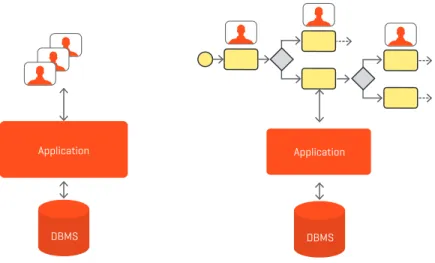
One difference between traditional and business process applications is that the application logic is more complex in a traditional application That means you have to write more code Why? Because the process that you see in the form of an implicit model in a traditional application has been hard-coded into the application; hence it is more complex, takes more time to develop, and is difficult and costly to change over time Having no explicit process means users of the application need to know when, where, and what to do, i e , to be able to follow the process, which is implied and not defined explicitly
Another difference is in visibility into the business operation Unless the development team builds monitoring and reporting capabilities into the application, it is nearly impossible to glean any useful information about the health of the production system Are there any bottlenecks in the processes? Can the processes be better optimized? A business process application can be readily monitored with out-of-the-box capabilities, and the information gathered can be used not only to keep the system running, but to also identify areas for process improvement and optimization
THE BENEFITS OF BUSINESS PROCESS APPLICATIONS TO END USERS
There are many benefits for companies and their users: Visibility – By explicitly capturing and modeling business processes utilizing simple, easy-to-use graphical modeling tools, you can ensure that everyone understands how the business operates In addition, a business process application can be readily monitored, providing visibility useful in keeping the system running and in optimizing business processes
Agility – Because business processes can be modeled instead of coded, users now have the flexibility to customize and modify processes more quickly This lets companies respond to changing requirements faster than with traditional applications
Improved Processes – Organizations will increase the efficiencies within their application and streamline activities with the improved visibility into business processes, giving them a competitive edge
Leverage Existing Investment – Avoid “rip-and-replace” projects by utilizing existing business logic while taking advantage of Business Process Management capabilities
Figure 1: A business application. Like any application, it has application logic, often using a database management system, and, in addition, it has an explicit business process as shown in this diagram.
Traditional Application
ApplicationDBMS
Application
Business Process Application
DBMSand where their business processes are inefficient, business managers and executives can make better business decisions This allows the business application to be driven by the needs of the business – eliminating dependencies on IT
Lower total cost of ownership (TCO) – Custom applications are achieved by simply modifying the process models, with little or no changes to the business logic This translates into lower costs and faster delivery times
Reduce time-to-value – Companies become more operationally responsive by staying on top of changing customer and market demands Faster delivery leads to faster deployment
Continuous Process Improvement - Unlike methodologies such as business reengineering, which is a one-off event, a business process application will enable your customers to improve their business processes continuously
Of course, all of these benefits are of interest to business users Utilizing Business Process Management, you are empowering the business people within your customer/user organizations to run their business better and to improve their operating performance on an ongoing basis
THE BENEFITS OF BUSINESS PROCESS APPLICATIONS TO APPLICATION
DEVELOPERS
It is not just your customers/users who are going to benefit from business process applications; you, as the application developer and vendor, will also benefit in the following ways:
Reduced cost of development of business process applications compared to a traditional application because business process applications are modeled, not coded In fact, Progress users are able to define their business processes, even if they are complex and sophisticated, in a short period of time, on the order of hours or days, not months
Easier customization of applications for different customers because most customizations are changes to business processes, which, again, are modeled not coded
Modernization of applications—Existing applications can be BPM-enabled, allowing for easier application modernization
Increased business value—Through add-on and new applications and easier customizations you can deliver increased value to your customers by meeting their requirements faster and better
Increased competitiveness—Through a combination of the above benefits, you gain a competitive edge
WHAT IS THE PROGRESS BPM-ENABLED APPLICATION DEVELOPMENT
PLATFORM?
The answer is Progress OpenEdge, a robust BPM-enabled application development platform tailored to the needs of OpenEdge developers that will allow you to develop dynamic business process applications and achieve the benefits discussed here Progress OpenEdge BPM offers an intuitive and productive way to modernize and streamline your application making your business more responsive With OpenEdge
Progress OpenEdge
Robust DBMS and business language for automating steps in business processes
Progress OpenEdge BPM
and flexible workflows that enable applications to be tailored for and by the consumers of the applications We call this dynamic business process-enabled application development
KEY CAPABILITIES OF PROGRESS OPENEDGE BPM
OpenEdge BPM provides a single platform for developers, business analysts and managers It incorporates business process analysis — the ability to easily and quickly define business processes as a model, define information and rules, and specify interfaces and requirements around that business process The system allows you to assimilate the business process based on assumptions as to the frequency of the process execution and resources required to execute different steps of the process, and it will also automatically generate comprehensive documentation of the process Once you go through business process analysis, your business process has been made explicit, and you can then:
1 Instrument your application to gain visibility into the business processes coded in your existing application, i e your application drives the business process; or
2 Enrich your business process model for execution, i e the process model drives your business process
Instrumentation of applications and the enrichment of business models to make a process executable is the task of application developers And once the application is executing, business managers, i e , operation managers who are responsible for the performance of the process, are able to monitor and improve the performance of the process
BPMS
Business ProcessExecution Application
Developers
BPI
Business ProcessImprovements Business Managers Business
Analysts
BPA
Business Process Analyses
In all likelihood, your application is structured as shown in Figure 2 This application includes three things: code for implementing user interfaces; code for implementing business logic; and arrows representing an invocation from one piece of code to another Most traditional application code looks complex like this because the process of the application is encoded into the application In other words, the application, in addition to the GUI and business logic, also includes the business process
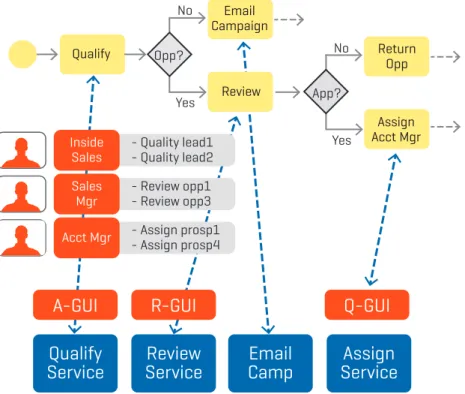
With OpenEdge BPM you can “extract” the process out of the code This means that the application code will look like Figure 3— a lot cleaner and a lot simpler There are code segments for GUIs as well as for implementing business logic Because the process has been extracted out and modeled using OpenEdge, now there are explicit processes, as you see in the diagram, where there is a relationship between steps of the process and segments of the code Simply put, the GUI and application logic code, in fact, implement the steps defined in the process model
When a process is executed, tasks are created in the user’s task box This means they don’t have to remember what to do They just click on a task and get all the necessary information to perform that
GUI 1
GUI 2
GUI 3
Func 1
Func 2
Func 4
Func 5
Func
5
GUI 4
Func
6
Func
3
Figure 2: Example of traditional application code
A-GUI
R-GUI
Q-GUI
Qualify
Service
Service
Review
Camp
Service
Assign
Qualify Email Campaign Review No Opp? Yes No App? Yes Return Opp Assign Acct Mgr InsideSales - Quality lead1- Quality lead2 - Review opp1 - Review opp3 Sales
Mgr
- Assign prosp1 - Assign prosp4 Acct Mgr
Figure 3: Example of application code using OpenEdge BPM
THE RELATIONSHIP BETWEEN MODERNIZING AND SOA-ENABLING YOUR
APPLICATION
There is a strong relationship between modernizing your existing application into a business process application and Service Oriented Architecture (SOA)-enabling your application Steps in a business process are fulfilled by segments of your code If you put segments of code together, in effect you have a business service that executes the step in the process If the application was SOA-enabled already, turning it into a business process application is greatly simplified because once you define the process, you already know what services are there, and you can easily associate those services with proper steps in the process However, if the application is not SOA-enabled yet, then some code reengineering will become necessary It is an opportune time to SOA-enable the application while process-enabling it so that maintaining the application going forward will take a lot less time and effort
METHODOLOGY AND TOOLS FOR MODERNIZING APPLICATIONS INTO
BUSINESS PROCESS APPLICATIONS
Here are the basic steps for BPM-enabling your application:
Step #1: Define the process of the application using Developer Studio for OpenEdge or the stand-alone Business Process Modeling tools
Step #2: Identify code segments in your existing application, which act as external sources (often external sources of data information) If those code segments are not offered as services yet (e g Web or REST services), consider converting them to Web services at the same time This will be the first step in SOA-enabling your application
Step #3: Map code segments that implement interfaces to steps in the process, i e interfaces to tasks If those interfaces are not Web-based yet, this is a good time to re-implement those interfaces using the Business Process Web Form Designer supplied in Progress Developer Studio for OpenEdge This will also be a step to SaaS-enabling your application
Step #4: Identify code segments that implement business logic associated with the steps in the process; for example, calculate reimbursement for a claim if your application is for insurance claims processing
Step #5: Identify exception-handling and error-processing code segments
Step #6: Consider combining code segments in the above three steps into services that implement steps in the process Once you do this for every step in the process, not only will you have process-enabled your application, but you will have SOA-process-enabled your application as well
Step #7: Eliminate dead code Often you will end up with some code that you do not need and doesn’t form part of any of the business services you have Those segments of code are dead code They are not necessary, and you can eliminate them, further simplifying your application
DO OPENEDGE DEVELOPERS NEED ADDITIONAL SKILLS TO IMPLEMENT
OPENEDGE BPM?
OpenEdge developers utilize their existing skills and need to acquire very few new skills Building business process applications is mostly a question of approach versus skills Rather than jumping into coding the application right away, as OpenEdge developers have done in the past, they will first need to model the process to quickly capture the requirements and logic of the application at the
PROGRESS SOFTWARE
Progress Software Corporation (NASDAQ: PRGS) is a global software company that simplifies the development, deployment and management of business applications on-premise or in the cloud, on any platform or device, to any data source, with enhanced performance, minimal IT complexity and low total cost of ownership
WORLDWIDE HEADQUARTERS
Progress Software Corporation, 14 Oak Park, Bedford, MA 01730 USA Tel: +1 781 280-4000 Fax: +1 781 280-4095 On the Web at: www progress com
Find us on facebook com/progresssw twitter com/progresssw youtube com/progresssw
For regional international office locations and contact information, please go to www progress com/worldwide
Progress and OpenEdge are trademarks or registered trademarks of Progress Software Corporation or one of its affiliates or subsidiaries in the U S and other
their customers to ensure the application they are going to build will meet the exact requirements of their customers This is very important Once the process is defined, they use the same skills they use in building GUIs and business logic
SUMMARY
Whether small or large, in manufacturing, telecom, construction, or financial services, companies of all kinds need business process applications—to achieve visibility, agility, efficiency, and business empowerment Progress delivers OpenEdge BPM to enable companies to build those business process applications Progress customers and partners who have developed applications will be able to modernize existing applications with OpenEdge BPM in addition to building new and add-on business process applications