Sharif University of Technology
Scientia IranicaTransactions B: Mechanical Engineering www.scientiairanica.com
Finite element formulations for free vibration analysis
of isotropic and orthotropic plates using two-variable
rened plate theory
J. Rouzegar
and R. Abdoli Sharifpoor
Department of Mechanical and Aerospace Engineering, Shiraz University of Technology, Shiraz, P.O. Box 71555-313, Iran. Received 1 January 2015; received in revised form 7 July 2015; accepted 15 September 2015
KEYWORDS Finite element method; Free vibration; Rectangular plate element;
Two-variable rened plate theory.
Abstract.In this paper, a nite element formulation based on two-variable rened plate theory is developed for free vibration analysis of isotropic and orthotropic plates. The two-variable rened plate theory, which can be used for both thin and thick plates, predicts parabolic variation of transverse shear stresses across the plate thickness, satises the zero traction condition on the plate surfaces, and does not need the shear correction factor. After constructing weak-form equations using the Hamilton principle for vibration formulation, a new 4-node rectangular plate element with six degrees of freedom at each node is introduced for discretization of the domain. The natural frequencies of isotropic plates with dierent boundary conditions and the fundamental natural frequencies of levy-type orthotropic plates are obtained. Comparison of results with exact solutions and other common plate theories shows that besides simplicity of the presented nite element formulations, they present accurate and ecient results. Also, the eects of orthotropy ratio, side-to-thickness ratio, and types of boundary conditions on the natural frequencies are studied.
© 2016 Sharif University of Technology. All rights reserved.
1. Introduction
Classical Plate Theory (CPT) is the simplest plate theory that gives good results for bending analysis of thin plates, but it does not take transverse shear deformation eects into account. The eect of shear deformation is important in bending analysis of thick plates and also for thin plates vibrating at higher modes; thus, numerous researchers have attempted to rene the CPT. Reissner proposed First-order Shear Deformation Theory (FSDT) based on stress approach [1] and another form of FSDT was proposed by Mindlin [2] based on displacement approach. The FSDT predicts the constant transverse shear stress along the plate thickness and hence the zero-stress conditions on free surfaces cannot be satised. Also,
*. Corresponding author. Tel./Fax: +98 71 37264102 E-mail address: [email protected] (J. Rouzegar)
this theory needs the shear correction factor in for-mulation. To resolve these deciencies, Higher-order Shear Deformation Theories (HSDTs) were developed. Second-order shear deformation theory of Whitney and Sun [3], third-order shear deformation theory of Hanna and Leissa [4], Reddy [5], Bhimaraddi and Stevens [6], Kant [7], and Lo et al. [8] are some famous HSDTs.
Recently, some new higher-order shear deforma-tion theories such as trigonometric shear deformadeforma-tion theory [9], hyperbolic shear deformation theory [10], and two-variable rened plate theory [11] have been developed. The two-variable plate theory (RPT) is a simple and ecient theory that contains only two unknown variables which are bending and shear compo-nents of transverse displacement. This theory satises the zero-stress conditions on free surfaces and does not need the shear correction factor in formulation. It was introduced by Shimpi [11] for isotropic plates and then extended to orthotropic plates by Shimpi
and Patel [12] and Thai and Kim [13]. The analysis of laminated composite plates was done by Kim et al. [14] and the vibration and buckling analyses of plates were performed by Shimpi and Patel [15] and Kim et al. [16], respectively. Levy-type solution for buckling analysis of orthotropic plates was studied by Thai and Kim [17]. Considering non-local eects, the buckling behavior of isotropic nano-plates was studied by Narender [18]. Free vibration of nano-plates was performed by Malekzadeh and Shojaee [19] using dierential quadrature method for solution of the governing equations.
Previous researchers have adopted the two-variable plate theory and presented analytical solu-tions for some plate problems with specic geometry, loading, and boundary conditions. In practice, it is too dicult to solve many engineering problems by common analytical methods. Using numerical approaches, the complicated problems could be sim-ulated in an approximate manner. Bhat [20] obtained natural frequencies by employing a set of characteristic orthogonal polynomials in the Rayleigh-Ritz method. This method yields superior results for lower modes, particularly when plates have some of the edges free. Misra [21] implemented the multi-quadratic radial basis function for free vibration analysis of isotropic plate. This method gives relatively good results, but its implementation is not simple. Semnani et al. [22] applied two-dimensional dierential transfer method for investigating free vibration behavior of variable thickness plates with dierent boundary conditions. Liew et al. [23] adopted the rst-order shear defor-mation theory in the moving least squares dierential quadrature method for predicting the free vibration behavior of moderately thick symmetrically laminated composite plates.
One of the popular and interesting numerical techniques is nite element method. Finite element analysis became quick, precise, and popular by the advancements in computer sciences. Recently, a nite element formulation based on two-variable rened plate theory was developed for bending analysis of thin and thick orthotropic plates [24]. In this study, a new Finite Element formulation based on two-variable Rened Plate Theory (FE-RPT formulation) has been developed for free vibration analysis of thin and thick isotropic and orthotropic plates. A new 4-node rect-angular plate element with six degrees of freedom at each node has been introduced. Besides accuracy of the developed formulation, it is very simple to implement in comparison to other shear deformation nite element methods. This formulation can be used for both thin and thick plates and is free from shear locking in contrast to rst-shear deformation nite ele-ment formulation. This formulation predicts parabolic transverse shear stresses across the plate thickness
and satises the zero-stress conditions on free surfaces. Accuracy and eciency of the presented formulation have been proved by solving some benchmark problems in the literature.
2. Theory of problem
2.1. Two-variable rened plate theory
The two-variable rened plate theory is constructed based on the following assumptions:
1. The displacements (u in x-direction, v in y-direction, and w in z-direction) are small relative to the plate thickness. Thus, the strain-displacement relations can be expressed as follows:
8 > > > < > > > :
"x= @u@x; xy= @v@x+@u@y;
"y= @v@y; yz= @w@y +@v@z;
"z=@w@z; zx=@w@x +@u@z;
(1)
where "x, "y, and "zare normal strains in x, y, and
z directions and xy, yz, and zx are shear strains
in z, x, and y planes, respectively.
2. The displacement eld (u in x-direction, v in y-direction, and w in z-direction) consists of bending and shear components:
w(x; y; t) = wb(x; y; t) + ws(x; y; t);
u = ub+ us; v = vb+ vs: (2)
The bending components of in-plane displacement play the same roles as those of u and v in classical plate theory. Thus, we can write:
ub= z@w@xb; vb= z@w@yb: (3)
3. The stress normal to the middle plane, z, is
small compared with other stress components and may be neglected in the stress-strain relations. Consequently, the stress-strain relations for an orthotropic plate can be written as:
8 > > > > > < > > > > > :
x= 1 E12121("x+ 12"y)
y =1 E12221("y+ 21"x)
z= 0 xy= G12xy yz = G23yz
zx= G31zx
(4)
where x, y, and zare normal stresses in x, y, and
z directions and xy, yz, and zxare shear stresses.
E1 and E2 are elastic moduli; G12, G23, and G31
are shear moduli; and 12, and 21 are Poisson's
4. Shear components of in-plane displacement are considered as the following functions:
us= h
1 4 z h 5 3 z h
3@ws
@x ;
vs= h
1 4 z h 5 3 z h
3@w
s
@y : (5) Based on the above assumptions, the displacements can be calculated as:
u(x; y; z) = z@w@xb + h 1 4 z h 5 3 z h
3@w
s
@x ;(6)
v(x; y; z) = z@wb @y + h
1 4 z h 5 3 z h
3@ws
@y ;(7)
w(x; y; t) = wb(x; y; t) + ws(x; y; t): (8)
The strain eld is obtained by substituting Eqs. (6)-(8) in Eq. (1):
"x= z@ 2wb
@x2 + h
1 4 z h 5 3 z h
3@2ws
@x2 ; (9)
"y= z@ 2wb
@y2 + h
1 4 z h 5 3 z h
3@2ws
@y2 ; (10)
"z= 0; (11)
xy= 2z@ 2wb
@x@y + 2h 1 4 z h 5 3 z h
3@2ws
@x@y;(12)
yz= 5 4 5 z h
2@ws
@y ; (13)
xz= 5 4 5 z h
2@ws
@x : (14)
Substituting strains in constitutive Eqs. (4), the ex-pressions for stresses can be obtained as the following equations: 8 > > > > < > > > > : x y xy yz zx 9 > > > > = > > > > ; = 2 6 6 6 6 4
Q11 Q12 0 0 0
Q12 Q22 0 0 0
0 0 Q66 0 0
0 0 0 Q44 0
0 0 0 0 Q55
3 7 7 7 7 5 8 > > > > < > > > > : "x "y xy yz zx 9 > > > > = > > > > ; ; (15) where: 8 > > > < > > > :
Q11=1 E12121; Q12=1 1212E221 = 1 2112E221;
Q22=1 E12221;
Q44= G23; Q55= G31; Q66= G12
(16)
2.2. The governing equations of free vibration The governing equations and boundary conditions of time-dependent problems can be obtained using Hamil-ton's principle:
0 =
t2
Z
t1
(T U)dt: (17)
The kinetic energy and total potential energy of a rectangular plate (of length a, width b, and thickness h) can be written as Eqs. (18) and (19), respectively:
T = Z z=h=2 z= h=2 Z y=b y=0 Z x=a x=0 1 2 "@u @t 2 + @v @t 2 + @w @t 2# dxdydz; (18) U = Z z=h=2 z= h=2 Z y=b y=0 Z x=a x=0 1
2[x"x+ y"y
+ xyxy+ yzyz+ zxzx]dxdydz; (19)
where is mass density. By substituting Eqs. (18) and (19) into (17) and taking the independent variations of wb and ws into account, the governing equations are
obtained as Eqs. (20) and (21): D11@
4w b
@x4 + 2(D12+ 2D66)
@4w b
@x2@y2 + D22
@4w b
@x4
h3
12 @2
@t2(r2wb) + h
@2wb
@t2 +
@2ws
@t2 = 0; (20) 1 84
D11@ 4w
s
@x4 +2(D12+2D66)
@4w s
@x2@y2+D22
@4w s
@x4
A55@
2ws
@x2 + A44
@2ws
@y2
h3
1008 @2
@t2(r2ws)
+ h
@2w b
@t2 +
@2w s
@t2
= 0; (21) where D11, D22, D12, D66, A44, and A55 are
plate-material stiness dened in Eq. (22): 8 > > > < > > > :
D11=Q11h
3
12 ; D22=Q22h
3
12 ; D12=Q12h
3
12 ;
D66= Q66h
3
12 ;
A44= 5Q644h; A55= 5Q655h:
(22)
As can be seen, the governing equations are given by two fourth-order dierential equations that are coupled for dynamic problems and uncoupled for static problems. Dierent possible boundary conditions were discussed in [12].
2.3. Finite element formulation of free vibration
Based on two-variable rened plate theory, the weak-form equations for free vibration analysis are ob-tained by substituting kinetic and potential energies in function of displacements into Hamilton's principle, integrating them across the plate thickness, and then using the calculus of variation technique:
0 =h123 Z
e
@3wb
@x@t2
@wb
@x + @3wb
@y@t2
@wb
@y
dxdy
+1008h3 Z
e
@3w
s
@x@t2
@ws
@x + @3w
s @y@t2 @ws @y dxdy + Z e " D11@
2w b
@x2 + D12
@2w b
@y2
@2w
b
@x2
+
D12@ 2wb
@x2 + D22
@2wb
@y2
@2wb
@y2
+ 4D66@ 2w
b
@x@y @2w
b @x@y # dxdy + Z e " 1 84 " D11@
2ws
@x2 + D12
@2ws
@y2
! @2ws
@x2
+
D12@ 2w
s
@x2 + D22
@2w s
@y2
@2w
s
@y2
+ 4D66@ 2ws
@x@y @2ws
@x@y #
+ A44@w@xs@w@xs
+ A55@w@ys@w@ys
# dxdy + h Z e @
@t(wb+ ws) @wb @t + @ws @t dxdy: (23) Eq. (23) can be rewritten in the following vector form:
Z
e
("
I0(wb)Twb+ I2(D1wb)T(D1wb)
#
+
I0(ws)Tws+84I2(D1ws)T(D1ws)
) dxdy + Z e
I0(ws)Twb+ I0(wb)Tws dxdy
+ Z
e
(
[(D2wb)TD(D2wb)]
+ "
1
84(D2ws)TD(D2ws)
+ (D1ws)TA(D1ws)
#)
dxdy = 0; (24)
where I0, I2, A, D, D1, and D2are dened as:
I0= h; I2= h 3
12 ; A =
A44 0
0 A55
;
D = 2
4DD1112 DD1222 00 0 0 D66
3
5 ; D1=
@ @x @ @y ;
D2=
8 > < > : @2 @x2 @2 @y2
2 @2
@x@y
9 > = >
;: (25)
The bending and shear transverse displacement elds can be determined by interpolating the nodal Degrees Of Freedom (DOFs) over the domain of elements:
wb(x; y) = n
X
j=1
b
j'j(x; y) = NTb;
ws(x; y) = n
X
j=1
s
j'j(x; y) = NTs; (26)
where band sare bending and shear DOF vectors in
each element, and 'j and N are interpolation functions
and shape functions, respectively. By substituting Eq. (26) into Eq. (24), the nite element equations for free vibration analysis based on two-variable rened plate theory are obtained:
M11 M12
M12 M22 b s
+
K11 0
0 K22
b s = 0 0 : (27) It is obvious that the obtained nite element equations are inertially coupled. The elemental mass, stiness, and force matrices are dened in the following equa-tions:
M11=Z e
[I0NNT + I2B1TB1]dxdy;
M22=Z e
I0NNT +84I2B1TB1
dxdy;
M12=Z e
K11=Z e
[BT
2DB2]dxdy;
K22=Z e
1
84B2TDB2+ B1TAB1
dxdy;
B1= D1NT; B2= D2NT: (28)
If the eect of shear deformation is ignored and just bending degrees of freedom are considered, the nite element formulation for classical plate theory will be obtained:
M11
b+ K11b= 0: (29)
2.4. Linear rectangular element
A 4-node rectangular plate element with bending and shear capabilities is utilized for discretization of prob-lems domains. As shown in Figure 1, each node has six degrees of freedom, including bending and shear components of transverse displacement and also their rst derivatives with respect to x and y:
DOFs :nwb @w@xb @w@yb ws @w@xs @w@ys
o
: (30) If the shear and bending nodal DOFs are dened by ab
i and asi, respectively, and the elemental shear and
bending DOFs are dened by ab
eand ase, we will have:
ab e= 8 > > > > > < > > > > > : ab i ab j ab k ab l 9 > > > > > = > > > > > ;
; ab i =
8 < :
wb
@wb=@y
@wb=@x
9 = ; ; as e= 8 > > > > > < > > > > > : as i as j as k as l 9 > > > > > = > > > > > ;
; as i =
8 < :
ws
@ws=@y
@ws=@x
9 =
; : (31)
For each pair of bending and shear nodal DOFs ab i
Figure 1. Rectangular plate element.
and as
i, the shape functions in terms of normalized
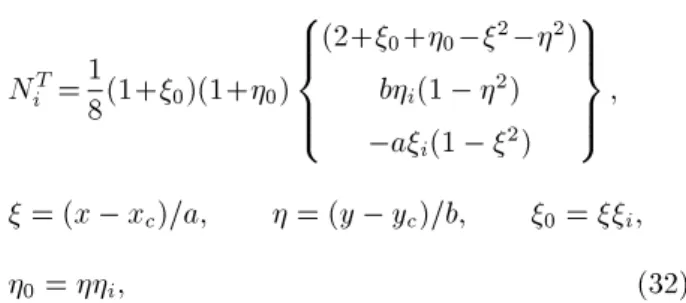
coordinates can be dened as follows [25]:
NT
i =18(1+0)(1+0)
8 > > < > > :
(2+0+0 2 2)
bi(1 2)
ai(1 2)
9 > > = > > ;;
= (x xc)=a; = (y yc)=b; 0= i;
0= i; (32)
where 2a and 2b are the width and length of rectangular element as shown in Figure 1.
3. Results and discussion
Two MATLAB codes, one based on Finite Element for-mulation of two-variable Rened Plate Theory (shortly FE-RPT) and the other based on Finite Element formulation of Classical Plate Theory (shortly FE-CPT), are prepared for free vibration analysis of isotropic and orthotropic plates and afterwards, some benchmark problems are solved by these codes and the obtained results are compared with the existing analytical solutions of the common plate theories. 3.1. Isotropic plates
In this section, the free vibration of isotropic rectangu-lar plates has been studied. Since the material property is independent of the coordinates, the material proper-ties in Eq. (4) can be given as:
E1= E2= E; G12= G23= G13= G;
12= 21= : (33)
The Poisson ratio is assumed to be 0.3 and the normalized frequency is dened as Eq. (34):
!mn= !mna
p
=G: (34)
Figure 2 shows the convergence study of two vibration modes for a simply supported square plate with h=a = 0:1. As seen in this gure, by increasing the number of elements, the results converge to the exact values. Convergence rate of lower vibration mode is faster than that of higher mode. In subsequent problems, 20 elements are considered at each plate edge to insure the convergence of results as shown in Figure 3.
Tables 1 and 2 present the obtained natural frequencies for simply supported isotropic square plate with h=a = 0:01 and h=a = 0:1. For thin plates, the results of FE-RPT and FE-CPT formulations are very close and both are in good agreement with FSDT results. But in case of thick plate (Table 2), results of FE-RPT are closer to the exact values than those of FE-CPT code. For thin plates, at low-vibration modes,
Figure 2. Mesh-independency study for SSSS plate.
Figure 3. Final mesh of square plate.
Table 1. Comparison of ! for SSSS square plate with a=h = 100.
m n FSDT [26] FE-CPT FE-RPT
1 1 0.0936 0.0962 0.0962
2 1 0.2406 0.2402 0.2401
1 2 0.2406 0.2402 0.2401
2 2 0.3847 0.3831 0.3827
3 1 0.4807 0.4803 0.4796
1 3 0.4807 0.4803 0.4796
3 2 0.6246 0.6212 0.6201
2 3 0.6246 0.6212 0.6201
the results of the present RPT formulation and FE-CPT formulation are identical; but at higher modes, these formulations have some discrepancies, which means that though considering shear deformation eect is important for thick plates, it has signicant eect on higher frequency modes of thin plates, too.
Figure 4 illustrates the percentage error of both FE-CPT and FE-RPT formulations in estimation of natural frequencies of a simply supported square plate.
Table 2. Comparison of ! for SSSS square plate with a=h = 10.
m n Exact [27] FE-CPT FE-RPT
1 1 0.932 0.954 0.929
1 2 2.226 2.355 2.215
2 2 3.421 3.712 3.391
1 3 4.171 4.618 4.142
2 3 5.239 5.907 5.178
3 3 6.889 7.996 6.781
2 4 7.511 8.852 7.408
1 5 9.268 10.167 9.389
Figure 4. Eect of shear strain on dierent vibration modes.
Figure 5. Eect of side-to-thickness ratio on !nfor
FE-RPT and FE-CPT.
The precision of FE-RPT formulation is higher than that of FE-CPT formulation and by increasing the vibration mode, FE-CPT formulation errors increase sharply, but the FE-RPT formulation errors remain nearly constant. It can be concluded that classical plate theory overpredicts all the vibration frequencies for thick plates and higher frequencies for thin plates, as discussed before.
on the fundamental natural frequency obtained by both FE-RPT and FE-CPT formulations. For thick plates, results of FE-CPT dier from those of FE-RPT and by decreasing the plate thickness, the results of FE-RPT coincide with those of FE-CPT, which shows that shear locking in the presented formulation does not occur.
It can be concluded that though FE-RPT leads to good results for vibrating of both thin and thick plates in lower and higher modes, FE-CPT gives good results just for vibrating of thin plate in lower modes. Since in FE-RPT formulation, two sets of fourth-order dierential equations should be solved, the computational time is nearly twice that of FE-CPT formulation; but in comparison to other higher-order shear deformation theories, the FE-RPT formulation is simple and ecient. It must be noticed that CPT formulation cannot predict shear deformation eects and is completely weak in simulation of thick plates and even in prediction of higher-mode natural frequencies of thin plates.
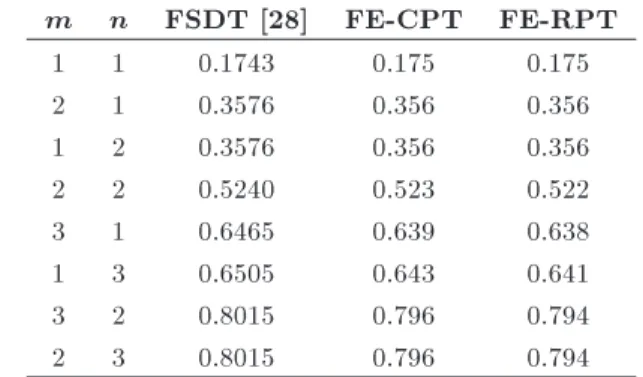
The natural frequencies for fully clamped square isotropic plate are obtained by FE-CPT and FE-RPT formulations and the results are compared with those of FSDT mesh free method [28] in Tables 3 and 4 for thin and thick plates, respectively. Again, in this case, for thick plates, results of FE-RPT formulation are more accurate than those of FE-CPT formulation. For thin plates, results of FE-CPT and FE-RPT formulations
Table 3. Comparison of ! for CCCC square plate with a=h = 100.
m n FSDT [28] FE-CPT FE-RPT
1 1 0.1743 0.175 0.175
2 1 0.3576 0.356 0.356
1 2 0.3576 0.356 0.356
2 2 0.5240 0.523 0.522
3 1 0.6465 0.639 0.638
1 3 0.6505 0.643 0.641
3 2 0.8015 0.796 0.794
2 3 0.8015 0.796 0.794
Table 4. Comparison of ! for CCCC square plate with a=h = 10.
m n FSDT [28] FE-CPT FE-RPT
1 1 1.558 1.734 1.603
2 1 3.018 3.487 3.093
1 2 3.018 3.487 3.093
2 2 4.171 5.054 4.351
3 1 5.121 6.122 5.082
1 3 5.159 6.157 5.159
3 2 6.017 7.537 6.203
2 3 6.017 7.537 6.203
Table 5. Comparison of ! for SCSC square plate with a=h = 100.
m n FSDT [26] FE-CPT FE-RPT
1 1 0.141 0.141 0.141
2 1 0.268 0.266 0.266
1 2 0.337 0.337 0.337
2 2 0.460 0.458 0.457
3 1 0.498 0.496 0.496
1 3 0.628 0.628 0.626
3 2 | 0.677 0.676
2 3 | 0.748 0.746
Table 6. Comparison of ! for SCSC square plate with a=h = 10.
m n FSDT [26] FE-CPT FE-RPT
1 1 1.302 1.397 1.324
2 1 2.398 2.607 2.423
1 2 2.888 3.299 2.957
2 2 3.852 4.431 3.924
3 1 4.237 4.775 4.257
1 3 4.936 6.017 5.040
3 2 | 6.431 5.531
2 3 | 7.095 5.934
are close at lower modes and they diverge for higher frequencies.
The natural frequencies for square plate with two clamped opposite edges and two simply supported edges (SCSC) are computed by the present formu-lations and the results are compared with those of FSDT [26] in Tables 5 and 6. For thin plate, results of FE-RPT and FE-CPT are in good agreement with those of FSDT. In comparison to FDT, FE-RPT formulation gives more accurate results than FE-CPT for thick plate. It should be noticed that the presented formulation is a higher-order shear deformation theory and the related results must dier from FSDT results. 3.2. Orthotropic Levy-type plates
In this section, an orthotropic square plate, which is simply supported on two opposite edges and has arbitrary boundary conditions along the other edges, is considered. For simplicity, a two-letter notation is used to describe the boundary conditions of the remaining edges as shown in Figure 6. For example, SC shows that one edge is simply supported and the other is clamped.
Material properties of orthotropic plates are con-sidered as follows:
G12=E2= G13=E2= 0:5; G23=E2= 0:2;
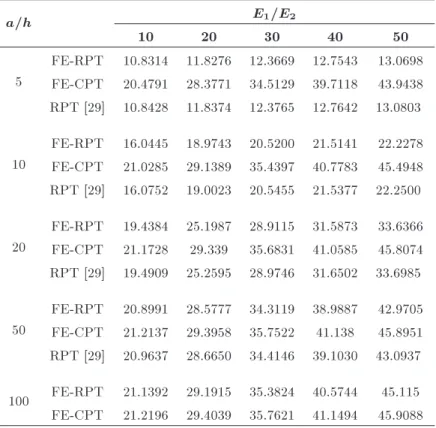
Figure 6. Boundary condition of Levy-type plate [29]. Table 7. Comparison of normalized natural frequency of CC plate.
a=h E1=E2
10 20 30 40 50
5
FE-RPT 10.8314 11.8276 12.3669 12.7543 13.0698 FE-CPT 20.4791 28.3771 34.5129 39.7118 43.9438 RPT [29] 10.8428 11.8374 12.3765 12.7642 13.0803
10
FE-RPT 16.0445 18.9743 20.5200 21.5141 22.2278 FE-CPT 21.0285 29.1389 35.4397 40.7783 45.4948 RPT [29] 16.0752 19.0023 20.5455 21.5377 22.2500
20
FE-RPT 19.4384 25.1987 28.9115 31.5873 33.6366 FE-CPT 21.1728 29.339 35.6831 41.0585 45.8074 RPT [29] 19.4909 25.2595 28.9746 31.6502 33.6985
50
FE-RPT 20.8991 28.5777 34.3119 38.9887 42.9705 FE-CPT 21.2137 29.3958 35.7522 41.138 45.8951 RPT [29] 20.9637 28.6650 34.4146 39.1030 43.0937 100 FE-RPT 21.1392 29.1915 35.3824 40.5744 45.115 FE-CPT 21.2196 29.4039 35.7621 41.1494 45.9088
The normalized fundamental natural frequency for orthotropic plate is dened as Eq. (36).
! = !ah2p=E2: (36)
In Table 7, the normalized natural frequencies for CC orthotropic plate with dierent side-to-thickness (a=h) and orthotropy (E1=E2) ratios are compared with
analytical RPT solution. For thick plate (a=h = 5), the presented FE-RPT formulation has good agree-ment with analytical RPT solution, but the FE-CPT formulation does not provide proper results. By
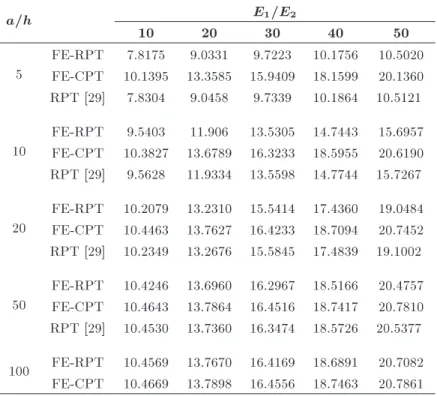
increasing the side-to-thickness ratio, results of FE-CPT formulation converge to those of FE-RPT, as shown in Figure 7. Also, it is observed that in-creasing orthotropy ratio causes the normalized nat-ural frequency to increase. The normalized natnat-ural frequencies obtained by FE-RPT and FE-CPT for-mulations for orthotropic plates with SC, SS, FC, FS, and FF edges are compared with the analytical RPT solution in Tables 8-12, respectively, and similar results to those in Table 7 are observed in these tables.
The eects of side-to-thickness ratio on normal-ized fundamental natural frequency of orthotropic plate
Table 8. Comparison of normalized natural frequency of SC plate.
a=h E1=E2
10 20 30 40 50
5
FE-RPT 9.5333 10.6768 11.2625 11.6455 11.9307 FE-CPT 14.6464 19.9556 24.1235 27.6707 30.8122 RPT [29] 9.5462 10.6878 11.2725 11.6549 11.9399
10
FE-RPT 12.8341 15.7706 17.5131 18.6948 19.5608 FE-CPT 15.0255 20.4725 24.7487 28.3879 31.6109 RPT [29] 12.8632 15.8014 17.5431 18.7235 19.5882
20
FE-RPT 14.4516 18.9992 22.2158 24.7015 26.7135 FE-CPT 15.1249 20.6081 24.9127 28.5760 31.8204 RPT [29] 14.4921 19.0510 22.2738 24.7632 26.7775
50
FE-RPT 15.0374 20.3574 24.4537 27.8742 30.8475 FE-CPT 15.1531 20.6466 24.9592 28.6294 31.8798 RPT [29] 15.0824 20.4197 24.5288 27.9597 30.9416 100 FE-RPT 15.1278 20.5783 24.8359 28.4416 31.6193
FE-CPT 15.1571 20.6521 24.9658 28.6370 31.8884 Table 9. Comparison of normalized natural frequency of SS plate.
a=h E1=E2
10 20 30 40 50
5
FE-RPT 7.8175 9.0331 9.7223 10.1756 10.5020 FE-CPT 10.1395 13.3585 15.9409 18.1599 20.1360 RPT [29] 7.8304 9.0458 9.7339 10.1864 10.5121
10
FE-RPT 9.5403 11.906 13.5305 14.7443 15.6957 FE-CPT 10.3827 13.6789 16.3233 18.5955 20.6190 RPT [29] 9.5628 11.9334 13.5598 14.7744 15.7267
20
FE-RPT 10.2079 13.2310 15.5414 17.4360 19.0484 FE-CPT 10.4463 13.7627 16.4233 18.7094 20.7452 RPT [29] 10.2349 13.2676 15.5845 17.4839 19.1002
50
FE-RPT 10.4246 13.6960 16.2967 18.5166 20.4757 FE-CPT 10.4643 13.7864 16.4516 18.7417 20.7810 RPT [29] 10.4530 13.7360 16.3474 18.5726 20.5377 100 FE-RPT 10.4569 13.7670 16.4169 18.6891 20.7082
FE-CPT 10.4669 13.7898 16.4556 18.7463 20.7861
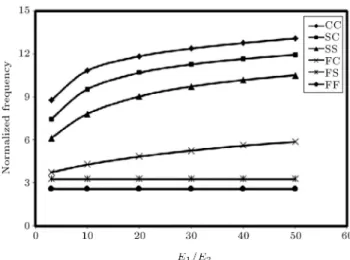
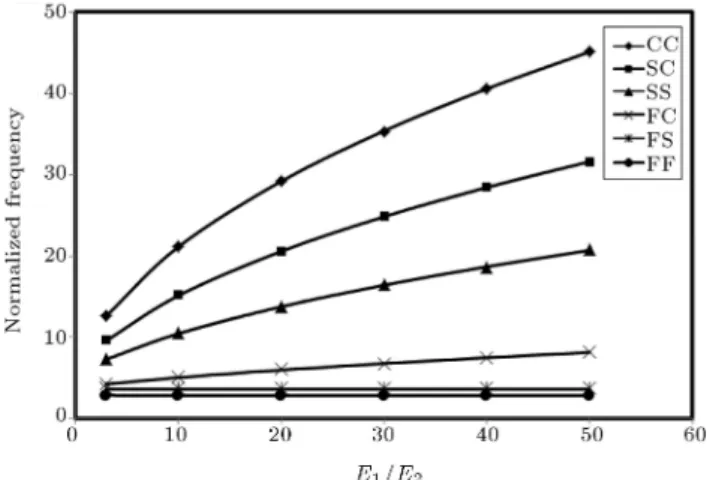
with orthotropy ratios 10 and 50 have been studied in Figures 8 and 9, respectively. By increasing the side-to-thickness ratio, the normalized frequencies in-crease rstly and then reach constant values. Fig-ures 8 and 9 show that plates with stier bound-ary conditions possess higher normalized frequencies than the plates with softer boundary conditions. In
Figures 10 and 11, the eects of orthotropy ratio (E1=E2) on normalized natural frequencies of thick
(a=h = 5) and thin (a=h = 100) orthotropic plates are studied. By increasing the orthotropy ratio, the normalized frequencies increase and this ratio has more signicant eect on normalized frequencies for thinner plates.
Table 10. Comparison of normalized natural frequency of FS plate.
a=h E1=E2
10 20 30 40 50
5
FE-RPT 4.2797 4.8388 5.2589 5.5912 5.8629 FE-CPT 4.9366 5.8489 6.6333 7.3334 7.9719 RPT [29] 4.2840 4.8450 5.2661 5.5990 5.8710
10
FE-RPT 4.8152 5.6169 6.2744 6.8353 7.3251 FE-CPT 5.0225 5.9517 6.7503 7.4630 8.1129 RPT [29] 4.8210 5.6262 6.2861 6.8489 7.3401
20
FE-RPT 4.9890 5.8868 6.6483 7.3192 7.9233 FE-CPT 5.0447 5.9783 6.7806 7.4965 8.1493 RPT [29] 4.9954 5.8973 6.6621 7.3356 7.9419
50
FE-RPT 5.0418 5.9707 6.7672 7.4764 8.1217 FE-CPT 5.0510 5.9857 6.7891 7.5059 8.1596 RPT [29] 5.0483 5.9816 6.7816 7.4938 8.1417 100 FE-RPT 5.0496 5.9830 6.7848 7.4998 8.1515 FE-CPT 5.0519 5.9868 6.7903 7.5073 8.1611 Table 11. Comparison of normalized natural frequency of FF plate.
a=h E1=E2
10 20 30 40 50
5
FE-RPT 3.2575 3.2580 3.2585 3.2588 3.2591 FE-CPT 3.5368 3.5369 3.5370 3.5372 3.5373 RPT [29] 3.2577 3.2582 3.2586 3.2589 3.2591
10
FE-RPT 3.5100 3.5104 3.5107 3.5109 3.5110 FE-CPT 3.5922 3.5104 3.5927 3.5929 3.5930 RPT [29] 3.5102 3.5105 3.5108 3.5110 3.5111
20
FE-RPT 3.5849 3.5853 3.5856 3.5858 3.5859 FE-CPT 3.6065 3.6068 3.6071 3.6072 3.6074 RPT [29] 3.5851 3.5854 3.5857 3.5858 3.5859
50
FE-RPT 3.6070 3.6073 3.6076 3.6078 3.6079 FE-CPT 3.6105 3.6108 3.6111 3.6113 3.6114 RPT [29] 3.6072 3.6074 3.6077 3.6079 3.6080 100 FE-RPT 3.6102 3.6105 3.6108 3.6110 3.6111 FE-CPT 3.6111 3.6114 3.6117 3.6119 3.6120
4. Conclusions
The nite element formulation for free vibration anal-ysis of isotropic and orthotropic plates has been de-veloped based on two-variable rened plate theory. This theory, which can be used for both thin and thick plates, predicts parabolic variation of transverse shear stresses across the plate thickness, satises the
zero traction condition on the plate surfaces, and does not need the shear correction factor. After constructing weak-form equations using the Hamil-ton principle, a new 4-node rectangular plate ele-ment with six degrees of freedom at each node was introduced for discretization of the domains. The eciency and accuracy of the presented formulation were proved by solving some benchmark isotropic and
Table 12. Comparison of normalized natural frequency of FF plate.
a=h E1=E2
10 20 30 40 50
5 FE-RPTFE-CPT 2.57572.5048 2.57502.8038 2.57482.8036 2.57482.8035 2.57472.8035 RPT [29] 2.5756 2.5749 2.5748 2.5747 2.5747 10 FE-RPTFE-CPT 2.77232.8389 2.77142.8379 2.77122.8387 2.77112.8376 2.77112.8376 RPT [29] 2.7721 2.7713 2.7712 2.7711 2.7711 20 FE-RPTFE-CPT 2.83022.8476 2.82932.8466 2.82912.8464 2.82902.8463 2.82892.8463 RPT [29] 2.8301 2.8292 2.8290 2.8289 2.8289 50 FE-RPTFE-CPT 2.84722.8501 2.84632.8491 2.82912.8464 2.84882.846 2.84592.8487 RPT [29] 2.8470 2.8462 2.8460 2.8459 2.8459 100 FE-RPT 2.8497 2.8487 2.8485 2.8484 2.8484 FE-CPT 2.8504 2.8494 2.8491 2.8491 2.8491
Figure 7. The eect of side-to-thickness ratio on normalized frequency of CC orthotropic plate (E1=E2= 10).
Figure 8. The eect of side-to-thickness ratio on normalized natural frequency of orthotropic plate (E1=E2= 10).
Figure 9. The eect of side-to-thickness ratio on normalized natural frequency of orthotropic plate (E1=E2= 50).
Figure 10. The eect of orthotropy ratio on normalized natural frequency of thick orthotropic plate (a=h = 5).
Figure 11. The eect of orthotropy ratio on normalized natural frequency of thin orthotropic plate (a=h = 100).
orthotropic plate problems. The comparison showed that besides simplicity of the presented formulation, the obtained results were in good agreement with exact values and analytical solutions available in the literatures. Because of considering shear deforma-tion eects, the present formuladeforma-tion gave proper re-sults for all natural frequencies of both thin and thick plates. By decreasing side-to-thickness ratio, the obtained frequencies converged to CPT results, which showed that the present formulation was free from shear locking eect. Also, the eects of side-to-thickness ratio, material properties, and types of boundary conditions on the obtained results were investigated.
References
1. Reissner, E. \The eect of transverse shear deforma-tion on the bending of elastic plates", J. Appl. Mech., 12(2), pp. 69-77 (1945).
2. Mindlin, R.D. \Inuence of rotary inertia and shear on exural motions of isotropic elastic plates", J. Appl. Mech., 18(1), pp. 31-8 (1951).
3. Whitney, J.M. and Sun, C.T. \A higher order theory for extensional motion of laminated composites", J. Sound Vib., 30(1), pp. 85-97 (1973).
4. Hanna, N.F. and Leissa, A.W. \A higher order shear deformation theory for the vibration of thick plates", J. Sound Vib., 170(4), pp. 545-555 (1994).
5. Reddy, J.N. \A simple higher-order theory for lam-inated composite plates", ASME. J. Appl. Mech., 51(4), pp. 745-752 (1984).
6. Bhimaraddi, A. and Stevens, L.K. \A higher order theory for free vibration of orthotropic, homogeneous, and laminated rectangular plates", J. Appl. Mech., 51(1), pp. 195-198 (1984).
7. Kant, T. \Numerical analysis of thick plates", Comput. Methods Appl. Mech. Eng., 31(1), pp. 1-18 (1982).
8. Lo, K.H., Christensen, R.M. and Wu, E.M. \A high-order theory of plate deformation. Part 1: Homo-geneous plates", J. Appl. Mech., 44(4), pp. 663-668 (1977).
9. Ghugal, Y.M. and Sayyad, A.S. \A static exure of thick isotropic plates using trigonometric shear deformation theory", J. Solid. Mech., 2(1), pp. 79-90 (2010).
10. El Meiche, N., Tounsi, A., Ziane, N., Mechab, I. and AddaBedia, E.A. \A new hyperbolic shear deforma-tion theory for buckling and vibradeforma-tion of funcdeforma-tionally graded sandwich plate", Int. J. Mech. Sci., 53(4), pp. 237-47 (2011).
11. Shimpi, R.P. \Rened plate theory and its variants", AIAA J., 40(1), pp. 137-146 (2002).
12. Shimpi, R.P. and Patel, H.G. \A two variable rened plate theory for orthotropic plate analysis", Int. J. Solids Struct., 43(22), pp. 6783-6799 (2006).
13. Thai, H.T. and Kim, S.E. \Analytical solution of a two variable rened plate theory for bending analysis of orthotropic Levy-type plates", Int. J. Mech. Sci., 54(1), pp. 269-276 (2012).
14. Kim, S.E., Thai, H.T. and Lee, J. \A two variable rened plate theory for laminated composite plates", Compos. Struct., 89(2), pp. 197-205 (2009).
15. Shimpi, R.P. and Patel, H.G. \Free vibrations of plate using two variable rened plate theory", J. Sound Vib., 296(4-5), pp. 979-999 (2006).
16. Kim, S.E., Thai, H.T. and Lee, J. \Buckling analysis of plates using the two variable rened plate theory", Thin Wall. Struct., 47(4), pp. 455-462 (2009). 17. Thai, H.T. and Kim, S.E. \Levy-type solution for
buckling analysis of orthotropic plates based on two variable rened plate theory", Compos. Struct., 93(7), pp. 1738-1746 (2011).
18. Narendar, S. \Buckling analysis of micro-/nano-scale plates based on two-variable rened plate theory in-corporating nonlocal scale eects", Compos. Struct., 93(12), pp. 3093-3103 (2011).
19. Malekzadeh, P. and Shojaee, M. \Free vibration of nanoplates based on a nonlocal two-variable rened plate theory", Compos. Struct., 95, pp. 443-452 (2013). 20. Bhat, R.P. \Natural frequencies of rectangular plates using characteristic polynomials in Raliegh-Ritz method", J. Sound Vib., 102(4), pp. 493-499 (1985). 21. Misra, R.K. \Free vibration analysis of isotropic plate
using multi-quadratic radial basis function", Int. J. Sci. Env. Tech., 2, pp. 99-107 (2012).
22. Semnani, S.J., Attarnejad, R. and Firouzjaei, R.K. \Free vibration analysis of variable thickness thin plates by two dimensional dierential transform method", ActaMechanica., 224(8), pp. 1643-1658 (2013).
analysis of symmetrically laminated plates based on FSDT using the moving least squares dieren-tial quadrature method", Comput Method Appl M., 192(19), pp. 2203-2222 (2003)
24. Rouzegar, J. and Abdoli Sharifpoor, R. \A nite element formulation for bending analysis of isotropic and orthotropic plates based on two-variable rened plate theory", Sci Iran- Tran. B: Mech. Eng., 22(1), pp. 196-207 (2015).
25. Melosh, R.J. \Structural analysis of solids", J. Struct. Div. ASCE, 89(4), pp. 205-223 (1963).
26. Hinton, E., Numerical Methods and Software for Dy-namic Analysis of Plates and Shells, Swensea: Piner-idge Press (1988).
27. Reddy, J.N. and Phan, N.D. \Stability and vibration of isotropic, orthotropic and laminated plates according to a higher-order shear deformation theory", J. Sound Vib., 98(2), pp. 157-170 (1985).
28. Liew, K.M., Wang, J., Ng, T.Y. and Tan, M.J. \Free vibration and buckling analyses of shear deformable plates based on FSDT mesh free method", J. Sound Vib., 276(3-5), pp. 997-1017 (2004).
29. Thai, H.T. and Kim, S.E. \Levy-type solution for free
vibration analysis of orthotropic plates based on two variable rened plate theory", Appl. Math. Model., 36(8), pp. 3870-3882 (2012).
Biographies
Jafar Rouzegar is currently an Assistant Professor in the Department of Mechanical and Aerospace En-gineering at Shiraz University of Technology, Iran. He received his BSc degree in Mechanical Engineering from Shiraz University, Iran, in 2002. He also received his MSc and PhD degree in Mechanical Engineering from Tarbiat Modares University, Iran, in 2004 and 2010, respectively. His research interests include: FEM and XFEM, fracture mechanics, and theories of plates and shells.
Reza Abdoli Sharifpoor received his BSc degree in Mechanical Engineering from Bu Ali Sina Univer-sity, Hamedan, Iran, in 2011. He also received his MSc degree in Mechanical Engineering from Shiraz University of Technology, Iran, in 2014. His research interests include FEM, theories of plates and shells, and composite materials.
![Table 10. Comparison of normalized natural frequency of FS plate. a=h E 1 =E 2 10 20 30 40 50 5 FE-RPT 4.2797 4.8388 5.2589 5.5912 5.8629 FE-CPT 4.9366 5.8489 6.6333 7.3334 7.9719 RPT [29] 4.2840 4.8450 5.2661 5.5990 5.8710 10 FE-RPT 4.8152 5.6169 6.2744 6](https://thumb-us.123doks.com/thumbv2/123dok_us/8380905.2226537/10.892.235.639.171.558/table-comparison-normalized-natural-frequency-plate-rpt-cpt.webp)