ECLS-K BASE YEAR DATA FILES AND
ELECTRONIC CODEBOOK
Prepared by Westat Rockville, Maryland
University of Michigan Department of Education
Ann Arbor, Michigan
Educational Testing Service Princeton, New Jersey
Prepared for
The National Center for Education Statistics U.S. Department of Education
TABLE OF CONTENTS
Section Page
1 INTRODUCTION ... 1-1 1.1 Background... 1-2 1.2 Conceptual Model... 1-3 1.3 Study Components... 1-4 1.4 Contents of Manual... 1-5 2 DESCRIPTION OF DATA COLLECTION INSTRUMENTS ... 2-1 2.1 The Direct Child Assessments... 2-2 2.2 Parent Interview... 2-9 2.3 Teacher Questionnaires... 2-14
2.3.1 Content of the ARS ... 2-14 2.3.2 Teacher SRS... 2-16 2.4 Special Education Teacher Questionnaire ... 2-19 2.5 Adaptive Behavior Scale ... 2-21 2.6 School Administrator Questionnaire ... 2-21 2.7 School Facilities Checklist... 2-21 2.8 School Records Abstract Form ... 2-23 2.9 Salary and Benefits Questionnaire/School Financial Questionnaire .. 2-23 2.10 Head Start Verification ... 2-23
3 ASSESSMENT AND RATING SCALE SCORES USED IN THE
ECLS-K ... 3-1 3.1 Direct Cognitive Assessment... 3-1 3.1.1 Number-Right Scores... 3-1 3.1.2 IRT Scale Scores ... 3-2 3.1.3 Standardized Scores (T-Scores) ... 3-6 3.1.4 Proficiency Scores... 3-7 3.1.5 Choosing the Appropriate Score for Analysis... 3-11 3.1.6 Reliabilities ... 3-13 3.2 Indirect Cognitive Assessment (ARS)... 3-15 3.2.1 Comparison to Direct Cognitive Assessment... 3-15 3.3 IRT Scores Available for the ARS ... 3-15 3.4 The Oral Language Development Scale (OLDS) ... 3-17 3.5 Psychomotor Assessment ... 3-18
TABLE OF CONTENTS (continued)
Section Page
3.6 SRS ... 3-19 3.6.1 Teacher SRS... 3-20 3.6.2 Parent SRS ... 3-21 4 SAMPLE DESIGN AND IMPLEMENTATION... 4-1
4.1 Selecting the Area Sample... 4-1 4.2 Selecting the School Sample... 4-2 4.2.1 Frame Construction... 4-4 4.2.2 School Measure of Size, Stratification, and Sample
Selection... 4-5 4.2.3 Freshening the School Sample ... 4-6 4.2.4 Sampling Children, Parents, and Teachers within
Schools ... 4-8 4.3 Calculation and Use of Sample Weights ... 4-10
4.3.1 Types of Sample Weights ... 4-11 4.3.2 Weighting Procedures ... 4-15 4.3.3 Computation of School and Teacher Weights... 4-17 4.3.4 Computation of Child Weights ... 4-18 4.3.5 Replicate Weights ... 4-21 4.3.6 Characteristics of Sample Weights ... 4-21 4.4 Variance Estimation... 4-23 4.4.1 Paired Jackknife Replication Method ... 4-23 4.4.2 Taylor Series Method... 4-25 4.5 Design Effects... 4-27 4.5.1 Use of Design Effects... 4-27 4.5.2 Average Design Effects for the ECLS-K ... 4-28 5 DATA COLLECTION METHODS AND RESPONSE RATES... 5-1
5.1 Data Collection Methods ... 5-1 5.2 Study Endorsements and School Recruitment... 5-1 5.3 Field Staff Training... 5-4
TABLE OF CONTENTS (continued)
Section Page
5.4 Fall-Kindergarten Data Collection... 5-7 5.4.1 Advance Mailings ... 5-7 5.4.2 Preassessment Visits ... 5-8 5.4.3 Conducting the Direct Child Assessment... 5-12 5.4.4 Conducting the Parent Interview... 5-14 5.4.5 Teacher Data Collection... 5-15 5.5 Fall-Kindergarten Response Rates... 5-15 5.6 Spring-Kindergarten Data Collection ... 5-22 5.6.1 Advance Contact with Respondents... 5-22 5.6.2 Preassessment Contact ... 5-22 5.6.3 Conducting Direct Child Assessments... 5-26 5.6.4 Conducting the Parent Interview... 5-27 5.6.5 Teacher and School Data Collection... 5-28 5.6.6 Conducting Data Collection on Children Who
Withdrew from Their Original School ... 5-29 5.6.7 Collection of Head Start Data ... 5-30 5.7 Data Collection Quality Control ... 5-31 5.7.1 Child Assessment Observations... 5-32 5.7.2 Parent Validations ... 5-32 5.7.3 School Validations ... 5-33 5.7.4 Quality Control of the OLDS Scoring... 5-34 5.7.5 Assessor Effects ... 5-35 5.8 Spring-Kindergarten Response Rates ... 5-35 5.9 Base Year Response Rates... 5-46 6 DATA PREPARATION... 6-1
6.1 Coding and Editing Specifications for CATI/CAPI ... 6-1 6.1.1 Range Specifications... 6-1 6.1.2 Consistency Checks (Logical Edits) ... 6-2 6.1.3 Coding... 6-2 6.2 Coding and Editing Specifications for Hard Copy Questionnaires .... 6-6 6.2.1 Receipt Control ... 6-6 6.2.2 Coding... 6-7
TABLE OF CONTENTS (continued)
Section Page
6.2.3 Data Entry ... 6-8 6.2.4 Data Editing ... 6-8 7 DATA FILE CONTENT AND COMPOSITE VARIABLES... 7-1 7.1 Identification Variables... 7-1 7.2 Missing Values ... 7-2 7.3 Variable Naming Conventions... 7-4 7.4 Composite Variables... 7-5 7.4.1 Child Variables ... 7-6 7.4.2 Family and Household Variables ... 7-8 7.4.3 Teacher Variables... 7-12 7.4.4 School and Class Characteristics ... 7-13 7.4.5 Parent Identifiers and Household Composition ... 7-17 7.4.6 Changes in Household Composition between
Fall-Kindergarten and Spring-Kindergarten ... 7-21 7.4.7 The Supplemental Section (SPQ) in the
Spring-Kindergarten Parent Interview ... 7-21 7.4.8 Industry and Occupation Codes Used in ECLS-K ... 7-22 7.5 Using Teacher Data Collected Either in Fall-kindergarten or
Spring-kindergarten ... 7-25 7.6 The Relationship Among Composite Variables on the Child,
Teacher, and School Catalogs... 7-26 7.7 Creating a Child File for Classroom Level Analysis ... 7-31 7.8 Creating a Classroom Level File Using Teacher Data... 7-31 8 GUIDE TO THE ECLS-K BASE YEAR ELECTRONIC CODE BOOK ... 8-1
8.1 Introduction... 8-1 8.1.1 Hardware/Software Requirements ... 8-2 8.1.2 ECLS-K Base Year ECB Features... 8-2 8.2 Installing, Starting, and Exiting the ECLS-K Base Year ECB ... 8-3
8.2.1 Installing the ECLS-K Base Year ECB Program on
Your PC... 8-3 8.2.2 Starting the ECLS-K Base Year ECB... 8-7 8.2.3 Exiting the ECLS-K Base Year ECB... 8-10 8.2.4 Removing the ECB Program From Your PC ... 8-10 8.2.5 The Title Bar ... 8-11
TABLE OF CONTENTS (continued)
Section Page
8.2.6 The Menu Bar ... 8-11 8.2.7 Using Shortcut Keys to Navigate... 8-12 8.3 The Variable List ... 8-13 8.3.1 Searching the Code Book for Variables... 8-15 8.4 The Working Taglist... 8-21 8.4.1 Opening A Taglist ... 8-22 8.4.2 Adding Variables to the Working Taglist ... 8-22 8.4.3 Removing Variables from the Working Taglist... 8-24 8.4.4 Saving Taglists... 8-25 8.4.5 Using Predefined Taglists ... 8-27 8.4.6 Deleting Taglists ... 8-27 8.4.7 Viewing Code Book and Variable Information ... 8-28 8.5 Extracting Data from the ECB... 8-35 8.5.1 Reviewing the Extract Specifications ... 8-41 8.5.2 Repairing and Compacting the Database ... 8-41 8.6 The Child Catalog... 8-42 8.6.1 Child Catalog Topical Variable Groupings... 8-44 8.6.2 Child Catalog Predefined Taglists ... 8-53 8.6.3 Child Catalog Limiting Fields... 8-60 8.7 The Teacher Catalog... 8-61 8.7.1 Teacher Catalog Topical Variable Groupings... 8-62 8.7.2 Teacher Catalog Predefined Taglists... 8-65 8.7.3 Teacher Catalog Limiting Fields... 8-65 8.8 The School Catalog... 8-66 8.8.1 School Catalog Topical Variable Groupings ... 8-68 8.8.2 School Catalog Predefined Taglists ... 8-70 8.8.3 School Catalog Limiting Fields ... 8-70 8.9 Switching Catalogs ... 8-71 8.10 Menu Bar Descriptions ... 8-73
TABLE OF CONTENTS (continued)
List of Tables
Table Page
2-1 Instruments used in the fall and spring ECLS-K ... 2-1 2-2 Flow of the fall direct child assessment... 2-4 2-3 Direct child assessment... 2-8 2-4 Flow of the spring direct child assessment ... 2-9 2-5 ECLS-K parent interview by major content topics and point of data
collection... 2-12 2-6 ARS response scale... 2-15 2-7 Teacher questionnaire ... 2-18 2-8 Special education teacher questionnaire ... 2-20 2-9 School administrator questionnaire... 2-22 3-1 Direct cognitive assessment: types of scores, variable names,
descriptions, ranges, means, and standard deviations... 3-3 3-2 Reliability of IRT-based scores and routing test number correct ... 3-14 3-3 Split half reliability of item-cluster-based scores ... 3-14 3-4 Reliability for the Rasch-based score ... 3-16 3-5 ARS: variable names, descriptions, ranges,
means, and standard deviations ... 3-17 3-6 OLDS: variable names, descriptions, ranges, means, and standard
deviations... 3-18 3-7 Psychomotor scales: variable names, descriptions, ranges, means, and
standard deviations ... 3-19 3-8 SRS response scale ... 3-19 3-9 Split half reliability for the teacher SRS scale scores ... 3-20 3-10 Split half reliability for the parent SRS scale scores... 3-20 3-11 Teacher social rating scores: variable names, descriptions, ranges,
means, and standard deviations ... 3-21 3-12 Parent social rating scores: variable names, descriptions, ranges, means,
and standard deviations... 3-22 4-1 Stratum definitions for the 38 non-self-representing strata ... 4-3 4-2 Distribution of the ECLS-K PSU sample by SR status, MSA status, and
census region ... 4-4 4-3 Characteristics of the ECLS-K original school sample ... 4-9 4-4 The ECLS-K: fall-kindergarten cross-sectional weights ... 4-11 4-5 The ECLS-K: spring-kindergarten cross-sectional weights... 4-12 4-6 The ECLS-K: base year longitudinal weights ... 4-14 4-7 Distribution of schools by number of cases with nonzero weights... 4-16 4-8 Number of children who were not assessed due to special situations ... 4-20 4-9 Characteristics of teacher- and school-level weights... 4-22 4-10 Characteristics of child-level weights... 4-22 4-11 ECLS-K Taylor Series stratum and first-stage unit identifiers ... 4-26
TABLE OF CONTENTS (continued)
List of Tables (continued)
Table Page
4-12 ECLS-K, fall-kindergarten: standard errors and design effects for the
full sample – child level... 4-30 4-13 ECLS-K, spring-kindergarten: standard errors and design effects for
the full sample – child level... 4-31 4-14 ECLS-K, panel: standard errors and design effects for the full
sample – child level ... 4-32 4-15 ECLS-K: median design effects for subgroups – child level... 4-34 4-16 ECLS-K, fall-kindergarten: standard errors and design effects for
the full sample – teacher level ... 4-35 4-17 ECLS-K, spring-kindergarten: standard errors and design effects for
the full sample – teacher level ... 4-36 4-18 ECLS-K: median design effects for subgroups – teacher level ... 4-38 4-19 ECLS-K, spring-kindergarten: standard errors and design effects for
the full sample – school level ... 4-39 4-20 ECLS-K: median design effects for subgroups – school level ... 4-40 5-1 OLDS routing results in fall-kindergarten ... 5-13 5-2 Number of children excluded from or accommodated in the
fall-kindergarten assessment... 5-13 5-3 Number of children excluded from parts of the psychomotor assessment ... 5-13 5-4 The ECLS-K, fall-kindergarten: number of cooperating schools and
before-substitution school-level response rates ... 5-16 5-5 The ECLS-K fall-kindergarten: number of completed child-level cases
and child-level completion rates, by school characteristic ... 5-18 5-6 The ECLS-K, fall-kindergarten: number of completed child-level cases
and child-level completion rates, by child characteristic... 5-20 5-7 The ECLS-K, fall-kindergarten: number of completed teacher
questionnaires and teacher-level completion rates... 5-23 5-8 The ECLS-K, fall-kindergarten: number of completed child-level cases
and overall child-level response rates, by school characteristic ... 5-24 5-9 The ECLS-K, fall-kindergarten: number of completed child-level cases
and overall child-level response rates, by school characteristic ... 5-25 5-10 OLDS routing patterns in spring-kindergarten for fall-kindergarten
respondents ... 5-26 5-11 OLDS routing results in spring-kindergarten ... 5-27 5-12 Number of children excluded from or accommodated in the
spring-kindergarten assessment ... 5-27 5-13 Number of children who moved by category and assessment result ... 5-30 5-14 The ECLS-K, spring-kindergarten: number of cooperating schools
and before-substitution school-level response rates... 5-36 5-15 The ECLS-K, spring-kindergarten: number of completed child-level
TABLE OF CONTENTS (continued)
List of Tables (continued)
Table Page
5-16 The ECLS-K, spring-kindergarten: number of completed child-level
cases and child-level completion rates, by child characteristic ... 5-40 5-17 The ECLS-K, spring-kindergarten: number of completed teacher
questionnaires and teacher-level completion rates... 5-42 5-18 The ECLS-K, spring-kindergarten: number of completed school
administrator questionnaire and school-level completion rates... 5-43 5-19 The ECLS-K, spring-kindergarten: child-level sample sizes and overall
response rates by school characteristic ... 5-44 5-20 The ECLS-K, spring-kindergarten: number of completed teacher
questionnaires and teacher-level response rates ... 5-47 5-21 The ECLS-K, spring-kindergarten: number of completed instruments
and child-level completion rates for additional data collected ... 5-48 5-22 The ECLS-K: number sampled and number and percent cooperating
during fall- or spring-kindergarten, with percent of fall respondents
who also responded in the spring... 5-48 7-1 Missing data for SES variables... 7-9 7-2 Preliminary Census poverty thresholds for 1998... 7-12 7-3 Pointers to parent figure questions... 7-19 7-4 SPQ item matches to fall-kindergarten items ... 7-23 7-5 Relationship among composite variables on the three ECB catalogs ... 7-27 7-6 Composite variables... 7-34 8-1 Add variables buttons ... 8-23 8-2 Remove variables buttons... 8-24 8-3 Code book information ... 8-28 8-4 Navigation buttons... 8-30 8-5 Child catalog required variables ... 8-43 8-6 Child catalog blocks... 8-45 8-7 Child catalog topical variable groupings ... 8-47 8-8 Fall-kindergarten predefined taglist - child catalog ... 8-53 8-9 Spring-kindergarten predefined taglist – child catalog... 8-55 8-10 Kindergarten base year predefined taglist – child catalog ... 8-58 8-11 Teacher catalog required variables ... 8-61 8-12 Teacher catalog blocks... 8-63 8-13 Teacher catalog topical variable groupings ... 8-64 8-14 School catalog required variables ... 8-66 8-15 School catalog blocks ... 8-68 8-16 School catalog topical variable groupings ... 8-69
TABLE OF CONTENTS (continued)
List of Figures
Figure Page
1-1 ECLS-K conceptual model ... 1-4 8-1 Windows Run screen ... 8-4 8-2 Copy files screen... 8-4 8-3 Setup screen ... 8-5 8-4 Directory selection screen... 8-5 8-5 Installation progress screens ... 8-6 8-6 Successful installation dialog box... 8-6 8-7 Desktop screen - click start... 8-7 8-8 First time user dialog box ... 8-8 8-9 The ECLS-K Base Year ECB splash screen... 8-8 8-10 Select Catalog screen ... 8-8 8-11 Main ECB screen... 8-9 8-12 Exit screen ... 8-10 8-13 Save Working Taglist dialog box ... 8-10 8-14 Title Bar ... 8-11 8-15 Menu Bar ... 8-12 8-16 The ECLS-K Base Year ECB main screen... 8-13 8-17 The Variable List ... 8-14 8-18 The “Go” button... 8-16 8-19 Narrow Text Search dialog box ... 8-17 8-20 No matches found message... 8-18 8-21 Example of narrowing a search... 8-19 8-22 Expand Text Search dialog box ... 8-20 8-23 No matches found message... 8-20 8-24 The ECB Working Taglist ... 8-21 8-25 Open Taglist dialog box... 8-22 8-26 Add Taglist dialog box ... 8-24 8-27 Save Taglist as dialog box ... 8-25 8-28 Save Taglist as dialog box (#2)... 8-26 8-29 Delete Taglist Selection screen... 8-27 8-30 Delete Taglist confirmation window ... 8-28 8-31 ECB view... 8-29 8-32 Printing Status screen... 8-30 8-33 Export Taglist Selection screen ... 8-31 8-34 Variable Quick View ... 8-32 8-35 Add All Variables dialog box ... 8-33 8-36 View of the entire code book... 8-34 8-37 Printer Dialog box... 8-34 8-38 Teacher catalog limiting fields dialog box... 8-36 8-39 Save SAS program file dialog box... 8-37 8-40 Save SAS program file location browse screen... 8-37
TABLE OF CONTENTS (continued)
List of Figures (continued)
Figure Page
8-41 Save SAS data file dialog box ... 8-38 8-42 Save SPSS program file dialog box... 8-38 8-43 Save SPSS program file location browse screen ... 8-39 8-44 Save SPSS data file dialog box... 8-39 8-45 Save STATA program file dialog box ... 8-40 8-46 Save STATA program file location browse screen ... 8-40 8-47 Save STATA data file dialog box... 8-41 8-48 Repair database completed screen ... 8-42 8-49 Child catalog limiting fields ... 8-60 8-50 Teacher catalog limiting fields ... 8-65 8-51 School catalog limiting fields ... 8-70 8-52 Save changes... 8-71 8-53 Select Catalog screen ... 8-72
List of Exhibits Exhibit
5-1 Timeline of base year data collection ... 5-2
List of Appendixes Appendix
A PDF FILES CONTAINING BASE YEAR INSTRUMENTS
B RECORD LAYOUT OF SCHOOL, TEACHER, AND CHILD
1. INTRODUCTION
The Early Childhood Longitudinal Study-Kindergarten Class of 1998-99 (ECLS-K) is a multisource, multimethod study that focuses on children’s early school experiences beginning with kindergarten. The ECLS-K has been developed under the sponsorship of the U.S. Department of Education, National Center for Education Statistics (NCES). This study is being conducted by Westat with assistance provided by the Survey Research Center and the School of Education at the University of Michigan and Educational Testing Services (ETS).
The ECLS-K is following a nationally representative cohort of children from kindergarten through fifth grade. A total of 21,260 children throughout the country participated by having a child assessment or parent interview in the fall and/or spring of kindergarten. The children were in kindergarten when sampled. Base year data were collected in the fall of 1998 and spring of 1999. Four waves of data collection are planned beyond kindergarten: fall and spring first grade, and spring third and fifth grades. All data collection will be completed in the spring of 2004 when most of the children will be in fifth grade.
The K has several major objectives and numerous potential applications. The ECLS-K combines elements of (1) a study of achievement in the elementary years; (2) an assessment of the developmental status of children in the United States at the start of their formal schooling and at key points during the elementary school years; (3) a cross-sectional study of the nature and quality of kindergarten programs in the United States; and (4) a study of the relationship of family, preschool, and school experiences to children’s developmental status at school entry and their progress during the kindergarten and early elementary school years.
The ECLS-K is part of a longitudinal studies program comprising two cohorts—a kindergarten cohort and a birth cohort. The birth cohort (ECLS-B) will follow a national sample of children, born in the year 2001, from birth through first grade. ECLS-B will focus on the characteristics of children and their families that influence children’s first experiences with the demands of formal school, as well as children’s early health care and in- and out-of-home experiences. Together these cohorts will provide the range and breadth of data required to more fully describe and understand children’s health, early learning, development, and education experiences.
The ECLS-K has both descriptive and analytic purposes. It will provide descriptive data on children’s status at entry into school, children’s transition into school, and their progress through fifth grade. The ECLS-K also will provide a rich data set that will enable researchers to analyze how a wide range of family, school, community, and individual variables affect children’s early success in school; explore school readiness and the relationship between the kindergarten experience and later elementary school performance; and record children’s cognitive and academic growth as they move through elementary school.
1.1 Background
National policymakers and the public at large have increasingly recognized that the prosperity of the United States depends on the successful functioning of the American education system. There is also growing awareness that school reform efforts cannot focus solely on the secondary and postsecondary years but must pay attention to the elementary and preschool years as well. Increased policy interest in the early grades is reflected in an intensified recent national policy aimed at ensuring that children are capable of reading by the third grade, providing college student and adult volunteer tutors for children who are having difficulty learning to read, and increasing the number of children served by Head Start to 1 million by the year 2002.
Efforts to expand and improve early education will benefit from insights gained through analyses of data from the large-scale, nationally representative, longitudinal ECLS-K database. The ECLS-K database contains information about the types of preschool and elementary programs in which children participate, the services they receive, and repeated measures of the children’s cognitive skills and knowledge. The ECLS-K database also contains measures of children’s physical health and growth, social development, and emotional well being, along with information on family background and the educational quality of their home environments.
As a study of early achievement, the ECLS-K allows researchers to examine how children’s progress is affected by such factors as placement in high or low ability groups, receipt of special services or remedial instruction, grade retention, and frequent changes in schools attended because of family moves. Data on these early school experiences are collected as they occur. This produces a more accurate measurement of these antecedent factors and enables stronger causal inferences to be made about their relationship to later academic progress.
The ECLS-K enables educational policy analysts to use an ecological perspective on early childhood education, using techniques such as multilevel modeling to study how school and classroom factors affect the progress of individual children. The data collected will enable analysts to examine how children’s status at school entry and performance in school are jointly determined by an interaction of child characteristics and family and school environments.
Data collected during the kindergarten year can serve as baseline measures to examine how schooling shapes later individual development. The longitudinal nature of the study enables researchers to study children’s cognitive, social, and emotional growth and to relate trajectories of change to variations in children’s school experiences in kindergarten and the early grades.
A goal of the kindergarten data collection has been to describe accurately the diversity of kindergarten children and the programs they attend. For instance, national data are available for the first time on public and private kindergarten programs and the children who attend them. The ECLS-K sample includes substantial numbers of children from various minority groups. Thus, the ECLS-K data present many possibilities for studying cultural and ethnic differences in the educational preferences and approaches of families, the developmental patterns and learning styles of children, and the educational resources and opportunities that different groups are afforded in the United States.
1.2 Conceptual Model
The design of the ECLS-K has been guided by a framework of children’s development and schooling that emphasizes the interaction between the child and family, the child and school, the family and school, and the family, school, and community. The ECLS-K recognizes the importance of factors that represent the child’s health status, socio-emotional and intellectual development and incorporates factors from the child’s family, community, and school-classroom environments. The conceptual model is presented in figure 1-1. The study has paid particular attention to the role that parents and families play in helping children adjust to formal school and in supporting their education through the primary grades. It has also gathered information on how schools prepare for and respond to the diverse backgrounds and experiences of the children and families they serve.
Child Characteristics Child and Family
Health Parent Characteristics
Parent-Child Interactions Community
Structure/ Social Support
Early Childhood NonParental Care/ Education Characteristics
Kindergarten Outcomes Elementary School
Characteristics
Elementary School Outcomes
Figure 1-1. ECLS-K conceptual model
1.3 Study Components
The emphasis that is being placed on the whole of the child’s environments and development has critical implications for the design of the ECLS-K. The design of the study allows for the collection of data from the child, the child’s parents/guardians, teachers, and schools.
Children are asked to participate in various activities to measure the extent to which they exhibit those abilities and skills deemed important to success in school. They are asked to participate in activities designed to measure important cognitive (e.g., general knowledge, literacy, and quantitative skills) and noncognitive (e.g., fine motor and gross motor coordination, socio-emotional) skills and knowledge. All measures of a child’s cognitive skills are obtained through an untimed one-on-one assessment of the child. During later years of the ECLS-K, children will report on their own experiences in and out of school.
Parents/guardians are an important source of information about the families of the children selected for the study and about themselves. They are asked to provide key information about their children, especially during the first years of the study. Parents are one of the important sources of information about children’s development at
school entry and their experiences both with family members and others. Information is collected from parents each time children are assessed using computer-assisted telephone interviewing (CATI) [or computer-assisted personal interviewing (CAPI) if they do not have a telephone].
Teachers, like parents, represent a valuable source of information on themselves, the children in their classrooms, and the children’s learning environment, i.e., the classroom. Teachers are not only asked to provide information about their own backgrounds, teaching practices, and experience, they are also called upon to provide information on the classroom setting for the sampled children they teach and to evaluate each sampled child on a number of critical cognitive and noncognitive dimensions. Teachers complete self-administered questionnaires each time children are assessed, with the exception of the fall first grade data collection.
School administrators are asked to complete self-administered questionnaires during the spring data collection. They are asked to provide information on the physical, organizational, and fiscal characteristics of their schools, and on the schools’ learning environment and programs. Special attention is paid to the instructional philosophy of the school and its expectations for students.
1.4 Contents of Manual
This manual provides documentation and guidance for users of the three data files of the ECLS-K: the child file, teacher file, and the school file. The manual contains information about the data collection instruments (chapter 2) and the psychometric properties of these instruments (chapter 3). The manual describes the ECLS-K sample design (chapter 4); data collection procedures and response rates (chapter 5); and data processing procedures (chapter 6). In addition, the manual shows how the data file is structured, provides definitions of composite variables (chapter 7), and explains how to use the Electronic Code Book (chapter 8). The Electronic Code Book contains unweighted frequencies for all variables.
Analysts who wish to obtain descriptive information about U.S. kindergarten students or their families, or who want to examine relationships involving children and families, children and teachers, or children and schools, should make use of the child file. Analysts wishing to obtain descriptive information about the population of kindergarten teachers in the United States, or to study relationships involving teachers as the principal focus of attention, should employ the teacher file. Analysts who want to obtain descriptive information about public and private schools that contain kindergarten classes, or who want to examine relationships among school characteristics, should make use of the school file.
2. DESCRIPTION OF DATA COLLECTION INSTRUMENTS
This chapter describes the instruments used to collect base year data in the fall of 1998 and spring of 1999 for the Early Childhood Longitudinal Study-Kindergarten Class of 1998-99 (ECLS-K). In the fall, data were collected by teacher questionnaires, parent computer-assisted interviews (CAIs), and direct child assessments. Most of the fall instruments were repeated for the spring of 1999 data collection, although the parent and teacher measures varied by content between the two data collection points to ease respondent burden. This chapter also describes the Head Start verification study, where part of the data was collected in the fall parent interview and student record abstract. Table 2-1 below lists all of the instruments used in each of the two rounds of data collection.
Table 2-1. Instruments used in the fall and spring ECLS-K
Fall-Kindergarten Spring-Kindergarten
Parent Interview Parent Interview
Child Assessment Child Assessment
Teacher Questionnaire-Part A Teacher Questionnaire-Part A Teacher Questionnaire-Part B Teacher Questionnaire-Part B Teacher Questionnaire-Part C Teacher Questionnaire-Part C
Special Education Teacher Questionnaire-Part A Special Education Teacher Questionnaire-Part B Adaptive Behavior Scale
School Administrator Questionnaire Student Record Abstracts
School Facilities Checklist Salary and Benefits Questionnaire
Appendix A contains a copy of the base year instruments, except for the direct child assessment, the social rating scale1 in the parent interview and teacher questionnaire, and the adaptive
1 Adapted with permission from Elementary Scale A (“How Often?”), Frank M. Gresham and Stephen N. Elliott ©1990, American Guidance
behavior scale.2 These latter measures contain copyright protected materials and agreements with the test publishers that restrict their distribution.
2.1 The Direct Child Assessments
Fall Child Assessments. In the fall of the base year, one-on-one child assessments were conducted with the sampled children. This assessment included cognitive, psychomotor, and physical components. The assessment took approximately 50-70 minutes and was designed to provide data on the developmental status of children in the United States at the start of their formal schooling. The ECLS-K cognitive assessment battery consisted of questions in three subject areas: language and literacy, mathematical thinking, and general knowledge. Psychomotor assessments were also included in the fall, along with assessments of the child's height and weight.
The assessment began by verifying the child's name and administering a set of warm-up exercises similar in form to the items used to administer the cognitive component. Prior to administering the cognitive assessment battery, a language-screening assessment was administered to those children identified from their school records (or by their teacher, if no school records were available) as coming from a language minority background (meaning that their primary home language was not English). This screening test was used to determine if a child was able to understand and respond to the cognitive assessment items in English.
The Language Screener. Efforts were made to include children who spoke a language other than English in the ECLS-K assessment. Field supervisors either checked the school records to determine children's home language or, if records were not available, requested this information directly from children's teachers. (See chapter 5 for a complete description of this process.) A brief language screener, the Oral Language Development Scale (OLDS), was given to those children who had a non-English language background. The screener determined if children understood English well enough to receive the direct child assessment in English. Children who passed the language screener received the full ECLS-K direct assessment battery. Children who did not pass an established cut score on the language screener received a reduced version of the ECLS-K assessments.
2 Lambert, Nadine, Nihira, Kazuo, and Leland, Henry, Adaptive Behavior Scale-Second Edition, ©1993, The American Association on Mental
The OLDS was also used to capture baseline information on children whose primary language was not English. The baseline data for these children can be used by researchers to examine English language acquisition over time.
The OLDS measured children's listening comprehension, vocabulary, and ability to understand and produce language. The OLDS consisted of three parts extrapolated from the preLAS 2000 (Duncan, S.E. and De Avila, E.A., 19983). For the OLDS, children participated in Simon Says, Art Show, and Let's Tell Stories. Part one, Simon Says, measured listening comprehension of basic English instructions (i.e., asking a child to do things such as touch ear, pick up paper, or knock on table). Part two, Art Show, was a picture vocabulary assessment where children were asked to name pictures they were shown. The Art Show served as an assessment of a child's ability to produce language and measured the child's command of expressive language. The final part of the OLDS, Let's Tell Stories, was used to obtain a sample of a child's natural speech by asking a child to retell a story read by the assessor. The child was read two different stories and asked to tell what happened using pictures as prompts. The assessor recorded on paper exactly what the child said and scored the story using the established preLAS 2000 scoring rules. The scores assigned were based on the complexity of the child's sentence structure and vocabulary in his or her retelling of the story. These scores provide researchers with a direct measure of oral language performance.
Children who passed the language screener received the full English direct assessment. Certain components of the direct child assessment could also be conducted in Spanish. If a child did not pass the language screener but spoke Spanish, he or she was administered a Spanish translated form of the mathematics assessment and an alternate form of the language screener, the Spanish version of the Oral Language Development Scale (Spanish OLDS), as well as a psychomotor assessment that was conducted in Spanish. The Spanish OLDS that was administered is similar in content to the English OLDS and measures the same constructs.
A variety of steps were undertaken to confirm that the scores obtained from the Spanish mathematics assessment would be comparable to those for the English version. After the test items were translated into Spanish, a back-translation was carried out, followed by a review of the assessment instrument by two Spanish-speaking math experts. Psychometric analyses were also performed to compare the English and Spanish mathematics test results. Differential Item Functioning (DIF)
procedures were carried out to determine whether the relative difficulty of each of the mathematics items was comparable in the English and Spanish version. Of the 31 mathematics items with sufficient numbers of observations for analysis, 16 appeared to be relatively easier for the Spanish speaking children and 15 for the English version. Of these 31 DIF statistics, 28 showed differences that were slight and/or not statistically significant. The three items marked as having "C" level DIF (sizeable difference in performance, and statistical significance) were split between the groups, with one item found to be relatively easier on the Spanish test and two relatively easier in English. A finding of differential item functioning does not necessarily indicate bias in the test; it may simply be an indication that achievement differences among groups may be more pronounced for certain skills than for others. A review of the "C" level test items by developmental and Spanish-language experts found no evidence of bias in either the content or the translation of the items. When Item Response Theory (IRT) procedures were carried out to calculate scaled scores, plots showing the fit of data to item parameters were examined for the Spanish compared to the English mathematics tests. The results were very similar to the DIF findings: there was an essentially identical fit for almost all of the test items; there were small differences in one direction or the other for a few items; and there was no evidence of systematic bias. All of these analyses support the conclusion that the language of administration had little or no impact on the scores obtained.
Children who did not pass the established cut score on the language screener and whose native language was not Spanish were excluded from the assessment; however, assessors collected physical measurements of these children's height and weight. Table 2-2 shows the paths of the direct child assessment by home language and scores on the English OLDS.
Table 2-2. Flow of the fall direct child assessment Home
Language English OLDS
Spanish OLDS
Warm-up
Booklet Reading Math
Psycho-motor
General Knowledge
Height/ Weight
English 9 9 9 9 9 9
Other 9Score Aboveat or Cutpoint 9 9 9 9 9 9
9Score Below Cutpoint
Speaks Spanish 9
9 Spanish
9 Spanish
9
Spanish 9
9Score Below Cutpoint Doesn't Speak Spanish
Two-Stage Assessment Design
The direct cognitive assessment consisted of a set of two-stage assessments: a first-stage routing section for each of the three subject areas, followed by several alternative second-stage forms. The same reading, mathematics, and general knowledge routing sections, consisting of 12 to 20 items with a broad range of difficulty, were administered to all children. A child's performance on the routing section determined the second-stage form that was administered. The reading and mathematics assessments had low, middle, and high difficulty second-stage options, while the general knowledge assessment had two second-stage alternatives. The purpose of this adaptive assessment design was to maximize accuracy of measurement and minimize administration time.
The second-stage forms varied by level of difficulty so that a child would be administered questions appropriate to his or her current level of ability for each cognitive domain. Administering assessment items that are too hard for a particular child not only causes frustration and distress but also provides very little information on the precise level of the child's ability. Because most of the items are likely to be answered incorrectly, all that can be concluded is that the child's ability level is below the difficulty level of the questions, but there is no information on how much below. Similarly, giving a larger number of very easy items to a child of high ability may be boring and, again, they are not very useful in pinpointing the child's achievement level. The assessment items that provide the best information are those that are slightly too easy or slightly too hard for an individual. The pattern of right and wrong responses on such items makes it possible to estimate ability within a narrow range. The number of questions included in this assessment was limited in order to minimize the time and burden on the children. Consequently, it was important to match the difficulty of the questions to the ability level of the children, to the extent that this was possible with preselected sets of items. The routing section provided a rough estimate of each child's achievement level, so that a second-stage form with items of the appropriate difficulty for maximizing measurement accuracy could be selected.
The cognitive assessment included both multiple choice and open-ended items. For ease of administration, questions of similar format were grouped together in order of increasing difficulty within each group. When the question format changed, practice items were used to introduce children to the new format. Assessments were shortened or discontinued if the administrator perceived that the child was uncomfortable or distressed about responding to the assessment items. When a child did not respond to a question, the assessor repeated the question. If there was still no response, or the child did not know the
answer, the assessor entered a code for "don't know" and moved on to the next question, while periodically reminding the child to try. For a child who did not respond to several questions in a row, the assessor still waited ten seconds after reading each question and entered a code for "don't know," but did not continue to repeat each question. If no response was given to ten questions in a row, assessors entered a "refuse" code into the computer for the remainder of the items in that subject area, without reading the questions, until reaching the next subject area, where he or she resumed reading the questions. This procedure was used to give children who did not want to respond to questions in one subject area (e.g., reading) a chance to respond to questions in another subject area (e.g., math). Scores in each subject area were computed only if at least ten questions were answered in the combined first and second stages.
Cognitive Components. The cognitive assessment focused on three general areas of competence: (1) language use and literacy (reading); (2) mathematics; and (3) knowledge of the social and physical world, referred to as "general knowledge." The assessment did not ask the children to write anything or to explain their reasoning; rather, they used pointing or verbal responses to complete the tasks. The data were collected using a computer-assisted interviewing methodology. The assessment included the use of a small easel with pictures, letters of the alphabet, words, short sentences, numbers, or number problems. A brief description of the three components of the cognitive assessment follows.
Language and Literacy. Thelanguage and literacy (reading) assessment included questions designed to measure basic skills (print familiarity, letter recognition, beginning and ending sounds, rhyming sounds, word recognition), vocabulary (receptive vocabulary), and comprehension (listening comprehension, words in context). Comprehension items were targeted to measure skills in initial understanding, developing interpretation, personal reflection, and demonstrating critical stance.
The reading assessment contained five proficiency levels. These five levels reflected a progression of skills and knowledge; if a child had mastered one of the higher levels, he or she was very likely to have passed the items that comprised the earlier levels as well. These five levels were: (1) identifying upper- and lower-case letters of the alphabet by name; (2) associating letters with sounds at the beginning of words; (3) associating letters with sounds at the end of words; (4) recognizing common words by sight; and (5) reading word in context.
Mathematical Thinking. The mathematics assessment items were designed to measure skills in conceptual knowledge, procedural knowledge, and problem solving. Approximately one-half of the mathematics assessment consisted of questions on number sense and number properties and
operations. The remainder of the assessment included questions in measurement; geometry and spatial sense; data analysis, statistics, and probability; and patterns, algebra, and functions. Each of the mathematics assessment forms contained several items for which manipulatives were available for children to use in solving the problems. Paper and pencil were also offered to the children to use for the appropriate parts of the assessment.
The items in the mathematics assessment could also be grouped into five-level proficiency levels or progression of skills, though the math clusters were less homogeneous in content than the reading clusters. The clusters of math items included: (1) identifying some one-digit numerals, recognizing geometric shapes, and one-to-one counting up to ten objects; (2) reading all one-digit numerals, counting beyond ten, recognizing a sequence of patterns, and using nonstandard units of length to compare objects; (3) reading two-digit numerals, recognizing the next number in a sequence, identifying the ordinal position of an object, and solving a simple word problem; (4) solving simple addition and subtraction problems; and (5) solving simple multiplication and division problems and recognizing more complex number patterns.
General Knowledge. The general knowledge assessment consisted of science and social studies material. The science items measure two broad classes of science competencies: a) conceptual understanding of scientific facts, and b) skills and abilities to form questions about the natural world, to try to answer them on the basis of the tools and the evidence collected, and to communicate answer and how the answers were obtained. Social studies material included questions relating to history/government, culture, geography, and economics. The assessment items drew on children's experiences with their environment, and many questions related to more than one of the categories.
The subject matter of the assessment of general knowledge was too diverse and insufficiently ranked or graded to permit formation of a set of proficiency levels. A score was calculated to represent each child's breadth and depth of understanding of the world around them. This assessment captured information on children's conception and understanding of the social, physical, and natural world and of their ability to draw inferences and comprehend implications. The skills children need to establish relationships between and among objects, events, or people and to make inferences and to comprehend the implications of verbal and pictorial concepts were also measured.
Physical Components. There were two parts to the physical component of the child assessment, psychomotor and antropometric. The assessor administered a psychomotor measure during
the baseline data collection in the fall of kindergarten and recorded each child's height and weight. The physical component included a spiral bound psychomotor booklet, psychomotor instructions and score sheet, a height and weight recording form, the Shorr Board (for measuring height), and a digital bathroom scale. Materials used for measuring fine motor skills included ten wood blocks, a pencil, and two pieces of plain white paper. The psychomotor assessment was divided into measuring fine and gross motor skills. Fine motor skills were assessed by having each child use building blocks to replicate a model, copy forms (e.g., an asterisk, a square) on paper, and draw a person. The child was asked to skip, hop on one foot, walk backward, and stand on one foot to assess gross or large motor skills. To measure physical growth and development, children's height and weight were measured. Table 2-3 displays the major domains measured during the child direct assessments in the fall and spring of kindergarten.
Table 2-3. Direct child assessment
Direct child assessment
Fall-Kindergarten
Spring-Kindergarten
Language screener (OLDS) X /
Reading (language and literacy) X X
General knowledge (science and social studies) X X
Mathematical thinking X X
Psychomotor X
Height and weight X X
Note: The columns to the right of each construct correspond to the waves of questionnaire administration. Waves that included the construct are marked with an "X." A "/" indicates that the OLDS was given to students new in the spring, or who did not pass the cut score in the English version during the fall OLDS administration.
Child Assessment Spring
In spring of the base year, the children who participated in the fall data collection were assessed a second time. In addition, children who were not assessed in the fall were assessed for the first time. These children included those sampled in converted schools (see chapter 5, section 5.2 for more detail). Assessments began at least 12 weeks before the end of the school year. Table 2-4 displays the process of the spring direct child assessments. The same assessment materials used in the fall were used with the following exceptions:
1. The psychomotor assessment was not administered in the spring-kindergarten assessment and beyond.
2. If the sampled child passed the OLDS in fall-kindergarten, he or she was automatically routed by the computer program to take the assessment in English and did not have to retake the OLDS. If the child did not score above the cut point for the OLDS in fall-kindergarten, he or she took the OLDS again in spring-kindergarten and was routed according to the new spring-kindergarten OLDS score.
3. If the child did not take the assessment at all in fall-kindergarten or was a newly sampled child in spring-kindergarten, he or she was routed according to his or her home language, just as the children were in fall-kindergarten.
Table 2-4. Flow of the spring direct child assessment Home
Language English OLDS
Spanish OLDS
Warm-up
Booklet Reading Math
General Knowledge
Height/ Weight
English 9 9 9 9 9
Other
Score at orAbove
Cutpoint in fall-kindergarten
9 9 9 9 9
9Score at or Above
Cutpoint 9 9 9 9 9
9Score Below
Cutpoint Speaks Spanish
9 9
Spanish
9
Spanish 9
9Score Below
Cutpoint Doesn't Speak Spanish
9
2.2 Parent Interview
The majority of parents participating in the base year data collection were interviewed in the fall of 1998 and again in the spring of 1999. Because more children were added to build school response rates, a group of parents completed their first interview in the spring of 1999. (see chapter 5, section 5.2). Parents or guardians were asked to provide important information about the sampled child, the home environment, parent behavior (e.g., interactions with the child's teacher, activities with the sampled child), and family characteristics using a computer-assisted telephone interview (CATI) or computer-assisted
personal interview (CAPI) for families without a telephone (see chapter 5, sections 5.4.4 and 5.6.4 for more details). Questions regarding family structure, child care use, household income, and child rearing practices were also included in the parent interview.
Fall Parent Interview
Typically the respondent for the parent interview was the mother of the child; however, the respondent could be a father, stepparent, adoptive parent, foster parent, grandparent, another relative, or nonrelative guardian. The respondent had to be knowledgeable about the child's care and education, be 18 years of age or older, and be living in the household with the child. In fall-kindergarten, respondents for the parent interview were selected according to the following order of preference:
1. The child's mother;
2. Another parent or guardian; and 3. Another household member.
The parent interview was conducted primarily in English, but provisions were made to interview parents who spoke other languages. The questionnaire was translated into Spanish, which was then printed on hardcopy. Bilingual interviewers were trained to conduct the parent interview in either English or Spanish. If the interview was conducted in Spanish, the interviewer used the hardcopy questionnaire and then entered respondents' answers into the CAI program. The parent interview was also translated into Chinese, Lakota, and Hmong languages and administered using the same data collection procedures as were used with Spanish speaking parents.
Topics addressed in the fall parent interview included a roster of current household members, family socio-demographic characteristics, languages spoken in the child's home, child care arrangements (currently and previously used), child's physical functioning, home activities, parent education and employment, and receipt of public assistance.
Parents were also asked to tell how often a student exhibited certain social skills and behaviors. The social rating scale (SRS) has five scales: approaches to learning, self-control, social interaction, impulsive/overactive, and sad/lonely.
See chapter 3, section 3.6.2 for variable names, ranges, means, and standard deviations for these scales.
The Approaches to Learning scale (Parent SRS) includes six items that rate how
often a child shows eagerness to learn, interest in a variety of things, creativity, persistence, concentration, and responsibility.
The Self-Control scale (Parent SRS) has five items that indicate children's ability to
control their behavior. It includes items that are worded positively as well as negative behaviors that are reverse coded (e.g., frequency with which a child fights, argues, throws tantrums, or gets angry).
The Social Interaction scale (Parent SRS) asks about children's interactions with
peers and adults. The three items address children's ease in joining in play, ability to make and keep friends, and positively interacting (comforting, helping) with peers.
The Impulsive/Overactive scale (Parent SRS) has two items that ask about children's
impulsivity and activity level.
The Sad/Lonely scale (Parent SRS) has four items that ask parents about children's
problems with being accepted and liked by others, sadness, loneliness, and low self-esteem.
Table 2-5 shows the broad content areas addressed in the parent interview and the point of data collection.
Spring Parent Interview
The content of the parent interview in spring-kindergarten differed from the fall interview. To avoid redundancy and increased respondent burden, many questionnaire topics were split between fall and spring data collection points. In spring-kindergarten, the parent interview included updating the household roster, parent's participation in activities in the child's school, parent's attitudes toward child-rearing, parent's psychological well-being and health, and the household's food situation. In addition, items from the SRS scales were repeated in the spring parent interview.
Table 2-5 shows the overall structure of the interview and distribution of topics across the two base year data collection points.
Table 2-5. ECLS-K parent interview by major content topics and point of data collection
Parent Questionnaire
Fall-Kindergarten
Spring-Kindergarten
Family structure X X
Demographics X X
Household roster X X
Marital status X X
Immigration status X
Primary language(s) spoken in home X
Parent's involvement with child's school X
Child care X
Arrangements with relatives X
Arrangements with nonrelatives X
Head Start attendance year before kindergarten X Year before kindergarten child care arrangements X
Child's health and well-being X X
Birth weight X
Physical functioning X
Services for children with special needs X
Social skills rating X X
Home environment and cognitive activities X X
Frequency of literacy activities X X
Computer use X
Television viewing X
Parental educational expectations for child X
Neighborhood safety X
Parent education X
Parent employment X
Parent income X
Table 2-5. ECLS-K parent interview by major content topics and point of data collection (continued)
Parent Questionnaire
Fall-Kindergarten
Spring-Kindergarten
Parent/child interaction X
Parent discipline X
Parent health and emotional well-being X
Relationships and social support X X
Marital satisfaction X
Background data for fall-kindergarten nonresponding parents X
Child's physical functioning/birth weight of child /
Home language /
WIC benefits /
Parent education/mother's employment history /
Prekindergarten Head Start attendance Services for children with special needs
/ /
Note: The columns to the right of each construct correspond to the waves of questionnaire administration. Waves that included the construct are marked with an "X." Content areas asked in spring only to new parent participants are marked with a "/."
In the spring parent interview, households were routed to one of two questionnaire paths, either as a new household or as a continuing household that participated in fall data collection. Parents who completed the fall-kindergarten parent interview were classified as continuing households. Parents who were selected to participate in fall-kindergarten, but either refused, did not finish the interview, could not be located, or were unavailable during the field period were also classified as new households in the spring. Parents of children in schools converted in 1999 were classified as new households. The group of parents entering the study in spring 1999 were asked the same questions in the spring interview as those who participated in the fall. These respondents were also asked an additional set of questions to replicate some of the items included in the fall interview.
The rules for respondent selection varied by questionnaire path. Respondents in continuing households were selected according to the following order of preference:
1. The fall-kindergarten respondent; 2. The child's mother;
3. Another parent or guardian; and 4. Another household member.
Respondents in new households were selected according to the following order of preference:
1. The child's mother;
2. Another parent or guardian; and 3. Another household member.
2.3 Teacher Questionnaires
Each kindergarten teacher received a self-administered questionnaire consisting of three distinct parts. The first section, part A, asked about the teacher's class and classroom characteristics. It was designed to collect data about the composition and demographics of the children in the class. Part B addressed more specific questions on class organization, typical class activities, and evaluation methods, as well as teacher views on kindergarten readiness, school environment, and overall school climate. Background questions about the teacher were also included in this section.
Part C asked teachers to report about the sampled children in their classrooms. Teachers were asked to respond to 20 questions about the child's academic performance. The academic rating scale (ARS) gathered data on each sampled child's skills in areas of language and literacy, general knowledge, and mathematical thinking. For example, some questions asked if the child used complex sentence structure, demonstrated early writing behaviors, formed explanations based on observations, or solved problems involving numbers. Part C also included questions from the SRS that collected data on five areas of children's social skills.
2.3.1 Content of the ARS
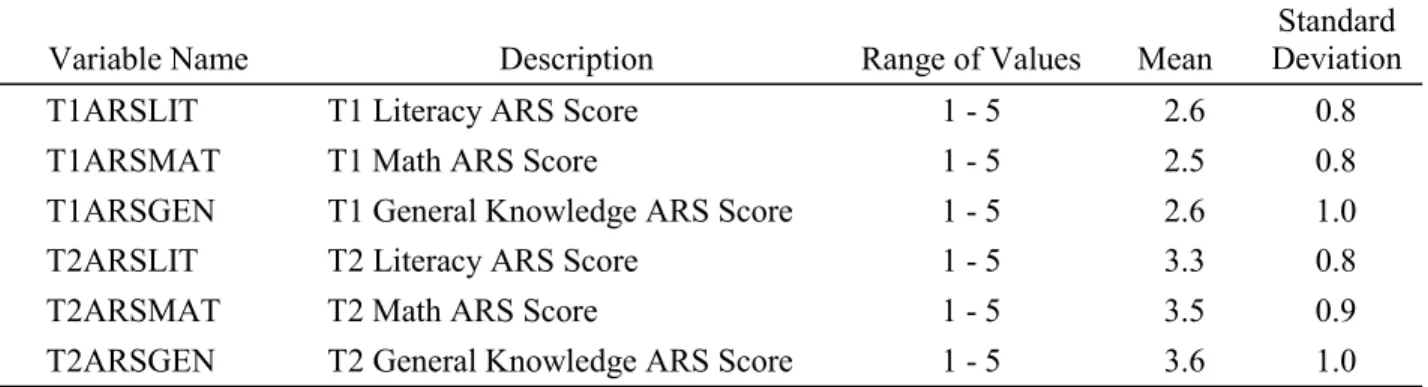
There are three scales of the ARS: language and literacy, general knowledge, and mathematics. Each of these is described below. The areas measured in the ARS overlap and augment what is measured in the direct cognitive assessment. The items were designed to ascertain the current skill
levels, knowledge, and behaviors of the child based on the teacher's past observation and experience with the child. Unless otherwise noted, the fall and spring ARS have the same number of items for each concept.
The Language and Literacy section of the ARS asks teachers to rate each child's
proficiency in speaking (1 item), listening (1 item), early reading (3 items fall, 4 items spring), and writing (1 item fall, 2 items spring). In addition, teachers rate the child's computer literacy (1 item).
The General Knowledge section of the ARS asks teachers to rate each child's
proficiency in social studies (1 item fall, 2 items spring) and science (3 items).
In the Mathematics section, teachers rate each child on one item on each of five
skills: concept of numbers, solving number problems, use of math strategies, data analysis (graphing), and measurement.
In all sections, the teacher rated the child's skills, knowledge and behaviors on a scale from "Not Yet" to "Proficient" (see table 2-6). If a skill, knowledge, or behavior had not been introduced into the classroom, the teacher coded that item as N/A (Not applicable).
See chapter 3, section 3.3 for scale scores, value ranges, means, and standard deviations for the ARS.
Table 2-6. ARS response scale
Not yet: Child has not yet demonstrated skill, knowledge, or behavior.
Beginning: Child is just beginning to demonstrate skill, knowledge, or behavior but does so very inconsistently.
In progress: Child demonstrates skill, knowledge, or behavior with some regularity but varies in level of competence.
Intermediate: Child demonstrates skill, knowledge, or behavior with increasing regularity and average competence but is not completely proficient.
Proficient: Child demonstrates skill, knowledge, or behavior competently and consistently. N/A: Not applicable: Skill, knowledge, or behavior has not been introduced in classroom
2.3.2 Teacher SRS
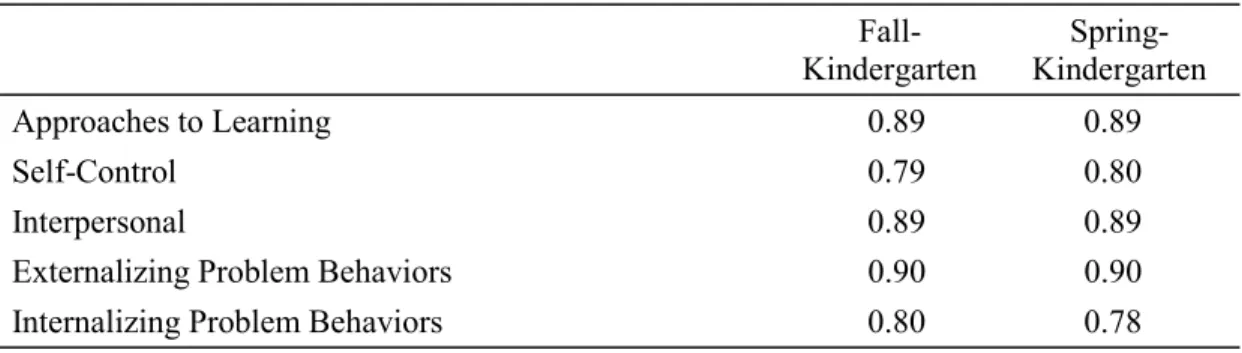
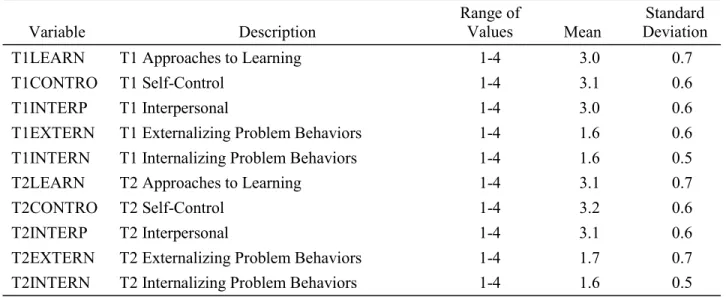
Teachers rated individual students as part of a self-administered questionnaire. These items are intended to measure approaches to learning, self-control, and interpersonal skills. The items were rated on a scale of one (Never) to four (Very often). See chapter 3, section 3.6.1 for variable names, ranges, means, and standard deviations for these scales.
The Approaches to Learning Scale (Teacher SRS) measures behaviors that affect the
ease with which children can benefit from the learning environment. It includes six items that rate the child's attentiveness, task persistence, eagerness to learn, learning independence, flexibility, and organization.
The Self-Control (Teacher SRS) Scale has four items that indicate the child's ability
to control behavior by respecting the property rights of others, controlling temper, accepting peer ideas for group activities, and responding appropriately to pressure from peers.
The five Interpersonal Skills (Teacher SRS) items rate the child's skill in forming
and maintaining friendships, getting along with people who are different, comforting or helping other children, expressing feelings, ideas and opinions in positive ways, and showing sensitivity to the feelings of others.
The two problem behavior scales reflect behaviors that may interfere with the learning process and with the child's ability to interact positively in the classroom.
Externalizing Problem Behaviors (Teacher SRS) include acting out behaviors. Five
items on this scale rate the frequency with which a child argues, fights, gets angry, acts impulsively, and disturbs ongoing activities.
The Internalizing Problem Behavior (Teacher SRS) Scale asks about the apparent
presence of anxiety, loneliness, low self-esteem, and sadness. This scale comprises four items.
This measure is adapted with permission from the instrument Elementary Scale A ("How Often?") (Gresham, F. M. and Elliott, S.N., 1990).
Fall-Kindergarten Teacher Questionnaires
Part A of the fall-kindergarten teacher questionnaire was given to all kindergarten teachers, regardless of whether they taught a sampled child. It included items characterizing the classroom and
students. Part B included questions regarding class organization and evaluation, typical class activities, and views on kindergarten readiness. The part C questionnaire asked teachers to complete an ARS and SRS rating for each sampled child in his or her classroom.
Spring-Kindergarten Teacher Questionnaires
Similar to the fall instrument, the spring questionnaire was also divided into three sections. The content of the items varied between fall and spring instruments to ease respondent burden. Part A was again completed by all kindergarten teachers in the school, regardless of whether they taught a sampled child. This section asked about the characteristics of the kindergarten class and the children in the class. The spring part B questionnaire included some, but not all, of the questions used in the part B fall questionnaire. Part B of the teacher questionnaire was completed only by kindergarten teachers new to the study. This questionnaire was similar to the part B questionnaire completed in fall. It was used to gather information about teacher background, instructional practices, views on kindergarten readiness, and the teaching climate of the school. The teacher part C questionnaire was completed by kindergarten teachers who taught sampled children. This questionnaire, similar to the part C questionnaire completed in fall, asked teachers to provide ratings of each sampled child in their classroom in academic and social areas. The spring part C also included a section titled "student information" that asked for overall academic and physical activity comparisons of the sampled child with the other children in the class and student support service participation. Table 2-7 shows the overall structure of the teacher questionnaire and the distribution of topics among the fall and spring data collection points.
Table 2-7. Teacher questionnaire
Teacher Questionnaire
Fall-Kindergarten
Spring-Kindergarten
Part A
Description of class—age, race, and gender distribution X
Class organization X1 X
Children with special needs X
Classroom aides X
Class assignment and grouping X
Types of activity/ interest areas X
Class activities X1 X
Instructional time in different subjects X
Types of materials and activities X
Child vs. teacher initiated activities X1
Parent involvement X
Professional development X
Part B
Evaluation and grading practices of students X /
Sharing progress information with parents /
Teachers' views on school readiness X /
Perceptions about school climate X /
Perception of personal influence on policies and classroom planning X
Teacher demographic information X /
Teacher experience and education X /
Job satisfaction X /
Table 2-7. Teacher questionnaire (continued)
Teacher Questionnaire
Fall-Kindergarten
Spring-Kindergarten
Part C
Indirect child cognitive evaluation by teacher X X
Language and literacy, mathematics, general knowledge X X
Teacher evaluation of target child's social skills X X
Sampled child additional information X
Participation in special services and programs X
Target child's overall academic skills and physical activity X
Reading group participation X
1Collected in part B for fall-kindergarten.
Note: The columns to the right of each construct correspond to the waves of questionnaire administration. Waves that included the construct are marked with an "X." Content areas asked in spring only to new teacher participants are marked with a "/."
2.4 Special Education Teacher Questionnaires
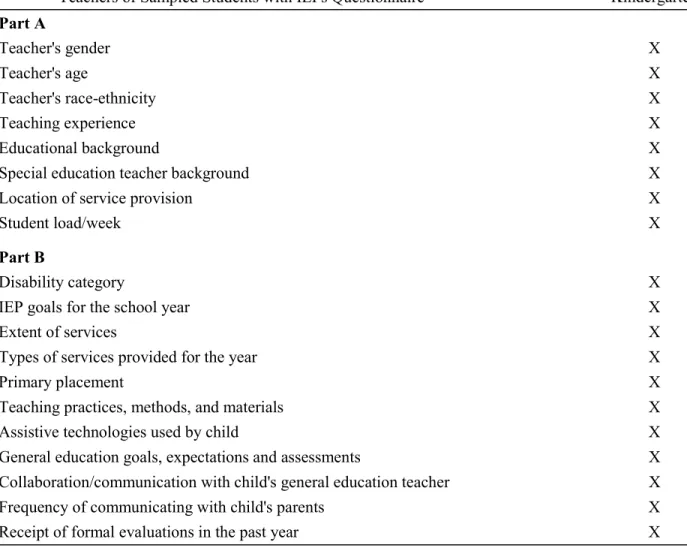
The special education teacher questionnaires were new in the spring. ECLS-K supervisors reviewed accommodation and inclusion information for children who received special education services. During the preassessment visit, the field supervisors specified primary special education teachers of sampled children and listed special education staff working with each child (e.g., speech pathologists, reading instructors, and audiologists). These questionnaires were given to special education teachers who taught sampled children. If a child received special education services from more than one special education teacher, a field supervisor determined the child's primary special education teacher.
The primary special education teacher was defined as:
The teacher who managed the child's Individualized Education Plan (IEP), or
The teacher who spent the most amount of time providing special education services
to the child, or
The teacher who is most knowledgeable about the child's special needs and
Items in the special education teacher questionnaires addressed topics such as the child's disability, IEP goals, the amount and type of services used by sampled students, and communication with parents and general education teachers.
Part A of the special education teacher questionnaire was designed to collect information about the special education teacher's professional background and experience. Part B asked about the special education services provided to the child and the nature of the child's special education curriculum. Table 2-8 provides a summary of the content areas addressed in the special education teacher questionnaire.
Table 2-8. Special education teacher questionnaire1
Teachers of Sampled Students with IEPs Questionnaire
Spring-Kindergarten
Part A
Teacher's gender X
Teacher's age X
Teacher's race-ethnicity X
Teaching experience X
Educational background X
Special education teacher background X
Location of service provision X
Student load/week X
Part B
Disability category X
IEP goals for the school year X
Extent of services X
Types of services provided for the year X
Primary placement X
Teaching practices, methods, and materials X
Assistive technologies used by child X
General education goals, expectations and assessments X
Collaboration/communication with child's general education teacher X
Frequency of communicating with child's parents X
Receipt of formal evaluations in the past year X
2.5 Adaptive Behavior Scale
The Adaptive Behavior Scale was completed for all sampled children who were identified in spring-kindergarten as excluded from the direct child assessment. A child was excluded from the assessment if he or she needed the assessment administered in Braille, enlarged print, or sign language, or if the child's IEP specifically prohibited the child from taking standardized assessments. This questionnaire was completed by the child's primary special education teacher and asked the teacher to provide ratings of the sampled child in three domains: independent functioning, language development, and numbers and time.
2.6 School Administrator Questionnaire
The school principal, administrator, or headmaster was asked to complete the school administrator questionnaire in the spring of 1999 (shown in table 2-9). This self-administered questionnaire was intended to gather information about the school, student body, teachers, school policies, and administrator characteristics. The questionnaire was divided into nine sections. The first seven sections requested mainly factual information about each school and the programs offered at the school. These sections could be completed by either a principal or a designee who was able to provide the requested information. The school's principal was asked to complete the remaining two sections concerning his or her background and evaluations of the school climate. This questionnaire was administered only in the spring of the base year data collection.
2.7 School Facilities Checklist
ECLS-K supervisors completed the facilities checklist. The facilities checklist collects information about the (1) availability and condition of the selected schools, (2) presence and adequacy of security measures, (3) presence of environmental factors that may affect the learning environment, and (4) overall learning climate of the school. (See chapter 5, section 5.6.5 for more detail on the collection of these data.)