
Sharif University of Technology
Scientia IranicaTransactions D: Computer Science & Engineering and Electrical Engineering www.scientiairanica.com
Extracting common spatial patterns from EEG time
segments for classifying motor imagery classes in a
Brain Computer Interface (BCI)
H. Ghaheri
and A.R. Ahmadyfard
Department of Electrical Engineering and Robotic, Shahrood University of Technology, Shahrood, Iran. Received 13 September 2012; accepted 11 May 2013
KEYWORDS Electroencephalogram (EEG);
Brain Computer Interface (BCI); Motor imagery; Common Spatial Pattern (CSP); Temporal segmentation; One-Versus-the Rest (OVR) method.
Abstract. Brain Computer Interface (BCI) is a system which straightly converts the acquired brain signals such as Electroencephalogram (EEG) to commands for controlling external devices. One of the most successful methods in BCI applications based on Motor Imagery is Common Spatial Pattern (CSP). In the existing CSP methods, common spatial lters are applied on whole EEG signal as one time segment for feature extraction. The fact that ERD/ERS events are not steady over time motivated us to break down EEG signal into a number of sub-segments in this study. I combine this sentence with next one: \We believe the importance of EEG channels varies for dierent time segments in classication, therefore we extract features from each time segment using the analysis of CSP method. In order to classify Motor Imagery EEG signals, we apply a LDA classier based on OVR (One-Versus-the Rest) scheme on the extracted CSP features. The considered Motor Imagery consists of four classes: left hand, right hand, foot and tongue. We used dataset 2a of BCI competition IV to evaluate our method. The result of experiment shows that this method outperforms both CSP and the best competitor of the BCI competition IV.
c
2013 Sharif University of Technology. All rights reserved.
1. Introduction
A Brain Computer Interface (BCI) allows severely disabled people to control external environment. Elec-troencephalogram (EEG)-based BCI translates brain electric signals into operative control commands. The most commonly used mental control strategy in BCI researches is the Motor Imagery (MI), because it can be associated with an attenuation or increase of localized neural rhythmic activity called Event-Related Desyn-chronization (ERD) or Event-Related SynDesyn-chronization (ERS) [1,2].
Scalp-recorded EEG signals, in addition to ERD and ERS activities, is contaminated by signals from
*. Corresponding author. Tel.: +98-09196675739
E-mail addresses: [email protected] (H. Ghaheri), [email protected] (A.R. Ahmadfard)
natural brain activities and artifacts such as elec-tromyogram (EMG) and electrooculogram (EOG) [3]. In presence of these distortions and other outliers, the signal to noise ratio of EEG signals is low; therefore recognizing ERD/ERS events from EEG signals is di-cult. Human skull has bone tissue, so signals generated in brain cortex interfere with each other before getting to scalp [4]. This means that the signals of EEG channels are sum of several sources generated under human skull. Therefore, selecting useful channels for classifying classes and extracting important events from selected EEG channels is dicult.
In order to extract discriminative features from EEG signals, a large number of signal processing and pattern recognition algorithms have been employed [5]. One of the most successful algorithms for channel reduction in MI-based BCI is Common Spatial Pattern (CSP) [6]. CSP is a decomposition method which rst
was proposed by Koles (1991) [7] for detecting some sort of mental diseases.
In CSP method, EEG signals acquired on top of the scalp are decomposed to two matrices. One of the matrices is the estimation of source signals generated under skull and the other matrix is the weights that show the importance of source signals in creation of EEG signals acquired on the scalp. The columns of weights matrix are called spatial lters [6]. In a two-class MI problem, CSP method calculates the spatial lters for maximizing the variance of signals between two classes of Motor Imagery. This set of spatial lters transform EEG signals to a new space in which the covariance matrices of transformed data corresponding to each class is diagonal. The extracted spatial lters are the eigenvectors corresponding to the largest and smallest eigenvalues of common covariance matrix. The result of ltering EEG signals, using the selected spatial lters, are used for classication of two classes. For the classication of a two-class Motor Imagery using CSP, the accuracy of above 90% has been reported [8].
Before CSP being applied, an appropriate band pass lter is needed to properly extract ERD/ERS events from EEG signals, so that the selection of frequency band aects the result of CSP method [8]. Although a wideband of 8-30Hz was suggested [8], ev-idence showed that selecting subject-specic frequency bands could yield an improvement in the recognition rate of MI-based BCI [9]. A problem with this preprocessing is that the center frequency of a proper lter varies from one subject to another, Therefore, several approaches, such as Common Spatio-Spectral Pattern (CSSP) [10] and Common Sparse Spectral Spatial Pattern (CSSSP) [11] are proposed to nd the appropriate frequency bands for ltering each subject. Recently, an alternative approach called Sub-band Common Spatial Pattern (SBCSP) was proposed, and has been shown to yield superior classication accuracy compared against CSSP and CSSSP on a pub-licly available dataset [12]. Ang et al. in 2008 proposed another approach called Filter Bank Common Spatial Patterns (FBCSP), and showed the FBCSP yields su-perior classication accuracy compared against SBCSP method [13]. FBCSP [13], which won dataset IIa and IIb in BCI competition IV (2008) [14], uses CSP features from a set of nine xed bandpass lters and feature selection algorithm based on mutual informa-tion to eectively choose the subject-specic features. This selection process selects features from the relevant frequency components.
Considering that EEG signals for a subject are represented as K N matrix X = [x1; x2; ; xN]
where K is the number of EEG channels and N is the number of samples for each channel. CSP method maps the samples of EEG signals to a new space based on
covariance matrix of the EEG signals. This method does not consider local structure of EEG signals, as for each channel, it uses the whole EEG signal as one time segment for computing the covariance matrix. CSP method considers each time point of all channels as a vector in the feature space, and maps it into another space based on the average covariance matrix of all EEG signals. As a result, the noise on one small time slot aects the covariance matrix of EEG signals. This introduces error when special lters are estimated.
Most of CSP-based method, as mentioned above, does not consider temporally local structure of the time EEG signals, too [15]. Time segment used in CSP method is very important, so that adding or removing one time sample varies covariance matrix and consequently spatial lters.
Wang and Zheng proposed a method [15] in which local structure of EEG signals is considered by dening time-dependent neighboring matrix, called LTCSP (Local Temporal Common Spatial Patten). With considering this adjacency matrix, the noise on one time point does not aect the extracting covariance matrix in the far time points. Therefore, LTCSP is less sensitive to potential outliers and artifacts. Similar to CSP method, LTCSP is an eigenvalue problem, so it is computationally simple, but it is more robust than CSP. Wang and Zheng [15] showed that LTCSP can discriminate better than CSP method in a two-class MI-based BCI problem.
LTCSP method used wide band frequency l-tering before extracting spatial lters. One defect of LTCSP can be that frequency ltering aects the spatial lter and extracted features that is consequent to wrong discriminating two classes.
One of the limitations for basic CSP method is the fact that it is only designed for a two-class problem. We used OVR (One-Versus-the Rest) algorithm to extend CSP to multiclass problem [16]. As CSP, LTCSP method, that is the extension of CSP method, is limited to binary-class problems, too. We can use all the extension approaches of CSP for LTCSP method to apply it for multiclass problem.
The goal of this paper is classifying four classes of Motor Imagery EEG signals. To conduct experiments, we utilized dataset 2a from the BCI competition, 2008 [14]. It contains EEG signals for 9 subjects. From each subject, it has been requested to imagine four motor imagery of left hand, right hand, both foots and tongue one at a time.
In this paper, we use the OVR approach to extend LTCSP method to a four-class problem. As we see in experimental results, LTCSP has better results than CSP in all subjects of our available data. The success of LTCSP method is considering the local structure of time signals.
Dynamic classier such as HMM (Hidden Markov Model) was used for MI classication too [17]. Success of these classiers is for considering temporal structure of EEG signals. This motivates us to use new method, considering time structure of EEG signals.
Observing time frequency distributions of EEG signals reveals that the energy of frequency bands during Motor Imagery varies with time. In other words, frequency patterns are not stable with time [18]. The sequence of this frequency patterns are important in classication. Gouy-Pailler et al. [18] considered this characteristic of MI signals, and proposed MS-JAD method for MI classication. MSMS-JAD is the improved JAD method [19] that in contrary to CSP and JAD methods diagonalizes covariance matrices of four classes simultaneously. MSJAD uses time segmen-tation on JAD algorithm. In MSJAD method, EEG signals are divided into a number of time segments, then JAD method is applied on all time segments [18]. Pailler et al. [18] compared their proposed method with CSP. They applied CSP method on Motor Imagery time segment and then they divided ltered signals into some time windows. They extracted features from the time segments in frequency domain. They applied their method on our available data, and com-pared their results with results of the best competitor in the competition IV. Their proposed method does not have good results related to the best competi-tor.
In this paper, for considering temporal structure of EEG signals in CSP method, we use CSP method on EEG time segments to extract proper features for four-class Motor Imagery classication. Unlike reference [18], in our method, at rst we divided EEG signals into some time segments, and then the CSP method was applied on each time segment. The features extracted from all time segments construct feature vector.
In fact, spatial lters are the weights that show the importance of signals under the skull for generating signals extracted on scalp. As mentioned above, the energy of frequency bands are not steady in the whole motor imagery time segment. It is possible that in some channels, some frequency bands activate in one time slot and deactivate in the others. In another time slot, it is possible that other frequency bands activate in other channels. Therefore, the importance of channels for classifying changes in dierent time slots. We divided time signals into several time segments, and applied CSP method in each segment. Through the experiment we found out the spatial lters vary for dierent time segments of EEG. This means that the importance of channels is dierent in each time segment for discriminating two classes.
We compared the result of our proposed method with the result obtained by the best competitor of
the competition 2008. The best performance in this competition was related to FBCSP method [20]. In average, with simple features such as variance, we could obtain better results than the results obtained by the method proposed by Gouy-Pailler et al. [18] and the best competitor. In these two methods, features extracted from frequency domain are more complex than our method. Also, our proposed method had better results than LTCSP or the same results in 7 subject of 9 in a four-class problem.
Although our proposed method has good result, we used wide band ltering before applying it on the available data. We can easily apply CSP-based methods, mentioned before [10-13], to select subject-specic frequency bands in each time segment, and improve our method. With this, we can consider both time structure and proper frequency band.
In the current CSP method, noise on non-informative parts of EEG signal aects the estimation of covariance matrix. Thus the extraction of spatial lters which provide features for classication is af-fected by noise and artifacts. By breaking each EEG channel into equal size time windows, the noise for each time window only aects the features extracted from that window not all features. This reduces the eect of noise and outliers on feature extraction process.
The rest of the paper is organized as follows: We provide a short overview on the CSP and LTCSP meth-ods in Section 2. In this section, we also explain our method and extension of it to a four-class problem by means of OVR method. Data acquisition, evaluation criterion and the result of experiments are explained in Section 3. Finally, the paper is drawn to conclusion in Section 4.
2. Theory
2.1. CSP method
The goal of CSP method is to design spatial lters that lead to new time series whose variances are optimal for the discrimination of two classes of EEG signals. We assume that we have two conditions of Motor Imaginary referred to as C1 and C2. Each condition
contains some trials. The output of each trial in a two-class problem is EEG signals from the person when he/she is asked to imagine one of the two conditions C1 or C2 (e.g. move right hand or left hand). For
a trial, signals are represented as K N matrix X = [x1; x2; ; xN] where K is the number of EEG
channels and N is the number of time samples for each channel. Consequently, xi(i 2 1; 2 N) is a column
vector with K dimension. It is worth to note that the mean value of the N samples for each channel of EEG signals must be zero. The estimation of the averaged normalized covariance matrix for each condition can be
given by [8]:
Ci =T1 i
X
j2Ti
XjXjT
trace(XjXjT); i 2 f1; 2g; (1)
where Ti is the number of trials for ith condition of
MI. The composite spatial covariance is determined by:
C = C1+ C2: (2)
C can be factorized as:
C = UTU; (3)
where U and are the matrix of eigenvectors and the diagonal matrix of eigenvalues for C, respectively [8]. These matrices are arranged so that eigenvalues being sorted in descending order.
Then the whitening transformation matrix P = U 1=2can equalize the variances in the space spanned
by U, i.e. all eigenvalues of PTCP are equal to one [8].
This means that we have: PTCP = I or PT(C
1+ C2)P = I; (4)
where I is the identity matrix. Now if C1 and C2 are
transformed as S1= PTC1P and S2= PTC2P and if
S1is factored by S1= BT1B, then S2= BT2B and
1+ 2= I.
This means that eigenvector with the largest eigenvalue for S1 has the smallest eigenvalue for S2
and vice versa. Thereupon the projection of whitened EEG signals into the space spanned by eigenvectors corresponding to the largest and smallest eigenvalues of S1will give new series of EEG signals that are optimal
for the classication of two populations [8]. With the transformation matrix W = P B, the mapping of trial X is given by:
Z = WTX: (5)
The new signals are the rows of matrix Z. The 2m signals corresponding to the m rst and last rows of Z are associated with the largest eigenvalues of each condition. Using the normalized variance of these signals, 2m features are extracted as follows:
fP = log P2mvar(ZP) i=1var(Zi)
!
; (6)
where P = 1; 2; ; 2m. Accordingly, from each trail of MI, a feature vector with 2m features are obtained and used for classication.
2.2. LTCSP method
As CSP method maximizes the variance of signals for one class and minimizes it for another class, the solution W can be determined by optimizing the following fraction:
maxtrace(WTC1W )
trace(WTC2W ): (7)
W must maximize the numerator against the denu-merator subject to WT(C
1 + C2)W = I. This is
an eigenvalue problem which can be converted as follows [15]:
1 T1
PT1
i=1
PK
j=1 wTjXiXiTwj=trace XiXiT
1 T2
PT2
i=1
PK
j=1 wTjXiXiTwj=trace XiXiT
; (8)
where T1and T2are the numbers of trials under
condi-tions one and two, respectively. Index i corresponds to ith trial, and wj is the jth column of matrix W . With
deletion of indexes, we can expand the term wTXXTw
as follow:
wTXXTw = 1
2N
N
X
l=1 N
X
m=1
wTx
l wTxm2: (9)
This says that the sum of the squared pairwise dis-tances between the projected data samples constructs the variance after ltering. In [15], a coecient HX
lm proposed that it species the adjacency value of
samples xl and xm.
wTXXTw = 1
2N
N
X
l=1 N
X
m=1
wTx
l wTxm2HlmX:
(10) The goal of adjoining this parameter is to reduce the noise eect of far samples in computation. So HX
lm
must decrease with increasing the distance between two temporally close data points. This value is between zero and one. Therefore, in Wang et al.'s method, a heat kernel was proposed for it:
HX lm=
(
exp( kxl xmk2=) j1 mj <
0 otherwise (11) HX is the symmetric matrix that is called the
adja-cency matrix, and k:k is the Euclidean norm of the two samples in RK. In this function, the parameter
is a positive number that denes the temporally local range out of which HX is equal zero. The parameter
is dened as = c0, where 0 is the standard
deviation of the squared norms of the training samples. Indeed, CSP is a special case of LTCSP when = N and c = +1 that means all samples are involved in optimization and have equal importance. Thus in CSP,
the noise of one sample has the same inuence on all other samples, whereas LTCSP eliminates this defect. It is worth to notice that adjacency matrix H must be constructed for each of the trials of both conditions.
After some manipulation, the average normalized temporally local covariance matrix is given by:
Ci=T1 i
X
j2Ti
XjLXXjT
trace XjLXXjT
; i 2 f1; 2g; (12)
where LX = DX HX is the Laplacian Matrix that
is a semi-positive denite matrix; therefore, it can be decomposed as:
LX = LX1=2
LX1=2
;
and DXis a diagonal matrix that its diagonal elements
are the row sums of HX i.e. DX ll =
PN
m=1HlmX.
Then similar to CSP method, the problem is nding matrix W that maximizes fraction Eq. (13) subject toWT(C1+
C2)
W = I.
maxtrace(WT
C1W )
trace(WTC2W ): (13)
Thereupon optimal W is given by:
W =UD 1=2 V ; (14)
where U is the matrix of eigenvectors, and D is the diagonal matrix of corresponding eigenvalues of
C1 +
C2, and
V is the eigenvectors matrix of
D 1=2 UT C1
UD 1=2. Then in LTCSP method the projected matrix of X is dened by:
Z =WTXLX1=2
: (15)
The m row of the upside and m row of the bottom of Z are suitable signals for classication and the feature vector corresponding to these m signals is evaluated as follows:
fP = log 0 @ var(
ZP)
P2m
i=1var(
Zi)
1
A ; P = 1; 2; ; 2m: (16) It has been reported that, compared with CSP, LTCSP signicantly enlarges the dierence of variances be-tween the rst and second classes. This implies that the variances obtained by LTCSP yield more discriminative information [15].
2.3. The Proposed method in a two-class problem
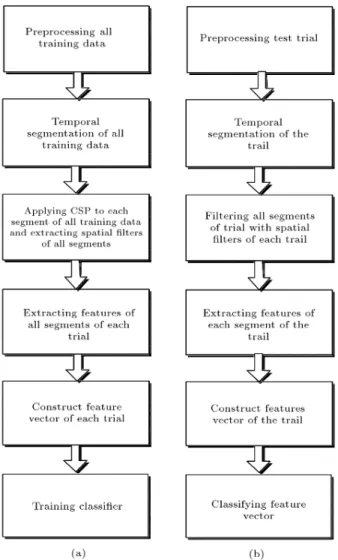
As mentioned above, in our method, EEG signals are divided into a number of time segments. Then CSP method is applied to each time segment for extracting proper features. We extend the proposed approach to a four-class Motor Imagery problem. This method has training and test phases. Flowchart of training and test process in a two-class problem is shown in Figure 1.
As EEG signals in our method are divided into a number of time segments, we refer to this method as SEG-CSP.
2.3.1. Training phase
The aim of training phase is to design a classier for classication of EEG samples. This phase has these steps:
Preprocessing: Prior to determining the spatial lters, the rate of EEG samples is reduced to 100 Hz, and then they ltered from 8 to 30 Hz, using
zero-Figure 1. Flowchart for (a) training (b) test of EEG patterns in a two-class MI classication system in SEG-CSP method.
phase forward/backward FIR lter. This frequency band is chosen because it encompasses mu (8-13 Hz) and beta (14-30 Hz) rhythms, which have been shown to be most important for the movement classication [21]; by this ltering artifacts, such EOG and EMG signals removed because the range of frequency band of these artifacts is out of this range [3]. Since ERD/ERS can occur before and after motor imagery execution [1,2], for training our proposed method, we used the 3 s time interval that begins of 0.5 s before the onset of the visual cue and ends to 2.5s after cue.
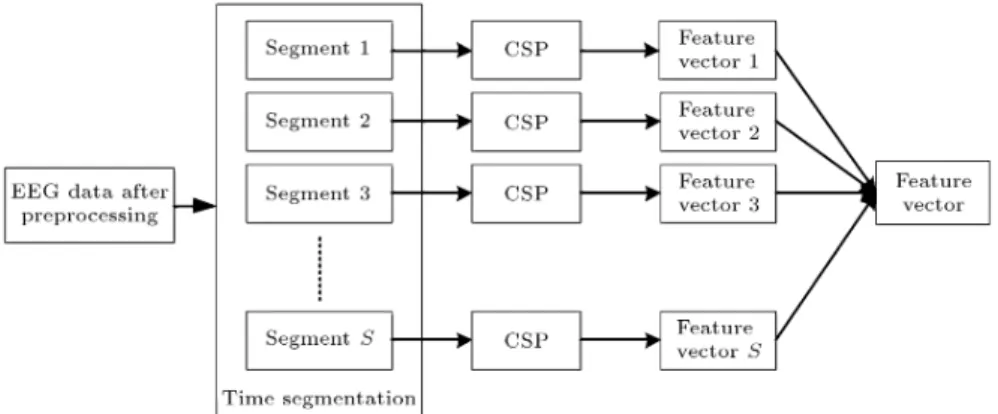
Time segmentation: After preprocessing, EEG signals are divided into a number of time segments with proper interference. As it is possible that the proper length of the time segments for feature extraction vary for each subject, the length of the time segments is considered a parameter in the proposed algorithm. In training phase, the accuracy of MI classication based on dierent lengths of time segments are evaluated. The length corresponding to the maximum accuracy is selected. The proce-dure for segmentation of EEG signals with segment length T second and time shift T second is shown in Figure 2.
Extracting spatial lters: In this step, CSP method is applied to each time segment in two classes, and spatial lters are extracted from each time segment. If we have S time segments,
Figure 2. Time segmentation procedure with T second segment length and T second time shift.
S matrices are obtained, which are denoted by W1; W2; ; WS.
Training features: Features from each time seg-ment are obtained by Eq. (6). Accordingly, from ith time segment, a feature vector is extracted, denoted by Fi:
Fi=fi
1 f2i fmi f2m1i f2mi
; i = 1; 2; ; S: (17) The concatenation of feature vectors corresponding to all time segments results in a feature vector denoted by F :
F =F1 F2 FS: (18)
Procedure of constructing feature vector is shown in Figure 3.
Learning classier: Using the extracted training features, a classier is designed to determine the class label of a test MI.
2.3.2. Evaluation phase
In evaluation phase, the following steps are taken for each test EEG data:
Preprocessing of test EEG same as the training phase.
Segmentation of EEG signals to a number of time segments with the optimal length obtained in the training phase.
Applying mapping matrix Wi to ith time segment
for i = 1; 2; ; S and extracting features of all segments.
Concatenation of feature vectors extracted from all time segments and obtaining nal feature vector.
Classifying the test MI, using the extracted feature vector and the designed classier in training phase.
2.4. Extension of CSP-based methods to a four-class problem
One of the limitations of basic CSP method is the fact that it is only designed for a two-class problem. Many studies have been conducted to extend this approach to a multiclass problem [16,19]. In these methods, a multiclass problem is broken into a number of two-class problems. One-Versus-the Rest (OVR) method computes the features of one condition versus the others. Hence, for solving a four-class problem, using OVR approach, we require four classiers where each classier states whether the test EEG belongs to that specic class or the rest. Therefore, in Eq. (1), the average covariance of Condition 2 is the sum of average covariance matrices of other 3 conditions [19]. If average covariance matrix of class i (i = 1; 2; 3; 4) is denoted by Ri, then for the ith classier that
discriminates class i from other classes, in Eq. (1), we have:
C1= Ri and C2=
X
k6=i
Rk: (19)
Since LTCSP is limited to binary-class problems, we can use all these extension approaches of CSP for
LTCSP method. In this paper, we use OVR approach to extend a two-class LTCSP method to a four-class problem. We name it OVR-LTCSP. In OVR-LTCSP method, we have four classiers each of which is a two-class LTCSP method two-classifying each two-class versus the rest.
In this paper, we use the OVR approach to apply our SEG-CSP method to a four-class problem too. The extended method is referred to as OVR-SEG-CSP. Similar to basic CSP, for a four-class problem, we need four classiers in which jth classifer discriminates jth class from the others (j = 1; 2; 3; 4). Each classier is a two-class SEG-CSP method of which the training and test phase was explained in the previous section.
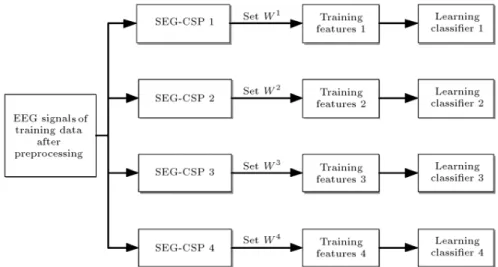
In OVR-SEG-CSP method, jth classier has a set of matrix W named W1j; W2j; ; WSj. The Procedure of training in OVR-SEG-CSP method is shown in Figure 4.
In evaluation phase, as shown in Figure 5, each test EEG data after preprocessing is divided into a number of time segments. Then from the prepared data, four feature vectors are extracted. Each feature vector is obtained using special lters for classifying one class versus the rest. Consequently, four results
Figure 4. Procedure of training in OVR-SEG-CSP method.
of classication by 4 classiers are provided. The true label of the test EEG data is determined by the classier that provides the highest class label probability [21]. In the problem with a few training data and noisy features, it is better to use steady and simple classiers with a few parameters [17]. In this research, sher's Linear Discriminant Analysis (LDAs) has been used for classication.
3. Experiments
3.1. Evaluation criterion
In this paper, we used the accuracy criterion for pre-senting the result of classifying EEG signals of a two-class motor imagery data. We applied the proposed method to dataset 2a of the BCI competition 2008 [14]. In order to compare the performance of this method with the best competitor in the 2008 competition we used kappa score, as used for evaluation of methods in this competition, for a four-class problem. The kappa score is determined as follow [22]:
= p1 p0 pe
e; (20)
where p0is the overall agreement on all test trails. This
parameter is equal to the classication accuracy. pe is
dened as the chance agreement. These parameters are calculated as:
p0= M
X
j=1
njj=N; (21)
and
pe= M
X
j=1
n:ini:=N2: (22)
nij is the element of confusion matrix on ith row and
jth column which indicates how many trails of class i have been classied as class j. In an M-class problem, ni:and n:irefer to the sum of the elements of ith row
and ith column of confusion matrix, respectively. The diagonal element niirepresents the number of correctly
classied test trials of ith class. The total number of trails is:
N =
M
X
i=1 M
X
j=1
nij: (23)
3.2. Dataset
The dataset 2a of the BCI Competition IV (2008) has been provided by the BCI research group at Graz University [14]. This dataset contains EEG signals recorded from nine subjects (persons) performing four dierent motor imagery tasks, i.e. left hand, right hand, both feet and tongue. The recording concluded 22 channels (with interelectrode distances of 3.5 cm), and was sampled with rate 250 Hz. Monopolar derivations were used throughout all recordings, where the left mastoid served as reference, and the right mastoid as ground. The dataset consists of 288 trials for training and 288 trials for test. This cue-based BCI includes three important periods. In the rst 2 seconds a xation cross is displayed on the screen; in the next second, cue is appeared; third period is from 3s to 6s in whitch subject is imagining the related action. The paradigm and montage are illustrated in Figure 6. 3.3. Results
Since BCI problems are subject-specic, in our pro-posed method, the length and overlap of time segments and m parameter of CSP method in these segments are dierent for each subject. For this reason, we must obtain optimal value of these parameters for each subject. If the overlap of time segments becomes large, the number of segments would be large. This causes the increase of dimensionality of feature vectors and the complexity of algorithm. Accordingly, the shift of time segments is chosen (T = 0:5 s). The length of time segments varies from 0.5 to 3 s with step time 0.5 s (i.e. T = 0:5, 1, 1.5, 2, 2.5, 3 in Figure 2). The number of spatial lters (2m) is considered as a parameter which varies from 2 to 16 (m is 1 to 8). The parameters T and m are the same in all time segments. The result of a four-class problem for subject 1 with dierent parameters T and m has been shown in Table 1.
Table 1. The classication rate for OVR-SEG-CSP method for subject 1 in classifying EEG signals of two class left and right hands with parameters T and m.
m T = 0:5 s T = 1 s T = 1:5 s T = 2 s T = 2:5 s T = 3 s
1 0.69 0.62 0.70 0.67 0.69 0.66
2 0.63 0.65 0.69 0.67 0.67 0.68
3 0.65 0.67 0.72 0.71 0.72 0.71
4 0.65 0.62 0.68 0.71 0.72 0.70
5 0.63 0.62 0.72 0.72 0.70 0.74
6 0.53 0.6 0.68 0.70 0.69 0.67
7 0.53 0.61 0.68 0.69 0.68 0.66
8 0.49 0.59 0.65 0.66 0.64 0.68
Table 2. The kappa score for evaluation of the proposed method OVR-SEG-CSP against the best competitor in the competition IV, three methods proposed in [18], OVR-LTCSP and OVR-CSP.
The best competitor in
The method proposed by
Gouy-Pailler et al. [18] OVR-CSP(m) OVR-LTCSP(c; ; m) OVR-SEG-CSP(T; m)
BCI 2008 CSP JAD MSJAD
Subject 1 0.68 0.52 0.65 0.66 0.74(5) 0.77(5,4,5) 0.74 (3s,5)
Subject 2 0.42 0.39 0.40 0.42 0.34 (4) 0.35(9,5,4) 0.43 (2.5s,6) Subject 3 0.75 0.67 0.77 0.77 0.76 (4) 0.80 (3,4,2) 0.80(2s,2) Subject 4 0.48 0.50 0.50 0.51 0.51 (3) 0.60 (10,2,3) 0.57(2s,2) Subject 5 0.40 0.49 0.44 0.50 0.22 (5) 0.31 (8,2,5) 0.31 (2.5s,2) Subject 6 0.27 0.18 0.19 0.21 0.27 (3) 0.37 (2,5,3) 0.38(1s,1) Subject 7 0.77 0.26 0.25 0.30 0.69 (3) 0.75 (2,5,3) 0.76 (2s,2) Subject 8 0.75 0.57 0.72 0.69 0.62 (5) 0.74 (8,3,5) 0.75 (1.5s,7) Subject 9 0.61 0.40 0.50 0.46 0.79 (3) 0.80 (3,5,7) 0.80 (2.5s,2)
Average 0.57 0.41 0.49 0.50 0.55 0.61 0.61
We repeated similar experiment for all subjects. The maximum performance and the corresponding parameters (m; T ) for each subject have been shown in Table 2. For instance, for subject 1, the maximum performance is obtained when T = 3 s and m = 5 are selected.
In order to compare the proposed method with the existing CSP method, we applied the OVR-CSP method [8] to the BCI dataset, i.e. OVR-CSP method is applied on whole considered 3 s (from 2.5 s to 5.5 s). The number of spatial lters (2m) is considered as a parameter which varies from 2 to 16 (m is 1 to 8). We obtained the classication rate for dierent values of m. The maximum classication rate for each subject and the optimal m for obtaining it are shown in column 5 of Table 2.
As we see in Table 2, our proposed method has a better result than OVR-CSP in all subjects except subject 1. In the worst case, i.e. subject 1, two methods have the same results. In subject 1, we obtained maximum kappa in T = 3 and m = 5. With T = 3, we only have one time segment as OVR-CSP, that two methods are the same and have the same results.
Thereupon, current CSP method is the state of our proposed method with T = 3.
In subject 8, the maximum kappa in our proposed method has been obtained in T = 1:5 s and m = 7. For this case, four time segments with T = 1:5 s and T = 0:5 s exist in 2.5 to 5.5 time interval. First and second important spatial lters of each time segment in classier 1 (left hand versus the rest) are shown in Figure 7.
As we see in this gure, spatial lters are dierent in time segments. This means that the importance
Figure 7. The selected two spatial lters in 4 time segment method for classifying left and right hand motor imagery classes for subject 2 by SEG-CSP.
of channels is dierent for classifying two classes in time segments. In current CSP method, only one time segment and consequently one spatial lter matrix ex-ist, that means the importance of channels considered similar in whole time segment. It is possible that specic events happen in one time segment that do not happen in the others. It is possible that one frequency band activates in one channel in one time segment that deactivate in other segment. For this reason, the importance of channels is dierent in segments. With extracting the events happening in dierent time intervals and considering all of them in classication process, we can get better results.
We apply OVR-LTCSP method on our available data. Similar to work done in [15], we had set = c0, where m 2 f1; ; 8g, 2 f2; ; 5g and c 2
f1; 2; ; 10g[+1 for LTCSP method. As mentioned above, 0 is the standard deviation of the squared norms of the training samples that we considered the training data of four classes as training data, where this and other parameters (i.e. m, and c) are xed during the four classiers of OVR method in one experiment. The maximal kappa and the corresponding parameters (m, , c) for each subject have been shown in Table 2. As we see, both OVR-CSP and our proposed methods have the same results in 3 subjects of the nine. In four of the subjects, our proposed method has better results than OVR-LTCSP and in 2 subjects, vice versa. Anyway, both of them have the same results in average. Our proposed method has two parameters (m and T ) and used CSP method in each time segment. LTCSP has 3 parameter and is more complex than CSP. thereupon, LTCSP is more complex than our proposed method which gives more time for execution. In our proposed method, time segmenting is done on EEG signals; CSP is applied in all time segments and features are extracted from all time segments. There-fore, the same process is applied in all segments. We can execute our proposed method in parallel process on the time segments. Thereupon, our proposed method is faster than LTCSP method in training and test phase. In Table 2, we also compare the performance of three addressed methods proposed by Gouy-Pailler et al. (2010) [18]. In CSP-based method proposed by them, in each classier of OVR approach, at rst they applied CSP on whole 3 s motor imagery time segments. After ltering by spatial lters, ltered signals divided into ve time segments and features in frequency domain are extracted from each segment, and all features classied by logistic regression method. We emphasize that in the proposed method, EEG signals are divided into a number of equal lengths time segments. Then the CSP method is applied on each time segment. We could obtain better results than the CSP-based method. This means that segmentation before CSP can extract more eective events for
classi-cation. Our proposed method outperformed MSJAD method proposed by Pailler et al. [18] that is more complex than our method. They used equal length for time segments for all subjects, but we considered it variable and selected optimal value for each subject.
The results of the method proposed by the best competitor of competition 2008 are shown in Table 2, too. The best competitor used OVR approach for expanding FBCSP method [13] to a four-class problem. They used 2 s time segment from 2.5 s to 4.5 s. In FBCSP, nine band-pass lter is applied in the time segment of EEG signals, and CSP is applied on the ltered signals in each frequency bands. After ltering the signals by spatial lters in each frequency band, features are extracted. Features are reduced by a feature selection algorithm based on mutual infor-mation classied by SVM (Support Vector Machine) classier. Our proposed method outperformed the method proposed by the best competitor in six subjects of the nine by the simple features such as variance, the simple classier such as sher LDA and without feature reduction.
We used wide band ltering before doing our proposed method on EEG signals. We applied CSP method in each time segments. We can apply CSP-base method such as SBCSP, FBCSP and other stead CSP methods in each time segment, and improve our method. With this manner subject-specic frequency patterns are extracted from each time window and features with more information for classication are obtained from EEG signals. With parallel processing in all segments we can save time.
4. Conclusions
In this paper we addressed the problem of multiclass BCI Motor imagery recognition. We used dataset 2a of BCI competition IV to evaluate the performance of the proposed method. This database contains EEG signals related to four dierent motor imagery tasks of nine subjects.
One of the most successful methods in MI-based BCI is CSP method. This method obtains spatial lters from EEG data; such lters reveal the importance of EEG channels in discrimination of MI data. In the existing CSP method, spatial lters are extracted using EEG channels as one time segment. The fact that the generated frequency patterns in Motor Imagery are dierent from one time slot to another, motivated us to apply CSP on EEG time segment. The augment of features from EEG time segments are used as the feature vector for discriminating EEG signals for two MI classes. We utilized the One-Versus-the-Rest (OVR) approach [16] to extend the proposed method to the four-class MI problem. We used LDA algorithm for this classication.
CSP method is based on estimating covariance matrix, and does not consider temporal segmentation of EEG signals. LTCSP [15] is the extension of CSP method that considers time structure of the signals.
We used time segmentation for considering the in-formation of consecutive time segments. Our proposed method and LTCSP have the same result in average, but our method is simpler than the other.
The best competitor used FBCSP method [13] for classifying a four-class motor imagery. Our method outperforms in many subject and in average of the best competitor's method. Our proposed method conquest MSJAD and CSP and JAD-based method proposed by Gouy-Pailler et al. [18]. In their CSP-based method they apply CSP method on whole motor imagery time segment, and then they divided ltered signal, by extracted spatial lters, into several time segments. In our method, we used time segmentation and then CSP applied in each time segment. More success of our method shows that time segmentation before CSP has a signicant eect on the improvement of results.
Obtaining the good results with our proposed method and using the simple features such as variance and simple classier such as sher LDA shows that information of consecutive time segments are impor-tant for classication. Our good achievement is due to the fact that the eect of noise and artifacts are reduced by segmenting EEG signals into a number of time slots.
However, the performance of this method depends on an appropriate pre-ltering in frequency domain. Since MI-based BCI is a subject-specic problem, as a future work, the performance of BCI system can be improved by selecting proper frequency band for each subject individually. For instance, we can apply CSP-based method such as SBCSP and FBCSP methods instead of CSP method in each time interval, and extract frequency bands, activate or deactivate, in each time segment.
Our proposed method applies the same process on all time segments; therefore, we can have faster method with parallel processing.
References
1. Pfurtscheller, G. and Neuper, C. \Motor imagery acti-vates primary sensorimotor area in humans", Neurosci. Lett., 239(2-3), pp. 65-68 (1997).
2. Pfurtscheller, G. and Lopes da Silva, F.H. \Event-related EEG/MEG synchronization and desynchro-nization: basic principles", Clin. Neurophysiol., 110(11), pp. 1842-1857 (1999).
3. Fatourechi, M., Bashashati, A., Ward, R.K. and Birch, G.E. \EMG and EOG artifacts in brain computer
in-terface systems: A survey", Clinical Neurophysiology, 118, pp. 480-494 (2007).
4. Sanei, S. and Chambers, J.A., EEG Signal Processing, John Wiley & Sons, Centre of Digital Signal Process-ing, Cardi University, UK (2007).
5. Bashashati, A., Fatourechi, M., Ward, R.K. and Birch, G.E. \A survey of signal processing algorithms in brain-computer interfaces based on electrical brain signals", J. Neural En., 4, pp. 32-57 (2007).
6. Muller-Gerking, J., Pfurtscheller, G. and Flyvbjerg, H. \Designing optimal spatial lters for single-trial EEG classication in a movement task", Electroenc. Clin. Neurophysiol., 110, pp. 787-798 (1999).
7. Koles, Z.J. \The quantitative extraction and topo-graphic mapping of the abnormal components in the clinical EEG. Electroencephalogr", Clin. Neurophysiol, 79(6), pp. 440-447 (1991).
8. Ramoser, H., Muller-Gerking, J. and Pfurtscheller, G. \Optimal spatial ltering of single trial EEG during imagined hand movement", IEEE Trans. Rehabil. Eng., 8(4), pp. 441-446 (2000).
9. Dornhege, G., Blankertz, B., Krauledat, M., Losch, F., Curio, G. and Muller, K.-R. \Combined optimization of spatial and temporal lters for improving brain-computer tnterfacing", IEEE Trans. Biomed. Eng., 53(11), pp. 2274-2281 (2006).
10. Lemm, S., Blankertz, B., Curio, G. and Muller, K.-R. \Spatio-spectral lters for improved classication of single trial EEG", IEEE Trans. Biomed. Eng., 52(9), pp. 1541-1548 (2005).
11. Dornhege, G., Blankertz, B., Krauledat, M., Losch, F., Curio, G. and Muller, K.-R. \Combined optimization of spatial and temporal lters for improving brain-computer interfacing", IEEE Trans. Biomed. Eng., 53(11), pp. 2274-2281 (2006).
12. Novi, Q., Guan, C., Dat, T.H. and Xue, P. \Sub-band common spatial pattern (SBCSP) for brain-computer interface", 3rd International IEEE/EMBS Conference on Neural Engineering CNE, 07, pp. 204-207 (2007). 13. Ang, K.K., Chin, Z.Y., Zhang, H. and Guan, C.
\Filter bank common spatial pattern (FBCSP) in brain-computer interface", IEEE Int.Joint Conf. Neu-ral Netw, pp. 2390-2397 (2008).
14. http://bbci.de/competition/iv/index.html
15. Wang, H. and Zheng, W. \Local temporal common spatial patterns for robust single-trial EEG classica-tion", IEEE Trans. Neural Systems and Rehabilitation Engineering, 16(2), pp. 1534-432 (2008).
16. Dornhege, G., Blankertz, B., Curio, G. and Muller, K.-R. \Boosting bit rates in noninvasive EEG single-trial classications by feature combination and multiclass paradigms", IEEE Transactions on Biomedical Engi-neering, 51(6), pp. 993-1002 (2004).
17. Lotte, F., Congedo, M., Lecuyer, A., Lamarche, F. and Arnaldi1, B. \A review of classication algorithms for EEG-based brain-computer interfaces", J. Neural Eng., 4, pp. 1-13 (2007).
18. Gouy-Pailler, C., Congedo, M., Brunner, C., Jutten, C. and Pfurtscheller, G. \Nonstationary brain source separation for multiclass motor imagery", IEEE Trans-actions on Biomedical Engineering, 57(2), pp. 469-478 (2010).
19. Dornhege, G., Blankertz, B., Curio, G. and Muller, K.-R. \Increase information transfer rates in BCI by CSP extension to multi-class", Advances in Neural Information Processing Systems, pp. 733-740 (2004). 20. Chin, Z.Y., Ang, K.K., Wang, C., Guan, C. and Zhang,
H. \Multi-class lter bank common spatial pattern for four-class motor imagery BCI", 31st Annual Inter-national Conference of the IEEE EMBS Minneapolis Minnesota, USA, pp. 2-6 (2009).
21. Brunner, C., Naeem, M., Leeb, R., Graimann, B. and Pfurtscheller, G. \Spatial ltering and selection of optimized components in four class motor imagery EEG data using independent components analysis", Pattern Recognition Letters, 28, pp. 957-964 (2007).
22. Schlogl, A., Kronegg, J., Huggins, J.E. and Mason, S.G. \Evaluation criteria in BCI research", In Toward Brain-Computer Interfacing, MIT Press, pp. 327-342 (2007).
Biographies
Habibeh Ghaheri received her BSc and MS in Electrical Engineering from Shahrood University, Iran, in 2009 and 2012, respectively. Her current research interests are in pattern recognition, signal and image processing. She has worked also on brain computer interface topic recently.
Alireza Ahmadyfard graduated from Isfahan Uni-versity of Technology in Electrical Engineering in 1989. He obtained his MSc degree in Communication Engi-neering from Amkabir University of Technology in 1994 and his PhD in Object Recognition in Computer Vision from University of Surrey in 2002. Now he is a member of Shahrood University of Technology. His research interests include signal processing, pattern recognition and computer vision.
![Table 2. The kappa score for evaluation of the proposed method OVR-SEG-CSP against the best competitor in the competition IV, three methods proposed in [18], OVR-LTCSP and OVR-CSP.](https://thumb-us.123doks.com/thumbv2/123dok_us/8393322.2230045/9.892.102.812.441.714/table-evaluation-proposed-method-competitor-competition-methods-proposed.webp)
