
Biological differences between sea waters: experiments in 1960
22
0
0
Full text
(2) DOUGLAS P. WILSON AND F. A. J. ARMSTRONG. Our present series of experiments were thus primarily designed to test Bougis's hypothesis. It was necessary to do them in the manner of our earlier experiments, using waters from contrasted localities, and not merely to repeat Bougis's and Bernhard's methods in which only natural sea water from one locality had been used. COLLECTION. OF MATERIALS. There was a scarcity of Echinus esculentus on the trawling grounds in 1960, attributed mainly to the activities of French scallop-dredgers working extensively over the grounds for months previously. Sea-urchins with greenish patches were often trawled up-an indication that they had been damaged some days earlier, probably dredged up and thrown back into the sea. The best urchins were got by underwater swimmers from rocky grounds inaccessible to scallop-dredgers. An attempt to find plankton-rich water to the westward failedl and we therefore chose to use water from the Firth of Clyde as a probable good water to contrast with a probable bad water from E 1. In the past Clyde water has often proved to be a better medium for developing eggs and larvae of seaurchins, and of some polychaetes, than water from the Plymouth district. We extend our thanks to the Millport Marine Station and to Mr E. Latham for sending us water from the Firth of Clyde. GENERAL. METHODS. I;. Our methods have been described in detail in earlier papers (Wilson, 195 Wilson & Armstrong, 1952, 1954, 1958) and there was no radical departure in the present experiments. As usual all water tested had first been passed through sterilized Doulton filter candles. We have standardized on three 175 ml. Pyrex glass crystallizing dishes for each test set, and we put 100 mi. of the water to be tested into each. The fertilized eggs, after washing in the manner described for each experiment, are distributed to the dishes with a special glass ladle of capacity 8 mi., and this volume of wash water with eggs is added to the roo mi. already in each dish. Unless otherwise stated, the larvae of all three dishes in anyone test set were identical in appearance and behaviour. Also, unless otherwise stated, swimming larvae were not decanted into clean empty dishes to separate them from undeveloped eggs or dead larvae. Throughout each experiment all dishes were examined with a hand-lens once or twice a day, and the contents of at least one dish of each test set, usually all three, were studied more closely on the stage of a dissecting binocular. A wide-mouthed pipette was used for removing larvae for preservation, or they were merely poured off into another dish and quickly flooded with near-absolute alcohol. After hardening, and before mounting, these preserved larvae were taken down in gradual steps to distilled water to remove precipitated salts, and then up again through a range of alcohols to be mounted without staining in Euparal. All alcohols and the distilled water were rendered alkaline with traces of borax. 1 Expt. I includes a test of a water collectedon this cruise; the result confirms our suspicion that this Western water was poor (see p. 669)..
(3) BIOLOGICAL DIFFERENCES BETWEEN SEA WATERS CHEMICAL Copper determinations. 665. WORK and adjustment. For Expts. I and 2 a biquinolyl method (Riley & Sinhaseni, 1958) was chosen because it is specific and has been particularly well tested. It is likely that the results give the total copper content of the water to the nearest 0'2 fLg Cu/l. Copper determinations had not originally been planned for Expt. 3, so, since time was short, the easier and quicker diethyldithiocarbamate method was used. The very straightforward version given by Barnes (1959, pp. 229-30) was employed. The results are believed to be reliable. Copper concentrations found are given in the Table below, which includes some values for water before and after filtration through porcelain candles. The effect of this filtration in reducing the copper content of the samples is clear; the E I, Clyde and outside waters have lost respectively 75 %, 30 % and 60 %. TABLE A Date of analysis 19. iii. 60 14. iv. 60. 26. iv. 60. Method Biquinolyl. Sample E 1, 9. iii. 60, filtered Clyde, 9. iii. 60, filtered Western, 9. iii. 60, filtered Biquinolyl E 1, 4. iv. 60, unfiltered E 1, 4. iv. 60, filtered Outside, 20. iv. 60, unfiltered Diethyldithiocarbamate Outside, 20. iv. 60, filtered Clyde, 21. iv. 60, unfiltered Clyde, 21. iv. 60, filtered * Not used for the Echinus experiments.. Copper content 0,6. 1'5. 0,8 2'0* 0'5*. 1'3 0'9 4'2. 1'7. Adjustment of copper contents to the levels required in the experiments was made by adding small volumes of a standard solution of cupric sulphate (copper content 5 fLg/ml.) to 500 ml. portions of sea water, using a microburette. Chelated samples. An approximately 0'1 M solution of the complexing agent (E.D.T.A.) in sea water was first made by dissolving 18'7 g of the disodium salt of ethylene-diamine-tetraacetic acid in 500 ml. of a mixture of E I and Clyde waters, and then adding solid sodium hydroxide to bring the hydrogen-ion concentration to pH 9'09. Sea-water samples with approximately 0'001 M E.D.T.A. were made as follows: Mixed water, chelated. 21. E 1+21. Clyde (pH of mixture 8'II) +40 ml. 0'1 M E.D.T.A. in sea water + 5 ml. o·IN-NaOH. pH after aeration 8'03. E 1, chelated 11. E I (pH 8'12) + 10 ml. O·IME.D.T.A. in sea water + 2 ml. o·IN-NaOH. aeration 8'08.. pH after. Clyde, chelated. 11. Clyde (pH 8'II)+ after aeration 8'09.. 10 ml. O'IM E.D.T.A. in sea water + 2 ml. O·IN-NaOH.. 42-2. pH.
(4) 666. DOUGLAS P. WILSON AND F. A. J. ARMSTRONG Volatile matter. The method described below was intended to provide sea-water samples free from, and enriched in, the recently reported volatile fraction (Armstrong & Boalch, 1960). Lucas (1955) has suggested that the results of some of our heat-treatment experiments (Wilson & Armstrong, 1954, pp. 350 and 359) may be due to the existence of a beneficial substance of a more or less volatile nature. 2'51. of sea water were distilled in an all-glass apparatus comprising a 3 1. boiling flask, 50 cm fractionating column packed with Raschig rings, splash trap, condenser, ice trap and 250 m1. receiver. The first 250 m1. of distillate containing most of the volatile matter was kept in a stoppered flask. A second 250 m1. portion was discarded. Loss of carbon dioxide during the distillation caused the sea water to become cloudy with a heavy precipitate of calcium carbonate, and after the distillation a stream of carbon dioxide was passed into the hot turbid liquid. The calcium carbonate dissolved, leaving a clear solution in less than I min. The flask and contents were rapidly cooled, and excess carbon dioxide removed by aspirating with clean air. The volume was then adjusted to 2'01. with distilled water. The mixtures shown in Table B were made for the experiments. If most of the volatile matter is assumed to have been collected in the first 250 m1. of distillate, then the enriched samples have double the normal concentration, and the original salinities are preserved unchanged. It must not be forgotten that boiling the samples may affect their characteristics. Since the initial acidities of those made with volatile fractions was high because of excess of carbon dioxide, the precaution was taken of allowing the 100 m1. portions in the experimental dishes to stand, partly uncovered, in order to approach equilibrium with the atmosphere. Any other method of reducing the acidity might have introduced undesirable complications. A separate set of dishes was kept for pH determinations, the results of which are as follows:. ,. mixing 6'79 6'59 7,89 7'92. pHon 400 ml. concentrated sea water + 100mI. E 1 + double distilled water E 1 + E 1 volatile fraction E 1 + Clyde volatile fraction Clyde + double distilled water Clyde + E 1 volatile fraction Clyde + Clyde volatile fraction. 6,81 7'19 7'83 7'I! 7'80 7'88 2h TABLE BIh 6'98 , , 7'10 7'02 7'08 7'00 7'84 6'97 6'92 7'04 6'85 Overnight 4h 6,62 6·69 pH after standing (not larvae dishes). THE EXPERIMENTS. The experiments were carried out in a room on the north side of the building. It was not possible to control room temperature, which was recorded with a thermograph. The range was never more than a few degrees Centigrade. EXPERIMENT. 1. E I water collected 9. iii. 60. Drawn up from 15-20 m below surface through a polythene tube; water not passed through pump; strained through sterilized 200-mesh bolting silk into specially cleaned carboy. Ship: R.V. 'Sarsia' with F.A.J.A. Salinity: 35'43%0' pH g'I1. Copper content after filtration 0,6 f'g/1. Western water collected I I. iii. 60. Method of collection as for E I water. Position: 50° 00' N., 7° 00' W..
(5) BIOLOGICAL. DIFFERENCES. BETWEEN. SEA WATERS. 667. Ship: R.V. 'Sarsia' with F.A.}.A. Salinity: 35'35%0' pH 8'08. Copper content after filtration 0,8 flog/I. Clyde water collected 9. iii. 60, 13.30 h. Water dipped from surface with polythene bucket and strained through polythene funnel and zoo-mesh bolting silk (sterilized in Plymouth) into specially cleaned carboy. Position: mid-Largs Channel, i-ebb, wind S.B. force 4. Boat: R.V. 'Mizpah'. Salinity: 32'03%0' pH 8'10. Copper content after filtration 1'5 flog/I.. The waters to be tested, in their untreated and treated forms, are listed in Table I. The fertilization was made at 6.15 p.m. on 22 March 1960, using one female and one male selected from a quantity of recently collected seaurchins. Each was caused to spawn first into a mixture of Clyde and E 1 waters in equal proportions, and then into a similar mixture of the same waters chelated. TABLE. 1. EXPERIMENT. 1. For Sets IV-VI the fertilization was made in Mixed water chelated; for all other Sets in untreated Mixed water (50% Clyde:50% E1). Set Eggs washed in Clyde water Clyde water, Cu, 1'5 /Lg/l. E1 water E I water, Cu, 0,6 /Lg/l. Mixed water III Mixture, 50 % Clyde, 50 % E I water IV Clyde water, chelated Clyde water, chelated V E I water, chelated E I water, chelated VI Mixed water, chelated Mixture, proportions as Set III, chelated VII Clyde water Clyde water, Cu increased to 10 /Lg/l. VIII Clyde water Clyde water, Cu increased to 20 /Lg/l. IX Clyde water Clyde water, Cu increased to 30 /Lg/l. E1 water X E I water, Cu increased to 10 /Lg/l. E1 water XI E1 water, Cu increased to 20 /Lg/l. E1 water XII E I water, Cu increased to 30 /Lg/l. E1 water XIII E I water, Cu increased to 1'5 /Lg/l. XIV Mixed Clyde and E I waters Western water, Cu, 0,8 /Lg/l.. I. II. The fertilized eggs gave well erected fertilization membranes; a very small proportion of the eggs did not fertilize. The two similar sized batches of eggs were each divided, shortly after fertilization, into three equal portions, making six portions in all. During the next hour and a half each portion was washed in six changes of a selected water so that at the end of that period there were eggs in Clyde water, E 1water, and the two waters mixed, and also in the same waters chelated. From these washed eggs the test dishes were supplied shortly after first cleavage; Table 1 records from which wash waters the eggs in each set came. Each dish received approximately the same number of eggs, which spread thinly over the bottom. Cleavage continued in a normal manner for all eggs except a small proportion which divided irregularly. Blastulae swam up in all dishes between 2 and 3 p.m. the next day. They swam up higher and in greater numbers in Clyde waters (all treatments) than in equivalent E 1 waters, and in unchelated waters than in equivalent chelated..
(6) 668. DOUGLAS P. WILSON AND F. A. J. ARMSTRONG. In the mixed water of Set III the blastulae were the close equals of those in Set I (Clyde water), swimming more strongly than the blastulae of Set II (E I water). In the chelated Sets IV-VI the larvae in the Clyde water and the mixed water were again about equal and were a little more vigorous than those in the E I water, though the distinction was less clear than in the unchelated waters. With increased copper concentration (Sets VII-IX and X-XII) the number of blastulae swimming decreased, being especially noticeable in Sets X-XII. However, in Set XIII (E I water to which there had been a slight addition of copper to bring the concentration equal with that in the Clyde water) swimming vigour was improved over Set II (E I water) and was the near equal of that in Set I (Clyde water). The blastulae in the Western Water of Set XIV swam a little feebly, as did those in the E I water of Set II. Structurally the blastulae of all sets looked alike. Throughout the following day, 24 March 1960, when the larvae were gastrulae, the same relative distinctions between sets persisted. Some morphological differences now become apparent. The gastrulae in Set I (Clyde water) were a trifle larger and more transparent than those in Set II (E I water), while those in the chelated waters had a dwarfed appearance, especially so in Set V (E I water chelated) as compared with Set II (E I water unchelated). There was perceptible dwarfing in the highest copper concentrations (Sets IX and XII). Strikingly the larvae in Set XIII (E I water with a minute addition of copper) were a little better developed than those in Set II (E I water). As development continued there was some loss of swimming vigour in all sets but the relative differences between sets remained as before. There were few or no deaths but some larvae developed faster or more normally than others; this was true in any dish from any set. While the dishes of anyone set were all alike as regards larval content, the differences between the larvae, structurally and behaviourally, of one set and another became accentuated. These were well marked on 25 March 1960, but a better comparison can be made for the following day when the larvae were nearly 4 days old. During the morning of that day, from one dish of each set there were withdrawn with a pipette a fair sample of the larvae swimming in mid-water and from off the bottom; these were fixed in alcohol and subsequently mounted unstained in Euparal for study of their skeletons, these observations to be added to those made on the larvae while still alive. It is thought that these preserved samples may contain a rather undue proportion of the more poorly developed larvae from the bottoms of the dishes than of the better developed larvae swimming well up from the bottom. This should be remembered when comparing the photographs on PI. I of some of these preserved larvae. On this day, 26 March 1960, the larvae of Set I (Clyde water-PI. I, fig. I) were more uniform in size and structure than those in Set II (E I waterPI. I, fig. 2) where there was greater variation in these respects with decidedly more shrunken abnormals. But in the E I water there were many normal and.
(7) BIOLOGICAL DIFFERENCES BETWEEN SEA WATERS. 669. near-normal four-armed plutei, with elongate bodies and slender post-oral arms. At the time of fixation the tissues of one or more of the arms of some of these plutei had begun to shrink down the skeletal rods, leaving the ends of the latter protruding. In the Clyde water the best of the larvae were somewhat squat with short and broad post-oral arms and scarcely distinguishable anterior lateral arms with no signs of such shrinkage. Moreover, while the plutei in the E I water had well-formed skeletal structures, even the most misshapen almost spherical larvae having some spicules, the best of the Clyde larvae had poorly developed skeletons, abnormally irregular and with elements missing. Such rods as were present were very thin; often there was no skeleton at all, or the barest traces, especially in the less well-formed larvae. The difference between the larvae of one water and those of the other were striking and unmistakable: morphologically there was a 'Clyde-type' of larva and an 'EI-type', the latter in appearance approximating the more closely to what is usually figured as a 'normal' pluteus for this stage in development. No Clyde-type larva was ever found in E I water and no E I-type in Clyde water. The distinction between a swarm oflarvae reared in one kind of water and a similar swarm reared in the other was even clearer while they were alive than is to be appreciated from the photographs of a few preserved specimens. Only in the mixed waters was there a tendency for both types to be present, especially in the chelated mixed water (Set VI). In the unchelated mixed water (Set III) the E I -type predominated. Chelation of the waters (Sets IV and V, PI. I, figs. 3 and 4) had done nothing to improve the larvae; they were if anything slightly inferior to the larvae in the corresponding unchelated waters of Sets I and II. It is the sets with added copper which are of most interest. Throughout the Clyde water series (Sets VII-IX) the larvae were all Clyde-type, with a proportion of almost spherical abnormals (PI. I, fig. 5, is typical); while throughout the E I water series (Sets X-XII) the larvae were either E I-type or showed varying degrees of imperfection down to shrunken spherical abnormals (PI. I, fig. 6, is typical). The higher copper concentrations adversely affected the larvae but the morphological type accorded with the kind of water used and not with the copper content. Actually the copper content had little adverse effect on the larvae until it exceeded 10 fLgfI., and even at 20 fLgfI. it was not great. It was pronounced at 30 fLgfI. The most unexpected result was the effect pf the minute addition of copper to E I water in Set XIII (PI. I, fig. 7). The plutei here were unmistakably better than any others in the whole experiment, being well developed E I-types with longer arms, better skeletons and a smaller proportion of abnormals than in Set II containing the same E I water without added copper. In the Western water (Set XIV-PI. I, fig. 8) the plutei were all very poor and abnormal in some degree and somewhat different in appearance from.
(8) 670. DOUGLAS P. WILSON AND F. A. J. ARMSTRONG. either E I or Clyde larvae, but it would not be profitable to attempt a detailed description. The experiment was discontinued at the fourth day because towards the end of that day some larvae died and others lost their arms. Neither of the two main waters would appear to have been as 'good' as the best waters of some previous years, and perhaps neither was particularly' bad'. They were unmistakably different and the basic difference was not masked by chelating or by the addition of copper. The fertilization, by all the usual indications such as well-raised fertilization membranes, seemed to be of good average quality and could have been expected to have given a high proportion of normal plutei, other conditions being favourable. At the beginning of the experiment the room temperature was 18° C; it fell rapidly to 16° C and then more slowly during the next 12 h to 14° C. After that it varied between 14 and 16'5° C falling to 12'5° C right at the end. EXPERIMENT 2. The waters used were the same as in Expt. I, but owing to most of the stock of E I and Clyde waters having been used up in that experiment the fertilization had to be made in the Western water. One female and one male were selected from about two dozen freshly trawled sea-urchins which were opened for examination of the gonads. The shed ova were fertilized at 6.15 p.m. on 31 March 1960 and the well-raised fertilization membranes of almost all eggs indicated full maturity. After fertilization the eggs were washed twice in Western water and then divided into two equal portions, one of which was washed with four changes of Clyde water and the other with four changes of EI water. The experiment was designed to test, first, the effect of small additions of copper to the E I water to check the result obtained in Expt. I, Set XIII. In five triplicated tests the copper concentration was stepped up in equal intervals from 0,6 to 9'6 fLg/l. Secondly, it was designed to test the effect of adding to the natural waters volatile fractions obtained from the E I and Clyde waters (see p. 666). Six tests including the controls, each test triplicated, were supplied in the usual way from either the Clyde or E I final wash-waters. Although the fertilization in its early stages looked good, many eggs ceased development at first c;leavage and many others divided irregularly or disintegrated. Only a very few blastulae of normal appearance were produced in any of the dishes. These swam up from the bottom about 21 h after fertilization. At 22 h two dishes of each set were decanted into clean dishes so that only these swimming blastulae and most of the water was saved. There were so few living larvae in anyone dish, however, that comparisons between the various tests could scarcely be made and the most that can be recorded is that the small additions of copper indeed appeared to promote swimming vigour,.
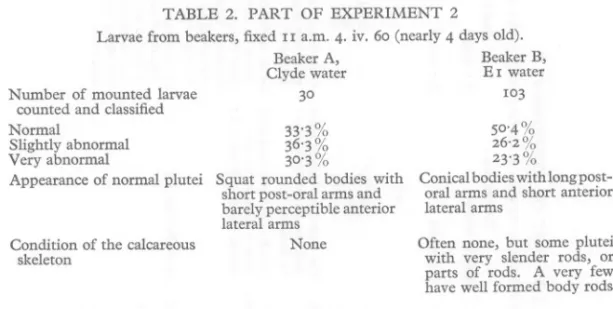
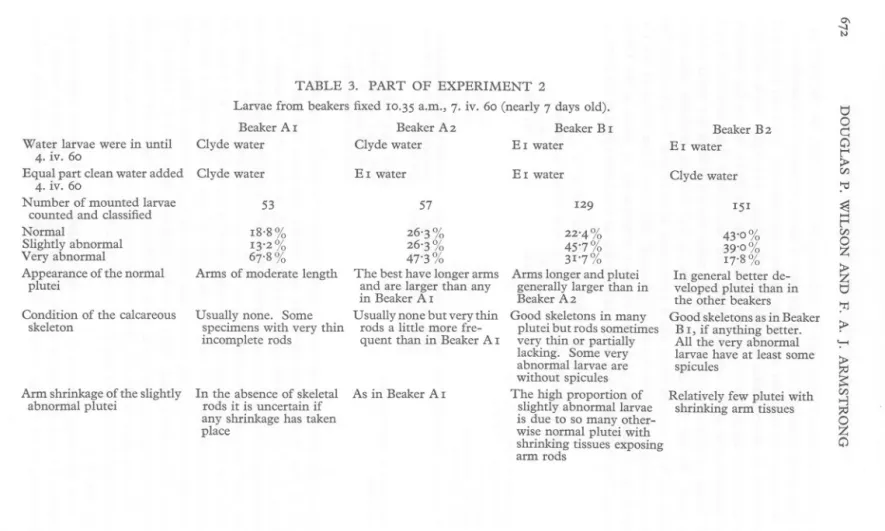
(9) BIOLOGICAL. DIFFERENCES. BETWEEN. SEA WATERS. 671. and that the volatile fractions were without noteworthy effect. By the third day so few larvae remained alive that this part of the experiment was abandoned. We return to consider the larvae in the wash-beakers. As usual these had been kept as controls after supplying the test dishes with eggs. Each still contained a very large number of eggs and so it was that from them a fair number of blastulae rose to the surface. These were poured into clean beakers (A and B, Table 2) with some of the water and more clean Clyde or E I water added to each. By the third day, 3 April 1960, it had become perfectly clear that whilst in both beakers there was a wide range of structural form between the most normal larvae and the most deformed, the best of the larvae in the E I water had longer arms and were superior structurally to those in the Clyde water. The difference was of the same order as had been apparent in Expt. 1. TABLE. 2. PART OF EXPERIMENT. 2. Larvae from beakers, fixed II a.m. 4. iv. 60 (nearly 4 days old). Beaker A, Beaker B, Clyde water E I water Number of mounted larvae 30 I03 counted and classified 5°'4% Normal 33'3% 26'2% Slightly abnormal 36'3% 23'3% 3°'3% Very abnormal Appearance of normal plutei Squat rounded bodies with Conical bodies with long postoral arms and short anterior short post-oral arms and lateral arms barely perceptible anterior lateral arms None Often none, but some plutei Condition of the calcareous with very slender rods, or skeleton parts of rods. A very few have well formed body rods. On 4 April 1960 the larvae were distinctly Clyde-type and E I-type respectively (PI. II, figs. A, B). Also the larvae were swimming more strongly in the E I water than in the Clyde where many had sunk to rest on the bottom. The swimming larvae of both vessels were poured off into clean beakers after some had been removed for preservation. Both lots were now divided equally to make four lots in all, two of Clyde water and larvae and two of E I water and larvae. To one beaker of each sort an equal volume of clean unused water of the same kind was added, to the other beaker an equal volume of clean unused water of the other kind. This gave the mixtures as set out in Table 3. It should be noted that as fewer larvae had been swimming in the Clyde water on this day than in the E I there were three or four times as many larvae in E I-derived beakers (B I and B2 in Table 3) than in the Clyde-derived beakers (AI and A2). Two mornings later, on 6 April 1960, there were no larvae swimming in beakers A I and A2, hardly any in beaker B I, but at least 20 in beaker B2. However, as all on the bottoms of the beakers were alive, all four beakers.
(10) 0\ -...). tv. TABLE. 3. PART OF EXPERIMENT. 2. tj. Larvae from beakers fixed 10.35 a.m" 7. iv. 60 (nearly 7 days old). Water larvae were in until 4. iv. 60 Equal part clean water added 4. iv. 60 Number of mounted larvae counted and classified Normal Slightly abnormal Very abnormal Appearance ofthe normal plutei Condition of the calcareous skeleton. Arm shrinkage of the slightly abnormal plutei. Beaker A I Clyde water. Beaker A 2 Clyde water. Beaker B I E I water. Beaker B2 EI water. Clyde water. EI water. EI water. Clyde water. o. eo r< >-. 53 18·8% 13'2% 67'8% Arms of moderate length. 57 26'3% 26'3% 47'3% The best have longer arms and are larger than any in Beaker AI. 129 22'4% 45'7% 31'7% Arms longer and plutei generally larger than in Beaker A2. 151 43'0% 39'0% 17'8% In general better developed plutei than in the other beakers Good skeletons as in Beaker B I, if anything better. All the very abnormal larvae have at least some spicules. Usually none. Some Usually none but very thin Good skeletons in many rods a little more freplutei but rods sometimes specimens with very thin incomplete rods quent than in Beaker A I very thin or partially lacking. Some very abnormal larvae are without spicules In the absence of skeletal As in Beaker A I The high proportion of Relatively few plutei with rods it is uncertain if slightly abnormal larvae shrinking arm tissues any shrinkage has taken is due to so many otherplace wise normal plutei with shrinking tissues exposing arm rods. [/). ;0. ~ •....•. r< [/). o. z >-. z tj ~ ?>. ':-' >:;>0. ~ [/) >-:l. o z o :;>0.
(11) BIOLOGICAL DIFFERENCES BETWEEN SEA WATERS. 673. were stirred up. In A I and A2 all except one or two larvae quickly sank down again but in B I a considerable number swam for some time, while in B 2 between 30 and 40 were still swimming well up late in the evening. The following day, 7 April 1960, there was no larva swimming above bottom in any beaker, though all were alive. It was observed that some of the plutei in beakers B I and B 2 had protruding arm rods; the living tissues were shrinking to expose them. Consequently all larvae were preserved at once. They were examined in alcohol immediately after preservation, and more thoroughly later after mounting. In Table 3 the main features of these larvae are compared; some of the preserved specimens are seen in PI. II, figs. A I, A2, B I and B2. There is revealed a series improving from the poorest larvae in beaker A I to the best and very much better larvae in beaker B 2. Again it is apparent that the E I water was superior to the water from the Clyde, but what is so striking is that the E I water was actually improved by the addition of Clyde water at a time when the larvae were 4 days old. The addition of E I water to Clyde water at the same larval age also affected improvement, though not to quite the same extent. This is the first time in the history of our experiments that a mixed water has proved superior to either of the components alone. It will, quite rightly, be objected that these results were obtained with relatively few larvae, themselves the survivors of a fertilization in which the majority of the eggs died, and moreover that there was only one test beaker for each kind of water. But it should be remembered that it is normal embryological practice to pour off swimming larvae from moribund eggs and subsequently to rear them through pelagic development, and that in our experiments when several dishes of the same sort have stood side by side it has been rare for anyone to vary to an appreciable extent. These considerations incline us to accept these results without at the present time being able to do more than guess at an interpretation. At the beginning of the experiment the room temperature was 14° C; within the first 24 h it rose to 17° C and fell to IS° C, thereafter varying slowly between 16'5° C and 13° C. EXPERIMENT. 3. The results of the first two experiments made it desirable to test new samples of waters from E I and from the Firth of Clyde. Circumstances however prevented water being got nearer than some miles from the E I position. Particulars of the waters are as follows. Outside water collected 20. iv. 60. Ship: M.V. 'Sula'. Position 5 miles east from Eddystone, approx. 50° II' N., 4° 8' W. Collected with polythene bucket and strained through 200-mesh bolting silk into glass carboy, all specially cleaned beforehand..
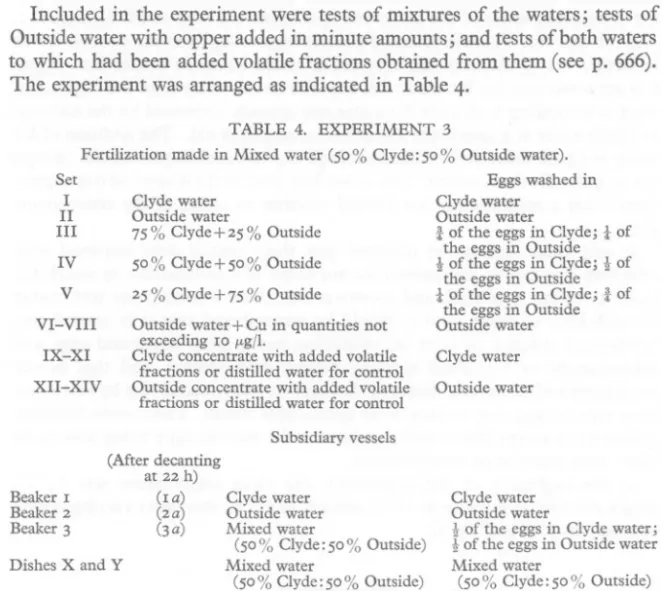
(12) DOUGLAS. P. WILSON. Salinity: 35'06%0' pH 8'03. 0'9. AND F. A. J. ARMSTRONG. Copper: before filtration 1'3. J-Lgjl.,. after filtration. J-Lgjl.. Clyde water collected 21. iv. 60, 10.50 a.m., using longboat.. Position mid-Largs Channel, approx. 55° 45' N., 4° 54' W. Tide i-ebb, light W. wind. Collected with polythene bucket and strained through 200-mesh bolting-silk into glass carboy, all specially cleaned beforehand. Salinity: 28'90%0' pH 8'17. Copper before filtration 4'2 J-Lgjl., after filtration 1'7 J-Lgjl. Although the water had been strained through bolting-silk there was a noticeable Skeletonema content in the water on arrival at Plymouth. This was removed by filtration.. Included in the experiment were tests of mixtures of the waters; tests of Outside water with copper added in minute amounts; and tests of both waters to which had been added volatile fractions obtained from them (see p. 666). The experiment was arranged as indicated in Table 4. TABLE. 4. EXPERIMENT. 3. Fertilization made in Mixed water (50% Clyde: 50% Outside water). Set I II III. Clyde water Outside water 75% Clyde+2S%. Outside. i. IV. so % Clyde + so % Outside. t. V. 2S% Clyde+7S%. t. VI-VIII. Outside. Outside water + Cu in quantities not exceeding 10 p.g/l. Clyde concentrate with added volatile fractions or distilled water for control Outside concentrate with added volatile fractions or distilled water for control. IX-XI XII-XIV. Eggs washed in Clyde water Outside water of the eggs in Clyde; the eggs in Outside of the eggs in Clyde; the eggs in Outside of the eggs in Clyde; the eggs in Outside Outside water. t of t of. i of. Clyde water Outside water. Subsidiary vessels (After decanting at 22 h) Beaker I Beaker 2 Beaker 3 Dishes X and Y. (I a). (2a) (3a). Clyde water Outside water Mixed water (so% Clyde:so% Mixed water (so% Clyde:so%. Outside) Outside). Clyde water Outside water of the eggs in Clyde water; of the eggs in Outside water Mixed water (so% Clyde:so% Outside). t. t. After 24 h the blastulae in dish X were divided and distributed into 2 dishes of Clyde water, 2 dishes of Outside water, 3 dishes of Mixed water (50% Clyde:so% Outside).. Great difficulty was experienced in obtaining sea-urchins, several days of collecting at sea procured less than 40, many small. They were opened on 27 April and were all found to be spent, or to have ova undergoing cytolysis. Five large sea-urchins from the aquarium, where they had been for several months, were next opened; four were male, one female and all fully mature. The female and one male were caused to spawn on beakers, both ova and.
(13) BIOLOGICAL DIFFERENCES BETWEEN SEA WATERS. 675. sperms were shed freely and seemed to be in perfect condition. Mter fertilization almost all eggs had well-raised fertilization membranes and the early cleavage stages, as far as the eight-cell stage, were regular and normal. The fertilization was made at 6.10 p.m., 27 April 1960, in a mixture of equal parts of the two waters; and it was into this same mixture that the urchins had been spawned. A dish (X) of this mixed water with eggs covering the bottom in a rather thick layer was set on one side, and a smaller dish (Y) with eggs in a thin layer was used to observe the development process during the first 3-4 h. A sufficient quantity of eggs was now divided equally between two beakers while still in the mixed water; as soon as this had been done one batch was washed in six changes of one kind of water, the other batch in six changes of the other water, all changes being completed before first cleavage. There followed the usual distribution to the test dishes, each receiving an equal quantity of eggs which scattered thinly over the bottom. Table 4 shows from which wash-water the various sets were supplied. The two wash-beakers were finally topped up with their respective kind of water and from them a third beaker was derived by mixing an equal quantity of water and eggs from both. These three beakers were to serve as additional controls. At 10 a.m. the next day it was found that almost all the eggs in all vessels with undiluted Outside water (Sets II, VI-VIII, XII-XIV, beaker 2) were dead and closer examination showed that they had in the later cleavage stages divided irregularly before dying. But there were some early blastulae apparently normal. In vessels with undiluted Clyde water (Sets I, IX-XI, beaker I) although there were fair numbers of living abnormal stages the majority were good-looking early blastulae beginning to move. In the mixed waters Sets III - V the proportion of abnormal stages was lower in Set III than in Set IV and highest in Set V, and was in rough accordance with the proportion of Outside water in the mixture. (It is important to note from Table 4 that the eggs were derived from the two wash waters in the same proportion.) In striking contrast dishes X and Y containing eggs which had been in mixed water continuously since fertilization had almost no abnormals; here nearly 100 % of the eggs had developed into perfect blastulae. These swam up slowly and when 24 h old those in dish X were distributed equally between three new dishes of mixed water, two dishes of Clyde water and two dishes of Outside water (see foot of Table 4). About 2 h earlier blastulae swimming near the surface in the three beakers (nos. 1-3 in Table 4) had been poured off into a second set of clean beakers (nos. Ia-3a in Table 4) which were then partially filled with more water of the kind appropriate to each. It should be noted that fewer swimming blastulae were obtained from the original Outside water beaker than from either of the other two. Because the death-rate in all dishes with Outside water was so high the tests with copper and with volatile fractions were inconclusive. They were also inconclusive for the tests with volatile fractions in the Clyde water.
(14) 676. DOUGLAS P. WILSON AND F. A. J. ARMSTRONG. because, as will be described below, larvae in Clyde water alone did not develop normally. The dishes of these sets are therefore of interest only in that their contained eggs and larvae behaved according to the source of the water, as they did in other vessels with water to which no additional substances had been added. But the further development of the blastulae from dish X and those decanted from the beakers is of interest; the former will be considered first. Some 16 h after transferring the blastulae from dish X to other dishes as described above, the swimming vigour of the gastrulae (which stage they had then reached) was markedly less in the two Outside water dishes than in the others, but no morphological differences were apparent. Such differences began to appear 24 h later at the prism or very early pluteus stage. In the mixed water these were more advanced with more prominent arm-buds than were any of those in the Clyde or Outside waters, although at this time there was little to choose in swimming vigour. On I May 1960, when 4 days old, the superiority of the larvae in the mixed water (all three dishes) was even more marked and they were again concentrating more to the surface than in the Clyde or Outside waters. The Clyde larvae were the worst with the shortest arms and the highest proportion of abnormals; the best of them resembled closely the' Clyde-type' of the preceding experiments. In the Outside water the best larvae resembled the 'E I-type'. The following day the larvae in the mixed water and in the Clyde water were nearly all dead. In the Outside water the larvae survived for another day or two, though all of them rapidly became very abnormal through loss of their arms. The blastulae decanted into clean beakers (nos. I a-3 a in Table 4) at 22 h now claim attention. Two days later, on 30 April 1960, at the prism stage, most of those in the Outside water were resting on, or swimming slowly over, the bottom with very few swimming in mid-water. In both Clyde and mixed waters more larvae were swimming well up above the bottom than lying on it. This difference in swimming vigour persisted for another day or so. On 2 May 1960 the Clyde larvae, now 5 days old, were almost all down on the bottom but in the mixed water fair numbers were still swimming well above and continued to do so through 6 May 1960 and some even as late as 9 May 1960. The morphological differences were even more striking. In the Clyde water the larvae never grew arms and had irregularly formed, sometimes few and very small skeletal spicules. In the Outside water there was better though generally abnormal development of the skeleton and the best larvae were more pluteus-like, though no normal pluteus could be found. In the mixed water, although there was a big proportion of abnormal larvae, which were partially or completely armless, there were many larvae with long arms and strong though often abnormal skeletons, and a few quite normal plutei were present. These differences are brought out clearly in the photographs of mounted 9 days old larvae (PI. III)..
(15) BIOLOGICAL DIFFERENCES BETWEEN SEA WATERS. 677. At the beginning of the experiment the room temperature was 17'5° C, it rose a degree and fell to 16° C in the first 24 h, thereafter varying slowly for several days between 15° and 18° C. DISCUSSION Our anticipation (p. 664) that the Clyde water would prove better than the water from E I was not fulfilled; on this occasion the reverse was true although neither water was particularly good, that is if we can assume that it was the waters and not the eggs which were to blame for the relatively few good plutei developing in any of the vessels, and for the early large mortalities in most dishes ofExpts. 2 and 3. That it was not the eggs is perhaps indicated by the experience with dishes X and Y of Expt. 3, where almost all eggs kept continuously in mixed water developed normally for a few days while those in either water alone did not (p, 675). None the less Expt. I shows very clearly that each water so influenced the development that a type of larva peculiar to it, structurally different from that in the other water, was produced. This occurred irrespective of copper concentration up to and beyond the maximum ever likely to be found in a natural sea water, and exceeding the highest figure given by Atkins (1953) for the Plymouth district. Moreover, whilst it is true that in the higher copper concentrations the larvae were distinctly stunted compared with those in lower concentrations (so confirming this aspect of Bougis's work) the differences were not of the same character, or as great, as they have been in past experiments when two waters of different origin have contrasted strongly (as in Expts.5 and 8, Wilson, 1951; Expt, I, Wilson & Armstrong, 1952; Expt. 7, Wilson & Armstrong, 1958). Our 1960 experiments therefore do not confirm Bougis's thesis in so far as it attempts to explain much of our earlier work, for our results show that differences between waters exist despite varying copper concentrations. Also, within the natural limits of such concentrations the effect of copper on Echinus larvae is less than that which we have sometimes observed a natural water (after filtration) to have. But we agree with Bougis that copper in amounts found in natural sea waters affects developing larval structure to a lesser degree, and it is conceivable that on occasions it could be responsible for less fundamental differences between sea waters than those which we have from time to time encountered. It is true that Bernhard (1957) working with Arbacia lingula showed a very marked difference between larvae of that species reared in water from the Gulf of Naples and in the same water after chelation. But as we have no direct comparison between the sensitivities to copper and other metallic ions of Arbacia larvae and those of Echinus esculentus it is not possible, for this and other reasons, to relate his observations directly to ours. Both Bernhard and Bougis worked with species of sea-urchin different from ours and both conducted their experiments in· manners not strictly.
(16) 678. DOUGLAS P. WILSON AND F. A. J. ARMSTRONG. comparable with our methods. They made no comparisons between water from one locality and water from an oceanographically different water mass. They often did not continue their experiments for as many days. We ourselves have repeatedly shown that almost any addition to a water, or treatment of a water, has some effect, mild or otherwise, on Echinus larvae reared in it, though this may not become apparent until some days have elapsed. Weare not surprised that addition of copper, or any other substance, to a water will alter its properties. So far the alteration has usually been in the direction of making a water worse. With us chelation has slightly worsened a water, though if our waters had been heavily contaminated with metallic ions it is possible that chelation would have affected some improvement, as Bernhard found with Naples water. (Unfortunately he does not give figures for copper or other metals in the natural water he collected for his work.) In fact chelation may only improve a water when there is heavy metallic contamination, for it will be remembered that in Expt. I (p. 668) the addition of a little extra copper to the E I water brought about a marked improvement, suggesting that the larvae benefit from the presence of a little copper in the water. Further experiments along these lines are desirable; the matter cannot on this one result be considered proved. The salinities of our waters were not known until after the experiments had been completed. In the first two experiments the salinity difference was not great and was closely similar to that in Expt. I of 1952 (Wilson & Armstrong, 1952, p. 338), where the larvae did so much better in the less saline Clyde water than in the salter E I water. There have been marked differences between larvae when the salinities of the compared waters have been very close (e.g. Expts. 3, 8A, B, Wilson, 1951). There have also been experiments with dissimilar salinities and no great differences between larvae (Expts. 1-3 and 5, Wilson & Armstrong, 1954). But never before have we used water with a salinity as low as that of the Clyde water in Expt. 3 of the present series. However, it was the E I water of normal salinity which in this experiment was so inimical to early larval development. We have no detailed observations of the effect of lowered salinity on the development of E. esculentus similar to those of Medes (1917) for Arbacia punctulata, but her results with the latter species would suggest that the lowered salinity of our Clyde water in Expt. 3 was not solely responsible for the armless, skeleton-less plutei it produced. We can find no evidence from all our past experiences that salinity within the range we have used can account for those major biological differences between sea waters which we have encountered. A striking feature of the 1960 experiments was the superiority of mixed water compared with either component alone. This was shown once in Expt. 2 and twice in different ways in Expt. 3. That it was not shown in Expt. I could be due to that experiment having been stopped at 4 days, because except in dishes X and Y of Expt. 3, where eggs had been kept con-.
(17) BIOLOGICAL DIFFERENCES BETWEEN SEA WATERS. 679. tinuously in mixed water and not at any stage put into either component alone, the phenomenon did not appear until after 4 days. Never before in our experience has a mixed water proved superior to either alone. It has been usual for a mixed water to be better than the worst component, and sometimes nearly as good as the better component. Several possible explanations of these phenomena spring to mind, but in the present state of our knowledge there is little to be gained by speculation; we prefer at the present time to record our observations without attempting to account for them. To us it would seem that these observations, taken in conjunction with those of previous years, show that the whole subject is much more complex than previously thought, and that it is unlikely that one simple factor (such as copper concentration, bacteria, or the relative availability of one single compound needed for normal larval growth) will explain everything. It may well be that a number of factors are operative, sometimes one or more, sometimes others, varying from time to time and place to place. We must look not for one explanation but for many, and the task of tracking these down is likely to prove tedious and timeconsuming. What cannot be denied is that waters are different, even if those differences show up only in laboratory experiments, although it would seem reasonable to conclude that they must also have their effects in the sea itself. In another respect the 1960 experiments are of interest; they show once again that eggs can be affected by the water they are in between fertilization and first cleavage, when this water differs from that in which they subsequently develop. This was brought out in Expt. 3 with mixtures (see Table IV, Sets III-V), bearing in mind the manner of washing of the contained eggs, and also in the same Expt. with dishes X and Y. These experiences support similar observations in 1954 and 1955 (Wilson & Armstrong, 1958) using surface and deep waters collected at E I. SUMMARY. Sea water from the Plymouth district and sea water from the Firth of Clyde each produced, from the same batches of fertilized eggs of Echinus esculentus, a different morphological type of larva. Each type was clearly recognizable irrespective of the copper concentration up to a level higher than that ever likely to be found naturally in the localities from which sea waters contrasted in earlier experiments had been obtained. Suggestions by continental workers that these earlier results may have been due to varying copper concentration are thus shown to be inapplicable. At higher levels of copper concentration larvae are stunted in their growth. Chelation of the two waters slightly worsened them, confirming our earlier observations on the effect of this treatment. In one of the waters to which a little extra copper had been added markedly improved larvae were obtained; this in conjunction with the effects of chelation 43. JOURN. MAR. BIOL. ASSOC. VOL. 41,. 1961.
(18) 680. DOUGLAS P. WILSON AND F. A. J. ARMSTRONG. suggests that copper in small amount is beneficial. This point requires further investigation. On three occasions much better larvae were obtained in mixtures of the two waters than in either water alone. Skeletal development was enhanced. It was again found that subsequent development can be affected by the water the eggs are in between fertilization and first cleavage. In conclusion it seems unlikely that one simple factor is responsible for biological differences between sea waters whenever and wherever they occur. It may be that a number of factors are operative, varying with time and place. The whole subject is probably more complex than previously thought. REFERENCES ARMSTRONG, F. A. J. & BOALCH,G. T., 1960. Volatile organic matter in algal culture media and sea water. Nature, Lond., Vol. 185, pp. 761-2. ATKINS,W. R. G., 1953. The seasonal variation in the copper content of sea water. J. mar. bioI. Ass. U.K., Vol. 31, pp. 493-4. BARNES,H., 1959. Apparatus and Methods of Oceanography. Part I: Chemical. London: Allen and Unwin. BERNHARD, M., 1957. Die Kultur von Seeigellarven (Arbacia lixula L.) in kiinstlichem und natiirlichem Meerwasser mit Hilfe von lonenaustauschsubstanzen und Komplexbildnern. Publ. Sta. zool. Napoli, Vol. 29, pp. 8Q-95. BOUGIS,P., 1959. Sur l'effet biologique du cuivre en eau de mer. C.R. Acad. Sci., Paris, T. 249, pp. 326-8. LUCAS,C. E., 1955. External metabolites in the sea. Deep Sea Res., Vol. 3 (Suppl.), PP·139-48. MEDES,G., 1917. A study of the causes and the extent of variations in the larvae of Arbacia punctulata. J. Morph., Vol. 30, pp. 317-432 .. RILEY, J. P. & SINHASENI,P., 1958. The determination of copper in sea water, silicate rocks and biological materials. Analyst, Vol. 83, pp. 299-304. WILSON,D. P., 1951. A biological difference between natural sea waters. J. mar. bioI. Ass. U.K., Vol. 30, pp. 1-26. WILSON,D. P. & ARMSTRONG, F. A. J., 1952. Further experiments on biological differences between natural sea waters. J. mar. bioI. Ass. U.K., Vol. 31, pp. 335-49· --1954. Biological differences between sea waters: experiments in 1953. J. mar. bioI. Ass. U.K., Vol. 33, pp. 347-60. --1958. Biological differences between sea waters: experiments in 1954 and 1955. J. mar. bioI. Ass. U.K., Vol. 37, pp. 331-48..
(19) J.. MAR. BIOL.. Ass. U.K.,. 41. (3). WILSON. & ARMSTRONG.. PLATE. (Facing p. 680). I.
(20) J. MAR.. BIOL.. Ass. UK., 41 (3). WILSON. &. ARMSTRONG.. PLATE. II.
(21) J.. MAR. BIOL.. Ass. UK., 41 (3). WILSON & ARMSTRONG.. PLATE. III.
(22) BIOLOGICAL. DIFFERENCES EXPLANATION. BETWEEN. SEA WATERS. 68I. OF PLATES. (All photographs are of larvae fixed and preserved in alcohol and mounted unstained in EuparaI. Photographed under dark-ground illumination. In order to save space several photographs have been combined by montage in each figure, but this has not involved any selection of good or bad larvae.) PLATEI Larvae from Expt. I. Fixed between IO and IO.30 a.m., 26. iii. 60 (see p. 668). Magnification, x 3S. Fig. Fig. Fig. Fig. Fig. Fig. Fig. Fig.. I. 2. 3. 4. S. 6. 7. 8.. Larvae Larvae Larvae Larvae Larvae Larvae Larvae Larvae. from from from from from from from from. Set Set Set Set Set Set Set Set. I. Clyde water; Cu, I'S /Jog/I. II. E I water; Cu, 0,6 /Jog/I. IV. Clyde water, chelated. V. E I water, chelated. VIII. Clyde water; Cu increased to 20 /Jog/I. XI. E I water; Cu increased to 20 /Jog/I. XIII. E I water; Cu increased to I'S /Jog/I. XIV. Western water; Cu, 0,8 /Jog/I. PLATEII. Larvae from Expt. 2, beakers (see pp. 67I-673 and Tables 2 and 3). Magnification, x 60. Fig. Fig. Fig. Fig. Fig. Fig.. A. Larvae from beaker A, Clyde water. Fixed II a.m. 4. iv. 60. B. Larvae from beaker B, E I water. Fixed II a.m. 4. iv. 60. A I. Larvae from beaker A I, Clyde water + Clyde water. Fixed IO.40 a.m. 7. iv. 60. A 2. Larvae from beaker A 2, Clyde water + E I water. Fixed IO.37 a.m. 7. iv. 60. B I. Larvae from beaker B I, E I water + E I water, Fixed IO.33 a.m. 7. iv. 60. B 2. Larvae from beaker B 2, E I water + Clyde water. Fixed IO.30 a.m. 7. iv. 60. PLATEIII Larvae from Expt. 3, beakers. Fixed 3.20 p.m. 6. v. 60 (see p. 676 and Table 4). Magnification x 60.. Fig. I. Fig. 2. (N.H. Fig. 3.. Larvae from beaker I a. Clyde water. Larvae from beaker 2 a. Outside water. Beaker 2a contained fewer larvae than either of the other two. See p. 675). Larvae from beaker 3 a. Mixed water.. 43-2.
(23)
Figure
Related documents
Results suggest that the probability of under-educated employment is higher among low skilled recent migrants and that the over-education risk is higher among high skilled
Assessing the Impact of Biodiversity Conservation in the Management of Maize Stalk Borer (Busseola f
Field experiments were conducted at Ebonyi State University Research Farm during 2009 and 2010 farming seasons to evaluate the effect of intercropping maize with
In practice, it is likely that the desired and interfering signals will arrive from many differ- ent directions, and therefore the actual beam pattern on the right side of Fig. 2a
Tutor-led classroom activity – discuss different types of shampoo and conditioning products available for different hair and scalp types.. How shampoo works on the hair with the pH of
Second, managers can develop chatbot service monitor programs by using the incident sorting process established by this study (Figure 2), which could be a useful tool to
The impact on the water body should, except for turbidity, not differ substantially from the part of the catchment upstream of the Klerkskraal Dam; ii Extend the Lower
Anti-oxidant potential was evaluated by free radical scavenging activity on DPPH and in vitro anti- inflammation activity of the selected samples stood determined
Current option ´Download configuration’ allows users to download the latest configuration for Mobisma nextG client directly to the smartphone using WIFI/GPRS/3G. It is important
