CONVENIENT ROUTE FOR STUDYING REACTIVITY OF
ISOTHIOCYANATES TOWARDS BARBITURYL
ISOTHIOCARBAMIDE
Madhuri M. Sontakke,
[a]Baliram N. Berad,
[a]Chandrakant S. Bhaskar,
[b]and
Madhukar G. Dhonde
[c]*Keywords: Barbituryl isothiocarbamide; alkyl isothiocyanates; aryl isothiocyanates, barbituryl isodithiobiurets
The simple protocol for the synthesis of barbituryl isodithiobiurets without any catalyst has been developed. The reactivity of alkyl or aryl isothiocyanates towards barbituryl isothiocarbamide has been studied. The differentreactivity, insolubility and high stability are output of our novel synthesized barbituryl isodithiobiurets. The mild reaction conditions, easy product workup and excellent yields, are the major advantages of present protocol.
Corresponding Authors
E-Mail: [email protected]
[a] Department of Chemistry, RTM, Nagpur University, Nagpur(MS), India – 440033.
[b] Department of Chemistry, Art’s, Commerce & Science College, Koradi (MS), India – 441111.
[c] Department of Chemistry, Shri Mathuradas Mohota college of Science, Nagpur(MS), India – 440009. Fax-+91-712-2744992
INTRODUCTION
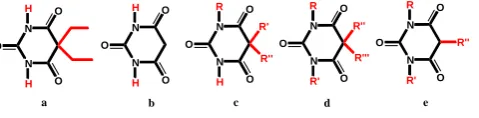
A large class of barbiturate drugs which are used as hypnotics, sedatives, anticonvulsants, anesthetics, as central nervous system depressants and also have industrial applications.1-6 In 1903 Fischer and Von Mering synthesized the first therapeutically active derivative of barbiturates by replacing the C-5 hydrogens of the barbituric acid ring with ethyl substituents, upon administration of this new barbiturate derivative, human subjects fell into a state of hypnosis or deep sleep, this new diethyl barbiturate, commonly called Veronal (Fig. 1a).7,8
The barbiturate moiety show a wide spectrum of medicinal activities including treat anxiety, insomnia, seizure disorders, migraine headaches and use in surgery as general anesthetics (Fig 1b).9 All of the barbiturate derivatives which have been reported to have pronounced hypnotic activity are disubstituted in 5-position. While the 5,5’-dialkyl barbituric acids are the hypnotics most commonly encountered, certain 1,5,5’-trialkyl derivatives (Fig. 1c) are active, producing narcosis of short duration. Some 1,3,5,5’-tetraalkyl derivatives (Fig. 1d) produce a hypnotic action of very transient character. The study of a series of 1,3,5-trialkyl barbituric acids (Fig. 1e), which was undertaken to determine whether such compounds have hypnotic activity comparable to their 1,5,5’-isomers or are inactive like the 5-monoalkyl and 1,5-dialkyl barbituric acids.10 The synthetic protocol of mono C-alkylation and mono C-benzylation of barbiturate intermediates has been developed.11
A variety organic isothiocyanates are good building block moiety used as precursor in many organic transformations. 12-14 Highly electrophilic centre carbon atom of NCS group
reacts rapidly, and under mild conditions with oxygen, sulfur or nitrogen centered nucleophiles to give rise to carbamates, thiocarbamides or thiourea derivatives respectively. Organic isothiocyanates have shown excellent and tremendous diverse biological, medicinal, pharmaceutical and other valuable properties such as goitrogenic, bacterial, fungal, protozoal, anti-carcinogenic15 inhibitory effects upon soil nitrification16 and bio-conjugate activities.17-18
Literature review uncovered that there is no direct C-S coupled barbituric acids. But the -position of side chain of barbituric acid has been substituted with sulphur using 5-n-amyl-5-(bromoethyl)-barbituric acid with potassium ethyl xanthate. The resulting products on pharmacological screening tests indicated that, such compounds are not suitable for anesthetia or hypnosis. 19 The same reaction protocol of the C-S bond formation products at position has been extended to include the potassium thiocyanate and isothiouronium salts but did not give products with anticonvulsant action by the electrical method. 20
Owing to the simplicity of the desired starting material, barbituryl isothiocarbamide (2) was prepared by simple reaction of monobromobarbituric acid 21 and thiourea by employing a well-known literature method. 22 In continuation we are reporting first time the synthesis of barbituryl isodithiobiurets by involving the barbituryl isothiocarbamide and alkyl/aryl isothiocyanates, these may prove important intermediate if investigated thoroughly (Scheme 1).
Figure 1. Barbiturates
N
N O
O
O
H
H
N
N O
O
O
H
H
N
N O
O
O
R'
R'' R
H
N
N O
O
O
R''
R''' R
R'
N
N O
O
O
R'' R
R'
b
DOI: 10.17628/ECB.2014.3.372
Scheme 1. Reactivity of alkyl/aryl isothiocyanates with barbituryl isothiocarbamide
EXPERIMENTAL
Synthesis of S-(2,4,6-trioxohexahydropyrimidin-5-yl)-1-(H)-5-aryl-2,4-isodithiobiurets (16-28)
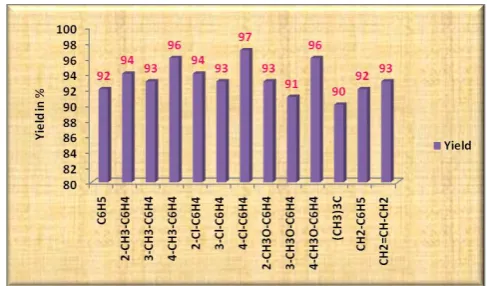
A mixture of 2-(2,4,6-trioxo-hexahydropyrimidin-5-yl) isothiourea (2, 2.5 mmol), alkyl/aryl isothiocyanate (3-15, 2.5 mmol), was stirred in DMF (20 mL) at 60 0C for 2.5 h till the consumption of starting material took place to afford a solid products (16-28). The progress of reaction was monitored by TLC. After completion of the reaction, crude products were filtered and further purified by recrystallization. The products were desulphurised by alkaline plumbite solution showing positive test of C=S grouping (Table 1 and Graph 1). The newly synthesized compounds were characterized by IR, 1H NMR, 13C NMR and HRMS studies.
Table 1. Synthesis of barbituryl isodithiobiurets via unlike reactivity of isothiocyanates
2, mmol
3-15, mmol
Ar Time, h
16-28 Yield,a
%
2.5 3 (2.5) C6H5 2.5 16 92
3.9 4 (3.9) 2-CH3-C6H4 2.0 17 94
3.9 5 (3.9) 3-CH3-C6H4 3.0 18 93
3.9 6 (3.9) 4-CH3-C6H4 2.0 19 96
3.9 7 (3.9) 2-Cl-C6H4 2.0 20 94
3.9 8 (3.9) 3-Cl-C6H4 3.5 21 93
3.9 9 (3.9) 4-Cl-C6H4 2.5 22 97
3.9 10 (3.9) 2-CH3OC6H4 2.5 23 93
3.9 11 (3.9) 3-CH3OC6H4 3.0 24 91
3.9 12 (3.9) 4-CH3OC6H4 2.5 25 96
3.9 13 (3.9) (CH3)3C 3.5 26 90
4.9 14 (4.9) CH2-C6H5 3.0 27 92
4.9 15 (4.9) CH2=CHCH2 3.5 28 93
a isolated yield
We have synthesized thirteen title compounds and characterized them on the basis of spectral analysis like, IR, 1H, 13C NMR and HRMS.
Graph 1. Isolated yields of the prepared compounds
Graph 2. Yield of compound 16 and 19 as the function of reaction time in different solvents
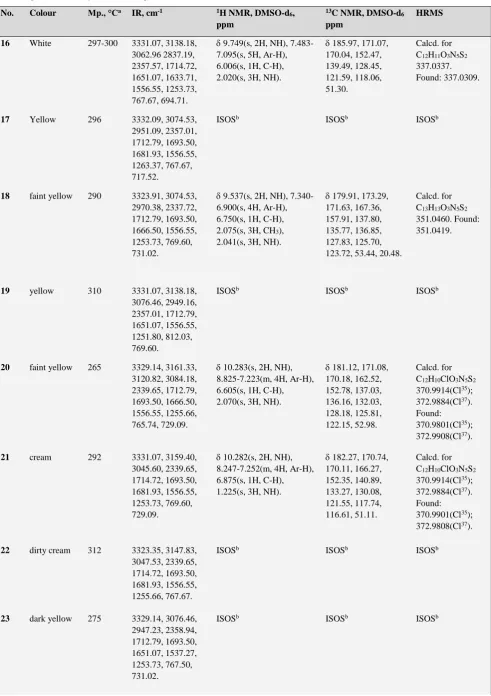
Few of them were insoluble in most of the organic solvents. Title compounds 16, 18, 20, 21 and 25 are soluble only in DMSO and rest of them including 17, 19, 22-24 and
26-28 are not soluble in suitable organic solvents, therefore
we have provided the spectral data like IR, 1H, 13C NMR and HRMS of these title compounds but for rest of them only IR spectra have been given (Table 2).
RESULTS AND DISCUSION
The starting material barbituryl isothiocarbamide was prepared by the simple substitution reaction of monobromobarbituric acid with thiourea in water medium to produce C-S bond formation products. The nuclophilic addition reaction of barbituryl isothiocarbamide with aryl/alkyl isothiocyanates were carried out in DMF medium at 60 0C without any catalyst, not as much of required time for completion of reaction to accessible excellent yields.
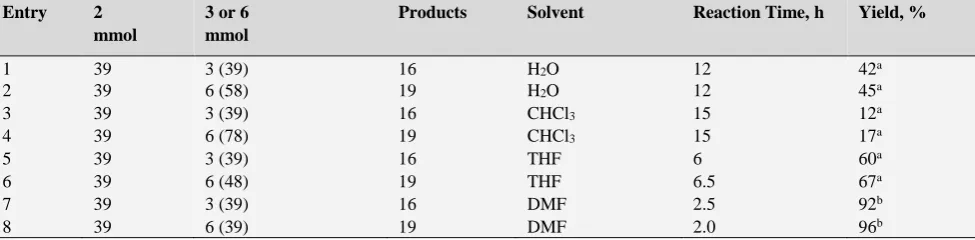
During initial exploratory nucleophilic addition reaction of barbituryl isothiocarbamide (2) and aryl/alkyl isothiocyanates (3-15) were investigated to establish the feasibility of our strategy and to optimize the reaction conditions without any catalyst. It is further revealed that, when we have taken same proportion of reactant (2), and interacted with variable proportion of reactants (3 and 6) using four different solvents, but best result of C-N coupled products (16 and 19) were observed in DMF medium at 60 0C within very short period of time for completion of the
reactions (Table 3 and Graph 2). N
N
O O
O H
H
S
present work
NH NH2 N
N O
O
O H
H
H
H H
Stirring in DMF at 600
C
2.0-3.5 h (3-15)
N N O
O
O H
H
Br
H
1
Br2
in Water
H2N
S NH2
in Water
Ref.15
Ar N C S 2
N N
O O
O H
H S
NH
H N
(16-28) S
H N Ar
Ref.14
Table 2. Spectral data of synthesized compounds (16-28).
No. Colour Mp., °Ca IR, cm-1 1H NMR, DMSO-d 6,
ppm
13C NMR, DMSO-d 6
ppm
HRMS
16 White 297-300 3331.07, 3138.18, 3062.96 2837.19, 2357.57, 1714.72, 1651.07, 1633.71, 1556.55, 1253.73, 767.67, 694.71.
9.749(s, 2H, NH), 7.483-7.095(s, 5H, Ar-H), 6.006(s, 1H, C-H), 2.020(s, 3H, NH).
185.97, 171.07, 170.04, 152.47, 139.49, 128.45, 121.59, 118.06, 51.30.
Calcd. for C12H11O3N5S2
337.0337. Found: 337.0309.
17 Yellow 296 3332.09, 3074.53, 2951.09, 2357.01, 1712.79, 1693.50, 1681.93, 1556.55, 1263.37, 767.67, 717.52.
ISOSb ISOSb ISOSb
18 faint yellow 290 3323.91, 3074.53, 2970.38, 2337.72, 1712.79, 1693.50, 1666.50, 1556.55, 1253.73, 769.60, 731.02.
9.537(s, 2H, NH), 7.340-6.900(s, 4H, Ar-H), 6.750(s, 1H, C-H), 2.075(s, 3H, CH3),
2.041(s, 3H, NH).
179.91, 173.29, 171.63, 167.36, 157.91, 137.80, 135.77, 136.85, 127.83, 125.70, 123.72, 53.44, 20.48.
Calcd. for C13H13O3N5S2
351.0460. Found: 351.0419.
19 yellow 310 3331.07, 3138.18, 3076.46, 2949.16, 2357.01, 1712.79, 1651.07, 1556.55, 1251.80, 812.03, 769.60.
ISOSb ISOSb ISOSb
20 faint yellow 265 3329.14, 3161.33, 3120.82, 3084.18, 2339.65, 1712.79, 1693.50, 1666.50, 1556.55, 1255.66, 765.74, 729.09.
10.283(s, 2H, NH), 8.825-7.223(m, 4H, Ar-H), 6.605(s, 1H, C-H), 2.070(s, 3H, NH).
181.12, 171.08, 170.18, 162.52, 152.78, 137.03, 136.16, 132.03, 128.18, 125.81, 122.15, 52.98.
Calcd. for C12H10ClO3N5S2
370.9914(Cl35);
372.9884(Cl37).
Found: 370.9801(Cl35);
372.9908(Cl37).
21 cream 292 3331.07, 3159.40, 3045.60, 2339.65, 1714.72, 1693.50, 1681.93, 1556.55, 1253.73, 769.60, 729.09.
10.282(s, 2H, NH), 8.247-7.252(m, 4H, Ar-H), 6.875(s, 1H, C-H), 1.225(s, 3H, NH).
182.27, 170.74, 170.11, 166.27, 152.35, 140.89, 133.27, 130.08, 121.55, 117.74, 116.61, 51.11.
Calcd. for C12H10ClO3N5S2
370.9914(Cl35);
372.9884(Cl37).
Found: 370.9901(Cl35);
372.9808(Cl37).
22 dirty cream 312 3323.35, 3147.83, 3047.53, 2339.65, 1714.72, 1693.50, 1681.93, 1556.55, 1255.66, 767.67.
ISOSb ISOSb ISOSb
23 dark yellow 275 3329.14, 3076.46, 2947.23, 2358.94, 1712.79, 1693.50, 1651.07, 1537.27, 1253.73, 767.50, 731.02.
DOI: 10.17628/ECB.2014.3.372
Cont. of Table 2.
24 faint yellow 305 3329.14, 3076.46, 2947.23, 2358.94, 1712.79, 1693.50, 1651.07, 1556.55, 1253.73, 767.50, 731.02.
ISOSb ISOSb ISOSb
25 light cream 311 3331.07, 3138.18, 3074.53, 2949.16, 2337.72, 1712.79, 1693.50, 1666.50, 1556.55, 1251.80, 827.46, 769.60
9.4094(s, 2H, NH), 7.2128-7.1945(d, 2H, J= 7.3Hz, Ar-H), 6.8265-6.8090(d, 2H, J= 7.0Hz, Ar-H), 6.5743(s, 1H, C-H), 3.7119(s, 3H, ArOCH3),
2.080(s, 3H, NH).
182.22, 170.92, 170.20, 166.28, 154.27, 149.74, 132.85, 127.35, 119.82, 113.78, 55.04, 49.49.
Calcd. for C13H13O4N5S2
367.0409. Found: 367.0397
26 pink 307 3331.07, 3074.53, 2951.09, 2358.94, 1714.72, 1693.50, 1651.07, 1556.55, 1255.66, 769.50.
ISOSb ISOSb ISOSb
27 dark yellow 269 3331.07, 3074.53, 2951.09, 2843.07, 2339.65, 1714.72, 1693.50, 1651.07, 1556.55, 1255.66, 767.67, 729.09.
ISOSb ISOSb ISOSb
28 dirty cream 302 3329.14, 3138.18, 2949.16, 2841.15, 2339.65, 1712.79, 1554.68, 1253.73, 910.60, 769.60.
ISOSb ISOSb ISOSb
aCompounds decomposed at particular temperature; b 1H, 13C NMR and HRMs data not given due to insolubility of compounds in organic
solvents. (ISOS- Insolubility in Organic Solvents)
Table 3. Optimization of reaction conditions.
Entry 2 mmol
3 or 6 mmol
Products Solvent Reaction Time, h Yield, %
1 39 3 (39) 16 H2O 12 42a
2 39 6 (58) 19 H2O 12 45a
3 39 3 (39) 16 CHCl3 15 12a
4 39 6 (78) 19 CHCl3 15 17a
5 39 3 (39) 16 THF 6 60a
6 39 6 (48) 19 THF 6.5 67a
7 39 3 (39) 16 DMF 2.5 92b
8 39 6 (39) 19 DMF 2.0 96b
a Reaction under reflux; bReaction under stirring at 60 0C
For optimization, we have taken same fraction of reactant (2), and interacted with inconsistent quantity of reactants (3 and 6) using various solvents like chloroform, tetrahydrofuran and DMF to yield products respectively in
is more polar than THF, yields and requisite time for completion of reactions were unlike. Therefore it has been further cleared that, the polarity of solvent has no role to play for completion of reactions.
CONCLUSION
The synthesis of barbituryl isodithiobiurets presents real challenge for C-N bond formation due to the simple nucleophilic addition of alkyl/ aryl isothiocyanates, stirring in DMF at 60 0C. Therefore, we believe that present protocol for the synthesis of selective and structurally diverse C-N bond formation in DMF medium without any catalyst as a very efficient, simple, high yielding methodology to yield products with high melting points and high stability.
ACKNOWLEGEMENT
The authors are thankful to Shri Shivaji Science College, Akola, Indian Institute of Science, Bangalore and SAIF Chandigarh for recording the IR, NMR and Mass spectra. Thanks are due to Head, Department of Chemistry; RTM Nagpur University, Nagpur for providing necessary facilities.
REFERENCES
1Wolff, M. E., Burger’s Medicinal Chemistry and Drug Discovery,
Wiley, New York, 1997.
2Oliva, A., Zimmermann, G., Krell, H. W., International Patent
WO 98/58925.
3Gleason, M., Gosselin, R. Eds., Clinical Toxicology of
Commercial Products, Williams & Wilkins Co, Baltimore,
MA, 1963, 26-27.
4Acheson, R. Introduction to the Chemistry of Hetero-Cyclic
Compounds, Interscience Publishers, New York, 1967,
339-42.
5Brown, D.; Evans, R.; Batterham, T. The Pyrimidines Supplement
I, Wiley Interscience, New York, 1970, 199-201.
6Zhou, W.; Kurth, M. J., Polymer, 2000, 42, 345.
7Neumann, D. The design and synthesis of novel barbiturates of
pharmaceutical interest, University of New Orleans, Thesis
and Dissertations, paper 2004, 1040.
8Goth, A., Medicinal Pharmacology principles and concept, 4th ed.,
C.V. Mosby Co., St. Louis, MO. 1968.
9Olin, B. R.; Ed.; Central Nervous system Drugs, Sedatives and Hypnotics, Barbiturates. In Fact and Comparisons Drug
Information. St. Louis, MO: Facts and Comparisons, 1993,
1398-1413.
10Cope, A. C.; Dorothea, H.; Dorothea, P.; Eide, C.; Arroyo, A., J.
Am. Chem. Soc., 1941, 63, 356-58.
11Jursic, B. S., Stevens, E. D., Tetrahedron Lett. 2003, 44, 2203-10.
12Sakai, S., Fujinami, T., Aizawa T., Bull. Chem. Soc. Japan, 1975,
48(10), 2981-82.
13Lewellyn, M. E., Wang, S. S., Strydom, P. J., J. Org. Chem.
1990, 55, 5230-31.
14Spirkova, K., Bucko, M., Stankovsky, S., ARKIVOC, 2005, v,
96-102.
15Yuesheng, Z., Paul, T., Cancer Res. Suppl. 1994, 54,
1976s-1981s.
16Kinoshita, Y., Matsuda, N., Sakai, S., Oshima, Y., Harada,
T.,Nishihara, T., Agric. Biol. Chem. 1966, 30(5), 447-51.
17Patai, S. Ed.; For a generally review on isothiocyanates and thioureas, see: the chemistry of cyanates and their thio
derivatives; Wiley: Chichester, 1977.
18Fernandez, J. M. G., Mellet, C. O., Blanco, J. C. J., Moto, J. F.,
Gadelle, A., Coste S. A., Defaye, J., Carbohydr. Res.1995,
268, 57-71.
19Glenn, S. S., John, B. B., J. Am. Chem. Soc., 1950, 72, 1140-41.
20Glenn, S. S., William, H. W., J. Am. Chem. Soc., 1952, 74,
498-99.
21Robert, B., Steven, J. C., Stephen, F., Doug, H., Gordo, S., David,
T., Synth. Commun. 1996, 26(22), 4195-209.
22Sontakke, M. M., Jichkar, A. A., Dhonde, M. G., Bhaskar, C. S.,
Berad, B. N., Synth. Commun., 2014, 44, 340-345.