Available online throug
ISSN 2229 – 5046
STABILITY OF MHD DEAN FLOW WITH RADIAL HEATING
RUDRA KANTA DEKA*
1, RUBUL DUTTA
2Department of Mathematics,
Gauhati University, Guwahati-781014, Assam, India.
(Received On: 21-09-15; Revised & Accepted On: 26-10-15)
ABSTRACT
I
n this paper we have presented a linear instability analysis on the effect of axial magnetic field on the Dean flow between two narrow spaced concentric circular cylinders. It is observed that when the temperature of the inner cylinder is more than the outer cylinder, the flow is stable. The non-conducting walls are found to be more destabilizing than the perfectly conducting walls.Keyword: Dean flow, axial magnetic field, radial heating.
NOMENCLATURE
a Dimensionless wave number ac Critical wave number
d Gap width between the cylinders N Temperature gradient parameter Pr Prandtl number
Pm Magnetic Prandtl number
Re Reynolds number
R1 Radius of the inner cylinder R2 Radius of the outer cylinder
S Sum of fluid pressure and magnetic pressure T Temperature of the fluid
T1 Temperature of the inner cylinder T2 Temperature of the outer cylinder
V velocity in the azimuthal direction in the basic state Vm average azimuthal velocity
ur, uθ, uz Fluid velocities in r, θ and z directions
Hr, Hθ, Hz Magnetic field strength in r, θ and z directions λ Axial wave length
σ Growth rate ρ Fluid density ν Kinematic viscosity
α Thermal diffusivity of the fluid e Magnetic diffusivity
µe Magnetic permeability
Q Hartmann number
x Non-dimensional radial distance
η Ratio of the radii
θ Non-dimensional temperature
Λ Dean number
Λc Critical Dean number
Corresponding Author: Rudra Kanta Deka*
1, Department of Mathematics,
© 2015, IJMA. All Rights Reserved 164
1. INTRODUCTION
Dean [1]and Reid [2] investigated the flow instability in a curved channel formed by two concentric circular cylinders, when the space between the cylinders is small and the disturbance is axisymmetric. The fluid is driven by a constant azimuthal pressure gradient around the circumference of the annulus. This is known as the ‘Dean flow’ in the literature. Gibson and Cook [3] analyzed the instability of this flow with respect to both axisymmetric and asymmetric disturbances in an annulus for both finite and narrow gap widths.
Chandrasekhar [4] investigated the influence of a uniform axial magnetic field on the flow instability between two concentric circular cylinders, with axisymmetric disturbance in a narrow gap. Recently, Mahapatra et al. [5] studied the inhibition of magnetic field on the stability of Dean flow for axisymmetric disturbance with arbitrary gap width. They also determined the asymptotic behavior of the critical wave number and Dean number for large Hartmann number, when the walls of the cylinders are non-conducting.
The effect of radial temperature gradient on the flow instability has been studied by many researchers on the Couette flow between circular cylinders in the presence or absence of axial magnetic field. For example, Takhar et al. [6] studied the flow instability of Taylor-Couette flow between rotating cylinders in presence of both axial magnetic field and radial temperature gradient. Ali et al. [7] presented the effect of radial temperature gradient on the Dean flow for narrow gap limit, while Deka and Paul [8] studied for permeable cylinders in presence of constant heat flux at the inner cylinder.
However, the effect of the radial temperature gradient on the stability of the hydromagnetic Dean flow in presence of axial magnetic field is limited in the literature. Recently, Dholey [9] studied the hydromagnetic Dean flow in a wide gap with radial heating for conducting cylinders. Finite difference method was applied to find the critical values at the onset of instability. Walowit et al. [10] studied the isothermal Dean flow for non-magnetic case and obtained the critical values at the onset of instability by Galerkin method. Their results are within 1% of Chandrasekhar’s [4] result. Also, Ali et al. [7] applied finite difference method and obtained critical values with similar error. Here we present a linear instability analysis on the effect of uniform axial magnetic field on the Dean flow in a narrow gap for axisymmetric disturbance. We shall determine the critical values by Harris and Reid [11] method and present the subsequent discussion for both conducting and non-conducting cylinders.
2. LINEAR STABILITY EQUATIONS
Let r, θ and z denote the usual cylindrical polar coordinates, and let ur, uθ, uz and Hr, Hθ, Hz denote the components of
velocity and magnetic field intensity, respectively. We consider two infinitely long concentric circular stationary cylinders with radius R1 (inner cylinder), R2 (outer cylinder). The cylinders are kept at two different temperatures T1 (inner cylinder) and T2 (outer cylinder) with the z-axis as their common axis. Note that the annulus is partially filled with the liquid with a partition in the annulus at the air-liquid interface to maintain the constant azimuthal pressure gradient, (∂P/∂θ)0.
The equations of motion and energy equation for an incompressible, viscous electrical conducting fluid in the presence of a uniform magnetic field in the axial direction admit of steady solution as,
0
2 1
2
1 2 2
1
0, 0, ( ) ln
2
0, constant
ln ln( / )
r z
r z
P D
u u u V r r r Cr
r
H H H H
T T r
T T
R R R
θ θ ρν θ ∂ = = = = ∂ + + = = = = − = − (1) with (2)
The pressure distribution given by, (∂S/∂r =ρV2/r) disappears from the stability problem and hence not determined explicitly. Here, S is the sum of fluid pressure P and the magnetic pressure (H2/8π).
To study the instability of this flow we superimpose a general disturbance on the basic solution, substitute in the hydromagnetic governing equations (cf. Chandrasekhar [4]) and neglect quadratic terms in the usual way. Since the coefficients in the resultant disturbance equations depend only on r, it is possible to look for solutions of the form:
© 2015, IJMA. All Rights Reserved 165
where v(r) is the azimuthal component of the small disturbance velocity, and with similar expressions for the other components of velocity, pressure, temperature and the components of magnetic field intensity. It is assumed that the axial wave length λ be real. Thus for the marginal state (σ = 0), substituting (3) and other disturbed quantities in incompressible MHD Navier Stokes equations (cf. Chandrasekhar [4] and Takhar et al. [6]), and after some analytical works, we obtain the following normal-mode disturbance equations:
(4)
(5)
(6)
where,
(7)
We now introduce the following non-dimensional quantities,
(8)
and the non-dimensional operators,
(9)
where d = R2−R1 is the gap width between the cylinders.
Now, in view of (7) and (8), equation (6) becomes,
(10)
Now with the non-dimensional quantity for temperature, θ=Tα/{dVm(T2-T1)} the above equation become,
(11)
For narrow gap between the cylinders (η→1, ξ→1), and the azimuthal velocity V = 6VmG(x) (see Chandrasekhar [4]), where Vm is the average velocity in the azimuthal direction. Using (7), (8) and introducing non-dimensional variable, ḡ = eν/(6λd4HVm)g assuming magnetic Prandtl number to be small enough and after dropping bars, equations. (4), (5) and (11) become,
(12)
(13)
(14)
where N={αPr(T2-T1)}/2 is the temperature gradient parameter, Pr = ν/α is Prandtl number, Q=μeH2d2/(4πρνe)is the
Hartmann number and G(x) = x(1-x).
Also, Λ=72(Vmd/ν)2(d/R2)=72Re2(d/R2) where Re = Vmd/ν is the azimuthal Reynolds number. Therefore, the Dean
number, Re(d/R2)1/2=(Λ/72)1/2.
The boundary conditions for both non-conducting and conducting walls respectively are,
(15)
© 2015, IJMA. All Rights Reserved 166
The ordinary differential equations (12)-(14) with boundary condition (15) or (16) determine an eigen value problem of the form,
(17)
and is a four parameter eigenvalue problem. For given values of N, Q, this relationship gives the curve of neutral stability. We are interested in the least positive values of the Dean number Re(d/R2)1/2=(Λ/72)1/2 and corresponding value of the wave number a, termed as critical Dean number [Rec(d/R2)1/2=(Λc /72)1/2] and critical wave number (ac); for these are the values which defines the onset of instability. We solve the eigenvalue problem using Harris and Reid [11] method. This method has been also used by for example Mahaptra et al. [5] and Deka and Paul [8] for similar instability problems.
3. RESULTS AND DISCUSSION
We are interested in determining the threshold of stationary instabilities; the flow between stationary circular cylinders, driven by a constant azimuthal pressure gradient, when the cylinders are kept at two different temperatures and an axial magnetic field is present. From smaller to large values of Q, indicating the strength of the magnetic field is considered. Also, both positive and negative values of N are chosen, because N depends on the temperature difference of the cylinder walls. Thus, if the temperature of the outer cylinder is higher than that of the inner, then T2 – T1 > 0 so that N > 0. Also, N < 0 when T2 < T1. Hence, we have considered several values of N ranging from -1.0 to 1.0 in our study. Ali et al. [7] studied the instability of Dean flow in presence of radial heating, which is a special case of the present problem with Q = 0. Also, our problem coincides with the work of Walowit et al. [10], when Q = 0 and N = 0.
To conduct our analysis, we compute calculations by the Runge–Kutta Fehlberg integration scheme with an automatic step size control with Harris and Reid method of unit disturbance. First, we compute for the case N = 0 and Q = 0 and obtain values of the pair (ac, Λc) as (3.96, 92912) while Chadrasekhar [4], Walowit et al. [10], Ali et al. [7] and Dholey [9] obtained as (3.96, 92975), (3.96, 92794), (3.95, 92782) and (3.95, 92788) respectively. Also, we have computed the critical values for the case N = 0 and Q≠ 0 and presented in Table 1. The compared values with Chandrasekhar [4] are in good agreement.
Table-1: Comparison between the results of Chandrasekhar [4] (B) with the present results (A) for N = 0. The boldfaced data are for conducting walls
N ac Rec(d/R2)1/2
A B A B
0 3.96 3.95 35.93 35.92 30 4.26 4.269 50.87 50.85 50 3.65 3.641 54.95 54.94 100 3.185 3.178 71.56 71.56 100 4.57 4.531 81.50 81.50 1000 0.866 0.866 227.31 227.32
-0.6 -0.4 -0.2 0.0 0.2 0.4 0.6
20 30 40 50 60 70 80 90
100 Q=0,
Q=10,n.c
Q=40,n.c
Q=10,con
Q=40,con
Re
c
(d
/R
2
)
1/
2
N
© 2015, IJMA. All Rights Reserved 167
3.1 Effect of radial temperature gradient:
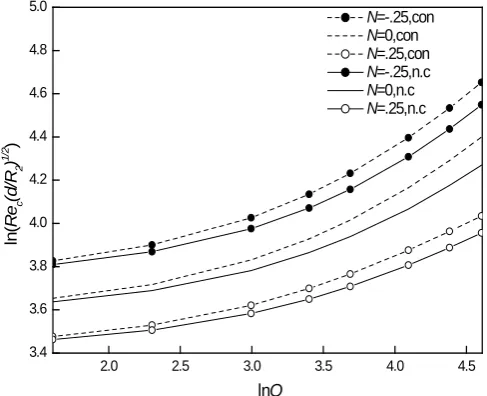
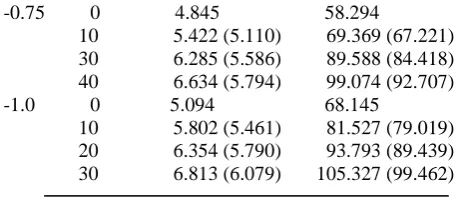
To study the effect of the radial temperature gradient, the numerical results are shown in Table 2 for N in the range [-1, 1] with different values of Q for both perfectly conducting and non-conducting walls and further illustrated with the help of figures. Figure 1 is drawn against N for Q = 0, 10 and 40. The critical Dean number increases as Q increases as N decreases from a positive value to a negative value. This indicates that radial heating exerts a stabilizing influence of
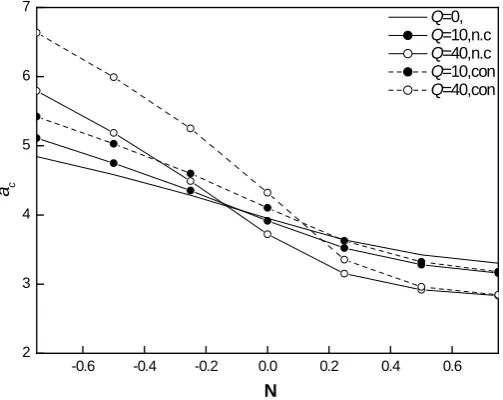
the flow, when the temperature of the inner cylinder is more than the outer cylinder. This behavior is cross verified in Fig. 2 drawn for critical Dean number against Q for N = -0.25, 0 and 0.25 for both conducting and non-conducting walls. Figure 3 shows the spacing of the vortices for positive as well as negative values of N when Q increases from a lower value to higher values. Obviously, the value of the critical wave number, ac strongly decreases for increasing magnetic field, when the cylinders are non- conducting and N = 0. Also, when the cylinders are conducting and the cylinders are isothermal, ac increases (see Chandrasekhar [4]). Therefore, for experimental purpose, due to the smaller sizes of the wave numbers, the insulated cylinders are considered in a laboratory as for larger sizes of the wave numbers, it is difficult to run experiment in a laboratory (see Rüdiger et al. [12]). Furthermore, in our present study, by applying radial heating, we have observed that the critical wave number shows a novel behavior. It is interesting to see that ac decreases as Q increases for both conducting and non-conducting cylinders, when the temperature of inner cylinder is lower than the outer cylinder (N > 0). However, for N < 0, the wave numbers increases with Q. In all the cases (N > 0, N = 0, N < 0), the wave numbers are larger for conducting walls in comparison to non-conducting walls.
2.0 2.5 3.0 3.5 4.0 4.5
3.4 3.6 3.8 4.0 4.2 4.4 4.6 4.8 5.0
N=-.25,con N=0,con N=.25,con N=-.25,n.c N=0,n.c N=.25,n.c
ln(
Re
c
(d/
R2
)
1/
2 )
lnQ
Fig.2: Variation of Rec(d/R2)1/2 against Q with N = -0.25, 0 and 0.25 for both conducting (con) and non conducting(n.c) wall
2.0 2.5 3.0 3.5 4.0 4.5
2.4 2.8 3.2 3.6 4.0 4.4 4.8 5.2 5.6 6.0 6.4
N=-.25,con N=0,con N=.25,con N=-.25,n.c N=0,n.c N=.25,n.c
ac
lnQ
Fig. 3: Variation of wave number acagainst Q with N = -0.25, 0 and 0.25
© 2015, IJMA. All Rights Reserved 168
-0.6 -0.4 -0.2 0.0 0.2 0.4 0.6
2 3 4 5 6 7
Q=0, Q=10,n.c Q=40,n.c Q=10,con Q=40,con
ac
N
Fig.4: Variation of wave number ac with against N for Q = 0, 10, 40
for both conducting (con) and non-conducting(n.c) walls.
Figure 4 shows the critical wave number (ac) evolutions versus N. It is obvious that in non-magnetic case (Q = 0), ac shows a smooth behavior and increases for N < 0 and decreases for N >0. However, in the presence of magnetic field, there is a strong increase for N < 0, while a weak decrease for N > 0. The observation of abrupt changes of the critical wave number was not unique to hydromagnetic Couette flow. The complicated figures of ac are difficult to be
physically explained, since the critical wave number always shows an unsmooth curve when heat is added in the fluid system. In the study of hydrodynamic Couette flow between rotating cylinders, Kong and Liu [13] and Soundalgekar et al. [14] observed such an unsmooth behavior.
Table-2: Values of ac and Rec(d/R2) 1/2
for assign values of N, Q for both conducting and non- conducting walls. The values in the brackets are for non-conducting walls.
N Q ac Rec(d/R2)1/2
1.0 0 3.236 20.458 30 2.888(2.883) 24.360(24.111) 50 2.721(2.719) 26.372 (26.091) 100 2.442(2.439) 30.472 (30.186) 0.75 0 3.302 22.880 30 2.941(2.927) 27.725 (27.276) 50 2.759(2.750) 30.161 (29.635) 100 2.460 (2.453) 35.030 (34.475) 0.50 0 3.423 26.123 30 3.072(3.026) 32.724(31.809) 50 2.858 (2.825) 36.004 (34.858) 100 2.507 (2.487) 42.374 (41.052) 0.25 0 3.640 30.447 30 3.461 (3.271) 40.431 (38.496) 50 3.238 (3.039) 45.820 (42.987) 100 2.748 (2.604) 56.504 (52.262) 0 0 3.950 35.920
30 4.270 (3.795) 50.854 (47.707) 50 4.368 (3.641) 59.974 (54.938)
100 4.531 (3.178) 81.499 (71.560) -0.25 0 4.285 42.392
30 5.057 (4.451) 62.547 (58.643) 50 5.430 (4.528) 75.081 (69.131) 100 6.178 (4.669) 104.856 (94.631)
© 2015, IJMA. All Rights Reserved 169
-0.75 0 4.845 58.294
10 5.422 (5.110) 69.369 (67.221) 30 6.285 (5.586) 89.588 (84.418) 40 6.634 (5.794) 99.074 (92.707)
-1.0 0 5.094 68.145 10 5.802 (5.461) 81.527 (79.019) 20 6.354 (5.790) 93.793 (89.439) 30 6.813 (6.079) 105.327 (99.462)
3.2 Inhibiting influence of magnetic field on stability:
Table 2 and fig. 2 show that for a given value of N, an increase in Hartmann number Q results an increase in the critical Dean number. Thus the magnetic field has an inhibiting effect on the onset of instability. The physical reason for this is that in addition to dissipation of mechanical energy due to viscosity arising out of shearing of fluid between the cylinders, there will be dissipation of magnetic energy due to Joule heating. In a conducting fluid where the effect of electrical resistance is important, fluid of small magnetic Prandtl number Pmas in our present problem, the effect of the
magnetic force can be regarded as giving rise to a strong magnetic viscosity in the presence of a magnetic field. Thus a magnetic field exerts a stabilizing influence on the flow. An interesting result which is observed from Table 2 and figure 3 is that for given values of Q, and N, the critical values of Dean numberfor conducting walls is greater than the corresponding value for electrically non-conducting walls. Thus we see that the insulating walls are more destabilizing than the conducting walls.
4. CONLUSIONS
A linear instability analysis is presented for narrow-gap hydromagnetic MHD dissipative Couette flow of an incompressible electrically conducting fluid between two concentric circular cylinders in the presence of a uniform axial magnetic field and a radial heating. The motion of the flow is driven by a constant azimuthal pressure gradient around the cylinders. It is shown that for given N, the critical Dean number at the onset of instability increases with increase in Hartmann number Q for both electrically conducting and electrically insulating walls. It is also found that insulating walls are more destabilizing than the conducting walls. The analysis reveals that the negative radial heating has stabilizing influence on the flow with the corresponding increase in the critical Dean numbers. It is found that when the temperature of the outer cylinder is more than the inner cylinder (N > 0), the critical wave numbers decreases, while increases for N < 0 as Q increases and this is true for both conducting as well as non-conducting walls.
ACKNOWLEDGEMENT
The authors greatly acknowledge the support of Department of Science and Technology (DST), New Delhi vide grant no. SR/S4/MS: 809/13 dt. 20/04/2014 to carry out this work.
REFERENCES
1. Dean W. R., Fluid motion in a curved channel, Proc. Roy. Soc. London, A121 (1928) 402-420.
2. Reid W. H., On the stability of viscous flow in a curved channel, Proc. Roy. Soc. London, A244 (1958) 186-198.
3. Gibson R. D. and Cook A. E., The stability of curved channel flow, Quart. J. Mech. Appl. Math., 27(2) (1974) 149-160.
4. Chandrasekhar S., Hydrodynamic and Hydromagnetic Stability, Oxford University Press, 1961, Oxford. 5. Mahapatra T. R., Dholey S. and Gupta A. S., Stability of hydromagnetic Dean flow between two arbitrarily
spaced concentric circular cylinders in the presence of a uniform axial magnetic field, Physics Letters A, 373(47) (2009) 4338–4345.
6. Takhar H. S., Ali M. A. and Soundalgekar V. M., The effect of radial temperature gradient and axial magnetic field on the stability of Couette flow: The narrow gap problem, Int. J. Energy Res., 16(7) (1992) 597-621. 7. Ali M. A., Takhar H. S. and Soundalgekar V. M., Effect of radial temperature gradient on the stability of flow
in a curved channel, Proc. Roy. Soc. London,A454 (1998) 2279-2287.
8. Deka R. K. and Paul A., Stability of Dean flow between two porous concentric cylinders with radial flow and a constant heat flux at the inner cylinder, J. Fluids Eng., 135(4) (2013) 041203-1-8.
9. Dholey S., Effect of radial temperature gradient on the stability of magnetohydrodynamic Dean flow in an annular channel at high magnetic parameter, J. Fluids Eng., 137 (2015) 031203-1-12.
10. Walowit J., Tsao S. and DiPrima R. C., Stability of flow between arbitrarily spaced concentric cylindrical surfaces including the effect of a radial temperature gradient, ASME J. Appl. Mech., 31(4) (1964) 585–593. 11. Harris D. L. and Reid W. H., On the stability of flow between rotating cylinders, Part 2, Numerical Analysis,
© 2015, IJMA. All Rights Reserved 170
12. Rudiger G., Hollerbach V., Schultz M. and Shalykov D. A., The stability of MHD Taylor-Coutte flow with current free spiral magnetic fields between conducting cylinders, Astronomische Nachrichten, 326(6) (2005) 409-413.
13. Chin-Hwa Kong and I-Chung Liu, The stability of non-axisymmetric circular Couette flow with a radial temperature gradient,Phys. Fluids 6(8) (1994) 2617-2622.
14. Soundalgekar V. M., Takhar H. S. and Ali M. A., Effects of a radial temperature gradient on the stability of a wide-gap annulus, Int. J. Energy Res., 14(6) (1990) 597-603.
Source of support: Department of Science and Technology (DST), New Delhi, India. Conflict of interest: None Declared
![Table-1: Comparison between the results of Chandrasekhar [4] (B) with the present results (A) for N = 0](https://thumb-us.123doks.com/thumbv2/123dok_us/7834828.2089846/4.595.186.412.422.763/table-comparison-results-chandrasekhar-b-present-results-n.webp)