Coupling between perception and action timing during sensorimotor synchronization Deborah J. Serrien and Michiel M. Spapé
School of Psychology, University of Nottingham, University Park, Nottingham, NG7 2RD, UK
Correspondence address: Deborah Serrien
School of Psychology University of Nottingham University Park
Nottingham, NG7 2RD, UK Phone: + 44 (0)115 951 5285 Fax: + 44 (0)115 951 5324
2 Abstract
Time is an important parameter in behaviour, especially when synchronization with external events is required. To evaluate the nature of the association between perception and action timing, this study introduced pitch accented tones during performance of a sensorimotor tapping task. Furthermore, regularity of the pacing cues was modified by small (subliminal) or large (conscious) timing perturbations. A global analysis across the intervals showed that repeated accented tones increased the tap-tone asynchrony in the regular (control) and irregular (subliminal) trials but not in the irregular trials with awareness of the perturbations. Asynchrony variability demonstrated no effect of accentuation in the regular and subliminal irregular trials, whereas it increased in the conscious irregular trials. A local analysis of the intervals showed that pitch accentuation lengthened the duration of the tapping responses, but only in the irregular trials with large timing perturbations. These data underline that common timing processes are automatically engaged for perception and action, although this arrangement can be overturned by cognitive intervention. Overall, the findings highlight a flexible association between perception and action timing within a functional information processing framework.
3 Introduction
The ability to time behavioural responses with external events such as tapping to the beat of a tune represents an ability that integrates action-perception coupling. Commonly, action timing is established on the basis of anticipatory mechanisms, guided by the predictable recurrence of the external cues. Anticipatory regulation has received support from the phenomenon of negative asynchrony, the synchronization error of about 20-80 ms that occurs when finger tapping to an isochronous sequence [1]. Anticipatory control remains present when timing perturbations are introduced in the pacing sequence, although the degree of predictive control is reduced when these disturbances become large and the participants become aware of the irregular events [13]. This observation indicates that the temporal information embedded within the pacing sequence modifies cognitive regulation of the action-perception coupling.
4 predictive sensorimotor control [13]. Also, the effect of performing hand was examined as the left (non-preferred) hand is commonly less successful in timing regulation than the right (preferred) hand in right-handers [6,9].
Of special interest was to assess whether action timing is prone to pitch accented tones as perception timing is. The working hypothesis was that pitch accents would affect action timing due to changes in perceived timing of the intervals, as suggested from perception timing data [14], and accordingly would influence the action-perception association. Furthermore, it is hypothesized that this effect would depend on the amount of timing perturbation because of changes in the degree of predictive regulation as well as on the performing hand as a result of dexterity.
Methods Participants
Twenty-seven right-handed participants (age: 20.7±1.9 years) as determined by the Edinburgh handedness inventory [8] with no musical training took part in the experiment. In accordance with the declaration of Helsinki, all gave informed consent to participate in the study.
Task and procedure
5 equal to 4D. A trial only comprised one type of perturbation. The duration of the tones was 30 ms (including a 15 ms stochastic fade-out to prevent tone offset artifacts) and included a pitch level of 1000 Hz. In addition to the timing perturbation, accentuation in the form of a 250 Hz increase in pitch was applied to the tone following the long and short interval, and occurred repeatedly within the sequence (every 4 to 8 tone). A trial only consisted of one type of accentuation (accent on long or short interval). Unaccented tone (control) trials were also included. There were three trials per performance condition, and the order of the trials was counterbalanced. A total of 36 trials was performed. Position of the fingers/hands was maintained throughout the experiment in order to preserve consistent movement kinematics. After each trial, subjects were asked whether they had perceived the rhythm as regular or irregular. There was a short break halfway through the experiment.
Insert Fig. 1 about here
Measurements
E-Prime software (Psychology Software Tools Inc., Pittsburgh, USA) recorded the tapping responses and the subjective scores in the various task conditions. For data analysis, the initial six taps from each trial were removed. The following performance measurements were included:
Subjective report. After each trial, participants reported whether they had perceived the
pacing sequence as regular or irregular. The percentage of perceived regularity was calculated. Synchronization error, mean. The synchronization error measures the precision of the
tap-tone asynchrony and expresses an index of action-perception accuracy. Negative scores indicate that the taps lead the tones, and underline predictive control. Outliers were excluded from data analysis (-350<SE<+350).
Synchronization error, variability. The standard deviation of the synchronization error estimates the consistency of the tap-tone asynchrony and captures action-perception regularity.
Intertap interval, mean. The mean intertap interval measures the time of the successive
6 about the robustness of the internal time dynamics. Outliers were excluded from data analysis (500 ms<ITI<1800 ms).
Intertap interval, variability. The coefficient of variation of the intertap interval measures
the consistency of the successive tap responses. It gives an index of the stability of the internal time dynamics.
Analysis
A local and global analysis of the data was conducted. The local analysis focused on the performance with respect to the distinct intervals (long vs. short), and assessed changes in timing regularity as obtained from the duration of the intertap intervals. The global analysis concentrated on the performance across the consecutive intervals, and evaluated modulations in subjective as well as objective measurements.
The local analysis was performed separately for the long and short interval and was conducted by means of 2 (Accentuation) x 2 (Perturbation) x 2 (Hand) ANOVAs. The first factor referred to the intervals with vs. without accent. The second factor indicated the 3% and 20% timing perturbations with respect to the baseline interval. The third factor corresponded to the left and right hand.
The global analysis was conducted by means of 2 (Accentuation) x 3 (Perturbation) x 2
(Hand) ANOVAs. The first factor corresponded to the accented vs. unaccented trials. The second factor referred to the 0%, 3% and 20% timing perturbations with respect to the baseline interval. The third factor represented the left and right hand. Post-hoc comparisons were conducted when necessary. Of note is that synchronization error and intertap interval are interdependent as each intertap interval is equal to the concomitant interstimulus interval plus the difference between the synchronization error of two successive taps (Vorberg & Wing 1996).
Results
Local analysis: interval-bound
Long interval. The analysis of timing regularity showed a significant main effect of
7 F(1,26)=5.89, p<.05. Post-hoc comparisons revealed no significant difference due to
accentuation in the 3% condition (p>.05), whereas the long interval with accent was significantly longer than the long interval with no accent in the 20% condition (p<.05). The mean tapping scores with and without accents were 998 ms and 996 ms (3% condition), 1101 ms and 1074 ms (20% condition).
Short interval. The analysis of timing regularity revealed a significant main effect of
Perturbation F(1,26)=27.01, p<.01 and a significant Accentuation x Perturbation interaction,
F(1,26)=5.56, p<.05. Post-hoc comparisons showed no significant difference due to
accentuation in the 3% condition (p>.05), whereas the short interval with accent was significantly longer than the short interval with no accent in the 20% condition (p<.05). The mean tapping scores with and without accents were 997 ms and 1001 ms (3% condition), 952 ms and 934 ms (20% condition).
These data with respect to the long and short interval highlighted that pitch accentuation affects timing regularity in a distinct way. In particular, lengthening of the accented intervals occurred in the 20% but not in the 3% condition. Accordingly, it is argued that repeated pitch accents in a tapping sequence affect the movement dynamics in irregular conditions that are characterized by large timing perturbations.
Global analysis: across intervals
Various measurements were included to illustrate subjective as well as objective performance.
Subjective report. Perceptual research has suggested that participants respond
8 Synchronization error, mean. The ANOVA showed a significant main effect of
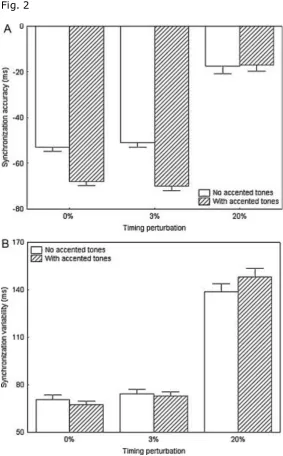
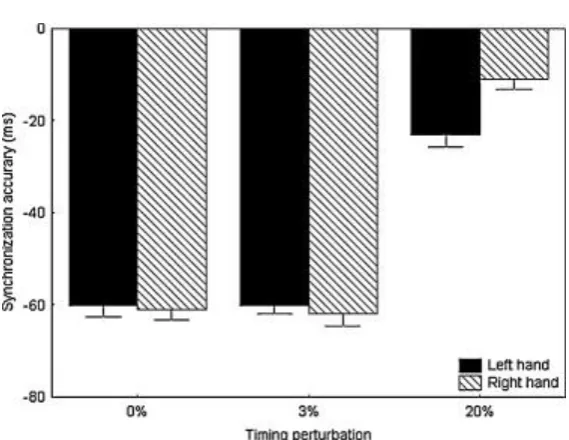
Accentuation F(1,26)=10.28, p<.01, and Perturbation F(2,52)=10.81, p<.01. The Accentuation x Perturbation interaction was significant, F(2,52)=4.36, p<.02 (Fig. 2A). This interaction illustrated that the accented tones shifted the synchronization error in the 0% and 3% conditions (p<.05 for both) but not in the 20% condition (p>.05). That the synchronization error in the 20% condition was not affected by the accented tones is supported by a lag-1 cross-correlation analysis that showed no significant differences between the long interval with accent, short interval with accent and no accent interval (p>.05). The mean coefficients were -0.38, -0.34 and -0.31 for the long interval with accent, short interval with accent and no accent interval, respectively. Finally, the Perturbation x Hand interaction was also significant, F(2,52)=3.92, p<.05 (Fig. 3). This interaction revealed that there were no performance
differences between both hands in the 0% and 3% conditions (p>.05 for both), whereas the left hand showed an increased negative asynchrony as compared to the right hand in the 20% condition (p<.05).
Insert Fig. 2 about here
Synchronization error, variability. The ANOVA indicated a significant main effect of
Perturbation F(2,52)=276.52, p<.01 and a significant Accentuation x Perturbation interaction, F(2,52)=5.45, p<.01 (Fig. 2B). This interaction revealed that variability of the synchronization
error was not affected by the accents in the 0% and 3% conditions (p>.05 for both) but it was in the 20% condition (p<.05).
Insert Fig. 3 about here
Intertap interval, mean. The ANOVA highlighted a significant main effect of Perturbation
F(2,52)=30.58, p<.01. The Hand x Perturbation interaction was also significant F(2,52)=4.77,
p<.01. This interaction indicated that the tempos of both hands were not significantly different
9 more from the baseline interval than the right hand in the 20% condition (p<.05). The mean tapping scores for the left and right hand were 996 ms and 995 ms, 994 ms and 994 ms, 980 ms and 984 ms for the 0%, 3% and 20% conditions, respectively.
Intertap interval, variability. The ANOVA showed a significant main effect of Perturbation
F(2,52)=272.02, p<.01. Post-hoc analysis indicated that the 0% and 3% conditions differed
from the 20% condition (p<.01 for both). The mean variability scores were 0.073, 0.074 and 0.171 for the 0%, 3% and 20% conditions, respectively.
Discussion
When tapping to the beat of an isochronous sequence, a synchronization error occurs that commonly provides a negative tap-tone asynchrony. This negativity highlights predictive timing control. People are generally unaware of this tendency, and when trained to achieve zero asynchrony by means of visual feedback, they report that they need to delay their taps in order to achieve synchronized behaviour [1]. The latter observation suggests that negative asynchrony associates with the subjective point of synchrony. Of interest in this study was to experimentally manipulate sensorimotor synchronization by means of pitch accented tones integrated within the pacing sequence. The work further assessed the impact of timing perturbations of the cueing signal (no=0%, small=3%, large=20%) and performing effector (left hand, right hand). The data revealed that the recurrent accents induced local (interval-bound) and global (across intervals) effects on tapping performance.
Interval taps and pitch accents
10 perceptual groups such that intervals between groups are perceived as longer [4,15]. The timing adjustment would then compensate for the perceptual bias in order to restore regularity of the rhythmical sequence. Alternatively, a psychoacoustic effect might have created the effect such that the shift from a high-pitch to a low-pitch tone would be perceived as shorter than the reversed transition [14].
Previously, Billion and Semjen [2] used intensity accents during sensorimotor synchronization and observed lengthening or shortening of the accented taps as a function of tapping rate. Conversely, we only observed lengthening of the accented intervals. Accordingly, it is argued that different types of accents have distinct effects on action timing, and that context-dependent factors play a role. For example, intensity accents will have a pronounced impact on the movement dynamics per se due to changes in the forcefulness of the taps.
The observations with respect to the local intervals show that pitch accentuation affected timing regularity. In addition, a global analysis across intervals of various performance measurements was conducted and permitted to highlight the large-scale consequences of the pitch accented tones on the action-perception coupling, as discussed next.
Error correction during sensorimotor synchronization
To maintain approximate tap-tone synchrony, adjustments are necessary. In particular, without error correction, temporal variability would accumulate and lead to phase drift of the responses relative to the pacing sequence [19]. Previously, the involvement of a dual-process model that combines phase and period correction has been proposed [7,12]. Phase correction is sensitive to temporal information below the perceptual threshold and represents an automatic tuning to the response interval, based on the most recent tap-tone asynchrony [1] or preceding tap and tone [5]. Conversely, period correction occurs when the interval of the stimulus sequence is modified in a systematic way, resulting in a change of the timekeeper interval. It depends on awareness of the timing perturbations [11] and is assumed to be based on a comparison between the current response interval and most recent stimulus interval.
11 the 3% condition confirm that subliminal perturbations trigger corrective processes to maintain synchrony [13,16]. Although the 20% condition was characterized by a reduced negative asynchrony, no positive scores were observed [13], which suggests that a predictive mode prevailed during which the responses were cognitively monitored according to the expected occurrence of the pacing stimuli. In this respect, activation of dorsolateral prefrontal cortex underlines cognitive involvement in the 20% condition [13].
Pitch accentuation: perception and action timing
The subjective reports revealed that participants perceived the accented tone conditions as less regular than the unaccented tone conditions, except for the 20% trials. The tapping data supported this observation. In particular, the pitch accented tones increased the synchronization error in the 0% and 3% trials but not in the 20% trials. This shift suggests that the perceived change of the accented intervals caused participants to modify their tapping behaviour. That the effect did not occur in the 20% trials suggests that pitch accentuation can be prevented from having an influence on the action-perception coupling in situations in which cognitive monitoring of the task demands intervenes. Furthermore, synchronization variability showed no effect as a result of the accented tones in the 0% and 3% conditions whereas an increase was noted due to accentuation in the 20% condition. These observations further underline the routine nature of timing control in the 0% and 3% conditions whereas it is cognitively driven, but more prone to instabilities, in the 20% condition. These data suggest that common timing processes are automatically recruited for perception and action during synchronized behaviour, although this organization can be overruled by cognitive intervention.
Based on the previous, it is argued that perception timing entrains action timing when synchronization can be achieved in an automatic mode. Conversely, segregation of timing processes becomes viable in case synchronization is accompanied by task awareness. Thus, the functional link between perception and action timing is supported by hierarchical and flexible mechanisms of information processing.
12 Right-handers often show a more refined timing control with the right (dominant) than left (non-dominant) hand [3,6,9,18]. In the present study, between-hand performance differences depended on task complexity. In particular, the synchronization error of both hands did not differ in the 0% and 3% conditions whereas the left hand showed an increased negative asynchrony as compared to the right hand in the 20% condition. This finding underlines that both hands behaved similarly in the easy, automatically-driven trials whereas a discrepancy occurred in the more complex, cognitively-guided trials during which the left hand maintained a pronounced predictive regulation.
13 Acknowledgements
14 Figure caption
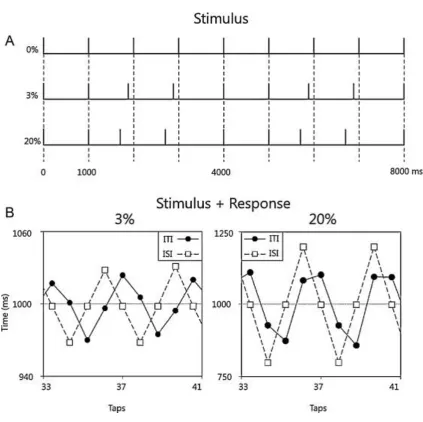
Fig. 1. (A) A succession of two basic cycles in the 0%, 3% and 20% conditions. Whereas the 0% condition included a baseline performance of 1000 ms, the 3% and 20% conditions integrated timing perturbations that evolved around a basic cycle: D, D(1-A), D, D(1+A) with D=baseline interval and A=relative perturbation level. This implied a cycle structure of 1000 ms - 970 ms - 1000 m – 1030 ms for the 3% condition and of 1000 ms - 800 ms - 1000 m – 1200 ms for the 20% condition. (B) Average time course of the interstimulus interval (ISI) and intertap interval (ITI) in the 3% and 20% conditions (example taps 33 to 41).
Fig. 2. (A) The accented tones shifted the synchronization error in the 0% and 3% conditions, but not in the 20% condition. (B). Variability of the synchronization error was not affected by the accents in the 0% and 3% conditions but it was in the 20% condition. Means ± SE are shown.
15 References
[1] G. Aschersleben, Temporal control of movements in sensorimotor synchronization. Brain Cogn. 48 (2002) 66-79.
[2] M. Billon, A. Semjen, The timing effect of accent production in synchronization and continuation tasks performed by musicians and nonmusicians. Psychol. Res. 58 (1995) 206-217.
[3] W.D. Byblow, R. Chua, D. Goodman, Asymmetries in coupling dynamics of perception and action. J. Mot. Behav. 27 (1995) 123-137.
[4] P. Fraisse, Les structures rythmiques. Louvain: Presses Universitaires de Louvain (1956). [5] D. Hary, G.P Moore, Synchronizing human movement with an external clock source. Biol.
Cybern. 56 (1987) 305-311.
[6] L.L. Helmuth, R.B. Ivry, When two hands are better than one: Reduced timing variability during bimanual movements. J. Exp. Psychol.: Hum. Percept. Perform. 22 (1996) 278-293.
[7] J.A. Mates, A model of synchronization of motor acts to a stimulus response. I. Timing and error corrections. Biol. Cybern. 70 (1994) 463-473.
[8] R.C. Oldfield, The assessment and analysis of handedness: The Edinburgh inventory. Neuropsychologia, 9 (1971) 97-113.
[9] M. Peters, B. Durding, Handedness as continuous variable. Can. J. Psychol. 3 (1978) 257-261.
[10] B.H. Repp, Does an auditory perceptual illusion affect on-line auditory action control? The case of (de)accentuation and synchronization. Exp. Brain Res. 168 (2006) 493–504. [11] B.H. Repp, Sensorimotor synchronization: A review of the tapping literature. Psychon.
Bull. Rev. 12 (2005) 969-992.
[12] A. Semjen, D. Vorberg, H-H. Schulze, Getting synchronized with the metronome: Comparisons between phase and period correction. Psychol. Res. 61 (1998) 44-55. [13] K.M. Stephan, M.H. Thaut, G. Wunderlich, W. Schicks, B. Tian, L. Tellmann, T. Schmitz,
16 sensorimotor synchronization--prefrontal cortex and the influence of awareness. Neuroimage 15 (2002) 345-352.
[14] H.G. Tekman, Accenting and detection of timing variations in tone sequences: Different kinds of accents have different effects. Percept. Psychophys. 63 (2001) 514-523.
[15] H.G. Tekman, Interactions of perceived intensity, duration, and pitch in pure tone sequences. Music Percept. 14 (1997) 281-294.
[16] M.H. Thaut, K.M. Stephan, G. Wunderlich, W. Schicks, L. Tellmann, H. Herzog, G.C. McIntosh, R.J. Seitz, V. Hömberg, Distinct cortico-cerebellar activations in rhythmic auditory motor synchronization. Cortex 45 (2009) 44-53.
[17] M.H. Thaut, B. Tian, M.R. Azimi, Rhythmic finger tapping in cosine wave modulated metronome sequences: evidences for subliminal entrainment. Hum. Mov. Sci. 17 (1998) 839-863.
[18] G. Truman, G.R. Hammond, Temporal regularity of tapping by the left and right hands in timed and untimed finger tapping. J. Mot. Behav. 22 (1990) 521-535.