ARTIGO ORIGINAL
Successful Pregnancies Outcomes with the
Use of
In Vitro
Fertilization after Essure
®
Unilateral Hydrossalpinx Occlusion
Gravidezes Bem Sucedidas com Recurso a Fertilização
In Vitro
após
Oclusão de Hidrossalpinge Unilateral com Essure
®1. Departamento de Biologia Experimental. Faculdade de Medicina da Universidade do Porto. Porto. Portugal. 2. Instituto de Biologia Molecular e Celular. Porto. Portugal.
3. Departamento da Mulher e da Medicina Reprodutiva. Centro Hospitalar do Porto. Porto. Portugal. 4. Centro de Procriação Medicamente Assistida. Centro Hospitalar do Porto. Porto. Portugal.
Recebido: 14 de Setembro de 2013 - Aceite: 07 de Novembro de 2013 | Copyright © Ordem dos Médicos 2014
Luís GUEDES-MARTINS1,2,3, Joana MESQUITA-GUIMARÃES4, Márcia BARREIRO4 Acta Med Port 2014 May-Jun;27(3):342-348
RESUMO
Introdução: Desde há duas décadas que assistimos à publicação de vários estudos dedicados à avaliação da influência da hidros-salpinge nos resultados de técnicas de transferência de embriões. O objectivo deste trabalho é apresentar os resultados do tratamento e vigilância gestacional em mulheres com história de infertilidade - associada a hidrossalpinge unilateral, visível no exame ecográfico transvaginal - submetidas a oclusão unilateral com Essure® e tratamento subsequente com fertilização in vitro.
Material e Métodos: Análise prospectiva de uma amostra constituída por seis mulheres, com antecedentes de infertilidade e hidros-salpinge unilateral, entre Abril de 2010 e Maio de 2013. Em todos os casos procedemos a exclusão de hidroshidros-salpinge recorrendo à colocação unilateral de um dispositivo Essure® por via histeroscópica antes da realização de um ciclo para fertilização in vitro.
Resultados: Das seis doentes submetidas a fertilização in vitro, quatro engravidaram (66,7%). Destas, registaram-se duas gravidezes de termo sem intercorrências até ao parto e duas gravidezes encontram-se em vigilância, sem intercorrências conhecidas até à data. Das doentes que não engravidaram após fertilização in vitro (n = 2, 33,3%), uma engravidou espontaneamente durante a vigilância subsequente.
Discussão: O avanço da histeroscopia no tratamento de hidrossalpinge, recorrendo à implantação do dispositivo Essure®, representa uma alternativa válida à abordagem laparoscópica.
Conclusão: Este estudo sugere que a oclusão tubar unilateral, induzida pelo dispositivo Essure®, melhora os resultados do tratamento com fertilização in vitro em casos de infertilidade associada a hidrossalpinge unilateral, visível no exame ecográfico transvaginal.
Palavras-chave: Fertilização In Vitro; Histeroscopia; Infertilidade Feminina; Gravidez; Nascimento Vivo; Esterilização Tubária; Portu-gal.
ABSTRACT
Introduction: Since two decades we witnessed the publication of several studies devoted to the study of the influence of the presence of hydrosalpinx on the results of embryo transfer techniques. The aim of this study is to present the results of treatment and pregnancy outcomes in women with a history of infertility associated with unilateral hydrosalpinx, visible on vaginal ultrasound, which were subjected to unilateral occlusion with Essure® and subsequent treatment with in vitro fertilization.
Material and Methods: We performed a prospective analysis of a sample of 6 women, with a history of infertility and unilateral hydrosalpinx, between April 2010 to May 2013. In all cases we proceeded to unilateral hysteroscopic placement of the Essure® microinsert, prior to performing a cycle for in vitro fertilization.
Results: Of the 6 patients undergoing in vitro fertilization, 4 became pregnant (66.7%). Of these, two were uneventful pregnancies until delivery and 2 are still under surveillance, without complications. Of the patients who did not become pregnant after in vitro fertilization (n = 2, 33.3%), 1 conceived spontaneously during the subsequent monitoring.
Discussion: The advancement of hysteroscopy in the treatment of hydrosalpinx using the Essure® microinsert placement is a valid alternative to the laparoscopic approach.
Conclusion: This study suggests the effectiveness of unilateral tubal occlusion caused by Essure® microinsert in improving outcomes
of in vitro fertilization treatment in cases of infertility associated with unilateral hydrosalpinx, visible in the vaginal ultrasound.
Keywords: Fertilization in Vitro; Hysteroscopy; Infertility, Female; Pregnancy; Live Birth; Sterilization, Tubal; Portugal.
INTRODUCTION
Derived from Greek, hydrosalpinx is a term used to describe a fallopian tube filled with water or fluid.1,2
The presence of an hydrosalpinx has a negative influence on the success rates of in vitro fertilisation (IVF-ET), presenting a therapeutic challenge related to its frequent presentation and sometimes difficult approach.3-11
The currently accepted view considers that the fluid within a dilated fallopian lumen plays a causative role in the reduction of pregnancy rate related to embryo-transfer
techniques.12-15 It is therefore widely accepted that the fluid
within the affected fallopian tube significantly prevents the implantation process. In fact, any surgical approach blocking the communication between the tube and the uterus would remove the leakage of the hydrosalpinx fluid and restore pregnancy rates.13-19 There is increasing evidence regarding
this hypothesis related to the occurrence of spontaneous pregnancies in women who underwent salpingectomy or proximal tubal occlusion following diagnoses of unilateral
35
35 ano s a p
rom
ov
er as
ciê
CA
PO
RTUG
UESA
ARTIGO ORIGINAL
hydrosalpinx and patent contralateral tubes.12
Essure® micro-insert is a device for definitive sterilisation, placed by hysteroscopic approach, 4 cm in length and with 1-2 mm thickness, made of a stainless steel inner coil wrapped in polyethylene terephthalate and an external nickel-titanium (nilitol) coating. The use of Essure® is a relatively new therapy approach for tubal occlusion, with expected advantages in non-eligible patients for laparoscopy and/or general anaesthesia.20-25 It
may be placed in an outpatient regime without the need for anaesthesia and away from the operating room.
A hydrosalpinx visible on trans-vaginal ultrasound is a clinical entity that appears to be associated to a worse reproductive outcome when not treated.1,2,7,9,14
Our study aimed to describe the results of infertility management and follow-up in relation to a unilateral hydrosalpinx visible on trans-vaginal ultrasound in women who subsequently underwent unilateral tubal occlusion with the Essure® micro-insert followed by IVF-ET treatment.
MATERIAL AND METHODS
This is a prospective observational study of six patients with an infertility history related to unilateral hydrosalpinx
visible on trans-vaginal ultrasound, diagnosed and treated between April 2010 and May 2013. A Essure® micro-insert was placed unilaterally by hysteroscopic approach in all patients before undergoing an IVF-ET cycle. Age above 40 and non-eligibility for IVF-ET were considered as exclusion criteria in our study. Patients were informed about potential benefits and risks related to hysteroscopic tubal occlusion with Essure® both verbally and in writing. All patients signed informed consent for study inclusion as well as for publication of collected data on assisted reproductive procreation and pregnancy outcomes. The study was approved by the Gynaecology Department at the Centro Hospitalar do Porto and institutional authorization for data publication was obtained.
Epidemiologic data was collected for each patient, including the patient’s age, BMI (Body Mass Index), duration and type of infertility, presence of unilateral hydrosalpinx confirmed by ultrasound, previous treatments and outcomes as well as any eventual laparoscopy ineligibility criteria. All procedures were carried out in an out-patient regime and the indication for placement of an Essure® micro-insert was the presence of a unilateral hydrosalpinx (regardless of the eligibility for laparoscopy).
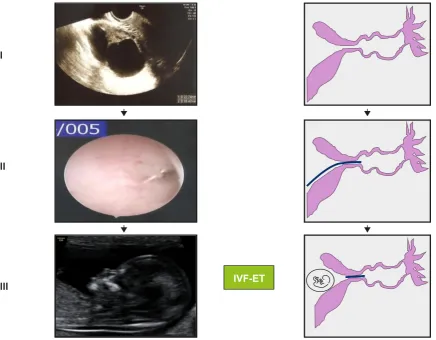
Figure 1 - Hydrosalpinx before (I) and upon (II-III) placement of an Essure® micro-insert device. Successful pregnancy at 12 weeks and 5 days, upon IVF-ET cycle (III).
I
II
ARTIGO ORIGINAL The placement of the Essure
® micro-insert was carried
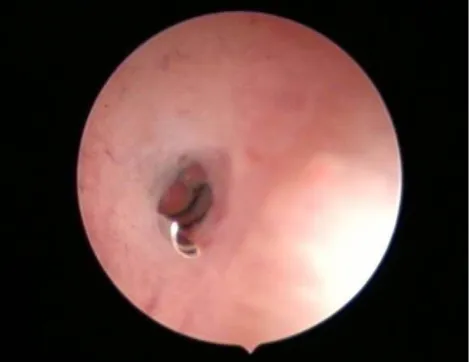
out by hysteroscopic approach, without anaesthesia, during the second week of the menstrual cycle. All patients were treated with misoprostol 0.2 mg (one 0.2 mg tablet previously humidified and placed by vaginal approach) on the day before and antibiotic coverage was given with azithromycin 1g, orally, half an hour before the procedure. We used a 5mm Storz® hysteroscope with working element and normal saline for uterine distension. Upon viewing of the tubal ostia, the Essure® device was placed unilaterally on the affected fallopian tube, allowing for one or two spirals to remain visible in the uterine cavity. The actual number of spirals visible in the cavity upon release of the device was recorded.
Approximately three months later, the implant expected location was checked by pelvic X-ray and trans-vaginal 2D-ultrasound, combined with 3D-ultrasound.
Subsequently, the patients underwent an IVF-ET cycle according to the protocol defined by our Department. Follow-up on outcomes of the technique and pregnancy was recorded (Fig.1). Finally, data statistical descriptive analysis was carried out.
RESULTS
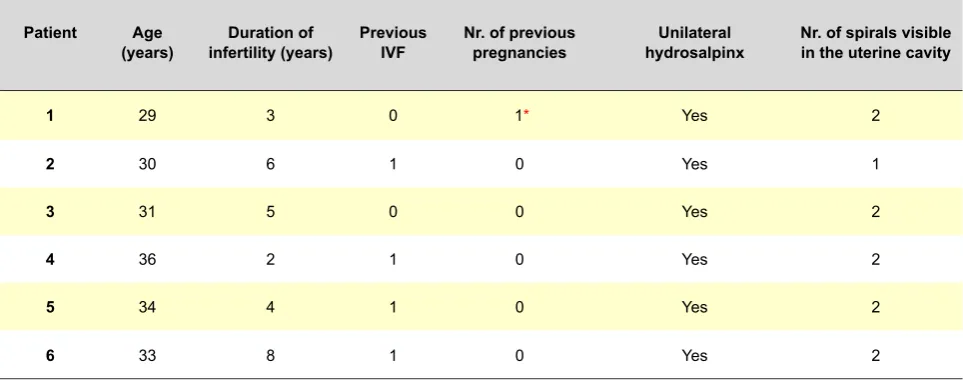
The average age and BMI of our group of patients was 37 years (min. 29; max. 36) and 24.3 Kg/m2 (min. 22.3; max. 30.1), respectively. The average infertility time was 4.7 years (min. 2; max. 8). From the six patients in our study, four had undergone previous unsuccessful IVF-ET (66.7%). A spontaneous pregnancy occurred in one of the patients (ectopic pregnancy, surgically managed with salpingectomy by laparotomy, one year before being admitted to our Hospital’s Centre for Medically Assisted Procreation) – Table 1. In all these patients there was a male infertility
cause, beyond the hydrosalpinx.
The presence of a unilateral hydrosalpinx was diagnosed in all patients (n = 6) by trans-vaginal ultrasound and all patients accepted a unilateral tubal occlusion with an Essure® micro-insert although one patient was ineligible for laparoscopy due to a previous diagnosis of a “frozen pelvis” through laparoscopy (patient 3).
The procedures involved the same surgeon, without anaesthesia and in an out-patient regime (as described above). The average number of spirals visible in the uterine cavity immediately upon hysteroscopic placement of the implant, was 1.8 (min. 1; max. 2) – Table 1. All procedures were carried out with no complications. No patient required hospital admission and no other related uterine pathology occurred.
Approximately three months later, according to the study protocol, the expected implant location was checked, without the need for a hysterosalpingogram. The information from the pelvic X-ray and trans-vaginal 2D/3D ultrasound was considered acceptable in all patients.
The average period of time between Essure® placement and onset of IVF-ET was seven months (min. 5; max. 8). Two embryos were transferred per IVF-ET cycle according to the protocol of the Centre for Medically Assisted Procreation where the study took place (elective single embryo transfer was not considered). Outcomes are shown in Table 2. Four out of six patients in our study got pregnant (66.7%). From these, two term healthy deliveries occurred and two healthy pregnancies are underway up to the present date. From the patients that did not get pregnant (n = 2, 33.3%), one spontaneous pregnancy occurred in patient number 6 and patient number 3 is currently waiting for an IVF-ET cycle.
Considering the aspects regarding ongoing pregnancies
Table 1 - General characteristics of our group of patients
Patient Age
(years) infertility (years)Duration of Previous IVF Nr. of previous pregnancies hydrosalpinxUnilateral Nr. of spirals visible in the uterine cavity
1 29 3 0 1* Yes 2
2 30 6 1 0 Yes 1
3 31 5 0 0 Yes 2
4 36 2 1 0 Yes 2
5 34 4 1 0 Yes 2
6 33 8 1 0 Yes 2
ARTIGO ORIGINAL
and the outcomes of the two term pregnancies, we wish to remark the adequate position of the implants and the lack of placentation disorders (as a consequence of a possible myometrial irritation), infectious complications (endometritis, chorioamnionitis, for example) and premature rupture of membranes, which were never described in any of the ultrasound obstetric examination in these patients.
DISCUSSION
Tubal pathology is a major indication for IVF-ET in women with infertility.1-8 In the case of hydrosalpinx, several
studies have analysed the influence of its presence on the outcomes of in vitro fertilisation.
Although still controversial, the negative impact of the effects of tubal fluid, low osmolarity and low levels of lactate and protein in hydrosalpinx fluid seem to be responsible for a decrease in spermatic mobility in these patients.9
IVF-ET was initially designed to manage untreatable tubal disease or the absence of both fallopian tubes.10 It
subsequently progressed as a form of therapy for almost every form of tubal-related infertility.11 In the subgroup of patients with a recognized infertility tubal factor, this does
not correspond to a single clinical entity and hydrosalpinx is described with a worst outcome.11 There is also increasing evidence regarding spontaneous pregnancy in women with a fertility history related to unilateral hydrosalpinx and patent contralateral fallopian tube, who have been treated by occlusion or excision techniques on the affected fallopian tube.12,13
In fact, surgery related to a blockade of communication between the affected fallopian tube and the uterus has undergone major technical improvements. Salpingectomy or tubal laparoscopic occlusion are currently considered as elective treatment for patients undergoing IVF-ET14,26,27
mainly with ultrasound-detectable hydrosalpinx.15 It is an
easy, minimally invasive procedure, associated to a quick recovery.14 Unlike it has been pointed out in recent studies, salpingectomy has not been related to a loss of ovarian reserve/response16-19 under subsequent stimulations. For
this reason, laparoscopy has been recognized by some authors as an elective treatment for hydrosalpinx, with tubal ligation and excision and clear benefits on the outcomes upon IVF-ET.28,29 Nevertheless, its main limitation is the fact
of not being necessarily performed under anaesthesia and
Table 2 - IVF-ET results and pregnancy monitoring
Patient Essure®-IVF Cycle time interval
(months)
Nr. of embryo
transferred Nr. of embryo implanted miscarriagesNr. of Pregnancy
1 5 2 2 1
No intercurrences, eutocic 39-week delivery of a
female newborn (w = 2,900g)
2 7 2 1 0
No intercurrences, dystocic 39-week caesarian delivery
of a male newborn (w = 3,030g)
3 7 2 0 0
-4 8 2 1 0 pregnancy, with no Singleton 19-week
intercurrences up to now
5 8 2 2 0
Twin bi-chorionic/ bi-amniotic 22-week
pregnancy, with no intercurrences up to now
6 - - - - Singleton spontaneous 37-week pregnancy, with no
ARTIGO ORIGINAL in an operating room context. The advances of hysteroscopy with placement of the
Essure® device is a viable alternative to a laparoscopic approach for hydrosalpinx treatment.21-25 In addition, it
precludes general anaesthesia, there is a reduction of surgical risk, an economic advantage30-32 (mainly related
to the avoidance of hospital admission and to a quick recovery), the possibility of treatment of other intrauterine disorders (such as endometrial polyp excision) within the same operative time and the reduction of ectopic pregnancy risk due to a proximal tubal occlusion (post-salpingectomy cornual ectopic pregnancy). When considered together, these are strong arguments for the advance of this technique, originally designed for permanent birth control.21-25 This procedure has been significantly criticized
due to unknown effects of the Essure® device, placed within the affected fallopian tube(s), on subsequent embryo and foetal development. Studies with biomaterials, such as the one by Wever et al.33, revealed that the Nickel-Titanium alloy may be appropriately used in implants as biologically safe, since it shows no cytotoxic, allergic or genotoxic activity, similar to what has been observed with the reference AISI 316 LVM stainless steel material. However, no negative effect was described on the embryo-foetal development in almost 20 successful pregnancies resulting from IVF-ET in infertile women who underwent tubal occlusion with an Essure® micro-insert device21-25. Nevertheless, we consider
that additional studies will be necessary to clarify these conclusions and particularly to reinforce lack of an adverse effect on placentation, risk of infection and premature birth. A maximum of four spirals visible in the uterine cavity after the placement of a Essure® micro-insert device has been described, in the largest clinical series.22-25 There
are in fact no comparative, randomized studies regarding pregnancy outcomes of women undergoing the placement of an Essure® device followed by IVF-ET related to the number of spirals left visible in the uterine cavity upon placement of the device. The largest published studies21-25
have important limitations related to sampling power and we wish to emphasize the need for multi-centric studies in order to confirm the so far obtained positive results. The concern regarding the occurrence of obstetric adverse outcomes related to the presence of a foreign body within the affected fallopian tube21-25 supports the objective of
leaving a minimum number of spirals visible in the uterine cavity, thus reducing the expected risks of endometrial injury and subsequent lower receptivity (Fig. 2).
In fact, the number of patients in our study is not enough for a recommendation on the priority use of hysteroscopy in tubal exclusion. However, patients ineligible for general
anaesthesia, with an increased risk of surgical complications, in particular due to a higher incidence of chronic inflammatory pelvic pathology in women with an history of infertility expressed by pelvic adhesions,34 previous multiple abdominal surgeries and with severe obesity should benefit from tubal occlusion by hysteroscopic, rather than from laparoscopic approach, as previously described21-25
More specifically, the comparison of a group of patients treated with the Essure® device with another submitted to occlusion of the affected fallopian tube by laparoscopic approach, even in patients eligible for laparoscopic surgery, is required.
In our centre, the protocol for confirming the normal position of the implant (Essure®) includes a pelvic X-Ray and 2D/3D ultrasound, looking for the presence of a linear, hyper-echoic foreign body placed at the proximal portion of the occluded fallopian tube, with a well-defined limit from the uterine cavity. In 2009, Pachy et al.35 demonstrated the
advantages of 3D ultrasound with vaginal probe for checking device placement. The simplicity of this examination, the absence of radiation and its reproducibility led some authors to adopt this control procedure after the placement of an Essure® micro-insert. In fact, to date, no real benefits have been shown from conventional radiological imaging over trans-vaginal ultrasound (2D/3D) for the assessment of appropriate implant placement36,37. Many authors
consider there is no safe, easy and reproducible method for infertility management regarding the assessment of tubal patency upon hysteroscopic sterilisation as upon unilateral or bilateral tubal occlusion.
ARTIGO ORIGINAL
CONCLUSION
In line with similar clinical series21-25, the present
study adds to the efficacy reports of unilateral tubal occlusion induced by the Essure® micro-insert device in the treatment of women with an infertility history related to unilateral hydrosalpinx visible on trans-vaginal ultrasound and undergoing IVF-ET. Overall, the small number of patients studied calls for a need for multi-centric studies. Randomized studies to determine the benefits of tubal occlusion by laparoscopic versus hysteroscopic approach (placement of an Essure® device) are particularly required. Safety analysis of the metallic alloy in an Essure® device over pregnancy and perinatal outcomes is also particularly relevant.
In our group of patients, the occurrence of one case of spontaneous pregnancy in a women after eight years
of infertility, upon unilateral placement of this device, gives support to the theory that the tubal fluid affects the occurrence of pregnancy, already well described in hydrosalpinges that are visible on ultrasound.3,5,8,13,19,21,24 No
negative effects have been identified regarding the presence of an Essure® device on the progression of pregnancy in any of our patients.
CONFLICTS OF INTEREST
The authors declare there were no conflicts of interest in writing this manuscript.
FINANCIAL SOURCES
The authors did not mention any external financial sources for writing this manuscript.
REFERENCES
1. Ioechle M. What is a hydrosalpinx? A plea for the use of a proper termi-nology in scientific discussion. Hum Reprod. 1999;14:578.
2. Strandell A. The influence of hydrosalpinx on IVF and embryo transfer: a review. Hum Reprod Update. 2000;6:387-95.
3. He RH, Gao HJ, Li YQ, Zhu XM. The associated factors to endometrial cavity fluid and the relevant impact on the IVF-ET outcome. Reprod Biol Endocrinol. 2010;8:46.
4. Sharara FI. Ultrasound-guided hydrosalpinx aspiration during oocyte collection improves outcome in IVF. Hum Reprod. 2009;24:756. 5. Hammadieh N, Coomarasamy A, Ola B, Papaioannou S, Afnan M,
Shar-if K. Ultrasound-guided hydrosalpinx aspiration during oocyte collection improves pregnancy outcome in IVF: a randomized controlled trial. Hum Reprod. 2008;23:1113-7.
6. Hammadieh N, Afnan M, Evans J, Sharif K, Amso N, Olufowobi O. A postal survey of hydrosalpinx management prior to IVF in the United Kingdom. Hum Reprod. 2004;19:1009-12.
7. Ajonuma LC, Ng EH, Chan HC. New insights into the mechanisms un-derlying hydrosalpinx fluid formation and its adverse effect on IVF out-come. Hum Reprod Update. 2002;8:255-64.
8. Strandell A, Lindhard A. Why does hydrosalpinx reduce fertility? The im-portance of hydrosalpinx fluid. Hum Reprod. 2002;17:1141-5. 9. Ng EH, Ajonuma LC, Lau EY, Yeung WS, Ho PC. Adverse effects
of hydrosalpinx fluid on sperm motility and survival. Hum Reprod. 2000;15:772-7.
10. Edwards RG, Steptoe PC, Purdy JM. Establishing full term human preg-nancies using cleaving embryos grown in vitro. Br J Obstet Gynecol. 1980;87:737-56.
11. Barmat LI, Rauch E, Spandorfer S, Kowalik A, Sills ES, Schattman G, et al. The effect of hydrosalpinges on IVF-ET outcome. J Assist Reprod Genet. 1999;16:350-4.
12. Sagoskin AW, Lessey BA, Mottla GL, Richter KS, Chetkowski RJ, Chang AS, et al. Salpingectomy or proximal tubal occlusion of unilateral hydro-salpinx increases the potential for spontaneous pregnancy. Hum Re-prod. 2003;18:2634-7.
13. Aboulghar MA, Mansour RT, Serour GI. Spontaneous intrauterine preg-nancy following salpingectomy for a unilateral hydrosalpinx. Hum Re-prod. 2002;17:1099-100.
14. Johnson NP, Mak W, Sowter MC. Laparoscopic salpingectomy for women with hydrosalpinges enhances the success of IVF: a Cochrane review. Hum Reprod. 2002;17:543-8.
15. Strandell A, Lindhard A, Waldenström U, Thorburn J. Hydrosalpinx and IVF outcome: cumulative results after salpingectomy in a randomized controlled trial. Hum Reprod. 2001;16:2403-10.
16. Strandell A, Lindhard A, Waldenström U, Thorburn J. Prophylactic sal-pingectomy does not impair the ovarian response in IVF treatment. Hum Reprod. 2001;16:1135-9.
17. Strandell A, Lindhard A. Hydrosalpinx and ART. Salpingectomy prior to IVF can be recommended to a well-defined subgroup of patients. Hum
Reprod. 2000;15:2072-4.
18. Puttemans P, Campo R, Gordts S, Brosens I. Hydrosalpinx and ART: hydrosalpinx--functional surgery or salpingectomy? Hum Reprod. 2000;15:1427-30.
19. Strandell A, Lindhard A, Waldenström U, Thorburn J, Janson PO, Ham-berger L. Hydrosalpinx and IVF outcome: a prospective, randomized multicentre trial in Scandinavia on salpingectomy prior to IVF. Hum Re-prod. 1999;14:2762-9.
20. Na ED, Cha DH, Cho JH, Kim MK. Comparison of IVF-ET outcomes in patients with hydrosalpinx pretreated with either sclerotherapy or lapa-roscopic salpingectomy. Clin Exp Reprod Med. 2012;39:182-6. 21. Sonigo C, Collinet P, Rubod C, Catteau-Jonard S. Place actuelle des
micro-implants Essure® dans la prise en charge des hydrosalpinx avant
fécondation in vitro. Gynecol Obstet Fertil. 2013;41:133-8.
22. Thébault N, Broux PL, Moy L, Vialard J. Utilization of Essure®
micro-insert for hydrosalpynx occlusion in infertile women. J Gynecol Obstet Biol Reprod. 2012;41:145-50.
23. Mijatovic V, Dreyer K, Emanuel MH, Schats R, Hompes PG. Essure®
Hydrosalpinx occlusion prior to IVF-ET as an alternative to laparoscopic salpingectomy. Eur J Obstet Gynecol Reprod Biol. 2012;161:42-5. 24. Mijatovic V, Veersema S, Emanuel MH, Schats R, Hompes PG. Essure
Hysteroscopic tubal occlusion device for the treatment of hydrosalpinx prior to in vitro fertilization-embryo transfer in patients with a contraindi-cation for laparoscopy. Fertil Steril. 2010;93:1338-42.
25. Hitkari JA, Singh SS, Shapiro HM, Leyland N. Essure treatment of hy-drosalpinges. Fertil Steril. 2007;88:1663-6.
26. Aboulghar MA, Mansour RT, Serour GI. Controversies in the modern management of hydrosalpinx. Hum Reprod Update. 1998;4:882-90. 27. Johnson N, van Voorst S, Sowter MC, Strandell A, Mol BW. Surgical
treatment for tubal disease in women due to undergo in vitro fertilisation. Cochrane Database Syst Rev. 2010;20.
28. Parihar M, Mirge A, Hasabe R. Hydrosalpinx functional surgery or sal-pingectomy? The importance of hydrosalpinx fluid in assisted reproduc-tive technologies. J Gynecol Endosc Surg. 2009;1:12-6.
29. Eytan O, Azem F, Gull I, Wolman I, Elad D, Jaffa AJ. The mechanism of hydrosalpinx in embryo implantation. Hum Reprod. 2001;16:2662-7. 30. Kraemer DF, Yen PY, Nichols M. An economic comparison of female
sterilization of hysteroscopic tubal occlusion with laparoscopic bilateral tubal ligation. Contraception. 2009;80:254-60.
31. Hopkins MR, Creedon DJ, Wagie AE, Williams AR, Famuyide AO. Ret-rospective cost analysis comparing Essure hysteroscopic sterilization and laparoscopic bilateral tubal coagulation. J Minim Invasive Gynecol. 2007;14:97-102.
32. Levie MD, Chudnoff SG. Office hysteroscopic sterilization compared with laparoscopic sterilization: a critical cost analysis. J Minim Invasive Gynecol. 2005;12:318-22.
ARTIGO ORIGINAL
Biomaterials. 1997;18:1115-20.
34. Torre A, Pouly JL, Wainer B. Anatomic evaluation of the female of the infertile couple. J Gynecol Obstet Biol Reprod. 2010;39:34-44. 35. Pachy F, Bardou D, Piovesan P, Jeny R. Vaginal tridimensionel
ultra-sound interest for the assessment of correct Essure sterilization micro-insert placement. J Gynecol Obstet Biol Reprod. 2009;38:321-7.
36. Kerin JF, Levy BS. Ultrasound: an effective method for localization of the echogenic Essure sterilization micro-insert: correlation with radiologic evaluations. J Minim Invasive Gynecol. 2005;12:50-4.