Proceedings of the
Second International Workshop on
Graph and Model Transformation
(GraMoT 2006)
Search Trees for Distributed Graph Transformation Systems
Ulrike Ranger and Mathias L¨ustraeten
13 pages
Guest Editors: Gabor Karsai, Gabriele Taentzer
Managing Editors: Tiziana Margaria, Julia Padberg, Gabriele Taentzer
Search Trees for Distributed Graph Transformation Systems
Ulrike Ranger and Mathias L ¨ustraeten
Department of Computer Science 3 (Software Engineering) RWTH Aachen University
Ahornstrasse 55, 52074 Aachen, Germany
[ranger|matlue]@i3.informatik.rwth-aachen.de
Abstract: Graph transformation systems, like PROGRES and Fujaba, can be used
for modeling software systems of various domains, and support the automatic gener-ation of executable code. A graph transformgener-ation rule is executed only if the pattern of the transformation’s left-hand side is found in the graph. The search for the pat-tern has an exponential worst-case complexity. In many cases, the average complex-ity can be reduced using search tree algorithms in the code generation phase. When modeling distributed graph transformations, the communication overhead between the coupled applications largely affects the pattern matching performance. There-fore, we present an approach for adapting existing search tree algorithms for the efficient search of distributed graph patterns. Our algorithm divides the distributed graph pattern into several sub-patterns such that every sub-pattern affects solely the graph of exactly one coupled application. The results of these sub-patterns are used to determine the match for the entire graph pattern.
Keywords: Graph Transformations, Search Trees, Distributed Systems
1
Introduction
Graph transformation systems (GTS), like PROGRES [Sch91] and Fujaba [FNTZ00], can be used to model software systems in a visual way. Additionally, they facilitate the generation of executable code, like C or Java, for the modeled software system. Several large projects of var-ious domains have been developed using GTS, but they lack support for specifying distributed systems. In our project, we extend GTS for appropriate concepts including the visual specifica-tion of distributed graph transformaspecifica-tions, which affect several applicaspecifica-tions simultaneously.
To support distributed graph transformations, we have to consider three aspects: First, the syntax and semantics of distributed graph transformations have to be defined (specification level). Second, a concept for the generation of efficient code has to be developed considering special requirements like communication costs (code generation level). Third, a runtime environment must be designed and implemented, which supports the execution of the generated applications (runtime level). This paper focuses on the code generation level. The specification level is described in [RSM06].
Our code generation approach for distributed graph transformations is based on the existing
search tree algorithms of PROGRES and Fujaba. Search trees allow to reduce the
Regarding distributed graph transformations, also the high communication costs within a dis-tributed system have to be considered within the search trees. Therefore, we adapt the code generation algorithm by the following approach: The distributed graph pattern specified within a graph transformation is divided into several sub-patterns, such that every sub-pattern affects solely the graph of exactly one coupled application. These sub-patterns are sent to the coupled applications, thus reducing the communication costs in comparison of querying the applications for every single remote element of the pattern. As sub-patterns may depend on formerly queried pattern elements, the dependencies to other patterns have to be analyzed. Thus, the sub-patterns are executed parameterized with former results, and their results determine the match of the entire distributed graph pattern.
The paper is structured as follows: InSection 2we shortly introduce distributed graph trans-formations considering a simple Publishing Trade as an example. Search trees, which are used to generate efficient executable code for local graph transformations, are described inSection 3.
Section 4presents our approach for adapting the presented search tree algorithm to distributed
graph transformations. A summary and an outlook on future work are given inSection 5.
2
Specifying Distributed Graph Transformation Systems
In this section, we shortly introduce the visual modeling of distributed graph transformation systems at specification level [RSM06]. This comprises the graph schema of the distributed system, which will be described inSubsection 2.1, and the visual specification of the dynamic behavior presented inSubsection 2.2.
In our approach, a distributed system is modeled by different specifications, each modeling one module of the software system. At runtime, each specification is executed separately in an application storing the according host graph1. These applications are coupled at runtime by ex-ecuting distributed graph transformations, which affect several applications simultaneously. The specificator only has to develop appropriate distributed transformations, as the GTS generates adequate source code, and the runtime environment automatically performs their execution.
2.1 Graph Schema of a Distributed Graph Transformation Systems
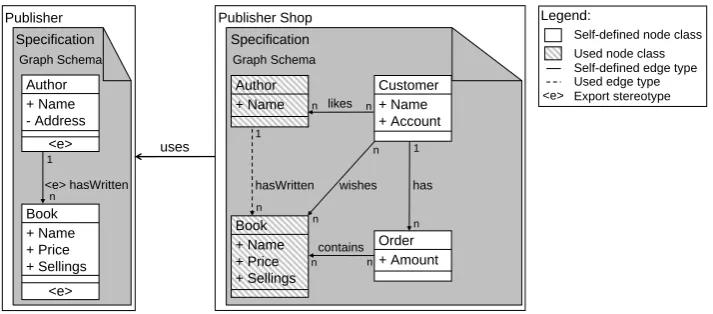
To illustrate our concepts, we use a simple Publishing Trade as example, whose static structure is depicted inFigure 1. Here, we assume that a book publisher already has an existing module
Publisher, managing allBooks and their Authors2. As thePublisherhas decided to sell his Books in an online shop, a new modulePublisher Shop for this purpose shall be developed, using the existing specification of thePublishermodule. The newPublisher Shopmanages the necessary data for selling theBooks of thePublisherincludingCustomers and their accordingOrders. Additionally, a Customer can have a wish list for desiredBooks, which is modeled by the wishes-edge. For advertising Books, thePublisher Shopmemorizes the Authors liked by theCustomers (likes-edge) when aCustomerhas bought aBook.
1 Until now, our approach has the restriction that every specification is executed exactly once within a distributed
system. We are developing appropriate concepts to fill this gap including the introduction of roles for executed applications and the usage of adequate role restrictions within graph transformations.
uses Publisher <e> hasWritten 1 n Publisher Shop has n 1 contains n n wishes n n likes n n Customer + Name + Account Author + Name - Address <e> Book + Name + Price + Sellings <e> Order + Amount hasWritten 1 Author + Name Book + Name + Price + Sellings n Specification Specification Legend:
Self-defined edge type Used edge type Self-defined node class Used node class
<e> Export stereotype Graph Schema Graph Schema
Figure 1: Graph schema for the distributed Publishing Trade
ThePublisherand thePublisher Shopare modeled by different specifications shown inFigure 1. As the Publisher manages all information about the Books and the Authors, the Publisher Shop
needs access to these data. Therefore, the Publisher defines an export interface by using the stereotype<e>. Each graph schema element marked with this stereotype forms the interface of the specification. An exported node class consists of the class name and the public attributes and methods defined within the node class.
The exported specification interface can be used by other specifications. To distinguish be-tween used and self-defined schema elements, the used elements are depicted as striped rectan-gles resp. dashed arrows within the specification. Although the used graph schema elements are read-only, they can be applied within the specification in nearly the same way as local, self-defined schema elements. E.g. edges can be self-defined between self-self-defined and used node classes or just between used node classes. With this mechanism, thePublisher Shopof our example inte-grates thePublisherinterface by defining new edges, e.g. thewishes-edge between the self-defined
Customernode class and the usedBooknode class realizing the wish list.
2.2 Distributed Graph Transformations
The dynamic behavior of a distributed system has to be specified within distributed graph
trans-formations. In distributed transformations, edges and nodes of used types can be applied in the
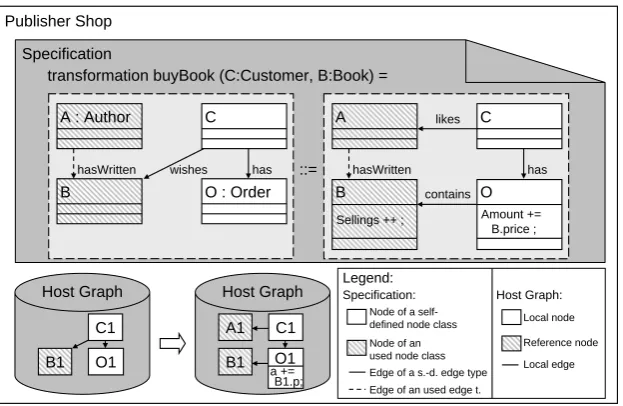
same way as of self-defined types but they address remote objects instead of local objects. At runtime, every node and edge only exists once within a distributed system, i.e. in the host graph of the application, which is based on the specification defining its type. Coupled applications only store reference nodes on remote nodes instead of copying remote nodes with their data into the local host graph. They are explicitly inserted into the runtime graphs storing the location of their according remote nodes. As reference nodes are only helper structures for accessing remote nodes, they are implicitly managed by the runtime level and are not regarded in the graph trans-formations. Their usage supports the realization of self-defined edges incident to remote nodes. In contrast to reference nodes, we do not store reference edges.
Publisher Shop
Specification
::= A : Author
B
C
O : Order
hasWritten wishes has
O
Amount += B.price ;
A C
hasWritten
contains
has likes
transformation buyBook (C:Customer, B:Book) =
Host Graph
B1 O1
C1
Host Graph
B1
A1 C1
O1
a +=
Legend:
Edge of a s.-d. edge type Edge of an used edge t.
Specification: Host Graph: Node of a
self-defined node class Node of an used node class
Local edge Local node
Reference node
B1.p;
B
Sellings ++ ;
Figure 2: Graph transformationBuyBook
within a distributed graph transformation by using the according node only in the transforma-tion’s right-hand side. This concept corresponds to creating a local node of a self-defined type. Analogously, the deletion of a remote node (and thus of the corresponding reference node) is triggered by using the according node only on the left-hand side of the transformation.
Furthermore, a reference node is automatically created in the local host graph if an appropriate node is used in the left-hand side of the transformation, and no adequate reference node is locally available, although an according remote node exists. In this case, the remote application defining the node’s type is searched for an adequate node, and an according reference node is created. Additionally, all reference nodes are automatically deleted if the actual remote node is deleted. Operations specified on remote objects, like the deletion of a node or an attribute assignment, are propagated transparently to the corresponding remote application3. To ensure the consistency of the host graphs by remote graph transformations, we will introduce a rule engine (cf.Section 5).
Figure 2 shows an example of the distributed graph transformation buyBookof the Publisher
Shop. In this transformation, a Customer buys a Book (given as input parameters), which has been on theCustomer’s wish list. This leads to the deletion of thewishes-edge as it is not longer needed. Furthermore, the two edgeslikesandcontainsare created. The attributeSellingscounting the number of sales ofB is incremented. Below the transformation, two example host graphs of thePublisher Shopare depicted showing the host graph before and after the execution of the transformation. According to the transformation edges are created and deleted and a new refer-ence nodeA1for theAuthor Ais inserted. In thePublisher’s host graph only the attributeSellings
of nodeB1is modified, which is not shown inFigure 2.
3 For propagating remote operations and the management of references, we develop an appropriate plug-in for the
3
Search Trees
After modeling a software system with a GTS, appropriate code has to be generated. As the matching of the left-hand side of a graph transformation has an exponential worst-case complex-ity, PROGRES and Fujaba use search trees [Z¨un96] for their code generation. In this section, we will describe these search trees using the code generation plug-in CodeGen2 [GSR05] of Fujaba as an example. As we present the current mechanism, we ignore the remote nature of operations concerning a coupled application.
3.1 General Structure of Search Trees
To generate executable and efficient code for graph transformations, every transformation is translated into a search tree. A search tree is a tree, having operations as nodes and precondition-relations between an operation and its child operations. The search tree contains all operations, which have to be performed for the modeled graph transformation in an appropriate execution order. In this paper, we use a more general notion of a search tree, since not only search op-erations are used. CodeGen2 uses over 20 different opop-erations, covering constraint checks and operations for creating and deleting nodes.
In general, the operations describe the runtime semantics of modeling elements of a transfor-mation. There is no 1-to-1-mapping between operations and modeling elements. One modeling element may result in several different operations in the search tree, because its runtime seman-tics is precisely defined in the code generation phase. On the other hand, one operation may also cover several modeling elements, as the semantics of one modeling element may be determined only in combination with other elements.
For translating the graph transformation into a search tree, every node of the transformation’s left-hand side (graph pattern) has to be identified in the host graph. As a first step, a search tree covering all bound nodes4is created. The second step regards all unbound nodes calculating a
spanning forest for the graph pattern. For every bound node, the forest contains a tree having the
bound node as root node. Every unbound node has to be searched in the host graph by traversing an edge of the pattern incident to a bound node. The unbound node together with its edge is inserted into the tree of the corresponding bound node. After building the complete spanning forest, for all unbound nodes of the spanning forest a search operation representing the unbound node and the traversed edge is inserted into the search tree. This operation is placed as child of the operation, which binds the edge’s source node.
Note that Fujaba does not allow isolated unbound nodes in graph patterns, because it uses the heap of the JAVA runtime environment instead of a graph database. Other graph transformation systems like PROGRES support this feature by querying the underlying database for nodes of a specific type. For the sake of simplicity, we do not regard the search of isolated nodes and patterns although this is covered by our approach using DRAGOS [B¨oh04].
After inserting the search operations into the search tree, the remaining modeling elements of the graph transformation (like edges and attribute assertions) have to be inserted. The position of
4 A bound node is a node, which already has been uniquely identified in the host graph, for example nodes given
Publisher Shop
Specification
A : Author
B O : Order
hasWritten wishes has contains
likes
query checkConsistency (B:Book, C:Customer) =
C
(a) Graph query
CheckBound "B"
CheckBound "C"
Search "A", "hasWritten"
Search "O", "has"
CheckEdge "wishes"
CheckEdge "contains" CheckEdge
"likes"
RootNode
(b) Search tree
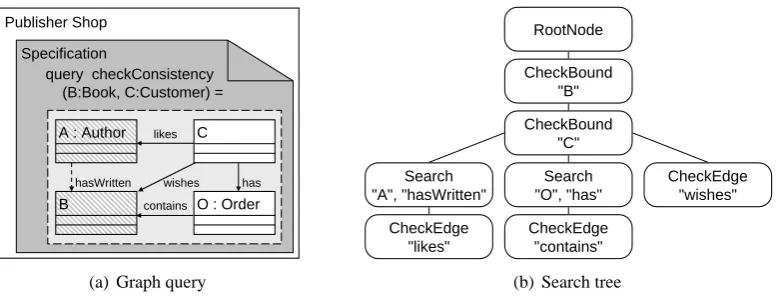
Figure 3: Graph querycheckConsistency
such an operation is determined by the following overall invariant of the tree: All preconditions of an operation must be fulfilled by preceding operations. To satisfy this invariant, the search tree may have to be reorganized according to the invariant. The complete algorithm for the search tree generation is shown in [GSR05].
To illustrate the generation of search trees, we introduce the querycheckConsistencydepicted inFigure 3(a). This query may be used for consistency checks, e.g. to test if thewishes-edge has been deleted when theBookhas been bought by theCustomerand is thus part of anOrder.
Figure 3(b)shows a possible search tree forcheckConsistency. The tree generation starts with twoCheckBound-operations forBandC, which are inserted as children of theRootNode. A Check-Bound-operation checks the validity of a bound node, i.e. that the node is not equal tonull.
To determine all search operations needed to cover the unbound pattern nodes, a spanning forest is computed consisting of two trees: One tree withBas root node and the other tree with
Cas root node. For our example, we assume that the spanning forest is given by all nodes with thehasWritten- and thehas-edge. According to this assumption, the search operations forAand
Ousing thehasWritten- resp. thehas-edge are inserted into the search tree.
To cover the remaining edges, namelycontains,wishesandlikes,CheckEdge-operations have to be inserted. ACheckEdge-operation must have at least those operations in their parent hierarchy, which cover the source and the target node of the edge. To fulfill this invariant, the tree may have to be reorganized before theCheckEdge-operations can be inserted.
In our example, the CheckBound-operation of node C (CheckC) is moved below the Check-Bound-operation of node B (CheckB) and all children of CheckB are moved below CheckC5. This reorganization is needed for the correct insertion of theCheckEdge-operation of thewishes -edge into the tree. All otherCheckEdge-operations can be inserted without any reorganization.
3.2 Cost Model
A graph transformation may have several different valid search trees, because there are several ways to cover all modeling elements by operations. To evaluate the different search trees, the
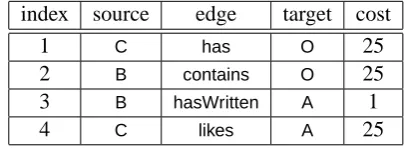
Table 1: Cost table for search operations of querycheckConsistency
index source edge target cost
1 C has O 25
2 B contains O 25
3 B hasWritten A 1
4 C likes A 25
code generation uses a cost model presented in the following.
Search operations may have different runtime costs, which can be estimated by exploiting e.g. the cardinalities of the graph schema. Search operations using a to-n-edge for matching an unbound node are very costly compared to those using a to-1-edge. Using a to-1-edge, the exact candidate node can be directly determined, whereas a search operation using a to-n-edge leads to n possible candidate nodes.
However, the costs for search operations can only be estimated, since the exact cardinality for a
to-n-edge in the host graph is not known during the code generation phase. Therefore, CodeGen2
and the PROGRES code generation use default values for the expected costs. [VVF05] presents an approach for adapting the edge cardinalities by analysis of sample instance graphs leading to very precise cost estimations. So far, this approach is not considered by CodeGen2 and thus not regarded in this paper.
Even by considering only the static graph schema, the runtime behavior can be greatly im-proved. Before generating the search tree, the costs for each operation of the transformation are estimated. Afterwards, a minimum spanning forest for the graph pattern is computed, which determines the preliminary search tree. This preliminary tree is incrementally extended by oper-ations until all modeling elements are covered choosing the cheapest operation in each step.
Considering our examplecheckConsistency(cf. Figure 3(a),Figure 3(b)), there are four possi-ble search operations (cf. Table 1), which have to be considered for the search tree generation. According to the target cardinalities of the edges, the costs for the search operations are either 1 or n. Note that this cost model is highly simplified and n has to be a real value greater than 1. For this purpose, CodeGen2 contains different cost strategies for assigning concrete cost values. The default cost strategy for search operations based on to-n-edges assumes a cardinality of 50. As result, it computes a cost of 25, since this is the value having 1 as lower and 50 as upper cardinality.
Table 2: Modified cost table for search operations of querycheckConsistency
index source edge target cost
1 C has O 25
2 B contains O 25
3 B hasWritten A 51
4 C likes A 25
4
Search Trees for Distributed Graph Transformations
InSection 2we presented our syntax and semantics for modeling distributed graph
transforma-tions. To execute such a transformation, it has to be translated into executable code. Therefore, we extend the CodeGen2-approach presented inSection 3.
In the following, only the code generation for queries is shown, because queries have the greatest impact on the runtime efficiency. A distributed query requires remote operations, like remote check operations and remote search operations. Each remote operation affects exactly one application which is called home application. After searching the distributed pattern, the transforming operations are performed, which require no modifications of CodeGen2.
4.1 Remote Offset
Remote operations have additional costs compared to their local correspondents, which results from the communication delay between the participating applications. The additional cost is called remote offset and depends on the network infrastructure. The remote offset is configurable for each pair of applications within a distributed system. By using a different cost strategy for remote operations, the offset is integrated into CodeGen2.
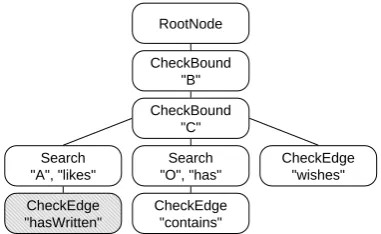
Revisit the queryconsistencyCheckintroduced inSection 3. Every search tree that is computed without regarding a remote offset uses the hasWritten-edge as first search operation. Thus, a remote operation is performed even it is not necessary, sinceAcan be found locally vialikes.
In many cases, a remote operation is more costly than every local operation. Considering this in our cost model, we introduce a remote offset for remote operations, which is larger than the maximal cardinality of any local edge. Thus, assuming a cost of 25 for a search operation using a to-n-edge, we set the remote offset to 50. The modified costs are depicted inTable 2.
Figure 4shows the search tree for the querycheckConsistency, which is computed according
to the modified cost table (cf. Table 2). Search operation 4 is chosen first instead of search operation 3 due to the remote offset. The only remote operation in the modified search tree is the
CheckEdge-operation oflikes, which is depicted striped in the search tree.
4.2 Boundary Nodes
In many cases, there exists a number of operations, which have the same home application. Instead of formulating queries for every operation, operations may be processed en bloc leading to one single query. Thus, the number of communication steps can be heavily reduced.
CheckBound "B" CheckBound
"C" Search
"A", "likes"
Search "O", "has"
CheckEdge "wishes" CheckEdge
"contains" CheckEdge
"hasWritten"
RootNode
Figure 4: Modified search tree for querycheckConsistency
such that every sub-pattern concerns solely one application. Additionally, several blocks for the same application may be needed, if contained elements are dependent on non-contained elements.
To illustrate this fact, the graph queryAdvertiseAuthor is depicted inFigure 5. The query can be used to advertise anAuthorto a givenCustomer C, using thelikes-relation of anotherCustomer
with the same interests. Starting at the only bound nodeC, the unbound nodes are searched in the following order: B,A1, C1andA2. This is the only possible order, as every search for an unbound node needs at least an edge incident to a bound node. Because of these dependencies, two different remote blocks are necessary for the same application, i.e. thePublisher.
To define the boundary of a block, we introduce the notion of boundary nodes. A boundary node is a node which needs at least one remote operation for its identification, and is incident to a local edge. InFigure 5,BandA2are boundary nodes due to the remote attribute check. Without the attribute check, the nodesBandA2can be covered locally. A block is defined as the largest connected graph pattern, which is limited by boundary nodes and covers only remote operations concerning the same application. E.g. two blocks exist in the query AdvertiseAuthor: Block 1 contains the attribute check of nodeB, the nodeA1and thehasWritten-edge. Block 2 contains the attribute check ofA2. These blocks are sent to their home application separately preserving this order. They are parameterized with the results of local searches, in the example byBresp. A2.
Publisher Shop
Specification
B : Book
A2 : Author
wishes likes
likes hasWritten
query AdvertiseAuthor
(C:Customer, n:String, m:String, out A2:Author) =
A1 : Author C1 : Cust. Name=n;
C
Name!=m;
linearize(Node RN, TreeSet LO){
RO := all direct subtrees of RN rooted by remote operations concerning one HA LO := LO + all remaining subtrees of RN
if (RO != /0){
for (i=2 to |RO|) move ROi below RO1
RN := root node of RO1
linearize(RN, LO) } else{
for (each l ∈ LO){
insert l below RN RN := root node of l linearize(RN, /0) }
} }
Listing 1: Pseudocode oflinearize
4.3 Realization of Remote Blocks
In the following, we describe how the creation of remote blocks can be computed after generating the search tree with CodeGen2 (cf. Section 3) considering the remote offset. We developed an algorithm for creating remote blocks using the generated search tree as input. This algorithm uses the following two propositions: Let R be the set of all remote operations concerning the same home application forming one remote block. Then
1. every element of R is contained in a common subtree with root RN6,
2. every element of R is reachable by RN by only traversing other elements of R.
We do not provide a formal proof of these propositions, but want to discuss their plausibility. To 1: Since a remote block is connected, all elements of R are somehow dependent on each other. Due to the tree structure of the search tree, these operations must have a common root op-eration. This root operation must cover a boundary node. Then, the elements of R are contained in the subtrees having a child of RN as their root.
To 2: This is valid, because all remote operations inside the remote block are dependent on each other.
In the following, we present the algorithm depicted inListing 1, which calculates the remote blocks. It rearranges all remote operations of the search tree in a chain, from which the blocks for the remote applications and their parameterization can be directly derived. The algorithm needs two sets, which are defined as follows: Let RO be the set of direct subtrees of RN, which are rooted by a remote operation concerning the same home application as RN. If RO is empty,
RO is recomputed containing all direct subtrees of RN, which are rooted by a remote operation
concerning the home application of one direct child of RN. Let LO be a set of subtrees within the search tree, which aggregates all direct subtrees of RN not contained in RO.
The algorithmlinearize(cf. Listing 1) starts with the root node of the search tree as RN and LO=/0. If RO6=/0, all subtrees contained in RO except of RO1 are moved below the root
node of RO1. Then the algorithm is called with the root node of RO1as new parameter RN and
6 The following abbreviations are used: RN for root node, and RO for remote operations having RN as direct
Op3 : CheckAttr
"name==n" RootNode Op1 : CheckBound
"C"
Op5 : Search
"C1", "likes"
Op7 : CheckAttr
"name!=m" Op6 : Search
"A2", „likes"
RootNode Op1 : CheckBound
"C"
Op3 : CheckAttr
"name==n"
Op4 : Search "A1", "hasWritten"
Op2 : Search "B", "wishes"
Op2 : Search "B", "wishes"
Op4 : Search "A1", "hasWritten"
Op5 : Search
"C1", "likes"
Op6 : Search
"A2", „likes"
Op7 : CheckAttr "name!=m"
Figure 6: Search tree for queryAdvertiseAuthor
LO. If RO= /0, all subtrees contained in LO are inserted below RN and the algorithm is called
recursively for all of their root nodes as RN and LO :=/0.
Due to proposition 1, every subtree containing a remote operation of block R is considered. According to proposition 2, every remote operation is considered by the algorithm. All needed rearrangements are possible, because siblings – and hence disjoint subtrees – in the search tree are independent of each other. The algorithm terminates, as every node of the search tree is used exactly once as parameter RN.
linearizedoes not improve the worst-case complexity of a distributed pattern matching. A
worst-case scenario consists of many remote blocks each covering only one remote operation. On the other hand, a best-case scenario consists of a chain of m remote nodes, which are connected by to-n-edges, and the chain is connected by a to-1-edge to a local node. Without optimization, at most n(m−1)communication steps are necessary to determine the match of the remote block, since m−1 links have to be traversed and there exist n possible candidates for each node in the pattern. With the block creation, the whole query can be done within one communication step.
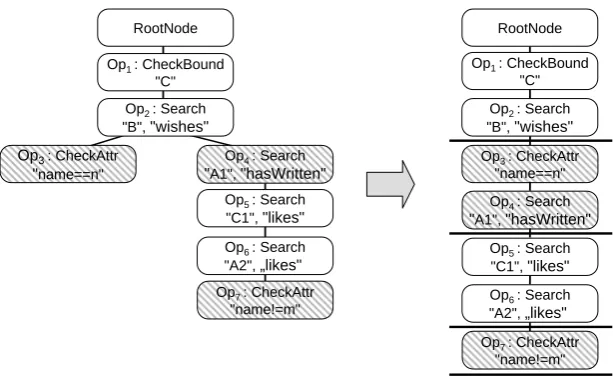
We will now illustrate the behavior oflinearizeconsidering the queryblockExample, whose search tree is shown inFigure 6. The algorithm starts with RN =RootNodeand LO= /0. Since all subtrees of RN start with a local operation, RO=/0 and LO={ST(Op1)}7. Due to RO=/0,
linearizeis called with RN={Op1}and LO=/0. Now, RO and LO are recomputed, resulting
in RO= /0 and LO={ST(Op2)}. linearize is called again with RN =Op2 and LO= /0.
RO is recomputed as{ST(Op3),ST(Op4)} and LO remains /0. The search tree is rearranged,
i.e. ST(Op4) is moved below Op3. Afterwards, linearize is called with RN=Op3 and
LO= /0. The algorithm has already computed the desired chain, and thus performs no further rearrangements of the search tree. Now it contains two chains of remote operations representing two remote blocks (cf.Subsection 4.2).
7 ST(Op1)stands for subtree with root nodeOp
5
Conclusion
In this paper, we presented our approach for generating efficient code for distributed graph trans-formations. Our approach is based on existing search tree algorithms used by the code gener-ations of PROGRES and Fujaba. The usage of search trees is advantageous for reducing the average complexity of searching graph patterns, as this search has an exponential worst-case complexity. To reduce also the communication costs arising in distributed systems, we extended the existing code generations: We have integrated a remote offset for remote operations in the cost heuristics giving priority to the execution of local operations. Additionally, we extract sub-patterns from the generated search tree, which are sent to the appropriate remote applications. Thus, the remote applications are not queried for every single element of the graph pattern, de-creasing the communication overhead.
As the coupled specifications export only schema parts, distributed graph transformations may be modeled, which violate certain local constraints. Thus, the execution of distributed graph transformations may lead to inconsistent host graphs within the distributed system. Therefore, we will introduce a rule engine as next step, which will facilitate the execution of repair actions [Win00]. Furthermore, this engine will be able to prevent the creation or deletion of a certain node as described in [HEET99].
Bibliography
[B¨oh04] Boris B¨ohlen. Specific graph models and their mappings to a common model. In John L. Pfaltz, Manfred Nagl, and Boris B¨ohlen, editors, 2ndInternational Workshop on Applications of Graph Transformations with Industrial Relevance, AGTIVE’03,
volume 3062 of LNCS, pages 45–60. Springer-Verlag, Heidelberg, Germany, 2004.
[FNTZ00] Thorsten Fischer, J¨org Niere, Lars Torunski, and Albert Z¨undorf. Story diagrams: A new graph rewrite language based on the Unified Modelling Language and Java. In Hartmut Ehrig, Gregor Engels, Hans-J¨org Kreowski, and Grzegorz Rozenberg, editors, 6th International Workshop on Theory and Application of Graph Transfor-mations, TAGT’98, volume 1764 of LNCS, pages 296–309. Springer-Verlag,
Heidel-berg, Germany, 2000.
[GSR05] Leif Geiger, Christian Schneider, and Carsten Reckord. Template- and modelbased code generation for MDA-tools. In Holger Giese and Albert Z¨undorf, editors, 3rd International Fujaba Days, volume tr-ri-05-259 of Technical Report. University of
Paderborn, Germany, 2005.
[HEET99] Reiko Heckel, Hartmut Ehrig, Gregor Engels, and Gabrielle Taentzer. A view-based approach to system modeling based on open graph transformation systems. In Hart-mut Ehrig, Gregor Engels, Hans-J¨org Kreowski, and Grzegorz Rozenberg, editors,
Handbook on Graph Grammars and Computing by Graph Transformation: Applica-tions, Languages, and Tools, volume 2, pages 639–668. World Scientific, Singapore,
[RSM06] Ulrike Ranger, Erhard Schultchen, and Christof Mosler. Specifying distributed graph transformation systems. 2006. Presented at the 3rdInternational Workshop on Graph-Based Tools, GraBaTs’06, in Natal, Brazil.
[Sch91] Andy Sch¨urr. Operationales Spezifizieren mit programmierten
Graphersetzungssys-temen. PhD-Thesis, RWTH Aachen University, 1991.
[VVF05] Gergely Varr´o, D´aniel Varr´o, and Katalin Friedl. Adaptive graph pattern matching for model transformations using model-sensitive search plans. In Gabor Karsai and Gabriele Taentzer, editors, 1st International Workshop on Graph and Model Trans-formation, GraMoT’05, volume 125 of ENTCS. Elsevier Science, 2005.
[Win00] Andreas Winter. Visuelles Programmieren mit Graphtransformationen. PhD-Thesis, RWTH Aachen University, 2000.