Proceedings of the
Third Workshop on Software Evolution
through Transformations:
Embracing the Change
(SeTra 2006)
Optimizing Pattern Matching Compilation
By Program Transformation
Emilie Balland and Pierre-Etienne Moreau
14 pages
Guest Editors: Jean-Marie Favre, Reiko Heckel, Tom Mens
Managing Editors: Tiziana Margaria, Julia Padberg, Gabriele Taentzer
Optimizing Pattern Matching Compilation
By Program Transformation
Emilie Balland1and Pierre-Etienne Moreau2
1UHP & LORIA at Nancy, France
[email protected] 2INRIA & LORIA at Nancy, France
Abstract: Motivated by the promotion of rewriting techniques and their use in major industrial applications, we have designedTom: a pattern matching layer on top of conventional programming languages. The main originality is to support pat-tern matching against native data-structures like objects or records. While crucial to the efficient implementation of functional languages as well as rewrite rule based languages, in our case, this combination of algebraic constructs with arbitrary na-tive data-structures makes the pattern matching algorithm more difficult to compile. In particular, well-known many-to-one automaton-based techniques cannot be used. We present a two-stages approach which first compiles pattern matching constructs in a naive way, and then optimize the resulting code by program transformation us-ing rewritus-ing. As a benefit, the compilation algorithm is simpler, easier to extend, and the resulting pattern matching code is almost as efficient as best known imple-mentations.
Keywords:Pattern matching, Optimization, Program transformation
1
Introduction to Tom
Pattern matching is an elegant high-level construct which appears in many programming lan-guages. Similarly to method dispatching in object oriented languages, it is essential in functional languages likeCaml,Haskell, orSML. It is part of the main execution mechanism in rewrite rule based languages likeASF+SDF,ELAN,Maude, orStratego.
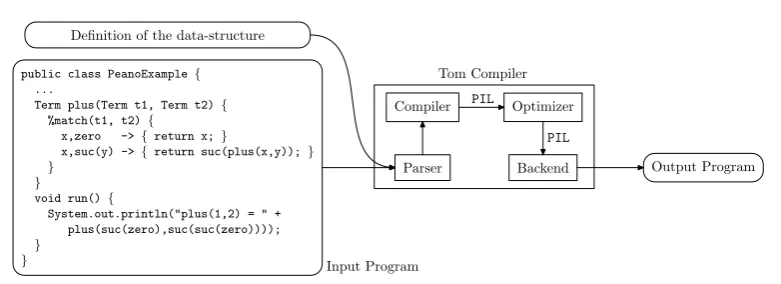
In this paper, we presentTom1 whose goal, similarly toProp[Leu96] orPizza[OW97], is to integrate the notion of pattern matching into classical languages such asCandJava. Following the first ideas presented in [MRV03], illustrated in Figure1, aTomprogram is a program written in a host language and extended by some new instructions like the%matchconstruct. Therefore, a program can be seen as a list ofTomconstructs interleaved with some sequences of characters. During the compilation process, allTomconstructs are dissolved and replaced by instructions of the host-language, as it is usually done by a preprocessor.
In order to understand the choices we have made when designing the pattern matching algo-rithm, it is important to considerTomas a generic and partialcompiler (like a pre-processor) which does not have any information about the host-language. In [BKM06],Tomprograms are
Definition of the data-structure
public class PeanoExample { ...
Term plus(Term t1, Term t2) { %match(t1, t2){
x,zero ->{return x;}
x,suc(y) ->{return suc(plus(x,y)); } }
}
void run(){
System.out.println("plus(1,2) = " + plus(suc(zero),suc(suc(zero)))); }
}
Parser Backend Output Program Compiler Optimizer
Tom Compiler
PIL PIL
Input Program
Figure 1: General architecture of Tom: the compiler generates an intermediate PIL program which is optimized before being pretty-printed by the back-end into the host-language.
described as islands anchored in host programs and the link between the two languages is for-mally defined in a generalized framework. In particular, the data-structure, against which the pattern matching is performed,is not fixed. In some sense, the data-structure is a parameter of the pattern matching, see [KMR05] for more details. In practice, this means that a description of the data-structure (a mapping) has to be given to explain Tom how to access subterms for example.
In this paper, we present how the introduced pattern matching construct is compiled, using a program transformation approach. There exists several methods [Car84,Aug85,Gr¨a91,FM01] to efficiently compile pattern matching. The simplest ones, calledone-to-one, inspect and com-pile each pattern independently. A more efficient approach consists in considering the system globally and building a discrimination network. These methods are calledmany-to-one, and they usually consist of three phases: constructing an automaton, optimizing it, and finally generating the implementation code. There are two main approaches to construct a matching automaton: one based on decision trees [Car84,Gr¨a91] and the other on backtracking automata [Aug85]. These two approaches emphasize the unavoidable compromise between speed and memory space [SRR95].
In our case, we cannot assume that a function symbol (i.e. a node of a tree) is represented by an integer, like it is commonly done in other implementations of pattern matching. Therefore, the classicalswitch/caseinstruction can no longer be used to perform the discrimination. SinceTomsupports several languages, it is also not possible to use an exception mechanism or a jump statement, like it can be done inMLcompilers [Jon87].
familiarity with term rewriting notations introduced in [BM05].
2
Compilation
To be data-structure independent and support several host-languages, Tom instructions, like %match, are compiled into an intermediate language code, calledPIL, before being translated into the selected host-language. To compile the%matchconstruct, we consider each rule inde-pendently.
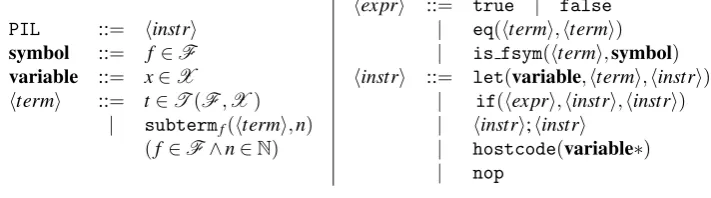
Contrary tomany-to-onealgorithms which construct decision trees or pattern automata, given a pattern, it is traversed top-down and left-to-right. Nested if-then-else constructs are generated to ensure that constructors of the pattern effectively occur in the subject at a correct position. This technique is inefficient because, for a set of rules, identical tests may be repeatedly performed. The worst-case complexity is thus the product of the number of rules and the size of the subject. The nested if-then-else are expressed in an intermediate language calledPIL, whose syntax is given in Figure2. Note thatPILhas both functional and imperative flavors: the assignment instruction let(variable,htermi,hinstri) defines a scoped unmodifiable variable, whereas the sequence instruction hinstri ; hinstri comes from imperative languages. A last particularity ofPILcomes from thehostcode(. . .)instruction which is used to abstract part of code written in the underlying host-language. This instruction is parameterized by a list of PIL-variables which are used in this part of host-code.
PIL ::= hinstri symbol ::= f ∈F variable ::= x∈X
htermi ::= t∈T(F,X)
| subtermf(htermi,n) (f ∈F∧n∈N)
hexpri ::= true | false
| eq(htermi,htermi)
| is fsym(htermi,symbol)
hinstri ::= let(variable,htermi,hinstri)
| if(hexpri,hinstri,hinstri)
| hinstri;hinstri | hostcode(variable∗)
| nop
Figure 2:PILsyntax
Similarly to functional programming languages, given a signatureFand a set of variablesX, the consideredPILlanguage can directly handleterms, boolean values (true,false), and per-form operations like checking that a given termt is rooted by a symbol f (is fsym(t,f)), ac-cessing to then-th child of a termt (subtermf(t,n)), or comparing two terms (eq(t1,t2)). The implementation ofsubtermf, eqandis fsym is given by the mapping which describes
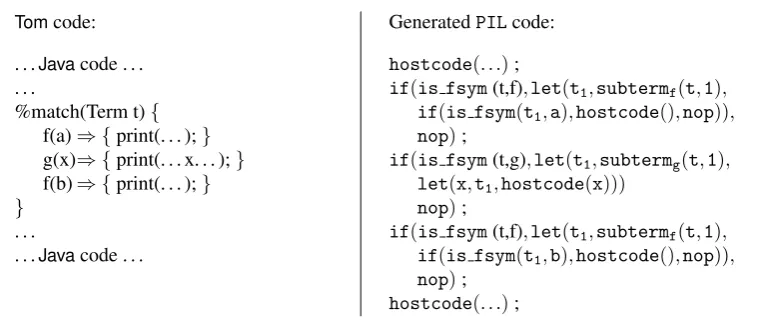
data-structures. To support the intuition, examples ofTomandPILcode are given in Figure3. We define PILsemantics as in [KMR05] by a big-step semantics `a laKahn. To represent a substitution, we model an environment by a stack of assignments of terms to variables. The set of environments is notedEnv. The reduction relation of the big-step semantics is expressed on tupleshε,δ,iiwhereεis an environment,δ is a list of pairs (environment, host-code), andiis an
Tomcode:
. . .Javacode . . . . . .
%match(Term t){
f(a)⇒ {print(. . . );}
g(x)⇒ {print(. . . x. . . );}
f(b)⇒ {print(. . . );} }
. . .
. . .Javacode . . .
GeneratedPILcode:
hostcode(. . .);
if(is fsym(t,f),let(t1,subtermf(t,1),
if(is fsym(t1,a),hostcode(),nop)),
nop);
if(is fsym(t,g),let(t1,subtermg(t,1),
let(x,t1,hostcode(x)))
nop);
if(is fsym(t,f),let(t1,subtermf(t,1),
if(is fsym(t1,b),hostcode(),nop)),
nop); hostcode(. . .);
Figure 3: The left column shows aTomprogram which contains three patterns: f(a),g(x), and f(b), wherexis a variable. As an example, when the second pattern matchest, this means thatt is rooted by the symbolg, and the variablexis instantiated by its immediate subterm. The right column shows the correspondingPILcode generated byTom. We can notice that this code is not optimal, but will hopefully be optimized by transformation rules afterwards.
which appear in the block. A complete definition of the semantics can be found in [BM05].
hε,δ,ii 7→bsδ0,withε∈Env,δ,δ0∈[Env,hinstri]∗,andi∈ hinstri
As PILprograms are predominantly constituted of if-then-else statements, the optimization rules will depend of the evaluation of expressionse∈ hexpri. In the following we introduce the notions of equivalence and incompatibility for expressions, and we consider two functionseval andΦ. evalis a function which given an environmentε and an expressione evaluateseinε
to obtain a value (i.etruefor true orfalsefor false). Given an environmentε and a host-code
listδ, the evaluation of a programπ∈PILresults in a host-code list: hε,δ,πi 7→bsδ0. During
this evaluation, expressionse, subterm ofπ, are evaluated in environments ε0. We call Φ the function that associates such an environmentε0 to a sub-expressione ofπ: ε0=Φ(π,e,ε,δ).
More formal definitions can be found in [BM05].
Definition 1 Given a programπ, two expressionse1 ande2are said π-equivalent, and noted
e1∼πe2, if for all starting environmentε,δ,eval(ε1,e1) =eval(ε2,e2)whereε1=Φ(π,e1,ε,δ) andε2=Φ(π,e2,ε,δ).
Definition 2 Given a program π, two expressions e1 and e2 are said π-incompatible, and noted e1⊥π e2, if for all starting environment ε, δ, eval(ε1,e1)6=eval(ε4,e2) where ε1= Φ(π,e1,ε,δ)andε2=Φ(π,e2,ε,δ).
We can now define two conditions which are sufficient to determine whether two expressions areπ-equivalent orπ-incompatible. Propositions1 and2 are interesting because the problem
easy to be checked because ofPILlanguage restrictions andcond2is a purely syntactic condi-tion. Proofs of these propositions are in [BM05].
Proposition 1 Given a programπand two expressions e1,e2∈ hexpriat different positions in, we have e1∼πe2if:∀ε,δ,Φ(π,e1,ε,δ) =Φ(π,e2,ε,δ) (cond1)and e1=e2(cond2).
The equality=correspond to syntactic equality and the two considered expressions are in a different position in the program so the two environments of evaluation are not trivially equal.
Proposition 2 Given a programπ and two expressions e1,e2∈ hexpri, we have e1⊥π e2 if:
∀ε,δ,Φ(π,e1,ε,δ) =Φ(π,e2,ε,δ) (cond1)andincompatible(e1,e2) (cond2), whereincompatible is defined as follows:
incompatible(e1,e2) = match e1,e2with
| false,true → > | true,false → >
| is fsym(t,f1),is fsym(t,f2) → > if f16=f2
| , → ⊥
3
Optimization
An optimization is a transformation which reduces the size of code (space optimization) or the execution time (time optimization). In the case ofPIL, the presented optimizations reduce the number of assignments (let) and tests (if) that are executed at run time. When manipulating abstract syntax trees, an optimization can easily be described by a rewriting system. Its applica-tion consists in rewriting an instrucapplica-tion into an equivalent one, using a condiapplica-tional rewrite rule of the formi1→i2IFc.
Definition 3 An optimization rule i1→i2 IF c rewrites a program π into a program π0 if
there exists a positionω and a substitutionσ such thatσ(i1) =π|ω,π0=π[σ(i2)]ω andσ(c)is verified. Ifc=e1∼e2(resp. c=e1⊥e2), we say thatσ(c)is verified whenσ(e1)∼π|ω σ(e2)
(resp.σ(e1)⊥π|ω σ(e2)).
3.1 Reducing the number of assignments
This kind of optimization is standard, but useful to eliminate useless assignments. In the context of pattern matching, this improves the construction of substitutions, when a variable from the left-hand side is not used in the right-hand side for example.
3.1.1 Constant propagation.
This first optimization removes the assignment of a variable defined as a constant. Since no side-effect can occur in aPILprogram, it is possible to replace all occurrences of the variable by the constant (writteni[v/t]).
3.1.2 Dead variable elimination and Inlining.
Using a simple static analysis, these optimizations eliminate useless assignments:
DeadVarElim:let(v,t,i) → i IF use(v,i) =0 Inlining:let(v,t,i) → i[v/t]IF use(v,i) =1
whereuse(v,i) is a function that computes an upper bound on the number of occurences of a variablevin an instructioni.
3.1.3 Fusion.
The following rule merges two successive let which assign the same value to two different variables. This kind of optimization rarely applies on human written code, but in the context of pattern matching compilation (see Figure3), this case often occurs. By merging the bodies, this allows to recursively perform some optimizations on subterms.
LetFusion:let(v1,t1,i1);let(v2,t2,i2) → let(v1,t2,i1;i2[v2/v1])IFt1∼t2
Note that the termst1andt2must be compatible to ensure that values ofv1andv2are the same at run time. We also suppose thatuse(v1,i2) =0. Otherwise, it would require to replacev1by a fresh variable ini2.
3.2 Reducing the number of tests
The key technique to optimize pattern matching consists in merging branches, and thus tests that correspond to patterns with identical prefix. Usually, the discrimination between branches is performed by a switch/case instruction. In Tom, since the data-structure is not fixed, we cannot assume that a symbol is represented by an integer, and thus, contrary to standard approaches, we have to use anifstatement instead. This restriction prevents us from selecting a branch in constant time. The two following rules define the fusion and the interleaving of conditional blocks.
3.2.1 Fusion.
The fusion of two conditional adjacent blocks reduces the number of tests. This fusion is possible only when the two conditions areπ-equivalent. Remind that the notion ofπ-equivalence means
that the evaluation of the two conditions in a given program are the same (see Definition1):
IfFusion:if(c1,i1,i01);if(c2,i2,i02)→if(c1,i1;i2,i01;i02)IFc1∼c2
3.2.2 Interleaving.
As matching code consists of a sequence of conditional blocks, we would like to optimize blocks withπ-incompatible conditions (see Definition2). Some parts of the code cannot be both ex-ecuted in a given environment, so swapping statically their order does not change the program behavior.
As we want to keep only one of the conditional block, we determine what instructions must be executed in case of success or failure of the condition and we obtain the two following trans-formation rules:
if(c1,i1,i01);if(c2,i2,i02)→if(c1,i1;i02,i01;if(c2,i2,i02))IFc1⊥c2
if(c1,i1,i01);if(c2,i2,i02)→if(c2,i01;i2,if(c1,i1,i01);i02)IFc1⊥c2
As for the equivalence in theIfFusionrule, to evaluatec1⊥c2, we just have to verify thate1 ande2are incompatible (cond2). Note that the two presented rules are not right-linear, therefore some code is duplicated (i02in the first rule, andi01 in the second one). As we want to maintain linear the size of the code, we consider specialized instances of these rules with respectivelyi02 andi01equal tonop.
IfInterleaving: if(c1,i1,i01);if(c2,i2,nop)→if(c1,i1,i01;if(c2,i2,nop))IFc1⊥c2
if(c1,i1,nop);if(c2,i2,i02)→if(c2,i2,if(c1,i1,nop);i02)IFc1⊥c2
These two rules reduce the number of tests at run time because one of the tests is moved into the “else” branch of the other. In practice, we only use the first one labelled byIfInterleaving. The second rule can be instantiated and used to swap blocks. Wheni01andi02are reduced to the instructionnop, the second rule can be simplified into:
if(c1,i1,nop);if(c2,i2,nop)→if(c2,i2,if(c1,i1,nop))IFc1⊥c2
Asc1andc2areπ-incompatible, we have the following equivalence:
if(c2,i2,if(c1,i1,nop)) ≡if(c2,i2,nop);if(c1,i1,nop)
After all, we obtain the following rule corresponding to the swapping of two conditional adja-cent blocks. This rule does not optimize the number of tests but is useful to bring closer blocks subject to be merged thanks to the strategy presented in the next section.
IfSwapping: if(c1,i1,nop);if(c2,i2,nop)→if(c2,i2,nop);if(c1,i1,nop)IFc1⊥c2
3.3 Application strategy
source program but the termination is an essential criterion. Moreover, the strategy should apply the rules to obtain a program as efficient as possible. Let us consider again the program given in Figure3, and let us suppose that we interleave the last two patterns. This would result in the following sub-optimal program:
if(is fsym(t,f),let(t1,subtermf(t,1),if(is fsym(t1,a),hostcode(),nop)),nop);
if(is fsym(t,g),let(t1,subtermg(t,1),let(x,t1,hostcode(x)))
if(is fsym(t,f),let(t1,subtermf(t,1),if(is fsym(t1,b),hostcode(),nop)),nop)
TheIfSwappingandIfFusionrules can no longer be applied to share theis fsym(t,f)
tests. This order of application is not optimal. As we want to grantIfFusion, the interleaving rule must be applied afterward, when no more optimization is possible.
The second matter is to ensure termination. TheIfSwappingrule is the only rule that does not decrease the size or the number of assignments of a program. To limit its application to interesting cases, we define a condition which ensures that a swapping is performed only if it enables a fusion. This condition can be implemented in two ways, either in using a context, or in defining a total order on conditions noted<(a lexicographic order for example). The second approach is more efficient: similarly to a swap-sort algorithm it ensures the termination of the algorithm. In this way, we obtain a newIfSwappingrule:
if(c1,i1,nop);if(c2,i2,nop)→if(c2,i2,nop);if(c1,i1,nop)IFc1⊥c2 ∧c1<c2
Using basic strategy operators such asInnermost(s)(which appliess as many times as pos-sible, starting from the leaves), s1|s2 (which appliess1 ors2 indifferently), repeat(s) (which appliessas many times as possible, returning the last unfailing result), ands1;s2(which applies s1, and thens2 ifs1 did not fail), we can define a strategy which describes how the considered rewrite system should be applied to normalize aPILprogram:
Innermost(
repeat(ConstProp|DeadVarElim|Inlining|LetFusion|IfFusion|IfSwapping);
repeat(IfInterleaving) )
Starting from the program given in Figure3, we can apply the ruleIfSwapping, followed by a step ofIfFusion, and we obtain:
if(is fsym(t,f), let(t1,subtermf(t,1),if(is fsym(t1,a),hostcode(),nop))
; let(t1,subtermf(t,1),if(is fsym(t1,b),hostcode(),nop)),nop);
if(is fsym(t,g),let(t1,subtermg(t,1),let(x,t1,hostcode(x))),nop)
Then, we can apply a step of Inlining to remove the second instance of t1, a step of LetFusion, and a step ofInterleaving(is fsym(t1,a)andis fsym(t1,b)areπ-incompatible).
This results in the following program:
if(is fsym(t,f),let(t1,subtermf(t,1),
if(is fsym(t1,a),hostcode(),if(is fsym(t1,b),hostcode(),nop))),nop);
Sinceis fsym(t,f)andis fsym(t,g)areπ-incompatible, we can apply a step ofIfInterleaving, and get the irreducible following program:
if(is fsym(t,f),
let(t1,subtermf(t,1),if(is fsym(t1,a),hostcode(),if(is fsym(t1,b),hostcode(),nop))),
if(is fsym(t,g),let(x,subtermg(t,1),hostcode(x)),nop)
4
Properties
When performing optimization by program transformation, it is important to ensure that the generated code has some expected properties. The use of formal methods to describe our opti-mization algorithm allows us to give proofs. In this section we show that each transformation rule is correct, in the sense that the the optimized program has the same observational behavior as the original. We also show that the optimized code is both more efficient, and smaller than the initial program.
4.1 Correction
Definition 4 Givenπ1andπ2two well-formedPILprograms, they are semantically equivalent, notedπ1∼π2, when:
∀ε,δ,∃δ0s.t.hε,δ,π1i 7→bsδ0andhε,δ,π2i 7→bsδ0
Definition 5 A transformation ruler is correct if for all well-formed programπ,rrewritesπ
inπ0(Definition3) implies thatπ∼π0(Definition4).
From this definition, we prove that every rule given in Section 3 is correct. For that, two conditions have to be verified:
1. π0is well-formed,
2. ∀ε,δ, the derivations ofπandπ0lead to the same resultδ0.
The first condition is quite easy to verify. The second one is more interesting: we consider a programπ, a rulel→rIFc, a positionω, and a substitutionσ such thatσ(l) =π|ω. We have
π0=π[σ(r)]ω. We have to compare the derivations ofπandπ
0in the context
ε,δ.
• when ω is the empty position (which corresponds to the root), we have to compare the derivation tree ofπ=σ(l)andπ0=σ(r),
• otherwise, we consider the derivation ofπ(resp.π0): there is a step which needs in premise
the derivation ofπ|ω (resp.π[σ(r)]ω). This is the only difference between the two trees.
In both cases, we have to verify thatπ|ω =σ(l)andσ(r)have the same derivation in a given
• equal toε,δ whenωis the empty position,
• otherwise, we have to consider the instruction iwhich immediately contains σ(l) (resp.
σ(r)). The context is defined by the context in whichiis evaluated in the derivation tree ofπ(resp.π0).
In the following, we give one representative proof of correction:IfSwapping2. To simplify
the proof we considerl,randcinstead ofσ(l),σ(r)andσ(c). In this rule,l=if(c1,i1,nop);if(c2,i2,nop) andr=if(c2,i2,nop);if(c1,i1,nop). To prove thatπ∼π0, we have to verify that for a given
ε,δ,landrhave the same derivation. Sincec1andc2areπ-incompatible, three cases have to be studied:
Case 1: eval(ε,c1) =trueandeval(ε,c2) =false
hε,δ,i1i 7→bsδ0 eval(ε,c1) =true hε,δ,if(c1,i1,nop)i 7→bsδ0
hε,δ0,nopi 7→bsδ0 eval(ε,c2) =false hε,δ0,if(c2,i2,nop)i 7→bsδ0 hε,δ,if(c1,i1,nop);if(c2,i2,nop)i 7→bsδ0
We now consider the programif(c2,i2,nop);if(c1,i1,nop).
Starting from the same environmentε andδ, we show that the derivation leads to the same
stateδ0, and thus prove thatif(c1,i1,nop);if(c2,i2,nop)andif(c2,s2,nop);if(c1,s1,nop)are equivalent:
hε,δ,nopi 7→bsδ eval(ε,c2) =false hε,δ,if(c2,i2,nop)i 7→bsδ
hε,δ,i1i 7→bsδ0 eval(ε,c1) =true hε,δ,if(c1,i1,nop)i 7→bsδ0
hε,δ,if(c2,i2,nop);if(c1,i1,nop)i 7→bsδ0
Sinceπ andπ0are well-formed, their derivation in a given context are unique (see [BM05]). hε,δ,i1i 7→bsδ0is part of these derivation trees, so it is unique, andδ0is identical in both
deriva-tions.
Case 2: eval(ε,c1) =falseandeval(ε,c2) =true, the proof is similar.
Case 3: eval(ε,c1) =falseandeval(ε,c2)false, the proof is similar.
4.2 Time and space reduction
To show that the optimized code is both more efficient, and smaller than the initial program, we consider two measures:
• thesizeof a programπ is the number of instructions which constitute the program,
• theefficiencyof a programπ is determined by the number of tests and assignments which
are performed at run time.
It is quite easy to verify that each transformation rule does not increase the size of the pro-gram: DeadVarElim, ConstProp, Inlining, and LetFusion decrease the size of a program, whereasIfFusion,IfInterleavingandIfSwappingmaintain the size of the transformed program.
It is also clear that no transformation can reduce the efficiency of a given program:
• each application ofDeadVarElim, ConstProp, and Inliningreduces by one the number of assignment that can be performed at run time,
• IfFusionreduces by one the number of tests,
• IfInterleavingalso decreases the number of tests when the first alternative is chosen. Otherwise, there is no optimization,
• IfSwappingdoes not modify the efficiency of a program.
The program transformation presented in Section 3 is an optimization which improves the efficiency of a given program, without increasing its size. Similarly to [FM01], this result is interesting since it allows to generate efficient pattern matching implementations whose size is linear in the number and size of patterns.
5
Experimental Results
The Tom compiler is written in Tom andJava. Therefore, the presented algorithm described using rules and strategies, has been implemented inTom. As illustrated Figure1, the optimizer is just an extra phase of the compiler, which is now integrated into the main distribution using the strategy given in Section3.3. In order to illustrate the efficiency of the compiler we have selected several representative programs and measured the effect of optimization in practice:
Fibonnacci Eratosthene Langton Gomoku Nspk Structure Tom Java 21.3s 174.0s 15.7s 70.0s 1.7s 12.3s
Tom Java Optimized 20.0s 2.8s 1.4s 30.4s 1.2s 11.3s
- Fibonacci computes 500 times the 18th Fibonacci number, using a Peano representation. On this example, the optimizer has a small impact because the time spent in matching is smaller than the time spent in allocating successors and managing the memory.
- Eratosthene computes prime numbers up to 1000, using associative list matching. The improvement comes from theInliningrules which avoids computing a substitution unless the rule applies (i.e. the conditions are verified).
algorithm, the optimizer performs program transformations such that a pair (position,symbol) is never tested more than once. This interesting property, which characterizes deterministic automata based approaches, can unfortunately not be generalized to any program.
-Gomokulooks for five pawn on a go board, using list matching. This example contains more than 40 patterns and illustrates the interest of test-sharing.
-Nspkimplements the verification of the Needham-Schroeder Public-Key Protocol.
- Structureis a prover for the Calculus of Structures where the inference is performed by pattern matching and rewriting.
The following table gives some comparisons with other well known implementations.
Fibonnacci Eratosthene Langton Tom Java Optimized 20.0s 2.8s 1.4s
Tom C Optimized 0.95s 0.36s 0.84s
OCaml 0.44s 0.7s 1.36s
ELAN 0.77s 0.8s 1.26s
All these examples are available on the Tomweb page. The measures have been done on a PowerMac 2 GHz, using Java 1.4.2, gcc 4.0, and Ocaml 3.09. They show that the proposed approach is effective in practice and allowsTomto become competitive with state of the art im-plementations such asOCaml. We should remind thatTomis not dedicated to a unique language. In particular, the fact that data-structure can be user-defined contrary to functional languages prevents us from using exception, goto, andswitch constructs and thus optimizations like those presented in [FM01].
6
Conclusion
In this paper, we have presented a new approach to compile pattern matching. This method is based on well-attested program optimization methods. Separating compilation and optimiza-tion in order to keep modularity, and to facilitate extensions is long-established in the compiler construction community. Using a program transformation and a formal method approach is an elegant way to describe, implement, and certify the proposed optimizations. This work is closed to Sestoft approach [Ses96] which compiles naivelyML-style pattern matches and by partial eval-uation removes redundant cases instead of constructing directly the decision tree. Moreover, this two-stage pattern compilation is directly implemented inTomand shows howTomlanguage is well-adapted for program analysis-transformation.
We have only be interested in optimizing syntactic matching and thus considered a subset of
PIL language. As Tomalready manages associativity, a future work will consist in develop-ing new transformation rules adapted to this theory, without havdevelop-ing to change the rules relative to syntactic one. However, note that the presented rules remain correct when considering an extension ofPIL.
work combined with the formal validation of pattern matching [KMR05] is another step towards the construction of certified/certifying optimizing compilers.
Bibliography
[Aug85] L. Augustsson. Compiling pattern matching. In Proceedings of the conference on Functional Programming Languages and Computer Architecture. Pp. 368–381. Springer-Verlag, 1985.
[BKM06] E. Balland, C. Kirchner, P.-E. Moreau. Formal Islands. In Johnson and Vene (eds.), Proceedings of the 11th international conference on Algebraic Methodology and Soft-ware Technology. LNCS 4019, pp. 51–65. Springer-Verlag, 2006.
[BM05] E. Balland, P.-E. Moreau. Optimizing Pattern Matching by Program Transformation. Technical report, INRIA-LORIA, 2005.http://hal.inria.fr/inria-00000763.
[Car84] L. Cardelli. Compiling a functional language. InProceedings of the ACM Symposium on LISP and Functional Programming. Pp. 208–217. 1984.
[FM01] F. L. Fessant, L. Maranget. Optimizing pattern matching. InProceedings of the sixth International Conference on Functional Programming. Pp. 26–37. ACM Press, 2001. doi:http://doi.acm.org/10.1145/507635.507641
[Gr¨a91] A. Gr¨af. Left-to-Right Tree Pattern Matching. In Proceedings of the 4th interna-tional conference on Rewriting Techniques and Applications. LNCS 488, pp. 323– 334. Springer-Verlag, 1991.
[Jon87] S. L. P. Jones.The Implementation of Functional Programming Languages (Prentice-Hall International Series in Computer Science). Prentice-Hall, Inc., Upper Saddle River, NJ, USA, 1987.
[KMR05] C. Kirchner, P.-E. Moreau, A. Reilles. Formal Validation of Pattern Matching Code. In Barahone and Felty (eds.),Proceedings of the 7th international conference on Prin-ciples and Practice of Declarative Programming. Pp. 187–197. ACM, July 2005.
[Leu96] A. Leung. C++-based Pattern Matching Language. 1996. citeseer.ist.psu.edu/leung96cbased.html
[MRV03] P.-E. Moreau, C. Ringeissen, M. Vittek. A Pattern Matching Compiler for Multi-ple Target Languages. In Hedin (ed.),12th Conference on Compiler Construction. LNCS 2622, pp. 61–76. Springer-Verlag, May 2003.
[RKS99] O. R¨uthing, J. Knoop, B. Steffen. Detecting Equalities of Variables: Combining Ef-ficiency with Precision. In Cortesi and Fil´e (eds.), SAS. LNCS 1694, pp. 232–247. Springer-Verlag, 1999.
[Ses96] P. Sestoft. ML Pattern Match Compilation and Partial Evaluation. In Danvy et al. (eds.),Dagstuhl Seminar on Partial Evaluation. LNCS 1110, pp. 446–464. Springer-Verlag, 1996.