Solanum jobsonii, a novel andromonoecious bush
tomato species from a new Australian national park
L. Mae Lacey1, Jason T. Cantley1, Christopher T. Martine1
1 Department of Biology, Bucknell University, 1 Dent Drive, Lewisburg, PA, USA
Corresponding author: Christopher T. Martine ([email protected])
Academic editor: L. Giacomin | Received 3 February 2017 | Accepted 13 June 2017 | Published 28 June 2017
Citation: Lacey LM, Cantley JT, Martine CT (2017) Solanum jobsonii, a novel andromonoecious bush tomato species
from a new Australian national park. PhytoKeys 82: 1–13. https://doi.org/10.3897/phytokeys.82.12106
Abstract
A new species of Solanum from the Australian “andromonoecious bush tomato clade” of Solanum
subgenus Leptostemonum is described. Solanum jobsonii Martine, J.Cantley, & L.M.Lacey, sp. nov. is
part of the S. eburneum Symon species group. It most closely resembles S. eburneum and S. watneyi
Martine & Frawley of the northwestern part of the Northern Territory, but is separated geographically
from them by the Sturt Plateau. Morphometric analyses show that S. jobsonii differs statistically from
S. eburneum, S. watneyi, and S. diversiflorum F.Muell. – a similar species in habit and leaf characters – in several key reproductive and vegetative characters. We provide morphometric evidence for the
recognition of S. jobsonii, a complete description, a table of comparisons within its species group, and
a map showing species group distributions. One of the first new species to be described from Limmen
National Park (established 2012), S. jobsonii is a testament to the value of designating and protecting
public lands, as well as supporting science relating to them.
Keywords
Limmen National Park, Northern Territory, Solanum watneyi, Solanum eburneum, Solanum diversiflorum,
Solanum jobsonii, Peter Jobson, andromonoecy, national parks, public lands, Australia
Introduction
Solanum L. is one of the more species-rich Angiosperm genera, with representation on
all continents save for Antarctica. In Australia, where upwards of 120 Solanum species are known (Symon 1981), members of the group are especially abundant components of disturbance-adapted and fire-tolerant outback plant communities; and a handful of
http://phytokeys.pensoft.net
Copyright L. Mae Lacey et al. This is an open access article distributed under the terms of the Creative Commons Attribution License (CC BY 4.0), which permits unrestricted use, distribution, and reproduction in any medium, provided the original author and source are credited.
species have been used for thousands of years by indigenous peoples as “bush tucker” (Peterson 1976, Symon 1981, Doonday et al. 2013).
However, despite the conspicuous nature of the genus in parts of Australia, new spe-cies of Solanum have continued to be discovered in recent years – especially members of the “spiny solanum” group (Solanum subgenus Leptostemonum Bitter) in the northern Australian Monsoon Tropics (Brennan et al. 2006, Bean and Albrecht 2008, Barrett 2013, Martine et al. 2013, Bean 2016, Martine et al. 2016a, Martine et al. 2016b).
The “andromonoecious bush tomato clade” is a group of 12 currently recognized species that was recognized by Martine and colleagues based on analysis of ITS (Martine et al. 2006) and trn-KmatK sequence data (Martine et al. 2009). Included in the clade are two morphologically similar species groups, one comprised of S. chippendalei
Symon, S. succosum A.R. Bean & Albr., S. beaugleholei Symon, and S. phlomoides
A.Cunn. ex Benth., and another comprised of S. eburneum Symon, S. watneyi Martine & Frawley and S. diversiflorum F.Muell. Unnamed variants are known to exist within each of these groups that require the collection of more specimens. One of these variants, from the S. eburneum group, is described here as Solanum jobsonii sp. nov.
Reproductive populations of Solanum jobsonii piqued the curiosity of Australian bota-nists during 2008 and 2010 biodiversity surveys (see Cowie et al. 2011) of the proposed Limmen National Park on the edge of the Gulf of Carpentaria in northeastern Northern Territory. Collections of these plants, initially identified as S. aff. eburneum, were brought to the attention of the authors by the staff of the Northern Territory Herbarium and in-spired a collecting expedition to the recently-designated Limmen NP in 2016. Specimens from this expedition and seed-grown greenhouse plants were used to conduct morpho-metric comparisons between S. jobsonii and the three previously recognized taxa in the S.
eburneum group. We here contrast both its morphology and distribution with its close
relatives, and provide a table of comparisons for members of the S. eburneum group.
Materials and methods
Based on locality data provided on specimens available at DNA and BUPL herbaria (acronyms according to Index Herbariorum; http://sweetgum.nybg.org/science/ih/), the primary known populations of S. jobsonii were visited along the Nathan River Road in Limmen NP. Herbarium specimens, leaf material for future DNA work, and mature fruits were collected. Seeds of the putative new species were removed from fresh fruits, dried, and stored for later use in establishing a greenhouse population.
then compared against related species collected during the 2016 expedition and speci-mens examined during visits to the Northern Territory Herbaria at Palmerston (DNA) and Alice Springs (NT).
Comparison statistics were generated using the software package JMP Pro 12 (SAS Institute Inc., Cary, North Carolina, USA). Initial analyses were carried out on the dataset using a one-way ANOVA with Student’s t-test mean comparison with P<0.05. A Connecting Letters Report summarizes mean values of each character across the four study taxa (S. watneyi, S. eburneum, S. diversiflorum, S. jobsonii) and provided simi-larity comparisons based on calculated means and tests carried out. This Connecting Letters Report was utilized to investigate individual differences between species before analyzing grouping differences through multivariate morphometric analyses.
Multivariate morphometric analyses were then conducted on the entire dataset for all four species. Principal component analysis (PCA) was used to determine morpho-logical variation pattern groupings among the four taxa. A set of variables was plotted based on corresponding eigenvalues calculated using JMP Pro, representing the origi-nal dataset with the greatest variation in a two-dimensioorigi-nal space.
Results
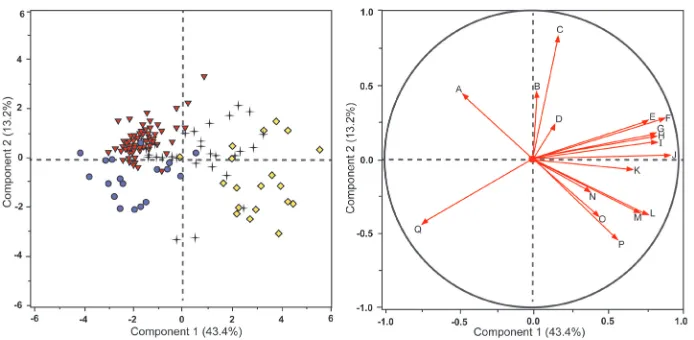
The PCA recognized five eigenvalues above a value of 1 and these were used to deter-mine that the data set was in its entirety five-dimensional, with principal components 1 and 2 contributing the greatest amount of variation among the points (56.6% of the variation within the data set). Figure 1 provides both the score plot with each of the data points plotted, as well as the loading plot. The loading plot depicts which char-acters had the greatest weight in pulling out the points within the score plot to each of their respective quadrants, therefore determining which characters had the greatest influence in delimiting the species. When reading Figure 1, one may mentally super-impose the two plots to view the points and the corresponding vectors whose magni-tude represents the associated character’s weight in plotting the dataset and grouping of individuals, but as the loading plot is much smaller it is represented as a separate panel to depict species character influence described above.
The PCA score plot based on all measured characters for S. watneyi, S. eburneum, S.
diversiflorum, and S. jobsonii supports the relative distinctiveness of Solanum jobsonii based
on character grouping when compared to the other three closely related taxa, although some overlapping with S. diversiflorum and S. eburneum variants is observed (Figure 1a). The loading plot (Figure 1b) suggests that the depth of lobing in young leaves near the apices of growing shoots (identified in Table 1 as “apical leaves”) was the character with the greatest weight pulling S. jobsonii in the direction of its respective quadrant.
Figure 1. Principal components analysis score plot (Fig.1a, left) and loading plot (Fig. 1b, right) of characters and species in Table 1. Most heavily weighted characters labeled and indicated with red arrows
in loading plot. Red triangles = S. jobsonii; black crosses = S. eburneum; purple circles = S. diversiflorum;
yellow diamonds = S. watneyi. Labels for loading plot are as follows: A Apical leaf depth of lobing
B Basal leaf width C Basal leaf depth of lobing D Stem prickle length E Hermaphrodite calyx lobe length
F Staminate calyx lobe length G Basal leaf length H Male corolla diameter I Hermaphrodite corolla
diameter J Apical leaf length K Apical leaf surface area L Petiole length M Internode length N Apical leaf
width O Plant height P Fruiting pedicel length Q Seed length.
discrete characters. Taxa maintaining separate letter distinctions for any one measured character are recognized as being significantly different from the other three taxa in that character. Nine characters (highlighted in Table 1) meet this criterion for Solanum
jobsonii, including corolla diameter (in both staminate and hermaphrodite flowers),
calyx lobe length, and length of the fruiting pedicel.
Table 2 presents an additional set of non-numerical characters that one can use for drawing distinctions between the four taxa of the S. eburneum species group (Table 2).
Taxonomic treatment
Solanum jobsonii Martine, J.Cantley, & L.M.Lacey, sp. nov.
urn:lsid:ipni.org:names:77163784-1
Fig. 2
Diagnosis. With affinity to Solanum eburneum, Solanum watneyi, and Solanum
diversi-florum, but differing by the involute corolla margins, deeply dissected leaves with 6–12
lobes and smaller creamy-yellow fruits.
Type. AUSTRALIA. The Northern Territory: Limmen National Park, on main road, 15°54'47"S, 135°31'43"E, elev. ca. 250 ft, 12 May 2010 (fl, fr), B. Stuckey & I.D.
Tab
le
1.
V
egetativ
e, floral, and fr
uiting characters measur
ed for S. watneyi , S. ebur neum , S. div ersiflor um , and S. jobsonii
with associated mean (M), standar
d devia
-tion (SD), sample siz
e (n), and Connecting Letters R
epor
t (CL) which indicates distinctions among species b
y character
. S
pecies not connected b
y the same letter in
a r
ow ar
e significantly differ
ent (p < 0.05) for that character
. All measur
ements in cm, ex
cept seeds per fr
uit, seed length and fr
uit wall width (mm), leaf sur
face ar
ea
(cm
2), and trichome density (per 0.5 cm 2 ar
ea). “
Apical
” r
efers to leav
es near the tips of gr
owing stems, while “B
asal
” r
efers to leav
es borne on lo
w
er por
tions of the
stems. The nine characters found to be significantly differ
ent in
S. jobsonii
when compar
ed to the other thr
ee taxa ar
e in bold.
Character S. watne yi S. ebur neum S. div ersiflor um S. jobsonii M SD n CL M SD n CL M SD n CL M SD n CL
Stem prickle length
0,26 0,26 25 BC 0,40 0 16 A 0,22 0,09 30 C 0,29 0,12 54 B Inter node length 4,01 0,98 25 A 2,16 0,67 16 B 2,23 0,91 30 B 1,48 0,51 54 C Petiole length 3,36 3,36 25 A 2,68 0,80 16 B 1,03 0,53 30 C 0,82 0,39 54 C A
pical leaf length
12,39 2,50 25 A 11,32 0,10 16 A 2,66 0,77 25 C 5,13 1,39 35 B
Apical leaf width
2,47 0,65 25 A 1,41 0,41 16 B 1,61 0,41 25 B 1,48 1,17 35 B B
asal leaf length
16,80 3,85 25 A 13,66 1,83 16 B 5,80 1,98 25 D 9,18 1,87 29 C B
asal leaf width
3,97 1,15 25 B 2,03 0,88 16 D 3,24 0,91 25 C 4,94 1,62 29 A
Apical leaf adaxial trichome density
382,60 98,36 5 A 243,40 88,79 5 B 215,60 90,21 5 B 316,20 60,91 5 AB
Apical leaf abaxial trichome density
518,20 147,30 5 A 331,00 137,05 5 B 420,60 116,48 5 AB 491,60 119,88 5 AB
Basal leaf adaxial trichome density
--28,40 3,21 5 --42,80 10,21 5
--Basal leaf abaxial trichome density
--116,20 36,92 5 --108,40 33,91 5
--Apical leaf depth of lobing
0,27 0,36 10 C 0,61 0,36 20 B 0,79 0,24 15 AB 0,90 0,62 15 A
Basal leaf depth of lobing
--1,48 0,38 15 --2,01 0,92 15
--Apical leaf sur
face ar ea 10,67 6,54 25 A 3,49 2,54 25 B 2,54 1,17 25 B 3,02 1,93 25 B
Basal leaf sur
face ar ea --9,99 4,12 25 --19,86 7,68 25 --Staminate cor olla diameter 4,01 0,62 25 A 3,46 0,31 16 B 2,24 0,45 16 D 3,02 0,44 23 C H er maphr odite cor olla diameter 4,75 0,58 25 A 4,03 0,35 16 B 3,00 0,37 16 D 3,58 0,50 17 C
Staminate calyx lobe length
1,13 0,14 7 A --0,35 0,09 15 C 0,88 0,14 10 B H er maphr
odite calyx lobe length
2,23 --1 A --0,35 0,09 6 C 1,16 0,14 14 B Fr
uiting pedicel length
Character S. watne yi S. ebur neum S. div ersiflor um S. jobsonii M SD n CL M SD n CL M SD n CL M SD n CL Fr uit width 1,96 0,36 29 BC 2,20 0,41 13 B 2,92 0,35 14 A 1,68 0,28 3 C
Seeds per fr
uit 53,11 28,45 28 C 78,69 36,67 13 B 433,00 --1 A 101,67 58,60 3 B Plant height 45,85 6,90 25 A 43,62 10,86 16 AB 33,80 4,44 3 BC 34,50 6,26 7 C Seed length 3,05 0,18 20 B 2,84 0,21 20 C 4,11 0,25 15 A 3,09 0,21 15 B Fr
uit wall width
5,50 --1 3,10 --1 4,40 --1 2,20 --1 Tab le 2.
Comparison of key qualitativ
e characters acr
oss the four closely-r
elated taxa of the
Solanum ebur neum species gr oup , including S. jobsonii . Character S. watne yi S. ebur neum S. div ersiflor um S. jobsonii Plant habit sprawling/lax, open er ect, compact
lax branches and leav
es
er
ect or lax, compact
Lobing of leav
es, # lobes
± shallo
w (if pr
esent), fe
w, 0–2 per leaf
deep
, numer
ous, 6–8 per leaf
pinnatifid, 4–8 per leaf
dissected, 6–12 per leaf
Cor
olla color
lighter purple, ‘
dusty purple
’
dar
ker purple, ‘
mauv e’ medium purple medium purple Cor olla margins wavy , undulating mor
e or less flat
repand inv olute Fr uit shape ± ellipsoidal ± globose ± globose ± globose Fr
uit color at maturity
yello
w, ‘light lemon
’ with light br
own striping
white, ‘
cr
eamy
’ without striping
light y
ello
w-gr
een with dar
k gr een striping yello w, cr eamy y ello w Fr
uit interior at maturity
mor
e or less dr
y
liquid-filled
liquid-filled
liquid-filled
Fr
uit firmness at maturity
firm
soft, squishy
firm
firm
Fr
uit position at maturity
pendant, on or near gr
ound
pendant fr
om stems, but not on gr
ound
pendant fr
om stems, but not on gr
ound
pendant fr
om stems,
but not on gr
ound
Seed color
light to dar
k br
own
black
tan to light br
own
dar
k br
own to black
Soil type
w
ell-drained limestone based sandy- or clay
ey-loamy soil
gray clay soil
red sandy soil
clay
ey soil with laterite
Description. Lax to weakly erect sub-shrub or short-lived perennial herb to 20–50 cm tall. Stems slender, woody, upright even when weighted by fruits; initially single stemmed, with strong lateral branching beginning at ca. 7 cm; internode length on ma-ture stems ca. 1.5 cm. Overall plant aspect dark green to gray-green, becoming slightly more yellow-green with age; pubescence of stems short and loose; moderately to densely pubescent throughout with stellate stalked trichomes, the stalk 0.05–0.1 (rarely to 0.2) mm long, with 6–8 rays 0.2–0.4 mm long, the midpoint elongate, to 0.4 mm long. Prickles sparse to moderately dense, straw-colored, straight, slightly widened at base,
Figure 2.Solanum jobsonii Martine, J.Cantley, and L.M.Lacey and related species. A Typical habitat in
clay soils with limestone stones and laterite pebbles, Limmen National Park, NT BS. jobsonii in flower
and C in mature fruit D Corolla comparisons of staminate (upper) and hermaphrodite (lower) flowers
for S. jobsonii (left) and S. diversiflorum (right) E Leaf shape across varying leaf ages for S. jobsonii (top) and S. diversiflorum (bottom) FS. jobsonii immature fruit with armed calyx G Corolla comparisons of
staminate (upper) and hermaphrodite (lower) flowers for S. eburneum (left) and S. watneyi (right) H Leaf
shape across varying leaf ages for S. watneyi (top) and S. eburneum (bottom) I Seed size, shape, and
color comparisons from left to right – S. jobsonii, S. diversiflorum, S. eburneum, and S. watneyiJS.
job-sonii trichome density of apical adaxial leaf surface (top) and apical abaxial leaf surface (bottom). Photos
A, B, C, F, G by J.T. Cantley; H by E.S. Frawley; D, E, I, J by L.M. Lacey. Yellow scale bars: B, D, F, G =
fine, 1–6 mm long, scattered on stems. Sympodial units difoliate, the leaves solitary or geminate. Mature leaves 5–9 cm × 1.5–5 cm, linear to lanceolate or elliptic, with 1–4 pairs of primary veins, with only a few prickles along midvein on leaf undersides; young leaves lighter green and gray-hairy but becoming dark green above, slightly paler beneath, both sides closely and densely stellate-pubescent, the older leaves becoming scabrous and uniformly dark on both sides, retaining dense pubescence primarily only along veins; base tapering; margins deeply incised and 6–12 lobed, occasionally shal-lowly lobed or nearly linear; apex blunt; petiole 0.3–2.3 cm long with few to no prickles. Inflorescence a supra-axillary andromonoecious cyme 1–6.5 cm long, consisting of a ba-sal hermaphrodite flower and a distal group of 2–5 (usually) staminate flowers; typically 2–5 staminate flowers open at a time; common peduncle typically 1.5–2.5 mm long; rachis slightly less pubescent than stems. Flowers 5-merous, heterostylous with a single hermaphroditic flower at the base of the inflorescence and the plants andromonoecious. Hermaphrodite flower ca. 1.5–3 cm below the staminate flowers, usually opening first or soon after lowest 1–2 staminate flowers; pedicel ca. 2 cm long at anthesis, elongating fur-ther after fertilization, armed with prickles 1–4 mm long; calyx lobes ca. 11–15 mm long and fused for first 2–3 mm, some pairs occasionally fused entirely with sepals arranged 2+2+1, armed with long, straight prickles and stellate trichomes; corolla 2.5–4.5 cm in diameter, medium purple, rotate, free of indumentum; stamens equal; filaments ca. 1.5 mm long; anthers 5 mm long, oblong-lanceolate to somewhat tapered, poricidal at the tips, in a tight anther cone; ovary glabrous, ca. 2 mm diameter at anthesis; style 6–11.5 mm long (including capitate stigma), curved. Staminate flowers with pedicels 9–14 mm long, unarmed or with few prickles; calyx lobes 6–10 mm long and fused for first 1–2 mm, occasionally 2+2+1 as above, with a few 1–4 mm weak prickles or prickles absent; corolla 2.5–3.5 cm in diameter, medium purple, broadly stellate to rotate; acumens ca. 0.5 mm long; stamens of same proportions as in hermaphrodite flower; ovary, style, and stigma vestigial and not exserted beyond the stamens. Fruit a globose berry 1.6–1.8 cm long, 1.5–2.0 cm wide, light green with darker green stripes when young, maturing to creamy yellow; flesh firm; locules 2, liquid-filled; fruit wall ca. 2.2 mm thick; fruits retained on plant after maturation. Fruiting pedicels 1.2–2.3 cm long. Fruiting calyx enclosing and exceeding fruit in early development, eventually covering 1/4 to 1/3 of developed fruit, the lobes narrowly triangular, long-acuminate, blunt-tipped, turning brown and weakly reflexing as fruit matures, short stellate-pubescent and armed with sharp spines 2–5 mm long, these single or paired along the calyx sutures. Seeds up to ~135 per fruit, 2.8–3.6 mm long, dark brown to black, flat, reniform, finely reticulate.
Distribution and ecology. Solanum jobsonii is presently known mostly from a restricted range of localities in Limmen NP in the sub-arid, monsoon-influenced zone of northeastern Northern Territory (Fig. 3) at elevations around 250 feet. The species is locally abundant in a few sites along and just off of the Nathan River Road, yet abundance elsewhere is not known. Solanum jobsonii is primarily associated with Eucalyptus pruinosa
Figure 3. Geographic distribution of S. watneyi, S. eburneum, S. diversiflorum, and S. jobsonii in eastern Western Australia and the Northern Territory, Australia, based on specimens held at the Northern Terri-tory Herbarium Palmerston (DNA).
grey-brown clay with limestone stones and laterite pebbles where the primary associated taxa were Melaleuca nervosa (Lindl.) Cheel (Myrtaceae), Dodonaea physocarpa F.Muell. (Sapindaceae), Dolichodandrone heterophylla (R.Br.) F. Muell. (Bignoniaceae), Grewia
retusifolia Kurz (Malvaceae), Carissa lanceolata R.Br. (Apocynaceae), Eulalia aurea
(Bory) Kunth (Poaceae), Calandrinia gracilis Benth. (Portulacaceae), herbs and grasses. Although S. jobsonii is nearly always found in E. pruinosa woodlands, the converse is not true; S. jobsonii was not present in many of the E. pruinosa stands in which we searched. This suggests that S. jobsonii is sensitive to fine-scale habitat variation that we did not observe.
Nothing is known about pollination biology or seed dispersal of S. jobsonii, but floral morphology aligns with the typical Solanum buzz pollination syndrome (see An-derson and Symon 1988) and the fleshy berries suggest biotic dispersal (see Symon 1979). Plants encountered in May 2016 bore numerous mature fruits that had not been taken by frugivores – a phenomenon also seemingly typical among close relatives.
Phenology. The few collections made of flowering material are from the early months of the dry season, April-June, but first flowers likely bloom during the wet season (November-March) given the observation of mature fruits in April and onward. Under greenhouse conditions S. jobsonii fruits mature around 60 days after hand pol-lination. Successful ex situ autogamous and geitonogamous pollinations infer that the species is self-compatible.
Etymology. The specific epithet of “jobsonii” is selected to honor Peter Jobson, Senior Botanist at the Northern Territory Herbarium at Alice Springs, an expert on the Northern Territory flora and the leader of the 2016 expedition to collect this and numerous other Solanum taxa with the authors.
Preliminary conservation status. Cowie et al. (2011) noted that Limmen NP is home to nearly 1200 plant taxa, including two, Seorsus intratropicus (F.Muell.) Rye & Trudgen (Myrtaceae) and Triodia longiloba Lazarides (Poaceae), for which Lim-men is considered the primary center of their distribution. Solanum jobsonii follows the pattern of these two taxa in its being restricted to specialized habitats and being largely known from this single national park, thus we suggest that it also be added to the park’s list of species of conservation significance (Cowie et al. 2011). The spe-cies is known from only four populations (even after much searching by the authors in other potentially-appropriate habitats), each consisting of a few dozen individuals. When evaluated using the IUCN Red List Categories and Criteria for extinction risk (IUCN 2001), S. jobsonii falls into the Vulnerable (VU) category under Criterion B (B1ab(iii)+2ab(iii)). The VU designation is the lowest of three threatened categories, but indicates the taxon still faces a high risk of extinction in the wild. It has an Area of Occupancy < 2000 km2 and Extent of Occurrence < 20,000 km2, less than 10 known
locations that are possibly fragmented, and observed decline in overall habitat quality. Suitable habitat will continue to decline without active conservation management.
Specimens examined. AUSTRALIA. Northern Territory: Limmen National Park, just north of Lorella Springs turn off, 15°54'44"S, 135°31'42"E, 17 April 2008 (fl, fr), D.J. Dixon 1745 (DNA); Limmen National Park, Nathan River Road, 3.7 km north of Lorella Springs turnoff, 15.94913°S, 135.53464°E, elev. 246 ft., 14 May 2016 (fl, fr), C.T. Martine, J.T. Cantley, L.M. Lacey and P. Jobson 4226 (DNA, BUPL); Limmen National Park, jct. Lorella Springs Rd. and Nathan River Rd., 15.91605°S, 135.52926°E, 14 May 2016 (fl, fr), C.T. Martine, J.T. Cantley, L.M. Lacey and P. Jobson
4227 (DNA, BUPL); Benmara Station, approx. 1 km west No. 38 Bore, 17°54'--"S,
136°57'--"E, 5 June 1984 (fl), Strong 253 (DNA); Limmen National Park, along main road, 16°01'39"S, 135°33'24"E, 8 May 2010 (fl, fr), B. Stuckey & I.D.
Cow-ie 595 (DNA); Savanna Way between Nathan River and Borroloola, 15°47'44"S,
135°25'46"E, 15 July 2008 (fl), H. van der Werff & B. Gray 222501 (DNA); Limmen National Park P, Nathan River Rd., Lorella Springs turnoff, 15°54'56"S, 135°31'46"E, 12 May 2010 (fl, fr), B. Wirff 531 (DNA).
Discussion. Morphological comparisons of S. jobsonii and its close relatives, S.
among the four taxa. Most notably, S. jobsonii differs from the other three species by its involute corolla margins, deeply dissected leaves with 6-12 lobes, smaller creamy-yellow fruits, and a set of nine morphometric characters highlighted in Table 1[includ-ing corolla diameter (in both staminate and hermaphrodite flowers), calyx lobe length, and length of the fruiting pedicel]. While leaf lobing can be a rather variable character within and between Solanum species, the deeply-cut sinuses of S. jobsonii (and the oc-casionally linear leaf lobes/blades) are quite visually distinctive – and this character holds up in comparison to the close relatives in both field collections and in cultivation. The new species maintains a distinct geographic distribution from its closely related con-geners, inhabiting limited areas on gray-brown clayey soil with limestone stones and laterite pebbles in the region of Limmen National Park in the northeastern portion of the Northern Territory. The species is named after Peter Jobson, Senior Botanist at the Northern Territory Herbarium at Alice Springs, who organized and led the expedition during which the new species was most recently collected and confirmed as distinct.
Solanum jobsonii is one of the first new plant species described from Limmen NP, an
area that received formal protection in only 2012.
National parks are under threat throughout the world, with federally-protected lands in places like the United States in potential danger of being left unfunded, de-forested, or sold into private ownership (The Guardian 2017). By contrast, the 10,000 km2 Limmen NP is a new acquisition for the Northern Territory Government and, in
its short time under protection, has already proved to be a cradle of impressive biodi-versity (Cowie et al. 2011). Notably, the use of trained biodibiodi-versity scientists in surveys of the proposed parkland provided masses of data in support of protecting this area as a national treasure. The discovery of the new species described here, and the potential description of other new forms of biodiversity from Limmen NP, is a testament to the benefits of not only investing in national parks in Australia and elsewhere, but also investing in parks-based scientific inquiry.
Acknowledgements
References
Anderson GJ, Symon DE (1988) Insect foragers on Solanum flowers in Australia. Annals of the Missouri Botanical Garden 75: 842–852. https://doi.org/10.2307/2409175
Barrett RL (2013) Solanum zoeae (Solanaceae), a new species of bush tomato from the North Kim-berley, Western Australia. Nuytsia 23: 5–21. http://florabase.dpaw.wa.gov.au/science/nuytsia/655 Bean AR (2016) Two new species of Solanum (Solanaceae) from the Northern Territory, Aus-tralia. Austrobaileya 9: 524–533. https://www.qld.gov.au/dsiti/assets/documents/aus-trobaileya/bean-new-solanum-species-nt-austrobaileya-v9s4-p524-533.pdf
Bean AR, Albrecht DE (2008) Solanum succosum A.R.Bean & Albr. (Solanaceae), a new species allied
to S. chippendalei Symon. Austrobaileya 7: 669–675. http://www.jstor.org/stable/41739087
Brennan K, Martine CT, Symon DE (2006) Solanum sejunctum (Solanaceae), a new functionally dioecious species from Kakadu National Park, Northern Territory, Australia. The Beagle, Records of the Museums and Art Galleries of the Northern Territory 22: 1–7. http://www. academia.edu/1542271/Solanum_sejunctum_Solanaceae_a_new_functionally_dioecious_ species_from_Kakadu_National_Park_Northern_Territory_Australia
Cowie I, Lewis D, Stuckey B (2011) Flora and Vegetation Survey of Limmen National Park (proposed), Northern Territory. Northern Territory Herbarium, Department of Natural Resources, Environment, The Arts and Sport, Northern Territory Government, Technical Report Number 20/2011D, Palmerston, 1–177.
Doonday B, Samuels C, Clancy E, Milner J, Chungulla R, Whisputt M, Yoomarie S, Lulu V, Johns A, Brown S, Vernes T, Richards E, Wightman G (2013) Walmajarri Plants and Animals: Aboriginal Knowledge from the Paruku Indigenous Protected Area, Southern Kimberley. Northern Territory Botanical Bulletin No 42. Department of Land Resource Management, NTG, Broome, 1–240.
The Guardian (2017) Republicans move to sell off 3.3m acres of national land, sparking ral-lies. https://www.theguardian.com/environment/2017/jan/31/public-lands-sell-congress-bureau-management-chaffetz [accessed 1.2.2017]
IUCN (2001) IUCN Red List Categories and Criteria: Version 3.1. Second edition. Gland/ Cambridge. http://www.iucnredlist.org/technical-documents/categories-and-criteria/2001-categories-criteria
Martine CT, Frawley ES, Cantley JC, Jordon-Thaden IE (2016a) Solanum watneyi, a new bush tomato species from the Northern Territory, Australia named for Mark Watney of the book and film “The Martian”. PhytoKeys 61: 1–13. https://doi.org/10.3897/phytokeys.61.6995 Martine CT, Cantley JC, Frawley ES, Butler A, Jordon-Thaden IE (2016b) New functionally
Martine CT, Anderson GJ, Les DH (2009) Gender-bending aubergines: Molecular phylo-genetics of cryptically dioecious Solanum in Australia. Australian Systematic Botany 22: 107–120. https://doi.org/10.1071/SB07039
Martine CT, Symon DE, Capaldi Evans E (2013) A new cryptically dioecious species of bush tomato (Solanum) from the Northern Territory, Australia. PhytoKeys 30: 23–31. https:// doi.org/10.10.3897/phytokeys.30.6003
Peterson N (1976) Aboriginal uses of Australian Solanaceae. In: Hawkes JG, Lester RN, Skel-ding AD (Eds) The biology and taxonomy of the Solanaceae. Linn. Soc. Symp. Ser. 7. Academic Press, London, 171–189.
Symon DE (1979) Fruit diversity and dispersal in Solanum in Australia. Journal of the Adelaide Botanic Garden 1: 321–331. http://www.jstor.org/stable/23872220