ARTIGO ORIGINAL
RESUMO
Introdução: O Mini-Mental State Examination é o teste de rastreio de défice cognitivo/demência mais difundido. No nosso país têm-se utilizado pontuações de corte definidas por grupos de literacia, mas existem novas propostas sustentadas por estudos mais repre-sentativos. Propomo-nos confirmar a influência da idade e da escolaridade no desempenho, avaliar a capacidade discriminativa dos novos dados normativos e testar a acuidade diagnóstica das pontuações de corte validadas para o défice cognitivo ligeiro e para as formas mais prevalentes de demência.
Material e Métodos: O estudo incluiu 1 441 participantes escolarizados, divididos em sete subgrupos: Défice cognitivo ligeiro, doença de Alzheimer, demência fronto-temporal, demência vascular, demência com corpos de Lewy, controlo-comunidade e controlo-clínica- memória.
Resultados: Em conjunto, idade e escolaridade explicam 10,4% da variância dos resultados no Mini-Mental State Examination, com ambas contribuindo significativamente para a predição dos resultados. A acuidade diagnóstica com base nos dados normativos mais recentes foi sempre superior à conseguida com as pontuações de corte de validação, revelando uma especificidade excelente (supe-rior a 90%) e uma sensibilidade também excelente para a doença de Alzheimer ligeira (91%), boa para demência com corpos de Lewy (78%), baixa para o défice cognitivo ligeiro (65%) e demência fronto-temporal e demência vascular (55%).
Discussão e Conclusões: O desempenho no Mini-Mental State Examination é influenciado pela idade e pela escolaridade, apoiando a utilização de dados normativos que considerem estas variáveis. Com esta abordagem, o Mini-Mental State Examination poderá ser um instrumento sensível e específico para o rastreio da doença de Alzheimer em todos os níveis de cuidados de saúde, mas a acui-dade de diagnóstico é limitada noutras situações frequentes em consultas especializadas, como o défice cognitivo ligeiro ou outras formas de demência.
Palavras-chave: Cognição; Défice Cognitivo Ligeiro; Demência; Doença de Alzheimer; Testes Neuropsicólogicos.
Mini-Mental State Examination: Screening and Diagnosis
of Cognitive Decline, Using New Normative Data
Mini-Mental State Examination
: Avaliação dos Novos
Dados Normativos no Rastreio e Diagnóstico do Défice
Cognitivo
1. Centro de Neurociências e Biologia Celular. Universidade de Coimbra. Coimbra. Portugal. 2. Faculdade de Medicina. Universidade de Coimbra. Coimbra. Portugal.
3. Consulta de Demência, Serviço de Neurologia. Centro Hospitalar e Universitário de Coimbra. Coimbra. Portugal. 4. Faculdade de Psicologia e de Ciências da Educação. Universidade de Coimbra. Coimbra. Portugal.
5. Instituto Biomédico de Investigação da Luz e Imagem. Universidade de Coimbra. Coimbra. Portugal.
6. Centro de Investigação do Núcleo de Estudos e Intervenção Cognitivo Comportamental. Universidade de Coimbra. Coimbra. Portugal. 7. Laboratório de Avaliação Psicológica. Faculdade de Psicologia e de Ciências da Educação. Universidade de Coimbra. Coimbra. Portugal. Autor correspondente: Isabel Santana. [email protected]
Recebido: 07 de agosto de 2015 - Aceite: 30 de novembro de 2015 | Copyright © Ordem dos Médicos 2016
Isabel SANTANA1,2,3, Diana DURO2,3, Raquel LEMOS4,5, Vanessa COSTA4, Miguel PEREIRA3, Mário R. SIMÕES4,6,7,
Sandra FREITAS1,4,6,7
Acta Med Port 2016 Apr;29(4):240-248 ▪ http://dx.doi.org/10.20344/amp.6889 ABSTRACT
Introduction: The Mini-Mental State Examination is the most commonly used cognitive screening test. In Portugal, the cut-off scores are defined according to literacy groups, but different proposals have been recommended by more representative studies. We therefore propose to confirm the influence of demographical variables, such as age and education, in the subject’s performance; evaluating the discriminant ability of the new normative data; and to further examine the diagnostic acuity of the validated cut-off scoring for mild cognitive impairment and for the most prevalent types of dementia.
Material and Methods: Our study includes 1 441 educated subjects, divided into seven subgroups: Mild cognitive impairment, Alzheimer’s disease, frontotemporal dementia, vascular dementia, dementia with Lewy bodies, community-controls and memory clinic-controls.
Results: Altogether age and education explain 10.4% of the Mini-Mental State Examination results variance, with both variables contributing significantly to the results’ prediction. The diagnostic acuity based on the most recent normative data was always higher than the one obtained through the validation cut-off scoring, revealing an overall excellent specificity (superior to 90%) and different sensitivity values: excellent for mild Alzheimer’s disease (91%), good for dementia with Lewy Bodies (78%) and low for mild cognitive impairment (65%), frontotemporal dementia and vascular dementia (55%).
Discussion and Conclusions: The performance on the Mini-Mental State Examination is influenced by age and education, supporting the use of normative data that consider those variables. With this approach, the Mini-Mental State Examination could be a sensitive and specific instrument for the Alzheimer’s disease screening among all healthcare levels. Nevertheless, its diagnostic acuity is limited in other conditions frequently seen in memory clinics, such as Mild Cognitive Impairment and other types of dementia.
ARTIGO ORIGINAL INTRODUCTION
Mini-Mental State Examination (MMSE)1 was
developed in the 70s for the identification of patients with cognitive impairment in field studies.2 It is currently the most widespread brief cognitive test and with the widest range of applications for mental status assessment, in epidemiological and clinical studies as well as in clinical practice, where it is used at all levels of healthcare, as a screening tool for cognitive impairment and dementia, as in longitudinal and outcome assessment.2,3 A 23/24 score was
originally proposed as a universal cut-off score for cognitive impairment/dementia.4 This is still used in many countries, even though a penalizing effect has been recognized in elderly and in patients with lower levels of education with a ceiling effect being observed in patients with higher education.5-7 It is consensual in literature that MMSE
performance is greatly influenced by different demographic variables, systematically regarding patient’s educational level and, in some studies, patient’s age.8-10
The first Portuguese studies of MMSE transcultural adaptation, standardisation and validity were carried out by Guerreiro et al. in the 90s11,12 on a mostly urban
convenience sample and relevance of education in global performance was confirmed. Based on this criteria, different cut-off scores according to patient’s educational level were defined (15 for illiterate patients, 22 for those with 1-11 years of schooling; 27 for >11 years). Morgado et al.13
updated MMSE normative data for Portugal in 2009, based on a robust community sample with patients aged over 50, obtained from patients living in Lisbon region. In this study, patient’s educational level was again identified as the major predictive variable of the global MMSE score and a cut-off score of 22 (5th percentile) was proposed for those with 0-2
years of schooling, 24 for 3-6 years and 27 for above seven years of schooling. Freitas et al.14 recently developed a
similar study (community convenience sample) with a wider age range (over 25 years of age) and based on a sample that may be considered as representative of Portuguese mainland population (stratified sampling considering the major sociodemographic variables and with a distribution similar to the Portuguese population).14 A significant number
of demographic and health variables were analysed and patient’s age and education were both found as significant and globally explained 26% of the variance in MMSE scores. According to these results, normative data adjusted for both variables were proposed (Appendix 1 - http://www.actamedicaportuguesa.com/revista/index.php/ amp/editor/downloadFile/6889/19736). At the same time, the same group developed MMSE validity studies at a tertiary-care centre, including major nosological groups associated to cognitive impairment and dementia: mild cognitive impairment (MCI) and Alzheimer’s disease (AD),15
frontotemporal dementia (FTD)16, vascular dementia (VD)17
and dementia with Lewy bodies (DLB).18 A cut-off score of 29
was optimal for MCI, corresponding to 67% sensitivity, 72% specificity and 69% diagnostic accuracy.15 Interestingly, a
cut-off score of 26 was consistently found, even though with
different diagnostic accuracies for the different groups and with optimal results for AD,19 as shown in Appendix 2 (http://
www.actamedicaportuguesa.com/revista/index.php/amp/ editor/downloadFile/6889/19737).
Re-evaluation of new assessment/classification proposals for other populations is crucial20 such as the promotion of periodical analysis of cut-off scores, as cultural evolution of populations may modify diagnostic accuracy.21
As regards MMSE, the study by Morgado et al.22 is a clear example of such an evolution: normative criteria changed over a 20-year period of time, with higher cut-off scores for each schooling group. This was very accurately described by the authors as the ‘epoch effect’.
Our study aimed to contribute for a systematic and dynamic assessment of MMSE:
1) Re-evaluation of age and education influence on MMSE performance and discrimination ability;
2) Specific assessment of last proposal’s normative data validity adjusted for those two variables (Freitas et al.)14;
3) Testing diagnostic accuracy of cut-off scores recommended for Portuguese population in validity studies for MCI as well as for the most prevalent forms of dementia,15-18 using new and more robust cut-off scores;
4) Based on these results, our study aimed to analyse the contribution and limitations of MMSE for hierarchical approach to cognitive impairment at different levels of healthcare, from basic ‘cognitive decline’ screening to the most specific nosological diagnosis.
MATERIAL AND METHODS Study design
Our group of participants included two convenience samples with educated patients and controls, divided by seven subgroups: (i) MCI; (ii) AD; (iii) FTD; (iv) VD; (v) DLB; (vi) Community-Control and (vii) Memory Clinic-Control. Patients were systematically recruited from Dementia Outpatient Clinic at Centro Hospitalar e Universitário de Coimbra (CHUC) and at a Memory Clinic also in Coimbra (MC); the Community-Control group included normative groups from different regions and from evaluation studies of different tools (excluding MMSE evaluation study) using primary healthcare services as recruitment site (Centros de Saúde, Unidades de Saúde Familiar) as well as Day Clinics; the Memory Clinic-Control group involved patients from MC’s database with a normal development for the age and educational level based on a thorough neuropsychological evaluation.
Participant Selection
1. Pathological Groups – Patients´ assessment protocol,
ARTIGO ORIGINAL should be mentioned that MMSE was not considered for diagnostic orientation or criteria. Laboratory and imaging
was carried out according to national and international recommendations and aimed to rule out any reversible dementia. Based on this investigation, a clinical diagnosis was proposed: single or multiple-domain amnestic MCI23 or dementia.24 Inclusion criteria regarded patients with MCI and Mild Dementia, based on global score of Clinical Dementia Rating – CDR (Hughes et al., 1982; Garrett et al., 2008; Santana et al., 2015) scale (stage 0.5/MCI and 1/mild dementia). Main forms of dementia were classified based on international criteria for the diagnosis of probable: AD25; FTD26; DBL27; VD.28 Finally, exclusion criteria were
considered: (i) moderate/severe dementia (CDR ≥ 2); (ii) patients with sensory decline affecting cognitive assessment; (iii) patients with other medical or neurological conditions with relevant cognitive impairment or unstable; (iv) patients with doubtful classification or mixed pathology.
2. Control Groups – Community-Control group included
individuals recruited from different research projects developed at the Central Region and in Alentejo by our Group, with the following common inclusion criteria: (i) Portuguese as native language and having attended school in Portugal; (ii) absence of any motor, visual and hearing impairments with a potential effect on MMSE performance; (iii) normal performance in test battery for MMSE assessment (see below); (iv) autonomy in activities of daily living; (v) absence of any alcohol/drug abuse with a potentially negative cognitive impact (including long-term or high-dose benzodiazepine, tricyclic antidepressant and neuroleptic addition); (vi) absence of any neurological, psychiatric or medical/systemic pathology with a potentially negative cognitive impact; (vii) without any significant depressive symptoms, as described below.
Information underlying these inclusion criteria is obtained from a structured interview including sociodemographic data, current clinical history and consumption patterns. Participants having been admitted upon this enquiry entered the second phase of selection aimed to assess cognitively healthy individuals (tools are shown in Appendix 3 - http:// www.actamedicaportuguesa.com/revista/index.php/amp/ editor/downloadFile/6889/19738).
Individuals CDR-classified as cognitive and functionally healthy (global CDR score = 0) and with no severe depression (score ≤ 20) according to Geriatric Depression Scale (GDS-30) (Yesavage et al., 1983; Barreto et al., 2008) were considered as eligible.
Memory Clinic-Control group included individuals mostly presenting with attention/memory subjective symptoms and with normal thorough neuropsychological assessment (Appendix 3). Individuals with severe depression (score ≤ 20) according to GDS-30 were excluded from the study.
Study instrument
MMSE is a classic paper-and-pencil test (one sheet), with a simple and quick application (5-10 minutes) and
untimed execution. In a routine assessment (as well as in our study aimed to assess the characteristics of the instrument for a daily routine application), the Portuguese version was used, as well as the application instructions and scoring rules proposed by Guerreiro.29 This is a 30-item
test (if the patient does not respond or responds incorrectly – score 0, if the patient responds correctly – score 1) organized in six cognitive domains: Orientation – 5 items regarding orientation for time and five regarding orientation for space; Retention – 3-word repetition (‘Pera, Gato, Bola’ – ‘pear, cat, ball’); Attention and calculation – subtraction of 3, starting from the number 30 (up to five subtractions); Delayed recall – the patient is asked to spontaneously recall three learnt and retained unrelated words; Language – including Naming two items (‘Lápis and Relógio’ – ‘Pencil and Watch’), Repeating one sentence (‘O rato roeu a rolha’ – ‘The mouse chewed the cork’), three-step test of verbal command Comprehension (Holding one sheet with the right hand, fold it in half and put it in a place to be indicated), test of written command Comprehension (‘Close you eyes’), one of spontaneous Writing – writing one grammatically correct sentence and making sense; Visuo-constructive ability (drawing two intersecting pentagons). The test allows for a maximum 30-point score and the higher the score, the more MMSE performance.
Statistical Analysis
Statistical Package for the Social Sciences (version 20, IBM SPSS, Chicago, IL) software was used for statistical analysis. Descriptive statistics was used for characterisation of our group of patients and for comparison between groups and Student’s t-test was used for two independent samples. ANOVA and post-hoc tests were used in group comparison. Pearson’s correlation coefficient and multiple linear regression (enter method) allowed for the investigation of the relationship between MMSE scores and sociodemographic variables. Sensitivity (proportion of patients with cognitive impairment who test positive) and specificity (proportion of patients without cognitive impairment who test negative) were calculated for the analysis of diagnostic accuracy.
RESULTS
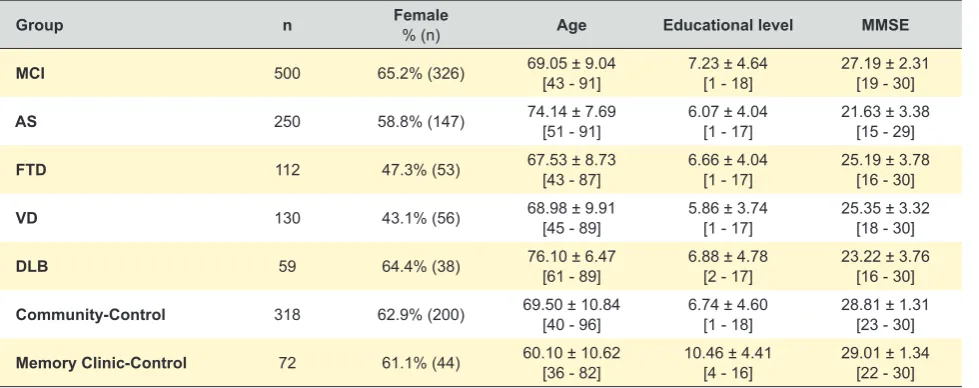
Our study involved 1,441 participants (60% - n= 864 female) with an average age of 69.75 ± 9.83 [minimum 36; maximum 96 years old) and an average 6.90 ± 4.50 [minimum 1; maximum 18] years of education. Seven subgroups were included: (i) MCI (n = 500); (ii) AD (n= 250); (iii) FTD (n= 112); (iv) VD (n = 130); (v) DLB (n= 59); (vi) Community-Control (n = 318) and (vii) Memory Clinic-Control (n= 72). Data regarding sociodemographic characteristics and MMSE performance are shown in Table 1.
Group comparison showed statistically significant differences regarding participant’s age (F(6,1434) = 28.468, p <
ARTIGO ORIGINAL
according to post-hoc tests. The remaining subgroups did not show statistically significant differences between them, although significant differences were found between these and the youngest subgroup, as well as between these and the oldest subgroups.
As regards schooling, statistically significant differences were also found between the groups (F(6.1434) = 11.110, p <
0.001) even though, according to post-hoc tests, only the Memory Clinic-Control subgroup showed a significantly higher average years of education when compared to the average educational level of the remaining subgroups, which have shown no significant differences between them. Group comparison regarding MMSE performance showed a more heterogeneous difference pattern of average total scores (F(6.1429) = 218.471, p < 0.001). The
worst average performance was found in patients with AD, followed by patients with DLB. These subgroups showed significant differences between them and when compared to the remaining subgroups. The patients with FTD and VD showed similar performances, significantly higher to patients with AD and DLB and significantly lower to the remaining subgroups. MCI subgroup obtained significantly lower average scores than control subgroups and significantly higher than every other clinical subgroup. No significant differences were found between control subgroups as regards MMSE performance.
MMSE scores showed a significant positive correlation with participant’s years of education (r = 0.24, p = 0.01) and a significant negative correlation with the age (r = 0.25,
p = 0.01). The results of multiple linear regression (enter method) showed that both variables significantly contributed to MMSE score prediction (F(2.1433) = 83.086, p < 0.001; Age:
ß = -0.220, t = -8.696, p < 0.001; Years of education: ß = 0.202, t = 7.984, p < 0.001). Globally, age and years of education explained 10.4% of variance in MMSE score and elderly patients and with lower educational levels increased the probability of having worst MMSE performance. A 1.5 standard deviation below the value proposed by
normative data regarding age/education, shown in Appendix 1 http://www.actamedicaportuguesa.com/revista/index.php/ amp/editor/downloadFile/6889/19736), was considered as criteria for the analysis of sensitivity and specificity of normative data for the Portuguese population.14 Results by
subgroups are shown in Table 2. The same analysis was carried out considering cut-off scores proposed by validity studies for the Portuguese population with MCI,15 AD,15
FTD,16 VD17 and DLB,18 i.e. by analysing cut-off scores shown
in Appendix 2 (http://www.actamedicaportuguesa.com/ revista/index.php/amp/editor/downloadFile/6889/19737): (i) ≥ 29 for the absence of any clinically significant cognitive decline, (ii) < 29 for MCI and (iii) < 26 for the presence of cognitive decline in patients with dementia related to AD, FTD, VD or DLB (results shown in Table 3).
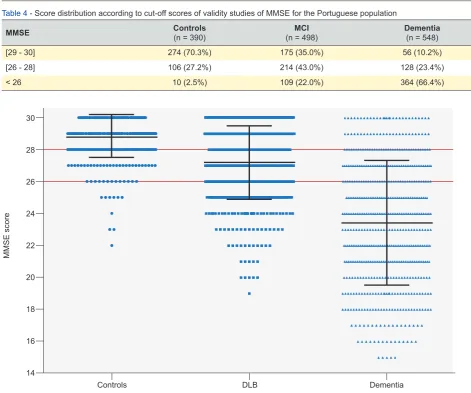
Our study aimed to analyse MMSE ability for the differentiation between the three major nosological categories – normal, MCI and Dementia group (including AD, FTD, VD and DLB): distribution of participants of the three groups by score intervals suggested by the cut-offs of the clinical validity studies for the Portuguese population (Appendix 2 - http://www.actamedicaportuguesa.com/ revista/index.php/amp/editor/downloadFile/6889/19737) are shown in Table 4 and displayed in Fig. 1.
DISCUSSION
With progressive population ageing,30,31 cognitive decline
and dementia became as relevant pathologies of our time and healthcare priorities.32 Therefore, MMSE as a screening test for dementia became increasingly important and within almost every international33-36 and Portuguese37 guidelines
as well as within major diagnostic criteria.27,28,38 However,
MMSE was designed in the 70s and, through the test’s almost half a century of existence, a new nosological category emerged – ‘mild cognitive impairment’ -, currently accepted as a pre-dementia stage.39,40 The emphasis on mild decline
required the use of sensitive screening tools and, within this new context, limitations to MMSE have been pointed out:
Table 1 - Subgroup characterisation
Group n Female % (n) Age Educational level MMSE
MCI 500 65.2% (326) 69.05 ± 9.04[43 - 91] 7.23 ± 4.64[1 - 18] 27.19 ± 2.31[19 - 30]
AS 250 58.8% (147) 74.14 ± 7.69[51 - 91] 6.07 ± 4.04[1 - 17] 21.63 ± 3.38[15 - 29]
FTD 112 47.3% (53) 67.53 ± 8.73[43 - 87] 6.66 ± 4.04[1 - 17] 25.19 ± 3.78[16 - 30]
VD 130 43.1% (56) 68.98 ± 9.91[45 - 89] 5.86 ± 3.74[1 - 17] 25.35 ± 3.32[18 - 30]
DLB 59 64.4% (38) 76.10 ± 6.47[61 - 89] 6.88 ± 4.78[2 - 17] 23.22 ± 3.76[16 - 30]
Community-Control 318 62.9% (200) 69.50 ± 10.84[40 - 96] 6.74 ± 4.60[1 - 18] 28.81 ± 1.31[23 - 30]
Memory Clinic-Control 72 61.1% (44) 60.10 ± 10.62[36 - 82] 10.46 ± 4.41[4 - 16] 29.01 ± 1.34[22 - 30]
ARTIGO ORIGINAL
Figure 1 - Distribution of clinical groups 14
16 18 20 22 24 26 28 30
Controls DLB Dementia
MMSE score
Table 2 -Sensitivity and specificity of normative MMSE cut-off scores
Group n Normative study (Freitas et al, 2015)
Sensitivity Specificity
MCI 500 64.6%
AD 250 91.2%
FTD 112 54.5%
VD 130 54.6%
DLB 59 78.0%
Community-Control 318 -- 96.5%
Memory Clinic-Control 72 -- 91.7%
Table 3 - Sensitivity and specificity of cut-off scores of validity studies of MMSE
Group n Clinical validity studies
Sensitivity Specificity
MCI 500 31.8%
AD 250 84.4%
FTD 112 44.6%
VD 130 44.7%
DLB 59 67.8%
Community-Control 318 -- 68.9%
Memory Clinic-Control 72 -- 76.4%
Table 4 - Score distribution according to cut-off scores of validity studies of MMSE for the Portuguese population
MMSE Controls (n = 390) (n = 498)MCI Dementia (n = 548)
[29 - 30] 274 (70.3%) 175 (35.0%) 56 (10.2%)
[26 - 28] 106 (27.2%) 214 (43.0%) 128 (23.4%)
ARTIGO ORIGINAL
(i) low level of complexity regarding memory and language tasks leading to lower sensitivity for MCI and false negatives in patients with high education levels; (ii) the lack of tasks for the assessment of executive function, with an impact on the sensitivity for the identification of frequent pathologies, such as FTD or VD.16,41-45 Paradoxically, longitudinal studies
of MCI/prodromal AD showed that MMSE adds to predicting cognitive decline and the progression to dementia when associated to biological markers such as magnetic resonance imaging46 or biological CSF (cerebrospinal fluid)
markers.47 In addition, this instrument is still being used as
an almost universal severity or staging criteria for patient inclusion in clinical trials.48 The actuality of this study in
Portugal is explained by the proposal of more demanding cut-off scores, according to the studies by Morgado et al.13
and by Freitas et al.14 It should be mentioned that illiterate
patients were already not included by the authors in the latter study, an option that was also based on its reduced representativeness in current society. Therefore, as our validity analysis is specifically referred to these cut-off scores, illiterate patients were also not included in the study and the results obtained will not be applicable to illiterate patients. However, apart from illiterate patients, we aimed to obtain groups of healthy individuals and patients that were representative of Portuguese healthcare reality, from community to specific memory outpatient clinics. Therefore, community control group involved patients having attended family doctors for cognitive characterisation or diagnostic assessment, while the second control group involved patients attending outpatient Memory clinics where neurologists deal with the same diagnostic challenges. Most patients presented with subjective attention and memory complaints even though a thorough neuropsychological assessment, adjusted for patient’s age and education level showed normal MMSE performance and therefore may be considered as cognitive controls for the specific aim of validity as a screening test. In fact, no significant differences were found when comparing average MMSE scores with those obtained in the community group, even though the differences regarding patient’s origin, age and educational level were not controlled in the performance analysis. Group distribution found in our study showed the same proportionality as found in a tertiary healthcare centre, with a preponderance of patients with mild cognitive impairment (MCI) and an indication for clinical assessment in specialist clinics, according to current guidelines.33,34
Sociodemographic characteristics (age and gender) and proportionality found in dementia groups were also in line with prevalence studies; AD was the most represented, followed by VD, FTD and finally by DLB. In terms of MMSE performance, MCI subgroup obtained significantly lower average scores when compared to control subgroups and significantly higher to all the remaining dementia subgroups, showing that MMSE is able to differentiate these three major nosological categories (control-MCI-dementia). AD group showed the worst performance among the different dementia subgroups, followed by DLB and the
highest average score was found both in FTD and VD. As MMSE is not considered for severity staging, we may reach the conclusion that this ranking of performances is a first evidence that MMSE has a better construct (memory, language and visuo-constructive ability) for detecting typical impairment in AD and DLB and is less sensitive to situations with frontal dysfunction such as in FTD and VD.14,49-51
As regards the influence of sociodemographic variables on global MMSE performance, age and educational level have a role in score prediction and with a similar weight, as shown by the beta value. The value of 10.4 was lower than those found for other screening tests, namely for MoCA, with a 49% global prediction for these variables, a 42% weight for educational level and 7% for patient’s age.52 Age was
confirmed as a significant and relevant variable in MMSE scores and supports the adequacy of the latest normative results obtained by Freitas et al.14 with patient’s age and
education-adjusted cut-off scores. The assessment of these normative scores per nosological group (shown in Table 2) showed the excellent specificity of MMSE (over 90%), i.e. it has the ability of identifying a great proportion of patients without cognitive impairment and generating not too many false positives.33 As regards sensitivity, tendencies found in other studies were globally confirmed, as follows:
An excellent sensitivity for mild AD (91%) and with a value even more satisfactory than what has been described in other studies53;
A moderate to satisfactory sensitivity (78%) for DLB, similar to the sensitivity suggested in the study by Ala et al.54;
A low pooled sensitivity (64.6%) for MCI, leading to the conclusion that the test is unsuitable for screening milder cognitive decline3, 15;
Low sensitivities for FTD and VD (55%), also showing that this test is unsuitable for these pathologies, probably due to the fact that frontal dysfunction, which is predominant, is not assessed by MMSE.16,41-45
ARTIGO ORIGINAL rate was found in the dementia group and most patients would also have been classified as MCI. MCI group was
also the most penalized group, with a 57% error rate, mostly false negatives. We may therefore reach the conclusion that individual classification exclusively based on validity data regardless of patient’s age and education is extremely unreliable and the use of normative data established according with these variables is preferred.
Considering the information obtained in our study, an assessment protocol may be proposed, in which MMSE-based approach may be complemented with other screening tools or more specific neuropsychological tests, carried out according to the levels of accuracy and expertise required for healthcare services. Therefore, in a primary care setting, we propose MMSE as a first-line screening tool, due to an easy and quick application and the already largely widespread knowledge among physicians dealing with geriatric patients. Considering MMSE specificity regarding the use of normative data, patients diagnosed with cognitive decline may be safely diagnosed with cognitive impairment/ dementia and referred for specific Memory outpatient clinics for more specific nosological approach to diagnosis and therapy. This diagnostic hypothesis may be even more supported with MMSE score below 26 – suggestive of dementia, as indicated by validity studies. In patients considered as normal according to normative data, AD will be very unlikely and DLB may also be safely excluded, as MMSE’s sensitivity is satisfactory for these two situations. However, as it has a highly limited diagnostic accuracy for MCI, FTD and VD, a more sensitive screening tool is recommended for the assessment of this ‘normal’ group, selected from studies allowing for the identification of tools with better discriminatory ability. In Neurology outpatient clinics, with a high prevalence of patients with MCI and other forms of non-Alzheimer dementia, MMSE should not be used as screening test, in favour of other more sensitive tools and with a wider construct. Even so, MMSE should remain as first-line screening test for illiterate patients and may complementarily be used as a severity staging tool as well as in longitudinal assessment over the entire course of the disease.
Our study has some limitations that should be mentioned. As already described, our analysis did not
include illiterate patients and therefore does not add any information regarding this group of patients. Moderate-severe stages of dementia were also not analysed, as diagnostic accuracy and usefulness of MMSE for these stages is well documented in literature.15,55,56 It should also
be mentioned that the comparison of the different MMSE normative proposals were not included in our study and therefore our conclusions may be only applied to the specific Portuguese cultural context and may not be extrapolated to other cultural and social realities.
CONCLUSION
Our study confirmed that MMSE performance is strongly influenced by patient’s age and educational level, supporting the use of normative data adjusted for both variables. With this type of approach, we found that MMSE is a sensitive and specific instrument for AD and DLB screening, unlike MCI, FTD and VD where it has a limited diagnostic accuracy. We also found that this analysis, based on a second sampling, reinforces the adequacy of normative proposal and cut-off scores proposed by Freitas
et al.14 allowing for the identification of the contribution and
limitations of the MMSE for the hierarchical diagnosis of cognitive impairment at different levels of healthcare.
HUMAN AND ANIMAL PROTECTION
The authors declare that the followed procedures were according to regulations established by the Ethics and Clinical Research Committee and according to the Helsinki Declaration of the World Medical Association.
DATA CONFIDENTIALITY
The authors declare that they have followed the protocols of their work centre on the publication of patient data.
CONFLICTS OF INTEREST
The authors declare that there were no conflicts of interest in writing this manuscript.
FINANCIAL SUPPORT
The authors declare that there was no financial support in writing this manuscript.
REFERENCES
1. Folstein M, Folstein S, McHugh P. Mini-Mental State: A practical method for grading the cognitive state of patients for the clinician. J Psychiatr
Res.1975;12:189-98.
2. Nieuwenhuis-Mark RE. The death knoll for the MMSE: Has it outlived its purpose?. J Geriatr Psychiatry Neurol. 2010;23:151-7.
3. Mitchell AJ. A meta-analysis of the accuracy of the mini-mental state examination in the detection of dementia and mild cognitive impairment.
J Psychiatr Res. 2009;43:411-31.
4. O’ Connor DW, Pollitt PA, Hyde JB, Fellows JL, Miller ND, Brook CP, et al. The reliability and validity of the Mini-Mental State in a British
community survey. J Psychiatr Res. 1989;23:87-96.
5. Gallacher JE, Eliood PC, Hopkinson C, Rabbitt PM, Stollery BT, Sweetnam PM, et al. Cognitive function in the Caerphilly study: Associations with age, social class, education and mood. Eur J
Epidemiol. 1999;15:161-9.
6. Han C, Jo SA, Jo I, Kim E, Park MH, Kang Y. An adaptation of the Korean Mini-Mental State Examination (K-MMSE) in elderly Koreans: Demographic influence and population-based norms (the AGE study). Arch Gerontol Geriatr. 2008;47:302-10.
7. Moraes C, Pinto JA, Lopes MA, Litvoc J, Bottino CM. Impact of sociodemographic and health variables on Mini-Mental State Examination in a community-based sample of older people. Eur Arch Psychiatry Clin Neurosci. 2010;260:535-42.
8. Anderson TM, Sachdev PS, Brodaty H, Trollor J, Andrews G. Effects of sociodemographic and health variables on Mini-Mental State Exam scores in older Australians. Am J Geriatr Psychiatry. 2007;15:467-76. 9. Bravo G, Hébert R. Age and education specific reference values for
ARTIGO ORIGINAL
from a non-demented elderly population. Int J Geriatr Psychiatry. 1997;12:1008-18.
10. Matallana D, Santacruz C, Cano C, Reyes P, Sampaer-Ternent R, Markides KS, et al. The relationship between educational level and Mini-Mental State Examination domains among older Mexican Americans. J Geriatr Psychiatry Neurol. 2011;24:9-18.
11. Guerreiro M, Silva AP, Botelho M, Leitão O, Castro-Caldas A, Garcia C. Adaptação à população portuguesa da tradução do Mini Mental State Examination. Rev Port Neurol. 1994;1,9.
12. Guerreiro M. Contributo da Neuropsicologia para o estudo das demências [Tese de Doutoramento]. Lisboa: Universidade de Lisboa; 1998.
13. Morgado J, Rocha CS, Maruta C, Guerreiro M, Martins IP. Novos valores normativos do Mini-Mental State Examination. Sinapse. 2009;2:10-6. 14. Freitas S, Simões MR, Alves L, Santana I. Mini Mental State Examination
(MMSE): Normative study for the Portuguese population in a community stratified sample. Appl Neuropsych Adults. 2015;22:311-9.
15. Freitas S, Simões MR, Alves L, Santana I. Montreal Cognitive Assessment (MoCA): Validation study for Mild Cognitive Impairment and Alzheimer´s Disease. Alzheimer Dis Assoc Disord. 2013;27:37-43. 16. Freitas S, Simões MR, Alves L, Duro D, Santana I. Montreal Cognitive
Assessment (MoCA): Validation study for Frontotemporal Dementia. J Geriatr Psychiatry Neurol. 2012;25:146-54.
17. Freitas S, Simões MR, Alves L, Vicente M, Santana I. Montreal Cognitive Assessment (MoCA): Validation study for Vascular Dementia. J Int Neuropsychol Soc. 2012;18:1031-40.
18. Costa V, Freitas S, Simões MR, Santana I. Estudo exploratório de validação do Montreal Cognitive Assessment (MoCA) na Demência com Corpos de Lewy. Sinapse;15:228.
19. Freitas S, Simões MR, Alves L, Santana I. Mini Mental State Examination (MMSE). In: Mário R. Simões, Isabel Santana & Grupo de Estudos de Envelhecimento Cerebral e Demência (GEECD), editors. Escalas e Testes na demência. 3rd ed. Lisboa: Novartis; 2015;p.18-23.
20. Larner AJ. Introduction to cognitive screening instruments: Rationale, desiderata, and assessment of utility. In: Mitchell AJ, editor. Cognitive screening instruments. London: Springer-Verlag; 2013;p.1-14. 21. Mitchell A J. The Mini-Mental State Examination (MMSE): An update
on its diagnostic validity for cognitive disorders. In: Mitchell AJ, editor. Cognitive screening instruments. London: Springer-Verlag; 2013,p.15-46.
22. Morgado J, Rocha CS, Maruta C, Guerreiro M, Mártins IP. Cut-off scores in MMSE: A moving target?. Eur J Neurol. 2010;17:692-5.
23. Albert MS, DeKosky ST, Dickson D, Dubois B, Feldman HH, et al. The diagnosis of mild cognitive impairment due to Alzheimer’s disease: Recommendations from the National Institute on Aging-Alzheimer´s Association workgroups on diagnostic guidelines for Alzheimer’s disease. Alzheimers Dement. 2011;7:270-9.
24. American Psychiatric Association. DSM-IV-TR: Diagnostic and statistical manual of mental disorders. 4ª ed. Lisboa: Climepsi Editors; 2002. 25. McKhann GM, Knopman DS, Chertkow H, Hyman BT, Jack CR,
et al.. The diagnosis of dementia due to Alzheimer’s disease: Recommendations from the National Institute on Aging-Alzheimer’s Association workgroups on diagnostic 38 guidelines for Alzheimer’s disease. Alzheimers Dement. 2011;7:263-9.
26. Neary D, Snowden JS, Gustafson L, Passant U, Stuss D, Black S. Frontotemporal lobar degeneration: A consensus on clinical diagnostic criteria. Neurology. 1998;51:1546–54.
27. McKeith IG, Dickson DW, Lowe J, Emre M, O’Brien JT, Feldman H, et al. Diagnosis and management of dementia with Lewy bodies: third report of the DLB consortium. Neurology. 2005;65:1863-72.
28. Román GC, Tatemichi TK, Erkinjuntti T, Cummings JL, Masdeu JC, Garcia JH, et al. Vascular dementia: Diagnostic criteria for research studies. Report of the NINDS-AIREN International Workshop. Neurology. 1993;43:250-60.
29. Guerreiro M, Fonseca S, Barreto J, Garcia C. Escala de avaliação da Doença de Alzheimer. In: Grupo de Estudos de Envelhecimento
Cerebral e Demências, editor. Escalas e testes na demência. 2nd ed.
Lisboa: GEECD; 2008. p.41-58.
30. Federal Interagency Forum on Aging-Related Statistics. Older americans 2010: Key indicators of well-being. [consultado 2015 Jun 10]. Dísponível em: http:// http://www.agingstats.gov/.
31. European Commission. The social situation in the European Union 2009. [consultado 2015 Jun 10]. Disponível em: http://www.ec.europa. eu/eurostat.
32. Santana I, Farinha F, Freitas S, Rodrigues V, Carvalho A. Epidemiologia da demência e da Doença de Alzheimer em Portugal: Estimativas da
prevalência e dos encargos financeiros com a medicação. Acta Med Port. 2015,28:182-8.
33. National Institute for Health and Clinical Excellence. Dementia: supporting people with dementia and their carers in health and social care. National Clinical Practice Guideline Number 42. London: National Institute for Health and Clinical Excellence; 2011.
34. Hort J, O’Brien JT, Gainotti G, Pirttila T, Popescu BO, Rektorova I, et al. EFNS guidelines for the diagnosis and management of Alzheimer’s disease. Eur J Neurol. 2010;17:1236-48.
35. Sorbi S, Hort J, Erkinjuntti T, Fladby T, Gainotti G, Gurvit H, et al. Guidelines on the diagnosis and management of disorders associated with dementia. Eur J Neurol. 2012;19:1159–79.
36. California Workgroup on Guidelines for Alzheimer’s Disease Management. Guidelines for Alzheimer’s Disease Management. State of California: Department of Public Health. 2008.
37. Direcção Geral da Saúde. Norma 053/2011 de 27/12/2011. Abordagem Diagnóstica e Terapêutica das Alterações Cognitivas (Demências; Doença de Alzheimer). [consultado 2015 Jun 10]. Disponível em: https:// www.dgs.pt/.
38. McKhann G, Drachman D, Folstein M, Katzman R, Price D, Stadlan EM, et al. Clinical diagnosis of Alzheimer’s disease: Report of the NINCDS-ADRDA Work Group under the auspices of Department of Health and Human Services Task Force on Alzheimer’s disease. Neurology. 1984;4:939-44.
39. Dubois B., Feldman HH, Jacova C, Dekosky ST, Barberger-Gateau P, Cummings J, Delacourte A, Galasko D, Gauthier S, Jicha G, Meguro K, O’brien J, Pasquier F, Robert P, Rossor M, Salloway S, Stern Y, Visser PJ, Scheltens P. Research criteria for the diagnosis of Alzheimer”s disease: revising the NINCDS-ADRDA criteria. Lancet Neurol. 2007; 6: 734-46.
40. Dubois B, Feldman HH, Jacova C, Hampel H, Molinuevo JL, Blennow K, et al. Advancing research diagnostic criteria for Alzheimer’s disease: the IWG-2 criteria. Lancet Neurol. 2014;13:614–29.
41. Hutchinson AD, Mathias JL. Neuropsychological deficits in frontotemporal dementia and Alzheimer’s disease: a meta-analytic review. J Neurol Neurosur Psychiatry. 2007;78:917-28.
42. Ihl R, Frölich TD, Martin, EM, Maurer K. Differential validity of psychometric tests in dementia of Alzheimer type. Psychiatry Res. 1992;44:93-106.
43. Markwick A, Zamboni G, Jager C. Profile of cognitive subtest impairment in the Montreal Cognitive Assessment (MoCA) in a research cohort with normal Mini-Mental State Examination (MMSE) scores. J Clin Exp Neuropsych. 2012;34:750-7.
44. Naugle RI, Kawczak K. Limitations of the Mini-Mental State Examination. Cleve Clin J Med. 1989;56:277-81.
45. Tombaugh TN, McIntyre NJ. The Mini-Mental State Examination: A comprehensive review. J Am Geriatr Soc. 1992;40:922–35.
46. Kovacevic S, Rafii MS, Brewer JB, Alzheimer’s Disease Neuroimaging
Initiative. High-throughput, fully automated volumetry
for prediction of MMSE and CDR decline in mild cognitive impairment. Alzheimer Dis Assoc Disord. 2009;23:139-45.
47. Hall A, Muñoz-Ruiz M, Mattila J, Koikkalainen J, Tsolaki M, Mecocci P, et al. Generalizability of the disease state index prediction model for identifying patients progressing
from mildcognitiveimpairment to Alzheimer’sdisease. J Alzheimers Dis.
2015;44:79-92.
48. Vellas B, Andrieu S, Sampaio C, Coley N, Wilcock G; European Task Force Group. Endpoints for trials in Alzheimer’s disease: a European task force consensus. Lancet Neurol. 2008;7:436-50.
49. Gregory CA, Orrell M, Sahakian B, Hodges JR. Can frontotemporal dementia and Alzheimer´s disease be differentiated using a brief battery of tests? Int J Geriatr Psychiatry. 1997;12:375-83.
50. Hodges JR, Patterson K, Ward R, Garrard P, Bak T, Perry R, et al. The differentiation of semantic dementia and frontal lobe dementia (temporal and frontal variants of frontotemporal dementia) from Alzheimer´s disease: A comparative neuropsychological study. Neuropsychology. 1999;13:31-40.
51. Mathuranath PS, Nestor PJ, Berrios GE, Rakowicz W, Hodges JR. A brief cognitive test battery to differentiate Alzheimer´s disease and frontotemporal dementia. Neurology. 2000;55:1613-20.
52. Freitas S, Simões MR, Alves L, Santana I. Montreal Cognitive Assessment (MoCA): Influence of sociodemographic and health variables. Arch Clin Neuropsych. 2012;27:165-75.
ARTIGO ORIGINAL
54. Ala TA, Hughes LF, Kyrouac GA, Ghobrial MW, Elble RJ. The Mini-Mental State exam may help in the differentiation of dementia with Lewy bodies and Alzheimer’s disease. Int J Geriatr Psychiatry. 2002;17:503– 9.
55. Harvan JR, Cotter V. An evaluation of dementia screening in the primary
care setting. J Am Acad Nurse Pract. 2006;18:351–60.