CORROSION INHIBITOR ALOE VERA – NICKEL SYSTEM
CONTROLLING THE CORROSION OF CARBON STEEL IN
RAIN WATER
A. John Amalraj
[a]*, J. Wilson Sahayaraj
[b], C. Kumar
[c], Susai Rajendran
[d,e],
A. Peter Pascal Regis
[f], S.K. Selvaraj
[d]and R. Mohan
[g]Keywords: corrosion inhibition, Aloe Vera, rain water, carbon steel.
The corrosion inhibition efficiency of an aqueous extract of Aloe Vera (AV) in controlling the corrosion of carbon steel rain water in absence and presence of with Ni2+ has been studied by weight loss method. Weight loss study reveals that the formulation consisting of 5 ml of AV and 50 ppm of Ni2+ has 98% inhibition efficiency. The results of polarisation study show that the formulation function controls the cathodic reaction predominantly. The AC impedance spectra reveal that a protective film formed on the metal surface. The UV – visible absorption spectra indicates the possibility of formation of Fe2+-AV complex and also Ni2+-AV complex in the solution. FTIR spectrum reveal that the protective film consists of Fe2+-AV complex and Ni(OH)2.
* Corresponding Author Fax: 91-0431-2332010 E-Mail: [email protected]
[a] PG and Research Department of Chemistry, Periyar E.V.R college (Autonomous), Trichy - 620023, Tamil Nadu, India. Email : [email protected]
[b] Department of chemistry, Jeppiaar Engineering college, Chennai - 600119, Tamil Nadu, India.
Email : [email protected]
[c] Bharathiar Matric higher secondary school, Elumalai, Madurai - 625535, Tamil Nadu, India
[d] PG and Research Department of Chemistry, GTN Arts College, Dindigul - 624 005, Tamilnadu, India. E-mail: [email protected]
[e] Research Centre, RVS School of Engineering and Technology, Dindigul - 624 005, Tamilnadu, India. [f] PG and Research Department of Chemistry, St.Joseph’s
College (Autonomous), Trichy - 620002, Tamil Nadu, India. [g] Department of Chemistry, Surya Polytechnic College,
Villupuram - 605652, Tamil Nadu, India.
Introduction
Natural products are nontoxic, biodegradable and readily available. The recent trend in research on environmental friendly corrosion inhibitors is taking us back to exploring the use of natural products as possible sources of cheap, nontoxic, and eco-friendly corrosion inhibitors. These natural products are either synthesized or extracted from aromatic herbs, spices, and medicinal plants. Of incre-asing interest is the use of medicinal plant extracts as corrosion inhibitors for metals in acid solutions. This is because these plants serve as incredibly rich sources of naturally synthesized chemical compounds that are environmentally acceptable, inexpensive, readily available, and renewable sources of materials.1,2 These chemicals
include alkaloids, flavonoids, terpenoids, glycosides, tannins, saponins, fats and oils, and carbohydrates, and so forth.3-11
several plant extracts12-16 and eco-friendly inhibitors17,18
attracted the researchers. Investigation of natural inhibitors is particularly interesting because they are non-expensive, ecologically friendly/acceptable and possess no threat to the environment. The present work is undertaken:
1. to evaluate the inhibition efficiency (IE) of an aqueous extract of Aloe Vera (AV) in controlling the corrosion of carbon steel in Rain water, in the absence and presence of Ni2+,
2. to understand the mechanistic aspects of corrosion inhibition by potentiodynamic polarization studies and AC impedance analysis,
3. to analyse the protective film formed on the carbon steel by FTIR spectra and fluorescence spectra, and
4. to propose a suitable mechanism for corrosion inhibition.
Methods and Materials
Preparation of Plant extract
An aqueous extract of Aloe Vera was prepared by grinding 50 g of Aloe Vera with double distilled water, filtering and suspending impurities, and making up to 500 ml. The extract was used as corrosion inhibitor in the present study.
Preparation of specimens
Weight-loss method
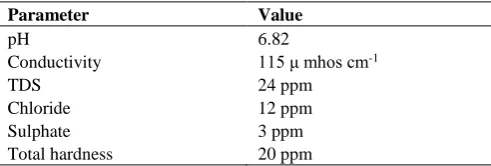
Relevant data on the rain water used in this study are given in Table 1. Carbon steel specimens in triplicate were immersed in 100 ml of the solutions containing various concentrations of the inhibitor in the presence and absence of Ni2+ for one day. The weight of the specimens before and
after immersion determined using Shimadzu balance, model AY62. The corrosion products were cleansed with Clarke’s solution.19 The inhibition efficiency (IE) was then calculated
using the equation
IE = 100 [1–(W2 / W1)] %
where W1 and W2 are the corrosion rates in the absence and
presence of the inhibitor, respectively.
Table 1. Parameters of rain water
Parameter Value
pH 6.82
Conductivity 115 μ mhos cm-1
TDS 24 ppm
Chloride 12 ppm
Sulphate 3 ppm
Total hardness 20 ppm
Potentiodynamic polarization study
Polarization studies were carried out in an H & CH electrochemical work station impedance analyzer model CHI660A. A three electrode cell assembly was used. The working electrode was carbon steel. A saturated calomel electrode (SCE) was used as the reference electrode and a rectangular platinum foil was used as the counter electrode.
AC impedance measurements
The instrument used for polarization was also used for AC impedance study. The cell set up was the same as that used for polarization measurements. The real part and imaginary part of the cell impedance were measured in ohms at various frequencies. The values of charge transfer resistance (Rt) and
the double layer capacitance (Cd1) were calculated.
Surface Examination
The carbon steel specimens were immersed in various test solutions for a period of one day, taken out and dried. The nature of the film formed on the surface of metal specimens was analysed by FTIR spectroscopic study.
Fluorescence spectra
These spectra were recorded in a Hitachi F–4500 fluorescence spectrophotometer.
FTIR Spectra
FTIR spectra were recorded in a Perkin – Elmer 1600 spectrophotometer. The film was carefully removed, mixed thoroughly with KBr made in to pellets and FTIR spectra were recorded.
Results and Discussion
Analysis of result of weight – loss method
The corrosion rate (CR) of carbon steel immersed in rain water (shown in Table 1) in the absence and presence of inhibitor systems are given in Tables 2-4. The inhibition efficiency (IE) are also given in these Tables. It is seen from Table 2 that the aqueous extract of Aloe Vera (AV) alone is not a good inhibitor. But in presence of Ni2+, it shows
excellent inhibition efficiency. As the concentration of Ni2+
increases, the inhibition efficiency (Table 3) also increases. For example, 5 ml AV shows 5% IE. 50 ppm of Ni2+ shows
44% IE. But it is interesting to note that the formation consisting of 5 ml AV and 50 ppm Ni2+ shows 98% IE. This
suggests that a synergistic effect exist between Ni2+ and AV
solution. That is mixed inhibitors shows better inhibition efficiency than individual inhibitors. This is accounts for very high IE offered by AV- Ni2+ system. As the immersion
period increases, IE decreases (Table 4-6). This is due to that Ni2+-AV complexes are not much transported towards
the metal surface. Hence inhibition efficiency decreases.
Table 2. Corrosion rates (CR) of carbon steel in aqueous solution in the presence of inhibitor and the inhibition efficiency obtained by weight loss method (inhibitor system: AV alone; immersion period: one day).
S.No. AV ml
Ni2+
ppm
IE
%
CR
mdd
1 0 0 - 41.00
2 1 0 –20 49.20
3 2 0 –15 47.15
4 3 0 –3 42.23
5 4 0 –2 40.18
6 5 0 5 38.95
Table 3. Corrosion rates (CR) of carbon steel in aqueous solution in the presence of inhibitor and the inhibition efficiency obtained by weight loss method (inhibitor system: Ni2+ alone; immersion period: one day).
S.No. AV ml
Ni2+
ppm
IE
%
CR
mdd
1 0 0 - 41.00
2 0 10 12 36.08
3 0 20 12 36.08
4 0 30 22 31.98
5 0 40 34 27.06
6 0 50 44 22.96
Table 4. Corrosion rates (CR) of carbon steel in aqueous solution in the presence of inhibitor and the inhibition efficiency obtained by weight loss method (inhibitor system: AV + Ni2+ system; immersion period: one day).
S.No. AV ml
Ni2+
ppm
IE
%
CR
mdd
1 0 0 - 41.00
2 1 50 44 22.96
3 2 50 51 20.09
4 3 50 56 18.04
5 4 50 66 13.94
Table 5. Corrosion rates (CR) of carbon steel in aqueous solution in the presence of inhibitor and the inhibition efficiency obtained by weight loss method (inhibitor system: AV + Ni2+ system; immersion period: two days).
S.No. AV ml
Ni2+
ppm
IE
%
CR
mdd
1 0 0 - 12.00
2 1 50 4 11.50
3 2 50 8 11.04
4 3 50 17 9.96
5 4 50 33 8.04
6 5 50 66 4.10
Table 6. Corrosion rates (CR) of Carbon steel in aqueous solution in the presence of inhibitor and the inhibition efficiency obtained by weight loss method (inhibitor system: AV + Ni2+ system; immersion period: three days).
S.No. AV ml
Ni2+
ppm
IE
%
CR
mdd
1 0 0 - 5.00
2 1 50 17 4.15
3 2 50 20 4.00
4 3 50 21 3.96
5 4 50 30 3.50
6 5 50 37 3.16
Analysis of results of polarisation study
The polarization curves of carbon steel immersed in rain water in the presence and absence of inhibitors are shown in Figure 1. The corrosion parameters are given in Table 7. When carbon steel is immersed in rain water environment, the corrosion potential is –602 mV vs saturated calomel electrode (SCE). When 5 ml of AV and 50 ppm of Ni2+ are
added to the rain water, the corrosion potential shifts to the cathodic side (–616 mV vs SCE). This suggests that this formulation controls the cathodic reaction predominantly. The Tafel slopes ba and bc for this system are not shifted
equally (203 mV decade-1 and 130 mV decade-1).
Figure 1. Polarization spectra. a: rain water, b: rain water containing 5 ml AV + 50 ppm of Ni2+.
Table 7. Corrosion parameters of carbon steel immersed in various test solutions obtained by polarization method. (inhibitor system: AV + Ni2+ system).
System Ecorr, mV
vs SCE
bc , mV decade-1
ba , mV decade-1
LPR Ω cm2
Icorr A cm-2
Rain water –602 184 235 144795 2.647·1
0–7 Rain water
+ 5 ml of AV + 50 ppm of Ni2+
–616 203 130 169700 2.385·1
0–7
When carbon steel immersed in rain water, the corrosion current, Icorr is 2.647·10–7 A cm-2. When 5 ml of AV and 50
ppm of Ni2+ is added to rain water, the Corrosion Current
decreases from 2.647·10–7 to 2.385·10–7 A cm-2. Linear
polarization resistance (LPR) value increases from 144795 Ω cm2 to 169700 Ω cm2. This indicates that protective film
formed on the metal surface.20-26
Analysis of the results of AC impendence studies
The AC impedance spectra of carbon steel immersed in rain water, in the presence and absence of inhibitors, are shown in Figure 2. The AC impedance parameters namely charge transfer resistance (Rt) and the double layer
capacitance (Cdl) are given in Table 8. When the carbon
steel immersed in rain water, the Rt value is 1299 cm2 and
the Cdl value is 4.4·10–10 F cm-2. When 5 ml of AV and 50
ppm of Ni2+ are added to the rain water, the R
t value is
increased from 1299 to 1336 Ω cm2 and the Cdl value has
decreased from 4.4·10–10 to 1.9·10–10 F cm-2.
The increase in Rt values and decrease in Cdl values
confirms that a protective film is formed on metal surface. This decreases corrosion rate of carbon steel and increases the inhibition efficiency.
Table 8. Corrosion parameters of carbon steel immersed in various test solution obtained by AC impedance spectra.
System Rt
Ω cm2
Cdl F cm-2
Rain water 1299 4.4·10–10
Rain water + 5 ml of AV
+ 50 ppm of Ni2+ 1336 1.9·10
–10
UV-Visible spectral study
The UV fluorescence spectra are given in Figure 3. It is observed from Figure 3c that AV has maximum absorbance of 197.73 at 1.483 nm and the absorbance fall sharply and reaches 0.0015 at 378 nm. The Figure 3d reveals that AV-Ni2+ gives a maximum absorbance of 1.1483 at 197.73 nm
and decreases sharply with increase in wavelength and reaches 0.0015 at 383 nm. The increase in the absorbance value on the addition of Ni2+ clearly indicates the occurrence
of interaction between Ni2+ and AV. When Fe2+ added to
AV (Figure 3e), two small peaks have appeared at 211.7 nm (abs 0.4170) and at 197 (abs 0.2710). The appearance of these two peaks is a clear proof for the formation of complex between Fe2+ and AV. The UV–visible absorption
spectra indicate the possibility of the formation of Fe2+-AV
complex and also Ni2+-AV complex in the solution.
Figure 3. UV fluorescence spectra. a: Ni2+, b: Fe2+, c: AV, d: AV + Ni2+, e: AV + Fe2+.
FTIR spectra
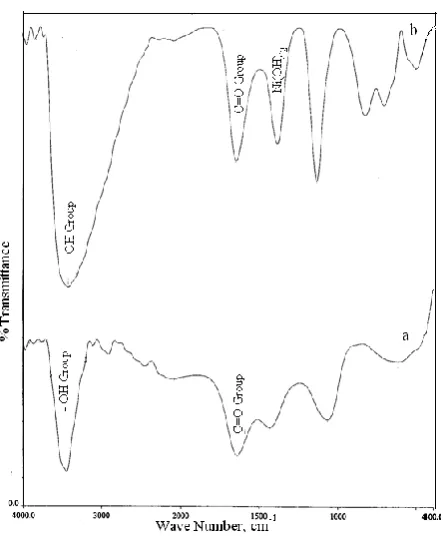
The FTIR spectra are given in Figure 4. The active principle in an aqueous extract of Aloe Vera is shown in Scheme 1. It contains phenolic -OH group and carboxyl (C=O) group.
Scheme 1
A few drops of an aqueous extract of aleo vera(AV) was dried on a glass plate. A solid mass was obtained. Its spectrum is shown in Figure 4a. The hydroxyl (-OH) group appears at 3431 cm–1 and carboxyl group (C=O) appears at 1631 cm–1. The FTIR spectrum of the protective film formed on the metal surface after immersion in the solution containing 5 ml of AV, 50 ppm of Ni2+ is shown in the
Figure 4b. The phenolic -OH stretch shifted from 3431 cm–1 to 3408 cm–1. The C=O stretching shifted from 1631 cm–1 to 1629 cm–1. These shifts confirm the formation of Fe2+-Aloe
Vera complex on the anodic sites of the metal surface.26,27
The peak at 1367 cm–1 is due to Ni(OH)2 formed on the
catholic sites of the metal surface. Thus the FTIR spectrum studies leads to the conclusion that the protective film Fe2+-
Aloe Vera complex formed on the anodic sites of metal surface and Ni(OH)2 formed on the cathode sites of metal
surface.
Mechanism of corrosion inhibition
Weight loss study reveals that the formulations consisting of 5 ml of AV and 50 ppm of Ni2+ has 98% inhibition
efficiency. FTIR spectrum reveals that the protective film consist of Fe2+-AV complex and Ni(OH)
2. In order to
explain the above observation the following mechanism of corrosion inhibition is proposed.28-30
1. When the environment consisting of 5 ml of AV and 50 ppm of Ni2+ is prepared, there is formation of Ni2+-AV
complex.
2. When carbon steel is introduced in this solution, there is diffusion of nickel complexes towards the metal surface.
3. On the metal surface, nickel complex are converted into iron complexes on the anodic sites.
Ni2+ -AV + Fe2+ → Fe2+-AV + Ni2+
4. The released Ni2+ combines with OH– to form Ni(OH) 2
on the cathodic sites.
Ni2+ + 2 OH– → Ni(OH)2
5. Thus the protective film consist of Fe2+-AV complex
and Ni(OH)2.
Conclusion
Weight Loss study reveals that the formulation consisting of 5ml of AV and 50 ppm of Ni2+ has 98% inhibition
efficiency.
The results of polarisation study show that the formulation function controls the cathodic reaction predominantly.
The AC impedance spectra reveal that a protective film formed on the metal surface.
The UV–visible absorption spectra indicate the possibility of formation of Fe2+-AV complex and also Ni2+-AV
complex in the solution.
FTIR spectrum reveal that the protective film consists of Fe2+-AV complex and Ni(OH)
2.
Acknowledgement
The authors are thankful to their respective managements for their help and constant encouragement.
References
1Saleh, R. M., Ismail, A. A. and El Hosary, A. H., Brit. Corr. J.,
1982, 17, 131.
2Abiola, O. K. and James, A. O., Corros. Sci., 2010, 52, 661.
3El-Etre, A. Y., J. Colloid Interface Sci., 2007, 314, 578.
4Okafor, P. C. and Ebenso, E. E., Pigment Resin Technol., 2007, 36, 134.
5Okafor, P. C., Ikpi, M. E., Uwah, I. E., Ebenso, E. E., Ekpe, U. J. and Umoren, S. A., Corros. Sci., 2008, 50, 2310.
6Okafor, P. C., Ebenso, E. E. and Ekpe, U. J., Int. J. Electrochem.
Sci., 2010, 5, 978.
7Obot, I. B., Umoren, S. A. and Obi-Egbedi, N. O., J. Mater.
Environ. Sci., 2011, 2, 60.
8Lebrini, M., Robert, F. and Roos, C., Int. J. Electrochem. Sci.,
2011, 6, 847.
9Lebrini, M., Robert, F., Blandinieres, P. A. and Roos, C., Int. J.
Electrochem. Sci., 2011, 6, 2443.
10James, A. O. and Akaranta, O., Res. J. Chem. Sci., 2011, 1, 31.
11Okafor, P. C., Ekpe, U. J., Ebenso, E. E., Oguzie, E. E., Umo, N. S. and Etor, A. R., Trans. SAEST, 2006, 41, 82.
12James, O. and Akaranta, O., Afr. J. Pure Appl. Chem., 2009, 3, 212.
13Okafor, P. C., Ikpi, M. E., Uwah, I. E., Ebenso, E. E., Ekpe, U. J. and Umoren, S. A., Corros. Sci., 2008, 50, 2310.
14Janaina Cardozo da Rocha, Jose Antonio da Cunha Ponciano Gomes and Eliane D’Elia, Corros. Sci., 2010, 52, 2341. 15Letica Guerrerio da Trindade and Reinaldo Simoes Goncalves.
Corros. Sci., 2009, 51, 1578.
16Noor, E. A., J. Appl. Electrochem., 2009, 39, 1465.
17Wilson sahayaraj, J., John Amalraj, A., Susai Rajendran and Vijaya, N., E-J. Chem., 2012, 9,1746.
18Wilson sahayaraj, J., John Amalraj, A., Susai Rajendran and Muthumegala, T. S., Zast. Mater., 2010, 51, 231.
19Wranglen, G., Introduction to Corrosion and Protection of
Metals, Chapman and Hall, London, 1985, 236.
20Kavipriya, K., Sathiyabama, J., Rajendran, S. and Krishnaveni, A., Int. J. Adv. Eng. Sci. Technol.,2012, 2, 106.
21Manimaran, N. and Rajendran, S., Manivannan, M. and Saranya, R., J. Chem. Biol. Phys. Sci.,2012, 2, 568.
22Sahaya Raja, A. S. and Rajendran, S., J. Electrochem. Sci. Eng.,
2012, 2, 91.
23Benita Sherine, A., Jamal Abdul Nasser, A. and Rajendran, S., Int.
J. Adv. Eng. Sci. Technol.,2010, 2, 314.
24Leema Rose, A.. Regis, P. P. A., Rajendran, S. Selvarani, F. R., Krishnaveni, S. A., Zastit. Mater., 2010, 51, 221
25Agiladevi, S., Susai Rajendran, Jeyasundari, J. and Pandiarajan, M., Eur. Chem. Bull., 2013, 2(2), 84.
Rajendran, S., Anuradha, K., Kavipriya, K., Krishnaveni, A. and Angelin Thangakani, J., Eur. Chem. Bull., 2012, 1(12), 503.
26Nakamoto, K., Infrared and Raman Spectra of Inorganic and
Coordination Compounds, Wiley and Sons, New York, 4th edition, 1986, 95.
27Silverstein, R. M., Bassler, G. C. and Morril, T. C., Spectrometric
Identification of Organic compounds, John Wiley and Sons, New York , 1986, 72.
28Mary Anbarasi, C. and Rajendran, S., Chem. Eng. Comm.,2012,
199, 1596.
29Arockia Selvi, J., Susai rajendran, Ganga Sri, V., John Amalraj, A. and Narayanasamy, B., Portug. Electrochim. Acta, 2009,
27, 1.
30Sribharathy, V. and Rajendran, S., Chem. Sci, Rev. Lett, 2012, 1, 25.