EVALUATION OF DISSOLUTION OF RIFAXIMIN AND ITS
IMPORTANCE
Ana Carolina Kogawa
[a]*and Hérida Regina Nunes Salgado
[a]Keywords: Antibiotic, dissolution, quality control, rifaximin, tablets.
Rifaximin, an oral antibiotic marketed as tablets, does not have dissolution method described either in official compendiums or literature. This lack of knowledge blinds the real rate of drug availability. Thus, all potentialities of the active principle are not enough if it is trapped in its formulation or it is released erroneously. The absence of dissolution method can reduce the drug to the level of an adjuvant. Therefore, the objective of this study was to develop and validate a successful dissolution method for the evaluation of rifaximin tablets. The method contemplated the parameters for linearity, selectivity, precision, accuracy and robustness. It was found that for the dissolution of the tablets of rifaximin of 200 mg, paddle apparatus at 50 rpm and 900 mL of acetate buffer of pH 5.0 + 0.2 % SLS as dissolution medium are optimum conditions. The method presented is useful and can be applied for the routine quality control of tablets of rifaximin.
* Corresponding Authors Fax: +55 16 3301 6967
E-Mail: [email protected]
[a] Faculdade de Ciências Farmacêuticas de Araraquara, UNESP, Rodovia Araraquara-Jaú, km 1, CEP 14801-902, Araraquara, SP, Brazil.
Introduction
The dissolution in the gastrointestinal tract is the biggest challenge for solid oral dosage forms.1-2 The main
applications of the dissolution tests are in drug development, stability studies, establishment of in vitro - in vivo correlations (IVIVC) that can be used to reduce the number of human studies during the development of a particular formulation3 and they can also be used as a substitute for
bioequivalence tests,4 quality control and pharmaceutical
equivalence studies.
Figure 1. Chemical structure of rifaximin (CAS 80621-81-4).
For solid dosage form for immediate release of rifaximin, no method for dissolution has been described in official compendia5-10 or literature. Rifaximin (Figure 1) is an oral
antibiotic with broad spectrum of action that acts locally in the gastrointestinal tract. It reaches high concentrations in the human intestine, where it is active against many enteropathogens.11-13 In market tablets of 200 mg are found.
The dose is 600 mg (1 tablet 3 times daily) or 800 mg (2 tablets 2 times a day).
The development of effective analytical methods for the quality control of marketed drugs is extremely important and aims to provide reliable information about the nature and composition of the materials in question.14 Validation is
an important part of the quality assurance program and aims to demonstrate that the analytical method is suitable for the intended proposal and safe to run.15
Analytical methods for rifaximin, available in literature and official compendia for its quality control, lacked a method to evaluate the dissolution of tablets. In its absence, the drug does not have the quality required for its safe and effective use. A practical and accurate analysis method is a primary step in the rational use of pharmaceuticals.16
Therefore, a dissolution method to tablets of rifaximin has been developed and validated in this work.
Experimental
The standard was rifaximin, content 99.0 %, acquired from NutraTech Development Limited (China). The pharmaceutical form was rifaximin tablets of 200 mg (labeled content), lot 12927, under the trade name FlonormTM, of the Laboratory Gonher Farmaceutica LTDA.
The placebo was prepared by physical mixing of excipients i.e., talc, microcrystalline cellulose, glycerol palmitostearate, titanium dioxide, colloidal anhydrous sílica, red iron oxide, disodium edetate, sodium carboxymethyl, hypromellose and propylene glycol.
Determination of the optimum dissolution conditions
second test, the media chosen was one in the dissolution of the drug was to be tested. Others pH values, tested in the second test, were pH 5.0 and pH 6.8. 10 mg of rifaximin was added to tubes containing 2.5 mL of each medium evaluated and then they were submitted to agitation in a shaker at 60 rpm for 36 hours at 37 ± 0.5 °C. After the equilibrium time, the samples were filtered using quantitative filters and the absorbances were measured spectrophotometrically in the UV region.
Determination of the dissolution profiles
The dissolution profiles for rifaximin tablets of 200 mg were obtained using the various media viz., acetate buffer of pH 5.0 (50 mM) + 0.1 % SLS, acetate buffer of pH 5.0 (50 mM) + 0.2 % SLS and acetate buffer of pH 5.0 (50 mM) + 0.5 % SLS. The media was deaerated by ultrasound for 30 min under 40 °C. The apparatus paddle under speeds of agitation of 50, 75 and 100 rpm was tested. The sampling times were 5, 10, 15, 20, 30 and 60 min. At the appointed times, 10 mL aliquots were taken from each sample and immediately filtered. The same volume of dissolution medium was replaced in order to maintain a constant total volume. The absorbances were measured spectrophotometrically in the UV region.
Validation of the method
The validation of the dissolution method was performed by evaluation of linearity, detection and quantification limits, selectivity, precision, accuracy and robustness.
Linearity
The linearity test was performed by creating a Ringbom curve by determining the absorbance of 29 concentrations of rifaximin standard, varying from 1 to 200 μg mL-1. For this,
a solution of 200 μg/mL of rifaximin standard was prepared in acetate buffer of pH 5.0 (50 mM) + 0.2 % SLS.
From the Ringbom curve 6 points at concentrations from 15 to 50 μg mL-1 of rifaximin standard was chosen for
evaluating the linearity of the method. The absorbance of the solutions were determined at 290 nm using acetate buffer pH 5.0 (50 mM) + 0.2 % SLS as blank. The analytical curve was constructed on three different days and in triplicate. The data obtained in the construction of the calibration curve were analyzed to obtain the equation of the line by the least squares method, and the check of linearity and parallelism was confirmed by Analysis of Variance (ANOVA).
Limit of detection (LD) and quantification (LQ)
LD of rifaximin was determined from the three calibration curves obtained, using the data of the standard deviation of the intercept (s) and average slope (L), according to Eqn. (1).
LD = (3.3s)/L (1)
LQ of rifaximin was obtained with the same data described above, according to Eqn. (2).
LD = (10s)/L (2)
Selectivity
The selectivity of the method was tested using placebo of rifaximin tablets. The placebo was prepared using amounts of excipients equivalent to one tablet of FlonormTM 200 mg,
which was transferred to dissolution cubas containing 900 mL of acetate buffer of pH 5.0 (50 mM) + 0.2 % SLS. The placebo was submitted to dissolution test under the conditions of the paddle for 1 h at 150 rpm. The possible interference of adjuvants was analyzed spectrophoto-metrically in the UV region.
Precision and accuracy
The precision and accuracy were evaluated at levels of 50 %, 100 % and 150 % of the theoretical concentration of the test. To obtain rifaximin stock solution, a solution of 900 μg mL-1 in acetate buffer of pH 5.0 (50 mM) + 0.2 % SLS
was prepared. In order to obtain solutions at the level of 50 % of the theoretical concentration of the test, 15 mL of rifaximin stock solution were transferred to dissolution cubas containing 900 mL of acetate buffer pH 5.0 (50 mM) + 0.2 % SLS. Then, amounts of adjuvants equivalent to 50 % of the amount contained in one tablet FlonormTM 200
mg was added to the cuba. In order to obtain solutions at the level of 100 % of the theoretical concentration of the test, 30 mL of rifaximin stock solution were transferred to dissolution cubas containing 900 mL of acetate buffer pH 5.0 (50 mM) + 0.2 % SLS. Then, amounts of adjuvants equivalent to 100 % of the amount contained in one tablet FlonormTM 200 mg was added to the cuba. In order to obtain
solutions at the level of 150 % of the theoretical concentration of the test, 45 mL of rifaximin stock solution were transferred to dissolution cubas containing 900 mL of acetate buffer pH 5.0 (50 mM) + 0.2 % SLS. Then, amounts of adjuvants equivalent to 150 % of the amount contained in one tablet FlonormTM 200 mg was added to the cuba. The
procedure was performed in triplicate. The solutions were subjected to dissolution test under the conditions of the paddle for 1 h at 50 rpm and analyzed spectrophoto-metrically in the UV region. On the analysis of the parameter precision, the relative standard deviation (RSD) was calculated for each level. This parameter was evaluated by intraday and interday precision. For the analysis of accuracy parameter, the percentage of recovery of rifaximin in each cuba was calculated by dividing the value obtained by the theoretical value corresponding to each concentration.
Robustness
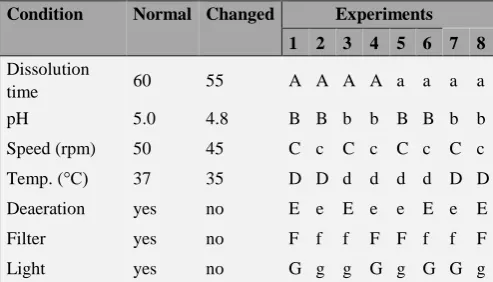
The robustness was evaluated using the Youden and Steiner test.17 7 variables with the potential of interference in
The normal conditions of analysis were defined as A, B, C, D, E, F and G and the changes as a, b, c, d, e, f and g. Eight experiments were performed as indicated in Table 1.
Table 1. Conditions tested for the robustness parameter.
Condition Normal Changed Experiments
1 2 3 4 5 6 7 8
Dissolution
time 60 55 A A A A a a a a
pH 5.0 4.8 B B b b B B b b
Speed (rpm) 50 45 C c C c C c C c
Temp. (°C) 37 35 D D d d d d D D
Deaeration yes no E e E e e E e E
Filter yes no F f f F F f f F
Light yes no G g g G g G G g
From these results, the effect of each variable was estimated by the difference between the average of results of the four analyzes with the capital letter and the average of the results of the four analyzes with the lowercase letter. Considering the standard deviation of the eight results, values with the effect greater than the product of the standard deviation by the square root of two are considered significant and alter the analytical response.
Results
Determination of the Optimum Conditions
The results of the first dissolution tests of rifaximin for determination of the optimum conditions of the dissolution medium for the rifaximin tabletsare shown in Table 2. The solubility of the drug was judged visually. The solubility test was performed in media which dissolved rifaximin and the results are shown in Table 3. The media to ensure optimum conditions for dissolution of rifaximin are acetate buffer of pH 5.0 (50 mM) + 0.5 % SLS, acetate buffer of pH 5.0 (50 mM) + 1.0 % SLS and phosphate buffer of pH 6.2 (50 mM) + 1.0 % Tween 20.
Table 2. Solubility of rifaximintablets in different media.
Solvent Results
Purified water Insoluble
HCl 0.01 M Insoluble
Phosphate buffer of pH 6.2 (50 mM) +
0.5 % Tween 20 Partially soluble
Phosphate buffer of pH 6.2 (50 mM) + 0.5 % Tween 80
Partially soluble
Phosphate buffer of pH 6.2 (50 mM) + 1.0 % SLS
Partially soluble
Determination of the dissolution profiles
The dissolution profile of rifaximin in acetate buffer of pH 5.0 (50 mM) + 0.1 % SLS, acetate buffer of pH 5.0 (50 mM) + 0.2 % SLS and acetate buffer of pH 5.0 (50 mM) + 0.5 % SLS is shown in Figure 2. The samples were analyzed by spectrophotometrically at 290 nm.
Table 3. Solubility of rifaximin in different media.
Solvent Concentration (µg mL-1)
A + 0.5 % Tween 20 360.38 A + 1.0 % Tween 20 362.94 A + 0.5 % Tween 80 185.10 A + 1.0 % Tween 80 430.32
A+ 0.5 % SLS 1792.16
A + 1.0 % SLS 2188.84
B + 0.5 % Tween 20 302.08 B + 1.0 % Tween 20 751.41 B + 0.5 % Tween 80 283.86 C + 0.5 % Tween 20 402.11 C + 0.5 % Tween 80 384.26
A = Acetate buffer of pH 5.0 (50 mM), B = Phosfate buffer of pH 6.2 (50 mM), C = Phosfate buffer of pH 6.8 (50 mM).
Table 4. ANOVA of the analytical curves of spectrophotometric determination of rifaximin in the UV region.
Variation sources
DFa SSb
Varian-ce
Fcal Ftab
(0.05)c
Among
concentrations 5 0.64 0.13 18.75* 3.11 Linear
regression 1 0.64 0.64 93.70* 4.75 Linearity
deviation 4 0.00 0.00 0.01 3.26
Inside (waste) 12 0.01 0.00 - -
Total 17 0.64 - - -
aDF = degrees of freedom, bSS = sum of squares, csignificant for
p<5 %
The acetate buffer of solutions of pH 5.0 (50 mM) + 0.5 % SLS and acetate buffer of pH 5.0 (50 mM) + 0.1 % SLS are not suitable for tests and dissolution profiles for rifaximin tablets 200 mg. In the first medium, in 90 min, the dissolution was 90.55 % and in the second médium, in 60 min the dissolution was only 29.91 %. The acetate buffer of solutions of pH 5.0 (50 mM) + 0.2 % SLS is suitable for tests and dissolution profiles for rifaximin tablets 200 mg. In this medium, there was a release of 92.06 % of the drug in 60 min.
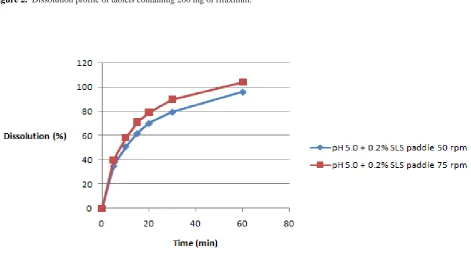
The influence of speed of agitation was tested to determine the optimum conditions of tests and dissolution profiles for rifaximin tablets 200 mg. A dissolution profile using tablets 200 mg of rifaximin, apparatus paddle at 50 and 75 rpm and acetate buffer of pH 5.0 (50 mM) + 0.2 % SLS as dissolution medium was built and is shown in Figure
3. The speed of agitation of the paddles has an influence on the release of rifaximin. The only condition which allowed one point higher than 85 % of dissolution was speed 50 rpm, which allows the comparison of dissolution profiles by the method "Simple Model Independent."
Figure 2. Dissolution profile of tablets containing 200 mg of rifaximin.
Figure 3. The dissolution profile of tablets containing 200 mg of rifaximin in acetate buffer of solution of pH 5.0 (50 mM) + 0.2 % SLS.
Table 5. Evaluation of the precision parameters for the dissolution test of rifaximin tablets 200 mg.
Level Absorbances Average SD RSD (%)
1 2 3 4 5 6
Intraday
50% 0.228 0.226 0.218 0.224 0.01 2.36
100% 0.440 0.430 0.425 0.432 0.01 1.77
150% 0.659 0.655 0.640 0.651 0.01 1.54
Interday
50% 0.209 0.200 0.198 0.228 0.226 0.218 0.213 0.01 6.04
100% 0.406 0.385 0.394 0.440 0.430 0.425 0.413 0.02 5.25
Validation of the method
The analytical curve of rifaximin, for the linearity parameter, was built with the average of the absorbance values of three analytical curves with concentrations from 15 to 50 µg mL-1, after evaluation of the results of Ringbom
curve.
The equation of the line, determined by the method of least squares, is y = 0.0150x + 0.0164, with a correlation coefficient (r) equal to 0.9999 for the rifaximin standard. ANOVA calculated for the data of the analytical curves of the rifaximin standard is shown in Table 4. The results of limit of detection and limit of quantification are1.50 µg mL-1
and 4.53 µg mL-1, respectively.
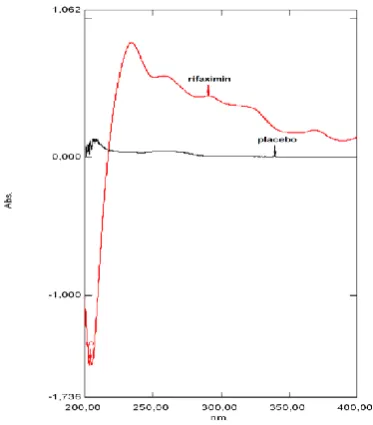
Figure 4 shows the spectrum concerning the evaluation of the adjuvants contained in the tablet FlonormTM 200 mg in
the parameter selectivity.
Figure 4. Overlapping of spectra of adjuvants of the tablet FlonormTM 200 mg and rifaximin standard solution at a
concentration of 30 µg mL-1 in acetate buffer of of pH 5.0 (50 mM)
containing 0.2 % SLS.
The values obtained in the evaluation of precision of parameters and in the recovery test of rifaximin in the dissolution test are shown in Table 5 and 6, respectively. The values of percentage of rifaximin dissolved in experiments 1 to 8 are 96.04, 96.34, 100.79, 89.79, 95.54 and 88.89, respectively. The value of standard deviation multiplied by square root of 2 is 5.91. The effect of each condition as calculated from the values found is given in Table 7.
Table 6. Evaluation of the accuracy parameter for the dissolution test of rifaximin tablets 200 mg.
Level Added
µg mL-1
Recovered µg mL-1
Recovery %
RSD %
50 % 15 15.03 100.18 3.99
100 % 30 29.87 99.57 1.70
150 % 45 44.52 98.92 1.50
Table 7. Effects obtained according to the Youden and Steiner test.
Condition Effect
Dissolution time 1.98
pH 2.00
Speed (rpm) 2.70
Temperature (°C) -1.10
Deaeration 2.65
Filter -6.13
Light 0.48
Discussion
In vitro dissolution tests have emerged as preferred method to evaluate the development of new active ingredients, pharmaceutical formulations and perform pharmaceutical equivalence studies.7, 9-10, 15, 18-20
The tablets of rifaximin have yet not been standardized by dissolution method. This status blinds the pharmaceutical product behavior that can have the best characteristics but is trapped in its formulation or is released erroneously in the organism. The absence of dissolution method for a pharmaceutical product can regress the action of the drug to that of an adjuvant.
In the comparison of dissolution profiles by the method “Simple Model Independent” just one point above 85 % dissolution must be included for product.21 Thus, the
conditions of 37.5 °C, paddle at 50 rpm and acetate buffer of pH 5.0 (50 mmol L-1) with 0.2 % SLS have been chosen to
allow the creation of a discriminatory dissolution profile, which can be used in pharmaceutical equivalence study of tablets of rifaximin 200 mg.
The presently developed method for dissolution test of tablets of rifaximin 200 mg presents satisfactory linearity in the range of 15 to 50 µg mL-1 with r = 0.9999, as
recommended by the ICH.15 The selectivity of the method
has been proven by analyzing the spectrum of adjuvants solution of rifaximin tablets, which demonstrated that the excipients do not interfere in the absorbance in the UV region. The proposed method of the dissolution test is precise because estimates for RSD of less than 6.5 % are obtained in the interday and intraday precision.
This method led to a recovery between 95 and 105 % and as per the literature recommendation10 is considered as
accurate.
According to Youden and Steiner,17 the variables that
The method was robust towards the other changes made in dissolution time, pH of the medium, the rotational speed of the paddles, temperature, deaeration, and the presence or absence of light.
Conclusions
The dissolution test of tablets of rifaximin 200 mg has been performed successfully at the conditions of the paddle at 50 rpm, acetate buffer of pH 5.0 (50 mmol L-1) with 0.2 %
SLS and at 37.5 °C. The method proved to be reliable and can easily be used to evaluate the quality of rifaximin tablets by laboratories and pharmaceutical industries because it predicts its behavior in the organism.
Acknowledgements
The authors acknowledge to CNPq (Brasília, Brazil) and FAPESP, CAPES (São Paulo, Brazil).
References
1
Dressman, J. B., Vertzoni, M., Goumas, K., Reppas, C., Estimating drug solubility in the gastrointestinal tract,
Adv. Drug Deliv. Rev., 2007, 59, 591-602.
https://doi.org/10.1016/j.addr.2007.05.009
2Stegman, S., Leveiller, F., Franchi, D., De Jong, H., Linden,
H., When poor solubility becomes an issue: From early stage to proof of concept. Eur. J. Pharm. Sci., 2007, 31, 249-261. https://doi.org/10.1016/j.ejps.2007.05.110
3Emami, J., In vitro - In vivo correlation: from theory to
applications. J. Pharm. Pharm. Sci., 2006, 9, 169-189.
4Costa, P., Lobo, J. M. S., Eur. J. Pharm. Sci., 2001, 13,
123-133. Modeling and comparison of dissolution profiles. https://doi.org/10.1016/S0928-0987(01)00095-1
5Farmacopeia Brasileira, Anvisa, Brasília, 2010, 5th.
6Farmacopeia Portuguesa, Imprensa Nacional, Lisbon,
2005, 6th.
7European Pharmacopeia, Council of Europe, 2011, 2.
8Japanese Pharmacopeia, Society of Japanese
Pharmacopeia, Tokyo, 2011, 16th.
9British Pharmacopeia, The Stationary Office, London,
2012, 1.
10The United States Pharmacopeia, The United States
Pharmacopeia Convention, Rockville, 2016, 39th.
11Rivkin, A., Gim, S., Rifaximin: New Therapeutic
Indication and Future Directions. Clin. Ther., 2011, 33, 812-827.
https://doi.org/10.1016/j.clinthera.2011.06.007
12Valentin, T., Leitner, E., Rohn, A., Zollner-Schwetz, I.,
Hoenigl, M., Salzer, H. J. F., Krause, R., Rifaximin intake leads to emergence of rifampin-resistant staphylococci. J. Infect., 2011, 62, 34-38.
https://doi.org/10.1016/j.jinf.2010.11.004
13Mullen, K. D., Sanyal, A. J., Bass, N. M., Poordad, F. F.,
Sheikh, M. Y., Frederick, T., Bortey, E., Forbes, W. P. Rifaximin is safe and well tolerated for long-term maintenance of remission from overt hepatic encephalopathy. Clin. Gastroenter. Hepatol., 2014, 12, 1390-1397.
https://doi.org/10.1016/j.cgh.2013.12.021
14La Roca, M. F., Sobrinho, J. L. S., Nunes, L. C. C., Neto,
P. J. R., Desenvolvimento e validação de método analítico: passo importante na produção de medicamentos. Rev. Brasil. Farm., 2007,88, 177-180.
15Validation of Analytical Procedures: Text and
Methodology Q2(R1). Int. Conf. Harmonization (ICH)., Geneva, 2005.
(https://www.ich.org/fileadmin/Public_Web_Site/ICH_ Products/Guidelines/Quality/Q2_R1/Step4/Q2_R1__Gu ideline.pdf)
16Nakashima, K., Ikeda, R., Wada, M., Analytical studies on
the development of high-performance liquid chromatographic methods with fluorescence or chemiluminescence detections and their practical applications. Anal. Sci., 2009, 25, 21-31,
https://doi.org/10.2116/analsci.25.21
17Youden, W. J.; Steiner, E. H., Statistical manual of the
AOAC. Association of Official Analytical Chemistry, Washington: DC, 1975.
18FDA, Food and Drug Administration, 1997. Dissolution
testing of immediate release solid oral dosage forms: Guidance for industry. U.S.: FDA 1997.
19FDA, Food and Drug Administration, 2000. Analytical
procedures and methods validation for drugs and biologics: Guidance for industry. U.S.: FDA 2000.
20FDA, Food and Drug Administration, 2000. Waiver of in
vivo bioavailability and bioequivalence studies for immediate-release solid oral dosage forms based on a biopharmaceutics classification system: Guidance for industry. U.S.: FDA 2000.
21BRASIL, Agência Nacional de Vigilância Sanitária
(ANVISA). RE 310, de 01 de setembro de 2004. Guia para realização do estudo e elaboração do relatório de equivalência farmacêutica e perfil de dissolução. Diário Oficial da União, Brasília, 30 de agosto 2004.