Available online throug
International Journal of Mathematical Archive- 7(8), August – 2016 63
DOUBLE DIFFUSIVE CONVECTION IN A BINARY VISCOELASTIC FLUID
SATURATED POROUS LAYER WITH SORET EFFECT AND INTERNAL HEAT SOURCE
S. N. GAIKWAD
1*, SHRAVAN S. KAMBLE
2, ANILKUMAR PUJARI
31,3
Department of Mathematics,
Gulbarga University, Kalaburagi - 585 106, Karnataka, India.
2
Department of Mathematics,
Govt. F. G. College, Chittapur - 585 211, Karnataka, India.
(Received On: 07-08-16; Revised & Accepted On: 29-08-16)
ABSTRACT
I
n this paper, we have investigated the effect of Soret parameter on the onset of double diffusive convection in a binary viscoelastic fluid saturated porous layer with internal heat source using linear stability theory which is based on the normal mode technique. The effect of Soret parameter, normalized porosity, the Lewis number, internal Rayleigh number and the Darcy-Prandtl number on the stability of a system is shown graphically. From this study we find that the effect of negative Soret parameter stabilizes the system while destabilizes the system for positive Soret parameterfor oscillatory mode. The Lewis number
(
Le
)
, normalized porosity(
ε
n)
, and internal Rayleigh number(
R
i)
have stabilizing effects. The effect of Darcy –Prandtl number(
)
D
r
p
destabilizes the system for oscillatory convection.Keywords: Double-diffusive convection (DDC), Viscoelastic fluid, Porous layer, Internal heat source, Soret parameter.
1.INTRODUCTION
The Soret effect is a mass flux due to a temperature gradient and appears in the species continuing equation when we have a multicomponent mixture where each species has its own diffusional velocity. The diffusion material is in an unevenly heated mixture of gases or a solution caused by the presence of temperature gradient in the system. The effect is named for the Swiss scientist J. Soret, who was the first to study thermodiffusion (1879). The study of thermohaline with thermodiffusion in a fluid saturated porous medium is of importance in geophysics, ground water hydrology; soil science, oil extraction etc. (see Parvathy and Patil, [15]). The reason is that the earth’s crust is a porous medium saturated by a mixture of different types of fluids such as oil, water, gases and molten form of ores dissolved in fluids. Thermal gradient present between the interior and exterior of the earth’s crust may help convection to set in and which causes the Soret effect. The Soret effect which make the larger molecule components to have a tendency to rise, while smaller molecule components go down to the bottom of the wall. However, gravity causes the heavy components in a given well is neither consistent nor readily predictable.
Internal heat generation becomes very important in geophysics, reactor safety analysis, fire & combustion studies and storage of radioactive materials. The onset of convection in a horizontal layer of an anisotropic porous medium with internal heat source subjected to an inclined temperature gradient was studied by Parthiban and Parthiban [14]. Recently, Bhadauria et al. [2] studied the natural convection in a rotating anisotropic porous layer with internal heat generation using a weak nonlinear analysis. Bhadauria [3] have studied double diffusive natural convection in an anisotropic porous layer in the presence of internal heat source.
Double diffusive convection in porous media occurs in many systems, and this problem has attracted considerable interest over the years due to its numerous fundamental and industrial applications, such as high –quality crystal production, liquid gas storage, migration of moisture in fibrous insulation, transport of contaminants in saturated soil, solidification of magmas. Extensive reviews of the literature on this subject can be found in the books by Ingham and Pop [8, 9], Vafai [20, 21], Nield and Bejan [13], and Vadasz [19].
Corresponding Author: S. N. Gaikwad
1*© 2016, IJMA. All Rights Reserved 64 If the cross diffusion terms are included in the species transport equations, then the situation will be quite different. Due to the cross diffusion effects, each property gradient has a significant influence on the flux of the other property. A flux of salt caused by a special gradient of temperature is called the Soret effect. Similarly, a flux of heat caused by a spatial gradient of concentration is called the Dufour effects. The Dufour coefficient is of order of magnitude smaller than the Soret coefficient in liquids, and the corresponding contribution to the heat flux may be neglected. Many studies can be found in the literature concerning the Soret and Dufour effects. A study by Rudraiah and Malashetty [16] discussed the double diffusive convection in a porous medium in the presence of Soret and Dufour effects. In another study, Rudraiah and Siddheshwar [17] investigated a weak nonlinear stability analysis of double diffusive convection with cross diffusion in a fluid saturated porous medium. Recently, Gaikwad and Kamble[4] have investigated double diffusive convection in a fluid saturated anisotropic porous layer with Soret effect. Also more recently, Altawallbeh et al. [1] have investigated the linear and nonlinear double diffusive convection in a saturated anisotropic porous layer with Soret effect and internal heat source.
It is well known that the Darcy’s law is not valid for non-Newtonian fluid flows in porous media. Recently, Swamy et al. studied the onset of Darcy-Brinkman convection in a binary viscoelastic fluid saturated porous layer, where the modified Darcy-Brinkman-Oldroyd model has been developed. This model overcomes not only the shortcomings encountered in the modified Darcy-Oldroyd model but also the disadvantages encountered in the Jeffrey’s model. By using a variable porous parameter (Darcy number), the modified Darcy-Brinkman-Oldroyd model bridges the gap between nonporous cases in which
Da
→ ∞
and very densely packed porous cases in whichDa
→
0.
A better understanding of the characteristics of the Darcy-Brinkman equation is therefore an important part of more practical problems and thus motivates the present report.More recently, Malashetty et al. [12] have investigated the onset of convection in a binary vicoelastic fluid saturated porous layer; Gaikwad and Kouser [6] have studied the onset of Darcy-Brinkman convection in a binary viscoelastic fluid saturated porous layer with internal heat source. Gaikwad and Kamble [5] have studied theoretically the cross diffusion effects on convective instability in porous media. Yaha et al. [23] and Yaha [22] have studied the presence of heat generation/absorption on boundary layer slip flow of nanofluid over a porous stretching sheet and also investigated the presence of pressure gradient on laminar boundary layer over a permeable surface with convective boundary condition respectively.
There are so many work is available on convective instabilities concerned to the investigation but a very little attention has been devoted to this study. Therefore, the main objective of the present work is to study the onset of double diffusive convection in a horizontal binary viscoelastic fluid saturated porous layer with internal heat source and Soret effect using linear stability analyses.
2. FORMULATION OF THE PROBLEM
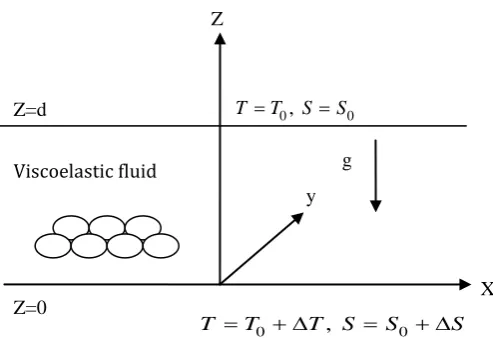
Figure A: Physical configuration of the problem.
The physical configuration of the problem is as shown in the above Fig. A. We consider an infinite horizontal sparsely packed, binary viscoelastic fluid saturated porous layer confined between the planes
z
=
0
andz
=
d
, with the vertically downward gravity force g acting on it. Constant temperatures∆ +
T
T
0 andT
0with stabilizing concentrationsΔ
S
+
S
0 andS
0 respectively are maintained between the lower and upper surfaces. Here∆
T
and∆
S
are the temperature and salinity difference between the walls respectively. A Cartesian frame of reference is chosen with the origin in the lower boundary and the z-axis vertically upwards. The modified Darcy−
Brinkman−
OldroydViscoelastic fluid Z=d
Z=0
0, 0
T =T S=S
0 , 0
T =T + ∆T S = S + ∆S
Z
X g
© 2016, IJMA. All Rights Reserved 65 model, which includes the time derivative, is employed as a momentum equation. With the Oberbeck
−
Boussinesq approximation, the basic governing equations are0,
∇⋅ =
q
(1)2 0
1 2
1
q
p
1
eq
q
,
t
t
t
K
ρ
µ
λ
ρ
λ
µ
ε
∂
∂
∂
+
+ ∇ −
= +
∇ −
∂
∂
∂
g
(2)(
)
2(
)
0
,
T
T
q
T
T
Q T
T
t
γ
∂
+ ⋅∇
= ∇ +
κ
−
∂
(3)(
)
2 21
,
S
S
S
S
D
T
t
ε
∂
+ ⋅∇
= ∇ + ∇
κ
∂
q
(4)(
)
(
)
0
1
TT
T
0 SS
S
0,
ρ ρ
=
−
β
−
+
β
−
(5)Where
q
is the velocity vector,p
is the pressure,λ
1and
λ
2 are the stress relaxation and strain retardation parameters respectively.ε
the porosity, T is the temperature, S is the solute concentration,g
is the gravitational acceleration,ρ
the density, t is time,Q
is internal heat source,µ
is the dynamic viscosity,µ
e is the effective viscosity,κ
Tand
κ
S are the thermal and solute diffusivity,D
1 is the Soret coefficient,β
Tand
β
S are thermaland solute expansion coefficient respectively. Further,
γ
=
(
ρ
c
) /(
mρ
c
p)
f,(
ρ
c
)
m= −
(
1
ε ρ
)(
c
)
s+
ε ρ
(
c
p)
f,c
is the specific heat of the solid,c
pis the specific heat of the fluid at constant pressure, the subscripts f s, and m denote fluid, solid and porous medium values respectively.2.1. Basic State
The basic state of the fluid is assumed to be quiescent and is given by
(
0, 0, 0 ,
)
( ),
( ),
( ),
( ).
b
q
=
p
=
p z
bT
=
T z
bS
=
S z
bρ ρ
=
bz
(6)Using Eq. (6) into Eqs. (1) – (5) yields
(
)
(
)
(
)
2 2
0
2 2
0 0 0
,
0,
0,
1
.
b b b
b T b
b T b S b
dp
d T
d S
g
Q T
T
dz
dz
dz
T
T
S
S
ρ
κ
ρ
ρ
β
β
= −
+
−
=
=
=
−
−
+
−
(7)Then the conduction state temperature and concentration are given by
( )
01
,
i b iz
T sin
R
d
T
z
T
sin R
∆
−
=
+
bΔ 1
0.
z
S
S
S
d
=
−
+
(8)2.2. Perturbed State
On the basic state, we superpose small perturbations in the form
,
b,
b,
,
,
b
′
T
= +
T
T
′
S
=
S
+
S
′
p
p
bp
′
ρ ρ
bρ
′
=
+
=
+
=
+
q
q
q
(9)where the primes indicate perturbations. Substituting Eq.(9) into Eqs. (1)
−
(5) and using the equations (6)-(8), the perturbations are given in the form'
. 0,
∇q = (10)
'
' ' 2 ' '
0
1 0 2
1
q
p
(
TT
SS g
)
1
eq
q
,
t
t
t
K
ρ
µ
λ
ρ β
β
λ
µ
ε
∂
∂
∂
+
+ ∇ +
′
−
= +
∇
−
∂
∂
∂
(11)( )
' ' 2.
,
q
bT
T
T
T
w
T
Q T
t
z
γ
∂
′
+
∇
′
+
∂
= ∇
κ
′
+
′
∂
∂
(12)( )
' ' 2 2 '1
.
b,
S
S
S
S
w
S
D
T
t
z
ε
∂
′
+
∇
′
+
∂
= ∇
κ
′
+ ∇
∂
q
∂
(13)© 2016, IJMA. All Rights Reserved 66 By operating curl twice on Eq. (11) we eliminate
p
′ and then use the scaling
(
)
(
)
(
) (
)
(
)
(
)
( )
( )
* * * * * * * 2,
,
,
,
,
, ,
,
,
,
'
/
,
,
,
T Tx y z
x y z
d
u v w
d
u v w
t
t
d
T
T T
S
S S
κ
γ
κ
∆
∗∆
∗′ ′ ′
=
′ ′ ′
=
′
′
=
=
=
(14)to non-dimensionalize equations (10)-(13) in the form (on dropping the asterisks),
(
)
2 2 2 4 2
1 1 1 2
1
1
T S1
0,
D
w Ra
T
Ra
S
Da
w
w
t
Pr
t
t
λ
∂
∂
λ
∂
+
∇ −
∇ + +
∇
− +
∇ − ∇
=
∂
∂
∂
(15)(
)
2
0,
i
R
q
T
w
t
∂
− ∇ − + ⋅∇
− =
∂
(16)(
)
2 2
1
0,
n
q
S
Sr
T
w
t
Le
ε
∂
−
∇ +
⋅ ∇
−
∇
− =
∂
(17)where
R
i=
Qd
2/
κ
T is the internal Rayleigh number , 1 12 T
d
λ κ
λ
γ
=
, relaxation parameter, 2 22 T
d
λ κ
λ
γ
=
, retardationparameter, 2 e
K
Da
d
µ
µ
=
, Darcy Number,2
Pr
D Td
K
γεν
κ
=
, Darcy-Prndtl number, TS
Le
κ
κ
=
, Lewis number,1 S T T
D
Sr
β
κ β
=
, Soret parameter, T TT
g TdK
Ra
β
νκ
∆
=
, thermal Rayleigh number, S ST
g SdK
Ra
β
νκ
∆
=
, soluteRayleigh number,
ε
n=
ε γ
/
, normalized porosity,2 2 2
1 2 2
x
y
∂
∂
∇ =
+
∂
∂
, 2 2 2 1 2z
∂
∇ = ∇ +
∂
.Since the boundaries are assumed to be stress free, isothermal and isohaline, the Eqs. (15-17).
2
2
0,
0,1.
w
w
T
S
at z
z
∂
=
= = =
=
∂
(18)3. LINEAR STABILITY ANALYSIS
In this section we predict the thresholds of both marginal and oscillatory convections. The Eigenvalue problem defined by Eqs. (15)
−
(17) and subjected to the boundary conditions (18) is solved using the time-dependent periodic disturbances in a horizontal plane. Assuming that the amplitudes of the perturbations are very small, we write( )
( )
( )
(
)
,
w
W z
T
z
exp i lx
my
t
S
z
Θ
σ
Φ
=
+
+
(19)where
l m
,
are horizontal wave numbers andσ
is the growth rate. Infinitesimal perturbations of the rest state may either dampen or grow depending on the value of the parameterσ
.Substituting Eq. (19) into the linearized version of Eqs. (15)
−
(17), we obtain(
)
(
2 2)
2 2(
)
(
2 2)
(
2 2)
21 2
1
T S1
1
0,
D
D
a W
Ra a
Ra a
D
a
Da D
a
W
Pr
σ
λ σ
Θ
Φ
λ σ
+
−
+
−
− +
−
−
−
=
(20)(
2 2)
0,
i
D
a
R
W
σ
Θ
−
−
−
−
=
(21)(
)
1 2 2 2 2
(
)
0,
n
Le
D
a
W
S
D
r
a
ε σ
−Φ
Θ
−
−
−
−
−
− =
(22)where
D
≡
d dz
anda
2=
l
2+
m
2, The boundary conditions (18) now becomes2
0
© 2016, IJMA. All Rights Reserved 67 We assume the solutions in the form
( ) ( ) ( )
(
W z
,
Θ
z
,
Φ
z
)
=
(
W
0,
Θ Φ
0,
0)
Sin
n z
π
,(
n
=
1, 2, 3,...).
(24)Substituting Eq. (24) with
n
=
1
(fundamental mode) into Eqs. (20)- (22), for non-trivial solution ofW
0,
Θ
0, and
Φ
0, we require
(
2)
1(
2(
) (
12 1)
2 1)
12 21 2 2 1
1
1
D 1 n S
T i
n
Pr
Da k
k
k Le
Srk a Ra
Ra
k
R
a
k Le
σ
ε σ
σ
ε σ
− −
−
+ Λ
+
+
−
=
+
−
+
(25)where
k
12=
π
2+
a
2, 21
1
1
λ σ
λ σ
+
Λ =
+
.3.1 Stationary Convection
For the validity of the principle of exchange of stabilities (i.e., steady case), we have
σ
=
0
(i.e.,σ
r=
σ
i=
0
) at themargin of stability. Then the Rayleigh number at which the marginally stable steady mode exists becomes
(
2) (
12 12)
1 2
1
.
St
T i S
k
Da k
Ra
k
R
Sr LeRa
a
+
=
−
−
(26)The critical cell size at the onset of instability is obtained from the condition
0
c St T a a
Ra
a
=
∂
=
∂
, which givesa
c=
π
(for brevity we have skipped one step)
In the absence of a heat source (i.e.,
R
i = 0) Eq. (26) reduces to(
)
2 2 1 1 2 1 21
.
St T Sk
Dak
Ra
k
SrLeRa
a
+
=
−
(27)In absence of the Soret parameter (i.e.,
Sr
=
0
) the above Eq. (27) reduces to(
)
4 2 1 1 21
.
St Tk
Dak
Ra
a
+
=
(28)when
Da
→
0,
that is for densely packed porous medium Eq. (28) becomes(
2 2)
22
,
St Ta
Ra
a
π
+
=
(29)which has the critical value
Ra
cSt=
4
π
2 fora
cSt=
π
obtained by Horton and Rogers (1945) and Lapwood (1948).3.2 Oscillatory Convection
We now set
σ
=
i w
i in Eq. (25) and clear the complex quantities from the denominator and rearrange the real and complex parts. SinceRa
T is a physical quantity, it must be real. Hence, it follows that eitherω
i=
0
(steady onset) or complex part equals to zero (ω
i≠
0
, oscillatory onset). For oscillatory onset we have( ) (
)
(
)
(
)(
)
(
)
(
)
2 2 2 2
2
2 1 1 1 1 2 2
1 1
2 2
2 1 2 2
2 1
1
1
1
i OscT S i
D n
k
k
R
Dak
Ra
k SrRa
k
R
.
a
Pr
k Le
ω λ λ
ω
λ ω
ε ω
−© 2016, IJMA. All Rights Reserved 68
4. RESULTS AND DISCUSSION
We have studied the Soret effect on the onset of convection in a binary viscoelastic fluid saturated porous layer with internal heat source using linear stability analysis. The expressions for stationary and oscillatory Rayleigh numbers are derived analytically and the graphs are plotted for different values of different parameters and the results are discussed here.
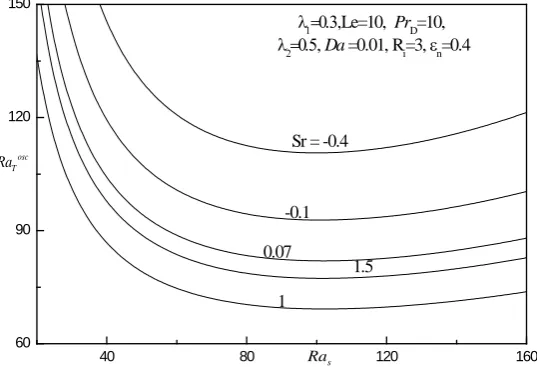
The figures (1-5) show the effect of oscillatory Rayleigh number with the solute Rayleigh number for different values
of various parameters. Fig. 1 depicts the effect of Soret parameter
Sr
on oscillatory Rayleigh number withRa
S. From this figure we observe that an increase in the values (positive) of the Soret parameter decreases the oscillatory Rayleigh number indicating that the effect of the Soret parameter destabilizes the system for oscillatory mode. On the other hand, for increasing in the negative Soret parameter increases the oscillatory Rayleigh number indicating that the effect of negative Soret parameter stabilizes the system for oscillatory convection. From Fig. 2, we find that increasing thevalues of normalized porosity
ε
n increases the oscillatory Rayleigh number indicating that the effect of normalizedporosity stabilizes the system for oscillatory mode.
Fig. 3 displays the effect of the Lewis number
Le
on the oscillatory Rayleigh number with the solute Rayleigh number. From this figure we observe that an increase of the Lewis number increases the oscillatory Rayleigh numberimplying that the effect of Lewis number stabilizes the system. Fig. 4 depicts the effect of Dracy-Prandtl number
Pr
Don oscillatory convection. From this figure we find that an increase in the values of Dracy-Prandtl number decreases the oscillatory Rayleigh number indicating that the Darcy- Parndtl number advances the onset of double diffusive
convection. The effect of an internal Rayleigh number
R
i on oscillatory convection is depicted in the Fig. 5. From this figure we observe that an increase in the value of internal Rayleigh numberR
i increases the oscillatory Rayleigh number indicating that the effect ofR
i stabilizes the system for oscillatory convection.5. CONCLUSIONS
The Soret effect on the onset of convection in a binary viscoelastic fluid saturated porous layer with internal heat source is studied using linear stability analysis which is based on the usual normal mode technique and the following important conclusions are drawn:
1. The effect of Soret parameter stabilizes the system for negative values of
Sr
while destabilizes the system for positive values of the Soret parameter for oscillatory convection.2. The normalized porosity, the Lewis number and an internal Rayleigh number have stabilizing effects in the system of oscillatory convection.
3. The Darcy –Prandtl number has destabilizing effect for oscillatory mode.
40 80 120 160
60 90 120 150
s
Ra
osc T
Ra
1
1.5 0.07
-0.1 Sr = -0.4
λ1=0.3,Le=10, PrD=10,
λ2=0.5, Da =0.01, Ri=3, εn=0.4
© 2016, IJMA. All Rights Reserved 69
50 100 150 200
50 100 150 200
s Ra
osc T
Ra
0.3 0.5 0.6
εn=1
λ1=0.3,Le=10, PrD=10, Sr=0.005,
λ2=0.5, Da = 0.01, Ri=3, Le=10
Fig.2. Oscillatory curves for different values of normalized porosity
ε
n.15 30 45 60
300 450 600 750
s Ra osc
T Ra
1 2
Le = 5
λ1=0.3, Sr=0.005, λ2=0.5, PrD=10, Da = 0.01, Ri=3, εn=0.4
Fig.3. Oscillatory curves for different values of Lewis number Le.
30 60 90 120 150
200 250 300 350 400 450
s Ra osc
T
Ra
8, 9 5
PrD= 2
λ1=0.3, Le=10, Sr=0.005,
λ2=0.5, Da = 0.01, Ri=3, εn=0.4
© 2016, IJMA. All Rights Reserved 70
REFERENCES
1. Altawallbeh, A.A., Bhadauria, B.S., Hasim, I., 2013. Linear and nonlinear double diffusive convection in a saturated anisotropic porous layer with Soret effect and internal heat source. Int. J. Heat Mass Transfer. 59, 103.
2. Bhadauria, B. S., 2012. Double diffusive convection in a saturated anisotropic porous layer with internal heat souorce. Transp. Porous Med. 92, 299.
3. Bhadauria, B. S., Kumar, A., Kumar, J., Sacheti, N. C., and Chandran, P., 2012. Natural convection in a rotating anisotropic porous layer with internal heat generation. Transp. Porous Med, 90, 687.
4. Gaikwad, S. N., and Kamble, S. S., 2012. Analysis of linear stability on double diffusive convection in a fluid saturated anisotropic porous layer with Soret effect. Adv. Appl. Sci. Res., 3(3), 1611.
5. Gaikwad, S. N., and Kamble, S. S., 2015. Theoretical study of cross diffusion effects on convective instability of Maxwell fluid in porous medium. American J. of Heat and Mass Transfer, 2(2), 108.
6. Gaikwad, S.N., Kouser, S. (2013). Onset of Darcy-Brinkman convection in a binary viscoelastic fluid saturated porous layer with internal heat source, heat Transfer-Asian Research, 42(8), 676.
7. Horton, C. W., and Rogers, F. T., 1945. Convective currents in a porous medium. J Appl Phys. 16, 367. 8. Ingham, D. B., Pop, I., 1998. Transport Phenomena in Porous Media. Pergamon. Oxford.
9. Ingham, D. B., Pop, I., 2005. Transport Phenomena in Porous Media. vol. 3 Elsevier, Oxford.
10. Joshi, M.R., Gaitonde, U.N., and Mitra S.K., 2006. Analytical study of natural convection in a cavity with volumetric heat generation. ASME Heat Transfer 128,176.
11. Lapwood, E. R., 1948. Convection of a fluid in a porous medium. Proc. Camb. Phil. Soc. 44, 508.
12. Malashetty, M.S., Swamy, M., Heera, R., 2009. The onset of convection in a binary viscoleastic fluid saturated porous layer, ZAAM J. of Appl. Maths. & Mechs., 89(5), 356.
13. Nield, D.A., Bejan, A., 2006. Convection in porous media, 3rd edn. Springer. New York.
14. Parthiban, C., and Parthiban P.R., 1997. Thermal instability in an anisotropic porous medium with internal heat source and inclined temperature gradient. Int. Commun. Heat Mass Transfer, 24 (7), 1049.
15. Parvathy, C.P., Prabhamani, R. Patil, 1989. Effect of thermal diffusion on thermohaline interleaving in a porous medium due to horizontal gradients, Indian J. of Pure and Appl. Maths., 20(7).
16. Rudraiah, N., Malashetty, M. S., 1986. The influence of coupled molecular diffusion on double diffusive convection in a porous medium, ASME, J. Heat Transfer 108, 872.
17. Rudraiah, N., Siddheshwar, P.G., 1998. A weak nonlinear stability analysis of double diffusive convection with cross diffusion in a fluid saturated porous medium. Heat Mass Transfer 33(4), 287.
18. Swamy, M. S., Naduvinamani , N.B., & Sidram, W., 2012. Onset of Darcy-Brinkman convection in a binary viscoelastic fluid saturated porous layer. Transp Porous Med. 94, 339.
19. Vadasz P., 2008. Emerging Topics in Heat and Mass Transfer in Porous Media, Springer, New York. 20. Vafai, K., 2000. Handbook of Porous Media, Marcel Dekker, New York.
21. Vafai, K., 2005. Handbook of Porous of Porous Media. Taylor & Francis (CRC), Boca Raton.
22. Yaha Shagaiya Daniel, 2015. Presence of heat generation/absorption on boundary layer slip flow of nanofluid over a porous stretching sheet. American J. of Heat and Mass Transfer, 2(1), 15.
23. Yaha Shagaiya, Daniel, and Simon K. Daniel, 2015. Presence of pressure gradient on laminar boundary layer over a permeable surface with convective boundary condition. American J. of Heat and Mass Transfer, 2(1), 1-14.