ISSN-L: 2501 - 1235 Available on-line at: www.oapub.org/edu
doi: 10.5281/zenodo.3369450 Volume 5 │ Issue 11 │ 2019
EXAMINATION OF THE LEVELS OF STATE ANXIETY OF THE
REGISTERED ATHLETES AT PHYSICAL EDUCATION AND SPORT
ACADEMIES ACCORDING TO CERTAIN VARIABLES
Çağatay Dereceli1i, Turhan Toros2 1Adnan Menderes University, Aydın, Turkey 2Mersin University,
Mersin, Turkey
Abstract:
The aim of this study is to investigate the levels of the state anxiety of registered athletes studying at physical education and sports academies in terms of certain variables. The universe of the study consists of registered active athletes studying at physical education teaching departments in Turkey. The sample of the study consisted of registered athletes of the season 2017-2018 studying physical education teaching in the provinces of Gaziantep, Adana, Mersin and Karaman and they are from the fields of athletics, soccer, basketball, volleyball, gymnastics, fencing, handball and swimming. A total of 190 volunteer soccer players 101of whom were male football players whose ages
ranged between 18-24 years (Xage=21.85±1.76) and sports age ranged between 4-10 years
(Xyears in sports=5.75±1.76) and 89 of whom were female whose ages ranged between 18-24
years (Xage=21.67±1.84) and years in sports ranged between 3-9 years (Xyears in
sports=6.01±1.39). In order to collect data on the state anxiety status of the athletes,
Competitive State Anxiety Inventory (CSAI-2) developed by Martens et al. (1990) and adapted to Turkish Culture by Koruc (1998.) In the analysis of the data, the relational scanning model which includes the comparison and correlation type of analyses among the variables was used. With the normality test results were found to have normal distribution, Independent T-Test was used for paired comparisons, and Pearson Correlation Analysis was used to examine the relationship status.
Keywords: sport, psychology, anxiety, athlete
1. Introduction
The word anxiety originates from ‘anxieties’ in Ancient Greek, and bears the meanings of worry, fear, and curiosity. It was first used by Cicero, with the meanings of pressure and drowning and its meaning was temporarily separated from the concept of 'angor' (Baydil, 2007).
The concept of anxiety entered the field of psychology in the first half of the century and the first research and studies in this field were conducted at the end of the 1940s. Sigmund Freud was the first to use the term in the field and defined it as a concept and carried out studies on it. Freud first argued that anxiety arises as a result of repression of impulses and instincts, and later he changed his view and attributed anxiety to the perception of a dangerous situation by the ego, and argued that system of repression works towards eliminating this situation. According to Freud, the duty of anxiety is to warn the self against a threat and danger situation and to activate the defense mechanism (Freud, 2009).
The biological, physiological, all concepts, and all the psychology teachings, which examine the personality structure and behavior, have always given importance to anxiety. Stating that “some have considered anxiety as the first fundamental force that constitutes personality, and others have considered it as a secondary condition, yet as a factor that plays an important role in the formation, development, and behavior of personality” (2005), Koknel describes anxiety as a state of mood that leads humans to experience worry, fear, delusion and sadness which in return create pressure and tension.
Anxiety is a form of fear responses that would not normally provoke a sense of fear. In other words, there is an inexplicable and unintelligible affect which is dolent and saddening (Bedir, 2008).
In the case of anxiety and fear, the reactions of the individual are similar. Therefore, it is not easy to distinguish between anxiety and fear (Tavacioglu, 1999). Cuceloglu (2005) states that some psychologists have put forth three differences between these two words. These are:
1) Source: As in the statement ‘I am afraid of bees’, we know the source of fear yet
that of anxiety is uncertain.
2) Severity: Fear is more severe than anxiety.
3) Duration: While fear takes a shorter period of time, anxiety lasts longer.
These generalizations fall under 4 main headings:
1) Removal of Support The individual is anxious when he/she feels that the
environmental conditions to which he/she is accustomed have disappeared.
2) Anticipating a Negative Outcome: The individual is anxious thinking that
negative outcomes may occur in the future.
3) Internal Contradiction When a contradiction occurs between a believed crucial
idea and action taken on it, there arises a tension in the form of anxiety. The individual begins to look for a solution to overcome this contradiction and continues to experience a certain level of anxiety until a solution is reached.
4) Uncertainty: Not knowing what will happen in the future is one of the main
reasons for anxiety (Cuceloglu, 2005).
When athletes are anxious, the body gets out of control and signals various warnings (Gacar and Coşkuner, 2010). Some of the warnings include tense muscles, irritability, nausea, increased blood pressure and respiratory rate, confusion, inability to concentrate, inability to make decisions, recourse to old habits, forgetting details. Also, ease and smoothness in movements can be lost, and they may experience deterioration in control and concentration (Koknel, 1998).
In environments filled with overpressure, we see that athletes are constantly making wrong decisions, passing and shooting, defensive and offensive behaviors are not realized good enough (Konter, 1996). The overly voiced idea that “the athlete will do better as the tension they are subject to increases!” is false. We can see how wrong this thought is in a basketball or soccer game that is approaching its last minutes. For example, the stress that is awakened in such a situation prevents the basketball or football player making a smooth pass to his/her teammate taking into account their teammates’ current positions and thus the quality of his/her movements deteriorate. The individual, in this case, is bombarded by warnings and become super-alert to the central warnings. For this reason, he/she cannot perceive the peripheral ones. (Macila, 2013).
As a result, an optimal concern is required for the athlete to achieve the desired performance. Accordingly, being above or below this level may adversely affect performance (Tavacioglu, 1999).
2. Method
2.1 Study Model
In this study with which the levels of state anxiety of the registered athletes studying at physical education and sports academies are examined in terms of age, gender and years in sport, the relational scanning model which includes the comparison and correlation type of analyses among the variables was used.
correlation and comparison types, which are sub-categories of relational survey models, were used (Karasar, 2015).
2.2 Study Group
The universe of the study consists of registered active athletes studying at physical education teaching departments in Turkey. The sample of the study consisted of registered athletes of the season 2017-2018 studying physical education teaching in the provinces of Gaziantep, Adana, Mersin and Karaman and they are from the fields of athletics, soccer, basketball, volleyball, gymnastics, fencing, handball and swimming. A total of 190 volunteer athletes 101of whom were registered female athletes whose ages
ranged between 18-24 years (Xage=21.85±1.76) and sports age ranged between 4-10 years
(Xyears in sports=5.75±1.76) and 89 of whom were registered male athletes whose ages ranged
between 18-24 years (Xage=21.67±1.84) and years in sports ranged between 3-9 years
(Xyears in sports=6.01±1.39). The distribution of the study group by gender and sports
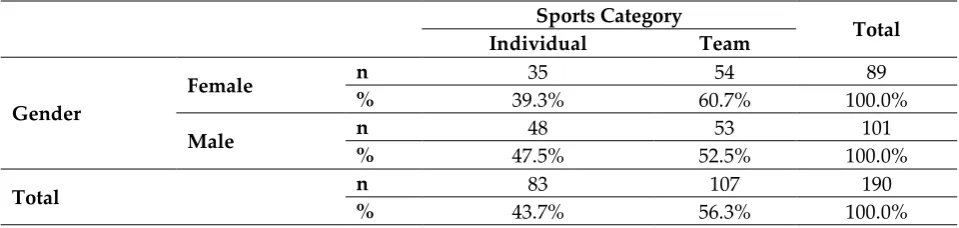
category is given in Table 1.
Table 1: The distribution of the study group by gender and sports category
Sports Category
Total
Individual Team
Gender
Female n 35 54 89
% 39.3% 60.7% 100.0%
Male n 48 53 101
% 47.5% 52.5% 100.0%
Total n 83 107 190
% 43.7% 56.3% 100.0%
When Table 1 is examined, it is seen that a total of 89 registered female athletes participated in the study, 35 (39.3%) from individual sports and 54 (60.7%) from team sports. When Table 1 is examined, again, it is seen that a total of 101 registered male athletes participated in the study, 48 (47.5%) from individual sports and 53 (52.5%) from team sports. Lastly, a total of 190 registered athletes, 83 (43.7%) from individual sports and 107 (56.3%) from team sports, participated in the study.
2.3 Ethical Considerations
The data used in the study were collected by the researchers themselves. In the process of collecting data, the researcher made necessary explanations for the purpose of the study which includes the scope of the research and the protection of the confidentiality of the information to be obtained. Participants voluntarily participated with the consent form and were informed about the study according to the Helsinki criteria. For the purposes of this study, necessary permits were obtained having resorted to ethics committee.
2.4 Data Collection Tools
In order to determine the demographic characteristics of the participants, they were handed in ‘Personal Information Form’ including questions such as gender, age and years in sports and sports category.
2.5 Competitive State Anxiety Inventory
Competitive State Anxiety Inventory-2 CSAI-2 is one of the scales used in sport psychology to measure anxiety before the competition. Developed by Martens et al, (1990), the inventory consists of three sub-scales and 27 items, which are designed to measure cognitive anxiety, somatic anxiety and self-esteem. Judgments are made according to 4 levels of evaluation.
The adaptation of CSAI-2 to Turkey was carried out by Koruc (1998). The test-retest reliability coefficients of the scale, which were carried out every other month, were calculated as .96 for cognitive anxiety, .93 for somatic anxiety and .95 for self-esteem. An increase in anxiety began to be observed as the competition neared. In the measurements made two weeks apart, a relationship was found respectively at the levels of .56, .67, .54, while two days prior to the competition, a relationship was found at the levels of .23, .22, .32., respectively. This finding informs us about the time-based stability of the tool as well as its validity. During the adaptation studies of the scale, item and factor analyses were performed. According to results of factor analysis performed to test the construct validity of the scale, factor loadings ranged between .68 and .98 for the cognitive anxiety sub-dimension, between .69 and .98 for somatic anxiety sub-dimension and ranged between .75 and .97 for self-esteem sub-dimension.
In the scope of this study, internal consistency coefficients of the Competitive State Anxiety Inventory were found to be .83 for cognitive anxiety, .78 for somatic anxiety and .86 for self-esteem.
2.6 Data Analysis
The data were analyzed statistically. In the normality test results, Kolmogorov Smirnov value of the Competitive State Anxiety Inventory sub-scale scores was not found to be significant according to gender, age, years in sports and sports category (p> .05). As a result of the normality test, the distribution was found to be normal and the independent t-test analysis was performed to reveal the statistical difference between two groups and Pearson Correlation Analysis was carried out to evaluate the data in terms of age and years in sports.
3. Findings
Table 2: The Mean, Standard Deviation, and the Lowest Values Obtained of the Competitive State Anxiety Scores of the Study Group
n Min. Max. X̄ Ss
Cognitive Anxiety 190 12 31 20.94 4.01
Self-Esteem 190 14 36 26.79 5.42
Total Score 190 51 81 66.03 6.29
When Table 2 is examined, it is seen that the lowest scores athletes obtained from the inventory were; 12 for cognitive anxiety, 11 for somatic anxiety, 14 for self-esteem and 51 for total anxiety scores; the highest scores were 31 for cognitive anxiety, 26 for somatic anxiety, 36 for self-esteem and 81 for total anxiety scores. The mean score from the inventory was X = 20.94 ± 4.01 for cognitive anxiety, X = 18.29 ± 3,81 for somatic anxiety, X = 26.79 ± 5.42 for self-esteem, and X=66.03±6.29 for total anxiety scores.
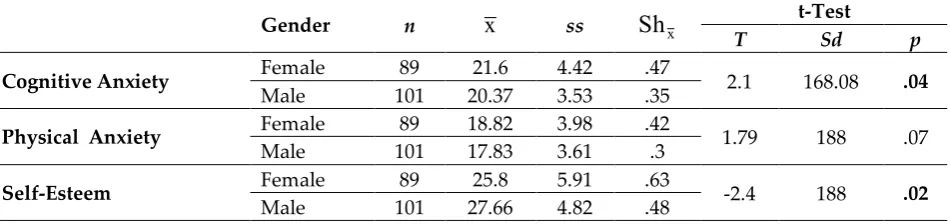
Table 3: The Comparison of Competitive State Anxiety Inventory scores of the Study Group in Terms of Gender
Gender n x ss Shx t-Test
T Sd p
Cognitive Anxiety Female 89 21.6 4.42 .47 2.1 168.08 .04
Male 101 20.37 3.53 .35
Physical Anxiety Female 89 18.82 3.98 .42 1.79 188 .07
Male 101 17.83 3.61 .3
Self-Esteem Female 89 25.8 5.91 .63 -2.4 188 .02
Male 101 27.66 4.82 .48 **p<.05
When Table 3 is examined, it was found that cognitive anxiety and self-esteem sub-dimensions of the inventory differed significantly according to gender (p <.05). It was found that somatic anxiety sub-dimension did not differ according to gender (p>. 05).
Table 4: Comparison between the Competitive State Anxiety Inventory of the Study Group and the Sports Category
Sports Category n x Ss Shx t-Test
T sd p
Cognitive Anxiety Individual 83 21.47 4.58 .5 1.55 148.95 .12
Team 107 20.53 3.48 .34
Bodily Anxiety Individual 83 19.36 3.93 .43 3.5 188 .00**
Team 107 17.47 3.52 .34
Self-Esteem Individual 83 26.76 5.11 .56 -.07 188 .95
Team 107 26.81 5.68 .55
**p<.01
Table 5: The relationship between the Competitive State Anxiety Inventory of the Study Group and the Age Variable
Age Cognitive Anxiety Somatic Anxiety Self-Esteem
Age r 1
Cognitive Anxiety r .185 1
Somatic Anxiety r .120 .445** 1
Self-Esteem r .038 .405** .399** 1
*p<,05; **p<,01
When Table 5 is examined, a significant positive correlation was found between the ages of the study group and the cognitive anxiety sub-dimension of the inventory (p <.05; r = 185). There was no relationship found between somatic anxiety and self-esteem sub-dimensions and age variables (p>, 05).
Table 6: The relationship between the Competitive State Anxiety Inventory Scores . of the study group and Years in Sports Variable
Years in Sports Cognitive Anxiety Somatic Anxiety Self-Esteem
Years in Sports r 1
Cognitive Anxiety r .230** 1
Bodily Anxiety r -.035 .445** 1
Self-Esteem r -.016 .405** .399** 1
**p<.01
When Table 6 is examined, there is a significant positive relationship between the years in sports of the athletes in the study group and the cognitive anxiety sub-dimension of the inventory (p<.01; r=.230). There was no relationship found between somatic anxiety and self-esteem sub-dimensions and age variables (p>.05).
4. Discussion and Result
The lowest scores athletes obtained from the inventory were; 12 for cognitive anxiety, 11 for somatic anxiety, 14 for self-esteem and 51 for total anxiety scores; the highest scores were 31 for cognitive anxiety, 26 for somatic anxiety, 36 for self-esteem and 81 for total anxiety scores. The mean score from the inventory was X = 20.94 ± 4.01 for cognitive anxiety, X = 18.29 ± 3.81 for somatic anxiety, X = 26.79 ± 5.42 for self-esteem, and X=66.03±6.29 for total anxiety scores. When the scores obtained from the inventory are examined, it is seen that the overall arithmetic average (= 66.03 ± 6.29) is below the mean of the total score (67.5). According to this result, it can be said that the state anxiety levels of the study group are negative.
It was found that cognitive anxiety and self-esteem sub-dimensions of the inventory differed significantly according to gender (p <.05). It was found that somatic anxiety sub-dimension did not differ according to gender (p>. 05).
athletes have been found more anxious than athletes doing team sports. In Engur (2002) 's study, a significant difference was found in the state anxiety states according to the sports category of the participants (t = 6.28). Athletes doing team sports have been found to have higher levels of anxiety compared to the athletes in team sports. This result is not in accordance with our study. Cognitive anxiety and self-esteem sub-dimensions did not differ according to sports category (p>.05). In a study conducted by Bedir (2008) on taekwondo players of the national team which junior women, junior men, youth men, youth women, elite women and elite men participated, there was no statistically significant difference found as to their state anxiety scores before the competition. This supports our study. While the physical condition may change according to the branch of team sports and individual sports, the state anxiety may be the same for the competitive athletes from each category. Therefore, it is not surprising to see that somatic anxiety differed while cognitive anxiety and self-esteem sub-dimension did not differ.
There is a significant positive relationship found between the years in sports of the athletes in the study group and the cognitive anxiety sub-dimension of the inventory (p<.05; r=.185). While there is no anxiety for the athletes to rise in their sports career at a young age; as the age increases, however, there may arise anxieties that they will not be able to participate in competitions such as the Olympic Games, World Championships or European Championships. The desire to play in a better team as their age increases and the desire to be selected into the national team increases accordingly. This being the reason, cognitive anxieties is believed to increase with age. There was no relationship found between somatic anxiety and self-esteem sub-dimensions and age variables (p>.05).
There is a significant positive relationship between the years in sports of the athletes in the study group and the cognitive anxiety sub-dimension of the inventory (p<.01; r=.230). There was no relationship found between somatic anxiety and self-esteem sub-dimensions and age variables (p>.05). The increase in the athletes' training age and in the number of competitions participated may lead them to a state anxiety. In this case, the cognitive anxiety of the athlete is expected to increase due to the years in sports.
References
Martens, R., Vealey, R. S., & Burton, D. (1990). Competitive anxiety in sport. Human kinetics.
Baydil, B. (2007, Eylül). Müsabaka Öncesinde Yapılan Akupunktur Uygulamasının
Sporcuların Durumluluk Kaygı Düzeylerine Etkisi. Yayınlanmamış Yüksek Lisans
Tezi, Gazi Üniversitesi, Sağlık Bilimleri Enstitüsü, Ankara.
Köknel, Ö. (2005). Kaygıdan Mutluluğa Kişilik (1. Baskı b.). İstanbul: Altın Kitaplar.
Tavacıoğlu, L. (1999). Spor Psikolojisi: Bilişsel değerlendirmeler. Ankara: Bağırgan
Yayınevi.
Köknel, Ö. (1998). Zorlanan İnsan: Kaygı Çağında Stres (4. Baskı b.). İstanbul: Altın
Kitaplar Yayınevi.
Koruç, Z. (1998). CSAI-2’nin Türkçe uyarlaması. V. Spor Bilimleri Kongresi. Ankara: Hacettepe Üniversitesi, 93.
Konter, E. (1996). Sporda Stres ve Performans (1. Baskı b.). İzmir: Saray Medikal
Yayıncılık.
Gacar, A., & Coşkuner, Z. (2010). Güreşçilerin Sürekli Kaygı Düzeylerinin Bazı
Değişkenler Açısından İncelenmesi. e- Journal of New World Sciences Academy,
5(4), 241-250.
Engür, M. (2002). Elit Sporcularda Başarı Motivasyonunun Durumluk Kaygı
Düzeylerine Etkisi. Yayınlanmamış Yüksek Lisans Tezi, Sağlık Bilimleri Enstitüsü,
Ege Üniversitesi, İzmir.
Cüceloğlu, D. (2005). İnsan ve Davranışı: Psikolojinin Temel Kavramları (14. Baskı b.). İstanbul: Remzi Kitabevi.
Macila, E. (2013). Basketbol Oyuncularının Durumluk ve Sürekli Kaygı Düzeylerinin
Belirlenmesi. Yayınlanmamış Yüksek Lisans Tezi, Yakın Doğu Üniversitesi, Sağlık
Bilimleri Enstitüsü, Lefkoşa, KKTC.
Karasar, N. Bilimsel Araştırma Yöntemi. 2015. Ankara: Nobel Yayınevi.
Creative Commons licensing terms