Bergbambos
and
Oldeania
, new genera of African
bamboos (Poaceae, Bambusoideae)
Chris M. A. Stapleton1
1 11 Chandos Close, Amersham, HP6 6PJ, United Kingdom
Corresponding author:Chris M. A. Stapleton ([email protected])
Academic editor:Leonardo Versieux | Received 1 August 2013 | Accepted 9 August 2013 | Published 23 August 2013
Citation: Stapleton CMA (2013) Bergbambos and Oldeania, new genera of African bamboos (Poaceae, Bambusoideae). PhytoKeys 25: 87–103. doi: 10.3897/phytokeys.25.6026
Abstract
Two new monotypic genera, Bergbambos and Oldeania are described for African temperate bamboo species
in the tribe Arundinarieae, after a comparison of their morphological characteristics with those of similar
species from Asia. Morphological differences are supported by their isolated geographical distributions. Molecular evidence does not support the inclusion of these species in related Asian genera, recognising
them instead as distinct lineages. New combinations Bergbambos tessellata and Oldeania alpina are made.
Keywords
Thamnocalamus, Yushania, Arundinarieae, new genus, Africa
Introduction
While Asian temperate bamboos have received critical attention over recent decades (Stapleton 1994, Wong 1995, Li et al. 2006), the generic placement of the temperate bamboos of Africa has not been properly addressed. There seem to be only two temper-ate bamboo species on the African mainland, currently enumertemper-ated most frequently as Thamnocalamus tessellatus (Nees) Soderstrom & R.P. Ellisand Yushania alpina (K. Schum.) W.C. Lin. These species are in tribe Arundinarieae Nees ex Asch. & Graebn., a group also known as the northern temperate clade, identified as a strongly supported monophyletic group from the first molecular analyses of bamboos onwards (Watanabe et al. 1994, Zhang 1996).
www.phytokeys.com
Copyright Chris M. A. Stapleton. This is an open access article distributed under the terms of the Creative Commons Attribution License 3.0 (CC-BY), which permits unrestricted use, distribution, and reproduction in any medium, provided the original author and source are credited.
let bracts), ebracteate or partially bracteate synflorescence paraclades (reduced sheath-ing subtendsheath-ing inflorescence branches) and 3 stamens in each floret. They constitute ca. 800 of the ca. 1400 woody bamboos, and are found in Asia, Africa, and the USA, having a montane or subtropical to temperate distribution.
Molecular studies reviewed by Bamboo Phylogeny Group (2012) suggest that se-melauctant inflorescences with 3 stamens and reduced branch sheathing have evolved
from tropical bamboos at least twice, once to give the northern temperate clade
Arun-dinarieae of Asia and Africa, spreading to N America, and on separate occasions in
Central & South America within the Bambuseae Kunth ex Dumort., principally to
give Chusqueinae Bews, with these characters also evolving on a smaller scale within the
Arthrostylidiinae Bews and Guaduinae Soderstr. & R. P. Ellis as well.
Most of the older 3-stamened species were placed at some time in Arundinaria
Michx., which has 529 combinations, but that genus is now widely recognised as containing only 3 species, all from the Southeast USA (Stapleton et al. 2004, Zeng et al. 2010, Bamboo Phylogeny Group 2012). Treatments of the other species of tribe Arundinarieae vary, according to the breadth of generic concept used, and which char-acters are given greatest weight. For example, the group of Asian species
morphologi-cally closest to Arundinaria could be placed (Zhang et al. 2012) either in a polyphyletic
broad interpretation of Arundinaria (e.g. Li et al. 2006), in a polyphyletic broad
inter-pretation of Bashania Keng f. & T.P. Yi (e.g. Keng and Yi 1996), or in the
monophy-letic Sarocalamus Stapleton (Stapleton et al. 2004, Bamboo Phylogeny Group 2012).
The morphologically more distinct species are currently placed in other genera, 27 of which were recognised by Bamboo Phylogeny Group (2012), out of a total of 42 gen-era that have been described within the tribe.
There appears to have been a rapid and relatively recent diversification within bam-boos with 3 stamens, including tribe Arundinarieae (Stapleton et al. 2009, Hodkinson et al. 2010, Zhang et al. 2011, Kelchner and BPG 2013), especially those found in montane and temperate areas such as the Andes, the Himalayas, and Northeast Asia. There have also been several reports of hybridisation, reviewed by Triplett et al. (2010) and Zhang et al. (2012). Hybridisation may well have been common in the bamboos, as mechanisms to avoid it have not been documented. Recent rapid diversification and hybridisation, combined with long generation times, appear to have limited the ability of DNA analyses to resolve phylogenetic patterns and define well supported groups for taxonomy, especially at the generic level (Stapleton et al. 2009, Hodkinson et al. 2010), despite reasonable or sometimes very substantial morphological variation.
Chao and Renvoize 1989) have resulted in polyphyletic and paraphyletic groups, or clades with weak support that are inconsistent in different analyses.
Rapid recent diversification seems to have spawned a host of small groups, of-ten distinguished by relatively minor characters. Combining them together into a few large genera has not been possible without establishing excessively variable genera that are difficult to define and demonstrably polyphyletic. On the other hand recognising only half of the genera described would still lead to a generic concept that is unusually narrow in the grasses. The latter procedure has been followed (Bamboo Phylogeny Group 2012), largely because it has been found unavoidable if a functional binomial classification system is to be maintained. This is necessary in order to allow pragmatic field identification, and subsequently improve sustainable utilisation and conservation of these species, many of which have a limited range of distribution and are threatened by changes in land use and climate. A substantial proportion of the woody bamboos are yet to be described, and the lack of a functional and stable nomenclatural system for field identification has been a major factor preventing their recognition.
Only two species of temperate bamboo have been described from the African
main-land. Thamnocalamus tessellatus (Nees) Soderstrom & R.P. Ellis is from mountains in
southern Africa,while Yushania alpina (K. Schum.) W.C. Lin is from mountains in
several countries across tropical Africa. Y. alpina was described initially in Arundinaria,
and T. tessellatus was soon transferred into that genus from Nastus Juss. They were
more recently moved into the morphologically closer Asian genera, Thamnocalamus
Munroand Yushania Keng f., the geographically closest representatives of which are
found in the Western Himalayas, Map 1 and Map 2.
Three further, less well known species, Thamnocalamus ibityensis (A. Camus)
Ohrnb., Yushania madagascariensis (A. Camus) Ohrnb. and Yushania humbertii (A.
Camus) Ohrnb. (including Yushaniaambositrensis (A. Camus) Ohrnb.) were described
from Madagascar. Thamnocalamus ibityensis has been considered conspecific with T.
tessellatus (Chao & Renvoize, 1989), but it would appear to have substantially different
branch sheathing. The two Yushania species would appear to share characteristics with
Y. alpina, but their culms, branching and culm sheaths are not known. Y.ambositrensis
resolved in a clade with Y. alpina (Triplett, 2008), but it is not clear how closely related
they really are to Y. alpina, or to each other, and which species names should be
rec-ognised. Further field work on temperate species of Madagascar is required, as existing collections are incomplete, although any such species may have already become extinct.
Comparison of morphological characters
consist-Map 1. Distribution of Thamnocalamustessellatus, Thamnocalamus in Asia, and Fargesia.
ent and accurate vegetative as well as floral characters in descriptions, the morphology of woody bamboos has been reviewed in depth (Stapleton 1997, available online). Recent bamboo treatments (Judziewicz et al. 1999, Li et al. 2006, Triplett et al. 2006, BPG 2012) have employed these revised concepts and terminologies, and they are fol-lowed here.
The characters and character states considered important at the generic level for distinguishing the two African species from similar Asian genera are given in Table 1.
Thamnocalamus tessellatus
Previous generic placements of Thamnocalamus tessellatus were based upon an
incom-plete knowledge of its morphology. Nastus tessellatus Nees was described before its
flowers were known, and transferred into Arundinaria (Munro 1868) simply as it bore
“very great resemblance” to that genus. Later discovery of its flowers has shown that it
indeed has 3 stamens, rather than the 6 of Nastus, but it has pachymorph rhizomes (see
Stapleton 1997: fig.1) rather than the leptomorph rhizomes of Arundinaria.
It was transferred into Thamnocalamus largely on the basis of leaf anatomical
char-acters by Soderstrom and Ellis (1982), who found that A. tessellata shared 10 characters
out of 11 with Thamnocalamus spathiflorus (Trin) Munro, while it only shared 7
char-acters with Fargesia nitida (Mitford) Keng f. However, A. tessellata also shared only 5
characters with Thamnocalamus aristatus E.G. Camus, while the possibly conspecific
T. spathiflorus and T. aristatus themselves only shared 6 out of 11 characters. When morphological characters other than those of leaf anatomy, along with more recent molecular results are taken into account, it would appear that the anatomical charac-ters used by Soderstrom and Ellis (1982) are more informative at the level of species or below rather than at generic level.
The synflorescence of T. tessellatus has been well illustrated in Hooker’s Icones
Plantarum (Prain 1913: Tab 2930 http://www.botanicus.org/page/1349516), and by Soderstrom and Ellis (1982). When examined closely, it can be seen that the
synflo-rescence of T. tessellatus has similarities to those of both Thamnocalamus and Fargesia
Franchet, see Table 1, as they are compressed, and are associated with several
support-ing sheaths. However, while Thamnocalamus has loose racemose panicles, T. tessellatus,
like Fargesia, consistently bears short racemes. These are structurally very similar to
those of Fargesia, but differences arise in the arrangement of the florets. In Fargesia
the racemes are held tightly within imbricating sheaths, which can extend well beyond the spikelets. Development within the sheaths forces them to emerge to one side and
appear unilateral, with the pedicels tightly pressed against the rhachis. Those of T.
tessellatus are more cylindrical, the spikelets not so constricted by the sheaths, and the pedicels are free to develop in a normal distichous fashion, Figure 1.
In addition, in T. tessellatus the pedicels are scabrous, the glumes of each spikelet
are basally tight and contain no vestigial bud remnants, and the racemes are usually
tab
le 1.
Principal morphological characters of
Bergbambos, O
ldeania,
and Asian members of 5 similar genera.
B
er
gbambos
(Thamnocalamus tessellatus)
Thamnocalamus Far gesia O ldeania (Y ushania alpina) Yushania Borinda Chimonocalamus synflor escence
raceme, not unilateral raceme to panicle, not unilateral raceme, unilateral panicle, not unilateral panicle, not unilateral panicle, not unilateral panicle, not unilateral
paraclades
largely ebracteate
substantially bracteate variably bracteate
largely ebracteate largely ebracteate largely ebracteate largely ebracteate pedicel scabr ous glabr ous glabr ous glabr ous glabr ous glabr ous glabr ous fer tile flor ets 1 2–sev eral 2–sev eral 2–sev eral 2–sev eral 2–sev eral 2–sev eral
glume bud r
emnants absent variable pr esent absent variable variable absent rhiz omes shor t-necked shor t-necked shor t-necked long-necked long-necked shor t-necked shor t-necked clump form unicaespitose unicaespitose unicaespitose culms solitar y pluricaespitose unicaespitose unicaespitose nodes without r oots without r oots without r oots with shor t r oots without r oots without r oots with r oot thorns supranodal ridge obscur e obscur e obscur e w ell dev eloped obscur e obscur e w ell dev eloped culm internodes ter ete ter ete ter ete sulcate ter ete ter ete ter ete branch sheathing reduced complete reduced reduced reduced reduced complete branch orientation er ect er ect er ect spr eading er
ect to spr
eading er ect spr eading mid-culm branches 5–7 3–8 5–7 3–7 5–11 5–7 3
culm sheath blades
er
ect or r
eflex
ed
usually er
ect
er
ect or r
eflex ed usually r eflex ed er
ect or r
eflex
ed
er
ect or r
eflex
ed
usually r
other Thamnocalamus and Fargesia species, but this character should be treated with caution as it can be a specific as well as a generic character.
Thamnocalamus tessellatus also hasvegetative characteristics that distinguish it,
no-tably from Asian members of Thamnocalamus, (see Table 1). A close inspection of the
branching reveals not the pattern seen in species such as Thamnocalamuscrassinodus
(T.P. Yi) Demoly, but instead the substantial reduction in sheathing seen in Fargesia,
Yushania, and Borinda Stapleton, Figure 2.
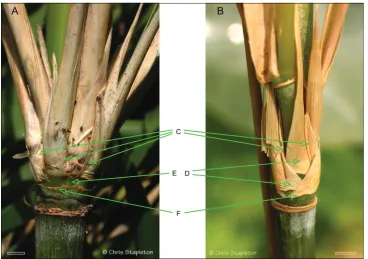
The branches of Thamnocalamus tessellatus are subequal, arranged side by side
through strong compression of the basal internodes of the central branch,
accompa-nied by loss of some of the sheaths at the nodes, Fig. 2A, cf Thamnocalamus crassinodus,
Fig. 2B. This allows lateral branch prophylls to be seen side by side without any inter-vening sheaths. These patterns were contrasted by Stapleton (1991; 1994: fig. 1; 1997:
fig. 2), and also illustrated for T. tessellatus by Soderstrom and Ellis (1982: fig.1, fig. 4).
In addition to the synflorescence and branching, T. tessellatus also differs in minor
de-tails that are harder to quantify, including the more varied orientation of the foliage leaves, and the delicate appearance of its oral setae and their more varied orientation, Figure 3.
Thus in terms of vegetative macro-morphological characteristics important at
the generic level, T. tessellatus is closer to Fargesia than to Thamnocalamus, but can
be distinguished from both. In general appearance it resembles a coastal species of
Figure 1. Raceme of Thamnocalamus tessellatus (A), compared to: BFargesia nitida, lateral view with
en-closing sheaths; CFargesia nitida with enclosing sheaths removed DFargesia nitida, dorsal view, sheaths
Pleioblastus Nakai from Japan, with rather loose clumps, erect culms with short branches bearing coarse, irregularly arranged foliage with persistent sheaths. This contrasts with the delicate foliage leaves, all oriented towards the light on
pendu-lous branches seen in Himalayan speciesof Thamnocalamus and in Fargesia. This is
likely to be associated with the more open ecological habitat in which T. tessellatus
is found, rather than the darker forest understorey habitats of Asian Thamnocalamus
and Fargesia species.
Yushania alpina
The synflorescence of Y. alpina is practically indistinguishable from those of several
Asian and American bamboos, including species of Arundinaria, Sarocalamus, and
Yushania—an open panicle with nearly complete reduction in sheathing at points of branching so that it is essentially ebracteate. However, the sheaths are often reduced to small tough bracts, as well as the more delicate sheath remnants or tufts of hairs seen in Figure 2. Comparison of branch complement sheathing from mid-culm nodes of Thamnocalamus
tessella-tus (A) and Thamnocalamus crassinodus (B) C Lateral branch prophylls D Sheaths obscuring prophyll bases
similar genera. In addition the lateral spikelets are more often sessile or subsessile, with-out a long pedicel. However, these characters are relatively minor and quite variable.
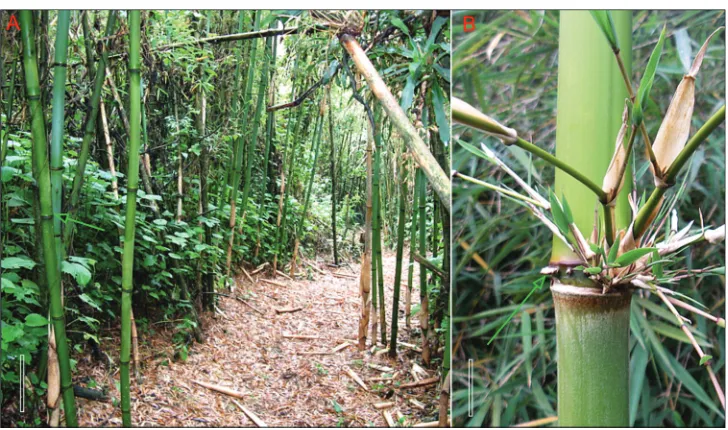
Yushania alpina is more distinct vegetatively. Reaching heights of up to 20m in its natural habitat, the tall, very erect culms are potentially much larger than those of any
Asian species of Yushania, which only reach a maximum height of about 7m. Culm nodes
and branching also differ substantially from those of Asian species of Yushania, Figure 4.
Branches vary in size more than those of Asian Yushania species. The central branch is
strongly dominant, and the first two lateral branches are also strong. The orientation of the
branches is less erect than those of most species of Yushania, becoming nearly horizontal.
Above the branches the internode is distinctly sulcate, much more prominently than is
seen in Asian Yushania species, as a result of the development of strong branches.
Moreo-ver there is often a dense ring of short, partially developed aerial roots at nodes in the lower part of the culm, often extending into the mid-culm region as well. This character is only
known in species of Chimonocalamus Hsueh & T.P. Yi, and the leptomorph-rhizomed
Chimonobambusa Makino among the Asian temperate bamboos. The roots are not as
sharp and thorn-like as those seen in Chimonocalamus and Chimonobambusa, but they can
be very distinct and prominent. Nodes have a distinct infranode between the culm sheath attachment and the supranodal ridge, which is well developed, Figure 5.
In its natural habitat, the open stands have a widely spaced appearance closer to
that of a species of Phyllostachys Siebold & Zucc., rather than the denser thickets of
Figure 4.Yushaniaalpina. A culm sheath B leaf sheaths, culm node with ring of thorn-like aerial roots and distinct supra-nodal ridge, sulcate internode, and dominant central branch. Scale bars top right, 2 cm.
Figure 5.Yushania alpinaA tall culms arising separately with prominent supra-nodal ridges (arrowed),
Rwenzori, Uganda B culm node with ring of thorn-like aerial roots (arrowed), Mt. Kenya.Scale bars A 25
cm, B 5 cm. Photos courtesy of: (A) Peter Gill, (B) Harry Jans, www.jansalpines.com
Asian Yushania species, because the rhizomes have consistently long necks, giving
Branch structure and sheathing is difficult to distinguish from that of Yushania or
Fargesia. Although the prophyll is usually 2-keeled, there is replication side by side of lateral branch initials without intervening sheaths. In this way it differs fundamentally
from Chimonocalamus, which has only 3 branches and full sheathing.
Discussion
The morphological differences between Thamnocalamus tessellatus, Yushania alpina
and other representatives of these and similar Asian genera suggest that although the two African bamboos share several characters and presumably common ancestors with Asian bamboos, they are not as closely related to their Asian relatives as previ-ously thought.
The morphological distinctions are supported by geographical isolation, (see Maps 1 and 2). Long-distance dispersal of temperate bamboos is highly unlikely because of a lack of any specialized seed dispersal mechanism or dormancy, brief viability of seed, ex-acting habitat requirements, and extremely infrequent flowering (Stapleton et al. 2004). Together the morphological distinctions and geographical isolation justify the rec-ognition of two new genera, following the existing relatively narrow generic concepts
applied in the northern temperate clade, tribe Arundinarieae.
The new genera are keyed out below along with their 6 morphologically clos-est relatives in the tribe including the two Asian genera with distinct nodal thorns,
as well as the North American type genus of the tribe, Arundinaria, and its Asian
analogue, Sarocalamus.
Key to Bergbambos, Oldeania and related genera
1 Rhizome leptomorph ...2
– Rhizome pachymorph ...4
2 Basal culm nodes with thorns, branches spreading ...Chimonobambusa
– Basal culm nodes without thorns, branches erect ...3
3 Pedicels glabrous, leaf blades thick, SE USA ...Arundinaria
– Pedicels not glabrous, leaf blades thin, Himalayas & W China ...Sarocalamus
4 Branches 3, all sheaths developed, basal nodes with thorns ...Chimonocalamus
– Branches 3-15, sheathing reduced, basal culm nodes with or without thorns ...5
5 Rhizomes long or variable in length, clumps open or spreading ...6
– Rhizomes consistently short, culms in single clumps ...7
6 Nodes raised, basal culm nodes usually with thorns, Africa ...Oldeania
– Nodes not raised, basal culm nodes without thorns, Asia ...Yushania
7 Branch sheathing complete ...Thamnocalamus
– Branch sheathing reduced ...8
– Racemes not unilateral, Africa ...Bergbambos
Sufficient data is now available to test whether this classification would gain sup-port from molecular phylogenetic evidence. These two African species were not clearly resolved with Asian representatives of any genera in any molecular studies. For
exam-ple, in a comparison of ITS sequences (Guo et al. 2002), Thamnocalamus tessellatus did
not resolve with the type species of Thamnocalamus, T. spathiflorus, and its position
varied between topologies. In the nuclear ribosomal ITS analysis of Hodkinson et al.
(2010), Yushania alpina did not group with other Yushania species or closely with any
other taxon. Weak associations between Yushania alpina and Chimonocalamus species
were found by Guo and Li (2004) and Triplett (2008), which is interesting as they share possession of aerial roots developed into thorn-like structures, although they
differ in other ways. However, neither Yushania alpina nor Thamnocalamus tessellatus
resolved with putative relatives in these or similar genera of temperate bamboos in the most comprehensive studies undertaken so far, using sequences from 8 regions of cpDNA in 146 species and 26 genera (Zeng et al. 2010), and 108 bamboos from 25 genera using plastid DNA and nuclear GBSSI gene sequences (Zhang et al. 2012).
The molecular data would suggest that their inclusion in Asian genera would ren-der those genera polyphyletic. Because their monotypic status is consiren-dered likely they could not be supported as monophyletic groups themselves in a classification based solely on molecular phylogeny. However, Zeng et al. (2010) and Zhang et al. (2012) considered them both to represent distinct lineages, and it is not possible to place them
in well supported meaningful monophyletic groups except the tribe Arundinarieae.
Therefore while the molecular data would not allow the diagnosis of monophyletic gen-era for the African bamboos following a strict Hennigian cladistic analysis, neither their
current placement in Thamnocalamus and Yushania, nor placement in any other existing
genus receives any support either. Continuing to include these bamboos in Asian genera causes serious problems when describing or distinguishing between those genera.
Although woody bamboos are considered to have evolved originally in Gondwa-naland rather than Eastern Asia (Hodkinson et al. 2010), these African
representa-tives are nested within the northern temperate clade, the tribe Arundinarieae, with
a largely Asian distribution. This is estimated to have diverged from other woody bamboos around 23 mya (Hodkinson et al. 2010), 29 mya (Bouchenak-Khelladi et al. 2010) or 37.5 mya (Christin et al. 2008), but to have radiated only ca. 9 mya (Bouchenak-Khelladi et al. 2010) 10 mya (Hodkinson et al. 2010), or 19 mya
(Christin et al. 2008). Peng et al. (2013) after sequencing 95% of the Phyllostachys
edulis genome found evidence of whole genome duplication 7–12 mya, supporting the more recent dates.
the Eurasian plate around that time, allowing a biotic interchange and subsequent radiation and diversification of Gondwanan elements into a wealth of new habitats. However, the temperate ancestors of these two African bamboo genera seem to have diverged around the same time that temperate bamboos arrived in Eastern Asia. In-clusion of endemic temperate bamboos from S India, Sri Lanka and Madagascar in a molecular phylogeny is required before any conclusions can be drawn as to where bamboos from the northern temperate clade first evolved, but there seems no evidence for an African origin, and it seems more likely that temperate bamboos radiated from India to Asia, Africa, and N America.
Nomenclature
Bergbambos Stapleton, gen. nov. urn:lsid:ipni.org:names:77131102-1 http://species-id.net/wiki/Bergbambos
Remarks. Differing from Arundinaria and Sarocalamus and similar to Thamnocalamus
and Fargesia in its short-necked pachymorph rather than leptomorph rhizomes, and
its compressed synflorescences. Differing from Borinda and Thamnocalamus in its
rac-emose rather than paniculate synflorescence branching. Differing from Fargesia in the
distichous rather than unilateral arrangement of spikelets in the racemes, the spikelets
usually having only one fertile floret, and the scabrous pedicels. Differing from
Tham-nocalamus in the branch complement with reduced sheathing, and from Fargesia in the more varied orientation of the leaf blades.
Type. Bergbambos tessellata (Nees) Stapleton comb. nov. urn:lsid:ipni.
org:names:77131104-1 Basionym: Nastustessellatus Nees, Fl. Afr. Austr. 1: 463. 1841.
Arundinaria tessellata (Nees) Munro; Thamnocalamustessellatus (Nees) Soderstrom & R.P. Ellis. Type: S Africa, Katberg, 4000–5000ft, J.F. Drège s.n. (lectotype, desig-nated in Soderstrom & Ellis 1982, pg. 54: K!, http://apps.kew.org/herbcat/getImage. do?imageBarcode=K000345516
Rhizome pachymorph, short-necked, giving dense clumps. Culms to 7 m tall, diam. to 2 cm, nodding to pendulous, terete, smooth, nodes not raised and unarmed. Mid-culm branch complement initially with 5–7 main branches, erect, sheathing reduced. Culm sheaths persistent, tough. Leaf sheaths several to many, persistent, blades thick with random orientation. Synflorescence semelauctant, racemose, branch sheathing occasionally a soft sheath remnant, usually absent. Racemes not unilateral. Spikelets shortly pedicellate with 1(–2) fertile florets, pedicel scabrous. Empty glumes 2, no bud remnants. Lemma and palea similar in length. Stamens 3, filaments free. Stigmas 3. Lodicules 3.
Name Bergbambos from the Afrikaans name (Bergbamboes) in South Africa.
http://species-id.net/wiki/Oldeania
Remarks. Differing from Arundinaria and Sarocalamus and similar to Yushania in its long-necked pachymorph rather than leptomorph rhizomes, though similar to all
in its open panicles. Differing from Yushania in its sulcate culm internodes, fewer,
more horizontal branches, culm nodes with well developed supra-nodal ridge and
of-ten thorn-like aerial roots. Similar to Chimonocalamus in its panicles and thorn-like
roots at culm nodes, but differing in its multiple branches with reduced sheathing and sulcate culm internodes.
Type. Oldeania alpina (K. Schum.) Stapleton comb. nov. urn:lsid:ipni.
org:names:77131105-1 Basionym Arundinaria alpina K. Schum. in Engler,
Pflanzen-welt Ost-Afrikas 5: 117. 1895. Sinarundinaria alpina (K. Schum.) C.S. Chao &
Ren-voize; Yushania alpina (K. Schum.) W.C. Lin. Type: Kenya, Kikiju, G.A. Fischer 672
(holotype: B n.v., destroyed).
Rhizome pachymorph, long-necked, giving open stands and solitary culms. Culms to 15(–20) m tall, diam. to 6(–10) cm, erect to nodding, terete with shallow sulcus above branches, smooth, nodes with prominent supranodal ridge, in lower to mid culm a nodal ring of dense, short, hard, and thorn-like aerial roots often well de-veloped. Mid-culm branch complement initially with 3–5 main branches, spreading, sheathing reduced. Culm sheaths deciduous, tough. Leaf sheaths several to very many, blades thick. Synflorescence semelauctant, paniculate, branch sheathing reduced to hard bracts, soft sheath remnants or hairs. Spikelets pedicellate with several fertile florets, pedicel scabrous. Empty glumes 2, bud remnants present or absent, fertile glumes 4–8. Lemma and palea similar in length. Stamens 3, filaments free. Stigmas 2. Lodicules 3.
Name Oldeania from the Maasai common name (Oldeani) in Tanzania.
Currently only the type species can be reliably placed in the genus, which thus has a distribution across tropical Africa from Cameroon in the west to E Africa, where it occurs from Ethiopia south to Tanzania. There is a possibility that spe-cies from Madagascar will be placed in this genus when they are better known, but they may be conspecific or even introduced. It provides important montane wildlife
habitats and food, notably for the critically endangered Mountain Gorilla, Gorilla
beringei beringei.
Acknowledgements
The American Bamboo Society is thanked for providing open access publication fees for this paper. Dr Hans-Helmut Poppendieck, Curator of Phanerogams at Herbarium
Hamburgense is thanked for information relating to the missing type of Arundinaria
alpina. Dr Ximena Londoño kindly looked for ms names while at the Smithsonian In-stitute, and Dr John Grimshaw provided information on African local names. Dr Syl-via Phillips arranged for collection of DNA samples in Ethiopia. Dr Eric Boa, Dr Peter Gill, and Harry Jans provided photos from Ethiopia and Uganda. Dr Martin Cheek at RBG Kew encouraged me to persevere with African bamboos. Journal editor Dr Leon-ardo Versieux and the anonymous reviewers are thanked for their valuable comments.
references
Bamboo Phylogeny Group (2012) An updated tribal and subtribal classification for the Bam-busoideae (Poaceae). In: Gielis J, Potters G (Eds) Proceedings of the 9th World Bamboo Congress, 10-12 April 2012, Antwerp, Belgium, 3–27.
Bouchenak-Khelladi Y, Verboom GA, Savolainen V, Hodkinson TR (2010) Biogeography of the grasses (Poaceae): a phylogenetic approach to reveal evolutionary history in geographi-cal space and geologigeographi-cal time. Botanigeographi-cal Journal of the Linnean Society 162: 543–557. doi: 10.1111/j.1095-8339.2010.01041.x
Chao CS, Renvoize SA (1989) A revision of the species described under Arundinaria
(Gramine-ae) in Southeast Asia and Africa. Kew Bulletin 44(2): 349–367. doi: 10.2307/4110809 Christin PA, Besnard G, Samaritani E, Duvall MR, Hodkinson TR, Savolainen V, Salamin N
(2008) Oligocene CO2 decline promoted C4 photosynthesis in grasses. Current Biology
18: 1–7. doi: 10.1016/j.cub.2007.11.058
Clayton WD, Renvoize SA (1986) Genera Graminum: Grasses of the World. Royal Botanic Gardens, Kew.
Dransfield S (2000) Woody Bamboos (Gramineae–Bambusoideae) of Madagascar. In: Jacobs SWL, Everett J (Eds) Grasses: Systematics & Evolution, CSIRO, 43–50.
Guo ZH, Chen YY, Li DZ (2002) Phylogenetic studies on the Thamnocalamus group and its
allies (Gramineae: Bambusoideae) based on ITS sequence data. Molecular Phylogenetics and Evolution 22: 20–30. [online 5 DEC 2001] doi: 10.1006/mpev.2001.1039
Guo ZH, Li DZ (2004) Phylogenetics of the Thamnocalamus group and its allies
(Gramine-ae: Bambusoideae): inference from the sequences of GBSSI gene and ITS spacer. Molecular Phylogenetics and Evolution 30: 1–12. http://ir.kib.ac.cn:8080/bitstre am/151853/11245/1/201109070015.PDF, doi: 10.1016/S1055-7903(03)00161-1 Hodkinson TR, Ní Chonghaile G, Sungkaew S, Chase MW, Salamin N, Stapleton CMA
(2010) Phylogenetic analyses of plastid and nuclear DNA sequences indicate a rapid late
Miocene radiation of the temperate bamboo tribe Arundinarieae (Poaceae, Bambusoideae).
Kelchner SA, Bamboo Phylogeny Group (2013) Higher level phylogenetic relationships within the bamboos (Poaceae: Bambusoideae) based on five plastid markers. Molecular Phyloge-netics and Evolution 67(2): 404–413. doi: 10.1016/j.ympev.2013.02.005
Keng PC, Yi TP (1996) Bashania. In: Keng PC, Wang ZP (Eds) Gramineae (Poaceae),
Bambu-soideae, Flora Reipublicae Popularis Sinicae 9 (1), Science Press, Beijing, 612–620. Li DZ, Wang ZP, Zhu ZD, Xia NH, Jia LZ, Guo ZH, Yang GY, Stapleton CMA (2006) In:
Wu ZY, Raven PH, Hong DY (Eds) Bambuseae, Flora of China 22 Poaceae. Science Press,
Beijing & Missouri Botanical Garden Press, St. Louis, 7–180. http://www.efloras.org/flo-rataxon.aspx?flora_id=2&taxon_id=20753
Munro W (1868) A monograph of the Bambusaceae. Transactions of the Linnean Society of London 26: 1–157.
Peng ZH, Lu Y, Lubin Li, Zhao Q, Feng Q, Gao ZM, Lu HY, Hu T, Yao N, Liu KY, Li Y, Fan DL, Guo YL, Li WJ, Lu YQ, Weng QJ, Zhou CC, Zhang L, Huang T, Zhao Y, Zhu CR, Liu XG, Yang XW, Wang T, Miao K, Zhuang CY, Cao XL, Tang WL, Liu GS, Liu YL, Chen J, Liu ZJ, Yuan LC, Liu ZH, Huang XH, Lu TT, Fei BH, Ning ZM, Han B, Jiang ZH (2013) The draft genome of the fast-growing non-timber forest species moso
bamboo (Phyllostachys heterocycla). Nature Genetics 45: 456–461. http://www.nature.
com/doifinder/10.1038/ng.2569
Prain D (1913) Hooker’s Icones Plantarum, Fourth Series 10. Dulau, London, UK. http:// www.botanicus.org/page/1349516
Soderstrom TR, Ellis RP (1982) Taxonomic status of the endemic South African bamboo,
Thamnocalamus tessellatus. Bothalia 14: 53–67.
Stapleton CMA (1991) A morphological investigation of some Himalayan bamboos with an enumeration of taxa in Nepal and Bhutan. PhD thesis. University of Aberdeen, UK.
Stapleton CMA (1994) The bamboos of Nepal and Bhutan Part II: Arundinaria,
Thamnocala-mus, Borinda, and Yushania (Gramineae: Poaceae, Bambusoideae). Edinburgh Journal of Botany 51(2): 275–295. http://www.bamboo-identification.co.uk/EJB2_fig.pdf
Stapleton CMA (1997) The morphology of woody bamboos. In: Chapman GP (Ed) The Bam-boos. Linnean Society of London Symposium Series, Academic Press, London, 251–267. http://www.bamboo-identification.co.uk/MORPH8_compr_encr.pdf
Stapleton CMA, Ní Chonghaile G, Hodkinson TR (2004) Sarocalamus, a new
Sino-Himala-yan bamboo genus (Poaceae–Bambusoideae). Novon 14: 345–349.
http://biodiversityli-brary.org/page/644003
Stapleton CMA, Hodkinson TR, Ní Chonghaile G (2009) Molecular phylogeny of Asian
woody bamboos: Review for the Flora of China. Bamboo Science and Culture, J. of
the American Bamboo Society 22(1): 5–25. http://www.bamboo-identification.co.uk/ MPAWB_open.pdf
Triplett JK, Weakley AS, Clark LG (2006) Hill cane (Arundinariaappalachiana), a new
Triplett JK (2008) Phylogenetic relationships among the temperate bamboos (Poaceae:
Bambu-soideae) with an emphasis on Arundinaria and allies. PhD thesis. Iowa State University, US.
Triplett JK, Oltrogge KA, Clark LG (2010) Phylogenetic relationships and natural
hybridiza-tion among the North American woody bamboos (Poaceae: Bambusoideae: Arundinaria).
American Journal of Botany 97(3): 471–492.
Watanabe M, Ito M, Kurita S (1994) Chloroplast DNA phylogeny of Asian bamboos (Bambu-soideae, Poaceae) and its Systematic Implication. Journal of Plant Research 107: 253–261. Widjaja EA (1997) New Taxa in Indonesian Bamboos. Reinwardtia 11: 57–152.
Wong KM (1995) The Bamboos of Peninsular Malaya. Malayan Forest Records No. 41. Forest
Research Institute, Malaysia, Kuala Lumpur.
Zeng CX, Zhang YX, Triplett JK, Yang JB, Li DZ (2010) Large multi-locus plastid phylog-eny of the tribe Arundinarieae (Poaceae: Bambusoideae) reveals ten major lineages and low rate of molecular divergence. Molecular Phylogenetics & Evolution 56: 821–839. http://ir.kib.ac.cn:8080/bitstream/151853/3020/1/201112200016.pdf, doi: 10.1016/j. ympev.2010.03.041
Zhang WP (1996) Phylogeny and classification of the bamboos (Poaceae: Bambusoideae) based on molecular and morphological data. PhD dissertation. Iowa State University. Zhang YJ, Ma PF, Li DZ (2011) High-throughput sequencing of 6 bamboo chloroplast
ge-nomes: phylogenetic implications for temperate woody bamboos (Poaceae: Bambusoide-ae). PLoS ONE 6(5): e20596. doi: 10.1371/journal.pone.0020596