* Author for correspondence
Abstract
Over the past decade the concept of Internet Addiction has grown in terms of its acceptance as a legitimate clinical disorder often requiring treatment. Many hospitals and clinics have emerged with outpatient treatment services for Internet Addiction. Most recently, the findings of this research area has led American Psychiatric Association to include the diagnosis of Internet Addiction in the Appendix in the DSM-V. The purpose of the present research was to investigate the relationship between Early Maladaptive Schema and Internet Addiction among students. This research is a cross-sectional survey. Statistical population of the study included undergraduate and postgraduate students of Azad University, Science and Research Branch, Tehran. 195 students by using simple sampling method were selected. The Young Schema Questionnaire-Short Form (YSQ-SF) and Generalized Problematic Internet Use Scale (GPIUS) were applied as measuring Instruments. To analyze the data Pearson Correlation and regression method were used. Results indicated that there was a significant relationship between 5 domains of Early Maladaptive Schema and Internet Addiction in students. Also, there was a significant relationship between each 15 dimensions of Early Maladaptive Schema with Internet Addiction. According to research findings, the formatting schema during early years can be strong factor in the tendency to use internet. It is essential that more detailed studies should be carried out in this area, particularly about internet addiction.
Keywords: Dimensions of Schema, Early Maladaptive Schema, Internet Addiction, Students
Relationship between Early Maladaptive Schema
and Internet Addiction: A Cross-Sectional Study
Farzaneh Shajari
1*, Faramarz Sohrabi
2and Farhad Jomehri
21Department of Psychology, Faculty of Psychology and Education, Science and Research Branch, Islamic Azad
University, Tehran, Iran; [email protected]
2Psychology Department, Allameh Tabataba'i University, Tehran, Iran
1. Introduction
The Internet or the World Wide Web, with its large extent, has turned the world into a small village in which people can communicate with each other using variety of tools regardless of their whereabouts. Internet access is rapidly growing and everyday a large number of people become new users of the Internet. Internet is everywhere, it is found at home, school, and university. Number of the Internet users in 2002 was 665 million in the world. As to Iran, we see slight differences with international statistics so that number of the Internet users in Iran showed 31% growth between 2000 and 2006 and currently 11.5 million of Iranian population are considered as the Internet
users1. The Internet is featured with countless attracting
features and the possibility to remain unanimous has attracted many youngsters to the Internet. As to Internet addiction, like other types of addiction, individuals who need higher levels of motivation and arousal constitute the more vulnerable group. Such needs can be tracked down to the unpleasant experiences in childhood.
or behavioral dependence on the Internet, whether it is considered a mental problem or a social issue is a chronic, epidemic, and recurrent phenomenon that is the source of many social, financial, family, physical, and psychological problems2.
Widyanto and Griffiths3 offered a general definition
of this psychological construct as a subset of technology addiction, which encompasses behavioral and non-chemical addiction in man-machine interaction. In terms of the Grohol’s stages4, the first stage (enchantment and
temptation) begins when the individual experiences a new environment or when an experienced user finds a new activity or possibility on the Internet. The first stage is highly addictive. In fact, it extends until the individual enters the second stage, called as disillusion or frustration. At the second stage, the individual feels frustrated and not interested in the activity; this stage is followed by the third stage which is reaching a balance. Stage three begins when the individual reaches balance, the distinguishing feature of this stage is that the individual starts to use the Internet in a normal manner. Individuals are different regarding the time it takes for them to enter this stage4. Stabilization
at the first stage and experiencing symptoms like those witnessed in drug addiction (i.e. resistance, reluctance symptom, feeling the necessity to use the Internet) in some of the patients have led many researchers to rely on the standards of drug addiction as the standards of internet addiction. However, it did not take too long for the scholars to find that the internet addiction should be considered as an impulse control disorder and the symptoms of which must be organized based on the most similar case of impulse control disorder i.e. gambling addiction5.
It was Goldberg6 who coined the term “Internet
addiction” to refer to obsessive and pathological use the Internet. On the other hand, Young proposed a definition of the Internet-related disorders and Pathological Internet Use (PIU) based in DSM-IV standard. He proposed a diagnostic test with eight Yes/No questions about Internet addiction based on the American Association of Psychology’s definition of gambling pathology. He argued that when six items out of eight items fit a respondent, the case is considered as an Internet addict7.
One definition of Internet addiction states that it is a
phenomena9 that are mostly formed and developed
in childhood10. In addition, early maladaptive schema
evolves over childhood development stage and they are rooted in ineffective connections with other key members in life11. Young9 argued that the early maladaptive schema
cause personality disorders and evolution. The schema might evolve in early childhood through negative experiences with key characters in one’s life12.
Maladaptive schemas are the cognitive infrastructures that lead to formation of irrational beliefs. They are featured with cognitive, emotional, and behavioral elements. When they are activated, different levels of emotions are formed and lead to different forms of cognitive mental turbulences such as depression, anxiety, professional disability, malnutrition, interpersonal conflicts, and the like. Maladaptive schemas are not directly responsible for personality disorders; although, they increase one’s vulnerability toward disorders.
Throughout man’s interaction with cognitive coordination, early maladaptive schema fights for their own survival. Although an individual knows a schema is the source of discomfort, they tend to keep it and feel comfortable when they are satisfied with it. People tend to move toward events that fit their schema, a feature that makes the schema hard to change. Patients take the schema for granted and have no doubt about their authenticity. One result of such viewpoint is that the schema affects processing future experiences. They have profound effect on thought, feeling, behaviors, and the way people interact with others. They lead adulthood life to the childhood’s unpleasant situations in a controversial and inevitable way, which in most of the cases result in unpleasant outcomes. Schema domains are classified based on 5 dissatisfied emotional needs, out of which two domains are under focus in this study including disconnection and rejection (abandonment/ instability, mistrust/misbehavior, emotional deprivation, shame/defectiveness, social isolation/alienation) and impaired autonomy and or performance (dependence/incompetence, vulnerability to harm or illness, undeveloped self/enmeshment, failure to achieve)13. Moeidfar et al.14 concluded that those people
addiction is low self-value.
Dadfarnia et al.15 conducted a study titled “early
maladaptive schema in the addict and surveying the mediator effect of control center on childhood maladaptive schema to predict quality of life and happiness and comparing early maladaptive schema in healthy and addict individuals.” They found that external focus point of control in childhood schema could be a reliable predictor of quality of life in the two groups and there was significant difference between the early maladaptive schema of healthy and addict individuals.
Kim et al. studied internet addiction and its psychological outcomes and reported no psychological co-symptoms with internet addiction. Their subjects obtained low depression and suicide thoughts scores1.
Given the inconsistent results of different studies, the present study is an attempt to find academic answer to the question “if the early maladaptive schemas are related to internet addiction?”
2. Methodology
The study design is survey and cross-sectional.
2.1 Study Population, Sample Group and
Sampling
Study population was comprised of the students in University of Science and Research-Tehran Branch, in the first semester of academic year 2011-2012 in Bachelors or Masters’ Program. As the statistics by the staff department indicated, 29212 individuals comprised the study population.
The participants were selected through random sampling and sample group size (n = 195) was determined based on Cochran’s Table with confidence level of 95%, sampling error of 0.07, and highest variance level.
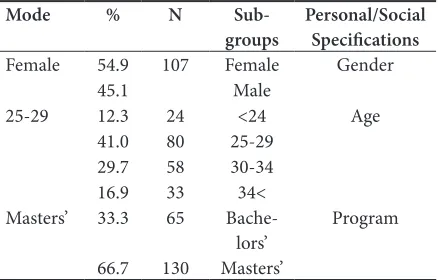
Demographical information of the sample group including gender, education level, and age showed that 45% of the participants were men and 55% were women; the largest age group was 41% at age range 25-29; 33% were in bachelors’ program and 67% were in masters’ program. Therefore, the majority of the participants were women, at age range 25-29, and in master’s program.
Table 1. Frequency and frequency percentage of demographical specifications
Personal/Social Specifications
Sub-groups N
% Mode
Gender Female
107 54.9 Female
Male 45.1
Age <24
24 12.3 25-29
25-29 80
41.0
30-34 58
29.7
34< 33
16.9
Program
Bache-lors’ 65
33.3 Masters’
Masters’ 130
66.7
3. Research Tools
3.1 Generalized Pathological Internet Use
Scale (GPIUS)
The scale is designed by Kaplan based on Davis’s theory (2001) on Internet addiction to measure psychological and behavioral specifications of internet addiction. The scale is comprised of 29 statements designed based on Likert’s five-point scale (completely disagree = 1,…, completely agree). It measure negative cognitive and behavioral outcomes of pathological internal use. Reliability of the main form of the question using Cronbach’s alpha has been reported between 78% and 85%16.
Internal consistency index of the questionnaire (i.e. Cronbach’s alpha) is 90%, which indicates only 10% of variance of total point of the questionnaire is contributed by error in measurement. Internal consistency of the scale was obtained using split-half method (81%, P<0.01). Construct validity of GPIUS and its high diagnosing capability are supported and it is used to measure internet addiction in different clinical and normal populations with high validity.
3.2 Young Schema Questionnaire (YSQ)
(Young and Brown, 1990, 2001)
Likert’s six-point scale. Therapists usually assign the patients to fill YSQ at home. The items are arranged based on schema and each item is featured with a two-word code that indicates which schema is measured. Finding two items of one schema with high score is enough to confirm the schema.
3.3 Validity and Reliability of YSQ
Validity and Reliability of YSQgiven that the questionnaire is a standard questionnaire, its reliability can be ensured based on previous studies. Rijkeboer et al.17 studied
reliability and distinguishing power of YSQ for Dutch population and reported the split-half reliability coefficient between 68-87% and retest coefficient with 6 weeks interval equal with 835. The questionnaire is translated into Persian, and its reliability has been supported.
3.4 Data Analysis
The collected data was analyzed using descriptive statistics
(central tendency and distribution) and inferential statistics (Pearson’s correlation and regression).
4. Findings
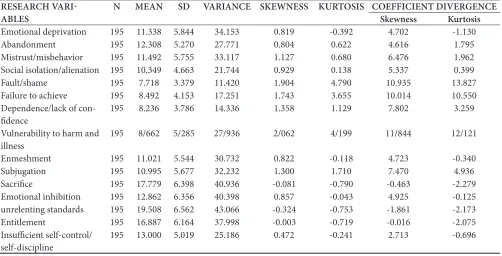
Table 2 and 3 list descriptive findings such as mean, standard deviation, variance, skewness, and kurtosis of internet addiction and the aspects of early maladaptive schema.
4.1 Hypothesis One
There is a relationship between early maladaptive schema and internet addiction.
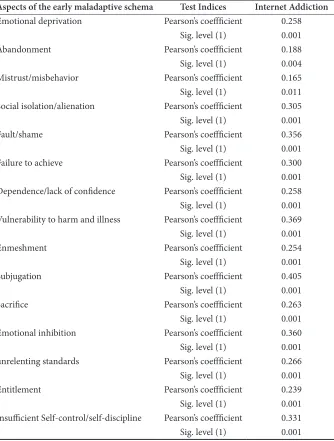
Pearson’s correlation test was used to examine the relationship between each aspect of the early maladaptive schema and internet addiction. As the results showed, error-level of each one of the fifteen aspects of the early maladaptive schema pertinent to the Internet schema was less than 0.05 and all the coefficients were positive.
Table 2. Descriptive data of Internet addiction Research
Variables N Mean SD Variance Skewness Kurtosis SkewnessCoefficient DivergenceKurtosis
Internet
addiction 195 66.554 16.164 261.290 0.062 -0.233 0.356 -0.674
Table 3. Aspects of the early maladaptive schema RESEARCH
VARI-ABLES N MEAN SD VARIANCE SKEWNESS KURTOSIS COEFFICIENT DIVERGENCESkewness Kurtosis
Emotional deprivation 195 11.338 5.844 34.153 0.819 -0.392 4.702 -1.130
Abandonment 195 12.308 5.270 27.771 0.804 0.622 4.616 1.795
Mistrust/misbehavior 195 11.492 5.755 33.117 1.127 0.680 6.476 1.962
Social isolation/alienation 195 10.349 4.663 21.744 0.929 0.138 5.337 0.399
Fault/shame 195 7.718 3.379 11.420 1.904 4.790 10.935 13.827
Failure to achieve 195 8.492 4.153 17.251 1.743 3.655 10.014 10.550
Dependence/lack of
con-fidence 195 8.236 3.786 14.336 1.358 1.129 7.802 3.259
Vulnerability to harm and
illness 195 8/662 5/285 27/936 2/062 4/199 11/844 12/121
Enmeshment 195 11.021 5.544 30.732 0.822 -0.118 4.723 -0.340
Subjugation 195 10.995 5.677 32.232 1.300 1.710 7.470 4.936
Sacrifice 195 17.779 6.398 40.936 -0.081 -0.790 -0.463 -2.279
Emotional inhibition 195 12.862 6.356 40.398 0.857 -0.043 4.925 -0.125
Table 4. Correlation coefficients of internet addiction and the aspects of early maladaptive schema
Aspects of the early maladaptive schema Test Indices Internet Addiction
Emotional deprivation Pearson’s coeffficient 0.258
Sig. level (1) 0.001
Abandonment Pearson’s coeffficient 0.188
Sig. level (1) 0.004
Mistrust/misbehavior Pearson’s coeffficient 0.165
Sig. level (1) 0.011
Social isolation/alienation Pearson’s coeffficient 0.305
Sig. level (1) 0.001
Fault/shame Pearson’s coeffficient 0.356
Sig. level (1) 0.001
Failure to achieve Pearson’s coeffficient 0.300
Sig. level (1) 0.001
Dependence/lack of confidence Pearson’s coeffficient 0.258
Sig. level (1) 0.001
Vulnerability to harm and illness Pearson’s coeffficient 0.369
Sig. level (1) 0.001
Enmeshment Pearson’s coeffficient 0.254
Sig. level (1) 0.001
Subjugation Pearson’s coeffficient 0.405
Sig. level (1) 0.001
Sacrifice Pearson’s coeffficient 0.263
Sig. level (1) 0.001
Emotional inhibition Pearson’s coeffficient 0.360
Sig. level (1) 0.001
unrelenting standards Pearson’s coeffficient 0.266
Sig. level (1) 0.001
Entitlement Pearson’s coeffficient 0.239
Sig. level (1) 0.001
Insufficient Self-control/self-discipline Pearson’s coeffficient 0.331
Sig. level (1) 0.001
Therefore, one may argue that all the fifteen aspects of the early maladaptive schema pertinent to internet addiction are positive and significant (Table 3).
4.2 Hypothesis Two
There is a relationship between the five domains of the early maladaptive schema and internet addiction
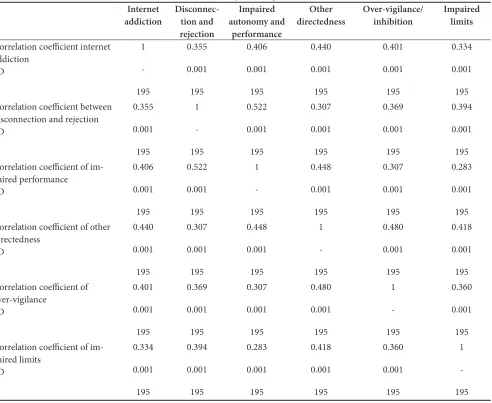
To examine the relationship between the five domains of the early maladaptive schema and internet addiction, Pearson’s correlation test was used. The results showed
that the relationship between the five domains of the early maladaptive schema and internet addiction is significant and positive (P<0.05). In addition, the correlation level between “other directedness” and internet addiction was higher than that of other domains of the early maladaptive schema (Table 4).
5. Discussion and Conclusion
Table 5. Correlation between the five domains of the early maladaptive schema and internet addiction Impaired limits Over-vigilance/ inhibition Other directedness Impaired autonomy and performance Disconnec-tion and rejection Internet addiction 0.334 0.001 195 0.401 0.001 195 0.440 0.001 195 0.406 0.001 195 0.355 0.001 195 1 - 195 Correlation coefficient internet
addiction SD N 0.394 0.001 195 0.369 0.001 195 0.307 0.001 195 0.522 0.001 195 1 -195 0.355 0.001 195 Correlation coefficient between
disconnection and rejection SD N 0.283 0.001 195 0.307 0.001 195 0.448 0.001 195 1 -195 0.522 0.001 195 0.406 0.001 195 Correlation coefficient of
im-paired performance SD N 0.418 0.001 195 0.480 0.001 195 1 -195 0.448 0.001 195 0.307 0.001 195 0.440 0.001 195 Correlation coefficient of other
directedness SD N 0.360 0.001 195 1 -195 0.480 0.001 195 0.307 0.001 195 0.369 0.001 195 0.401 0.001 195 Correlation coefficient of
over-vigilance SD N 1 -195 0.360 0.001 195 0.418 0.001 195 0.283 0.001 195 0.394 0.001 195 0.334 0.001 195 Correlation coefficient of
im-paired limits SD
N
** Correlation is significant at the 0.01 level (2-tailed)
maladaptive schema and internet addiction was examined. To the best of our knowledge, the present study is the first study on the relationship between the five domains of the early maladaptive schema and internet addiction in Iran and the world. There are studies on the early maladaptive schema and the disorders types I and II and few of them were noted in literature review section. As mentioned, the American Psychology Association is going to add internet addiction in DSM-V annex. The relationship between internet addiction and each one of the aspects of the early maladaptive schema and their five domains,
5.1 Hypothesis One
There is a relationship between the five domains of the early maladaptive schema and internet addiction.
of the childhood schema could predict quality of life of healthy and addict individuals and there was significant difference between the two groups.” One may conclude that the schema are directly effective on probability of internet addiction since, as the results indicated, the stronger the maladaptive schema, the higher the probability of addiction to drugs, the Internet, or obsessive behaviors. Taking into account the findings of Brummett18 on “correlations between anxious attachment,
early maladaptive schema, and overcoming self-efficacy and intensity of addiction in hypothetical paths”, it is clear that our results are consistent with Brummett18 because
there was a relationship between the early maladaptive schema and addiction.
5.2 Hypothesis Two
There is a relationship between the five domains of the early maladaptive schema and internet addiction.
As the results showed there was a positive and significant (p<0.05) relationship between internet addiction and the five domains of early maladaptive schema (disconnection and rejection, impaired autonomy and performance, impaired limits, other directedness, over-vigilance/inhibition). Based on correlation level, internet addiction was most affected by other directedness followed by impaired autonomy and performance, over-vigilance, disconnection and rejection, and impaired limits). According to the literature review, other directedness includes schema subjugation, sacrifice, and approval seeking. People with this schema seek others’ approval, prefer continuous emotional relationship, and avoid taking revenge. People with subjugation schema fear abandonment.
Individuals with schema “sacrifice” show overlap between their schema and the twelve concepts of “pathological dependence”. It is notable that internet addiction is a pathological dependence. The overlap can explain the relationship between this schema and the Internet schema. In addition, these individual are characterized with “approval seeking” schema so that their sense of value depends on others’ responses. Therefore, these individuals may take any measure to satisfy their needs (fear of abandonment, others’ approval, continuous emotional relationship, sense of value induce by others, and so on). Naturally, one of the most accessible and easy solutions is the Internet and these people are fast to adopt it.
Ghasemi et al.19 compared the early maladaptive
schema in three groups of healthy, addicted to tradition drugs, and addicted to synthesized drugs individuals and concluded that individuals in these three groups are different with respect to the early maladaptive schema, emotional deprivation schema, abandonment/ instability, mistrust/misbehavior, social alienation/ isolation, shame and fault, failure to achieve, dependence/ lack of competence, Vulnerability to harm and illness, undeveloped self/enmeshment, subjugation, emotional inhibition, poor self-discipline/self-control. In addition, the three groups were not different regarding the schema sacrifice, entitlement/grandiosity, and unrelenting standards. In general, their results showed that some of the early maladaptive schema the disconnection and rejection domain in particular can be used as important predictors of drug addiction. Therefore, their results are consistent with our results given the relationships between the domains and some aspects of the early maladaptive schema and “subjugation” in particular.
The fact that the questionnaire used as the research tool is a self-statement questionnaire raises questions about authenticity of the data. To collect more reliable data, other data gathering methods are recommended such as observation, interviewing, and behavioral observations. Future works may devise two groups of the Internet addicts and non-interne addicts and compare form and effects of the early maladaptive schema between the two groups, find probable differences, strength and depth of the schema, the effect of the environment, and their priority.
Researchers in the domains of work and activity personality specifications are recommended to survey personality profile (using reliable tests) and examine the type of relationship between “personality specification” and “Internet addiction” based on schema. Results of such studies may help clarifying what personality types with what schema are more probable to overuse the Internet.
6. References
1. Alavi Seyed S, Merati M, Janatifard F, Eslami M, Haghighi M. Surveying the relationship between psychological symp-toms and internet addiction in students of Isfahan-based universities. Hamedan University of Medical Science. 2010; 2: 57–65.
2. Gonzalez NA. Internet addiction disorder and it’s relation to impulse control [MA Dissertation]. USA: College of Psy-chology, Texas University; 2008. p. 6–25.
3. Widyanto L, Griffiths M. Internet addiction: A critical Re-view. Journal of Mental Health and Addiction. 2006; 4:31– 51.
4. Grohol, JM. Internet Addiction Guide. A resource for ob-jective, useful information about Internet addiction, a theorized disorder. Is the Internet Addiction Test valid? PsychCentral.com; 20 Jul 2012. Available from: http://psy-chcentral.com/netaddiction/
5. Ghasemzadeh L, Sharaie M, Moradi A. Surveying prev-alence of Internet addiction and its relationship with iso-lation and self-confidence among high school students in Tehran city. Education Quarterly. 2007; 89:41–68.
6. Goldberg I. Internet addiction disorder. 1996. Available from: http://sh.st/xoK7A?utm_source=scholar.google. com&utm_medium=QL&utm_name=1
7. Young KS, Abreu NDC. A Handbook and Guide to Eval-uation and Treatment Internet Addiction. Hoboken, New Jersey: John Wiley and Sons, Inc.,; 2011.
8. Byun S, Ruffini C, Mills JE, Douglas AC, Niang M, Step-chenkova S, Lee SK, Loutfi J, Lee JK, Atallah M, Blanton M. Internet addiction: metasynthesis of 1996-2006 quan-titative research. CyberPsychology and Behavior. 2009; 12(2):203–7.
9. Young J. Cognitive therapy of personality disorders (sche-ma oriented approach) Translated by Sahebi A and Hamid-pour H. Tehran, Iran: Arjmand Publciation; 1990.
10. Young JE, Klosko J, Weishaar ME. Schema therapy practi-tioners guide. New York: Guilford; 2003. p. 73-5.
11. Pinto-Gouveia J, Castilho P, Galhardo A, Cunha M. Early maladaptive schemas and social phobia. Cognitive Therapy and Research. 2006; 30(5):571–84.
12. Torres C. Early maladaptive schema and cognitive distor-tion in psychophathy and narcissism [PhD Thesis]. Austra-lia: Australian National University; 2002.
13. Young J. Therapeutic schema, applied guideline for clinical experts. In: Hamidpour H, Andouz Z,Tehran, Iran: Arj-mand Publication; 2003.
14. Moiedfar S, Habibpour K, Ganji A. Internet addiction, causes and outcomes among juveniles living in Tehran city. Media Quarterly, Fall; 2007; 3:55–80.
15. Dadfarnia SH, Iezadi Khah Z, Sedifi M, Hatampour R. The maladaptive schema in drug addicts. Contemporary Psy-chology Special Edition. 2010; 1:325–6.
16. Caplan SE. Problematic Internet use and psychosocial well-being: development of a theory-based cognitive–be-havioral measurement instrument. Computers in Human Behavior. 2002; 18(5):553–75.
17. Rijkeboer MM, van den Bergh H, van den Bout J Stability and discriminative power of the Young Schema-Question-naire in a Dutch clinical versus non-clinical population. Journal of Behavior Therapy and Experimental Psychiatry. 2005; 36(2):129–44.
18. Brummett BR. Attachment style, early maladaptive sche-mas, coping self-efficacy, therapy alliance and their influ-ence on addiction severity in methadone-maintenance treatment. ETD Collection for Fordham University, Paper AAT 3286413. 2007.