
Volume 18 (2009)
Proceedings of the
Eighth International Workshop on
Graph Transformation and Visual Modeling Techniques
(GT-VMT 2009)
Repotting the Geraniums:
On Nested Graph Transformation Rules
Arend Rensink and Jan-Hendrik Kuperus
15 pages
Guest Editors: Artur Boronat, Reiko Heckel
Managing Editors: Tiziana Margaria, Julia Padberg, Gabriele Taentzer
Repotting the Geraniums:
On Nested Graph Transformation Rules
Arend Rensink1and Jan-Hendrik Kuperus2
1[email protected] Department of Computer Science
Universiteit Twente, Postbus 217, 7500 AE Enschede, The Netherlands
Sogeti Nederland BV, Postbus 76, 4130 EB Vianen, The Netherlands
Abstract: We propose a scheme for rule amalgamation based on nested graph pred-icates. Essentially, we extend all the graphs in such a predicate with right hand sides. Whenever such an enriched nested predicate matches (i.e., is satisfied by) a given host graph, this results in many individual match morphisms, and thus many “small” rule applications. The total effect is described by the amalgamated rule. This makes for a smooth, uniform and very powerful amalgamation scheme, which we demon-strate on a number of examples. Among the examples is the following, which we believe to be inexpressible in very few other parallel rule formalism proposed in the literature:repot all flowering geraniums whose pots have cracked.
Keywords: Geraniums, Graph Transformation, Rule Amalgamation, Quantified Rules, Nested Rules, Parallel Rules
1
Introduction
Standard graph transformation rules are existential. By this we mean that a rule applies wherever there exists a matching of its left hand side into the host graph, and the effect of its application is limited to the homomorphic image of its left hand side under the matching.1
The existentiality of rules certainly has advantages, such as their reversibility (at least in a DPO setting). However, there are certain types of transformation where this is clearly a limitation. For instance, if a certain change has to applieduniversally, that is, toallsub-graphs with a certain structure, then this can be quite cumbersome to model using existential rules.
This limitation has been recognised especially by tool builders, who after all are in the business of using graph transformations for practical cases; hence, virtually all graph transformation tools have some way to definerule schemesorparallel rules. (A thorough overview and comparison of related work follows later.) Not all of the solutions have a firm theoretical justification, but the work of Taentzer [28,26] is ground-breaking in explaining the effect of parallel rule application in a general setting, namely asrule amalgamation.
In this paper we describe a way to specify rule amalgamation, based on the concept ofnested graph predicatesof [21,11]. The basic idea is a very simple one: where a nested graph predicate
1 An exception to this is the dangling edge deletion by SPO rules; indeed, the fact that this is not existential in the
is essentially a diagram of graphs and graph morphisms, a nested ruleis a similar diagram of “simple” rules and morphisms. The application of such a rule to a given host graph consists of first matching the graph predicate consisting of the left hand sides of the rule diagram (which will result in a set of match morphisms, each of which goes from a left hand side of one of the simple rules to the host graph), and then using the structure of the rule diagram as interaction scheme in terms of rule amalgamation. The interaction schemesynchronisesthe atomic rule applications according to the match morphisms.
We described a preliminary version of this idea in [22]. This has now been improved and implemented [13], so that we can report on some implementation and performance details. Fur-thermore, we give some more examples which show the expressiveness of the approach.
The geraniums in the title and abstract refer to the following challenge. We have a number of flower pots, each of which contains a number of geranium plants. These tend to fill all available space with their roots, and so some of the pots have cracked. For each of the cracked pots that contains a geranium that is currently in flower, we want to create a new one, and moreover, to move all flowering plants from the old to the new pot. Create a single parallel rule that achieves this in a single application, without the use of control expressions. The complexity of this example stems from the fact that it involves a nested universal quantification, which (as far as we are aware) cannot be expressed in other declarative rule formalisms proposed in the literature, with the possible exception of [9,14].
The remainder of this paper is structured as follows. In Section2we recall the relevant concepts of rule amalgamation; in Section3we give a new presentation of nested graph predicates, and we show how these can be used to generate amalgamated rules, which we call nested rules in this paper. In Section4we discuss implementation issues, and demonstrate the use of nested rules, including the geraniums as well as some examples encountered in practice. Finally, in Section5
we discuss related work, draw conclusions and discuss future work.
2
Rule amalgamation
We will first (briefly) recall the concepts of amalgamated graph transformation in the Single Pushout approach from [5], generalising from two rules along the lines of [27], resulting in a setup very similar to [12].
Definition 1(Graph) Agraph Gis a tuplehV,E,src,tgticonsisting of a set of nodesV, a set of edgesE, and source and target mappingssrc,tgt: E→V. Gis calledlabelledif there is also a functionlab:E→Lto a global set of labelsL, andsimpleifE⊆V×L×Esuch thatsrc,lab andtgtare projections to the three components.
The examples in this paper are set in the category of simple labelled graphs, but for the purpose of the definitions one can imagine any pair of graph categoriesGtot,G such thatG has an initial object 0 and coproducts, andGtotis a full subcategory ofG with initial object and coproducts which are preserved by the inclusion functor. We refer to the arrows inG as partial morphisms and to those inGtotas total morphisms.
GDto the objects and arrows ofC, such thatD(e):D(src(e))→D(tgt(e))for all edgese. Di-agramD commutesif for all parallel paths in GD, the composition (in C) of the edge images give rise to the same C-arrow. As usual, we will often identify the elements of GDwith their images underD. In this paper we frequently usetree-shaped diagrams, in whichGDis a tree rooted in the initial object, i.e., has no cycles, no sharing (no distinct edges with the same target) and exactly one rootrtD(a node without incoming edge) such thatD(rtD) =0. Note that a tree-shaped diagram trivially commutes. A tree-tree-shaped diagramDis said to be eninstanceof another tree-shaped diagramD0if there exists a root-preserving graph morphismi:GD→GD0(called the instantiation morphism) such thatD0=D◦i. (So an instance may copy or ignore parts ofD.)
Definition 2 (Rule and Sub-rule) A rule is a morphism p: L→R in G. A rule p0 is called a sub-ruleof p if there exists a pair of total morphismseL:L0→Land eR:R0→Rsuch that p0◦eL=eR◦p, i.e., the following diagram commutes:
L0 R0
L R
p0
eL eR
p
The paire=e(eL,eR)is called asub-rule embedding.
Rules give rise to derivations in the usual way of the single-pushout approach.
Definition 3 (Match and Derivation) A matchof a rule p in a graph G is a total morphism m:L→G. Given a rule and a match, aderivationis a pushout inG, depicted by the diagram
L R
G H
p
m m0
d PO
m0is called thecomatchanddthederivation morphism. Note thatm0is in general not total.
We write G−p−→,m H if a derivation as in the above diagram exists. Sub-rules and sub-rule embeddings form a categoryR(with the natural definition of identities and arrow composition) with an initial object and coproducts. Below we will sometimes call the objects ofR simple rules, to contrast them with the notion of composite rule that we are about to define.
Definition 4(Composite Rule) A composite rule schemaSis a tree-shaped diagram overR.
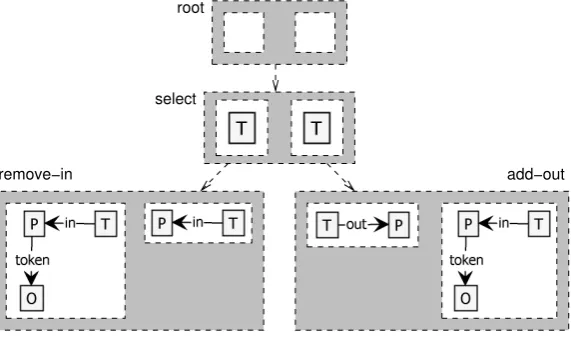
For instance,Figure 1shows a composite rule schema that can be used to model the firing of a Petri Net transition. The rule morphisms are left implicit. In general, a composite rule schema corresponds to asynchronisation rule, and a composite rule instance (i.e., a tree-shaped diagram Pthat is an instance ofS, in the sense discussed above) to acomponent production setin terms of [27], except that in that paper both kinds of diagrams are required to be bipartite graphs, and the component production set satisfies a certain completeness property.
select
remove−in
root
add−out
Figure 1: Composite rule schema for firing a Petri Net transition.
• The rule diagram DP, consisting of the rule morphisms pfor all objects pofP and the individual embedding morphismseLandeRfor all arrowseofD;
• The “left-hand-side” diagramLPoverGtotconsisting of all the left hand sidesLpand the corresponding total morphismseL.
To define the derivations generated by a composite rule, first we extend the notion of a match.
Definition 5(Composite Rule Match) Let S be a composite rule schema. A composite rule match ofSinGconsists of an instancePofStogether with a set of matchesmp:Lp→Gfor all pinP, which, when added toLP, make the resulting diagram commute.
A match of a composite rule schemaSin a graphGis called a (partial)coveringofGin [27]. Given such a match, as usual one can define the composite derivation (star-parallel derivationin [27]) either by taking the coproductqof the rule diagramDPand applying that as an ordinary rule (with respect to the unique match ofqinGthat is guaranteed by the coproduct construction), or by building the coproduct of the diagram consisting of the targetsHpof the individual derivations G−p−−,mp→Hptogether with the comatchesm0p. Due to the universal properties of coproducts, these two constructions are guaranteed to yield isomorphic results.
In order to get a useful notion of parallel transformation, the allowed rule schema matches have to be restricted. [27] identifies a number of possible criteria. The main contribution of this paper is to propose yet another criterion, which uses the theory of nested graph predicates introduced by us in [21] and later, independently, in [11].
3
Nested Graph Predicates
We give a new presentation of nested graph predicates, to make the connection with rule amal-gamation clearer. A predicate will be a pair consisting of a tree-shaped graph diagramDover
Gtotand a formula generated by the following grammar,L:
out in
trans root
out−token in−token
out−in
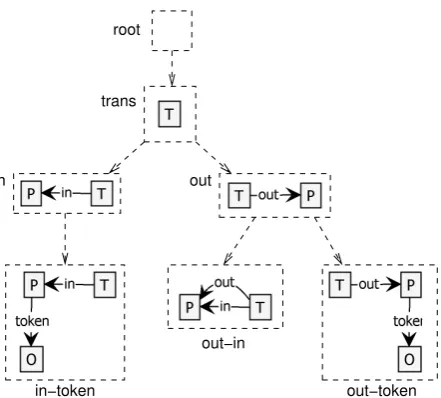
Figure 2: Graph diagram on which transition enabledness can be expressed
Herexdenotes one of the non-root nodes of the graphGD. Apart from the basic logic operators defined above, we also use∧,⇒,∀etc., defined in the standard way. Furthermore, we abbreviate
∃x.tttox. Every such non-root nodexhas a unique incoming edge; we will denote this edgeinx. For instance, some formulae over the diagram inFigure 2are:
1. ¬out-in(which is an abbreviation of¬∃out-in.tt), expressing that a given Petri Net does not have a loop;
2. ∀trans.∀in.in-token, expressing that every transition of a Petri Net can fire;
3. ∃trans.(∀in.in-token∧ ∀out.(out-token⇒out-in)), expressing that there is an enabled transition according to the Condition/Event interpretation (in which all output places have to be empty, unless they are also input places).
Formulae are typed over the nodes ofGD. The type of a formula is a graph inDfor which we need a matching into the subject graph before we can evaluate the formula; in other words, it represents the “free variables” of the formula. We writeφ :tto denote thattis a type ofφ. We only deal with formulae that are well-typed according to the following rules:
• tt:tfor all nodestofGD;
• ¬φ:tifφ:t;
• φ1∨φ2:tifφ1:tandφ2:t;
• ∃x.φ:tift=src(inx)andφ:x.
φis calledgroundifφ: 0 (where 0 is the initial object ofG). For instance, we have¬∃out-in.tt: out, whereas the other two example formulae above are ground.
G
Figure 3: Proof of∃trans.(∀in.in-token∧ ∀out.(out-token⇒out-in)). The dotted lines indicate some of the relevant node mappings.
is that the matching f can be decomposed intog◦D(inx)(whereinxis the unique edge inDwith tgt(inx) =x).
Formally, the semantics of the logic is expressed by a relation f|=φwhereφ:tandf:D(t)→
Gis a total morphism inG:
• f |=ttalways holds;
• f |=¬φif f6|=φ;
• f |=φq∨φ2if f|=φ1or f|=φ2;
• f |=∃x:φ ifg|=φfor somegsuch that f =g◦D(inx).
Ifφ is ground, we also writetgt(f)|=φ instead of f |=φ. For instance, ifGis the Petri Net depicted on the right ofFigure 3, then the figure shows that there is an enabled Condition/Event transition, as expressed by the example formula3above.
A formulaφ is in positive form if it does not contain negations (but may containff,∧and∀). Every formula is equivalent to a positive form formula, which can be obtained easily by “push-ing” negations inward. For instance, formula3above is equivalent to∃trans.(∀in.∃in-token.tt∧ ∀out.(∃out-in.tt∨ ∀out-token.ff)).
If φ is a ground positive form formula, then a proof diagram ofG|=φ is defined to be a commuting diagramPoverGtot, consisting of an instanceQofDwith instantiation morphism
i: GQ→GD, augmented with a graph Gand for all nodes v ofQ a morphism fv: Q(v)→G. Furthermore, for every nodevofQthere is a setΨvof sub-formulae ofφsuch thatφ∈ΨrtQ, and for allψ∈Ψv,ψ:i(v)and the following conditions are satisfied:
• ψ6=ff
• Ifψ=ψ1∨ψ2, then eitherψ1∈Ψvorψ2∈Ψv;
• Ifψ=∃x.ψ0, thenvhas an outgoing edgeewithi(e) =inxandψ0∈Ψtgt(e).
• Ifψ=∀x.ψ0, then for allg:D(x)→Gsuch that fv=g◦D(inx),vhas an outgoing edgee withi(e) =inx, ftgt(e)=gandψ0∈Ψtgt(e).
A proof diagram is calledminimalif it does not have spurious edges; i.e., the only edges are those necessitated by the last two bullets above. For instance,Figure 3 is a minimal proof diagram, if v andw are the two occurrences of outin the diagram then Ψv={∃out-in.tt} and Ψw =
{∀out-token.ff}.
Predicate-driven amalgamation. The step from nested graph predicates to amalgamated rules is very small: rather than interpreting formulae over diagrams over Gtot, we use tree-shaped diagrams overR, i.e., composite rule schemas. The interpretation ofφoverSis defined to be its interpretation over the left-hand-side diagramLS. The following is a key insight:
Proposition 1 Given a composite rule schema S, a closed formulaφ interpreted over S, and a
graph G, a minimal proof diagram of G|=φ is a composite match of S in G.
For instance, we can turn the diagram in Figure 2into a diagram over R by replacing the graph in-token by the rule remove-in of Figure 1, replacing out by add-out, and turning all other graphs into identity rules (i.e., based on identity production morphisms). The resulting diagram “refines” Figure 1. The formula ∃trans.(∀in.in-token∧ ∀out.(out-token⇒out-in)), which previously just expressed the existence of an enabled transition in a Condition/Event net, now encodes the firing of such a transition under the condition that it is enabled.
The developments in this section culminate in the following definition, which we will use in the remainder of the paper:
Definition 6(Nested Rule) A nested graph transformation rule is a tree-shaped diagramSover
Rwith a formulaφ∈L overS. A match of such a rule is a minimal proof diagram ofφoverLS, and a rule derivation is the composite derivation with respect to such a minimal proof diagram.
4
Implementation and examples
The theory of nested rules has been implemented in GROOVE [20], with some restrictions.
Nested rules in GROOVEhave been used and shown their value in several applications. In this section we discuss some of the implementation choices and show some applications.
4.1 GROOVEimplementation
The main functionality of GROOVEis to explore the complete state space of a graph transforma-tion system. Every derivatransforma-tion gives rise to a transitransforma-tion, and independent derivatransforma-tions interleave, giving rise to a size blow-up that is at worst exponential in the number of independent derivations. A composite rule derivation can combine a large number of simple rule derivations. Apart from the ease of specification, this has the advantage that the number of transitions as well as the number of interleaving points between transitions decreases, in some cases quite dramatically.
Modified positive form formulae. Rather than the full logic defined above, GROOVE only supports restricted positive form formulae, as defined by the following syntax:
φ ::= ∃x.(Vk∈K¬xk)∧( V
i∈Iψi)
ψ ::= ∀x.(Vk∈K¬xk)∧( W
j∈Jφj)
where¬xk abbreviates∀xk.ff, andI,J,K are arbitrary index sets. Thus, disjunction is restricted to existentially quantified sub-formulae and conjunction to universally quantified sub-formulae. It can be proved (in fact, it indirectly follows from [21]) that this is no real restriction, in the sense that every formula is equivalent to a “normal form” formula in this restricted syntax, but we will not elaborate on this point here.
Single-graph representation. One of the disadvantages of nested rules as formulated in Def-inition 6is that they consist of two parts, a rule diagram and a formula. In GROOVE, we have chosen to include all of these into a single graph representation. For this purpose, we introduce specialquantifier nodesthat stand for the∀- and∃-quantifiers of the formula and are arranged (using specialin-labelled edges) in a tree of alternating quantifiers. The root of this tree is an
∃-node which is left implicit, so that a simple rule is just a special case of a composite rule. The “fresh” nodes of the quantified graphs, i.e., those nodes that are not in the codomain of the incoming morphisms, are attached to the corresponding quantifier nodes using specialat-labelled edges. For fresh edges of the quantified graph, this solution does not work since GROOVEdoes not support edges on edges; instead, if such a fresh edge does not have fresh end nodes, we include the name of the quantifier as a prefix of the edge label.
As an example,Figure 4shows the firing rule of Condition/Event nets in this one-graph rep-resentation. As usual in the GROOVEnotation, non-RHS elements (which are to be deleted) are
dashed thin blue (or dark grey), non-LHS elements (which are to be created) are wider solid green (or light grey), and NAC elements are wide, closely dashed red (or dark grey). The dotted nodes and edges form the tree of quantifiers (where the root is omitted); to make the connection with the diagram inFigure 2 explicit, we have named all quantifier nodes. For the existential out-in-quantifier this name is in fact necessary as it occurs as a prefix in one of thein-edges, to associate this edge with the quantifier.
Non-vacuous universal quantification. If no match of x exists in a given host graph, the formulaψ =∀x.φ is true irregardless of φ. In this case, ψ is said to be vacuously true. Con-sequently, a universally quantified nested (sub-)rule may be vacuously applicable, in which case the rule has no effect. Sometimes this may be just what one wants, as in the firing rule of Fig-ure 4: for a transition with no input places, the sub-ruleinis always enabled and has no effect. However, quite often vacuous derivations are not intended. Though non-vacuity can always be enforced through an application condition, we have included a special quantifier node, denoted
∀>0, which guarantees that the sub-rule is matched at least once. Thus,∀>0x.
φ is equivalent to
∃x.φ∧ ∀x.φ.2
2 Thus, the difference between∀and∀>0 is very similar to that between optional and obligatory set nodes in
root
outToken out in
inToken trans
outIn Created (R\L)
Deleted (L\R)
NAC
Figure 4: Nested C/E firing rule inGROOVEsyntax, with the explicit tree structure shown to the right
4.2 Examples
We now show some other applications of nested rules.
Geraniums. The title challenge of this paper is to create a new pot for every cracked flower pot with at least one flowering geranium, and to transfer all flowering geraniums in the cracked pot to the new one. This is an example of a rule that needs two nested universal quantifiers: an outer quantifier for the pots, and an inner quantifier for the plants in the pots. This puts the rule beyond what can be formulated in other approaches to parallel graph transformation rules, such as the cloning rules of [18] or the set nodes and star rules in PROGRES [24], except in the extension recently proposed in [9] — see Section5for a more extensive discussion.
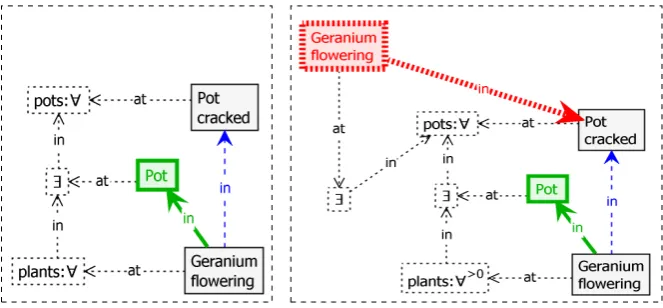
In GROOVE, a first attempt is given on the left side of Figure 5. An example derivation is shown inFigure 6. However, this rule is incorrect as it also creates new pots for cracked pots that do not contain any flowering geraniums. To rule this out, we need the non-vacuous universal quantifier discussed above. However, we cannot simply replace theplants-quantifier by ∀>0, since then the rule requires thatallcracked pots have at least one flowering geranium, hence it would become inapplicable for a graph like the one inFigure 6. To resolve this, we have to add
Figure 6: Example derivation of the left hand rule ofFigure 5
a disjunct to thepots-quantifier, resulting in the rule on the right hand side ofFigure 5.
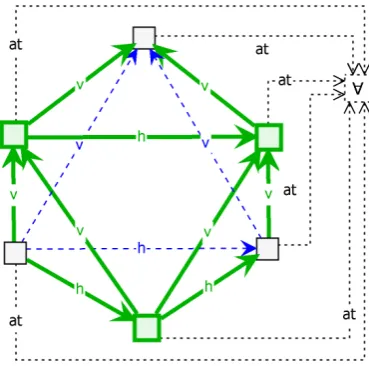
Sierpinski Triangles Another example that is very suited to specification in nested rules is the Sierpinski case described in [29]. This involves a challenge to give a graph grammar that generates all Sierpinski triangles (a certain fractal shape) up to an arbitrary depth. One step of the generation process involves replacing all up-pointing sub-triangles by a more involved graph (which contains three new up-pointing triangles). A nested GROOVErule that specifies this given
inFigure 7.
In [29], we have described a sequential GROOVEsolution to the Sierpinski case, and we have remarked that the above parallel rule has (only) slightly better performance. This may be surpris-ing in the light of the fact that the sequential solution generates many more intermediate states. However, in this particular case no real state space exploration is needed: instead, a “linear” exploration strategy is used that selects a single rule application and never backtracks. In this type of exploration, generating the intermediate states causes only little overhead.
Figure 8: One of the rules of the ad-hoc network connectivity protocol in [3]. The =-labelled NAC-edges are injectivity constraints.
Network gossipping protocol. In [3] we describe a GROOVE model of an ad-hoc network connectivity protocol. The paper shows that this model gives rise to a large symmetry reduction, so that larger network instances can be modelled than with other specification methods (although the size of the state space is still exponential in the size of the network). Nested rules have been used here in several places, to reduce the number of derivation steps and especially the number of interleavings of steps. In contrast to the previous example, in this case it is important to explore the state space in full, and indeed without the use of nested rules the advantage with respect to other methods to some degree disappears. An example rule where nesting has been exploited is shown inFigure 8: this specifies that all but two outgoinglink-edges have to be removed from every network node.
5
Evaluation
We have shown how to integrate the concepts of nested graph predicates and rule amalgamation. It turns out that these concepts mesh together quite well, and give rise to a usable specification formalism for parallel rules. This formalism has been implemented in GROOVE; we have given several practical examples where this type of rule has been very useful.
On the downside, it turns out that nested rules can be complicated to write. This is mainly due to the chosen single-graph representation: especially when the rules become larger, the fact that all nesting levels are combined in a single graph makes the resulting figure hard to read. An alternative is to use a hierarchical graph syntax, where the quantifier nodes are containers for the graph elements associated with them.
Related work. We briefly review alternative approaches to parallel rule specification.
quantifica-tion in terms of our nested rules; in fact, every adaptive star rule can easily be formulated as a nested rule with a single universal quantifier.
PROGRES [24] and also FuJaBA [19] feature so-calledset nodes, which are essentially single universally quantified nodes. Furthermore, PROGRES hasstar rules, which are essentially rules that are entirely universally quantified. An interesting extension to set nodes can be found in [9], which allows to specifyset regionsrather than just set nodes. Since these set regions can be nested, this comes close to our notion of nested quantifiers, and we conjecture that this for-malism can in fact specify the geranium rule. Unfortunately, the paper does not provide enough information to be sure.
Some approaches are based on rule schemas with sub-graphs that can be cloned or copied before applying the rule: for instance, [18,1,17]. The latter two have the interesting option of specifying connectionsbetweenthe clones, which may for instance be ordered in a linear list. This is outside the capabilities of our nested rules. On the other hand, each of these approaches deals with a single level of (universal) quantification only, and so we believe that they cannot solve the geranium challenge.
As we have made clear, our nested rules are built on the principle of rule amalgamation. Other papers that have shown the power of amalgamation for specifying parallel rules (in particular, the Petri net firing rule) are [15,8].
Another approach that needs mentioning in this context is that ofsynchonised hyperedge re-placement; see, e.g., [14]. A central concept in this formalism is to combine “local” rules into larger ones, using synchonisation algebras to determine how rules are to be combined. It is claimed in [30] that this is powerful enough to repot the geraniums.
Finally, another method altogether for repotting the geraniums is by using control expressions rather than a single parallel rule or rule schema. There have been many proposals for powerful control languages; we would like to mention PROGRES, FuJaBA’s storyboards, but also the recent notions ofrecursive rules[10,32], which in fact have no extraneous control conditions but rather integrate them with the rules themselves. We would also categorise the use of the (very powerful) pattern definitions in model transformation tools such as TEFKAT [16] and VIATRA2 [31] as control expressions, though admitedly the dividing line grows thin in these cases.
Future work. We see nested rules as a first step towards the ability to specify an arbitrary transformation as a single transaction with atomic execution. The planned next step is to en-hance the GROOVEcontrol language with an atomicity statement that turns an arbitrary control statement into such a transaction.
Another potentially useful extension is the introduction ofcounting quantifiers, being exis-tential quantifiers that assert the existence of a given, fixed number of distinct instances of a sub-graph (other than 1, which is the default meaning of existential quantification). For instance, the rule in Fig.8could be simplified using such a feature.
Bibliography
[2] A. Corradini, H. Ehrig, U. Montanari, L. Ribeiro, and G. Rozenberg, eds. Third Interna-tional Conference on Graph Transformations (ICGT), vol. 4178 ofLNCS. Springer, 2006.
[3] P. Crouzen, J. van de Pol, and A. Rensink. Applying formal methods to gossiping networks with mCRL and Groove. SIGMETRICS Perform. Eval. Rev., 36(3):7–16, 2008.
[4] F. Drewes, B. Hoffmann, D. Janssens, M. Minas, and N. V. Eetvelde. Adaptive star gram-mars. In A. Corradini et al. [2], pp. 77–91.
[5] H. Ehrig and M. L¨owe. Parallel and distributed derivations in the single-pushout approach. TCS, 109(1&2):123–143, 1993.
[6] K. Ehrig and H. Giese, eds. Graph Transformation and Visual Modeling Techniques (GT-VMT), vol. 6 ofElectronic Communications of the EASST. EASST, 2007.
[7] J. Engelfriet and G. Rozenberg. Node replacement graph grammars. In G. Rozenberg [23], pp. 1–94.
[8] C. Ermel, G. Taentzer, and R. Bardohl. Simulating algebraic high-level nets by parallel attributed graph transformation. In Kreowski, Montanari, Orejas, Rozenberg, and Taentzer, eds., Formal Methods in Software and Systems Modeling, vol. 3393 ofLNCS, pp. 64–83. Springer, 2005.
[9] C. Fuss and V. E. Tuttlies. Simulating set-valued transformations with algorithmic graph transformation languages. In A. Sch¨urr et al. [25], pp. 442–455.
[10] E. Guerra and J. de Lara. Adding recursion to graph transformation. In K. Ehrig and H. Giese [6].
[11] A. Habel and K.-H. Pennemann. Nested constraints and application conditions for high-level structures. In Kreowski, Montanari, Orejas, Rozenberg, and Taentzer, eds., Formal Methods in Software and Systems Modeling, vol. 3393 ofLNCS, pp. 293–308. Springer, 2005.
[12] R. Heckel, J. M¨uller, G. Taentzer, and A. Wagner. Attributed graph transformations with controlled application of rules. In Valiente and Rossello Llompart, eds., Colloquium on Graph Transformation and its Application in Computer Science, Technical Report B–19. Universitat de les Illes Balears, 1995.
[13] J.-H. Kuperus. Nested quantification in graph transformation rules. Master’s thesis, De-partment of Computer Science, University of Twente, 2006.
[14] I. Lanese and E. Tuosto. Synchronized hyperedge replacement for heterogeneous systems. In Jacquet and Picco, eds.,Coordination Models and Languages (COORDINATION), vol. 3454 ofLNCS, pp. 220–235. Springer, 2005.
[16] M. Lawley and J. Steel. Practical declarative model transformation with tefkat. In Bruel, ed.,MoDELS Satellite Events, vol. 3844 ofLNCS, pp. 139–150. Springer, 2006.
[17] J. Lindqvist, T. Lundkvist, and I. Porres. A query language with the star operator. In K. Ehrig and H. Giese [6].
[18] M. Minas and B. Hoffmann. An example of cloning graph transformation rules for pro-gramming. In R. Bruni and D. Varr´o, eds., Graph Transformation and Visual Modeling Techniques (GT-VMT), vol. 211 ofENTCS, pp. 241–250, 2006.
[19] J. Niere and A. Z¨undorf. Using FUJABA for the development of production control sys-tems. In Nagl, Sch¨urr, and M¨unch, eds., Applications of Graph Transformations with In-dustrial Relevance, (AGTIVE), vol. 1779 ofLNCS, pp. 181–191. Springer, 2000.
[20] A. Rensink. The GROOVE simulator: A tool for state space generation. In Pfaltz, Nagl, and B¨ohlen, eds.,Applications of Graph Transformations with Industrial Relevance, (AGTIVE), vol. 3062 ofLNCS, pp. 479–485. Springer, 2004.
[21] A. Rensink. Representing first-order logic using graphs. In H. Ehrig, G. Engels, F. Parisi-Presicce, and G. Rozenberg, eds.,Second International Conference on Graph Transforma-tions (ICGT), vol. 3256 ofLNCS, pp. 319–335. Springer, 2004.
[22] A. Rensink. Nested quantification in graph transformation rules. In A. Corradini et al. [2], pp. 1–13.
[23] G. Rozenberg, ed. Handbook of Graph Grammars and Computing by Graph Transforma-tions, Volume 1: Foundations. World Scientific, 1997.
[24] A. Sch¨urr. Programmed graph replacement systems. In G. Rozenberg [23], pp. 479–546.
[25] A. Sch¨urr, M. Nagl, and A. Z¨undorf, eds. Applications of Graph Transformations with Industrial Relevance (AGTIVE), vol. 5088 ofLNCS. Springer, 2008.
[26] G. Taentzer. Parallel and Distributed Graph Transformation: Formal Description and Application to Communication-Based Systems. PhD thesis, TU Berlin, 1996.
[27] G. Taentzer. Parallel high-level replacement systems. TCS, 186(1-2):43–81, 1997.
[28] G. Taentzer and M. Beyer. Amalgamated graph transformations and their use for speci-fying AGG — an algebraic graph grammar system. In Schneider and Ehrig, eds., Graph Transformations in Computer Science, vol. 776 ofLNCS, pp. 380–394. Springer, 1994.
[29] G. Taentzer, E. Biermann, D. Bisztray, B. Bohnet, I. Boneva, A. Boronat, L. Geiger, R. Geiß, ´A. Horvath, O. Kniemeyer, T. Mens, B. Ness, D. Plump, and T. Vajk. Generation of Sierpinski triangles: A case study for graph transformation tools. In A. Sch¨urr et al. [25], pp. 514–539.
[31] D. Varr´o and A. Balogh. The model transformation language of the VIATRA2 framework. Sci. Comput. Program., 68(3):214–234, 2007.

![Figure 8: One of the rules of the ad-hoc network connectivity protocol in [3]. The= -labelled NAC-edges are injectivity constraints.](https://thumb-us.123doks.com/thumbv2/123dok_us/7814977.2086692/12.595.213.382.149.314/figure-rules-network-connectivity-protocol-labelled-injectivity-constraints.webp)
