Available on-line at: www.oapub.org/edu
Copyright © The Author(s). All Rights Reserved. doi: 10.5281/zenodo.1418528 Volume 4 │ Issue 10 │ 2018
CONTRIBUTIONS OF THE MANAGEMENT SKILLS OF
MANAGERS TO ORGANIZATIONAL CLIMATE ACCORDING
TO THE OPINIONS OF EMPLOYEES WORKING IN
DIRECTORATE OF YOUTH SERVICES AND PROVINCIAL
DIRECTORATE OF YOUTH AND SPORTS
iCumaali Yavuz1,
Yunus Emre Karakaya1ii,
Tamer Karademir2
1Assist. Prof. Dr., Firat University,
Faculty of Sports Sciences, Turkey
2Assoc. Prof. Dr., Sütçü İmam University,
High School of Physical Education and Sports, Turkey
Abstract:
This study was conducted in order to reveal the effects of management skills of managers to organizational climate, according to the opinions of employees working in the Directorate of Youth Services and Provincial Directorate of Youth and Sports. The sample group of the study comprises of 73 randomly chosen employees from five cities (Elazığ: 17 employees, Diyarbakır: 10 employees, Gümüşhane: 14 employees, Isparta: 18 employees and Kırklareli: 14 employees). In order to collect the data for the study, “Contributions of Perceived Management Skills of Managers to Organizational Climate Scale”, which was developed by Akar (2006), was adopted. The Scale form consists of 4
subscales and a total of 30 matters. These are “Job Centeredness”, “Tolerance”, “Close
Control” and “Contempt”. In the data analysis, frequency and percentage calculations were used. In terms of the mean points on the scale, determinant statistics, normality analysis, and homogeneity results were examined. Due to the inability of the data to present a normal distribution, in independent pair group comparisons, Mann-Whitney U test of non-parametric tests was adopted while Kruskal-Wallis H test was adopted in multiple group comparisons. The statistical meaningfulness degree Alpha (α) error rate was adopted as p<0.05. The following results were obtained as a result of the mentioned tests: No statistically significant difference was observed according to the sample
group’s variables of marital status and educational level. In the “Job Centeredness”
i A part of this study was verbally presented as a conference paper in the 15th International Sports
subscale of the scale, meaningful differences were observed in the professional seniority (0.041<p) and service time (0.039<p). In the “Tolerance” subscale, meaningful differences were observed in the variables of gender (0.012<p) and professional seniority (0.045<p).
Furthermore, in the “Contempt” subscale, meaningful differences were observed in the
variable of the place of duty (0.015<p).
Keywords: physical capacities; breathing; shooting performance
1. Introduction
The increase in the needs of humans and the obligation to meet the needs in a rational way, which is one of the major outcomes of modernization, has required individuals to cooperate. As a result of this, organizations to achieve this aim has emerged from a collective effort in the society (Can, 2005; Yılmaz, 2008). It is observed that organizations have been active in social life in a modern way for the last one hundred and fifty years. It is also note-worthy that organizations, which are investigated scientifically in detail, struggle to survive in the long term (Taşçı, 2013: 4). The belief regarding whether the political behavior in the organization is beneficial or harmful for the individual or the organization is related to how this behavior is perceived rather than how it occurred. Thus, the way the attitudes and behaviors of the organization and the individuals are perceived by the others in the organization plays a significant role in the evaluation of the political environment formed in the organization. This is because individuals’ perceptions of their environment as a political one do not depend on the reality of whether political behaviors exist in the organization (Buenger et al., 2007).
organization from other organizations. This is because the organization is composed of the general impressions of the organization, which is formed by its members as a result of interacting with the members of other organizations, the organization structure, the organization policies and the organizational processes. This demonstrates the properties existing only in that organization (Önen, 2008).
Organization climate is a subjective matter that can generally be manipulated by individuals’ powers or effects (Bock et al., 2005: 89). Organizational climate reflects unique properties of organizations such as the organizational culture. This state of uniqueness can be present in different departments of the same organization. Another property of organizational culture is that it is not similar to the formal structure of the structure in that it demonstrates an informal property. While all of the employees might perceive the physical structure of the organization the same, the perception of the organizational climate that forms its psychological structure can be varied as many as its employees (Tutar & Altınöz, 2010: 197). Organizational climate attaches the organization’s health to the measurement and evaluation of personal perceptions in the working environment of the employees. These personal observations function as a total data that demonstrates how well the organization is performing and how well the employees are treated (Giles, 2010: 68). With organizational climate, an environment where organizations’ individual, organizational and environmental qualities form the human behavior in the organization is described. An organizational climate that incorporates openness, credibility, sincerity, reliability, participation and helpfulness, thus, high levels of expectation and satisfaction is an ideal organizational climate (Parıltı & Tolon, 2011).
1.2 Aim and Significance of the Study
In the globalized world, the changes and innovations experienced have taken many organizations under their influence. By providing coordination between the future aims of the organization, current innovations should be developed to conduct the current tasks in a better way and opportunities for possible future-positions to be assumed should be provided. These circumstances bring along the subject of organizational climate. In the modern management mentality, organization managers’ attention paid to organizational climate is significant for both organizational efficiency and employee satisfaction.
Organizational climate demonstrates the way the employees feel about the atmosphere in the organization. In order for an organization to improve, employees should feel good about themselves for they are the main resource of an organization. In cases where organizations demand smart, innovative, professional and positive team members, it is essential for them to create an organizational climate with a healthy working environment in order for the employees to demonstrate positive behaviors in conjunction with the various changing scenarios in the world.
institution is distinguished from others by their own organizational climate. Each organization, along with unique cultural and organizational structures, resembles other organizations. This should be regarded as a natural process. Acknowledgment of a sports institution’s organizational climate also facilitates the understanding of the reflection of the behaviors adopted by the institution’s managers and employees on the organization’s success. In this study conducted within this framework, it was aimed to reveal effects of the managers’ management skills on the organizational climate according to the perceptions of the employees who work in the Directorate of youth services and provincial directorate of youth and sports.
2. Method
In this study, the “quantitative method” was adopted and the relational screening model was adopted as the research model. Karasar (2008: 81) defined the relational screening model as a research model that aims to determine the existence and the level of covariance between two or more variables.
The study group was chosen by random method and it consists of 73 employees who work in provincial directorates of youth and sports in five cities (Elazığ: 17 employees (% 23.3), Diyarbakır: 10 employees (% 13.7), Gümüşhane: 14 employees (% 19.2), Isparta: 18 employees (% 24.7) and Kırklareli: 14 employees (% 19.2)).
For the data collection, the “Contributions of Perceived Management Skills of Managers to Organizational Climate Scale”, which was developed by Akar (2006) and contains 30 matters in order to collect data regarding the behaviors of managers in organizational climate, was adopted. The general reliability coefficient for the scale was determined to be 0.952 by Akar (2006). Yıldırım (2009) conducted a factor analysis of the scale in order to determine the construct validity and factor structure of the scale to be used in his study. The suitability of the data for the factor analysis, which was collected by the scale, was analyzed by the Kaiser-Meyer-Olkin (KMO) coefficient and Bartlett Sphericity test. In the conducted analysis, the KMO value was determined to be 0.961 and thus, it was determined that the scale was suitable for factor analysis. In the factor
analysis, the techniques of “Principal Component Analysis” and “Varimax with Kaiser
Normalization” were adopted. In this analysis, the Eigenvalue was determined as 1, and it was determined that the matters were grouped into 4 subscales. Of these 4 subscales, the first one explained the 28.43% of the total variance while the second one explained the 21.13% of the total variance followed by the third subscale with 12.54% and fourth subscale with 6.82%. The total amount of variance explained was determined as 69.10%. The results of the rotated factor matrix indicated that the loads of 30 matters of the scale were above 0.30, and thus, it was decided to keep all of the matters for further analyses. The “Job Centeredness” subscale had 16 matters while the “Tolerance” subscale had 8
matters followed by “Close Control” subscale with 3 matters and “Contempt” subscale
determining the perceptions of sports employees are as the following: “Completely Disagree (1.00-1.80)”, “Partially Agree (1.81-2.60)”, “Disagree (2.61-3.40)”, “Agree (3.41-4.20)” and “Completely Agree (4.21-.5.00)”. In this scoring system, the most positive expression was scored as 5 while the most negative was scored as 1, and interpreted in this way. In the development stage of the scale, instead of calculating the total score for each scale, the total mean scores for each matter forming the subscales were selected as the baseline.
In the data analysis, frequency and percentage calculations were conducted. Additionally, in terms of the mean scores of the scale, descriptive statistics, normality analysis and homogeneity results were investigated. Because the data did not demonstrate a normality distribution, non-parametric tests, Mann-Whitney U test for two samples and Kruskal-Wallis H test for multiple samples, were conducted. “Spearman’s Rho correlation analysis” was conducted in order to determine the level and the direction of the relationships between dependent variables. The statistical significance level (alpha (α) error rate) was determined as p<.0.05.
3. Findings
In accordance with the aims of the study, the findings obtained from the perceptions of the study group were presented below.
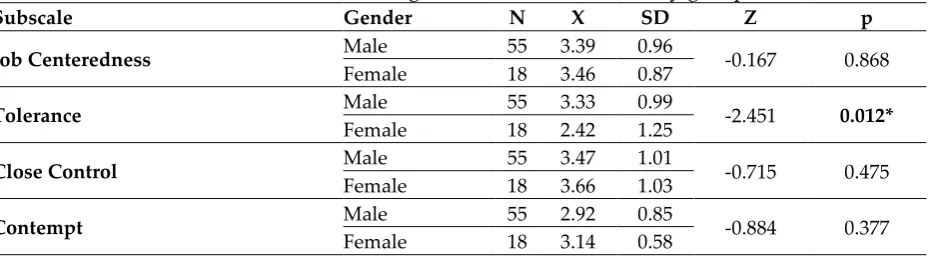
Table 1: The results of the Mann Whitney U test conducted to determine whether a significant difference existed in the gender variable of the study group
Subscale Gender N X SD Z p
Job Centeredness Male 55 3.39 0.96 -0.167 0.868
Female 18 3.46 0.87
Tolerance Male 55 3.33 0.99 -2.451 0.012*
Female 18 2.42 1.25
Close Control Male 55 3.47 1.01 -0.715 0.475
Female 18 3.66 1.03
Contempt Male 55 2.92 0.85 -0.884 0.377
Female 18 3.14 0.58 *p<0.05
Table 2: The results of the Mann Whitney U test conducted to determine whether a significant difference existed in the marital status variable of the study group
Subscale Marital Status N X SD Z p
Job Centeredness Single 29 3.43 0.97 -0.220 0.826
Married 44 3.40 0.92
Tolerance Single 29 3.21 1.15 -0.130 0.897
Married 44 3.27 1.01
Close Control Single 29 3.73 0.97 -1.523 0.128
Married 44 3.37 1.02
Contempt Single 29 3.00 0.80 -0.250 0.803
Married 44 2.96 0.79
According to Table 2, it was determined that there was no statistically significant difference in the managers’ perceptions levels of management levels according to the marital status variable.
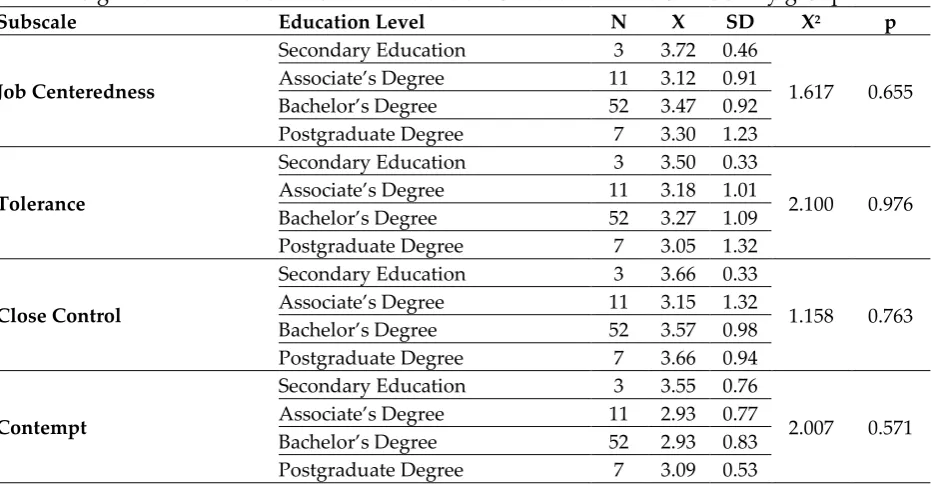
Table 3: The results of the Kruskal Wallis-H test conducted to determine whether a significant difference existed in the education level variable of the study group
Subscale Education Level N X SD X2 p
Job Centeredness
Secondary Education 3 3.72 0.46
1.617 0.655 Associate’s Degree 11 3.12 0.91
Bachelor’s Degree 52 3.47 0.92 Postgraduate Degree 7 3.30 1.23
Tolerance
Secondary Education 3 3.50 0.33
2.100 0.976 Associate’s Degree 11 3.18 1.01
Bachelor’s Degree 52 3.27 1.09 Postgraduate Degree 7 3.05 1.32
Close Control
Secondary Education 3 3.66 0.33
1.158 0.763 Associate’s Degree 11 3.15 1.32
Bachelor’s Degree 52 3.57 0.98 Postgraduate Degree 7 3.66 0.94
Contempt
Secondary Education 3 3.55 0.76
2.007 0.571 Associate’s Degree 11 2.93 0.77
Bachelor’s Degree 52 2.93 0.83 Postgraduate Degree 7 3.09 0.53
Table 4: The results of the Kruskal Wallis-H test conducted to determine whether a significant difference existed in the professional seniority variable of the study group
Subscale Professional Seniority Period N X SD X2 p Difference
Job Centeredness
1-5 years (a) 47 3.53 0.95
6.410 0.041* b<a 6-10 years (b) 14 2.93 0.68
11 years and above (c) 12 3.51 1.01
Tolerance
1-5 years (a) 47 3.34 1.10
6.189 0.045* b<c 6-10 years (b) 14 2.71 0.95
11 years and above (c) 12 3.51 0.91
Close Control
1-5 years (a) 47 3.65 0.95
2.352 0.308 - 6-10 years (b) 14 3.14 1.15
11 years and above (c) 12 3.41 1.02
Contempt
1-5 years (a) 47 2.97 0.82
0.057 0.972 - 6-10 years (b) 14 2.92 0.75
11 years and above (c) 12 3.02 0.80
*p<0.05
According to Table 4, it was determined that statistically significant differences existed
between the managers’ perceptions levels of management abilities in the “Job
Centeredness” and “Tolerance” subscales according to the professional seniority variable. According to the perceptions of the study group, the group with 6-10 years of professional seniority had higher perceptions for attitude and behaviors of job centeredness and tolerance of managers.
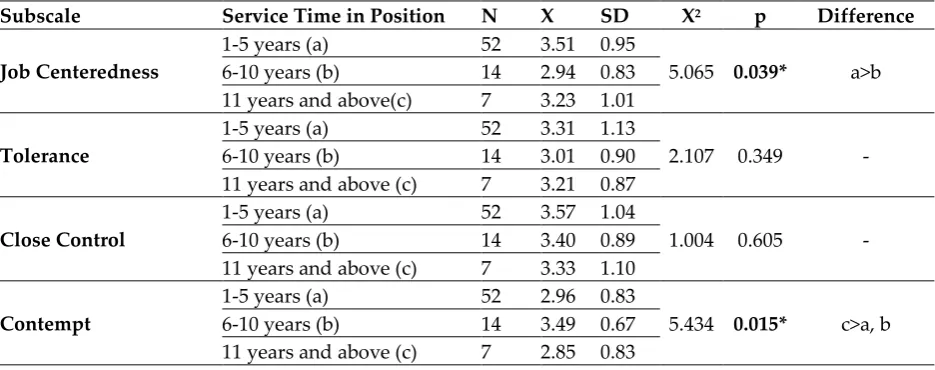
Table 5: The results of the Kruskal Wallis-H test conducted to determine whether a significant difference existed in the service time variable of the study group
Subscale Service Time in Position N X SD X2 p Difference
Job Centeredness
1-5 years (a) 52 3.51 0.95
5.065 0.039* a>b 6-10 years (b) 14 2.94 0.83
11 years and above(c) 7 3.23 1.01
Tolerance
1-5 years (a) 52 3.31 1.13
2.107 0.349 - 6-10 years (b) 14 3.01 0.90
11 years and above (c) 7 3.21 0.87
Close Control
1-5 years (a) 52 3.57 1.04
1.004 0.605 - 6-10 years (b) 14 3.40 0.89
11 years and above (c) 7 3.33 1.10
Contempt
1-5 years (a) 52 2.96 0.83
5.434 0.015* c>a, b 6-10 years (b) 14 3.49 0.67
11 years and above (c) 7 2.85 0.83 *p<0.05
According to Table 5, it was determined that statistically significant differences existed
between the managers’ perceptions levels of management abilities in the “Job
Centeredness” and “Contempt” subscales according to the service time variable. According to the perceptions of the study group, the group with 1-5 years of service
Centeredness” subscale while the group with 6-10 years of service time had higher perceptions of managers’ attitudes and behaviors in the “Contempt” subscale.
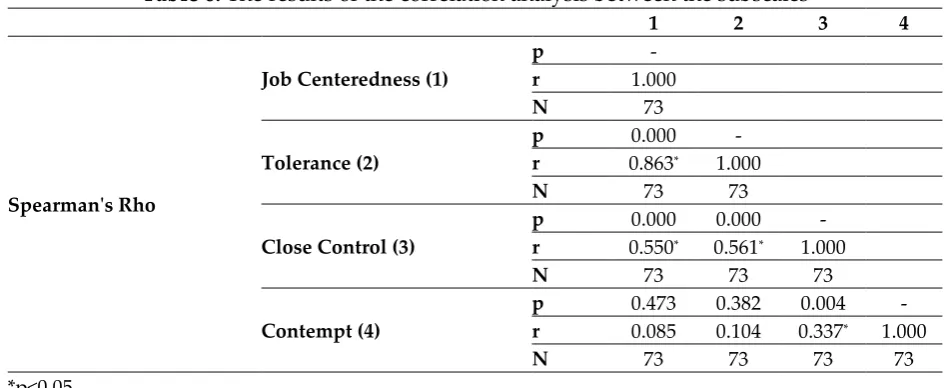
Table 6: The results of the correlation analysis between the subscales
1 2 3 4
Spearman's Rho
Job Centeredness (1)
p -
r 1.000
N 73
Tolerance (2)
p 0.000 -
r 0.863* 1.000
N 73 73
Close Control (3)
p 0.000 0.000 -
r 0.550* 0.561* 1.000
N 73 73 73
Contempt (4)
p 0.473 0.382 0.004 -
r 0.085 0.104 0.337* 1.000
N 73 73 73 73
*p<0.05
According to Table 6, among the subscales of the “Contributions of Perceived Management Skills of Managers to Organizational Climate Scale”, a positive linear correlation at a high
level was observed between the “Job Centeredness” and “Tolerance” subscales (r=0.863;
p<0.05). Furthermore, a moderate level of positive linear correlation was observed between the “Job Centeredness” and “Close Control” subscales (r=0.550; p<0.05). Similarly,
a moderate level of positive linear correlation was identified between the “Tolerance”
and “Close Control” subscales (r=0.561; p<0.05). Between the subscales of “Close Control” and “Contempt”, a low level of linear positive correlation was detected (r=0.337; p<0.05).
4. Discussion and Conclusion
serving in educational institutions in the subscales of “Contempt, Job Centeredness and Tolerance”, which constitute the managers’ behaviors in the organizational climate while
a significant difference was reported in the perceptions regarding the “Close Control”
subscale.
According to the marital status variable of the study group, it was determined that no significant difference existed between the perceived levels of managers’ management abilities. In the study conducted by Çokluk (2001), it was reported that research assistants’ evaluation of the organizational climate did not constitute a significant difference in terms of the marital status.
According to the education level variable of the study group, it was determined that no significant difference existed between the perceived levels of managers’ management abilities. In the evaluation of the studies regarding the variable of education level, the following results were reported: in the studies conducted by Yaşar (2005) and Karadağ et al. (2018), no significant difference was observed between the education level and the organizational climate. In the study conducted by Akar (2006), no significant difference was reported in perceptions of teachers serving in educational institutes in the “Duty” subscale, which constitutes the managerial types of managers. In the study conducted by Aksoy (2006), it was reported that there a significant and negative relationship between the perceived organizational climate scores and education levels. In the study conducted by Özdemir (2006), it was reported that there was a decrease in the positive perception of organizational climate with increasing education level of the study group. In the study conducted by Erol (2014), it was reported that the academics with the highest academic title in the hierarchy, due to generally being in a managerial position, perceived the organizational climate in more supportive and innovative ways, compared to academics in subordinate positions. In the study conducted by Nurluöz et al. (2010), it was reported that with higher academic titles, academics perceived the managers’ behaviors and the general atmosphere of the faculty more positively. In the study conducted by İlleez (2012), it was reported that with employees’ higher positions in the organizational hierarchy, their possibility to perceive the environment more supportive increases while on the contrary, with lower positions in the organizational hierarchy, the organizational climate is perceived as bureaucratic.
According to the professional seniority variable of the study group, statistically
significant differences were determined in the subscales of “Job Centeredness” and
according to the professional seniority. Kasırga & Özbek (2008) reported in their study investigating the organizational climate in schools of physical education and sports that there was no significant difference between the academics’ professional seniorities and their perceptions of organizational climate. In the study conducted by Küçüköde (2005) in the Çukurova University, Turkey, it was reported that academics with higher organizational seniority had more positive views towards the elements of organizational climate. In the study conducted by Vigoda-Gadot & Talmud (2010), it was reported that young academics with lower organizational seniority placed more importance on organizational support compared to those with higher organizational seniority.
Among the subscales of the scale used in the study, a positive linear correlation
at a high level was observed between the “Job Centeredness” and “Tolerance” subscales
while a positive linear correlation at a moderate level was detected between the “Job
Centeredness” and “Close Control” subscales. No significant relationship was observed
between the subscales of “Job Centeredness” and “Contempt”. A positive linear
correlation at a moderate level was also observed between the subscales of “Tolerance”
and “Close Control”. However, there was no significant relationship between the subscales of “Tolerance” and “Contempt”. A positive linear correlation at a low level was
observed between the subscales of “Close Control” and “Contempt”. These findings
indicated that with increasing levels of job centeredness, the study groups’ levels of tolerance and close control increased. On the other hand, with increasing close control, the levels of contempt were also increased even though it was a slight one. In the investigation of the studies conducted on the subject of organizational climate, the following results were observed: In the study conducted by Gök (2009) investigating the effects of organizational climate on the employees’ motivations, it was reported that 74.6% of the employees had healthier and more positive perceptions. In the study conducted by Korkmaz (2011) investigating the effects of organizational climate and organizational health on the organizational dedication in educational institutions, it was reported that a positive climate had a positive effect on organizational dedication, which is another significant variable for organizations. In the study conducted by Arabacı (2011), it was reported that employees in universities had lower perceptions of organizational climate in terms of organizational communication. In the study conducted by Bucak (2002), it was reported that employees of the faculty had moderate levels of perceptions of superior-subordinate relationship in terms of the organizational climate.
climate is the most vital element affecting the job performance. The managers, whose employees change and improve rapidly, and who encourage their employees in taking risky decisions in environments, support them in line with the decisions they take and have open communication channels in sports institutions with a hospitable and friendly atmosphere, will improve the job performance. Thus, as a result of the improvement in the job performance of employees, it is believed that organizational success can be achieved. As it was mentioned above, organizational climate is not only an element that affects only one individual but also has a quality of contributing to the productivity and efficiency of the organization. Moreover, the management has an obligation to create an organizational climate where employees are motivated to work eagerly and effectively as well as to regulate the organizational processes.
The results of the study revealed that perceiving sports employees as supportive and positive is one of the most important factors affecting sports employees in having a positive perception of organizational climate. The positive perception of the organizational climate of sports employees by the employees will initially affect the feelings of the employees, reflecting on the outside as positive emotions and behaviors. This will enable sports employees’ expectations to be met in terms of quantity and quality. Additionally, studies to be conducted on this topic with a larger sample and different variables will provide better insights into employees’ perceptions of organizational climate. This study also revealed that the management of the organizational climate in a positive way also contributes to reducing the problem of alienation. Managers in sports institutions should also consider the perceptions and wishes of employees while taking decisions. Because the climate of an organization is not stable and on the contrary, ever-changing, sports managers should constantly receive feedbacks about the organizational climate and should implement regulations accordingly. Rewarding sports employees, improving working environments and planning events for enhancing the communication between employees could lead to a more positive perception of organizational climate. Furthermore, sports managers’ appreciation of their employees, providing opportunities for their employees to utilize their abilities and evaluating creative ideas can greatly contribute to improving the organizational climate.
References
1. Akar, A. (2006). The contribution of the skills of managers’ administration skills
to organization climate in respect of teachers` perception in primary education schools. Gazi University, Master’ Thesis, Ankara.
2. Aksoy H. (2006). The effects of organizational climate on motivation. Marmara
University, Institute of Social Sciences, Master’ Thesis, İstanbul.
3. Arabacı, İ. B. (2011). Organizational climate of Fırat University. International
4. Bock G. W., Robert W. Z., Kim Y. G. & Lee, J. L. (2005). Behavioral intention formation in knowledge sharing: examining the roles of extrinsic motivators, social-psychological forces, and organizational climate. MIS Quarterly, Special Issue on Information Technologies and Knowledge Management, 29 (1), p. 89.
5. Bucak, B. E. (2002). Abant izzet baysal üniversitesi eğitim fakültesinde örgüt
iklimi: yönetimde ast-üst ilişkileri (trans.: The organizational climate in the education faculty of Abant İzzet Baysal University: the relationships of superior-subordinate in management). Muğla University, Journal of Educational Sciences Institute, (7), s. 11-27.
6. Buenger, C. M., Monique, F., Robert, W. B. & Nick M. (2007). A study of the
perceptions of organizational politics scale (pops) for use in the university classroom. Developments in Business Simulation and Experiential Learning, (34), p. 294-301.
7. Can, H. (2005). Organizasyon ve yönetim (trans.: Organisation and
management). 7th Edition, Ankara: Siyasal Kitabevi.
8. Çokluk, Ö. (2001) Ankara üniversitesi eğitim bilimleri fakültesinde görev yapan
araştırma görevlilerinin fakültenin örgüt iklimi özelliklerine ilişkin algı ve değerlendirmeleri (trans: Perceptions and evaluations of research assistants serving in the faculty of educational sciences in Ankara University regarding the features of the organizational climate in the faculty). Eurasian Journal of Educational Research, (5), p. 45-51.
9. Diş, O. (2015). The relationship between organizational climate and power
sources the school principals’ use. Atatürk University, Educational Sciences Institute, Master’s Thesis, Erzurum.
10.Erol, E. (2014). The relationship between organizational climate and perceptions
of organizational politics in educational faculties. Pamukkale University, Institute of Educational Sciences, Doctorate Dissertation, Denizli, p. 104.
11.Giles, P. (2010). The impact of adult degree-completion programs on the
organizational climate of Christian colleges and universities. Walden University, Doctorate Dissertation, p. 68.
12.Gök, S. (2009). A study on the influence of organizational climate on motivation
of employees. International Journal of Human Sciences, (6), p. 587-605.
13.Gökçen, G. A. (2014). Regarding to teachers' perception, effect of managers’
managerial abilities on school climate. Yeditepe University, Institute of Educational Sciences, Master’s Thesis, İstanbul, p. 9-26.
14.Gürkan, G. Ç. (2006). Organizational commitment: Organizational climate's effect
on organizational commitment and research of the relationship between organizational climate and organizational commitment in Trakya University. Master's Thesis, Trakya University, Institute of Social Sciences, Edirne, p. 52.
15.İlleez, Z. (2012). The effect of organizational climate on organizational
16.Karadağ, D., Sezer, S. Y. & Karadağ, M. (2018). Evaluation of the opinions of sports clubs administrators related to planning process (elazığ sample). Turkish Studies, 13 (3), p. 389-408.
17.Karasar, N. (2008). Bilimsel araştırma yöntemi: kavramlar, ilkeler, teknikler
(trans.: Scientific research methods: concepts, principles, techniques). Ankara: Nobel Yayın Dağıtım, p. 81.
18.Kasırga, İ. & Özbek, O. (2008). Organızatıonal climate in the higher schools of
physical education and sport. Spormetre Journal of Physical Education and Sports Science, 6 (2), p. 59-68.
19.Korkmaz, M. (2011). The effects of organizational climate and organizational
health on organizational commitment in primary schools. Educational Administration: Theory and Practice, 17, p. 117-139.
20.Küçükgöde, V. (2005). Perceptions of faculty members about organizational
climate at Çukurova University Faculty of Agriculture. Master's Thesis, Cukurova University, Institute of Science and Technology, Adana.
21.Memduhoğlu B. H. & Şeker, G. (2011). Organizational climate of primary schools
in the view of teachers. Inönü Unıversity Journal of the Faculty of Education, 12 (1), p. 1-26.
22.Nurluöz, Ö., Birol, C. & Silman, F. (2010). Examining administrative behaviors of
educational administrators in universities by perceptions of academic staff and students. Educational Administration: Theory and Practice, 16 (4), p. 579-599.
23.Önen, L. (2008). Effect of culture on organizational climate. Master’s Thesis,
Marmara University, İstanbul.
24.Özdemir F. (2006). The effect of organizational climate on job satisfaction level:
An evaluative study in textile sector. Cukurova University, Institute of Social Sciences, Doctorate Dissertation, Adana.
25.Parıltı, N. & Tolon, M. (2011). Yerel yönetimlerde imaj kavramı ve olası sonuçları
(trans.: The concept of image and its possible outcomes in local administrations). Access: http://w3.gazi.edu.tr/web/metehan/1.pdf. Access Date: 04.06.2017.
26.Şişman, M. (2012). Eğitimde mükemmellik arayışı: etkili okullar (trans.: The
search for perfection in education: effective schools). 3. Baskı, Pegem Yayıncılık, Ankara.
27.Tahaoğlu F. (2007). The effect of leadership roles of primary school principals on
organizational climate (a case study in Gaziantep). Gaziantep University, Institute of Social Sciences, Master’s Thesis, Gaziantep.
28.Taşcı, D. (2013). Örgüt kuramına giriş (trans.: Introduction to the concept of
organization). In Taşcı, D. ve Erdemir, E. (Ed.), Örgüt teorisi (Organization theory). Eskişehir: Anadolu University Publications, p. 1-29.
29.Tavşanlı, Ö. F., Birgül, K. & Oksal, A. (2016). Analysing the variables that predict
30.Tutar, H. & Altınöz, M. (2010). The effect of organizational climate on employee performance: a study on the employees of ostim manufacturing enterprises. Ankara University, Faculty of Sports Sciences, 65 (2), p. 197.
31.Vigoda-Gadot, E. & Talmud, I. (2010). Organizational politics and job outcomes:
The moderating effects of trust and social support. Journal of Applied Social Psychology, 40 (11), p. 2829-2861.
32.Yaşar, Ö. (2005). The Effect of organizational trust on organizational climate: A
case study in industrial companies of Gaziantep. Gaziantep University, Institute of Social Sciences, Master’s Thesis, Gaziantep.
33.Yıldırım, M. (2009). Teachers’ perceptions of principals’ management skills’
contribution to the school climate in elementary schools (the example of bahçelievler district, İstanbul). Beykent University, Institute of Social Sciences, Master’s Thesis, İstanbul.
34.Yılmaz, K. (2008). Eğitim yönetiminde değerler (trans.: Values in education
management). Pegema Yayıncılık, Ankara.
35.Yılmaz, K. & Altınkurt, Y. (2013). Adaptation of organizational climate scale into
Creative Commons licensing terms