CONCEPTUALIZING NARRATIVES OF RELIGIOUS GENERATIONAL GAP BETWEEN MUSLIM IMMIGRANTS AND THEIR FRENCH-BORN DESCENDANTS.
Shreya Parikh
A thesis submitted to the faculty at the University of North Carolina at Chapel Hill in partial fulfillment of the requirements for the degree of Master of Arts in the Department of Sociology
in The Graduate School.
Chapel Hill 2020
iii ABSTRACT
Shreya Parikh: Conceptualizing Narratives of Religious Generational Gap between Muslim Immigrants and their French-Born Descendants.
(Under the supervision of Dr. Charles Kurzman)
iv
ACKNOWLEDGEMENTS
I would like to thank my advisor Dr. Charles Kurzman who has guided my work with rigorousness and generosity. His excitement at what I thought were mundane details from the field has structured this work. Dr. Jacqueline Hagan and Dr. Rahsaan Maxwell have provided feedback during various stages of this project. Dr. Juliette Galonnier (CERI-Sciences Po Paris) and Dr. Carol Mann (Université Paris-8) provided valuable support during my time in France. Dr. Juliane Hammer (UNC) provided intellectual and emotional support as I deconstructed my experiences of doing fieldwork.
State-borders and citizenship had real implications on my ability to conduct research. My first application for visa to France was rejected by the Embassy of France in Washington DC. I thank Raphaël Beauregard-Lacroix and my parents Mayur and Sandhya Parikh for supporting me throughout the many uncertainties that this research project has brought. I thank folks at the Islamicate Graduate Student Association (especially Samah Choudhury and Arianne Ekinci) who became my family!
Financial support for travel and research was key to making the project feasible. For that, I thank the Center for European Studies, the Department of Sociology, and the Graduate and
v
vi
TABLE OF CONTENTS
LIST OF TABLES ... viii
LIST OF FIGURES ... ix
Section 1: Introduction ... 1
Section 2: Religious generational gap in the literature ... 5
2.1 Evidence from Quantitative studies ... 5
2.2 Evidence from Qualitative studies ... 11
Section 3: Religious generational gap: Evidence from quantitative survey data... 24
3.1 Religious practices ... 26
3.2 Markers of religiosity ... 31
3.3 Source of Islamic knowledge ... 34
3.4 Islam and gender ... 39
3.5 Dividing the sacred from the profane ... 39
3.6 Claiming Islamic identity ... 41
Section 4: Qualitative Evidence of Religious Generational Gap from the Field ... 43
4.1 Choice versus inheritance of Islam ... 47
4.2 Islamic epistemologies ... 50
vii
4.4 Dividing the sacred from the profane ... 59
4.5 Claiming Islamic identity ... 64
Section 5: Conclusion and discussion ... 69
APPENDIX A: QUESTIONNAIRE... 76
APPENDIX B: LIST OF INTERVIEWEES. ... 78
APPENDIX C: LIFE STORIES OF INTERVIEWEES. ... 79
C.1: First-generation immigrants ... 79
C.2: Second-generation immigrants... 90
C.3: Third-generation immigrants ... 97
APPENDIX D: LOGIT REGRESSION ANALYSIS FOR PEW (2006) and TeO (2008) DATA ... 101
viii
LIST OF TABLES
Table 3.1: Differences is religiosity between foreign-born and French-born
Muslims (using Pew 2006). ... 28
Table 3.2: Differences is religiosity between foreign-born and French-born
Muslims (using TeO 2008). ... 33
Table 3.3: Differences is religiosity between foreign-born and French-born
Muslims (using IFOP 2019). ... 37
Table 5.1: Observable generational difference in religiosity and possible
ix
LIST OF FIGURES
Figure 1: HLM (Habitation à loyer modéré; low-income housing) buildings
on the periphery between Paris and the suburbs. ... 19
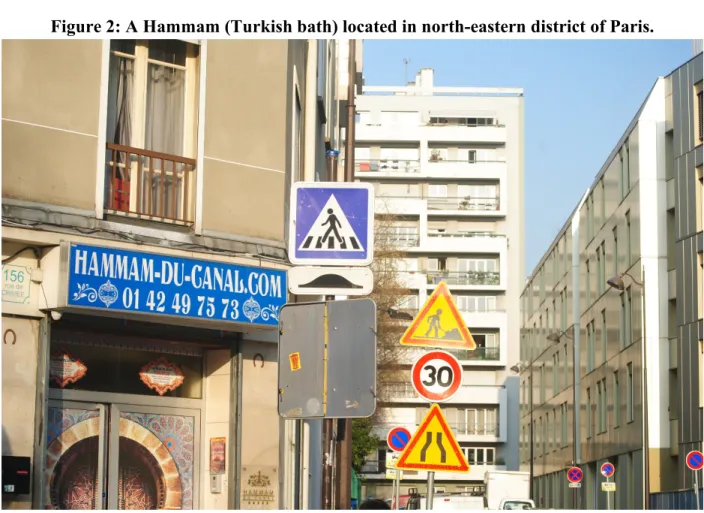
Figure 2: A Hammam (Turkish bath) located in north-eastern district of Paris. ... 21
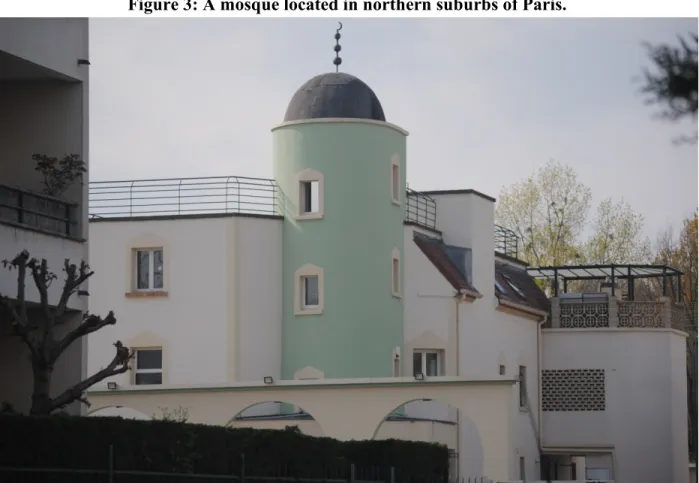
Figure 3: A mosque located in northern suburbs of Paris. ... 27
Figure 4: A street corner in Barbès, in the northern part of Paris. ... 35
Figure 5: A store catering to local Sub-Saharan African origin Muslims in Goutte d’Or area in northern part of Paris. ... 45
1 Section 1: Introduction
Every Friday after the afternoon prayer, a women’s group meets at the Grand Mosque of Paris. Quranic verses are discussed and thoughts are shared, in a mixture of French and North African Arabic dialects, about ways in which to apply Quran’s lessons in daily life. Many of these women are first-generation immigrants, and a popular discussion is the religious
generational differences they have with their French-raised children or grandchildren. During my Friday visits to the mosque, many complained that the “younger” generation of Muslim women and men in France wore hijab or grew “Islamic” beard while “knowing nothing about the essence of Islam” (Houda’s words).1 Second-generation women who frequented the mosques usually chatted with those of their own immigrant-generation, complaining about the
“incomprehension of Islam among the parents” who had not read the Quran and did not understand that Muslim women “could marry any man as long as they are pious Muslims [and that] it did not matter what ethnic background they came from” (Nesrine’s words, fieldnotes from March 2019).
That religious generational gap with members of other immigrant-generation exists was a social fact for many Muslim women and men I met both within and outside the mosques (Durkheim
1 The second- and third-generation immigrants were collectively referred to as “youth” or “younger (wo)men” by first-generation immigrants. Also note that all names have been changed to protect the identities of those
2
1982).2 Among the first-generation men I conversed with at the immigrant-dominated cafes in northern Paris, and among second- and third-generation women and men I shared meals with during religious association meetings, many agreed with the women I met at the Grand Mosque about the existence of a religious generational gap between first-generation immigrants and French-raised descendants of these immigrants.3
Scholars who employ qualitative methods agree that there is a generational gap in religiosity, i.e. the religiosity of first-generation Muslims in France is different from that of their second- and third-generation descendants; however, those employing quantitative surveys have discovered little consistent evidence of a generational gap in religiosity among Muslims in either France or elsewhere in Europe.
For example, a survey carried out by IFOP (French Institute of Public Opinion) in 2019 asked Muslim women and men of age 50 years and above if they would “say that in your family, your entourage or your neighborhood, the young Muslims you know are today more religious, less religious or neither more nor less religious than your generation was at the same age?”4 Around
2 In this paper, I borrow from Danièle Hervieu-Léger's definition that “a religion is an ideological, practical, and symbolic device by which a consciousness (individual or collective) of belonging to a particular believing line is constituted, maintained, [and] developed” (cited in Kakpo 2005: 140).
3 In the context of this paper, I define first-generation immigrants as those who immigrated to France, and second- and third-generation immigrants are those who were born in France to (at least) a parent or grand-parent who immigrated to France. It should be noted that second- and third-generation as categories are not used by my
interviewees; rather, they prefer to be called first- or second-generation French respectively. In following the general practice in sociological literature on immigration, I use the terms “second-generation immigrant” and
“third-generation immigrant.” I also refer to the second- and third-“third-generation Muslim immigrants as French-born or French-raised Muslims collectively.
4 The question asked was “Diriez-vous que dans votre famille, votre entourage ou votre quartier, les jeunes
3
half of them agreed that there was a religious gap, 40 percent said that there was no difference, and around 9 percent did not respond. Of those who agreed, 55 percent said that the younger generation was “more religious” and 45 percent said that the younger generation was “less religious.”5
This paper takes this discrepancy in evidence related to religious generational gap as the starting point. Using a mixed methods approach, I reflect on how results from qualitative case studies can be bridged with those from quantitative survey data to understand religious generational gap as a sociological phenomenon. I argue that new quantitative survey data is needed to capture the varied manifestations of religious generational gap that are identified in the qualitative literature and in my interviews with Muslims in France. These issues are important because many
Europeans view religiosity among Muslim immigrants and their descendants as a proxy for integration into the society (Alba 2005; Zolberg and Woon 1999), i.e. lower religiosity among French-raised Muslims compared with that among first-generation immigrants is often
interpreted as integration into largely secular societies in Europe.
The paper is organized as follows: The first part of the paper sketches out the debates and propositions in the literature in relation to the presence (or the absence) of religious generational gap. Second, I examine results from available quantitative surveys – I compare indicators of religiosity for foreign-born (or first-generation) and French-born (second- or third-generation) Muslims in France to see if we can find significant differences in religiosity between the two generational groups, especially for observables/outcomes mentioned in the qualitative studies. I
4
find that while quantitative survey data provides no generalizable evidence of the presence of religious generational gap, many among my interviewees as well as others I interacted with while collecting qualitative data talked about the existence of a religious generational gap (in many cases without me prompting them to). Third, I use this primary qualitative data (interviews and observations) collected among Muslims of immigrant origin in France to outline five key themes of generational differences identified by my interlocutors. In conclusion, I propose survey questions based on these themes that might be used to collect better-quality survey data on religiosity among European Muslims.6
5
Section 2: Religious generational gap in the literature
In this section, I review evidence on religious generational gap among Muslims of immigrant origin, primarily in France but also in other European countries with significant Muslim population of immigrant origin. I start with a review of studies that make use of quantitative survey data, and then review evidence from qualitative studies.
2.1 Evidence from Quantitative studies
Quantitative studies use shifts in religiosity of immigrant-origin Muslims over immigrant
generation to measure integration into the predominantly secular societies of European countries. These studies ask: Is there a secularization of Muslims from first-generation to
second-generation? Secularization in these studies is understood as “the decreasing importance and impact of religion in modern societies” (Phalet, Gijsberts, and Hagendoorn 2008:412). Studies from around Europe agree that there is a significant intergenerational transmission of religiosity among Muslims from first- to second-generation (Brouard and Tiberj 2011; Güngör, Fleischmann, and Phalet 2011; Soehl 2017).
One of the earliest surveys to study trajectories of immigrants in France, titled “Geographical Mobility and Social Inclusion” (MGIS), was fielded in 1992 by the French Institute for
6
immigrant generation. We see that, in the first-generation, around 47 percent of men and 58 percent of women indicate that they practice religion either regularly or occasionally. On the other hand, among those of second generation with two Algerian parents, 32 percent of men and 42 percent of women indicate practicing religion regularly or occasionally. This proportion is even less among children of one Algerian and one French parent. Among the first-generation, between 70-80 percent respect Ramadan fasting and religious restrictions on consumption of pork meat. The proportion of those who respect restriction on consumption of alcohol is around 55 percent (men) and 76 percent (women) (1996:240). Among the children of two Algerian parents, around 60 percent respect Ramadan fasting and religious restrictions on consumption of pork meat and about half of them respect religious restriction on the consumption of alcohol (1996:248). In terms of language used, around half of the first-generation population declare Arabic as their maternal language and an additional 24 percent declare using a mix of Arabic, Berber, and French (1996:190). On the other hand, only 10 percent of those born of two Algerian parents declare Arabic as a mother tongue and an additional 28 percent declare speaking a
mixture of French and Arabic (1996:203). Hence, overall, we see a decline in the use of Arabic language over immigrant generation.7
In 2005, Sylvain Brouard and Vincent Tiberj fielded data in order to compare “the new French” with “French” people who lack direct links to immigration. Their findings do not allow us to compare the two immigrant generations, unfortunately; yet, they compare age cohorts and conclude that there is a move toward “reislamization” among the younger cohort. They use data for the question that asked Muslims “if they accord more, as much, or less importance to religion
7
today than they did before” and find that, overall, the distribution for the three categories was at 42 percent (more), 41 percent (as much), and 17 percent (less). The percent of those who indicated that the importance of religion for them is higher at the time of the interview than it was before was highest among 18-24 year old individuals (Brouard and Tiberj 2011:17).
Hakim el Karoui (2016) published a report titled “A French Islam is possible” using data from a quantitative survey on Muslim religiosity that was fielded in 2016. Data from 1,029 individuals of “Muslim faith or culture” was obtained (of which 874 self-identified as Muslim). El Karoui concludes that those “far removed from religion” comprise about half of respondents aged 40 and above, as compared with a third of younger respondents to conclude that there might be a trend of “strengthening of religious identity among the new cohorts (compared to their elders at the same age)” (p.19).8 He cautions that “[a]t this stage, it is not possible to statistically verify that this impact is linked to age rather than to a generational effect” (p.19) yet argues that overall there is a rise in fundamentalism especially among those of younger generation.
Several recent works on the study of immigrant religiosity in France have used data from the Trajectories and Origins (TeO 2008) survey, which I analyze later in this paper. Using TeO (2008) data, Thomas Soehl (2017) shows that “the offspring of religiously non-homogamous families are significantly less religious” (p.1001). He concludes that there is a possibility of an overall “non-trivial decline in religiosity of the third-generation” because of decline in religious in-partnering in the second-generation (p.999).9 Hugues Lagrange (2013) studies shifts in the
8 The data used for this report remains private, given that it was collected by two private institutions: Montaigne Institute and French Institute of Public Opinion (IFOP). I have attempted to get access to this data, but received no response from the institutions.
8
religiosity of immigrants in France overall. Among others, he compares data on the religiosity of first- and second-generation immigrants of Algerian descent using data from MGIS (1992) and TeO (2008). He shows that while there was a significant difference between the proportion of those who declared themselves to have a religious affiliation in 1992 in both generations (around 85 percent among first- and 70 percent among second-generation), in 2008 this gap is almost non-existent (around 90 percent of both groups declare having religious affiliation) (p.13). This can be understood as a potential sign of Islamic “identity affirmation” among the descendants of immigrants from the region (p.34). In terms of frequency of practice of religion, around 15 percent of second-generation of Algerian descent in both 1992 and 2008 declared practicing frequently, while the proportion has fallen from around 20 percent to around 15 percent in the first-generation from 1992 to 2008 (p.13). What remains to be known is whether these trends can be generalized for the whole of the Muslim population (including those of third- or fourth- immigrant generation).
Another analysis of shifts in religiosity among immigrant origin population (belonging to all religious denominations) in France is offered by Patrick Simon (one of the directors of the TeO 2008 survey data) and Vincent Tiberj (2013). They write that the survey data itself concentrates on “elements revealing the beliefs and personal practices” of religion and that they cannot provide analysis of “differences in values based on religious affiliation” (emphasis is mine). They conclude that while religious transmission remains strong among immigrant-origin individuals in France, there is also a significant proportion of those who experience “religious reinforcement” (i.e. increase in religiosity of second-generation compared to their
9
generation parents) (p.25). Yet, the proportion of those who undergo “religious reinforcement” is significantly smaller than the proportion of those who undergo “secularization” (i.e. decrease in religiosity compared to their parents). In addition, they reject the thesis of “radicalization” based on the analysis of the dataset (p.26) and conclude that (like in the case of Lagrange 2013):
“[T]here is no [evidence of] generational rupture that signals a more intense relation to religion
among the youth born in France, but rather [an evidence of] a more general affirmation of
religion among immigrant populations since the 1980s, which is a part of a more global
movement of the evolution of the function of religion in the Muslim countries” (Simon and Tiberj
2013:27)
Continuing on the question of religious identity, evidence about the existence of “practicing and believing Muslims”, “believing Muslims”, and individuals “of Muslim origins” as separate categories of self-identification appears in surveys of Muslim communities undertaken by IFOP between 1989 and 2011 (IFOP 2011).10 However, the IFOP report does not break the findings based on immigrant generation for us to know how self-identification differs by immigrant generation.
Outside of the French context, the study of shifts in religiosity using quantitative studies is slightly more developed because of availability of better-quality data for multiple years. Quantitative studies related to religious generation gap between foreign-born Muslims and European-born Muslims of immigrant origin for other countries in Europe describe two trends
10
overall: no change from first- to second-generation or a decrease in religiosity over immigrant generation.11
Multiple studies have emerged from the study of Muslim religiosity in the Netherlands. Phalet and colleagues use data on the religiosity of Turkish- and Moroccan-Dutch Muslims (for years 1998, 2002, and 2005) in the Netherlands and conclude that “the second generation practices less and attaches less importance to religious schools than the first generation” (2008:431). Van de Pol and van Tubergen (2014) study trends in transmission of religiosity from first- to second-generation of the same Muslim population. They conclude that while religious practices (like reading Quran, following halal dietary restrictions, or wearing headscarves) continues to have the same frequency from first- to second-generation in majority of the cases (between 60-90
percent), “it is more often the case that people are less religious as opposed to more religious than their parents” (p.97). This conclusion is similar to that made by Simon and Tiberj (2013) in the French case.
Another study, again in the case of Netherlands, seeks to understand the transmission of ethnic and religious identity from first- to second-generation and the shift in the relation between the two identities over generation. Like in the previously mentioned studies, they conclude that “second generation reports weaker ethnic and religious identities, and engages less in ethno-cultural and religious practices.” For example, the percentage of first-generation immigrants of Turkish and Moroccan origins who do not call themselves Muslims is lower than that found among second generation (around 5 percent in first- to around 12 percent in second-generation) (Maliepaard, Lubbers, and Gijsberts 2010). In addition, the authors also argue that “the
11
differences in religious identity between the recent migrants and the second generation are due to the fact that the former are more attached to their ethnic group” and that “for the second
generation, feeling Moroccan or Turkish plays a stronger role in maintaining a religious identity than it does for the first” (p.464). The high correlation between ethnic and religious identity among second-generation goes against the evidence of the de-linking of religious and ethnic identity among European-raised Muslims compared to first-generation that has been presented in multiple qualitative studies (that I outline later).
Breaking from the trends of either decrease in or maintenance of first-generation religious practices evidenced in previous quantitative works, Maliepaard et al. (2012) show that there has been a recent rise (since 2004) in the frequency of mosque attendance among second-generation Muslims of Moroccan and Turkish origin in the Netherlands compared to the first-generation Muslims of their ethnic origin. It remains to be known if such increase is observable in other indicators of religious practice, religiosity, and religious identity.
2.2 Evidence from Qualitative studies
Some of the earliest studies that pointed to a difference between the religiosity of first-generation Muslims and their European-raised descendants were qualitative studies undertaken in the
context of France. An interest in the study of the evolution of religiosity among immigrants and their descendants has been around since 1980s, when Muslims became more “visible” in the French public space.12 In a majority of these studies, starting with the works of Jocelyne Cesari (1997, 1998), Gilles Kepel (1991), Farhad Khosrokhavar (1997), Olivier Roy (1999), and Nancy
12
Venel (1999) in the 1990s, a common argument has been that the religiosity of the
first-generation Muslims is different from that of French-raised Muslims. At the European level, an edited volume compiled by Steven Vertovec and Alisdair Rogers (1998) demonstrated similar trends in religious generational gap across multiple countries including Denmark, Germany, the Netherlands, and the United Kingdom.
Four key theories are found in the qualitative literature on shift in Muslim religiosity over immigrant generation: individualization of religion; de-ethnicization, deterritorialization, and deculturalization of religion; reislamization; and radicalization of religiosity among French- (or European-) raised Muslims compared to first-generation Muslim immigrants. These theories are proposed, in many cases, as interrelated with each other, as I outline below.
One of the prominent theories in the qualitative literature on difference in religiosity between first-generation Muslims and French-raised Muslims is the idea that Islam in the later generation is more “individualized” compared to that found among the first-generation Muslims. Jocelyne Cesari, one of its key proponents, writes:
“The European Muslims advance an individualized logic of decision-making and choice that fits
well in the growing subjectification of religious affiliation (appartenance). It is not sufficient to
believe and to practice because one is born into this or that belief tradition, rather [it is important]
to express one’s individuality by making a choice of practicing [a religion] and to give a personal
meaning to the revealed message” (Cesari 2002a:20).
13
“if we don’t want to do [Ramadan], we don’t do it”, unlike in “bled” (country of origin) where they would have social pressure to fast (Gonzales De Quijano 1987:824).
This “chosen” Islamic identity, that Farhad Khosrokhavar (1997) terms as a “bricolage” of identity, is contrasted to the “inherited” Islam of the first-generation (also mentioned in Tietze 2000:263). As Adis Duderija writes:
“Islamic identity for many western-born/raised Muslims is based upon a conscious choice of
religious identity reconstruction and not merely on the basis of reproduction of an inherited aspect
of their ethnic heritage or tradition” (Duderija 2007:146).
The importance of “choice” among the Western-raised Muslims compared to first-generation immigrants when talking about religion has also been pointed out in studies outside of France. For example, Garbi Schmidt’s (2004) work has shown the importance of “choice” and
“rationality” among Muslim youth of immigrant origin in Denmark, Sweden, and the United States when talking about religious affiliation and adoption of religious practices.
14
At the same time, evidence about the younger generation showing more “visible symbols” relating to religious identity compared to the first-generation remains debated. Jean Beaman (2016) argues against Killian’s (2007) proposition to show that middle class second-generation Maghrebi Muslims don’t show religiosity in public and, instead, seek to maintain the secular norms of the French society by keeping religion in the private.13
The desire to have agency in religious matters also manifests itself in terms of differences in sources used to gain information about religion among French-raised Muslims, as compared with first-generation immigrant Muslims. One of the most important contemporary sources of Islamic knowledge is the internet, which Olivier Roy calls the “virtual ummah” (Roy 2004:183).14
Kaltenbach and Tribalat (2002) write that the internet becomes a handy tool for young French Muslims because it provides a great variety of sources on Islam and also allows them to communicate with other fellow Muslims in online forums. The difference between the two generations emerges because “the children of those ‘Muslims’ who came to work in France…are in search of information that their parents are frequently incapable of providing [because the first-generation] practice a popular Islam that they got to know in their country of origin” (p.269).
13 In most studies on shifts in religiosity over immigrant generation, difference is made between individualization and privatization of religion. There is evidence of the former process taking place over immigrant generation (i.e. increase in importance of agency in relation to religious practices and construction of religious identity over generation); there is general agreement that religion among Muslims of first-generation is more “private” and “quiet” in that that demands for religious accommodation in public space are less present among the first-generation rather than among those who are born or raised in Europe.
15
Another important source of Islamic knowledge that qualitative studies have identified among younger generations is the Quran and other holy texts. As Jørgen Nielsen writes:
“[T]here is growing evidence that young people are meeting formally and informally in small
groups on a regular basis to discuss the source texts. Qur’an and Hadith are explored as fresh
texts, without the intervention of centuries of Islamic scholarship. In consequence, the texts are
interpreted in the light of current needs and with methods which are based on the intellectual tools
acquired through education in European schools” (Nielsen 2016:130).
This reading of the holy texts by European-raised Muslims is contrasted with “traditional” ideas about Islam that first-generation parents have and which, the literature argues, are derived from religious authorities in their country of origin. Nielsen (2016) mentions the use of Islam as a form of legitimizing factor by first-generation parents to control the behavior (especially marriage and partner choice) of their European-raised children. At the same time, Islam is also used by the younger generation to legitimize their perceptions of gender roles, especially in the familial context; choices like shared domestic and childcare responsibilities, for example, are “explained as being legitimately Islamic, even as being more correct, in Islamic terms, than the practices of their parents” (Nielsen 2016:130).
The presentation of “true Islam” as “gender equal” by European-raised Muslims is a trend observable in many countries in Europe. The younger generation, especially women, use this to challenge gender roles imposed upon them by their parents, as Dounia Bouzar (2003) has shown. Bouzar gives the example of Nouria, a second-generation Muslim of Turkish origin, who says:
“When I found my religious sources and I could study them, I realized that Islam gave me rights
that my father forbade me: [for example] studies [and] my consent to choose my husband who
16
Developing on Bouzar’s work, Chantal Saint-Blancat writes that “the women use veil, that they might choose or refuse, as a symbol of quest for liberty and parity” (2004:241).
Bouzar (2003) also mentions the trend of “de-ethnicization” of Islam among the younger generation of Muslims who make a “separation between their geographic origin and their religious belief” in order to break from the “Arab or French” dilemma, i.e. having to put two identities in opposition with each other and being forced to choose one over the other. This separation allows the younger generation to keep links with their ethnic community while also allowing them to live a fully French life (p.47). Instead of relying on ethnic identity, many French-raised Muslims come to rely on religion as a criterion for community building (termed as
Ummah in Arabic). This tendency has been termed as “neo-communitarianism” ( néo-communautarisme) by Nancy Venel (2004).
For Olivier Roy, de-ethnicization of Islam among the younger generation of immigrant origin is linked to “deculturalization” and “deterritorialization” of Islam away from the country of origin of their parents. This process generates for him a shift towards religion as “faith and authenticity, not academic knowledge or scholarly training,” and where boundaries of religiosity are marked by “signs of belonging (such as styles of clothing, wearing of hijab or growing a beard) and performative actions or declarations (such as dotting a speech with Arabic expressions)” (2004:166).
While Jørgen Nielsen agrees about the importance of Arabic language among the European-raised Muslims, he disagrees about religion not being about “academic knowledge.” He gives the example of a high proportion of British-born Muslims (of immigrant origin) enrolling in
17
The idea of separating Muslim identity from ethnic identity (especially Arab identity) developed among the second-generation over time. The tendency to de-link “Arab” and “Muslim” identity was documented among young Muslims by Gonzales de Quijano (1987) and continues to be manifested at a higher rate today, according to the cases documented by the qualitative literature. For example, Nathalie Kakpo’s work demonstrates that sons of first-generation Maghrebi
immigrants from a small city close to Geneva chose to dissolve the links between “naturalized genealogy” (being Maghrebi) and “symbolic genealogy” (Islam) because of the situation of marginalization that they faced in everyday life. She writes:
“The [symbolic genealogy] is mobilized by the youth because the [naturalized genealogy] is
“defective.” As a historical religion, Islam signifies permanence, power and greatness whereas
naturalized linkages - embodied by the father or the land from which he came - is synonymous
with domination and humiliation” (Kakpo 2005:152).
De-ethnized Islam is also used by younger generation of Muslims, especially women, in order to contest arranged marriages with Muslims of the same ethnic group. As in the case of Nouria (quoted earlier) studies among Muslims raised in the United States have also demonstrated the presence of de-ethicized religiosity, especially in the instances of marriage and spouse selection (Grewal 2009).
The separation of ethnic and religious identity over time developed in parallel with the separation between French-raised Muslims who simply believe and those who both believe in and practice Islam (Beaman 2016; Cesari 2002b). Nancy Venel (2004) identifies frequency of ritual prayer as the distinction made between practicing and believing Muslims, with the former group
18
Gilles Kepel, writing about Islam in the French suburbs in 1991, pointed towards potential shifts taking place in mid-1980s in the religiosity of the French-raised children, in contrast to that of their parents. He writes that the youth of immigrant origin “were in a large majority distant from Islam and did not define themselves as Muslims in a spontaneous fashion, until the first signs of reislamization began to manifest itself in Parisian suburbs and especially in Lyonnais suburbs starting in 1985” (Kepel 1991:353). Olivier Roy, who agrees that there is a form of
reislamization among Western-raised Muslims overall, defines it as such: “a way of
appropriating [the process of acculturation], of experiencing it in terms of self-affirmation, but also of instrumentalizing it to ‘purify’ Islam” (2004:23).
19
Figure 1: HLM (Habitation à loyer modéré; low-income housing) buildings on the periphery between Paris and the suburbs.
*Many of these were built to house immigrant-origin families and continue to contribute in urban segregation of immigrant-origin families from those without immigrant origins in France. All
photos in this thesis were taken by the author.
20
derived not out of choice but rather from a relation with others of the same religion and ethnic community (Cesari 1997; also noted in Lamchichi 1999:78). Among these first-generation Muslims, a desire for accommodation of religious practices and religious identity in France is comparatively absent (Cesari 1994).
The “quiet” first-generation immigrants are contrasted with European-raised Muslims who claim religious identity in the public space. One of the popular methods of claiming religious identity in the public space is the use of haram-halal division to mark what is sacred or permissible in the society, and what is not. Using the case of Turkish-origin Muslims in Germany, Nikola Tietze stresses that plural Muslim identities develop among German-raised Turkish-origin Muslims because of the context specific to living in the diasporic community (2000). She points, among others, to the use of religion to order life in the “disorder of the [German] society” – clarity of “frontiers between haram and halal” provide ways of ordering the society to German-born Muslims (p.258).
Elaborating on his ideas of “de-ethnicized” Islam, Olivier Roy argues that some Western-raised Muslims (second- or third-generation immigrants) have come to adopt what he calls “neo-fundamentalism.” Neo-fundamentalism for Roy is a form of radicalization which is manifested as “support for Al Qaeda, but also a new sectarian communitarian discourse, advocating multiculturalism as a means of rejecting integration into Western society” (Roy 2004:2).
21
origin who commit acts of terrorism is “homegrown terrorists” (Kastoryano 2017). Basing his arguments on observations and interviews with radicalized men inside and outside of prison, Farhad Khosrokhavar argues that “the most formidable supporters of radicalization are not grandfathers or fathers but the sons,” and that these “generational differences” are found both inside and outside the prisons in France (2017:74). Kaltenbach and Tribalat (2002) argue that the increasing use of internet as a source of religious information among French-raised Muslims opens up the opportunity to be “seduced by radical discourses” (p.270).
Figure 2: A Hammam (Turkish bath) located in north-eastern district of Paris.
22
by embracing forms of Islamic identity” like Salafism or membership of Tablighi Jamaat (Khosrokhavar 2017:94–96; see also Parvez 2017:Chapter 5-6).
Adis Duderija writes that because of the “processes of immigration”, two types of Muslim identities have emerged among the Western-born descendants of Muslim immigrants: “Neo-Traditional Salafis (NTS) and Progressive Muslims (PMs)” (2007:150). What he describes as the former is similar to the radicalized identities described earlier, while the latter group consists of those who “are observant Muslims [and] who view Western norms, popular culture, and
lifestyles as mostly compatible with Islam. They do not see inherent conflict in their dual identities as Muslims and Europeans” (Mandaville 2002:220).
One can see three main limitations to most qualitative evidence on religious generational gap: first, most of the theorization of this gap is built on interviews and observations with French- (or Western-) raised Muslims. First-generation Muslim immigrants are less well-represented in qualitative works, especially more recent works. Second, qualitative studies – including this one – are undertaken mostly in the context of urban spaces in either France or elsewhere in Europe. Hence, we do not have qualitative data about the difference in religiosity between
first-generation Muslims and French- (or European-) raised Muslims living in rural areas.
Third, many qualitative works talk about concepts I described above – like individualization, de-ethnicization, reislamization, or radicalization of Islam among French-raised Muslims compared to their first-generation counterparts. Yet, in much of the work, attempts to provide a list of observable religious differences that can be used to design quantitative surveys have not been made. One might explain this absence of observable outcomes of religiosity by the fact that many of these authors have argued that the presence of a uniform discourse (like
23
religious practices (Tietze 2002). For example, Chantal Saint-Blancat writes that “a demand for individualization of the interpretation of religious practice…leads in the long term to the
inclusion of a pluralism of behavior within the community” (2004:241). Yet generational difference in variation of religious practice could itself potentially be analyzed with large-scale survey data.
This paper takes it as its goal to bridge this gap between the findings of qualitative and
24
Section 3: Religious generational gap: Evidence from quantitative survey data
In this section, I make use of data from three quantitative surveys: Pew Global Attitudes Survey (Pew 2006), Trajectories and Origins survey (TeO 2008), and French Institute of Public Opinion study of the Muslim population (IFOP 2019). The three surveys were selected because they contain a significantly sized sample of Muslims as well as measures for country of birth (in France versus in a foreign country) and religiosity.15 Here, I take foreign-born status to be synonymous with first-generation and French-born status to be synonymous with descendants of immigrants, given that a large majority of the Muslim population in France has immigrant origins.16
The Pew Global Attitudes Survey oversampled Muslims in four European countries in 2006; in each of these four countries (France, Germany, Great Britain, and Spain), around 400 Muslims were surveyed. In the case of France, quota sampling design was used and adults aged 18 years or above were interviewed over phone. This means that the data is representative of telephone households. Of the total interviewed, half were foreign-born (200) and the other half were French-born (199).
15 Recent waves of European Social Survey data for France have data on religious denomination as well as country of birth. Yet, the sample size of those who identify as Muslim in each wave (between 50-100 respondents) is too small for meaningful statistical analysis.
25
Trajectories and Origins (TeO) survey data was collected in 2008 by the National Institute of Statistics and Economic Studies (INSEE) and the National Institute for Demographic Studies (INED). Data was obtained in metropolitan France (excluding the overseas French departments and territories) between September 2008 and February 2009 through face-to-face interviews. TeO (2008) contains the largest sample of Muslims among all existing surveys and is
representative for ages 18-50 years overall. I make use of data for 5,071 individuals who self-identified as Muslim, out of a total of 21,761 respondents. As in the case of Pew survey data, I differentiate the generational groups based on country of birth (2,674 are foreign-born and 2,397 are French-born). Both Pew (2006) and Teo (2008) survey datasets provide probability weights; they are used in the data analysis that I undertake in the rest of the paper.
The French Institute of Public Opinion (IFOP), a private survey institute in France, published a survey report in September 2019 measuring the opinion of the Muslim population in France on various subjects, most of which concern religiosity.17 A total of 1,012 of those having “Muslim religion or origin” were interviewed over phone in August and September 2019. Of these, 540 are either foreigners or French nationals by acquisition (I categorize them as foreign-born or first-generation) and 472 are French by birth (I categorize them as French-born Muslims who are descendants of first-generation immigrants). The raw data for this survey is not made available publicly, hence I make use of the data from the published report to analyze differences in religiosity of both generational groups.
26
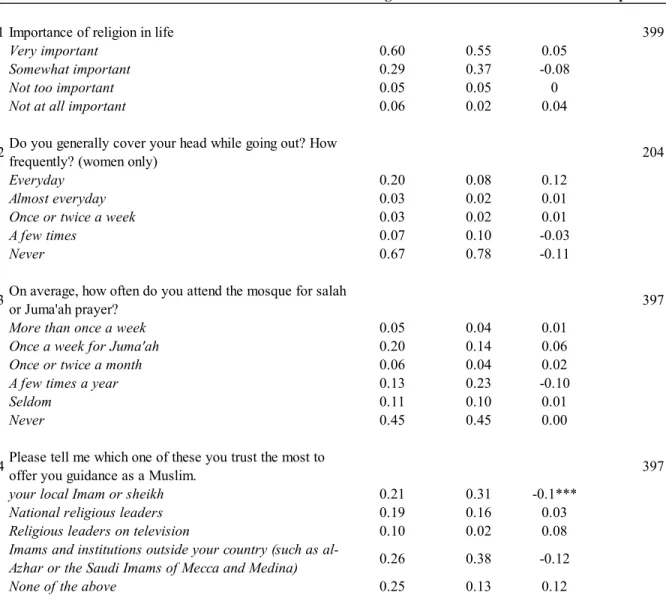
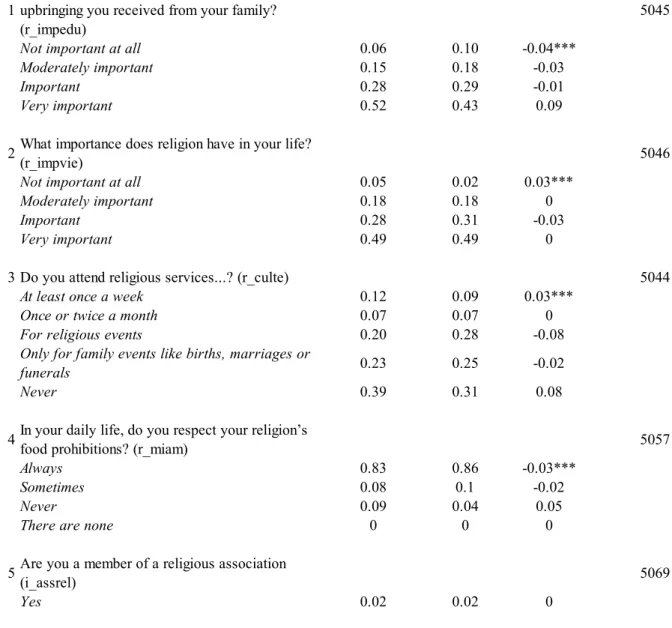
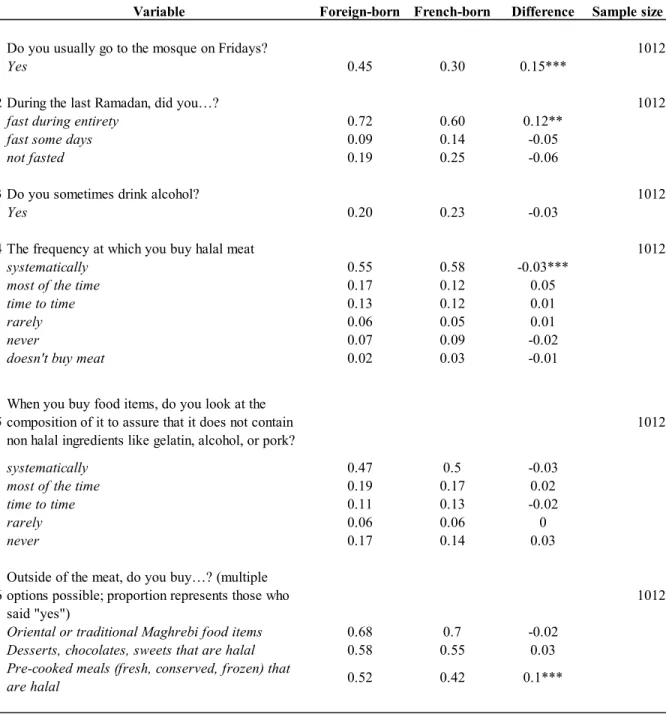
I analyze differences in religiosity between the two generational groups for the three surveys in Table 3.1 (for Pew (2006) data), Table 3.2 (for TeO (2008) data), and Table 3.3 (for IFOP (2019) data). We see that religion remains important for Muslims of both generations in the two surveys that ask about importance of religion in life (Pew 2006, TeO 2008). Below I analyze key
indicators measuring religiosity to understand trends in generational differences. 3.1 Religious practices
Visit to the mosques, especially for Friday prayers, remains an important sign of commitment to religion among Muslims around the world. Yet, more than half of the Muslim population in France does not “usually go to the mosques” for Friday prayers (IFOP 2019). Contrary to the popular discourse that the French-raised Muslims have a higher frequency of religious practices like mosque attendance, a higher proportion of first-generation immigrants “usually go to the mosques” for Friday prayers compared to the French-born Muslims (45 percent compared to 30 percent; see IFOP 2019). We see a similar trend in frequency of mosque attendance or other religious services in TeO 2008 and no significant difference in Pew 2006. What remains to be known is whether there is a generational gap in frequency of prayers, given that prayers can be undertaken outside of the mosques.18
27
Figure 3: A mosque located in northern suburbs of Paris.
* Many of these mosques were built in recent years, some through funding from governments or institutions in Muslim-majority countries.
28
Table 3.1: Differences is religiosity between foreign-born and French-born Muslims (using Pew 2006).
Variable Foreign-born French-born Difference Sample size
1 Importance of religion in life 399
Very important 0.60 0.55 0.05
Somewhat important 0.29 0.37 -0.08
Not too important 0.05 0.05 0
Not at all important 0.06 0.02 0.04
2 Do you generally cover your head while going out? How frequently? (women only) 204
Everyday 0.20 0.08 0.12
Almost everyday 0.03 0.02 0.01
Once or twice a week 0.03 0.02 0.01
A few times 0.07 0.10 -0.03
Never 0.67 0.78 -0.11
3 On average, how often do you attend the mosque for salah or Juma'ah prayer? 397
More than once a week 0.05 0.04 0.01
Once a week for Juma'ah 0.20 0.14 0.06
Once or twice a month 0.06 0.04 0.02
A few times a year 0.13 0.23 -0.10
Seldom 0.11 0.10 0.01
Never 0.45 0.45 0.00
4 Please tell me which one of these you trust the most to offer you guidance as a Muslim. 397
your local Imam or sheikh 0.21 0.31 -0.1***
National religious leaders 0.19 0.16 0.03
Religious leaders on television 0.10 0.02 0.08
Imams and institutions outside your country (such as
al-Azhar or the Saudi Imams of Mecca and Medina) 0.26 0.38 -0.12
None of the above 0.25 0.13 0.12
Pew (2006) survey containing data on 200 foreign-born and 199 French-born Muslims
29 Table 3.1: continued
Variable Foreign-born French-born Difference Sample size
5Overall, do you think that the quality of life for Muslim women in France is better, worse, or about the same as
the quality of life for women in most Muslim countries? 398
Better 0.57 0.68 -0.11***
Worse 0.24 0.08 0.16
About the same 0.19 0.24 -0.05
6
Please tell me how worried you are about each the following issues related to Muslims living in France: Muslim women in France taking on modern roles in society
390
Very worried 0.15 0.18 -0.03
Somewhat worried 0.35 0.27 0.08
Not too worried 0.17 0.19 -0.02
Not at all worried 0.33 0.37 -0.04
7
Please tell me how worried you are about each the following issues related to Muslims living in France: The influence of music, movies, and television on Muslim youth in France
399
Very worried 0.19 0.14 0.05**
Somewhat worried 0.30 0.19 0.11
Not too worried 0.19 0.25 -0.06
Not at all worried 0.32 0.41 -0.09
8
Please tell me how worried you are about each the following issues related to Muslims living in France: A decline in the importance of religion among France's Muslims
398
Very worried 0.22 0.2 0.02
Somewhat worried 0.39 0.33 0.06
Not too worried 0.17 0.24 -0.07
Not at all worried 0.23 0.24 -0.01
Pew (2006) survey containing data on 200 foreign-born and 199 French-born Muslims
30 Table 3.1: continued
Consumption of halal diet is another important marker of religiosity among many Muslims, especially in France, given the importance of consumption of alcohol and pork as indicative of Frenchness in the popular discourse. Halal diet consists of prohibition in consumption of alcohol and pork; in addition, only meats obtained from animals killed in a prescribed manner are
considered “halal” (which means ‘permissible’ in Arabic). In terms of consumption of halal diet, French-born Muslims show a significantly higher frequency of respecting food prohibitions
Variable Foreign-born French-born Difference Sample size
9
Some people think that suicide bombing and other forms of violence against civilian targets are justified in order to defend Islam from its enemies. Other people believe that, no matter what the reason, this kind of violence is never justified. Do you personally feel that this kind of violence is...
395
Often justified 0.05 0.08 -0.03
Sometimes justified 0.08 0.13 -0.05
Rarely justified 0.20 0.18 0.02
Never justified 0.67 0.61 0.06
10Do you think there is a struggle in France between moderate Muslims and Islamic fundamentalists or don’t
you think so? 395
Yes 0.57 0.57 0
11 Which side do you identify with more in this struggle, moderate Muslims or Islamic fundamentalists? 217
Moderate Islam 0.88 0.92 -0.04
Islamic fundamentalism 0.12 0.08 0.04
12Do you think there is a natural conflict between being a devout Muslim and living in a modern society, or don’t
you think so? 398
Yes, there is a conflict 0.35 0.21 0.14***
No, there is not a conflict 0.65 0.79 -0.14
Pew (2006) survey containing data on 200 foreign-born and 199 French-born Muslims
31
compared to the foreign-born Muslims; 86 percent of French-born Muslims indicated “always” consuming halal food compared to 83 percent of foreign-born Muslim (TeO 2008). In addition, the difference in frequency at which French-born Muslims buy halal meat compared to foreign-born Muslims is statistically higher, yet not large (IFOP 2019). There is no significant difference by generation in response to frequency at which Muslims “look at the composition of [food items] to assure that they do not contain non-halal ingredients like gelatin, alcohol, or pork” (IFOP 2019).
Consumption of alcohol is also considered haram, or not permissible, by many Muslims. About 20 percent of both generational groups indicate that they consumed alcohol sometimes, and there is no generational difference in that respect (IFOP 2019).
3.2 Markers of religiosity
One of the popular discourses in France suggests that the French-born Muslims use religious markers, especially in the form of clothing, more frequently than the first-generation immigrant Muslims. This is especially true for discourses related to wearing of hijab among women.
32
Table 3.2: Differences is religiosity between foreign-born and French-born Muslims (using TeO 2008).
Variable Foreign-born French-born Difference Sample size
1What importance did religion have in the upbringing you received from your family?
(r_impedu) 5045
Not important at all 0.06 0.10 -0.04***
Moderately important 0.15 0.18 -0.03
Important 0.28 0.29 -0.01
Very important 0.52 0.43 0.09
2 What importance does religion have in your life? (r_impvie) 5046
Not important at all 0.05 0.02 0.03***
Moderately important 0.18 0.18 0
Important 0.28 0.31 -0.03
Very important 0.49 0.49 0
3 Do you attend religious services...? (r_culte) 5044
At least once a week 0.12 0.09 0.03***
Once or twice a month 0.07 0.07 0
For religious events 0.20 0.28 -0.08
Only for family events like births, marriages or
funerals 0.23 0.25 -0.02
Never 0.39 0.31 0.08
4 In your daily life, do you respect your religion’s food prohibitions? (r_miam) 5057
Always 0.83 0.86 -0.03***
Sometimes 0.08 0.1 -0.02
Never 0.09 0.04 0.05
There are none 0 0 0
5 Are you a member of a religious association (i_assrel) 5069
Yes 0.02 0.02 0
TeO (2008) survey containing data on 2,674 foreign-born and 2,397 French-born Muslims
33 Table 3.2: continued
Variable Foreign-born French-born Difference Sample size
6 In everyday life, do you wear clothing or jewelry in public that evokes your religion? (r_ostent) 4957
Always 0.13 0.14 -0.01*
Sometimes 0.07 0.10 -0.03
Never 0.80 0.76 0.04
7 Which kind? (multiple options allowed) 5071
Jewels 0.04 0.15 -0.11***
Clothing 0.04 0.03 0.01
Headcover 0.13 0.06 0.07***
Other signs 0.00 0.01 -0.01*
Use of at least one sign 0.19 0.24 -0.05*
8 Which kind? (multiple options allowed; women only) 2709
Jewels 0.07 0.22 -0.15***
Clothing 0.03 0.02 0.01
Headcover 0.24 0.12 0.12***
Other signs 0.00 0.00 0
Use of at least one sign 0.32 0.35 -0.03
9 Language of reference (lref_gr) 5071
Arabic and related dialects (not Berber) 0.56 0.57 -0.01***
10 What is your level in Arabic (if Arabic is reference language) (l_nivlr) 2316
Understand a few words 0.01 0.04 -0.03***
Understand well but you have trouble speaking 0.04 0.19 -0.15
Understand and speak easily but without reading
or writing 0.25 0.58 -0.33
Fluent (speak, read and write) 0.71 0.19 0.52
11 In France, have you taken lessons in Arabic in France (if Arabic reference language) (l_courlr) 2317
Yes 0.08 0.35 -0.27***
12 Would you like to be buried in...? (r_tombe) 4358
Wishes to be buried outside of France 0.57 0.45 0.12***
TeO (2008) survey containing data on 2,674 foreign-born and 2,397 French-born Muslims
34
Since the “Headscarf Affair” in 1989, which was started by a heavily mediatized controversy over the suspension of three female students from their middle school because of their hijab, all forms of headscarves have become a common aspect of media coverage in France. One
discourse that has been popularized and that was used to support the banning of hijab from the French public schools starting 2004 is that hijabs were a sign of increasing “radicalization” among French-born Muslim girls. By contrast, analysis of survey data shows that less than a quarter of all Muslim women wear a hijab (Pew 2006, TeO 2008, IFOP 2019). All three surveys indicate that first-generation women are more likely to wear a hijab than French-born Muslim women (around a quarter among first-generation women wear a hijab while between 10-15 percent of French-born Muslim women wear a hijab according to the three surveys). 3.3 Source of Islamic knowledge
Arabic language has a high importance among Muslims around the world because the Quran, the holy text revealed to the Prophet Mohammad, is written in Arabic and is considered the
35
Figure 4: A street corner in Barbès, in the northern part of Paris.
* Barbès is filled with commerce catering to immigrant-origin families from North Africa.
36
first-generation indicates knowledge of standard Arabic language (or Quranic Arabic) and whether the courses in Arabic language teach Quranic Arabic or one of the Arabic dialects.
Scholars like Olivier Roy (2004) have talked about the increasing use of internet as a source of Islamic knowledge among the younger generation, especially in the case of French-born Muslims. What quantitative evidence do we have about this difference? There is a significant difference in both the generations in terms of sources they prefer to get knowledge about Islam. When asked to indicate “which [authority] you trust the most to offer you guidance as a
Muslim,” French-born Muslims showed a higher preference for a “local Imam or Sheikh” who is based in France (31 percent compared to 21 percent among foreign-born) but at the same time, they also showed a higher preference for knowledge derived from “Imams and institutions outside your country (such as al-Azhar or the Saudi Imams of Mecca and Medina)” (38 percent compared to 26 percent; see Pew 2006).19 We do not know what proportion of those who consult authorities outside of France consult with those who are based in their country of origin. We also do not know if the choice of the source is based on shared ethnicity of the imams (like Arab or Sub-Saharan African, for example).
Religious associations are also indicated as important source of Islamic knowledge for French-raised Muslims (Nielsen 2016:13–14), yet we see that both generations of Muslims show negligible participation in religious associations (about 2 percent in both generational groups; TeO 2008).
37
Table 3.3: Differences is religiosity between foreign-born and French-born Muslims (using IFOP 2019).
Variable Foreign-born French-born Difference Sample size
1 Do you usually go to the mosque on Fridays? 1012
Yes 0.45 0.30 0.15***
2 During the last Ramadan, did you…? 1012
fast during entirety 0.72 0.60 0.12**
fast some days 0.09 0.14 -0.05
not fasted 0.19 0.25 -0.06
3 Do you sometimes drink alcohol? 1012
Yes 0.20 0.23 -0.03
4 The frequency at which you buy halal meat 1012
systematically 0.55 0.58 -0.03***
most of the time 0.17 0.12 0.05
time to time 0.13 0.12 0.01
rarely 0.06 0.05 0.01
never 0.07 0.09 -0.02
doesn't buy meat 0.02 0.03 -0.01
5When you buy food items, do you look at the composition of it to assure that it does not contain
non halal ingredients like gelatin, alcohol, or pork? 1012
systematically 0.47 0.5 -0.03
most of the time 0.19 0.17 0.02
time to time 0.11 0.13 -0.02
rarely 0.06 0.06 0
never 0.17 0.14 0.03
6Outside of the meat, do you buy…? (multiple options possible; proportion represents those who
said "yes") 1012
Oriental or traditional Maghrebi food items 0.68 0.7 -0.02 Desserts, chocolates, sweets that are halal 0.58 0.55 0.03 Pre-cooked meals (fresh, conserved, frozen) that
are halal 0.52 0.42 0.1***
IFOP (2019) survey containing data on 540 foreign-born and 472 French-born Muslims
38 Table 3.3: continued
Variable Foreign-born French-born Difference Sample size
7 Do you wear the veil, whether it's the hijab or the niqab? (frequency of wearing of veil) 1012
yes, always 0.24 0.14 0.1***
yes, except at work 0.03 0.07 -0.04
yes, but rarely 0.1 0.05 0.05
no, but used to before 0.12 0.08 0.04
no, and have never worn 0.51 0.65 -0.14
8 Would you say that the law banning "integral veil" (niqab) on the streets and in other public spaces is…? 1012
mostly a good thing 0.32 0.31 0.01*
mostly a bad thing 0.56 0.62 -0.06
9 Which of the two options do you feel closest to? 1012
The practice of Islam must be adapted and fitted on
certain points to be in conformity with French secularism 0.43 0.39 0.04
The French secularism must be adapted and fitted on
certain points to be compatible with the practice of Islam 0.35 0.38 -0.03
none of the two 0.2 0.19 0.01
10
Here is a list of sentences. For each of them, can you tell me if you totally agree, tend to agree, tend to disagree or totally disagree (related to adherence to various statements on political, economic and societal issues; proportion represents those who "agreed")
1012
Secularism allows Muslims to freely practice their
religion 0.76 0.64 0.12***
The homosexuals should be free to live their life as they
wish 0.62 0.73 -0.11***
In France, Islamic law, sharia, should prevail over the
laws of the Republic 0.36 0.18 0.18***
11
I am going to read you a list of affirmations. For each of them, can you tell me if you agree? (related to adherence to various claims about Islam in France; proportion represents those who "agreed")
1012
Children should be able to eat halal in school canteens 0.82 0.82 0
Girls should have the right to wear the veil in middle and
high school 0.68 0.69 -0.01
We should be able to assert our religious identity
at work 0.56 0.52 0.04
The employer must adapt to the religious obligations of
their employees 0.51 0.46 0.05
IFOP (2019) survey containing data on 540 foreign-born and 472 French-born Muslims
39 3.4 Islam and gender
Integration into the French society would imply adoption of values about gender equality over immigrant generation. On the other hand, popular discourse, especially around wearing of hijab among French-raised Muslims, describes the Muslims in France as “radicalizing” and potentially undergoing a “regression” in terms of freedom for women (Marine Le Pen’s words).20 The idea that is put forward in these discourses is that Muslims overall want to maintain “traditional” gender roles rather than adopt French ideas of gender roles (assumed to be more egalitarian). Yet, we see that a higher proportion of French-born Muslims find that the “quality of life for Muslim women in France is better than the quality of life for women in most Muslim countries” (68 percent compared to 57 percent among foreign-born Muslims) (Pew 2006).
In addition, a significantly higher proportion of French-born Muslims agree that “the
homosexuals should be free to live their life as they wish” (73 percent compared to 62 percent among foreign-born Muslims) (IFOP 2019).
There is no generational difference in response to whether those interviewed are worried or not about “Muslim women in France taking on modern roles in society” (Pew 2006). In both groups, around half are “worried” and the other half are “not worried.”
3.5 Dividing the sacred from the profane
Pew (2006) asked Muslims in France: “Do you think there is a natural conflict between being a devout Muslim and living in a modern society, or don’t you think so?” The popular discourse (where more French-raised Muslims are described as radicalizing than the first-generation)
40
would dictate that more French-raised Muslims agree to the existence of the conflict. Rather, we find that a majority of Muslims disagree and that a significantly higher proportion of French-born Muslims than foreign-French-born Muslims disagree (79 percent compared to 65 percent) (Pew 2006).
Many Muslims and non-Muslims in France attribute the so-called increase in radicalization among the “youth” to media influence. We see a significant difference between the two generations in response to whether individuals are worried about the “influence of music, movies, and television on Muslim youth in France” – a higher proportion of foreign-born are worried compared to the French-born (around half of the formed compared to about a third of the latter group) (Pew 2006).
Pew (2006) asked Muslims three questions than can be used to see if there is a rise of
fundamentalism and radicalized behavior. We see no significant differences between the two generations in responses to these questions. A majority of the Muslims do not think that “suicide bombing and other forms of violence against civilian targets are justified in order to defend Islam from its enemies” (between 80-90 percent). A majority of the Muslims also identify with
“moderate Islam” compared to “Islamic fundamentalism” (around 90 percent).
41 3.6 Claiming Islamic identity
Popular discourse has presented French-born Muslims as placing higher importance on Islam as an identity compared to first-generation immigrants. One discourse that has been proposed is that French-born Muslims ask for more accommodations of their religious practices compared to the foreign-born Muslims. IFOP (2019) survey asked a set of opinion questions to measure opinions on religious accommodations at school, at work, and in the French society overall.
While a majority of Muslims agree about desirability of making religious accommodations at schools (allowing wearing of headscarf, and provision of halal food in school canteens), there is no significant generational gap (IFOP 2019). Around half of the Muslims in both generational groups agree to accommodations at workplace (agreement with “We should be able to assert our religious identity” and “The employer must adapt to the religious obligations of their
employees”). These work-related accommodations form a part of highly-publicized debates in France, especially on topics like allowing wearing of headscarves, having prayer spaces, and accommodating work hours during Ramadan. Yet, there is no significant generational difference in opinions about these accommodations.
A slightly higher proportion of French-raised Muslims think that “the law banning the ‘integral veil’ (niqab) on the streets and in other public spaces” is “mostly a bad thing” (62 percent compared with 56 percent). The differences are not very significant (IFOP 2019).
42
question that asks opinion on whether “secularism allows Muslims to freely practice their religion,” a significantly higher proportion of foreign-born Muslims agree that it does allow this freedom (76 percent compared to 64 percent among French-born) (IFOP 2019).
In addition, choosing the site of burial is also a question that links religion and desires for accommodation in France. Overall, around half of the Muslim population in France wishes to be buried outside of France (the survey does not specify whether they want to be buried in the country of origin or elsewhere; see TeO 2008). A significantly higher proportion of foreign-born Muslims wish to be buried in France compared to French-born Muslims (57 percent compared to 45 percent; see TeO 2008).
43
Section 4: Qualitative Evidence of Religious Generational Gap from the Field
What accounts for the contrast between qualitative studies, which emphasize religious generational difference, and quantitative studies that find little generational difference?
This section identifies five key themes that emerge in conversations with Muslims in France on the religious generational gap. These themes are linked to a set of observable outcomes that indicate differences in religiosity between the two immigrant generational groups. Among those interviewed are individuals who are either practicing Muslims or ‘cultural’ Muslims.21 I
conducted a total of 25 semi-structured interviews with Muslims in the Greater Paris region over a total of six months (May-July 2018 and February-April 2019).22
Among the 25 individuals I interviewed, 15 are women and 10 are men; 13 are first-generation immigrants and 12 are French-raised descendants of immigrants (8 are second-generation and 4 are third-generation).23 The average age of my interviewees at the time of the interview was around 40 years. French-raised Muslims I interviewed were younger on average (around 34 years of age) than the first-generation immigrants I interviewed (around 45 years of age). My
21 In order to have a more nuanced picture of narratives of religious generational gap, I interviewed individuals who identify as Muslims (those who believe in and practice their religion) as well as those who are ‘cultural’ Muslims in the sense that they were exposed to Islam in their childhood through family but who do not identify as Muslims. I refer to them all, as a group, as ‘Muslims’ in the context of this paper.
22 See Appendix A for the questionnaire.
44
interviewees varied in terms of demographic characteristics like country of origin, socio-economic class, level of education, and occupation at the time of the interview.
The Greater Paris region was chosen because it has the highest proportion of Muslims in France; about 40 percent of the total immigrant-origin Muslim population in France lives in this region.24 Individuals were contacted through religious associations or made acquaintance with at mosques or immigrant-majority spaces where I also collected observation data. Given that I relied on snowball sampling for a part of the sample, the final set of cases should not be considered random or statistically representative. In addition to the interviews, observations at mosques and immigrant-majority spaces allowed me to witness discussions that brought to light the popularity of conversations on religious generational gap.25
24 This is based on the analysis of TeO (2008) survey data – around 41% of first-generation Muslims and 36% of French-born Muslims of ages 18-50 years lived in the Greater Paris area in 2008.
25 Given that these conversations were not recorded (in the light of the impromptu nature of many events that I would stumble upon), the quotes gathered from these conversations as well as from interviews not recoded on audio-recorder do not represent the exact wordings of my interlocutors. I traded exactness of words for access to
45
Figure 5: A store catering to local Sub-Saharan African origin Muslims in Goutte d’Or area in northern part of Paris.
A majority of Muslims of immigrant origin with whom I interacted during my fieldwork agreed that a general religious generational gap exists between first-generation immigrants and French-raised Muslims.26 French-raised Muslims commented on the gulf between their religiosity and that of generation immigrants (especially generation parents). At the same time, first-generation immigrants felt that there was a significant difference between their own religiosity and that of those belonging to the generation of their children or grandchildren. Many of them