!
Observable Social Cognition: A Rating Scale: An Interview-Based Assessment for Schizophrenia
Kristin Healey
A thesis submitted to the faculty of the University of North Carolina at Chapel Hill in partial fulfillment of the requirements for the degree of Master of Arts in the Department
of Psychology (Clinical).
Chapel Hill 2013
Approved by:
Joseph C. Lowman
Jonathan S. Abramowitz
!
""! Abstract
KRISTIN HEALEY: Observable Social Cognition: A Rating Scale: An Interview-Based Assessment for Schizophrenia
(Under the direction of David L. Penn)
Individuals with schizophrenia consistently show impairments in social cognition (SC).
Current SC measures are hampered by methodological issues that limit use of SC as a
viable treatment target. An alternative assessment method is to administer a scale
incorporating an informant’s impressions. The Observable Social Cognition: A Rating
Scale (OSCARS) was administered to 62 outpatients and 50 non-psychiatric controls
(NPCs) to assess SC performance. OSCARS demonstrated sufficient internal consistency
and test-retest reliability. Construct validity was assessed through exploratory factor
analysis. Patient OSCARS scores were not significantly correlated with measures of SC,
with the exception of aggressive attributional style. Results indicated individuals with
less impairment in SC reacted more aggressively to ambiguous situations. Control
OSCARS scores were significantly correlated with measures of theory of mind and
attributional style. In patients, OSCARS was significantly correlated with several
measures of functioning and neurocognition. Implications for using OSCARS as an
"""!
Table of Contents
List of Tables………..iv
List of Figures………..v
List of Abbreviations……….vi-vii Chapter I. INTRODUCTION……….1
Overview of social cognition……….1
Problems with measuring social cognition...……….2
Observer based scales……...……….3
The present study: aims and hypotheses………3
II. METHODS………....5
Participants……….5
Development of OSCARS……….6
Social cognitive measures..………8
Functional measures……….10
III. RESULTS………14
Reliability analyses………..14
Validity analyses………..14
Exploratory analyses………19
IV. DISCUSSION………..20
!
"#! List of Tables
Table
1. Demographic and clinical characteristics………31
2. Descriptive statistics for OSCARS, social cognitive measures,
and functional outcome measures Factor analysis of the OSCARS……...32
3. Inter-correlation among OSCARS items……….33
4. Factor analysis of the OSCARS………...34
5. Correlations between OSCARS total informant score and
OSCARS factors: schizophrenia and control sample………...…35
6. Convergent validity: correlations between OSCARS total informant score and OSCARS factor scores with measures of
social cognition (n=62) ………...36
#! List of Figures
Figure
1. Receiver operating characteristic curve for schizophrenia participants
!
#"!
List of Abbreviations
AIHQ: Ambiguous Intentions Hostility Questionnaire
AS: Attributional Style
AUC: Area Under the Curve
CAI: Cognitive Assessment Interview
CGI-CogS: Clinical Global Impression of Cognition in Schizophrenia
CR: Cognitive Rigidity
EFA: Exploratory Factor Analysis
EMP: Empathy
EP: Emotion Perception
ER40: Penn Emotion Recognition Task
FEDT: Face Emotion Discrimination Task
FEIT: Face Emotion Identification Task
GAF: Global Assessment of Functioning
GSFS: Global Social Functioning Scale
ICC: Intraclass Correlation Coefficient
JTC: Jumping To Conclusions
NC: Neurocognition
NPC: Non-psychiatric Control
OSCARS: Observable Social Cognition: A Rating Scale
PANSS: Positive and Negative Syndromes Scale
QLS-S: Quality of Life - Social
#""! RFS: Role Functioning Scale
RMSEA: Root Mean Square Error of Approximation
ROC: Receiver Operating Characteristics
SC: Social Cognition
SCIT: Social Cognition and Interaction Training
SCoRS: Schizophrenia Cognition Rating Scale
SD: Standard Deviation
SOFAS: Social and Occupational Functioning Assessment Scale
SOPS: Scale of Prodromal Symptoms
SSPA: Social Skills Performance Assessment
TASIT: The Awareness of Social Inference Test
TAU: Treatment As Usual
TLI: Tucker Lewis Index
ToM: Theory of Mind
! 1. Introduction
1.1. Overview of Social Cognition
Social cognition (SC) may be defined as a set of neurocognitive processes related
to the understanding, recognition, processing, and appropriate use of social stimuli in
one’s environment (Adolphs, 2009; Ochsner, 2008; Penn, Corrigan, Bentall, Racenstein,
& Newman, 1997). Individuals with schizophrenia consistently show impairments in SC
across the following primary domains: attributional style, theory of mind (ToM), emotion
perception, and associated underlying processes (Green, Olivier, Crawley, Penn, &
Silverstein, 2005; Kohler, Walker, Martin, Healey, & Moberg, 2010; Penn, Sanna, &
Roberts, 2008; Pijnenborg et al., 2009; Pinkham & Penn, 2006). SC has received
considerable attention in the field of schizophrenia research over the past ten years due to
its relationship with poor functional outcomes (Brekke, Kay, Lee, & Green, 2005;
Couture, Penn, & Roberts, 2006; Nuechterlein et al., 2004). For example, there is a
growing body of evidence suggesting that social cognition, specifically emotion
perception and ToM, has a consistent relationship with functioning (Appelo et al., 1992;
Brekke et al., 2005; Brune, 2005; Couture et al., 2006; Hooker & Park, 2002; Kee, Green,
Mintz, & Brekke, 2003; Kohler et al., 2003; Mueser et al., 1996; Nuechterlein et al.,
2004; Penn, Ritchie, Francis, Combs, & Martin, 2002; Pinkham & Penn, 2006; Schenkel,
Spaulding, & Silverstein, 2005). A review of 22 studies on the relationship between
social cognition and functioning found correlations between domains of emotion
$!
small to modest in size (Couture et al., 2006). And, recent findings from a meta-analysis
indicate that SC has a stronger relationship with functional outcome than neurocognition
(NC) (Fett et al., 2011).
1.2. Problems with measuring social cognition
Given the importance of social cognition to social functioning, it is critical to
utilize valid and reliable measures to enhance our understanding of these constructs.
Current measures have important methodological issues that limit the utility of social
cognition as a viable treatment target. First and most broadly, SC tasks’ psychometric
properties are often not well established, with consistent ceiling effects and little data
regarding norms, practice effects and sensitivity to change (Bora, Yucel, & Pantelis,
2009; Yager & Ehmann, 2006). Thus, it is critical to evaluate the psychometric properties
of both established and new tests (i.e. construct validity, reliability, normative standards,
distribution of scores and practice effects).
Second, current SC tasks have significant conceptual and measurement-related
overlap (Green et al., 2008). For example, the Eyes task prompts subjects to label
pictures of eyes with a word that best categorizes their interpretation of the person’s
experience (Baron-Cohen, Jolliffe, Mortimore, & Robertson, 1997). This task is meant to
assess ToM, but also likely involves aspects of emotion perception as well. Third, there
is no consensus concerning which SC measures best capture a given domain or construct.
This results in administration of a heterogeneous group of tasks with inconsistent findings
(Bora et al., 2009). As stated in a recent commentary by Yager and Ehrmann (2006),
“There are few widely accepted standardized measures of social cognition that are
!
%!
the supplementation of existing measures with novel methods of assessing SC.
1.3. Observer-based scales
An alternative approach to measuring SC deficits is to administer an
observer-based rating scale. Such a scale utilizes “first hand” ratings from individuals that have
witnessed the individual interact in a naturalistic social setting. This method was used for
the Schizophrenia Cognition Rating Scale (SCoRS), an interview-based measure that
considers informant reports, or information from individuals that had the most regular
contact with the patient in everyday situations (i.e. family members, significant others,
friends, social workers). Informant information and patient self-reports are incorporated
when interviewers make final ratings of cognition. The SCoRS was found to be a valid
assessment of cognition, as global ratings were significantly correlated with composite
scores of cognitive performance (Keefe, Poe, Walker, Kang, & Harvey, 2006). Ventura et
al. (Ventura, Cienfuegos, Boxer, & Bilder, 2008; Ventura et al., 2010) developed similar
scales incorporating informant reports, the Clinical Global Impression of Cognition in
Schizophrenia (CGI-CogS) and subsequently the Cognitive Assessment Interview (CAI)
from a subset of SCoRS and CGI-CogS items. Again, both were found to be valid
assessments of cognition, though informant report added only incremental variance to
patient interview-based ratings (Ventura et al., 2010).
To our knowledge, there is no scale that takes into account “first hand” ratings of
informants in the evaluation of social cognitive deficits in schizophrenia. It is possible
that individuals that interact with the individual with schizophrenia regularly in “real
world” settings may provide a comprehensive and accurate view of their true social
&! 1.4. The present study: aims and hypotheses
The present study evaluated the psychometric characteristics of a new observer
based rating scale of social cognition incorporating informant ratings, the Observable
Social Cognition: A Rating Scale (OSCARS). First, this study evaluated the internal
consistency and the test-retest reliability of the OSCARS over an approximate one-week
period. Second, the construct validity was investigated through an exploratory factor
analysis of the OSCARS. Construct validity was also assessed with group comparisons
and analyses of diagnostic sensitivity. Third, the convergent validity of the scale was
examined via the relationship between the OSCARS and measures of emotion perception,
ToM, attributional style and jumping to conclusions. Fourth, external validity was
explored through investigating the relationship between the OSCARS and measures of
social skill, social, and role functioning. And fifth, since SC tends to be moderately
associated with general intelligence and basic cognition, it is expected that IQ and
cognition will be moderately associated with ratings on the OSCARS, which will provide
! 2. Methods
2.1. Participants
Sixty-three individuals aged 25-60 with schizophrenia spectrum disorders and
without current substance use problems were recruited through a university-based
outpatient clinic as well as mental health centers in the Durham/Chapel Hill/Raleigh area.
In the interest of parsimony, individuals with schizophrenia spectrum disorders will be
referred to as individuals with schizophrenia. All participants were maintained on regular
psychiatric outpatient treatment and antipsychotic medication throughout the study.
Individuals were participating in a study of social cognition and interaction training
(SCIT), a 20-24 week, manual-based group intervention that targets dysfunctional SC
processes (Penn et al., 2005; Roberts & Penn, 2009). Screening procedures involved
administration of the Wechsler Abbreviated Scales for Intelligence (WASI; Whitmyre &
Pishkin, 1958) to rule out any individuals with possible mental retardation (IQ < 70).
Individuals diagnosed with a major nervous system disorder (e.g., seizure disorder) were
also excluded from participation. Participants were required to endorse a mild or greater
level of social impairment as determined by a subgroup of items from the Social
Functioning Scale (SFS; Birchwood, Smith, Cochrane, Wetton, & Copestake, 1990).
Participants were randomly assigned to a treatment as usual (TAU) (n=30) or the
SCIT treatment group (n=32). Four cohorts participated in the study, with a cohort
comprising one SCIT group and one TAU group (totaling approximately 14-18
'!
assessed through review of participants' medical charts and confirmed with items from
the psychotic disorders section of the Structured Clinical Interview for DSM-IV – Patient
Edition (SCID-P; Werner, 2001). Symptomatology was assessed with the Positive and
Negative Syndromes Scale (PANSS) (Kay, Fiszbein, & Opler, 1987). The OSCARS was
administered to participants in both TAU and SCIT treatment groups.
Fifty English-speaking non-psychiatric controls aged 18-65 were recruited
through flyers and craigslist.org postings that reported no history of mental illness and no
first-degree relatives with a psychotic disorder, bipolar disorder, or autism. There were
no statistically significant differences between patient and NPC groups in baseline
demographic variables with the exception of participant education and IQ (Table 1).
Education and IQ were later included as covariates.
[TABLE 1]
2.2. Development of OSCARS
2.2.1. OSCARS Item Generation
The OSCARS is an 8-item, interview-based assessment of social cognition in
outpatients with schizophrenia. These items were developed by the study’s principal
investigators (Drs. Penn, Combs, and Roberts) to broadly assess the social cognitive
domains of ToM, emotion perception, cognitive rigidity, jumping to conclusions, and
attributional style. These areas were selected because they have shown consistent deficits
in patients with schizophrenia. The initial pool included eleven items that were reviewed
for validity and quality by five experts in the field of social cognition: Drs. Patrick
Corrigan (Illinois Institute of Technology), Allen Fenigstein (Kenyon College), Daniel
!
(!
University). Experts rated each item on a 1-5 scale, 1 (lowest level of validity) and 5
(greatest level of validity). Items that reached an average rating of 3 or above were
retained. Three items were removed because they were not considered to be valid
indicators of social cognition, but rather social skill, self-awareness, and insight.
Each OSCARS item is comprised of a question probing a specific social cognitive
construct followed by general example behaviors that reflect impairment in that domain.
Each item is scored on a 7-point likert-type scale, higher ratings indicated a greater
degree of observed impairment. Anchor points were created for four levels (1,3,5,7), and
captured the degree of impairment as reflected in the severity and/or by the frequency
that the impairment is observed.
2.2.2. OSCARS Administration
The OSCARS can be administered one of two ways, first as a semi-structured
interview, and second as an informant-based questionnaire. It takes approximately 15-20
minutes to administer and rate. The interviewer was blinded to treatment group. The
informant was provided with a copy of the instrument and directly selected each rating on
the 7-point scale, utilizing the anchors provided. Thus, informant ratings were based
solely on that individual’s report, specifically regarding their interaction with and
knowledge of the individual. For a subset of subjects (n=39), complete administration of
the OSCARS generated an additional interviewer rating. The interviewer rating is an
integrated rating that considered the information provided by the informant and permitted
the interviewer to agree or disagree with the informant’s rating.
Regarding informant selection, we aimed to interview the person who had the
)!
informants held a variety of roles: first-degree family members (n=29), friends (n=8),
significant others (n=6), roommates (n=4), other family members (n=3), social workers
(n=3), clubhouse staff (n=3), therapists (n=2), supervisors (n=2), pastor (n=1), and job
counselor (n=1) (n=62 total). Healthy control informants held the following roles:
first-degree family members (n=10), friends (n=13), significant others (n=23), roommates
(n=3), and other family members (n=1) (n=50 total).
2.3. Social cognitive measures
2.3.1. Emotion Perception
The Face Emotion Discrimination Task (FEDT) and the Face Emotion
Identification Task (FEIT) were used to measure emotion perception (Kerr & Neale,
1993). The FEDT is comprised of 30-paired faces, instructing the participant to judge
whether the two faces are displaying the same or different emotions. The FEIT contains
19 photographs depicting six basic emotions (happy, sad, afraid, angry, surprised, and
ashamed). Emotion perception performance is indexed as the total number of correct
items on both tasks. The protocol was later supplemented with the Penn Emotion
Recognition Test (ER40; Kohler et al., 2003). The ER40 contains 40 photographs
depicting six emotions (happy, sad, anger, fear, disgust, and neutral). Performance is
indexed as the total number of correct items.
2.3.2. Theory of Mind
Both the Hinting Task (Corcoran, 2003) and The Awareness of Social Inference
Test (TASIT; McDonald, Flanagan, Rollins, & Kinch, 2003) were used to measure ToM.
The hinting task comprises ten short stories depicting an interaction between two
!
*!
instructed to infer what the character is implying by their allusion. Performance is
indexed as the number of correct items. Part 2 of the TASIT (Social Inference—Minimal)
was administered, which is comprised of a series of 15-videotaped interpersonal
interactions lasting 20-60s each. Five of these segments involve straightforward verbal
exchanges that match the situational context and social cues of the actors. Ten segments
involve sarcastic verbal exchanges where the actor means the opposite of what they are
saying. After each videotape, participants are asked to draw conclusions about (A) the
intentions of the “target” actor, (B) if the “target” actor wants to convey the literal or
non-literal meaning of their message, (C) the “target” actor’s understanding of the situation,
and (D) what the “target” actor is feeling. The total number of items correct indexes
performance.
2.3.3. Attributional Style
The Ambiguous Intentions Hostility Questionnaire (AIHQ; Combs, Penn, Wicher,
& Waldheter, 2007) was used to measure attributional style. It consists of 5 short
vignettes that reflect situations that are ambiguous in intentionality. Participants are
instructed to imagine the vignette is actually happening to them (e.g., “You walk past a
bunch of teenagers at a mall and you hear them start to laugh”) and verbally respond why
the other person acted that way towards them. The participant rates whether that
individual acted that way on purpose (definitely no [1], definitely yes [5]), how angry it
would make them feel (not at all angry [1], very angry [5]), and how much they would
blame the other person (not at all [1], very much [5]). Lastly, the participant is asked to
write down how they would react to the situation. Two raters later independently coded
+,!
compute an “AIHQ hostility bias” and how they would react to compute an “AIHQ
aggression index.” Raters were blind to condition and assessment number, using a
five-point Likert-type scale ranging from not at all hostile (1) to very hostile (5). The three
participant rated items of intentionality, blame, and anger were summed to create an
“AIHQ blame index.”
2.3.4. Probabilistic Reasoning (Jumping To Conclusions)
The “beads in the jar” task (Dudley, John, Young, & Over, 1997a; Dudley, John,
Young, & Over, 1997b) was used to assess JTC. This computerized task consists of
images of two jars with different proportions of red and blue beads, one with 60% blue
beads and one with 60% red beads. The participant is told that the computer will
randomly select beads from a jar and the participant’s job is to decide from which jar the
beads are being selected. The number of beads selected before a decision is made
indexes performance.
2.4. Functional Measures
2.4.1. Social Skill and Social Functioning
The Social Skills Performance Assessment (SSPA; Patterson, Moscona,
McKibbin, Davidson, & Jeste, 2001) was used to assess social skill/social functioning.
The SSPA comprises two 3-minute role-plays between the participant and research
confederate that were videotaped for subsequent ratings. Scene one consists of an
interaction where the participant plays the role of a tenant getting to know a new
neighbor. Independent raters coded participants’ responses in scene one on the following
categories: interest/disinterest, fluency, clarity, focus, affect, overall conversation,
!
++!
participant plays a tenant requesting their landlord fix a leak that has gone unrepaired
with the objective of having the landlord fix the leak immediately. Raters coded
participants’ responses in scene two for: interest/disinterest, fluency, clarity, focus, affect,
negotiation ability, submission/persistence, overall argument, and social appropriateness.
Each category was rated on a scale of 1 to 5, lower ratings indicating greater social skill
impairment. These categories produce additional indices of: “paralinguistic” skills
composed of fluency and clarity summed scores; “participation, composed of interest and
focus summed scores; “affect” and “social appropriateness” composed of individually
rated items summed across role plays; and “SSPA Total” summed across all items in that
scene.
The Global Social Functioning Scale (GSFS) was used to measure social
functioning. This scale was partially derived from the Social and Occupational
Functioning Assessment Scale from DSM-IV (SOFAS; APA, 2000) and the Global
Assessment of Functioning (GAF) as it appears in the Scale of Prodromal Symptoms
(SOPS; Miller et al., 2009). The item content was altered to focus specifically on social
and interpersonal functioning. The Global Social Functioning Scale yields a single global
social/interpersonal functioning score between 0 and 10, with lower scores indicating
greater impairment. Trained research clinicians determined the score based on
information from informant report.
The Role Functioning Scale (RFS; McPheeters, 1984), a 4-item semi-structured
interview, measures four major domains of everyday functioning: working productivity,
+$!
network relationships. The RFS was conducted as an informant-based interview. Each
item is rated on a scale of 1-7, higher ratings indicating greater functioning.
The Quality of Life Scale—Social (QLS-S) and Work (QLS-W) (Heinrichs, et al.,
1984) comprises eight and four item subscales, respectively. Items are rated from a
semi-structured interview regarding the participant’s functioning over the past four weeks.
Social or “Interpersonal Relations” items assess the participant’s amount of social
activity, capacity for intimacy, tendency towards withdrawal, and active versus passive
participation. Work or “Instrumental Role” items assess the participant’s functioning in
work, school, and housework roles. Items are rated on a seven point Likert-type scale
(0-6), with lower ratings indicating greater impairment. The QLS-S ranges from 0 to 48 and
the QLS-W from 0-24.
2.4.3. Intelligence Quotient
The Wechsler Abbreviated Scales for Intelligence (WASI) was used to measure
IQ, which consisted of administration of Matrix Reasoning and Vocabulary subtests.
2.4.4. Cognition
The informant-based Schizophrenia Cognition Rating Scale (SCoRS) was used to
measure cognition, consisting of items assessing attention, memory, reasoning and
problem solving, working memory language production, and motor skills (Keefe et al.,
2006). Global ratings were derived from three different ratings: informant interview,
interview with the patient, and interviewer impressions. The interviewer global rating
was utilized because it has the highest correlation with indices of functioning (Keefe et
al., 2006). Each global rating is coded on a scale of 1-10, higher ratings indicating greater
!
+%! 2.4.5. Symptoms
The Positive and Negative Syndrome Scale (PANSS) was used to assess
symptomatology, which consisted of: negative scale, positive scale, general
psychopathology scale, and total scale scores. Higher scores are associated with more
severe symptoms.
2.5. Procedure
Advanced doctoral students in the clinical psychology program at the University
of North Carolina conducted SCIT treatment sessions. Study protocol was administered
under the supervision of the principal investigator (DLP). All research assistants
completed comprehensive training on administration of study measures prior to working
with participants. Raters were required to achieve acceptable levels of inter-rater
reliability (ICCs and Kappas > .80) on all interview-based measures.
Participants with social functioning deficits were referred to the study by
treatment staff knowledgeable about their presenting problems and psychiatric history.
Following a telephone-screening interview, participants completed the baseline measures
and were then randomized to treatment condition. The OSCARS was administered at
baseline and then again 7-10 days later to evaluate test-retest reliability (mean=9.36,
SD=3.04). The same informant was interviewed at both baseline and retest for all
! 3. Results
Data analyses were performed using SPSS version 16.0 and SAS version 9.1x
system for Windows. Statistical significance will be defined as p<.05. Prior to all
analyses, correlational analyses between interviewer and OSCARS informant ratings
were computed. Interviewer and informant ratings were significantly correlated (r=.95),
thus informant ratings will be used for subsequent analyses.
3.1. Reliability Analyses
The internal consistency of the OSCARS (Cronbach’s alpha) was .80 in patients
and .78 in controls. Test-retest reliability of the eight OSCARS items ranged from .50 to
.70 (mean=.62, SD=.07). OSCARS total score test-retest reliability was .86 (n=47)
(participants with schizophrenia only).
3.2. Validity Analyses
The construct validity of the OSCARS was evaluated via correlational analyses
followed by a factor analysis in patients (n=62) and controls (n=50). All subsequent
analyses were conducted separately, as evidence suggests the factor structure of social
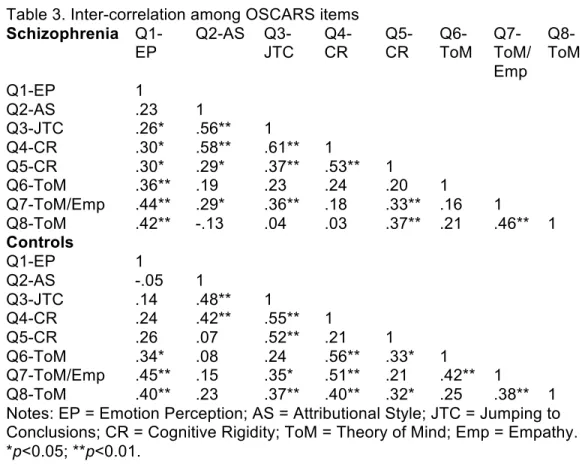
cognition differs between patients and controls (Eack et al., 2009). Table 3 presents the
inter-correlations among the 8 OSCARS items in patients and controls. An exploratory
factor analysis (EFA) examined whether the OSCARS loads on separable factors. An
EFA was used because there have been inconsistent findings concerning factor loadings
of social cognitive domains (Mancuso, Horan, Kern, & Green, 2011). The factor
!
+-!
investigated with a chi-square test and model fit indices. Maximum likelihood extraction
method was used because it generally provides better estimates than other approaches
(Fabrigar et al., 1999). Crawford-Ferguson Quartimax, oblique rotation was selected
because the factors are likely inter-correlated and not orthogonal.
In participants with schizophrenia, a two-factor solution was the model of best fit.
The root mean square error of approximation (RMSEA) was within the range of
reasonable fit at .07 (CI: .00-.15) (Brown and Cudeck, 1992). The Tucker-Lewis Index
(TLI) was also adequate at .93 (Hu and Bentler, 1999). There was consensus between the
scree plot and model fit for the selection of a two-factor model. Items were assigned to
one factor depending on the magnitude of each factor loading (Table 4). The first factor
contained high loadings for questions probing attributional style (2), jumping to
conclusions (3), and cognitive rigidity (4,5). Factor 1 was labeled “social cognitive
reasoning,” as it appears to assess the social cognitive behavioral indicators of
impulsivity, hostility, and rigidity. The second factor contained high loadings for
questions probing theory of mind (6,7,8) and emotion perception (1). Factor 2 was
labeled “social cue detection,” as items share content involving interpretation of subtler
manifestations of social cognition, e.g. emotional faces.
Factor scores were computed by summing OSCARS raw item scores that
correspond to each factor. The factors were moderately inter-correlated with one another
(Table 5). It should be noted that test-retest reliability was .87 for factor 1 and .85 for
factor 2.
In controls, a three-factor solution was determined to be the model of best fit. The
+'!
.04 (CI: .00-.19) (Browne and Cudeck, 1992). The Tucker-Lewis Index (TLI) indicates
excellent model fit at .98 (Hu and Bentler, 1999). There was consensus between the scree
plot and model fit for the selection of a three-factor model. The first factor contained high
loadings for questions probing attributional style (2), jumping to conclusions (3), and
cognitive rigidity (5). Factor 1 was labeled “social cognitive reasoning,” as items assess
social cognitive behavioral indicators of impulsivity, hostility, and rigidity. The second
factor contained high loadings for questions probing emotion perception (1) and theory of
mind (7, 8). Factor 2 was labeled “social cue detection,” as items share content involving
interpretation of subtler manifestations of social cognition, e.g. emotional faces and
understanding others’ perspectives. The third factor contained high loadings for questions
probing cognitive rigidity (4) and theory of mind (6). Factor 3 was labeled “social
cognitive flexibility” as items assess flexibility in social situations and subtle theory of
mind ability. Factors 1 and 2 in healthy controls are very similar to factors 1 and 2 in
individuals with schizophrenia. Factor scores were computed by summing OSCARS raw
item scores that correspond to each factor. The factors were moderately inter-correlated
with one another (Table 5).
Construct validity was also evaluated through investigating whether outpatients
with schizophrenia would show impairment in the OSCARS relative to the NPC group.
Chi-square tests and ANOVA were used to examine group differences on demographic
variables. Participant education and WASI IQ score were significantly different between
groups and thus were included as covariates in an ANCOVA. Individuals with
schizophrenia had significantly greater deficits on the OSCARS than NPCs (F(1,108),
!
+(!
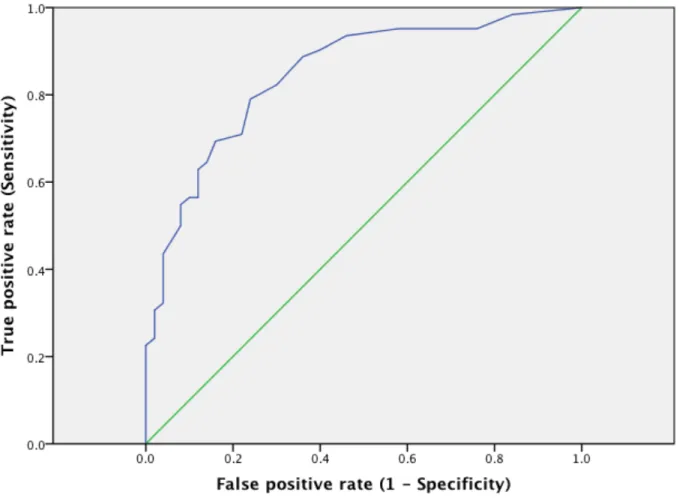
To assess diagnostic sensitivity, we conducted receiver operating characteristic
(ROC) analyses to evaluate the potential for the OSCARS to be used as a diagnostic tool.
A value of 1.0 indicates perfect diagnostic prediction and .50 indicates a level of chance.
ROC analyses on OSCARS total scores indicated a high area under the curve (AUC)
estimate of .85 (95% confidence interval [CI] = .78-.92; p<.000) in differentiating
between individuals with schizophrenia and healthy controls (Figure 1). The optimal
cut-off point suggested by the Youden Index was an OSCARS total score of 17 (sensitivity =
.71, specificity = .78). Thus, anyone scoring higher than this cut-off may be considered
scoring in the schizophrenia spectrum range, and anyone scoring below this cut-off can
be considered scoring in the non-clinical range.
The convergent validity of the OSCARS was measured by computing a series of
correlations between OSCARS total scores, factor scores, and measures of social
cognition in patients and control samples separately (Table 6). In the schizophrenia
sample, OSCARS total and social cue detection scores were significantly negatively
associated with AIHQ aggression index scores, indicating that higher aggressive
attribution ratings (i.e. increased tendency to report acting aggressively in ambiguous
situations) are correlated with less impairment in social cognition.
In controls, OSCARS total was significantly correlated with TASIT total score,
indicating greater theory of mind performance is associated with less impairment in
real-world social cognition. Social Cognitive Reasoning (factor 1) was significantly correlated
with AIHQ hostility bias; greater real-world social cognitive impairment was associated
+)!
(1) hinting task and Social Cognitive Reasoning (factor 1) and (2) beads task and Social
Cognitive Flexibility (factor 3) approached statistical significance.
External validity of the OSCARS was examined through computing a series of
correlational analyses between OSCARS total and factor scores, and performance on
indices of functional outcome in the schizophrenia sample (Table 7). OSCARS total and
Social Cognitive Reasoning (factor 1) were significantly associated with GSFS scores
such that less impairment in social cognition was associated with higher global social
functioning. OSCARS total and Social Cue Detection (factor 2) were significantly
correlated with SSPA scene 2 participation scores, indicating higher interest and focus
during the role-play was associated with less impairment in social cognition. Several
OSCARS indices were significantly correlated with RFS Working productivity and
Independent Living subscales; greater productivity and independence were associated
with less impairment in social cognition. OSCARS total and Social Cognitive Reasoning
(factor 1) scores were significantly associated with role of functioning total scores;
greater functionality was associated with lower deficits in social cognition. Additionally,
several correlations approached statistical significance and were in the expected
direction, including: OSCARS total/Social Cognitive Reasoning (Factor 1) scores and
SSPA Role play 2 total score; Social Cognitive Reasoning (Factor 1) and RFS Extended
Social network score; and OSCARS Total and QLS Work score.
Discriminant validity was explored through computing correlations between
OSCARS total or factor scores and indices of neurocognition in the schizophrenia sample
only. All OSCARS indices were significantly associated with the SCoRS, including
!
+*!
and Social Cue Perception (factor 2) (r=.57, p<.000). WASI Full Scale IQ was not
significantly correlated with the OSCARS. The correlation between WASI and Social
Cognitive Reasoning (factor 1) approached significance (r=-.23, p=.069). In other words,
the OSCARS was correlated with an observational index of cognition, but not a
standardized IQ test score. In addition, there were no significant correlations between
OSCARS total or factor scores and PANSS subscales. The range of correlations was -.10
to .20.
3.3. Exploratory Analyses
Informant role in the patient group was split between first-degree family members
(n=29) and other individuals (n=33), thus exploratory analyses were conducted to
investigate potential differences in OSCARS ratings. First-degree family members rated
participants as having significantly greater social cognitive deficits on the OSCARS than
other informants (F(1,60), p=.008; first-degree family mean = 26.72, SD = 7.89; other
individuals mean = 21.79, SD = 5.68). Similar analyses were not conducted in the control
group because of uneven sample size (first degree family members, n=10; other
! 4. Discussion
The results of the present study indicate that the OSCARS is a psychometrically
reliable, easily administered, observer based measure of social cognition. The OSCARS
had adequate test-retest reliability and internal consistency. Exploratory factor analyses
yielded interpretable factors in both patient and healthy control data. The OSCARS
displayed evidence of construct validity, as OSCARS total scores (a) were significantly
different between groups in the expected direction and (b) adequately differentiated
between patients and controls in ROC analyses. The OSCARS displayed weak evidence
of convergent validity with measures of social cognition but did show an association with
various functional outcome measures. Interpretation of findings and implications for
OSCARS use will be discussed below.
The OSCARS did not show impressive convergent validity in patients with
schizophrenia, as indicated by the low correlations between OSCARS indices and
measures of social cognition; it was not significantly associated with any measures of
social cognition in the expected direction. This may be partially related to the
questionable psychometric properties of current social cognitive measures used in
schizophrenia research (Green et al., 2008). However, social cue detection (factor 2) was
significantly negatively correlated with the AIHQ Aggression Index, indicating
individuals with less social cognitive impairment report more aggressive responses to
hypothetical ambiguous situations. Correlations between the OSCARS and AIHQ
!
$+!
preceded by hostile biases. This is contrary to foundational work on attributional biases in
aggressive boys, which posits aggressive behaviors occur as a result of systematic hostile
biases (Dodge, 2006). However, individuals with serious mental illness are often targets
of stigma, thus participants with higher social cognition may expect social situations to be
more stigmatizing, and respond to them in a more reactive/automatic manner.
In healthy controls, the OSCARS yielded a 3-factor, rather than the 2-factor
solution in the schizophrenia sample. This is consistent with findings on emotion
intelligence, which showed a 4-factor model in healthy controls and a 2-factor model in
people with schizophrenia (Eack et al. 2009). This suggests that there might be
qualitative differences in social cognitive ability in controls and individuals with
schizophrenia. The extent to which individuals with schizophrenia experience generalized
versus specific social cognitive deficits is not well understood, however this might
contribute to the present sample’s differential factor analytic structures. Generalized
deficits have been implicated in basic neurocognition, and likely result in a simpler factor
structure (Dickinson and Harvey, 2009). Healthy controls may have differentiated social
cognitive abilities, creating more variance, and hence, a greater number of factors..
The OSCARS total and factor scores in controls were significantly associated
with indices of ToM and attributional style, and approached statistical significance with
jumping to conclusions. All significant correlations in were in the expected direction,
with the most consistent associations being between the OSCARS and TASIT, a
performance based ToM task. Overall, however, the significant number of correlations
with social cognitive measures was not impressive, consistent with the findings from the
$$!
The OSCARS showed preliminary evidence of external validity, as it was
significantly, albeit modestly correlated with indices of functioning, particularly: global
social functioning, working productivity, independent living, functionality total, and
approached statistical significance with QLS-Work. However, the OSCARS was not
significantly correlated with SSPA (role-play) indices, with the exception of the
participation score (role play 2). Thus, the present data suggest that the OSCARS is more
consistently associated with critical functional abilities—the ability to perform basic
self-care (e.g. cooking, cleaning, laundry), and to work and sustain employment, than abilities
that manifest during social interactions. It is possible the OSCARS functions as more of
a social capacity scale, whereby the scores indicate the level of social cognition an
individual is capable of in an ideal situation, e.g. with an individual (informant) they see
regularly and are comfortable with (Patterson and Mausbach, 2010). However, social
capacity may not readily generalize to social functioning in the outside world or in a
social role-play, including strangers.
Discriminant validity was assessed through correlations between OSCARS and
neurocognition, though some work suggests there is a moderate relationship between
these dimensions (Fett et al., 2011). Though correlations with standardized IQ (WASI)
merely approached statistical significance, all OSCARS indices were significantly
correlated with the observer based SCoRS. Higher correlations between OSCARS and
SCoRS may be related to method variance, as the same informant provided information
to the same interviewer/rater. However, if correlations are not fully accounted for by
!
$%!
global social, independent living) in a way that is largely separable from social skill,
social cognition, and objective measures of neurocognition.
Exploratory analyses were conducted to assess the nature of the relationship
between informant role (first-degree family members versus other individuals) and
OSCARS rating. Comparisons of these two groups indicated that first-degree family
members rated individuals with schizophrenia as having higher levels of social cognitive
impairment. It is unclear if this difference between groups is as a result of error variance
or true variance between the groups. Potential error-related reasons for this difference
may be related to (1) first-degree family members’ possible difficulty forming accurate
ratings due to their own social cognitive difficulties (Janssen et al., 2003), or (2) Error
related to frustration with the family member (Schultz et al., 2013). A true variance
related reason might be related to first-degree family’s increased frequency of contact
with the individual, and thus able to better speak to the individual’s deficits. Further study
is required to clarify this relationship.
The primary weakness of the methodology of this study was that the same
informant provided collateral information used to score the GSFS, RFS, SCoRS, and
OSCARS ratings. Thus, significant correlations may be partially due to common method
variance, which measures systematic error. However, method variance does not account
for OSCARS relationships with non-observer based scales, such as SSPA 2 participation
and near significant correlations with SSPA 2 total, QLS Work, and WASI. Additionally,
the RFS collects information on both social and non-social content (e.g. work and
independent living), which decreases the likelihood that correlations are due to content
$&!
the possibility that method variance is responsible for significant relationships. Further,
requiring different interviewers to gather collateral across informant-based scales would
prevent potential contamination across scales of rating information. Future research
would benefit from addressing these issues.
In summary, this is the first known study to utilize informant report in the
assessment of social cognition in individuals with schizophrenia. The OSCARS could
provide supplemental collateral information beyond a battery of laboratory-based
measures of social cognition. OSCARS administration is relatively brief (15-20 minutes)
and appears to evidence external validity, though this may be due to shared method
variance. Further research is needed to better understand the OSCARS’ relationships with
real world functioning. However, the present study provides preliminary evidence that
the OSCARS may be useful for clinicians in collecting data about patients’ potential
real-world social cognitive deficits, in turn increasing the degree to which these impairments
are considered treatment targets.
! !! !
$-! Table 1. Demographic and clinical characteristics
Schizophrenia
(N=62) Controls (N=50) Test Statistics n M (SD) n M (SD) t, !2 (df)
! P value
Age 62 39.58
(11.47)
50 39.86 (9.85)
t=.14 (110) .89
Education
Participant 62 12.26 (1.21)
50 13.40 (1.18)
t=5.02 (110) .00
Mother 56 12.66 (2.37)
48 12.67 (1.92)
t=-.01 (102) .99
Father 47 12.96 (2.65)
31 12.87 (1.59)
t=-.16 (76) .87
WASI (IQ) 62 99.74
(15.28)
50 110.80 (15.00)
t=3.84 (110) .00
Age of first Hospitalization
62 22.71 (7.89) Number of
Hospitalizations
61 6.31 (6.65)
PANSS Symptoms "
Positive 62 16.52 (4.74)
"
Negative 62 14.97 (4.03)
"
General 62 34.18 (7.47)
"
Total 62 65.66 (13.10)
"
Sex (% male) 66.13 66.00 !2 =.00 (df=1) 1.00
Race/Ethnicity
Caucasian (%) 64.52 68.00
African American (%) 35.48 32.00 !2 =.15 (df=1) .84 Hispanic/Latino
$'!
Table 2. Descriptive statistics for OSCARS, social cognitive measures, and functional outcome measures
Schizophrenia Controls Test Statistics n Mean SD n Mean SD t, (df)! P value
OSCARS Total 62 24.10 8.31 50 13.86 5.68 -7.42 (110) .00
Emotion Perception
FEDT 62 25.00 2.22 50 25.28 2.18 .67 (110) .50 FEIT 62 12.23 2.66 50 13.94 2.24 3.63 (110) .00 ER40 28 30.43 5.47 49 33.16 2.71 2.93 (75) .00
Theory of Mind
TASIT 62 47.35 7.16 50 53.78 5.12 5.34 (110) .00 Hinting Task 62 14.81 3.01 50 16.90 2.61 3.89 (110) .00
Attributional Style
AIHQ Blame Index 62 41.45 13.39 50 36.60 10.84 -2.07 (110) .04 AIHQ Hostility Bias 62 10.71 3.05 50 8.44 2.48 -4.25 (110) .00 AIHQ Aggression Index 62 8.95 1.94 50 10.28 1.83 3.70 (110) .00
Jumping to Conclusions
Beads Task 62 8.06 5.29 50 8.60 4.88 .55 (110) .58
Functioning
GSFS 61 5.98 1.15 - - - - -
SSPA1: Paralinguistic 60 7.04 1.26 - - - - -
SSPA1: Participation 60 7.16 1.73 - - - - -
SSPA1: Appropriateness 60 3.61 1.21 - - - - -
SSPA1: Affect 60 2.99 .98 - - - - -
SSPA1: Overall Conversation
60 3.23 .79 - - - - -
SSPA1: Total 60 28.40 4.63
SSPA2: Paralinguistic 60 7.28 1.44 - - - - -
SSPA2: Participation 60 8.14 1.72 - - - - -
SSPA2: Appropriateness 60 4.02 1.00 - - - - -
SSPA2: Affect 60 3.01 .92 - - - - -
SSPA2: Total 60 28.38 5.41
RFS:Working productivity 61 4.61 1.61 - - - - -
RFS: Independent living 61 5.38 1.34 - - - - -
RFS: Immediate social 61 5.51 .98 - - - - -
RFS: Extended social 61 5.05 1.41 - - - - -
Role of functionality total 61 20.54 3.70 - - - - -
QLS-Social 62 25.04 8.96 - - - - -
QLS-Work 62 14.32 4.78 - - - - -
QLS: Total 62 39.36 11.59
Neurocognition
SCoRS 62 4.92 2.48 - - - - -
! !! !
$(! Table 3. Inter-correlation among OSCARS items
Schizophrenia
Q1-EP Q2-AS Q3-JTC Q4-CR Q5-CR Q6-ToM Q7-ToM/ Emp
Q8-ToM
Q1-EP 1
Q2-AS .23 1
Q3-JTC .26* .56** 1
Q4-CR .30* .58** .61** 1
Q5-CR .30* .29* .37** .53** 1
Q6-ToM .36** .19 .23 .24 .20 1
Q7-ToM/Emp .44** .29* .36** .18 .33** .16 1
Q8-ToM .42** -.13 .04 .03 .37** .21 .46** 1
Controls
Q1-EP 1
Q2-AS -.05 1
Q3-JTC .14 .48** 1
Q4-CR .24 .42** .55** 1
Q5-CR .26 .07 .52** .21 1
Q6-ToM .34* .08 .24 .56** .33* 1
Q7-ToM/Emp .45** .15 .35* .51** .21 .42** 1
"#! Table 4. Factor analysis of the OSCARS
Factor 1: Social Cognitive Reasoning
Factor 2: Social Cue
Detection
Factor 1 Social Cognitive Reasoning
Factor 2 Social Cue
Detection
Factor 3 Social Cognitive Flexibility
Schizophrenia Controls
Q1-EP .33 .43 Q1-EP -.01 .75 .03
Q2-AS .75 -.16 Q2-AS .37 -.26 .30
Q3-JTC .75 .01 Q3-JTC .98 -.03 .05
Q4-CR .82 -.01 Q4-CR .05 .00 .98
Q5-CR .50 .36 Q5-CR .55 .34 -.17
Q6-ToM .28 .21 Q6-ToM -.08 .35 .51
Q7-ToM/EMP .32 .47 Q7-ToM/Emp .10 .43 .34
Q8-ToM -.08 .97 Q8-ToM .21 .37 .18
Notes: EP = Emotion Perception; Att = Attributional Style; JTC = Jumping to Conclusions; CR = Cognitive Rigidity; ToM = Theory of Mind; EMP = Empathy.
! !! !
"#!
Table 5. Correlations between OSCARS total informant score and OSCARS factors: schizophrenia and control sample
Correlations to the left of the diagonal are Schizophrenia sample, shaded cells to the right of the diagonal are Control sample.
*p<0.05; **p<0.01.
OSCARS Total
Factor 1: Social Cognitive Reasoning
Factor 2: Social
Cue Detection
Factor 3 Social Cognitive Flexibility
OSCARS Total 1 .76** 85** 77**
Factor 1: Social Cognitive Reasoning
.85** 1 .41** .46**
Factor 2: Social Cue Detection
.80** .36** 1 .52**
Factor 3
Social Cognitive Flexibility
"#!
Table 6. Convergent validity: correlations between OSCARS total informant score and OSCARS factor scores with measures of social cognition (n=62)
OSCARS Total Factor 1: Social Cognitive Reasoning Factor 2: Social Cue Detection OSCARS Total Factor 1 Social Cognitive Reasoning Factor 2 Social Cue Detection Factor 3 Social Cognitive Flexibility
Schizophrenia Controls
Emotion Perception
FEDT -.02 -.11 .09 -.17 -.21 -.12 -.08
FEIT -.02 -.04 .01 -.03 -.08 -.06 .13
ER40 .00 .16 -.20 .03 .08 .12 -.20
Theory of Mind
TASIT -.14 -.13 -.10 -.40** -.39** -.24# -.37**
Hinting Task .07 -.03 .15 -.22 -.28# -.15 -.07
Attributional Style
AIHQ Blame Index .08 .10 .03 .00 .13 -.15 .07
AIHQ Hostility Bias .11 .03 .16 .12 .34* -.15 .20
AIHQ Aggression Index -.24# -.14 -.27* -.12 .05 -.21 -.08
Jumping to Conclusions
Beads Task -.12 -.08 -.08 -.23 -.15 -.17 -.27#
! !! !
"#!
Table 7. Schizophrenia participants’ external validity: correlations between OSCARS total informant score or OSCARS factor scores and measures of functional outcome
OSCARS Total Factor 1 Social Cognitive Reasoning Factor 2 Social Cue Detection
GSFS -.27* -.30* -.13
SSPA1: Paralinguistic .00 .02 -.01 SSPA1: Participation -.11 -.16 -.01 SSPA1: Appropriateness .00 -.02 .02
SSPA1: Affect -.06 -.12 .03
SSPA1: Overall Conversation -.17 -.16 -.11 SSPA1: Total -.07 -.09 -.03 SSPA2: Paralinguistic -.16 -.14 -.12 SSPA2: Participation -.28* -.20 -.26* SSPA2: Appropriateness -.06 -.15 .06
SSPA2: Affect .00 -.10 .13
SSPA2: Total -.25# -.23# -.18 RFS: Working productivity -.39** -.34** -.29*
RFS: Independent living -.28* -.27* -.20 RFS: Immediate social -.13 -.16 -.06 RFS: Extended social -.21 -.24# -.09 Role of functionality total -.38** -.38** -.25#
QLS: Social -.02 -.11 .10
QLS: Work -.24# -.20 -.20
QLS: Total -.11 -.17 -.01
GSFS = Global Social Functioning Scale; SSPA = Social Skills Performance Assessment (1/2 denote role play number); RFS = Role Functioning Scale; QLS = Quality of Life Scale
*p<0.05; **p<0.01; #p<.08.
"#!
Figure 1. Receiver operating characteristic curve for schizophrenia participants and controls
! !! !
""!
References
Adolphs, R. (2009). The social brain: Neural basis of social knowledge. Annual Review of
Psychology, 60, 693-716.
American Psychiatric Association. Diagnostic and statistical manual of mental disorders, DSM-IV-TR. Washington, DC: American Psychiatric Association, 2000.
Appelo, M. T., Woonings, F. M., van Nieuwenhuizen, C. J., Emmelkamp, P. M., Slooff, C. J., &
Louwerens, J. W. (1992). Specific skills and social competence in schizophrenia. Acta
Psychiatrica Scandinavica, 85(6), 419-422.
Auther, A.M., Smith, C.W., Cornblatt, B.A., 2006. Global Functioning: Social Scale (GF: Social). Zucker-Hillside Hospital, Glen Oaks, New York.
Baron-Cohen, S., Jolliffe, T., Mortimore, C., & Robertson, M. (1997). Another advanced test of theory of mind: Evidence from very high functioning adults with autism or asperger
syndrome. Journal of Child Psychology and Psychiatry, and Allied Disciplines, 38(7),
813-822.
Birchwood, M., Smith, J., Cochrane, R., Wetton, S., & Copestake, S. (1990). The social
functioning scale. the development and validation of a new scale of social adjustment for use
in family intervention programmes with schizophrenic patients. The British Journal of
Psychiatry : The Journal of Mental Science, 157, 853-859.
Bora, E., Yucel, M., & Pantelis, C. (2009). Theory of mind impairment in schizophrenia:
Meta-analysis. Schizophrenia Research, 109(1-3), 1-9.
Brekke, J., Kay, D. D., Lee, K. S., & Green, M. F. (2005). Biosocial pathways to functional
outcome in schizophrenia. Schizophrenia Research, 80(2-3), 213-225.
Browne, M. W., & Cudeck, R. (1993). Alternative ways of assessing model fit. Sage Focus
Editions, 154, 136-136.
Brune, M. (2005). "Theory of mind" in schizophrenia: A review of the literature. Schizophrenia
Bulletin, 31(1), 21-42.
Combs, D. R., Penn, D. L., Wicher, M., & Waldheter, E. (2007). The ambiguous intentions hostility questionnaire (AIHQ): A new measure for evaluating hostile social-cognitive biases
"#!
Corcoran, R. (2003). Inductive reasoning and the understanding of intention in schizophrenia. Cognitive Neuropsychiatry, 8(3), 223-235.
Couture, S. M., Penn, D. L., & Roberts, D. L. (2006). The functional significance of social cognition in schizophrenia: A review. Schizophrenia Bulletin, 32 Suppl 1, S44-63.
Couture, S. M., Granholm, E. L., & Fish, S. C. (2011). A path model investigation of neurocognition, theory of mind, social competence, negative symptoms and real-world
functioning in schizophrenia. Schizophrenia research,125(2), 152-160.
Dickinson, D., & Harvey, P. D. (2009). Systemic hypotheses for generalized cognitive deficits in
schizophrenia: a new take on an old problem. Schizophrenia bulletin, 35(2), 403-414.
Dodge, K. A., & Somberg, D. R. (1987). Hostile attributional biases among aggressive boys are
exacerbated under conditions of threats to the self. Child development, 58(1), 213-224.
Dodge, K. A. (2006). Translational science in action: Hostile attributional style and the
development of aggressive behavior problems. Development and Psychopathology, 18(3),
791-814.
Dudley, R. E., John, C. H., Young, A. W., & Over, D. E. (1997a). The effect of self-referent material on the reasoning of people with delusions. The British Journal of Clinical Psychology / the British Psychological Society, 36 (Pt 4), 575-584.
Dudley, R. E., John, C. H., Young, A. W., & Over, D. E. (1997b). Normal and abnormal
reasoning in people with delusions. The British Journal of Clinical Psychology / the British Psychological Society, 36 ( Pt 2)(Pt 2), 243-258.
Eack, S.M., Pogue-Geile, M. F., Greeno, C. G., & Keshavan, M. S. (2009). Evidence of factorial variance of the Mayer–Salovey–Caruso Emotional Intelligence Test across schizophrenia and normative samples. Schizophrenia Research, 114(1-3), 105-109.
Fabrigar, L. R., Wegener, D. T., MacCallum, R. C., Strahan, E. J. (1999). Evaluating the use of exploratory factor analysis in psychological research. Psychological Methodology, 4, 272-299.
Fett, A. K., Viechtbauer, W., Dominguez, M. D., Penn, D. L., van Os, J., & Krabbendam, L. (2011). The relationship between neurocognition and social cognition with functional outcomes in schizophrenia: A meta-analysis. Neuroscience and Biobehavioral Reviews, 35(3), 573-588.
! !! !
"$!
Green, M. F., Olivier, B., Crawley, J. N., Penn, D. L., & Silverstein, S. (2005). Social cognition in schizophrenia: Recommendations from the measurement and treatment research to
improve cognition in schizophrenia new approaches conference. Schizophrenia Bulletin,
31(4), 882-887.
Green, M. F., Penn, D. L., Bentall, R., Carpenter, W. T., Gaebel, W., Gur, R. C., et al. (2008). Social cognition in schizophrenia: An NIMH workshop on definitions, assessment, and
research opportunities. Schizophrenia Bulletin, 34(6), 1211-1220.
Heinrichs, D. W., Hanlon, T. E., & Carpenter, W. T. (1984). The Quality of Life Scale: An instrument for rating the schizophrenic deficit syndrome. Schizophrenia Bulletin, 10, 388-398.
Hooker, C., & Park, S. (2002). Emotion processing and its relationship to social functioning in
schizophrenia patients. Psychiatry Research, 112(1), 41-50.
Hu, L. T., & Bentler, P. M. (1999). Cutoff criteria for fit indexes in covariance structure analysis: Conventional criteria versus new alternatives. Structural Equation Modeling: A
Multidisciplinary Journal, 6(1), 1-55.
Janssen, I., Krabbendam, L., Jolles, J., & Van Os, J. (2003). Alterations in theory of mind in
patients with schizophrenia and non‐psychotic relatives. Acta Psychiatrica
Scandinavica, 108(2), 110-117.
Kay, S. R., Fiszbein, A., & Opler, L. A. (1987). The positive and negative syndrome scale
(PANSS) for schizophrenia. Schizophrenia Bulletin, 13(2), 261-276.
Kee, K. S., Green, M. F., Mintz, J., & Brekke, J. S. (2003). Is emotion processing a predictor of
functional outcome in schizophrenia? Schizophrenia Bulletin, 29(3), 487-497.
Keefe, R. S., Poe, M., Walker, T. M., Kang, J. W., & Harvey, P. D. (2006). The schizophrenia cognition rating scale: An interview-based assessment and its relationship to cognition,
real-world functioning, and functional capacity. The American Journal of Psychiatry, 163(3),
426-432.
Kern, R. S., Green, M.F., Fiske, A. P., Kee, K. S., Lee, J., Sergi, M. J., et al. (2009). Theory of mind deficits for processing counterfactual information in persons with chronic
"%!
Kerr, S. L., & Neale, J. M. (1993). Emotion perception in schizophrenia: Specific deficit or further evidence of generalized poor performance? Journal of Abnormal Psychology, 102(2), 312-318.
Kohler, C. G., Turner, T. H., Bilker, W. B., Brensinger, C. M., Siegel, S. J., Kanes, S. J., et al. (2003). Facial emotion recognition in schizophrenia: Intensity effects and error pattern. The
American Journal of Psychiatry, 160(10), 1768-1774.
Kohler, C. G., Walker, J. B., Martin, E. A., Healey, K. M., & Moberg, P. J. (2010). Facial
emotion perception in schizophrenia: A meta-analytic review. Schizophrenia Bulletin, 36(5), 1009-1019.
Mancuso, F., Horan, W. P., Kern, R. S., & Green, M. F. (2011). Social cognition in psychosis: Multidimensional structure, clinical correlates, and relationship with functional outcome.
Schizophrenia Research, 125(2-3), 143-151.
McDonald, S., Flanagan, S., Rollins, J., & Kinch, J. (2003). TASIT: A new clinical tool for assessing social perception after traumatic brain injury. The Journal of Head Trauma
Rehabilitation, 18(3), 219-238.
McPheeters, H. L. (1984). Statewide mental health outcome evaluation: A perspective of two southern states. Community Mental Health Journal, 20(1), 44-55.
Miller, T. J., McGlashan, T.H., Woods, S.W., Stein, K., Driesen, N., Corcoran, C. M., Hoffman, R., & Davidson, L. (1999) Symptom assessment in schizophrenic prodromal states.
Psychiatric Quarterly, 70(4), 273-287.
Mueser, K. T., Doonan, R., Penn, D. L., Blanchard, J. J., Bellack, A. S., Nishith, P., et al. (1996). Emotion recognition and social competence in chronic schizophrenia. Journal of Abnormal
Psychology, 105(2), 271-275.
Nuechterlein, K. H., Barch, D. M., Gold, J. M., Goldberg, T. E., Green, M. F., & Heaton, R. K. (2004). Identification of separable cognitive factors in schizophrenia. Schizophrenia
Research, 72(1), 29-39.
Ochsner, K. N. (2008). The social-emotional processing stream: Five core constructs and their translational potential for schizophrenia and beyond. Biological Psychiatry, 64(1), 48-61.
Patterson, T. L., Moscona, S., McKibbin, C. L., Davidson, K., & Jeste, D. V. (2001). Social skills performance assessment among older patients with schizophrenia. Schizophrenia
! !! !
"&!
Patterson, T. L., & Mausbach, B. T. (2010). Measurement of functional capacity: a new approach to understanding functional differences and real-world behavioral adaptation in those with mental illness. Annual review of clinical psychology, 6, 139.
Penn, D. L., Roberts, D. L., Munt, E. D., Silverstein, E., Jones, N., & Sheitman, B. (2005). A pilot study of social cognition and interaction training (SCIT) for schizophrenia.
Schizophrenia Research, 80(2-3), 357-359.
Penn, D. L., Corrigan, P. W., Bentall, R. P., Racenstein, J. M., & Newman, L. (1997). Social
cognition in schizophrenia. Psychological Bulletin, 121(1), 114-132.
Penn, D. L., Ritchie, M., Francis, J., Combs, D., & Martin, J. (2002). Social perception in
schizophrenia: The role of context. Psychiatry Research, 109(2), 149-159.
Penn, D. L., Sanna, L. J., & Roberts, D. L. (2008). Social cognition in schizophrenia: An
overview. Schizophrenia Bulletin, 34(3), 408-411.
Phillips, L. K., & Seidman, L. J. (2008). Emotion processing in persons at risk for schizophrenia. Schizophrenia bulletin, 34(5), 888-903.
Pijnenborg, G. H., Withaar, F. K., Evans, J. J., van den Bosch, R. J., Timmerman, M. E., & Brouwer, W. H. (2009). The predictive value of measures of social cognition for community
functioning in schizophrenia: Implications for neuropsychological assessment. Journal of
the International Neuropsychological Society : JINS, 15(2), 239-247.
Pinkham, A. E., & Penn, D. L. (2006). Neurocognitive and social cognitive predictors of
interpersonal skill in schizophrenia. Psychiatry Research, 143(2-3), 167-178.
Roberts, D. L., & Penn, D. L. (2009). Social cognition and interaction training (SCIT) for
outpatients with schizophrenia: A preliminary study. Psychiatry Research, 166(2-3),
141-147.
Roberts, D. L., Combs, D. R., Willoughby, M., Mintz, J., Marks-Gibson, C., Rupp, B., et al. A randomized, controlled trial of Social Cognition and Interaction Training (SCIT) for outpatients with schizophrenia spectrum disorders. (Under review)
Schenkel, L. S., Spaulding, W. D., & Silverstein, S. M. (2005). Poor premorbid social functioning and theory of mind deficit in schizophrenia: Evidence of reduced context
"'!
Schulz, R., Cook, T. B., Beach, S. R., Lingler, J. H., Martire, L. M., Monin, J. K., & Czaja, S. J. (2013). Magnitude and causes of bias among family caregivers rating Alzheimer disease patients. The American Journal of Geriatric Psychiatry, 21(1), 14-25.
Ventura, J., Cienfuegos, A., Boxer, O., & Bilder, R. (2008). Clinical global impression of cognition in schizophrenia (CGI-CogS): Reliability and validity of a co-primary measure of cognition. Schizophrenia Research, 106(1), 59-69.
Ventura, J., Reise, S. P., Keefe, R. S., Baade, L. E., Gold, J. M., Green, M. F., et al. (2010). The cognitive assessment interview (CAI): Development and validation of an empirically derived, brief interview-based measure of cognition. Schizophrenia Research, 121(1-3), 24-31.
Werner, P. D. (2001). Structured Clinical Interview for DSM-IV Axis 1 Disorders: Clinician Version. In B.S. Plake & J.C. Impara (Eds.), The fourteenth mental measurements yearbook (pp. 1123-1125). Lincoln: NE: Buros institute of Mental Measurements.
Whitmyre, J. W., & Pishkin, V. (1958). The abbreviated wechsler adult intelligence scale in a psychiatric population. Journal of Clinical Psychology, 14(2), 189-191.
Yager, J. A., & Ehmann, T. S. (2006). Untangling social function and social cognition: A review of concepts and measurement. Psychiatry, 69(1), 47-68.