© 2018 IJSRST | Volume 4 | Issue 2 | Print ISSN: 2395-6011 | Online ISSN: 2395-602X Themed Section: Science and Technology
Detection of Leaf Disease Using Feature Extraction for Android Based System
Dixit Ekta Gajanan, Gavit Gayatri Shankar, Gode Vidya Keshav
Department of Computer Engineering, Gokhale Education Society's R. H. Sapat College of Engineering, Management Studies and Research, Nashik, Maharashtra, India
ABSTRACT
Although professional agriculture engineers are responsible for the recognition of plant diseases, intelligent systems can be used for their diagnosis in early stages. The expert systems that have been proposed in the literature for this purpose, are often based on facts described by the user or image processing of plant photos in visible, infrared, light etc. The recognition of a disease can often be based on symptoms like lesions or spots in various parts of a plant. The color, area and the number of these spots can determine to a great extent the disease that has mortified a plant. Higher cost molecular analyses and tests can follow if necessary. This application can easily be extended for different plant diseases and different smart phone platforms.
Keywords : Image Processing, Intelligent System, Molecular Analyses, Plant Diseases, Smart Phone.
I.
INTRODUCTION
The studies of fruit or plant can be determined by observable patterns of specific plant and it is critical to monitor health and detect disease within a plant. Through proper management strategies such as pesticides, fungicides and chemical applications one can facilitates control of diseases which interns improve quality. There are various techniques available such as spectroscopic and imaging technology are applied to achieve superior plant disease control and management. With smart farming today’s farmer can use decision tools and automation techniques which seamlessly integrate product, knowledge and services for better productivity, grading and surplus yield. The purpose of this paper is to monitor diseases on fruits or plants or plants or plants and suggest better solution for healthy yield and productivity and for this SURF Pattern Matching concept is used. System uses two image databases, one for training of already stored infected area image and other for execution of query images. Three fruits or plants namely grapes, apple and pomegranate have been used for research in this paper.
As there is enormous economical loss in export business due to degraded quality of fruit and it also has a harmful impact on human health. Detection of Fruit Disease using color, texture analysis, gives a great platform for implementing a smart farming. The model when designed and implemented can be considered for enriching India as a smart country.
II.
LITERATURE SURVEY
encourage agronomist to build better production and make correct time to time judgment.
A Review of Image Processing For Pomegranate Disease Detection, Authors (Manisha A. Bhange, Prof. H. A. Hingoliwala), 2015. This process suggests a solution for the recognition of pomegranate fruit disease and for that disease after detection is proposed. In this process, web based technique applied to help non experts in identifying fruit diseases which is depends on the picture representing the symptoms of the fruit. Farmers can take image of fruit disease and upload it to the system. Then the farmer will see the fruit is affected by bacterial blight or not.
A Cost Effective Tomato Maturity Grading System using Image Processing for Farmers, Authors (Sudhir Rao Rupangadi, Ranjani B.S., Prathik Nagaraj,Varsha G Bhat),2014. In this system, it classifies ripeness of fruit based on its color or texture. It involves current techniques mainly manual inspection which leads to errorious classification, which results in economic losses due to inferior produce in the market chain. There are short comings that are several methodologies but they require highly expensive setups and complicated procedures, overall accuracy is achieved up to 98%.
Adapted Approach for Fruit Disease Identification using Images, Authors (Shiv Ram Dubey, Anandsingh Jalal). An adaptive approach is experimentally validated. The approach consist of steps and that are stated as; first step is k-means clustering technique which is applied for defect segmentation and second step involves some state of art features that are extracted from segmented image and then segmented image are classified into one of classes with the help of multi-class support vector machine. It achieves precision up to 93%.
Fruit Detection using Improved Multiple Features based Algorithm, Authors (Hetal N. Patel, Dr.R.K.Jain, and Dr. M. V. Joshi), 2011. It gives improved solution
for locating the fruits or plants or plants or plants on the plant based on multiple features. Multiple feature extortion technique can include steps like extraction of color and intensity feature, extraction of orientation feature, extraction of edge feature, extraction of area from feature maps. The process is entirely automatic and it can work without user involvement. To improve output it considers numerous features.
Tomato quality evaluation with image processing: A review, Authors(Abraham Gastlum- Barrios, Rafael A. Brquez-Lpez, Enrique Rico-Garca, Manuel Toledano-Ayala and Genaro M. Soto-Zaraza), 2011. All over the world there is excessive requirement for tomato. Therefore grade assessment of tomato is prime task using image processing it can be acquire. Worldwide study of tomato production is done to accomplish the target. It is useful to obtain tomato quality, good color, pattern, size and composition. Instead of manual testing we can achieve fast and accurate testing in laboratories for tomato grading.
Fast and Accurate Detection and Classification of Plant Diseases, Author (H. Al- Hiary, S. Bani-Ahmad, M. Reyalat, M. Braik, and Z. ALRahamneh), 2011. Improved solution for automated diagnosis and grading of plant leaves disorder can be diagnose with help of K-Means Clustering procedure. It uses SGDM Matrix for Hue Saturation. Also Otsu method is applied for masking pixels based on certain threshold values. It uses color concur technique for extracting features of leaf but it is unable support huge complicated network structure.
III.
PROPOSED ARCHITECTURE
using Neural Network. Feature vectors such as image color, morphology, texture and structure of hole are applied for extracting features of each image and for diagnosis of disease morphology gives accurate result. SURF algorithm used as locator and descriptor for extracting the features. Using extracted features Scope of Interest can be calculated and extraction can be followed as its first step after which refinement and analysis is done.
Family of SURF Pattern Matching is used to evaluate or appraisal functions that depends upon huge number of inputs and they are generally unknown. They are systems of interdependent ”neurons” and utilities from inputs for computing and are having a potential of machine learning along with pattern recognition in adaptive nature. This is convenient technique which reduces human effort and gives 90% accurate result. For starting this process, initially non-uniform weights are fixed and then training begins. Supervised and unsupervised are two methodologies used for training. Supervised training mechanism provides the network with the specific output either by manually ”grading” the network’s performance or by providing the desired outputs accomplished by the inputs while Individual training can be achieved by network that takes inputs without external help. Supervised training approach is used by bulk of networks whereas unsupervised training is applied to execute some initial characteristics on inputs. Basically database server is used for comparison of extracted image with trained database which in turns diagnose and classify disease of fruits or plants.
A. System Architecture
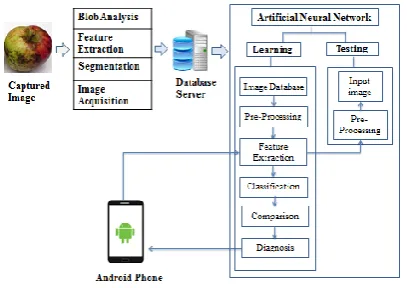
Figure 1. System Architecture
B. Methodology
1) Image acquisition: It is the initial condition for the work flow series of image processing because as processing is possible only with the help of an image. The image obtained is entirely natural and is the consequence of any hardware which was handled to produce it.
2) Image Segmentation: It is the method for segregation of digital image into several segments. Objects and bounding line of images are located by using image segmentation. Pixels with similar label portion share distinguishing features for allocating a label to each pixel in an image. For this we are using K-Means Clustering methodology.
3) Feature Extraction: Four feature vectors are considered namely color, texture, morphology and structure of hole of the fruits. Algorithm used for extracting the features is as follow: SURF (Speed up Robust Feature) algorithm is applied for extracting the features. SURF algorithm used as local descriptor and blob detector.
S(x,y)=∑ ∑ ………….eq 1
Algorithm is mainly divided as -
a. Scope point Detector
4) Blob Analysis: It is intended at detecting scope of interest surrounded by digital image that varies in properties. Blob Analysis solution consists of the successive stages:
a. Extraction: It is primary step of image thresholding technique which inspects a region corresponding to single object or objects.
b. Refinement: Extracted region contain various kind of loud sound due to degraded quality of image. Region transformation techniques are used in refinement step.
c. Analysis: It is ultimate stage for refined region to evaluate & compute the outcome. If the region shows multiple objects then divide it into separate blobs for inspection.
5) Pattern Matching: It is the procedure of examining stated successions of tokens for the existence of the elements of some pattern.
C. Algorithm
Input – Images of Various Fruits Output – Detection of Fruit Disease
Step 1: Accept image using android phone from user:
(Color, Morphology, Texture, Structure of Hole) Step 2: Extraction of Feature Vectors
E (n) = [C (n) + M (n) + T (n) +H (n)] Here,
C = Color, M = Morphology, T = Texture, H = Structure of Hole, E = Extraction of features, n = No. of images
Step 3: Calculating ROI:
Let E (n) be set of Extracted Images and If<Fruit Detected> Then E (n) Else Reject
Step 4: Pattern Matching
Let T be set Trained Database
If<E (n) = = T> Then Classification Detection Else Go To Step (2)
Step 5: Stop.
D. Mathematical Model
Four feature vectors such as color, morphology, texture and structure of hole are used as learning database images for extracting the features.
A. Color: It is the most valuable properties used by
human for object discrimination. As RGB color space is affected by light and angle of image which has been captured so there is need for conversion into HSI color space.
Heu = {
………eq
2
Here, Thita=
[ ] ………eq3
Saturation = 1- [ ]…………..eq4
Intensity = ………..eq5
B. Morphology: Erosion concept is applied for
acquiring boundaries of all database images.
Erosion = { }…………..……….eq 6 Image Boundary= Original image - Eroded image….eq7
Where,
X is erosion which indicates database images and Y as input image which is set of each points Z such that Y converted by Z and contained in X in morphology. Entire knowledge about structure is symbolized with the help discrete cosine conversion considering few co-efficient.
C. Texture: Visual patterns describe texture property,
each having similarity. Texture identification is done by modeling textures as two-dimensional deviation of gray level.
…………..…eq8
Then
Where,
IV.
CONCLUSION
Proposed system suggests that the advanced approach is a worth, which can distinctly support an accurate diagnosis of fruit diseases in a minor computational effort. It also dedicates future study on automatically estimating the severity of the disease.
V.
REFERENCES
[1]. Monica Jhuria, Ashwini Kumar, Rushikesh Borse Image Processing for Smart Farming: Detection of Disease and fruit Grading Proceeding of the 2013 IEEE second international Conference on image Processing. [2]. Sudhir Rao Rupanagudi, Ranjani B.S., Prathik
Nagaraj ,Varsha G. Bhat A cost effective Tomato maturity Grading system using image Processing for Farmers 2014 International Conference on Contemporary Computing and Information. [3]. Shiv Ram Dubey, Anand Singh Jalal Adapted
Approach for Fruit Disease Identification using Images
[4]. Manisha A. Bhange, Prof. H. A. Hingoliwala A Review of Image Processing for Pomegranate Disease Detection. International Journal of Computer Science and Information Technologies, Vol. 6 (1), 2015, 92-94.
[5]. Hetal N. Patel, Dr. M.V.Joshi, Fruit Detection using Improved Multiple Features based Algorithm International Journal of Computer Applications (0975 8887), Volume 13 No.2, January 2011.
[6]. Abraham Gastlum-Barrios, Rafael A. Borquez-Lpez, Enrique Rico-Garca Tomato Quality Evaluation with Image processing: A review African Journal of Agricultural Research Vol. 6(14), pp. 3333-3339, 18 July, 2011.
[7]. H. Al-Hiary, S. Bani-Ahmad, M. Reyalat, M. Braik and Z. ALRahamneh Fast and Accurate Detection and Classification of Plant Diseases International Journal of Computer Applications (0975 8887) Volume 17 No.1, March 2011. [8]. P.Vimala Devi and K.Vijayarekha Machine
Vision Application to Locates, Detect Defects and Remove Noise: A Reviewvol.7—No.1—104-113— January March — 2014
[9]. Shiv Ram Dubey, A.S. Jalal Detection and Classification of Apple Fruit Diseases using Complete Local Binary Patterns
[10]. Rashmi Pandey, Sapan Naik ,Roma Marfatia Image Processing and Machine Learning for Automated Fruit Grading System: A Technical Review International Journal of Computer Applications (0975 8887) Volume 81 No 16, November 2013 .
[11]. Anshuka Srivastava, Swapnil Kumar Sharma Development of a Robotic Navigator to Assist the Farmer in Field Proceeding of the International Multi Conference of Engineers and Computer Scientists 2010 Vol. (2) IMECS 2010 March 17-19 Hong Kong.
[12]. Savita N. Ghaiwat, Parul Arora Detection and Classification of Plant Leaf Diseases Using Image processing Techniques: A Review International Journal of Recent Advances in Engineering and Technology (IJRAET)ISSN (Online): 2347 - 2812, Volume-2, Issue - 3, 2014.
[13]. Anand.H.Kulkarni, Ashwin Patil R. K. Applying image processing technique to detect plant diseases International Journal of Modern Engineering Research (IJMER) Vol.2, Issue.5, Sep-Oct. 2012 pp-3661-3664.