INTRODUCTION
Gladiolus (Gladiolus L. hybrids), one of the most popular bulbous cut flowers of the world, has the problem of shorter vase life due to vascular occlusion by bacteria. Stem blockage in cut flowers is generally caused by bacterial proliferation along with their decay products (Teixeira-da-Silva, 2003). Bio-control through bacteria represent a potential alternative management approach (Jetiyanon and Kloepper, 2002) and may help in developing an organic method for effectively controlling detrimental microbes in the vase solutions (Carlson et al., 2015). The bio-control agents are used for biological management of pests to control a specific microbe (Shanmugam et al., 2011; Sajjad et al., 2014). Among bacterial antagonists, Pseudomonas fluorescens is most effective against a wide range of plant pathogens infecting different plants such as carnation, bean, radish, cucumber, tomato, and tobacco (van Loon et al., 1998), while P. fulva
has extended vase life of cut zinnia stems (Carlson et al.,
2015). Moreover, Burkholderia cepacia and Bacillus spp.
(spore forming Gram-positive bacteria) have effectively been used to control plant diseases (Kloepper et al., 2004). Use of compatible and multiple bio-control agents in various groups
also helps to control plant diseases, such as combinations of bacteria (Raupach and Kloepper, 1998; Shanmugam et al.,
2002), fungi (Paulitz et al., 1990), bacteria and fungi (Duffy
et al., 1996), yeasts (Janisiewicz, 1996), and bacteria and yeast (Janisiewicz and Bors, 1995).
An experiment was conducted to compare different beneficial bacterial strains for their efficacy to control detrimental bacteria in vase solutions with gladiolus stems. There is dire need to develop organic preservatives for keeping flower organic grown without chemicals until end of vase life. However, there are currently no effective organic preservatives available in the market and those available are not effective (Ahmad et al., 2014). Organic carbohydrate source and acidifier are available but organic biocides are not available. Therefore, this study was conducted to elucidate the effect of bio-control bacterial strains, some of which have been proved effective for various agronomic crops, in controlling detrimental bacteria in vase solutions and effect on the postharvest water relations and quality characteristics of cut gladiolus. Moreover, the findings of the study would help develop an organic floral preservative to be used for handling organically grown cut flowers.
ISSN (Print) 0552-9034, ISSN (Online) 2076-0906 DOI:10.21162/PAKJAS/16.3769
http://www.pakjas.com.pk
BIO-CONTROL ACTIVITY OF BACTERIAL STRAINS ON POSTHARVEST
PERFORMANCE OF Gladiolus L. HYBRIDS ‘MAMMOTH’
Iftikhar Ahmad
1,2,*, Muhammad Saleem
2,3, John M. Dole
2and Ann G. Matthysse
41Institute of Horticultural Sciences, University of Agriculture, Faisalabad-38040, Pakistan; 2Department of
Horticultural Science, North Carolina State University, Raleigh, NC, 27695, USA; 3Department of Horticulture,
Bahauddin Zakariya University, Bahadur Sub-campus, Layyah, Pakistan; 4Department of Biology, University of
North Carolina, Chapel Hill, NC, 27599, USA.
*Corresponding author’s email: [email protected], [email protected]
A study was carried out to elucidate the efficacy of different bacterial strains on controlling detrimental bacteria and on vase life extension of Gladiolus L. hybrids ‘Mammoth’. In a preliminary study, three bacterial strains (Bacillus pumilus, Delftia acidovorans, and Herbasperillum sp.) were isolated from the vase solutions of cut Gladiolus, identified and cultured to obtain the bacteria to be used in the study. These isolated strains were compared with two strains of Pseudomonas fluorescens (PF-279 and PF-417). All tested strains produced similar vase life of cut gladiolus stems, which was also similar to that of stems placed in tap water. However, stems placed in solutions with PF-279 Pseudomonas fluorecsens resulted in highest water uptake, while the stems placed in solutions with higher concentrations of Herbasperillum sp. (10 or 20 mL L-1) had lowest
water uptake. Cut stems require low pH for sustaining water uptake and vase life extension, but use of nutrient broth to culture bacteria increased initial solution pH, which resulted in early senescence of cut stems due to rapid bacterial growth, vascular occlusion due to embolisms and reduced stem hydraulic conductance compared to the stems placed in tap water (control). In summary, tested bacterial strains had no effect on controlling detrimental bacteria present in the vase solutions or vase life extension of cut gladiolus and cannot be used in organic floral preservatives for holding cut stems after harvest.
MATERIALS AND METHODS
The study was conducted at the Postharvest Laboratory, Department of Horticultural Science, NC State University, Raleigh, NC, during 2012-13. Prior to the study, a preliminary trial was conducted by placing fifteen stems in three vases [containing 500 mL deionized (DI) water] with five stems per vase. Stems were observed daily for differences in appearance due to senescence. Aliquots of the vase solution were taken on day 7 of vase life (which was when the stems started showing differences in appearance) from each vase, diluted, and cultured on nutrient agar plates to isolate the bacterial strains. On the basis of size and color, three types of colonies were isolated and re-cultured until pure cultures were obtained and submitted to the NCSU Plant Disease and Insect Clinic for identification of strains. Two other strains,
Pseudomonas fluorescens (PF-279) and Pseudomonas fluorescens (PF-417), were obtained from Washington State University, WA, USA, and University of North Carolina, Chappel Hill, NC, USA, respectively, and compared along with strains isolated from the vase solutions.
Plant material: Cut stems of gladiolus (Gladiolus L. hybrids ‘Mammoth’) were received from a commercial grower,
Glad-A-Way Farms, California, USA, within four days of harvest. On arrival, stems were sorted into 19 similar groups on the basis of stem caliper. Initially stems were sorted into groups with similar diameters followed by distribution uniformly among the treatments. Thus, each treatment would contain the same number of thick, intermediate and thin stems. Stems were dipped in soapy solution for 5 sec., rinsed in tap water, surface sterilized by spraying 70% alcohol, recut with sterilized secateurs to final uniform stem length of 80 cm, labeled, and placed in vases (three stems per vase) in a vase-life evaluation room set at 21±1°C temperature, 40-60% relative humidity (RH) and a 12 h light period provided by cool-white fluorescent tubes, which provided a photosynthetic photon flux of ~20 μmol m-2 s-1 measured with
a 1078 QMSW Quantum meter (Apogee Instruments, Inc., Logan, UT, USA).
Treatments: Inoculum of each strain was prepared by inoculating single colony from isolated pure cultures and grown for 48 hrs. with continuous shaking. Vases containing 700 mL of tap water were sterilized and covered with parafilm to reduce the chances of air contamination. Initial bacterial population varied from 1 x10⁴ to 25 x104 cfu mL-1 for
different strains. There were 19 treatments with all five strains
Table 1. Effect of different concentrations of various bacterial strains on vase life and weight changes of ‘Mammoth’ gladiolus. Stems were placed in either tap water, pure nutrient broth, or in nutrient broth plus Pseudomonas
fluorescens (PF-279), Pseudomonas fluorescens (PF-417), Bacillus pumilus, Herbasperillum sp., or Delftia acidovorans, at 5, 10, or 20 mL L-1.
Treatments Vase life
(d)
Initial fresh weight
(g)
Termination fresh weight (g)
Dry weight (g) Fresh weight change
(g)
Strain Conc.
(mL L-1)
Tap water (-ve control) - 9.5z 77.1 73.2 8.2 -3.9
Nutrient Broth (+ve control) 5 9.5 76.8 73.5 8.3 -3.4
10 8.8 79.4 77.6 8.4 -1.8
20 9.3 82.5 79.6 8.7 -2.9
Pseudomonas fluorescens (PF-279) 5 8.9 84.4 78.5 8.3 -5.9
10 9.4 80.2 77.3 8.5 -2.9
20 9.1 82.4 76.4 8.2 -6.0
Pseudomonas fluorescens (PF-417) 5 9.1 81.4 78.1 8.7 -3.3
10 9.4 79.4 71.0 8.0 -6.2
20 9.0 77.2 75.2 8.4 -4.2
Bacillus pumilus 5 9.3 83.6 80.9 8.6 -2.6
10 9.3 71.1 66.6 7.7 -4.5
20 9.1 78.2 76.9 8.4 -1.3
Herbasperillum sp. 5 9.6 71.8 64.4 7.8 -7.4
10 9.2 85.8 77.8 8.8 -8.0
20 9.4 77.5 72.1 8.3 -5.4
Delftia acidovorans 5 9.4 75.0 74.6 7.9 -0.3
10 9.1 74.6 73.6 7.9 -1.0
20 9.0 80.1 75.6 8.3 -4.5
Significancey
Overall NS NS NS NS 0.012
Strain (S) NS NS NS NS NS
Conc. (C) NS NS NS NS NS
S x C NS NS NS NS NS
Data represent means of five vases of three stems each or 15 individual stems; z Mean separation within columns by LSD
at P ≤ 0.05; yP values were obtained using General Linear Models (GLM) procedures (version 9.3; SAS Inst. Inc., Cary,
and nutrient broth at 5, 10, or 20 mL L-1 along with tap water
(control). Each treatment was applied to five vases of three stems each.
Measurements: Data were recorded for vase life [time period (days) from placing stems in vases to the time of stem termination], initial and final fresh weight (one designated stem from each vase), dry weight (measured at termination after drying in oven at 70°C for 72 h), fresh weight change, water uptake (measured in milliliters from all vases when first stem was terminated in entire experiment), percentage of florets opened during vase period, initial and final pH, pH change, initial and final EC, EC change, and symptoms of termination, which included bent stem or petal wilting (Saleem et al., 2013). Cut stems were observed every day during vase period and every stem was terminated if it had developed one or more of the above mentioned symptoms on more than half of the flowers/petals, foliage, or stem (Ahmad
et al., 2013a).
Statistical analysis: The experimental layout was completely randomized design with factorial arranged treatments and five replicate vases of three stems each. Data were analyzed using analysis of variance (ANOVA) and General Linear Models
procedures of SAS (version 9.3, SAS Inst., Inc., Cary, NC) and Fisher’s LSD at P ≤ 0.05 was used to separate means (Steel et al., 1997).
RESULTS AND DISCUSSION
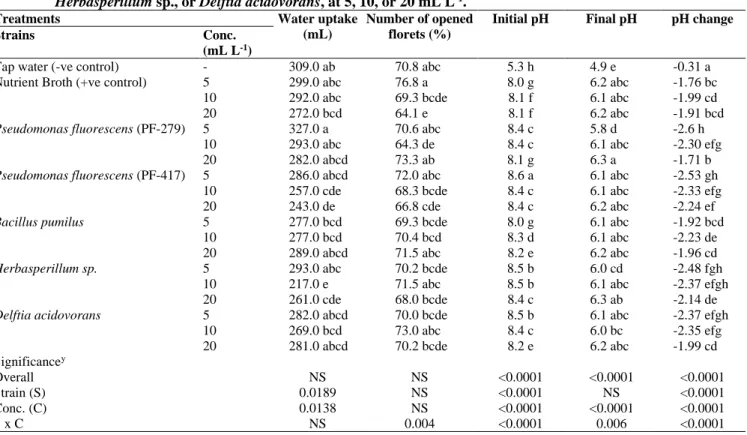
Use of bio-control strains did not extend vase life of gladiolus stems and resulted in vase life similar to the stems placed in tap water (Table 1). Moreover, all stems had similar fresh weight changes during vase period and dry weight of a stem. However, stems placed in vase solutions with Pseudomonas florescens (PF-279) at 5 mL L-1 maintained water uptake and
had a higher uptake than stems placed in solutions with
Herbasperillum sp. or Pseudomonas florescens (PF-417) at 10 or 20 mL L-1 (Table 2). Use of higher concentrations of all
bacterial strains tested lowered the water uptake, but had no effect on opening of the florets during vase period. In another study, bacterial strains viz. P. fulva and Escherichia coli K12 extended vase life compare to other tested bacterial strains, nutrient broth and control (DI), but all bacterial strains had no effect on water uptake of cut stems of zinnia (Carlson et al.,
2015).
Table 2. Effect of different concentrations of various bacterial strains on water uptake, number of opened florets, and pH changes of ‘Mammoth’ gladiolus. Stems were placed in either tap water, pure nutrient broth, or in nutrient broth plus Pseudomonas fluorescens (PF-279), Pseudomonas fluorescens (PF-417), Bacillus pumilus,
Herbasperillum sp., or Delftia acidovorans, at 5, 10, or 20 mL L-1.
Treatments Water uptake
(mL)
Number of opened florets (%)
Initial pH Final pH pH change
Strains Conc.
(mL L-1)
Tap water (-ve control) - 309.0 ab 70.8 abc 5.3 h 4.9 e -0.31 a
Nutrient Broth (+ve control) 5 299.0 abc 76.8 a 8.0 g 6.2 abc -1.76 bc
10 292.0 abc 69.3 bcde 8.1 f 6.1 abc -1.99 cd
20 272.0 bcd 64.1 e 8.1 f 6.2 abc -1.91 bcd
Pseudomonas fluorescens (PF-279) 5 327.0 a 70.6 abc 8.4 c 5.8 d -2.6 h
10 293.0 abc 64.3 de 8.4 c 6.1 abc -2.30 efg
20 282.0 abcd 73.3 ab 8.1 g 6.3 a -1.71 b
Pseudomonas fluorescens (PF-417) 5 286.0 abcd 72.0 abc 8.6 a 6.1 abc -2.53 gh
10 257.0 cde 68.3 bcde 8.4 c 6.1 abc -2.33 efg
20 243.0 de 66.8 cde 8.4 c 6.2 abc -2.24 ef
Bacillus pumilus 5 277.0 bcd 69.3 bcde 8.0 g 6.1 abc -1.92 bcd
10 277.0 bcd 70.4 bcd 8.3 d 6.1 abc -2.23 de
20 289.0 abcd 71.5 abc 8.2 e 6.2 abc -1.96 cd
Herbasperillum sp. 5 293.0 abc 70.2 bcde 8.5 b 6.0 cd -2.48 fgh
10 217.0 e 71.5 abc 8.5 b 6.1 abc -2.37 efgh
20 261.0 cde 68.0 bcde 8.4 c 6.3 ab -2.14 de
Delftia acidovorans 5 282.0 abcd 70.0 bcde 8.5 b 6.1 abc -2.37 efgh
10 269.0 bcd 73.0 abc 8.4 c 6.0 bc -2.35 efg
20 281.0 abcd 70.2 bcde 8.2 e 6.2 abc -1.99 cd
Significancey
Overall NS NS <0.0001 <0.0001 <0.0001
Strain (S) 0.0189 NS <0.0001 NS <0.0001
Conc. (C) 0.0138 NS <0.0001 <0.0001 <0.0001
S x C NS 0.004 <0.0001 0.006 <0.0001
Data represent means of five vases of three stems each or 15 individual stems; z Mean separation within columns by LSD
at P ≤ 0.05; yP values were obtained using General Linear Models (GLM) procedures (version 9.3; SAS Inst. Inc., Cary,
During vase period, pH of the solutions containing bacterial strains became much more acidic with the greatest decrease (2.6 units) for PF-279 at 5 mL L-1, which might be the reason
for continued water uptake by the stems (Table 2). Higher
water uptake due to low pH has also been reported in other studies with different ornamental species (Ahmad et al.,
2013b; Carlson and Dole, 2013). However, the solution EC
Table 3. Bacterial populations of various bacterial strains, Pseudomonas fluorescens (PF-279), Pseudomonas
fluorescens (PF-417), Bacillus pumilus, Herbasperillum sp., or Delftia acidovorans, sampled on day 0, 3, 6 or
9. Inoculum of each strain was added at 5, 10, or 20 mL L-1.
Strain Volume of inoculant
added (mL L-1)
Bacterial counts (cfu 0.1 mL-1)
Day 0 Day 3 Day 6 Day 9
Water (-ve control) 11x103 28x103 51x103
1x10⁶ 1x10⁶ -
- - -
Nutrient broth (+ve control) 5 288x104 235x104 235x104
- 7x10⁶ 4x10⁶
- - -
10 366x104 112x104 187x104
6x10⁶ 10x106 2x10⁶
- - -
20 298x104 225x104 133x104
53x106 32x106 1x10⁶
- - -
Pseudomonas fluorescens (PF-279) 5 156x102 287x104 170x104 210x104
8x10³ 5x10⁶ 4x10⁶ 3x10⁶
1x10⁴ 1x10⁸ - -
10 463x104 184x104 256x104
2x10⁶ 6x10⁶ 8x10⁶
1x10⁸ - -
20 612x104 186x104 120x104
2x10⁶ 5x10⁶ 2x10⁶
- - -
Pseudomonas fluorescens (PF-417) 5 356x102 201x104 105x104 31x104
200x103 92x106 2x10⁶ 8x10⁶
53x104 - - -
10 290x104 131x104 107x104
5x10⁶ 1x10⁶ 4x10⁶
1x10⁸ - -
20 415x104 152x104 203x104
6x10⁶ 2x10⁶ 4x10⁶
1x10⁸ - -
Bacillus pumilus 5 413x102 136x104 180x104 216x104
60x103 11x106 2x10⁶ 3x10⁶
8x10⁴ 1x10⁸ - -
10 313x104 224x104 400x104
15x106 18x106 19x106
- - 1x10⁸
20 246x104 120x104 109x104
10x106 7x10⁶ 11x106
1x10⁸ - -
Herbasperillum sp. 5 456x102 280x104 35x104 285x104
90x103 42x106 1x10⁶ 7x10⁶
22x104 2x10⁸ - -
10 495x104 186x104 149x104
43x106 4x10⁶ 73x106
4x10⁸ - -
20 510x104 81x104 35x104
50x106 1x10⁶ 1x10⁶
8x10⁸ - -
Delftia acidovorans 5 296x102 184x104 290x104 288x104
47x103 2x10⁶ 8x10⁶ 18x106
11x104 - - -
10 416x104 556x104 607x104
13x106 43x106 29x106
- - -
20 640x104 240x104 210x104
23x106 5x10⁶ 11x106
2x10⁸ - -
changes for all treatments were statistically similar (data not presented).
The bacterial population in different vase solutions greatly varied when sampled on 3 day intervals during vase life (Table 3). Although no significant extension in vase life of cut gladiolus stems occurred, the PF-279 bacteria appeared to have countered the negative effects of detrimental bacteria in the vase solutions to produce similar vase life as with tap water. It has been reported that avoiding bacterial proliferation in vase solutions is more important as compared to their populations in the solutions (Carlson et al., 2015). Certain bacterial strains may have little or no effect but several species may shorten the vase life of various cut flower crops (van Doorn et al., 1991; Jacob and Kim, 2010) by blocking the vascular system (Put, 1990), by producing enzymes which kill plant tissues (Membre and Burlot, 1994), or by producing senescence causing hormones, such as ethylene (van Doorn et al., 1991). Therefore, more comprehensive studies need to be conducted by using different strains, concentrations and populations of the bacteria for evaluation of their effects on extending postharvest longevity of cut flowers.
In summary, Pseudomonas florescens (PF-279) yielded better results among all tested strains by maintaining water uptake by the stems (Gast, 2000) due to low solution pH, which is beneficial in extending vase life of many cut flower species by slowing bacterial growth in vase solution (van Doorn and Perik, 1990), avoiding stem vasculature blockage and embolisms (Durkin, 1979), maintaining higher stem hydraulic conductance (Marousky, 1971), reducing water stress symptoms and numerically lengthening the vase life of cut gladiolus stems.
Acknowledgements: The authors would like to acknowledge the Glad-A-Way Farms, CA, USA, for providing cut gladiolus stems, and Washington State University, WA, USA, for providing bacterial strain, Pseudomonas fluorescens (PF-279), for the study.
REFERENCES
Ahmad, I., J.M. Dole, M. Saleem, M.A. Khan, A. Akram and A.S. Khan. 2013a. Preservatives and packaging material have an impact on the post-harvest longevity of cut Rosa hybrida L. ‘Kardinal’ flowers. J. Hort. Sci. Biotech. 88:251-256.
Ahmad, I., J.M. Dole, A.S. Carlson and F.A. Blazich. 2013b. Water quality affects vase life of cut callas, hydrangeas and snapdragons. Sci. Hortic. 153:26-33.
Ahmad, I., J.M. Dole, E.M.R. Clark and F.A. Blazich. 2014. Floral foam and/or conventional or organic preservatives affect the vase-life and quality of cut rose (Rosa × hybrida L.) stems. J. Hort. Sci. Biotech. 89:41-46.
Carlson, A.S. and J.M. Dole. 2013. Postharvest water quality affects vase life of cut Dendranthema, Dianthus, Helianthus, and Zinnia. Sci. Hortic. 164:277-286. Carlson, A.S., J.M. Dole, A.G. Matthysse, W.A. Hoffmann
and J.L. Kornegay. 2015. Bacteria species and solution pH effect postharvest quality of cut Zinnia elegans. Sci. Hortic. 194:71-78.
Duffy, B.K., A. Simon and D.M. Weller. 1996. Combination of Trichoderma koningii with Fluorescent pseudomonads for control of take-all on wheat. Phytopath. 86:188-194.
Durkin, D. 1979. Effect of millipore filtration, citric acid, and sucrose on peduncle water potential of cut rose flower. J. Amer. Soc. Hort. Sci. 104:860–863.
Gast, K.L.B. 2000. Water quality for florists—why is it so important. Kans. State Univ. Agr. Expt. Sta. Coop. Ext. Serv., USA.
Jacob, B.M. and E. Kim. 2010. Inhibiting biofilm formation of Enterobacter sp. prevented premature withering in cut flowers. Korean J. Chem. Eng. 27:1252–1257.
Janisiewicz, W.J. 1996. Ecological diversity, niche overlap, and coexistence of antagonists used in developing mixtures for biocontrol of post-harvest diseases of apples. Phytopath. 86:473-479.
Janisiewicz, W.J. and B. Bors. 1995. Development of microbial community of bacterial and yeast antagonists to control wound-invading postharvest pathogens of fruits. Appl. Environ. Microbiol. 61:3261-3267.
Jetiyanon, K. and J.W. Kloepper. 2002. Mixtures of plant growth promoting rhizobacteria for induction of systemic resistance against multiple plant diseases. BioControl 24:285-291.
Kloepper, J.W., C.M. Ryu and S. Zhang. 2004. Induced systemic resistance and promotion of plant growth by
Bacillus spp. Phytopath. 94:1259-1266.
Marousky, F.J. 1971. Inhibition of vascular blockage and increased moisture retention in cut roses induced by pH, 8-hydroxyquinoline citrate and sucrose. J. Am. Soc. Hort. Sci. 96:38–41.
Membre, J.M. and P.M. Burlot. 1994. Effects of temperature, pH, and NaCl on growth and pectinolytic activity of
Pseudomonas marginalis. Appl. Environ. Microbiol. 60:2017–2022.
Paulitz, T.C., J.S. Ahmad and R. Baker. 1990. Integration of
Pythium nunn and Trichoderma harzianum isolate T-95 for the biological control of Pythium damping-off of cucumber. Plant Soil 121:243-250.
Put, H.M.C. 1990. Micro-organisms from freshly harvested cut flower stems and developing during the vase life of chrysanthemum, gerbera and rose cultivars. Sci. Hortic. 43:129–144.
control of multiple cucumber pathogens. Phytopath. 88:1158-1164.
Sajjad, Y., M.J. Jaskani, M.Y. Ashraf, M. Qasim and R. Ahmad. 2014. Response of morphological and physiological growth attributes to foliar application of plant growth regulators in gladiolus 'white prosperity'. Pak. J. Agri. Sci. 51:123-129.
Saleem, M., I. Ahmad and M.A. Khan. 2013. Cultivar effects on growth, yield and cormel production of gladiolus (Gladiolus grandiflorus L.). J. Ornam. Hort. Pl. 3:39-48. Shanmugam, V., N. Kanoujia, M. Singh, S. Singh and R. Prasad. 2011. Biocontrol of vascular wilt and corm rot of gladiolus caused by Fusarium oxysporum f. sp. gladioli using plant growth promoting rhizobacterial mixture. Crop Prot. 30:807-813.
Shanmugam, V., N. Senthil, T. Raguchander, A. Ramanathan and R. Samiyappan. 2002. Interaction of Pseudomonas fluorescens with Rhizobium for their effect on the
management of peanut root rot. Phytoparasitica 30:169-176.
Steel, R.G.D., J.H. Torrie and D.A. Dickey. 1997. Principles and Procedures of Statistics: A biometrical approach. McGraw Hill Book Co., New gladiolYork, USA. Teixeira-da-Silva, J.A. 2003. The cut flower: postharvest
considerations. Online J. Biol. Sci. 3:406-442.
van Doorn, W.G. and R.R.J. Perik. 1990. Hydroxyquinoline citrate and low pH prevent vascular blockage in stems of cut rose flowers by reducing the number of bacteria. J. Amer. Soc. Hort. Sci. 115:979–981.
van Doorn, W.G., H.C.M. de Stigter, Y. de Witte and A. Boekestein. 1991. Micro-organisms at the cut surface and in xylem vessels of rose stems: a scanning electron microscopy study. J. Appl. Bacteriol. 70:34–39.