A TYPOLOGICAL EXAMINATION OF STEPFAMILY RELATIONSHIP QUALITY AND ADOLESCENTS’ SHORT-TERM AND LONG-TERM ADJUSTMENT
Todd M. Jensen
A dissertation submitted to the faculty at the University of North Carolina at Chapel Hill in partial fulfillment of the requirements for the degree of Doctor of Philosophy in the School of Social Work.
Chapel Hill 2017
Approved by: Gary L. Bowen
ABSTRACT
TODD M. JENSEN: A Typological Examination of Stepfamily Relationship Quality and Adolescents’ Short-Term and Long-Term Adjustment
(Under the direction of Gary L. Bowen)
Stepfamilies are an increasingly common family form, marked by distinct challenges and opportunities with implications for family functioning and youth well-being. Currently, there exists a dearth of research whereby adaptive stepfamily processes across central dyadic relationships are investigated holistically. Moreover, few studies have explored links between specific patterns of stepfamily processes and youth adjustment over time. More research is also needed whereby associations between larger social environments, stepfamily processes, and youth well-being are examined together. This three-paper dissertation seeks to fill these gaps in the literature.
The first paper employs factor mixture modeling to identify population heterogeneity with respect to mother-child, stepfather-child, nonresident father-child, and stepcouple
relationship quality using a sample of 1,182 adolescents in mother-stepfather families with living nonresident fathers from Wave I of the National Longitudinal Study of Adolescent to Adult Health. The results favor a four-class factor-mixture solution with class-specific factor covariance matrices. The four patterns are labeled residence-centered, inclusive, conflictual couple, and disconnected. Socio-demographic and substantive differences between patterns are evident.
young adulthood. Results from structural equation models and latent growth curve models indicate that adjustment over time is optimized among youth in the residence-centered and inclusive patterns. Typology-adjustment differences between male and female youth arise with respect to concurrent levels of depression and trends in delinquency; male youth appear to benefit most from the residence-centered pattern, whereas female youth appear to benefit most from not experiencing the disconnected pattern.
Using the stepfamily-process patterns identified in the first paper, the third paper
examines three plausible functions of neighborhood collective efficacy with respect to stepfamily life: an ability to (a) prevent maladaptive patterns of stepfamily processes, (b) promote
stepchildren’s adjustment beyond the influence of stepfamily processes, and (c) protect stepchildren’s adjustment when faced with maladaptive patterns of stepfamily processes. The results indicate that higher levels of neighborhood collective efficacy are associated with
ACKNOWLEDGEMENTS
To begin, I wish to acknowledge the various institutions and funding sources that have formed the foundation upon which I have built my work and future career. These include the Royster Society of Fellows, the Carolina Population Center, and the Carolina Consortium on Human Development at the Center for Development Science, along with Dr. Andrea Hussong, Dr. Jennifer Coffman, and the other predoctoral and postdoctoral fellows. I also wish to
acknowledge the staff, faculty, and administrators in the School of Social Work, who have modeled limitless work ethic and unfailing commitment to the core social work professional values. I am a better person for knowing and working with these individuals. I am also grateful for my wonderful doctoral cohort, classmates, and colleagues. I want to mention Teresa Ilinitch by name, who even in the short time I knew her before her passing, touched my life forever.
TABLE OF CONTENTS
LIST OF TABLES ... ix
LIST OF FIGURES ...x
INTRODUCTION ...1
References: Introduction ...9
PAPER I: CONSTELLATIONS OF DYADIC RELATIONSHIP QUALITY IN STEPFAMILIES: A FACTOR MIXTURE MODEL ...12
Introduction ...12
Method ...20
Results ...27
Discussion ...32
References: Paper I ...38
Tables: Paper I ...42
Figures: Paper I ...45
PAPER II: A TYPOLOGY OF STEPFAMILY PROCESSES AND ADOLESCENTS’ SHORT-TERM AND LONG-TERM ADJUSTMENT ...46
Introduction. ...46
Method ...56
Results ...62
Discussion ...69
References: Paper II. ...74
Introduction ...83
Method ...92
Results ...98
Discussion ...99
References: Paper III ...104
Tables: Paper III ...109
Figures: Paper III ...112
CONCLUSION ...113
LIST OF TABLES
Table 1.1 - Model Fit Comparisons ...42 Table 1.2 - Relationship-Quality Item Means, Standard Errors, Z Scores,
and Composite-Scale Differences Between Latent Classes ...43 Table 1.3 - Covariate Means, Standard Errors, Z Scores, and Differences
Between Latent Classes ...44 Table 2.1 - Patterns of Stepfamily Processes ...78 Table 2.2 - Youth Adjustment at Wave II Regressed on Latent-Class
Membership and Covariates by Youth Sex ...79 Table 2.3 - Autocorrelated Longitudinal SEM With Youth Depression at
Waves I, III, and IV Regressed on Latent-Class Membership and
Covariates by Youth Sex ...80 Table 2.4 - Youth Delinquency Latent-Growth Curve Across Waves I, III,
and IV Regressed on Latent-Class Membership and Covariates, Males Only ...81 Table 2.5 - Youth Delinquency Latent-Growth Curve Across Waves I, III,
and IV Regressed on Latent-Class Membership and Covariates, Females Only ...82 Table 3.1 - Patterns of Stepfamily Processes ...109 Table 3.2 - Multinomial Logistic Regression With Patterns of Stepfamily
Processes Regressed on Neighborhood Collective Efficacy ...110 Table 3.3 - Adolescent Adjustment Regressed on Neighborhood Collective
LIST OF FIGURES
Figure 1.1 - Standardized Factor Means and Inter-Factor Correlations for
INTRODUCTION
YOUTH DEVELOPMENT IN THE CONTEXT OF FAMILY TRANSITIONS AND STRUCTURAL DIVERSITY: OPPORTUNITIES FOR SOCIAL WORK
The American Academy of Social Work & Social Welfare has recently articulated 12 Grand Challenges for Social Work, an initiative that aims to unify the efforts of researchers, practitioners, and educators across the field of Social Work. One challenge is to ensure healthy development for all youth. Although there are a variety of social contexts in which youth development unfolds, perhaps the most proximal context is the family.
Structural transitions in families can give rise to stressful processes that place youth at a heightened risk of maladjustment (Amato, 2000; Hetherington & Elmore, 2003). Further, family stress can be exacerbated in the context of ongoing discrimination and oppression (Peters & Massey, 1983). Thus, a focus on family transitions and structural diversity will be an integral piece of any professional effort to build a just and equitable society that works for all families and children. It will also be a vital component of efforts to ensure the healthy development of all youth.
A Focus on Stepfamilies
One of the most common transitions families in the United States experience is the formation of a stepfamily. Indeed, one-third of all youth will reside in a cohabiting or married stepfamily before reaching legal adulthood (Bumpass, Raley, & Sweet, 1995; Pew Research Center, 2011). Stepfamilies form when one or both partners in a new committed relationship bring a child or children with them from a previous relationship. Thus, stepfamilies bring
together new and existing dyadic relationships, forming a mix of biological and social relations. Although stepfamilies are increasingly common, the pathways to and initiation of
disruptions in parent-child relationships (Brown & Manning, 2009; Coleman et al., 2013; Jensen & Shafer, 2013; Jensen, Shafer, & Larson, 2014; Pace, Shafer, Jensen, & Larson, 2015;
Papernow, 2013; Shafer, Jensen, Pace, & Larson, 2013). These challenges, among others, can be stressful for youth in stepfamilies.
The Implications of Family Structural Transitions
Stepfamily stressors have implications for the well-being of youth. Nationally
representative studies indicate that youth in stepfamilies exhibit more behavioral problems (e.g., getting into fights, violating laws; Hoffman, 2006), a 12.7 to 24.6 percent higher rate of drug use (Hoffman, 2002), more school-related behavior problems (e.g., failure to complete assignments, strain in relationships with other students and teachers), and a .10- to .45-point lower grade-point average (Tillman, 2007) than youth in biological nuclear families. A meta-analysis of 61 studies confirmed that youth living in a stepfamily household fare significantly worse than youth in biological nuclear families across indicators of academic achievement (i.e., grades, standardized test scores) and psychological well-being (i.e., depression, self-esteem, overall mental health; Jeynes, 2006). Further, children in stepfamilies either fare no better or worse than their
counterparts in single-parent families (Jeynes, 2006). As a case in point, youth in post-divorce stepfamilies exhibit higher levels of depression and are at greater risk of suicidal ideation than children from post-divorce single-parent families (Sweeney, 2007). These well-being disparities are costly to youth, families, and society.
Marked differences in well-being between stepchildren and children in single-parent families suggest that stepfamily formation can pose challenges to children above and beyond the challenges that accompany parental divorce and life in single-parent homes—common
have a cumulative impact on children’s well-being (e.g., Cavanagh, Schiller, & Riegle-Crumb, 2006; Osborne & McLanahan, 2007; Shafer, Jensen, & Holmes, 2016). Two meta-analytic studies found that parental divorce, a common transition, diminishes children’s school achievement, self-concept, and psychological and social adjustment (Amato, 2001; Amato & Keith, 1991). Family transitions also have economic implications, as family fragmentation costs U.S. taxpayers approximately $112 billion each year (Scafidi, 2008).
Opportunities for Helping Youth Thrive
The past several decades of stepfamily research have mostly provided insights relating to stepfamily stressors and risks (Coleman & Ganong, 1990; Coleman, Ganong, & Fine, 2000). This body of research embodies a deficit-comparison perspective (Coleman & Ganong, 1990), by which the well-being of youth in a variety of family structures is contrasted with youth in biological nuclear families. Relatively less is known about factors distinguishing stepfamilies that promote youth well-being from stepfamilies that inhibit well-being. Efforts to distinguish these families embody a normative-adaptive perspective (Coleman & Ganong, 1990), casting light on antecedents and correlates of stepfamily resilience and the thriving of youth in
stepfamilies. Generation of knowledge in this area is paramount to inform policy-making, family life education, and intervention programs for stepfamilies. Moreover, a normative-adaptive perspective will be an important feature of future research as evidence suggests youth in stepfamilies, although having lower mean levels of adjustment, have greater variation in
At least three core categories of factors can promote the well-being of youth in stepfamilies: individual factors (e.g., personality characteristics, attachment orientation, temperament), extra-familial factors (e.g., support and accommodations in legal, health, educational, and community settings), and familial factors (e.g., positive relationships and interactional patterns between family members, financial status; Hetherington & Elmore, 2003). Of these, familial factors may be particularly fruitful targets of intervention development given their malleability (Fraser & Galinsky, 2010). Moreover, research consistently shows the power and influence of family processes in shaping individual outcomes. Indeed, what families do can exert greater influence on youth well-being than what families look like (e.g., Hetherington et al., 1998).
The Dissertation Papers
across mother-child, stepfather-child, nonresident father-child, and stepcouple dyads. Using factor mixture modeling, this paper merges together advancements in family theory, latent-variable mixture methodology, and a focus on informing intervention development for
stepfamilies—the fastest growing family form in the United States (Teachman & Tedrow, 2008). Validation analyses are also conducted to highlight meaningful differences between stepfamily-process patterns with respect to socio-demographic characteristics, stepcouple stability, and youths’ concurrent adjustment. Findings from Paper 1 highlight four distinct patterns of stepfamily processes, each with unique levels of dyadic relationship quality and
inter-relationship correlations. Implications for intervention development center on a need to address distinct stepfamily experiences marked by unique challenges and strengths.
the stepfamily-process patterns identified in Paper 1 with the respect to the contours of youth development and well-being across adolescence, emerging adulthood, and young adulthood. Paper 2 also highlights the role of youth sex as a moderating influence.
Importantly, family scholars have admonished researchers to “put families into place” by examining the influence of the larger and overlapping social environments, such as communities or neighborhoods, in which families are embedded (Mancini & Bowen, 2013; Noah, 2015). Currently, the literature lacks research by which stepfamily processes and stepchildren’s adjustment are contextualized in such environments. Thus, In Paper 3, “Stepfamily Processes and Adolescent Adjustment: The Role of Neighborhood Collective Efficacy,” I examine three plausible functions of neighborhood collective efficacy with respect to stepfamily life: an ability to (a) prevent maladaptive patterns of stepfamily processes, (b) promote youths’ adjustment beyond the influence of stepfamily processes, and (c) protect youths’ adjustment when faced with maladaptive patterns of stepfamily processes (i.e., moderating influence). Findings from Paper 3 highlight the importance of viewing stepfamilies in their larger social contexts. From an intervention standpoint, the findings also emphasize the value of targeting neighborhood-level characteristics in an effort to bolster stepfamily relationships and youth adjustment.
REFERENCES: INTRODUCTION
Amato, P. R. (2000). The consequences of divorce for adults and children. Journal of Marriage and Family, 62(4), 1269-1287.
Amato, P. R. (2001). Children of divorce in the 1990s: An update of the Amato and Keith (1991) meta-analysis. Journal of Family Psychology, 15(3), 355-370.
Amato, P. R., & Keith, B. (1991). Parental divorce and the well-being of children: A meta-analysis. Psychological Bulletin, 110(1), 26-46.
Brown, S. L., & Manning, W. D. (2009). Family boundary ambiguity and the measurement of family structure: The significance of cohabitation. Demography, 46(1), 85-101.
Brown, S. L., Stykes, J. B., & Manning, W. D. (2016). Trends in children's family instability, 1995–2010. Journal of Marriage and Family, 78, 1173-1183.
Bumpass, L. L., Raley, R. K., & Sweet, J. A. (1995). The changing character of stepfamilies: Implications of cohabitation and nonmarital childbearing. Demography, 32(3), 425-436. Cavanagh, S. E., Schiller, K. S., & Riegle-Crumb, C. (2006). Marital transitions, parenting, and schooling: Exploring the link between family-structure history and adolescents' academic status. Sociology of Education, 79(4), 329-354.
Cherlin, A. (1978). Remarriage as an incomplete institution. American Journal of Sociology, 84(3), 634-650.
Cherlin, A. J. (2010). Demographic trends in the United States: A review of research in the 2000s. Journal of Marriage and Family, 72(3), 403-419.
Coleman, M., & Ganong, L. H. (1990). Remarriage and stepfamily research in the 1980s: Increased interest in an old family form. Journal of Marriage and Family, 52(4), 925-940.
Coleman, M., Ganong, L., & Fine, M. (2000). Reinvestigating remarriage: Another decade of progress. Journal of Marriage and Family, 62(4), 1288-1307.
Coleman, M., Ganong, L., & Russell, L. (2013). Resilience in stepfamilies. In D. Becvar (Ed.), Handbook of family resilience (pp. 85-103). New York: Springer.
Fraser, M. W., & Galinsky, M. J. (2010). Steps in intervention research: Designing and developing social programs. Research on Social Work Practice, 20(4), 459-466.
Hetherington, E. M., Bridges, M., & Insabella, G. M. (1998). What matters? What does not? Five perspectives on the association between marital transitions and children's adjustment. American Psychologist, 53(2), 167-184.
Hetherington, E. M., & Elmore, A. M. (2003). Risk and resilience in children coping with their parents’ divorce and remarriage. In S. S. Luthar (Ed.), Resilience and vulnerability: Adaptation in the context of childhood adversities (pp.182-212). Cambridge, UK: Cambridge University Press.
Hoffman, J. (2002). The community context of family structure and adolescent drug use. Journal of Marriage and Family, 64(2), 314-330.
Hoffmann, J. P. (2006). Family structure, community context, and adolescent problem behaviors. Journal of Youth and Adolescence, 35(6), 867-880.
Jensen, T., & Shafer, K. (2013). Stepfamily functioning and closeness: Children’s views on second marriages and stepfather relationships. Social Work, 58(2), 127-36.
Jensen, T., Shafer, K., & Larson, J. (2014). (Step)parenting attitudes and expectations:
Implications for stepfamily functioning and clinical intervention. Families in Society: The Journal of Contemporary Social Services, 95(3), 213-220.
Jeynes, W. H. (2006). The impact of parental remarriage on children: A meta-analysis. Marriage & Family Review, 40(4), 75-102.
Mancini, J. A., & Bowen, G. L. (2013). Families and communities: A social organization theory of action and change. In G. W. Peterson & K. R. Bush (eds.), Handbook of marriage and the family (pp. 781-813). New York: Springer.
Manning, W. D., Brown, S. L., & Stykes, J. B. (2014). Family complexity among children in the United States. The ANNALS of the American Academy of Political and Social Science, 654(1), 48-65.
Noah, A. J. (2015). Putting families into place: Using neighborhood-effects research and activity spaces to understand families. Journal of Family Theory & Review, 7, 452-467.
Osborne, C., & McLanahan, S. (2007). Partnership instability and child well-being. Journal of Marriage and Family, 69(4), 1065-1083.
Pace, G. T., Shafer, K., Jensen, T. M., & Larson, J. H. (2015). Stepparenting issues and
relationship quality: The role of clear communication. Journal of Social Work, 15(1), 24-44.
Pew Research Center. (2011). Pew social & demographic trends survey. Washington, DC: Pew Research Center.
Scafidi, B. (2008). The taxpayer costs of divorce and unwed childbearing: first-ever estimates for the nation and all fifty states. New York: Georgia Family Council and Institute for American Values.
Shafer, K., Jensen, T., M., Holmes, E. K. (2016). Divorce stress, stepfamily stress, and depression among emerging adult stepchildren. Journal of Child and Family Studies. Advance online publication. doi: 10.1007/s10826-016-0617-0
Shafer, K., Jensen, T. M., Pace, G. T., & Larson, J. H. (2013). Former spouse ties and postdivorce relationship quality: Relationship effort as a mediator. Journal of Social Service Research, 39(5), 629-645.
Sweeney, M. M. (2007). Stepfather families and the emotional well-being of adolescents. Journal of Health and Social Behavior, 48(1), 33-49.
Sweeney, M. M. (2010). Remarriage and stepfamilies: Strategic sites for family scholarship in the 21st century. Journal of Marriage and Family, 72(3), 667-684.
Teachman, J., & Tedrow, L. (2008). The demography of stepfamilies in the United States. In J. Pryor (Ed.), The international handbook of stepfamilies: Policy and practice in legal, research, and clinical environments (pp. 3-29). Hoboken, NJ: John Wiley & Sons.
PAPER I
CONSTELLATIONS OF DYADIC RELATIONSHIP QUALITY IN STEPFAMILIES: A FACTOR MIXTURE MODEL
Prior to age 18, nearly one-third of all youth in the United States will reside in a
stepfamily household (Pew Research Center, 2011). Stepfamilies form when one or both partners in a new committed relationship bring a child or children from a previous relationship (Ganong & Coleman, 2017). Stepfamily scholars favor this inclusive definition of stepfamilies, which encompasses both married and cohabiting partnerships. The majority of stepfamilies—roughly 80%—are reared by a biological mother and stepfather (Kreider & Ellis, 2011).
Over the past several decades, stepfamilies have drawn considerable scholarly and clinical attention. This focus on stepfamilies is warranted on several fronts. For one, stepfamilies are an increasingly common family form. Stepfamilies are also marked by distinct challenges that are generally not experienced by biological nuclear families (Coleman, Ganong, & Russell, 2013). Further, stepfamilies, just like any other family, represent a central developmental context for the adults and youth who reside in them.
Amid family structural transitions and stress, family processes are a proximal determinant of family resilience, collective and individual goal attainment, and individual well-being
Past research highlights the centrality of resident parent-child, stepparent-child,
nonresident parent-child, and stepcouple relationships (Coleman et al., 2013); however, less is known about the ways in which relationship quality across these four dyads cluster together and interrelate to form distinct patterns of stepfamily processes. The identification of holistic
stepfamily-process patterns can enrich understanding about youth adjustment in stepfamilies, highlight processes that promote or hinder stepfamily resilience, and inform the development of stepfamily interventions that address issues linked to varying stepfamily experiences (Coleman, Ganong, & Fine, 2000). The general aim of the current study was to identify the presence of distinct stepfamily-process patterns with respect to mother-child, stepfather-child, nonresident father-child, and stepcouple relationship quality in a representative sample of youth residing in mother-stepfather families. To properly frame the current study, I begin by overviewing relevant background information, theory, and research.
Stepfamilies: Challenges and Opportunities
Although stepfamilies are increasingly common, the pathways to and initiation of stepfamily life (e.g., divorce, death of a parent) can be strenuous. Moreover, few social or legal guidelines are available to help individuals successfully navigate family transitions (Cherlin, 1978). As a result, stepfamilies often face challenges, such as children experiencing loyalty binds between nonresident parents and stepparents, stepcouple disagreements about parenting
Stepfamilies also bring together individuals with distinct family and relationship histories, structurally forge together existing and new dyadic relationships, and encompass relationships that transcend single households. Whereas biological nuclear families generally include parental and parent-child dyads, central relationships in stepfamilies generally include resident parent-child, stepparent-child, nonresident parent-child, and stepcouple dyads.
Although complicated at times, the formation of new dyads in stepfamilies can generate positive opportunities for youth and adults (Sweeney, 2010). For example, the entrance of a stepparent can bolster youths’ social capital and social support networks; provide meaningful support and companionship to youths’ biological parents; and result in increased household income and other tangible assets, which can help ease the financial stress that often accompanies single parenthood (Sweeney, 2010). In all, the diverse array of dyadic relationships adds
complexity to the stepfamily experience, and the quality and output of these relationships has implications for stepfamily functioning and individual well-being. Below I highlight the primacy and interconnectedness of four common stepfamily dyads.
Common Stepfamily Dyads
often struggle in their efforts to foster strong emotional bonds with their new romantic partner while simultaneously maintaining strong bonds with their children. In some instances, gains in one relationship can be obtained at the expense of other relationships, especially early on in stepfamily development (Papernow, 2013).
Stepparent-child. Mutually satisfying stepparent-child relationships are central antecedents to stepfamily functioning and stability (Papernow, 2013). Stepparent-child relationships are generally more variable than parent-child relationships, and stepparents can assume one of many different roles in the lives of their stepchildren (e.g., Weaver & Coleman, 2005). Even in the best cases, high-quality stepparent-child relationships require significant amounts of time to develop (Coleman, Ganong, & Jamison, 2011; Papernow, 2013). If achieved, stepparent-child relationships marked by warmth, closeness, good communication, support, and affection can promote youth adjustment across a number of physical, behavioral, and
psychological well-being indicators (Bzostek, 2008; Jensen, Shafer, & Holmes, 2015; King, 2006); and positively influence other stepfamily relationships (King, Thorsen, & Amato, 2014).
Stepcouple. High-quality couple relationships often encompass positive communication, affection, relationship satisfaction, and stability (Amato, Booth, Johnson, & Rogers, 2007). Stepcouples differ from couples in biological nuclear families as they are often burdened by stress originating from other stepfamily subsystems and tensions with ex-partners. Stepparents can also experience a “stuck outsider” position, often causing them to feel put off by both stepchildren and their new partner (Papernow, 2013). Whereas in biological nuclear families couples have time to forge normative and predictable patterns of behavior prior to introducing children into the family system, stepcouples are formed in the context of existing family relationships and processes—a context into which stepparents can have difficulty integrating (Papernow, 2013). Consistent with emotional security theory, conflict between a biological parent and stepparent has been linked to youth maladjustment (Dunn, O’Connor, & Cheng, 2005). Conflictual stepcouple relationships can also impair parent-child and stepparent-child relationships (Cox & Paley, 1997; Dunn et al., 2005). Conversely, youth are more likely to report being close to a resident stepfather when they report that their mother and stepfather agree on parenting and argue infrequently (Jensen & Shafer, 2013).
Theoretical Framework
understanding of stepfamily functioning can be optimized when features of multiple individuals and relationships are examined together.
A systems perspective would also posit the existence and aid in the prediction of distinct patterns of stepfamily relationship quality. As systems, families strive for equilibrium via goal attainment, adaptation, integration, and pattern maintenance (Robbins, Chatterjee, & Canda, 2012). When stepfamily members share common goals (e.g., forging a cohesive family unit) and demonstrate a sufficient and unified use of family resources, equilibrium can resemble a
constellation of universally high-quality dyadic relationships (although other states of
equilibrium are certainly possible). Importantly, stepfamilies can restrict family boundaries to include primarily those who reside in the household, or expand boundaries to include nonresident biological parents and other nonresident kin (Ganong & Coleman, 2017). Thus, stepfamily equilibria marked by high-quality dyadic relationships could pertain only to residential
relationships or to all dyadic relationships of which children and parents are a part, regardless of the number and location of households involved. In these contexts, high-quality dyadic
relationships can be positively reinforcing due to positive spillover effects and circular causality (Cox & Paley, 1997; Robbins et al., 2012). Moreover, these types of stepfamilies might have greater access to resources, such as education and income, which help facilitate the interactions needed to acquire and maintain positive stepfamily relationships.
Systemic equilibrium can become disrupted, or take on a more conflictual form, when stepfamily members have divergent values and goals—a phenomenon known as systemic
might emerge that reflects a high-quality parental relationship and strained parent-child relationships. Alternatively, a resident biological parent might value the maintenance of high-quality relationships with his or her children, leading to the production of high-high-quality parent-child relationships and a strained couple relationship. The goals of and resources available to nonresident parents can also influence their parenting behaviors (e.g., Russell, Beckmeyer, Coleman, & Ganong, 2016), and thus influence the make-up of parent-child relationship quality and other stepfamily dynamics. Youth in stepfamilies are also capable of possessing goals that diverge from those of their parents, leading to strained and conflictual parent-child relationships. Moreover, triangulation tactics might be used among system members who possess divergent goals and seek to rebel against the stepfamily system (e.g., youth seeking to form a coalition with a biological parent against a stepparent; one biological parent seeking to turn a child against the other biological parent).
theory, a full gamut of relationship-quality constellations is theoretically possible, ranging from universally high-quality and positively related to disparately high-quality and negatively related. Typological Analyses of Stepfamily Relationship Quality
In relation to these theoretical perspectives, quantitative typological or person-oriented analyses (i.e., mixture modeling) offer a holistic view of participants in a sample and cluster together individuals who appear to share previously unobserved commonalities across measured phenomena (i.e., population heterogeneity). These types of analyses are scarce in the stepfamily literature, although at least two notable studies exist. Using cluster analysis, Schrodt (2006) identified five constellations of stepfamily functioning with respect to measures of stepfamily dissension, involvement, avoidance, flexibility, and expressiveness. More recently, Amato, King, and Thorsen (2015) used latent class analysis and identified four latent classes, each with a unique pattern of mother-child, stepfather-child, and nonresident father-child closeness.
There are valuable opportunities for ongoing typological analyses of dyadic relationship quality in stepfamilies. For one, building on the Amato et al. (2015) study, information about the stepcouple relationship could be included alongside information about parent-child relationships. In addition, advancements in mixture modeling make it possible to model latent relationship-quality factors with multiple items, thereby handling measurement error and providing stronger construct measures. Another important question in this area of research remains: are there distinct subtypes of stepfamily relationships with different patterns of interrelationships between dyads? To date, no study of which I am aware has applied the methods needed to quantitatively identify such subtype-specific dyadic interrelationships—complex features that reflect tenets of the theories reviewed above, and that are now detectable as a result of methodological
Current Study
Taken together, previous research and theory suggest that dyadic relationships in stepfamilies are highly variable, interrelated, and associated with individual and family outcomes. In addition, population heterogeneity likely exists with respect to constellations of dyadic relationship quality in stepfamilies; however, little is known about the actual composition of such constellations. The current study aimed to address gaps in the literature by identifying latent constellations of multiple-item factors pertaining to mother-child, stepfather-child, nonresident father-child, and stepcouple relationship quality. Another aim was to identify constellation-specific patterns of interdependence across dyadic relationships. Comparative demographic profiles of each latent class were also generated, and the predictive validity of stepfamily-process patterns was examined in the context of stepcouple stability and youth adjustment. The current study focused on stepfamilies with adolescent stepchildren because adolescents tend to experience greater hardship in response to family transitions compared to younger children (Jensen & Howard, 2015), and adolescence is a sensitive and pivotal developmental period (Sawyer et al., 2012).
Method Data and Sample
of relational and contextual information, parent data provided information pertaining to socio-demographic characteristics and parental relationships.
At Wave I, 2,756 adolescents reported living in a household with a biological mother and stepfather. The current study focused on mother-stepfather families for two reasons: (a) nearly 80% of all stepfamilies in the United States are headed by biological mothers and stepfathers (Kreider & Ellis, 2011), and (b) Add Health contains a relatively small number of father-stepmother families or stepfamilies headed by same-sex couples. Participants were included in the analytical sample if (a) they indicated that their stepfather was a father figure in their life (only these adolescents were asked questions about their relationship with the stepfather), (b) they indicated that their nonresident biological father was still living, and (c) they had valid Wave I sampling weights so that representative estimates could be obtained. Thus, the final analytical sample included 1,182 adolescents (mean age: 15.64 years, SD = 1.70). Nearly 53% of the sample was female and 74% of the parents indicated being married to the stepparent (as opposed to unmarried cohabitation or missing response). Nearly, 62% of adolescents identified as Hispanic White, 19% as Hispanic Black, 3% as Hispanic Asian, 2% as non-Hispanic Other/Native American, and 14% as non-Hispanic. Average stepfamily duration was 6.72 years (SD = 4.11 years).
Measures
and stepcouple relationships. Previous studies have established evidence for the validity of the items and constructs detailed below.
Mother-child relationship quality. Mother-child relationship quality was measured from the youths’ perspective with five items (α = .85). The first two items asked participants to indicate how close they felt to their mother and how much they thought their mother cared about them. Response options for these two items ranged from 1 (not at all) to 5 (very much). The remaining three items asked participants to indicate how much they agreed or disagreed with the following statements: “Most of the time, your mother is warm and loving toward you,” “You are satisfied with the way your mother and you communicate with each other,” and “Overall, you are satisfied with your relationship with your mother.” Response options for these items ranged from 1 (strongly agree) to 5 (strongly disagree), and were reverse coded such that higher values indicated a higher-quality relationship.
Stepfather-child relationship quality. Stepfather-child relationship quality was measured from the youths’ perspective with the same five items (α = .90) used to measure the quality of the mother-child relationship. Each item was worded such that youth were asked about the quality of the stepfather-child relationship. Higher values indicated a higher-quality
relationship.
Response options for these two items ranged from 0 (not at all) to 5 (more than once a week). Thus, higher values indicated a higher-quality relationship.
Stepcouple relationship quality. Stepcouple relationship quality was measured from the biological mother’s perspective with the following two items: “How would you rate your
relationship with your current (spouse/partner)?” and “How much do you fight or argue with your current (spouse/partner)?” Response options for the former ranged from 1 (completely unhappy) to 10 (completely happy), and response options for the latter ranged from 1 (a lot) to 4 (not at all). Higher values indicated a higher-quality relationship.
Covariates. Consistent with previous research and a stepfamily development perspective (Hawkins, Amato, & King, 2007; Hetherington et al., 1998; Jensen & Howard, 2015; King et al., 2015; Papernow, 2013), the following socio-demographic covariates at Wave I were used to help validate the analytic solution, once estimated: youth sex (female [1], male [0]), youth age
(continuous item in years), youth racial/ethnic identity (dummy codes for non-Hispanic White, non-Hispanic Black, Hispanic, and Asian/Native American/Other), mother’s education (less than high school [1], completed high school/GED [2], some college [3], college degree or more [4]), stepfather’s education (coded the same as mother’s education), household income (continuous item in thousand-dollar units), parental marital status (married [1], unmarried cohabiting [0]), mother’s past romantic relationships in the last 18 years (continuous item), stepfamily duration (continuous item in years), and household composition (continuous item representing the number of household residents).
separating (no [1], yes [0]). Youth depression was measured with a 9-item version of the Center for Epidemiologic Studies Depression Scale (α = .80; Radloff, 1977); items asked youth to indicate how often they experienced a number of depressive symptoms in the past week (e.g., felt depressed, felt sad, felt too tired to do things). Response options ranged from 0 (never or rarely) to 3 (most or all of the time); higher values indicated higher levels of depression. Youth
delinquency was an 8-item scale (α = .74) that asked youth to indicate how often in the past 12 months they engaged in various delinquent behaviors (e.g., deliberately damaged the property of another, stole items, hurt someone in a fight, threatened others). Response options ranged from 0 (never) to 3 (5 or more times); higher values indicated higher levels of delinquency. Youth self-esteem was a 6-item scale (α = .85) that asked youth to indicate the extent to which they agreed or disagreed with statements such as “you feel loved and wanted,” “you feel socially accepted,” “you have a lot of good qualities,” and “you like yourself just the way you are.” Response
options ranged from 1 (strongly agree) to 5 (strongly disagree), and were reverse coded such that higher values indicated higher levels of self-esteem.
Data Analysis
or class-invariant parameters, including factor means (α), factor covariance matrices (𝜳), factor loadings (𝜆), and item intercepts (𝜈; Clark et al., 2013; Muthén, 2008).
I compared the fit of two FMM specifications that assumed class-invariant measurement parameters. The first of these models, known as latent class factor analysis (heretofore referred to as FMM-1; Clark et al., 2013), specifies a non-parametric factor distribution and only allows factor means (α) to vary across classes (Muthén, 2008). This specification; for k = 1, 2, …, K latent classes with p observed indicators, 𝐲, and m factors; is illustrated as follows:
𝐲%& = 𝝂&+ 𝜦𝜼%&+ 𝜺%&
𝜼%& = 𝜶&
where 𝐲%&represents a p vector of individual i’s observed responses in latent class k; 𝝂& is a p
vector of item intercepts; 𝜦 is a p x m factor-loading matrix; 𝜼%& is an m vector of factor scores;
𝜺%& is a p vector of item residuals; and 𝜶& is an m vector of factor means. With this specification,
class-specific factor covariance matrices are fixed to zero (and not shown in the equations), meaning that no within-class factor variances or inter-factor covariances are estimated.
The second FMM specification with class-invariant measurement parameters, known as mixture factor analysis (heretofore referred to as FMM-2; Clark et al., 2013), specifies a
parametric factor distribution and allows factor covariance matrices, in addition to factor means, to be freely estimated across latent classes (Muthén, 2008). This approach is illustrated
mathematically as follows:
𝐲%& = 𝝂&+ 𝜦𝜼%&+ 𝜺%&
𝜼%& = 𝜶&+ 𝞯%&
Where 𝞯%& is an m vector of residuals that is assumed to have a normal distribution, mean of 0, and covariance matrix 𝜳&. Thus, the factor covariance matrix, 𝜳&, is estimated and class-specific.
Preliminary FA and LCA models were used to identify the best-fitting number of factors and latent classes—information to be used when selecting FMM specifications (Clark et al., 2013). In terms of comparing the fit of preliminary models and FMM specifications, models with the following were favored: lower Akaike Information Criterion (AIC), Bayes Information Criterion (BIC), and adjusted BIC (aBIC) values (Clark et al., 2013); higher entropy and mean posterior probability values; class sample-sizes larger than 30; and non-significant bootstrap likelihood ratio tests. Perhaps most important, the substantive and theoretical fit of model parameters was considered when selecting a final FMM solution (Clark et al., 2013). Because mixture-model solutions can be unreliably derived from local log-likelihood maxima, I also used recommended sets of random start values to examine whether the log likelihood of each tested model could be replicated (Muthén & Muthén, 2012).
Following the selection of a best-fitting FMM solution, I conducted a series of validation analyses to examine the extent to which socio-demographic and substantive covariates differed between latent classes. I also examined class differences with respect to relationship quality item scores. Validation analyses were conducted using the 3-step procedure, a robust approach that
among participants. Preliminary calculations indicated that the factor-structure specification was over-identified and sufficiently powered to assess model fit (Kline, 2011; MacCallum, Browne, & Sugawara, 1996).
Results Model Comparisons
Table 1.1 displays model fit indices associated with all preliminary LCA/FA and FMM specifications. The log-likelihood of each model shown was successfully replicated, providing evidence that the model solutions were not produced by local log-likelihood maxima. Starting with the preliminary LCA models, information criteria indicated incremental improvement in model fit when the number of latent classes was increased from one to five; however, the five-class solution produced a five-class in which only 23 cases were assigned. This five-class sample size represented less than 2% of the total sample, and indicated that the five-class solution might be an over-extraction. Bootstrap likelihood ratio tests indicated that a higher number of classes significantly improved model fit (tests significant at p < .05). Taken together, results from
preliminary LCA suggested that models with two to four latent classes should be examined in the context of FMM. In terms of preliminary FA, only the fit of a four-factor model was evaluated because the factor structure was hypothesized a priori, consistent with a confirmatory FA approach. Thus, all subsequent FMM specifications included a four-factor structure.
four-class FMM-2 model also yielded a highly interpretable, substantive, and theoretically meaningful solution. Thus, the four-class FMM-2 model was selected as the best-fitting solution.
Factor-Mixture Solution
Constellations of Dyadic Relationship Quality. To optimize interpretability, Table 1.2 displays latent-class differences with respect to raw-item scores, composite-scale scores, and Z scores; Z scores are particularly helpful for assessing the practical significance of class
differences and comparing findings to other studies (e.g., Amato et al., 2015). Again, class scores were estimated using the 3-step procedure, which adjusts for classification uncertainty
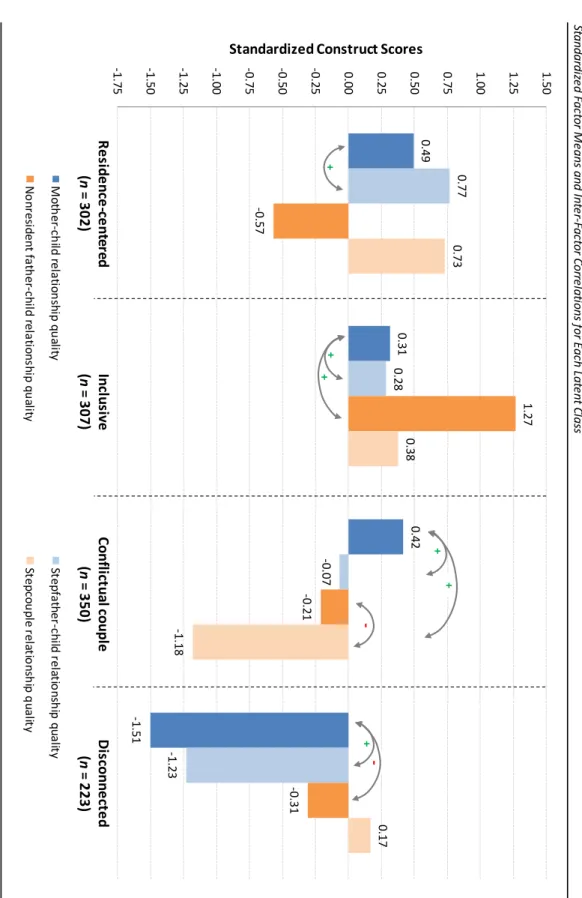
(Asparouhov & Muthén, 2014). In Class 1, the residence-centered pattern (n = 302; 25.5%), participants reported above-average mother-child (Z = .49) stepfather-child (Z = .77), and stepcouple (Z = .73) relationship quality; however, youth in this class reported below-average relationship quality with the nonresident father (Z = -.57). In Class 2, the inclusive pattern (n = 307; 26%), participants reported above-average mother-child (Z = .31), stepfather-child (Z = .28), nonresident father-child (Z = 1.27), and stepcouple (Z = .38) relationship quality. Most notable was the extent to which nonresident father-child relationship quality deviated positively from the sample mean (about 1.3 standard deviations). Participants in Class 3, the conflictual couple pattern (n = 350; 29.6%), reported above-average mother-child relationship quality (Z = .42), nearly average stepfather-child relationship quality (Z = -.07), and below-average
.17). Notably, levels of mother-child and stepfather-child relationship quality were very low in this class.
In terms of significant mean differences between latent classes, results indicated that the residence-centered, inclusive, and conflictual couple patterns had significantly higher mother-child relationship quality than the disconnected pattern; and the residence-centered pattern had higher mother-child relationship quality than the inclusive pattern. The residence-centered pattern had significantly higher stepfather-child relationship quality than the other three groups; and the inclusive pattern had significantly higher stepfather-child relationship quality than the disconnected pattern. The inclusive pattern had significantly higher nonresident father-child relationship quality than the other three groups; and the conflictual couple pattern had significantly higher nonresident father-child relationship quality than the residence-centered pattern. The residence-centered pattern had significantly higher stepcouple relationship quality than the other groups; the inclusive and disconnected patterns had significantly higher stepcouple relationship quality than the conflictual couple pattern; and the inclusive pattern had significantly higher levels of stepcouple relationship quality than the disconnected pattern. Refer to Table 1.2 for more details.
Factor Variances and Inter-Factor Covariances. Each latent class had significant within-class variance for all four factors with one exception: there was not significant variance for nonresident father-child relationship quality in the inclusive pattern. Moreover, each class had unique patterns of inter-factor covariance, which is represented in Figure 1.1. In the residence-centered group, mother-child and stepfather-child relationship quality had positive covariance. This indicated that the quality of the mother-child relationship and the quality of the stepfather-child relationship tended to increase or decrease in concert. In the inclusive pattern, mother-stepfather-child relationship quality had positive covariance with both stepfather-child relationship quality and nonresident father-child relationship quality. In the conflictual couple pattern, mother-child relationship quality had positive covariance with both stepfather-child relationship quality and stepcouple relationship quality. In addition, nonresident father-child relationship quality had negative covariance with stepcouple relationship quality. This indicated that the quality of the nonresident father-child relationship tended to increase when the quality of the stepcouple relationship decreased, or vice versa. In the disconnected pattern, mother-child relationship quality had positive covariance with stepfather-child relationship quality, but negative
covariance with nonresident father-child relationship quality. This indicated that the quality of the mother-child and nonresident father-child relationships tended to vary in opposition to each other. Details about measurement parameters and class-specific covariance matrices are available upon request.
Factor-Mixture Validation
Table 1.3 displays class-specific means/proportions, standard errors, and Z scores for all covariates used to help validate the factor-mixture solution. Results indicated that the
residence-centered (48%), inclusive (44%), and disconnected (44%) patterns. Youth in the disconnected pattern (M = 15.87 years; Z = .14) were also significantly older than youth in the inclusive (M = 15.20 years; Z = -.26) and disconnected (M = 15.29 years; Z = -.20) patterns. The inclusive (79%) and disconnected (79%) patterns had a larger proportion of youth who identified as non-Hispanic White compared to youth in the residence-centered (68%) pattern. The
residence-centered pattern (8%) had a larger proportion of youth who identified as Asian/Native American/Other compared to youth in the inclusive (1%) and disconnected (2%) patterns. Mothers in the inclusive pattern (M = 2.76; Z = .21) reported higher levels of education than mothers in the residence-centered pattern (M = 2.43; Z = -.15); household income was significantly higher among those in the inclusive pattern (M = 58.04 in thousands; Z = .18) compared to those in the conflictual couple pattern (M = 45.03 in thousands; Z = -.11). Mothers in the inclusive pattern (M = 2.15; Z = .13) also reported having more past romantic relationships in the past 18 years than mothers in the conflictual couple pattern (M = 1.98; Z = -.10).
Stepfamily duration was significantly longer among those in the residence-centered (M = 6.65 years; Z = -.02), conflictual couple (M = 6.80 years; Z = .02), and disconnected (M = 7.39 years; Z = .16) patterns compared to those in the inclusive pattern (M = 5.54 years; Z = -.29).
In terms of stepcouple stability, the residence-centered pattern (96%) had a significantly larger proportion of mothers who indicated they had not discussed separating from their partners compared to the inclusive (88%), conflictual couple (63%), and disconnected (83%) patterns; proportions in the inclusive and disconnected patterns were also higher than that in the conflictual couple pattern. Youth in the disconnected pattern (M = 1.11; Z = .83) reported
residence-centered pattern (M = .10; Z = -.27) reported significantly lower levels of delinquent behavior than youth in the inclusive (M = .16; Z = -.10), conflictual couple (M = .27; Z = .26), and disconnected (M = .17; Z = -.07) patterns; youth in the inclusive pattern reported
significantly lower levels of delinquent behavior than youth in the conflictual couple pattern. Youth in the residence-centered pattern (M = 4.30; Z = .37) reported significantly higher levels of self-esteem than youth in the inclusive (M = 4.17; Z = .16), conflictual couple (M = 4.17; Z = .15), and disconnected (M = 3.53; Z = -.91) patterns; youth in the inclusive and conflictual couple patterns also reported higher levels of self-esteem than youth in the disconnected pattern.
Discussion
Results from the current study highlight four possible stepfamily subpopulations marked by unique constellations of dyadic relationship quality and patterns of relationship-quality interdependencies. The residence-centered pattern illustrates a stepfamily system in which residential relationships are all high-quality and, in part, positively reinforcing. These
stepfamilies could represent highly integrated, adaptable, and pattern-maintaining systems with unified goals and boundaries centered around household residents and a nuclear family model (Robbins et al., 2012). Given the low levels of nonresident father-child relationship quality, nonresident fathers associated with this stepfamily type might be absent, disengaged, or excluded from the system.
reinforcing, signaling a unified coparental regime. Moreover, these stepfamilies are marked by higher levels of mothers’ education and household income—an indication that the family possesses the systemic resources needed to facilitate and sustain high-quality dyadic
relationships, especially the relationship between youth and nonresident fathers, by providing the means to pay for youth travel and other coparenting expenses.
Whereas the residence-centered and inclusive patterns appear to possess goal-consensus and synergy (consistent with systems theory ideals), the conflictual couple and disconnected patterns appear to illustrate goal-divergent and conflictual systems (consistent with conflict theory; Robbins et al. 2012). Stepcouple relationships in the conflictual couple pattern are particularly burdened by conflict and sensitive to the quality of the nonresident father-child relationship. High-quality nonresident father-child relationships could lead stepfathers to
experience role ambiguity, the negative consequences of which spilling over into the stepcouple relationship (e.g., stepcouple disagreements about parenting strategies, nonresident father involvement, and the stepparent role). Conversely, as stepcouple relationship quality improves, the stepfather might acquire greater acceptance from his stepchildren (Jensen & Shafer, 2013), resulting in stepchildren shifting time and energy away from the nonresident father in an effort to invest in the stepfather-child relationship. The conflictual couple pattern might possess other divergent goals, such that mothers seek to sustain strong bonds with their children whereas stepfathers primarily seek to forge a strong stepcouple bond. Cases in which there are insufficient resources to realize both of those goals, stepfamilies could display high-quality mother-child relationships and low-quality stepcouple relationships.
In the disconnected pattern, conflict, competition for resources, and triangulation
relationships—an indication of a compromised coparental relationship. Moreover, youth in this group appear to adjust poorly to stepfamily life, perhaps as a result of their own divergent goals and systemic rebellion (e.g., youth giving priority to biological ties, peer relationships, or pre-stepfamily dynamics), leading to strained mother-child and stepfather-child relationships. This might be particularly true if mothers and stepfathers seek to attain goals that focus on developing the stepcouple relationship, as evidenced by high-quality stepcouple relationship quality.
Unfortunately, youth in the disconnected pattern also report relatively low-quality relationships with their nonresident fathers, giving them few sources of reliable parental support. The
significantly larger proportion of female stepchildren in this group compared to the other groups matches previous research suggesting that female stepchildren, on average, report lower-quality parent-child relationships in stepfamilies than male stepchildren (Jensen & Howard, 2015). The higher average age of youth is also consistent with past research suggesting that older
stepchildren report lower-quality stepfamily relationships than younger stepchildren (Jensen & Howard, 2015).
Pattern differences in terms of youth racial/ethnic identify are not easily interpretable; however, the fact that youth identifying as non-Hispanic Black or Hispanic are no more or less likely to be represented in any specific pattern suggests that these youth might not be at any particular risk in terms of stepfamily relationship quality. Stepfamilies with members identifying as Asian, Native American, or as members of other racial minority groups might possess distinct strengths as they have the most representation in the residence-centered pattern compared to the other patterns. On the other hand, stepfamilies with youth identifying as non-Hispanic White are less represented in the residence-centered pattern compared to other patterns. Future research should assess racial/ethnic identity and other socio-demographic factors as they relate to complex examinations of stepfamily relationship quality.
The factor-mixture solution is further validated by predictable pattern differences across substantive covariates. Not surprisingly, the proportion of mothers who discussed ending the relationship with their partners was commensurate with the level of stepcouple relationship quality in each pattern. Differences in youth adjustment between pattern also provide tentative evidence that patterns of stepfamily processes have implications for youth well-being. A combination of below-average mother-child, stepfather-child, and nonresident father-child relationship quality (i.e., the disconnected pattern) is associated with the highest levels of depression among youth. In this context, youth likely have no solid parent-child relationship on which to rely when distressed or in need of support, leading to internalizing problems
(Hetherington, 2003).
Despite having near- or above-average parent-child relationship quality, youth in
behaviors. This link might be explained, in part, by emotional security theory, which focuses attention on children’s regulatory response systems in the context of parental conflict or other threats to emotional security (Davies & Cummings, 1994). Youth self-esteem appears most closely connected to parent-child relationship quality, consistent with research on youth
adaptation to family transitions (Hetherington, 2003). The similarity in well-being between youth in the residence-centered and inclusive patterns could stem from a compensatory phenomenon, such that youth derive psychological and behavioral benefits when the cumulative quality across parent-child relationships is high, regardless of which specific parent-child relationship is most high-quality (e.g., King, 2006).
Limitations and Future Research
Any conclusions drawn from this study should be tempered by some limitations. In the context of mixture modeling it can be challenging to actually prove whether latent classes truly exist (Bauer & Curran, 2003). Instead, latent classes should be viewed as helpful approximations of unobserved population heterogeneity, insomuch as validation analyses and substantive
interpretations warrant it. Moreover, the process of selecting a factor-mixture solution is informed by both objective information criteria and substantive interpretation. Thus, future research should seek to replicate the findings produced here, and alternative explanations for the final solution should be considered. I will note, however, that each identified typology is highly compatible with the theoretical framework used to guide and inform this study, lending
confidence to the interpretation and validity of results.
fathers and stepmothers or by same-sex couples. Third, although I highlight associations between stepfamily-process patterns and concurrent youth adjustment, future research should incorporate longitudinal data and assess the influence of patterns on youth adjustment over time.
Longitudinal analyses can help overcome ambiguity relating to the temporal order of
REFERENCES: PAPER I
Amato, P., Booth, A., Johnson, D., & Rogers, S. (2007). Alone together: How marriage in America is changing. Cambridge, MA: Harvard University Press.
Amato, P. R., & Gilbreth, J. G. (1999). Nonresident fathers and children's well-being: A meta-analysis. Journal of Marriage and Family, 61, 557-573.
Amato, P. R., King, V., & Thorsen, M. L. (2015). Parent-child relationships in stepfather
families and adolescent adjustment: A latent class analysis. Journal of Marriage and Family, 78, 482-497.
Aquilino, W. S. (2006). The noncustodial father–child relationship from adolescence into young adulthood. Journal of Marriage and Family, 68, 929-946.
Asparouhov, T., & Muthén, B. (2014). Auxiliary variables in mixture modeling: Three-step approaches using Mplus. Structural Equation Modeling: A Multidisciplinary Journal, 21, 329-341.
Bauer, D. J., & Curran, P. J. (2003). Distributional assumptions of growth mixture models: Implications for overextraction of latent trajectory classes. Psychological Methods, 8, 338-363.
Brown, S. L., & Manning, W. D. (2009). Family boundary ambiguity and the measurement of family structure: The significance of cohabitation. Demography, 46, 85-101.
Bzostek, S. H. (2008). Social fathers and child well-being. Journal of Marriage and Family, 70, 950-961.
Cherlin, A. (1978). Remarriage as an incomplete institution. American Journal of Sociology, 84, 634-650.
Clark, C. L., Muthén, B. O., Kaprio, J., D'Onofrio, B. M., Viken, R., & Rose, R. J. (2013). Models and strategies for factor mixture analysis: An example concerning the structure underlying psychological disorders. Structural Equation Modeling: A Multidisciplinary Journal, 20, 681-703.
Coleman, M., Ganong, L., & Fine, M. (2000). Reinvestigating remarriage: Another decade of progress. Journal of Marriage and Family, 62, 1288-1307.
Coleman, M., Ganong, L., & Russell, L. (2013). Resilience in stepfamilies. In D. Becvar (Ed.), Handbook of family resilience (pp. 85-103). New York: Springer.
Davies, P. T., & Cummings, E. M. (1994). Marital conflict and child adjustment: an emotional security hypothesis. Psychological Bulletin, 116(3), 387.
Dunn, J., O'Connor, T. G., & Cheng, H. (2005). Children's responses to conflict between their different parents: Mothers, stepfathers, nonresident fathers, and nonresident stepmothers. Journal of Clinical Child and Adolescent Psychology, 34, 223-234.
Enders, C. K. (2010). Applied missing data analysis. New York: Guildford Press.
Ganong, L., & Coleman, M. (2017). Stepfamily relationships: Development, dynamics, and interventions (2nd ed.). New York: Springer.
Ganong, L. H., Coleman, M., & Jamison, T. (2011). Patterns of stepchild–stepparent relationship development. Journal of Marriage and Family, 73, 396-413.
Hawkins, D. N., Amato, P. R., & King, V. (2007). Nonresident father involvement and adolescent well-being: Father effects or child effects? American Sociological Review, 72, 990-1010.
Hetherington, E. M. (2003). Social support and the adjustment of children in divorced and remarried families. Childhood, 10, 217-236.
Hetherington, E. M., Bridges, M., & Insabella, G. M. (1998). What matters? What does not? Five perspectives on the association between marital transitions and children's adjustment.
American Psychologist, 53, 167-184.
Jensen, T., & Howard, M. O. (2015). Perceived stepparent-child relationship quality: A systematic review of stepchildren's perspectives. Marriage & Family Review, 51, 99-153. Jensen, T., & Shafer, K. (2013). Stepfamily functioning and closeness: Children’s views on
second marriages and stepfather relationships. Social Work, 58, 127-136.
Jensen, T., Shafer, K., & Holmes, E. (2015). Transitioning to stepfamily life: The influence of closeness with biological parents and stepparents on children’s stress. Child & Family Social Work. Advance online publication. doi:10.1111/cfs.12237
Jensen, T., Shafer, K., & Larson, J. (2014). (Step)parenting attitudes and expectations:
Implications for stepfamily functioning and clinical intervention. Families in Society: The Journal of Contemporary Social Services, 95, 213-220.
Kennedy, S., & Ruggles, S. (2014). Breaking up is hard to count: The rise of divorce in the United States, 1980–2010. Demography, 51, 587-598.
King, V., Amato, P. R., & Lindstrom, R. (2015). Stepfather–adolescent relationship quality during the first year of transitioning to a stepfamily. Journal of Marriage and Family, 77, 1179-1189.
King, V., Boyd, L. M., & Thorsen, M. L. (2015). Adolescents' perceptions of family belonging in stepfamilies. Journal of Marriage and Family, 77, 761-774.
King, V., Thorsen, M. L., & Amato, P. R. (2014). Factors associated with positive relationships between stepfathers and adolescent stepchildren. Social Science Research, 47, 16-29. Kline, B. (2011). Principles and practice of structural equation modeling (3rd ed.). New York:
The Guilford Press.
Kreider, R. & Ellis, R. (2011). Living arrangements of children: 2009. Washington, DC: U.S. Census Bureau.
MacCallum, R. C., Browne, M. W., & Sugawara, H. M. (1996). Power analysis and
determination of sample size for covariance structure modeling. Psychological Methods, 1, 130-149.
Muthén, B. (2008). Latent variable hybrids: Overview of old and new models. In G. R. Hancock & K. M. Samuelsen (Eds.), Advances in latent variable mixture models (pp. 1-24). Charlotte, NC: Information Age.
Muthén, L.K., & Muthén, B.O. (2012). Mplus user’s guide (7th ed.). Los Angeles, CA: Muthén & Muthén.
Noah, A. J. (2015). Putting families into place: Using neighborhood-effects research and activity spaces to understand families. Journal of Family Theory & Review, 7, 452-467.
Papernow, P. (2013). Surviving and thriving in stepfamily relationships: What works and what doesn’t. New York: Routledge.
Patterson, J. (2002). Integrating family resilience and family stress theory. Journal of Marriage and Family, 64, 349-360.
Pew Research Center. (2011). Pew social & demographic trends survey. Washington, DC: Pew Research Center.
Radloff, L. S. (1977). The CES-D scale a self-report depression scale for research in the general population. Applied Psychological Measurement, 1, 385-401.
Robbins, S. P., Chatterjee, P., & Canda, E. R. (2012). Contemporary human behavior theory: A critical perspective for social work (3rd ed.). Upper Saddle River, NJ: Pearson.
Sawyer, S. M., Afifi, R. A., Bearinger, L. H., Blakemore, S. J., Dick, B., Ezeh, A. C., & Patton, G. C. (2012). Adolescence: a foundation for future health. The Lancet, 379(9826), 1630-1640.
Schrodt, P. (2006). A typological examination of communication competence and mental health in stepchildren. Communication Monographs, 73, 309-333.
Sobolewski, J. M., & King, V. (2005). The importance of the coparental relationship for nonresident fathers’ ties to children. Journal of Marriage and Family, 67, 1196-1212. Sweeney, M. M. (2010). Remarriage and stepfamilies: Strategic sites for family scholarship in
the 21st century. Journal of Marriage and Family, 72, 667-684.
Walsh, F. (2002). A family resilience framework: Innovative practice applications. Family Relations, 51, 130-137.