ALL IN THE FAMILY: EVALUATING VOTER RESPONSE TO NEGATIVE CAMPAIGN ADVERTISEMENTS IN INTRA-PARTY CONTESTS
Steven W. Sparks
A thesis submitted to the faculty of the University of North Carolina at Chapel Hill in partial fulfillment of the requirements for the degree of Master of Arts in the Department of Political Science, Concentration American Politics.
Chapel Hill 2015
ABSTRACT
STEVEN W. SPARKS: All in the Family: Evaluating voter response to negative campaign advertisements in intra-party contests
(Under the direction of Thomas Carsey.)
Scholars have shown that voters are constrained by party identity in their reactions to nega-tive attacks sponsored by in-group candidates. If party cues are no longer a reliable source for evaluating ad content, how do voters interpret and respond to negative advertising? The present research compares viewer responses to negative political advertising in one-party and two-party contests. Findings support a theory of “unconstrained backlash” in which negativity in both types of contests cause similar decreases in evaluations of the sponsor candidate, but the lack of constraints on party identity cause voters to cast harsher punish-ments upon ad sponsors in one-party contests.
TABLE OF CONTENTS
LIST OF TABLES . . . v
LIST OF FIGURES . . . vi
Introduction . . . 1
Partisanship, Social Identity, and Impression Formation . . . 2
Constrained Backlash to Negative Advertising in Two-Party Contests . . . 4
Negativity in Intra-Party Contests: A Theory of Unconstrained Backlash . . . 7
Research Design . . . 8
Results . . . 11
Discussion . . . 14
Appendix A: Candidate Profiles . . . 18
Appendix B: Results from Permutation Testing . . . 20
LIST OF TABLES
Table
1 Respondent Ideology and Partisanship . . . 11 2 Respondent Feeling Thermometer Evaluations of Negative Ad Sponsor . . 12 3 Change in Vote Choice After Negative Ad Treatment . . . 13
LIST OF FIGURES
Figure
1 Experimental Treatment Groups . . . 9
2 Two-Party Candidate Profiles for Republican Respondents . . . 10
3 Two-Party Candidate Profiles for Democratic Respondent . . . 18
4 One-Party Candidate Profiles for Republican Respondents . . . 18
Introduction
Televised political advertisements are often credited for their role in shaping voter be-havior. Political ads enable citizens to learn and retain important distinctions about the can-didates that they would likely otherwise not learn (Freedman et al. 2004; Jamieson 1992). Negative political television advertisements, in particular, are credited by many scholars for having profound effects on voting behavior and electoral outcomes by mobilizing cer-tain segments of the electorate and therefore increasing turnout (Djupe and Peterson 2002; Freedman et al. 2004; Jackson and Carsey 2007; Lau and Pomper 2001; Wattenberg and Brians 1999).
The vast majority of existing research, however, explores how voters respond to negative political messaging in standard two-party contests (see Carraro and Castelli 2010; Freed-man and Goldstein 2002; Jackson and Carsey 2007; Lau and Pomper 2001; Matthews and Dietz-Uhler 1998; Stevens et al. 2008). What receives less attention, however, is how voter perceptions, and subsequently their voting behavior, are shaped when two competing can-didates are not from opposing parties. Very little is known about how negative advertising affects voter behavior in both non-partisan and single-party contexts, yet a vast number of contests fall within one of these two categories. We cannot yet fully evaluate the true effects of negative advertising because we do not know how they shape behavior in the absence of party cues.
the in-group and devaluing the status of the out-group (Brewer 1993; Tajfel 1981). When partisanship no longer creates a bias with which people interpret political information in the context of a one-party or nonpartisan race, it should be expected that viewer responses to political advertising will be fundamentally different than in a two-party context.
While voters that dislike negative campaigning may lower their overall evaluation of an in-group candidate that attacks someone of the out-party, it is expected that they will be constrained by their partisan identification and ultimately still vote for the in-group candi-date. When the candidate is attacking someone of the same party, however, this constraint is no longer present. This paper proposes a theory ofunconstrained backlashwhereby voters will be more likely to abandon support for an in-group candidate when they attack someone of the same party than when they attack someone of the opposing party.
In this study, I conduct an experiment to test whether there is a difference in the way that respondents perceive and react to negative advertisements in one-party versus two-party contests. Using a hypothetical race between two candidates running for the U.S. House of Representatives, I measure respondent vote choices and overall evaluations of the negative ad sponsor before and after viewing the advertising treatment. Results show that negative advertising causes similar decreases in evaluations of the ad sponsor in both one-party and two-party contests, however, respondents are more likely to withdraw support from both the target and sponsor of the advertisement in a one-party contest.
Partisanship, Social Identity, and Impression Formation
in low-information contests such as U.S. House elections (Abramowitz 1980; Converse 1966; McDermott 1997; Stokes and Miller 1966), where the majority of citizens are unable to make sophisticated, well-informed voting choices. Yet despite lacking detailed knowl-edge of candidates and issues, voters are quite adept at using cues to make ideologically-consistent decisions (McDermott 1997). Voters use party identification, in particular, as an information shortcut to make meaningful inferences about candidate ideology (Conover and Feldman 1982; McDermott 1997; Tversky and Kahneman 1974).
Whether caused by party sorting (Levendusky 2009; Nivola and Brady 2006), ideologi-cal polarization (Abramowitz 2010; Bafumi and Shapiro 2009), or conflict extension (Lay-man and Carsey 2002), the contemporary party system now presents voters with clearly distinct images of the two major parties. Even inattentive voters are able to adopt positions that match up with their party affiliation on issues of which they have little detailed knowl-edge. With the two parties growing farther apart and easier to distinguish from each other ideologically, it has become easier for voters to interpret important cues that inform them about the policy implications that might arise from this inter-party competition.
Party identity plays an important role in the way that people view and interpret the political world around them. According to social identity theory, membership in a given group shapes a person’s self-concept through the value and emotional significance that this membership plays for identity. Humans naturally seek positive distinctiveness for their own group, which they resolve by making dichotomous social comparisons of “us” vs. “them” (Brewer 1993; Tajfel 1981). Humans naturally exaggerate perceptual contrasts between one’s in-group and the out-group (Turner et al. 1987), seeking to raise the status of their own group while simultaneously lowering their evaluation of the out-group by evaluating information in a manner that is consistent with this view of the world. In this way, social identity acts as a lens through which people make evaluations. When an identity becomes a salient lens in a given context, it leads to perceptual and attitudinal biases that favor the in-group and devalue the outgroup, altering perception of external actors and events. (Tajfel 1978).
Importantly, partisanship acts as a fundamental aspect of social identity (Green 1999),
contributing to one’s perception of both the self and the outside world. Therefore, it should be the case that electoral contexts that make this aspect of a voter’s identity a salient lens through which they process information will be fundamentally different from those that do not. When candidates and advertising messages are evaluated in a manner that seeks to maintain positive distinctiveness for the in-group, there should be important biases in infor-mation processing that may not be present when party identity is not a salient lens through which voters process these stimuli. In the context of the present research, it is expected that partisanship will become a salient component of respondents’ social identity when evalu-ating a contest between two candidates of opposing parties, but not when both candidates are of the same party. This should have important consequences for how viewers shape their candidate evaluations and importantly, how they ultimately make voting decisions in response to negative advertising.
Given what we know about the effect of partisanship on information processing, how does the presence or absence of party cues affect the ways that viewers respond to negative advertising? How do voters react to stimuli when they are no longer able to rely on partisan cues to shape perceptions as influenced by their social identity?
Constrained Backlash to Negative Advertising in Two-Party Contests
Stroh use an experimental setting with respondents assigned either a negative or positive descriptive treatment of a candidate running for office. Respondents emphasized their pol-icy disagreements with candidates who were described negatively, while they ignored their policy disagreements with candidates who were described in a positive manner (1996).
While preference-inconsistent information is often discredited and dismissed, it also tends to further polarize views among partisans. Recent work has shown that when respon-dents learned additional information about the death penalty (Peffley and Hurwitz 2007), the Iraq War (Gaines et al. 2007; Nyhan and Reifler 2007), political candidates (Redlawsk 2002), or tax policy (Nyhan and Reifler 2007), the broad finding is that the discovery of new incongruent information usually further polarizes opinions rather than moderating them. Not surprisingly, this effect also occurs in response to viewing negative advertisements. An ad that attacks the candidate of the viewer’s preferred party will typically cause defensive reactions that favor the in-group rather than cause an erosion of support for the target. Par-tisans tend to see negative attacks against their favored candidate as unfounded (Stevens et al. 2008). Televised attack ads also mobilize voters who support the target candidate due to the perceived threat to their candidate and party (Martin 2004) while simultaneously evok-ing feelevok-ings of sympathy among viewers who support the target candidate, a phenomenon known as thevictim syndrome effect(Franz and Ridout 1997).
While the threshold for tolerance of negativity may be higher when attack ads target the outgroup, evidence shows that voters are repelled by negativity regardless of who sponsors the advertisement. Despite the influence of motivated reasoning, voter frustration with negative advertising isn’t limited to that which comes from the opposing party. People simply dislike negative attacks; when a viewer’s preferred candidate attacks the opposition, viewers tend to lower their evaluations of their own candidate, distancing themselves from their candidate in this backlash reaction once they perceive that the attacks that have gone too far, a response known as the black-sheep effect (Carraro and Castelli 2010; Matthews and Dietz-Uhler 1998).
In addition to lowering viewers’ evaluations of the attacking candidate, experimental-based research on campaign advertising argues that negativity turns voters off from the
process entirely. When asked about their likelihood of voting, respondents in negative treatment groups report that attacks make them less likely to go to the polls on election day altogether (Ansolabehere et al. 1994; Ansolabehere et al. 1999; Kahn and Kenney 1999). There is disagreement about this effect, however, with observational research instead showing that heightened negativity raises the urgency of a contest, creating a perception of threat and thereby increasing turnout (Djupe and Peterson 2002; Freedman et al. 2004; Jackson and Carsey 2007; Lau and Pomper 2001; Wattenburg and Brians 1999).
Despite the lack of consensus between these two strains of research, the important point is that respondents in experimental settings are so repelled by negative campaigning that they report a desire to sit the process out entirely. In accordance with the black sheep effect, voter evaluations in response to attacks aired by their own candidates is so off-putting that they no longer want to support their own party. It should be meaningful that this pattern persists even when attacking the opposing team. Given all that we know about motivated reasoning and the perceptual and attitudinal biases imposed by social identity, it may be surprising that partisans don’t relish the thought of tearing down the opponent. The aforementioned research on theblack sheep effectand on viewer response to negativity, however, suggest strongly that viewers dislike negativity without regard for whom the ad is attacking. It is this mechanism that motivates the first hypothesis:
Hypothesis 1: There should be no difference in the degree to which respondents will lower their evaluations of an in-group negative ad sponsor, regardless of whether the candidate is attacking somebody of the opposing party or somebody of the same party.
op-posing team. Voting for the opop-posing party lowers a strong partisan’s self-evaluation by placing them among deviants in their own in-group while simultaneouslyraisingthe status of the out-group. We might consider the betrayal felt among Democrats when Georgia Sen-ator Zell Miller endorsed President Bush for re-election in 2004. The subsequent backlash among copartisans and branding of him as a “Zell Out” serves as an example of this effect. This desire to maintain self-esteen and positive distinctiveness helps partisans stay loyalty to their respective teams.
Negativity in Intra-Party Contests: A Theory of Unconstrained Backlash
Past research explains the role of negative advertising in shaping voter behavior in two-party contests in which partisanship and social identity act as constraining mechanisms that limit voters from defecting from their party when campaigns become overly negative. When both candidates are of the same party, however, partisanship is no longer a salient lens through which citizens view the dynamics of the contest. Differences in party cues should not drive vote choice anymore, so the forces of social identity would no longer direct the voter into viewing the contest in an “us” vs. “them” scenario. Absent the pressures of vot-ing against their own social identity and thereby supportvot-ing the out-group, voters should be better able to shift their support from one candidate to the next without devaluing the status and self-esteem they derive from that identity. With the effects of partisan constraint no longer present, voters should instead demonstrate what I callunconstrained backlashwhen their preferred candidate is overly negative. By this, I mean that when negativity leads re-spondents to lower their evaluations of the ad sponsor in a two-party contest, their backlash will be constrained by party ID and they should still vote for their in-group candidate. In contrast, negativity in a one-party setting will not have these same constraining features of partisanship, allowing respondents to abandon support for their candidate more easily.
Additionally, since social identity theory dictates that people seek positive distinctive-ness from their in-group (Brewer 1993; Tajfel 1981), voters should find negative attacks against any candidate of their in-group to be intolerable. Research shows that in-group members derogate in-group deviants more so than out-group deviants (Abrams et al. 2014).
Here, candidates that tear down one of their own party members are the ultimate in-group deviants. If this lowers the threshold for causing a victim syndrome effect among voters when both candidates are of the in-group, then voters should more readily abandon support for a candidate in response to negative attack advertisements in intra-party contests.
It is these combined mechanisms that motivate the second hypothesis:
Hypothesis 2: The negative ad sponsor will lose more supporters after running a nega-tive attack in a one-party contest than in a two-party contest.
One might argue that it would be unusual to observe a contest where only one candi-date goes negative, making these expectations normatively uninteresting. The goal in this experimental setting, however, is to isolate the impact of negativity on both the sponsor and the target. An experiment in which both candidates attacked each other would be unable to isolate this effect, making it unclear whether the evaluation changed because they were the target or because they were the sender. Here, however, it allows us to isolate effects that would be next to impossible to disentangle in observational data.
Research Design
To test the theory of unconstrained backlash, I create an experiment to measure can-didate evaluations and vote choice for a hypothetical scenario in which a cancan-didate who is of the respondent’s in-group party launches a negative attack against an opponent. The experimental manipulation included a control group with two candidates of opposite par-ties, while the treatment group included two candidates that were of the same party as the respondent.
Respondents were first asked to report their partisan affiliation to determine whether they would be assigned to a treatment where the ad sponsor was a Republican or a Demo-crat. Those who reported no party affiliation were asked to choose which party they agree with most often. Respondents who reported neither party were dropped from the study1
1In total, 60 of 435 respondents were dropped from the results, representing 13.7% of the original sample.
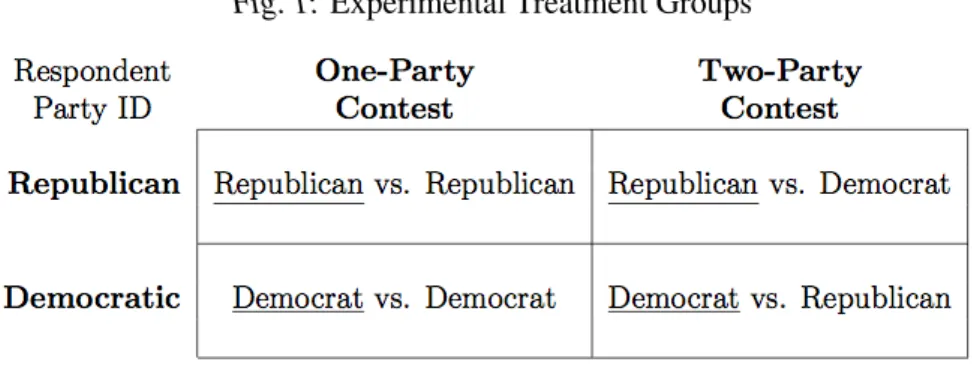
Fig. 1:Experimental Treatment Groups
because the experiment is concerned with evaluating the ways in which partisanship shapes perception of information and changes voting behavior.
Participants were then randomly assigned into one of four treatments shown in Figure 1. Each manipulation consisted of a hypothetical matchup between two candidates for the U.S. House of Representatives. The names and photographs of the sponsor candidate and target candidate were consistent across all four treatment groups. Below, the underlined candidate indicates the ad sponsor. In each treatment group, the respondent and the ad sponsor are of the same political party, while the party of the ad target varies between in-party and out-party members.
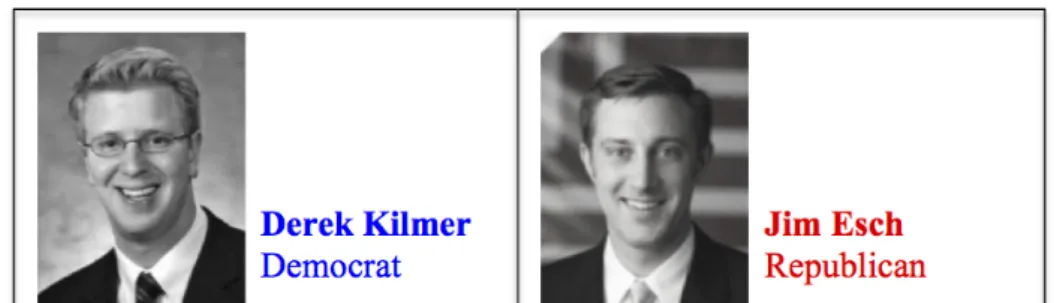
Respondents were presented with a side-by-side profile of both candidates, shown in Figure 2. Candidate profiles from the remaining three manipulations are presented in Ap-pendix A. Respondents were asked to review the stated positions on three issues: climate change, abortion, and the economy. These were chosen because they represent three highly salient issues in the current political climate and allow for distinct preferences to be formed in a hypothetical laboratory setting.
In all treatment groups, photographs and names of the ad sponsor and target were held constant. Both candidates are depicted as white males in their early 40s to limit the in-tervening effects of race, gender, or age for respondent evaluations. Issue positions for the Republican and Democratic candidates were held constant across both of the two-party treatment groups. The experiment is investigating respondent evaluations of the ad sponsor, so issue positions of the ad sponsors in the one-party treatment groups were the same as those of the adsponsorsin two-party treatment groups. See Appendix A for the complete
Fig. 2:Two-Party Candidate Profiles for Republican Respondents ! Jim Esch Democrat Derek Kilmer Republican
Pro-choice: Abortion should be safe, legal, and rare. Contraception should be provided by insurance providers.
Climate Change: Climate change is a disastrous consequence of human activity. Congress must take action before it’s too late.
Jobs/Economy: We need real tax fairness that requires millionaires and billionaires to pay their fair share.
Pro-life: I am committed to protecting the rights of the unborn and reversing pro-abortion policies.
Climate Change: Our planet is in a natural climate cycle. Proposals by environmentalists will further damage our struggling economy,
Jobs/Economy: The government’s role is to get out of the way, helping job creators and entrepreneurs by decreasing regulation.
set of candidate profiles used in each treatment group.
After reviewing the candidate issue positions, respondents were asked to rate the neg-ative ad sponsor according to the ANES 100-point feeling thermometer using a sliding scale tool. Once this was completed, they were asked to report which candidate for which they would be most likely to vote. Choices included Derek Kilmer, Jim Esch, Not Sure, or Neither. This report served as a pre-test of preferences prior to viewing the negative advertisement.
alcohol, implying that the candidate therefore lacks the judgment necessary to be an elected member of Congress. The total runtime of the ad was 20 seconds. Any mentions of party were removed by editing to allow for consistency across all manipulations.
After viewing the ad, respondents were asked to give their vote choice a second time, with the options of Derek Kilmer, Jim Esch, Not Sure, or Neither Candidate. They were also asked to give a second rating of the ad sponsor on the 100-point feeling thermometer. The survey was then concluded.
This survey2 was conducted twice, once in October 2014 and again in February 2015. Participants were recruited via e-mail from introductory American government classes at the University of North Carolina at Chapel Hill. Students completed the survey online and received course credit in exchange for their participation.3 In all, 375 individuals
participated in the experiment. There were no significant differences in the results when comparing the two administrations.
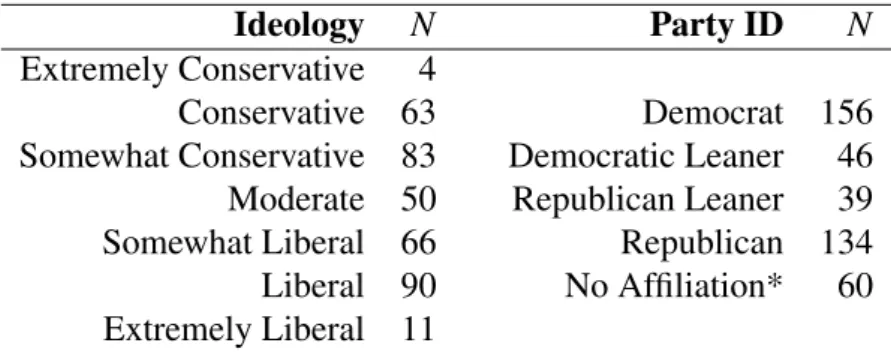
Distribution of respondent ideology and partisanship is presented in Table 1:
Table 1:Respondent Ideology and Partisanship
Ideology N Party ID N
Extremely Conservative 4
Conservative 63 Democrat 156
Somewhat Conservative 83 Democratic Leaner 46 Moderate 50 Republican Leaner 39 Somewhat Liberal 66 Republican 134 Liberal 90 No Affiliation* 60 Extremely Liberal 11
*Respondents with no party affiliation were dropped from the results.
Results
Feeling thermometer evaluations are presented in Table 2. The Initial Rating column lists the mean respondent evaluation of the ad sponsor prior to viewing the negative ad
2IRB number 14-2788.
3The benefits and potential drawbacks of using a student sample are discussed in the conclusion.
treatment. Interestingly, the mean initial rating for the two-party treatment group is 4.8 points higher than that of the one-party treatment group. A difference in means test shows these to be statistically different (p < 0.01). When partisanship becomes a salient lens through which to evaluate the candidates, the baseline evaluation of the ad sponsor raises by nearly 5 points. TheFinal Ratingcolumn lists the mean evaluation of the sponsor candidate
after the respondent has viewed the negative advertisement. Once again, the negative ad sponsor in two-party treatment groups is rated 4.7 points higher than in one-party treatment groups. A difference in means test shows this to be statistically different (p < 0.05). For both treatment groups, the differences between theInitial Rating andFinal Rating means are statistically different (p < 0.01).
Table 2:Respondent Feeling Thermometer Evaluations of Negative Ad Sponsor
N Initial Rating Final Rating Change
One-Party Races 167 64.8 53.5 -11.1
Two-Party Races 155 69.6 58.2 -10.5
Hypothesis 1 predicted that negative ads would lower respondent evaluations of the sponsor candidate similarly in both one-party and two-party contests. The results offer strong support to confirm this prediction. TheChangecolumn in Table 2 shows the mean shift in evaluation between measurements before and after the ad exposure. Mean eval-uations of the sponsor lowered by 11.1 points in one-party contests and by 10.5 points in two-party contests, a difference in means that is not statistically significant (p > 0.7). There is no statistically significant difference between the change in respondent evaluations for the ad sponsor, regardless of whether the attack is launched against an out-party opponent or an in-party opponent. Regardless of whether party identification is made salient through a two-party contest, negativity lowers respondent evaluations of the ad sponsor by approximately 11 points across all treatment group.
party or someone from another party. Put simply, respondents don’t like to see candidates resort to character-based negativity in campaign communications. If there is no meaningful difference in the degree to which partisans lower evaluations of a candidate of their own party between one-party and two-party contests, the remaining question is how this lowered evaluation ultimately shapes voting behavior in both electoral contexts.
In addition to feeling thermometer evaluations, respondents were asked to make a voting decision based on the information provided about each candidate. Table 3 displays the
change in the percentage of respondents that chose each candidate from before viewing the negative ad toafter viewing the ad. For the ad sponsor, Derek Kilmer, the number of supporters declined by 7.4 percentage points after respondents viewed the ad when both candidates were of thesameparty. In contrast, when candidates were fromdifferentparties, the proportion of respondents supporting Kilmer only dropped by 2.7 percentage points. Thus, the drop in support for Kilmer after respondents viewed the ad that he sponsored was 4.7 percentage points larger in the one-party treatment when compared with the two-party treatment. The remaining rows of the table present the same details for the other three vote choice options offered to respondents: Jim Esch (ad target), Neither, or Not Sure. Starred rows in Table 3 indicate whether the difference in difference between the two treatment groups for that vote choice is statistically significantly different.
Table 3:Change in Vote Choice After Negative Ad Treatment
1 Party 2 Parties Vote Choice
Derek Kilmer(sponsor) - 7.4 PP - 2.7 PP Jim Esch(target) - 11.6 PP - 3.8 PP* Neither +4.8 PP +3.2 PP Not Sure +14.3 PP +4.8 PP*
(N= 189) (N= 186) *p<.05
Hypothesis 2 predicted that the negative ad sponsor would lose more supporters in a one-party contest than in a two-party contest. Findings provide evidence to support this hypothesis, although the difference in differences does not reach the conventional threshold of statistical significance. Statistical significance is tested through permutation testing to determine whether that difference in differences is meaningfully different from random
assignment of the treatment variable (see Appendix B). Greater loss for the ad sponsor in a one-party contest fails to reach statistical significance at the conventional .05 level, however, it is worth noting that there is a sizable effect in the expected direction and suggests that the findings of this study warrant further research with a larger sample.
While these results suggest that respondents are more likely to abandon support for the negative ad sponsor in a one-party contest, the findings also demonstrate that voters are more likely to abandon support for the ad target in one-party contests. The targeted candidate lost 7.8 more percentage points in one-party races, which does reach statistical significance under permutation testing. When an ad says something negative about some-body’s preferred candidate, that message is more effective when it comes from a source within the party than when it comes from a source within the rival party.
One critique of this experiment might be that it could be the case in a laboratory setting that respondents simply move their support arbitrarily from one candidate to the other in one-party treatment groups. Results in Table 3 show that this is not the case. Rather, the ad treatment is leaving voters with uncertainty because they are left with the choice between one candidate who sponsored a particularly nasty attack and another candidate who, as the ad claims, used poor judgment and was arrested for driving under the influence of alcohol. Faced with this “lesser of two evils” choice and without a party cue to help them resolve it, a large number of respondents appear to be choosing simply not to choose either candidate. The one-party treatment group experienced a 14.3 percentage pointgainin respondents in theNot Surecategory, compared with a 4.8 percentage point gain in the two-party treatment group.
Discussion
view-ing the ad treatment. It should be of no surprise that partisans exhibit motivated reasonview-ing and motivated skepticism when making voting decisions in a two-party contest. Perhaps more compelling, however, is the finding that in a one-party setting, voters are more likely to punish both the sponsor and the target in response to content of the ad. When party iden-tity no longer constrains respondents to maintain their support for their initial candidate choice, there is greater flexibility to alter behavior based on the ways that political messag-ing is perceived and less evidence of motivated reasonmessag-ing in the interpretation of advertismessag-ing content.
The present research also suggests the importance of source cues for respondent evalua-tions. When respondents who expressed their vote choice as support for thetargetcandidate see attacks coming from the opposite party, they are less likely to abandon support for that candidate than if the attack is coming from the same party. This is important for developing a complete understanding the role of political messaging in primary contests, but not neces-sarily surprising. Although voters may be more willing to abandon support for an in-group candidate that attacks a copartisan, the attack is also more effective in eroding support for the target. It may be that these two mechanisms largely cancel each other out in terms of overall vote percentages earned by each candidate. More normatively troubling, especially in the context of the top-two primary where two candidates of the same party may face each other in the general election, is that single-party contests may ultimately lead to lower voter turnout as a result of these two mechanisms working together.
While the aforementioned findings have captured a meaningful increase of voter un-certainty in response to negative advertising in one-party contests, future research should improve upon this measurement by seeking to uncoverhowvoters handle this uncertainty. It could be that when facing greater confusion that respondents will seek out additional dis-tinguishing information about each candidate that may better direct an informed decision. Uncertainty may lead to less-informed decision-making processes, instead making choices based on varying idiosyncratic features of the contest. Perhaps most plausible is that exces-sive negativity in one-party races will ultimately lead voters to abstain from voting in that contest entirely. It could be the case that abstention in up-ballot, high-salience races could
have a trickle down effect for lower-ticket contests, ultimately having profound impacts for participation and outcomes far beyond the original scope of conflict.
There are limitations to the present research that deserve acknowledgment. A larger sample size in future studies will allow for a stronger test of the theory. Further, using a sample of university students enrolled in an introductory political science course may raise concerns for external validity when it’s impossible for the sample to be representative of the American population as a whole. Further, it may be the case that the young age of the respondents may translate to partisan identifications that are not as strong or developed as would be found in a representative adult sample. If this is the case, however, then arguably this study has served as a conservative test of the hypotheses. Respondents with partisan identifications that have developed over the course of many years and through many elec-tion cycles would perhaps demonstrate a sharper difference between the intra-party and the inter-party treatment groups. Regardless, it is worth noting that past experimental studies have found no significant differences between samples of college students and nationally representative adult subjects (Druckman 2004; Marcus et al. 1995).
Further research would also be well served to investigate how respondent behavior is shaped further by the degree of ideological difference between the candidates. In other words, it may be important differences between how respondents perceive messaging when two candidates of the same party are ideologically similar versus when they are not. In other words, a contest between two ideologically-similar Republicans may elicit far different results than a contest between a moderate Republican and a Tea Party Republican. In the latter example, ideological distinctiveness between two copartisans may lead respondents to exhibit behavior closer to that of a two-party contest.
made salient in two-party contests, respondents show that they lower their evaluation of the negative ad sponsor but are unlikely to abandon support for their party.
Appendix A: Candidate Profiles
Fig. 3: Two-Party Candidate Profiles for Democratic Respondent
Fig. 4:One-Party Candidate Profiles for Republican Respondents
!
Derek Kilmer
Republican Jim Esch Republican
Pro-life: Government employee insurance plans should not pay for contraception or abortions.
Climate Change: Although we should be good environmental stewards, we must create policies under which businesses can thrive.
Jobs/Economy: Cutting government spending will allow us to lower taxes on business that are the engine of our economy.
Pro-life: I am committed to protecting the rights of the unborn and reversing pro-abortion policies.
Climate Change: Our planet is in a natural climate cycle. Proposals by environmentalists will further damage our struggling economy,
Fig. 5:One-Party Candidate Profiles for Democratic Respondents
!
Jim Esch
Democrat
Derek Kilmer
Democrat
Pro-choice: Abortion should be safe, legal,
and rare. Contraception should be provided by insurance providers.
Climate Change: Climate change is a
disastrous consequence of human activity. Congress must take action before it’s too late.
Jobs/Economy: We need real tax fairness
that requires millionaires and billionaires to pay their fair share.
Pro-life: Women should be able to make
reproductive and health care decisions without government interference.
Climate Change: Government should offer tax
incentives to consumers that encourages green technology that invest in green technology and
Jobs/Economy: Raising the minimum wage
will help working-class families make ends meet.
REFERENCES
Abramowitz, Alan. 2010. The Disappearing Center: Engaged Citizens, Polarization, and
American Democracy.New Haven: Yale University Press.
Abrams, Dominic. 1994. “Political Distinctiveness: An Identity Optimizing Approach.”
European Journal of Social Psychology24: 357-365.
Abrams, Dominic and M.A. Hogg. 1988. “Comments on the motivational status of self-esteem in social identity and intergroup discrimination.” European Journal of Social Psychology18: 317-334.
Abrams, Dominic, Sally Palmer, Adam Rutland, Lindsey Cameron, and Julie Van de Vyver, 2013. “Evaluations of and Reasoning About Normative and Deviant Ingroup and Out-group Members: Development of the Black Sheep Effect.” Developmental Psychology
50: 258-270.
Bafumi, Joseph and Robert Shapiro. 2009. “A New Partisan Voter.”The Journal of Politics
71: 1-24.
Bartels, Larry. 2002. “Beyond the Running Tally: Partisan Bias in Political Perceptions.”
Political Behavior24: 117-150.
Brewer, Marilynn, Jorge Manzi and John Shaw. 1993. “In-Group Identification as a Func-tion of DepersonalizaFunc-tion, Distinctiveness, and Status.” Psychological Science 4: 88-92.
Campbell, Angus, Philip Converse, Warren Miller, and Donald Stokes. 1960.The American Voter. Chicago: The University of Chicago Press.
Carey, John, Richard Niemi and Lynda Powell. 2000. “Incumbency and the Probability of Reelection in State Legislative Elections.”The Journal of Politics62: 671-700.
Carraro, Luciana and Luigi Castelli. 2010. “The Implicit and Explicit Effects of Negative Political Campaigns: Is the Source Really Blamed?”Political Psychology31: 617-645. Claasen, Ryan and Benajmin Highton. 2009. “Policy Polarization among Party Elites and the Significance of Political Awareness in the Mass Public.” Political Research Quarterly62: 538- 551.
Conover, Pamela and Stanley Feldman. 1982. “Projection and the Perception of Candi-dates’ Issues.” Western Political Quarterly35: 228-244.
Converse, Philip. 1964. “The Nature of Belief Systems in Mass Publics.” In David Apter,
Ed. Ideology and Discontent. New York: The Free Press.
Ditto, Peter and David Lopez. 1992. “Motivated Skepticism: Use of Differential Deci-sion Criteria for Preferred and Nonpreferred ConcluDeci-sions.” Journal of Personality and Social Psychology63: 568-584.
Djupe, Paul, and David Peterson. 2002. “The Impact of Negative Campaigning: Evidence From the 1998 Senatorial Primary.”Political Research Quarterly55: 845-860.
Duck, J., Hogg, M., and Terry, D. 1995. “Me, Us, and Them: Political Identification and the Third-Person Effect in the 1993 Australian Federal Election.” European Journal of Social Psychology25: 195-215.
Edwards, Kari and Edward Smith. 1996. “A Disconfirmation Bias in the Evaluation of Arguments.”Journal of Personality and Social Psychology71: 5-24.
Fiorina, Morris, Samuel Abrams, and Jeremy Pope. 2005. Culture War? The Myth of a
Polarized America.New York: Pearson.
Fiorina, Morris and Samuel Abrams. 2009.Disconnect: The Breakdown of Representation in American Politics. Norman: University of Oklahoma Press.
Franz, Michael and Travis Ridout. 2007. “Does Political Advertising Persuade?” Political Behavior29: 465- 491.
Freedman, Paul, and Ken Goldstein. 2002. “Campaign Advertising and Voter Turnout: New Evidence for a Stimulation Effect.”The Journal of Politics64: 721-740.
Gaines, Brian, James Kuklinski, Paul Quirk, Buddy Peyton, and Jay Verkuilen. “Same Facts, Different Interpretations: Partisan Motivation and Opinion on Iraq.” The Journal of Politics69: 957-974.
Green, Steven. 1999. “Understanding Party Identification: A Social Identity Approach.”
Political Psychology20: 393-403.
Hale, Jon, Jeffrey Fox, and Rick Farmer. 1996. “Negative Advertisements in US Senate Campaigns: The Influence of Campaign Context.” Social Science Quarterly77: 329-43.
Harrington, Joseph and Gregory Hess. 1996. “A Spatial Theory of Positive and Negative Campaigning.”Games and Economic Behavior17: 209-29.
Herrnson, Paul. 2004.Congressional Elections: Campaigning at Home and in Washington.
Jackson, Robert and Thomas Carsey. 2007. “U.S. Senate Campaigns, Negative Advertising, and Voter Mobilization in the 1998 Midterm Election.”Electoral Studies26: 180-195. Jamieson, Kathleen. 1992. Dirty Politics: Deception, Distraction, and Democracy. New
York: Oxford University Press.
Johnson-Cartee, Karen, and Gary Copeland. 1997. Manipulation of the American Voter: Political Campaign Commercials. Westport: Praeger.
Kahn, Kim Fridkin and Patrick Kenney. 1999. “Do Negative Campaigns Mobilize or Sup-press Turnout?” American Political Science Review93: 877-90.
Kelly, Caroline. 1988. “Intergroup Differentiation in a Political Context.” British Journal of Social Psychology27: 319-332.
Kelly, Caroline. 1989. “Political Identity and Perceived Intragroup Homogeneity.” British Journal of Social Psychology28: 289-301.
Kelly, Caroline. 1990. “Social Identity and Intergroup Perceptions in Minority-Majority Contexts.”Human Relations43: 583-599.
Kunda, Ziva. 1990. “The Case for Motivated Reasoning.” Psychological Bulletin 108: 480-498.
Lau, Richard, and Gerald Pomper. 2001. “Effects of Negative Campaigning on Turnout in U.S. Senate Elections, 1988-1998.” The Journal of Politics63: 804-819.
Layman, Geoffrey and Thomas Carsey. 2002. “Party Polarization and ‘Conflict Extension’ in the American Electorate.”American Journal of Political Science46: 786-802. Levendusky, Matthew. 2009. The Partisan Sort: How Liberals Became Democrats and
Conservatives Became Republicans. Chicago: University of Chicago Press.
Lord, Charles, Lee Ross, and Mark Lepper. 1979. “Biased Assimilation and Attitude Polarization: The Effects of Prior Theories on Subsequently Considered Evidence.”
Journal of Personality and Social Psychology37: 2098-2109.
Martin, Paul. 2004. “Inside the Black Box of Negative Campaign Effects: Three Reasons Why Negative Campaigns Mobilize.”Political Psychology25: 545-562.
Matthews, Douglas and Beth Dietz-Uhler. 1998. “The Black Sheep Effect: How Positive and Negative Advertisements Affect Voters Perceptions of the Sponsor of the Adver-tisement.”Journal of Applied Social Psychology28: 1903-1915.
McDermott, Monika. 1997. “Voting Cues in Low-Information Elections: Candidate
der as a Social Information Variable in Contemporary United States Elections.” Amer-ican Journal of Political Science41: 270-283.
Moskowitz, David and Patrick Stroh. 1996. “Expectation-Driven Assessments of Political Candidates.”Political Psychology17: 695-712.
Nelson, Thomas and Jennifer Garst. 2005. “Values-Based Political Messages and Persua-sion: Relationships among Speaker, Recipient, and Evoked Values.” Political Psychol-ogy26: 489-515.
Nicholson, Stephen. 2012. “Polarizing Cues.” American Journal of Political Science 56: 52-66.
Nivola, Pietro and David Brady. 2006. Red and Blue Nation? Characteristics and Causes of America’s Polarized Politics.Washington: Brookings Institution Press.
Nyhan, Brendan and Jason Reifler. 2010. “When Corrections Fail: The Persistence of Political Misperceptions.”Political Behavior2010: 303-330.
Palfrey, Thomas and Keith Poole. 1987. “The Relationship between Information, Ideology, and Voting Behavior.”American Journal of Political Science31: 511-530.
Redlawsk, David. 2002. “Hot Cognition or Cool Consideration? Testing the Effects of Motivated Reasoning on Political Decision Making.”The Journal of Politics64: 1021-1044.
Smith, Steven, Jason Roberts, and Ryan Vander Wielen. The American Congress. New York: Cambridge University Press.
Stevens, Daniel, John Sullivan, Barbara Allen, and Dean Alger. 2008. “Whats Good for the Goose is Bad for the Gander: Negative Political Advertising, Partisanship and Turnout.”
The Journal of Politics70: 527-541.
Taber, Charles and Milton Lodge. 2006. “Motivated Skepticism in the Evaluation of Polit-ical Beliefs.” American Journal of Political Science50: 755-769.
Tajfel, Henri. 1978. “Social categorization, social identity, and social comparisons.” In Henri Tajfel (Ed.),Differentiation Between Social Groups. London: Academic Press. Tajfel, Henri. 1981. Human Groups and Social Categories: Studies in Social Psychology.
Cambridge: Cambridge University Press.
Theilmann, John and Allen Wilhite. 1998. “Campaign Tactics and the Decision to Attack.”
Turner, John et al. 1987. Rediscovering the Social Group: A Self-Categorization Theory.
New York: Blackwell.
Tversky, Amos and Daniel Kahneman. 1974. “Judgment under Uncertainty: Heuristics and Biases.”Science Magazine27: 1124-1131.
Wattenberg, Martin, and Craig Brians. 1999. “Negative Campaign Advertising: Demobi-lizer or MobiDemobi-lizer?” The American Political Science Review 93: 891-899.
West, Darrell. 2014. Air Wars: Television Advertising and Social Media in Election Cam-paigns. 1952-2012. Washington: CQ Press.