1
The Effects of Race-Related Factors on Social Cognition in Black Women
Emily Winterich-Knox
University of North Carolina at Chapel Hill
Abstract
Social cognition, the ability to perceive, interpret, and process information in social interactions, is an important predictor of functional outcomes in individuals with schizophrenia (Green et al., 2015; Halverson et al., 2019). Past studies have found differences across race in social cognition tasks in both clinical and non-clinical populations, highlighting a need to assess contextual and individual race-related factors behind this discrepancy (Nagendra et al., 2018; Pinkham et al., 2008, 2017). The Challenge and Threat model provides a framework to understand how multiple race-related factors interact to impact physiological and psychological response to social
RACE-RELATED FACTORS AND SOCIAL COGNITION 3
Acknowledgements
The Effects of Race-Related Factors on Social Cognition in Black Women
Schizophrenia is a severe mental illness that occurs in approximately 3 million
individuals in the U.S., and 1% of the world population (Hennekens et al., 2005). Schizophrenia is characterized by a combination of positive symptoms (e.g. delusions), negative symptoms (e.g. avolition), and disorganized behavior (e.g. incoherent speech; American Psychological
Association, 2013). Pronounced cognitive deficits are another key feature in many individuals diagnosed with schizophrenia (Green et al., 2015). Schizophrenia is also characterized by impaired functioning, including community-based functioning (i.e. independent living), and social skills (Green, 2019).
Impaired daily functioning is a critical target for treatment in schizophrenia, as it supports recovery beyond just symptom reduction. Consequently, it is vital to explore the underlying factors of such impairment. Past research has focused on the role of neurocognition (i.e., working memory, processing speed, and problem solving) on daily functioning (Green et al., 2015). However, more recent research has examined another domain of cognition, social cognition, defined as the mental processes used to perceive, interpret, and process information in social interactions (Green et al., 2015). Although there is a clear connection between neurocognitive deficits and functional outcomes, research has found that social cognition mediates the
RACE-RELATED FACTORS AND SOCIAL COGNITION 5
Social cognition in schizophrenia research can be divided into four sub-domains: emotion processing, theory of mind, social perception, and attributional bias (Pinkham et al., 2014). Emotion processing is the ability to perceive and use emotions in different social contexts, such as identifying the correct emotion from a facial expression, and understanding how to best respond (Green et al., 2008). Theory of mind (ToM) is the ability to decipher an individual’s speech and behaviors to understand their intentions and beliefs (Green et al., 2015). For example, ToM is used to detect the true meaning in indirect speech through inference (e.g., picking up on white lies; Pinkham et al., 2016). Social perception refers to the ability to identify social roles, societal rules, and social context (Green et al., 2008). Social perception is evaluated through participants identifying interpersonal characteristics in often ambiguous social situations (Pinkham et al., 2016). Lastly, attributional bias refers to the extent to which an individual ascribes the causes of positive and negative events to internal (due to one-self), external (due to others), or situational factors (due to the situation or context; Green et al., 2008). These four sub-domains are useful in understanding the intricacies that influence daily functioning in individuals with schizophrenia, and creating accurate measurements for each of these domains has been a crucial step in progress towards treatment.
bias-oriented tasks examine patterns in interpretations of social situations, with no right or wrong answers (Buck et al., 2016).
One understudied area of social cognition is racial differences. A small body of research suggests that these differences exist across social cognitive tasks. In the large-scale Social Cognition Psychometric Evaluation (SCOPE) study, results indicated that in both healthy and clinical groups, Black participants had lower scores on emotion processing and ToM tasks compared to White participants (Pinkham et al., 2017). Other research has also found that Black participants obtain lower scores on some social cognitive measures (Pinkham et al., 2008). These findings parallel research on neurocognitive performance in clinical and non-clinical groups, which have generally found that Black individuals have lower scores than their White
counterparts on neurocognitive tasks (e.g., Keefe et al., 2006; Nagendra et al., 2018). Notably, these effects have been sustained even after controlling for education level (Nagendra et al., 2018).
RACE-RELATED FACTORS AND SOCIAL COGNITION 7
demand evaluations include perceptions of danger, required effort, and uncertainty, and examples of resource evaluations include perceptions of individual knowledge and abilities, as well as external support (Mendes et al., 2002).
The Challenge and Threat model has the potential to unify a variety of findings on
race-related factors and cognitive performance. For example, research suggests that experimenter race may impact cognitive performance. Richeson, Trawalter, and Sheltonet (2005) found that Black individuals performed better on a cognitive task when tested by Black versus White experimenters. Similarly, Richeson et al. (2005) revealed that Black individuals had more impaired executive functioning after an interracial interaction. Nagendra et al. (2018) found Black participants performed better on skills-based social cognitive tasks when tested by a same-race experimenter. Thus, a Black experimenter may decrease the perceived demands of a task, while a White experimenter may do the opposite. In other words, experimenter race may impact the extent to which individuals experience a Challenge or a Threat response in a cognitive testing situation.
Another race-related factor that may impact both evaluations of demand and personal resources is perceived discrimination. Perceived discrimination has been found to affect neurocognitive performance, such that individuals with higher reports of perceived
Past research has also found that the interaction between experimenter race and perceived discrimination can lower cognitive performance in Black individuals. One study found that Black participants with high levels of reported perceived discrimination performed worse on neurocognition tasks when tested by a White experimenter compared to a Black experimenter (Thames et al., 2013). Further, Nagendra et al. (2018) examined performance in healthy Black men on tasks that assess for attributional bias to test for perceived hostility and potential mistrust. They found that individuals who reported higher levels of perceived discrimination were more prone to discern negative intentionality in accidental interpersonal scenarios (Nagendra et al., 2018), suggesting that cumulative experiences of perceived discrimination may result in Black individuals experiencing a threat response under such circumstances (e.g. being tested by a White experimenter).
RACE-RELATED FACTORS AND SOCIAL COGNITION 9
RSA has been linked in prior studies to both experiences of racism and cognitive performance. For example, Hill et al. (2017) found an inverse relationship between perceived discrimination and baseline RSA, revealing the gradual negative effect discrimination can have on physiological ability to respond to environmental stressors. Further, Quintana et al. (2012) found that participants with higher baseline RSA performed better on a measure of theory of mind. Muhtadie et al. (2015) found that RSA reactivity, or vagal flexibility, was a predictor for performance on a social-emotional perception test, with higher reactivity predicting more accurate performance. Therefore, RSA has been found to link to both race-related factors and social cognitive performance, and should be evaluated as a potential mediator when exploring the relationship between perceived discrimination, racial context, and social cognition.
Physiological arousal also serves to provide a more objective measurement of threat response compared to self-reports of anxiety or activation.
The purpose of this honors thesis is to address the gap in extant literature on the effects of race-related factors on social cognition. Thus, using the Challenge and Threat framework, this study examines how individual and contextual race-related factors impact performance, looking at effects of experimenter race and levels of perceived discrimination specifically. This study also analyzes the mediating effects of RSA on social cognitive performance in order to explore the links between psychological and physiological responses as a product of varying demand and resource allocations. This study is a first step in understanding racial differences in social
Aims:
1) Examine the main effects of experimenter race and perceived discrimination, as well as their interaction, on skills-based tasks. It is hypothesized that the participants with lower perceived discrimination scores, tested by Black experimenters, or the interaction of the two, will perform more accurately on skills-based social cognition tasks, due to
experiencing a challenge response. In comparison, those tested by White experimenters, with higher perceived discrimination scores, or their interaction, will have lower social cognitive scores due to experiencing a threat response.
2) Examine the main effect of experimenter race, perceived discrimination, and their
interaction on bias-oriented tasks. Similar to the hypothesis above, it is hypothesized that participants with lower perceived discrimination scores, tested by Black experimenters, or the interaction of the two, will perform lower on bias-oriented social cognition tasks (indicating lower attributional bias). In contrast, participants with higher perceived discrimination scores, tested by White experimenters, or their interaction, will have higher bias-oriented scores.
3) To explore the role of RSA on race-related factors under the Challenge and Threat model, specifically:
a) Examine the relationship between baseline RSA and perceived discrimination, with a hypothesis that individuals with higher frequency of perceived
RACE-RELATED FACTORS AND SOCIAL COGNITION 11
b) Examine RSA reactivity as a mediator of the relationship between perceived discrimination and social cognition. It is hypothesized that participants with higher perceived discrimination will have lower RSA reactivity during each task, and therefore will perform worse on social cognition tasks.
Methods
Participants
The data for this study is taken from a larger project called “Black American Women and Social Cognition.” This study recruited 48 Black women between the ages of 18-30, half
undergraduate and half non-undergraduate (i.e. graduate students and community members). The participants were primarily recruited through an online interface called Join the Conquest, as well as flyers around UNC-Chapel Hill and Facebook ads. Participants were excluded if they had a relative with schizophrenia, bipolar disorder, or autism, if they had experienced a severe head injury, or a Beck’s Depression Inventory score higher than 13. Due to task requirements, participants were also excluded if they indicated any impairments with reading, visual, or hearing limitations.
Measures
Pre-Experimental Session Questionnaire. The Daily Life Experiences Scale(RaLES-DLE;
more), as well as how much any of these experiences bothered the participant from 0 (“has never happened to me”) to 5 (“bothers me extremely”). Two scores are calculated from this
questionnaire, a frequency score and a microstress score. Each was calculated by summing the rating of the items and then dividing by the number of items (Harrell, 1997). Only the frequency subscale was used for analyses. Possible scores for the frequency subscale range from 0-5.
Social cognition tasks. There was a total of four tasks completed to measure social cognition. See
the Appendix for examples of each task.
ER-40. The Penn Emotion Recognition Task (ER-40; Kohler et al., 2003) was used to assess emotion perception. Participants were asked to recognize which four facial emotions or no emotion was being displaced in 40 photos of faces presented on a computer. The faces in the ER-40 differed by age, race, and gender. The task was assessed by the total score of correct responses. Possible scores range from 0-40.
BLERT. The Bell-Lysaker Emotion Recognition Task (BLERT; Bryson et al., 1997) also assessed emotion perception with six emotion categories or no emotion. The stimuli were 21 ten-second video clips on a computer of the same White male reciting a monologue with different intonation and facial changes. Performance was indexed for the composite number of correct responses. Possible scores range from 0-21.
RACE-RELATED FACTORS AND SOCIAL COGNITION 13
presented on a computer. Performance was indexed by the total number correct. Possible scores range from 0-36.
AIHQ. Lastly, the Ambiguous Intentions Hostility Questionnaire (AIHQ) – Abbreviated (Combs et al., 2007) was used to measure hostile attributional biases by assessing reactions to ambiguous negative situations (e.g. “You walk past a bunch of teenagers at a mall and you hear them start to laugh”), intentional negative situations (e.g. “While driving, the person in the car behind you honks their horn and then cuts you off”) and accidental negative situations (e.g. “A friend of yours slips on the ice, knocking you to the ground”). Regardless of subscale, each scenario was followed by three questions, that assessed intentionality (e.g. “do you think X happened on purpose?”), anger/hostility, (e.g. “How angry would this make you feel?”), and blame (e.g. “How much would you blame X?”). A blame score was calculated and used for analyses for the accidental and ambiguous subscales by computing the mean across the five questions for each scale. The ambiguous blame score was used because it has been found to have high levels of internal consistency (Combs et al., 2007). The accidental blame score was used as it was found to have significant results in Nagendra et al.’s study (2018). For both indices, scores ranged from 1-5.
Physiological markers. Experimenters attached electrodes using the Lead II electrode
configuration to the participant to collect electrocardiographic (ECG) and impedance
scored by visually inspecting the waveform of the R spikes and then averaging the responses into 1-minute segments. RSA was calculated using Mindware software’s HRV 2.6 module, and then the scores derived from this program were inspected by trained research assistants. Any
misidentified R spikes were manually edited. Respiration rate was found via the dz/dt signal also using the Mindware scoring module, and was analyzed as a covariate in the RSA analyses. However, respiration rate was not found to influence any of the results, so the results do not discuss respiration rate analyses.
Procedure
Participants completed a 30-minute questionnaire, including the measure of perceived discrimination, at least 24 hours before coming into the in-person lab session. In the two-hour experimental session, participants were randomized to either be tested by two White research assistants or two Black research assistants. All research assistants were women to reduce potential gender effects. All research assistants followed a protocol that included a standardized script, dress code, and instruction on speaking in a neutral tone throughout the session.
RACE-RELATED FACTORS AND SOCIAL COGNITION 15
Data Analytic Plan
Descriptive statistics, correlations, and regressions were evaluated using SPSS 23.0. Social cognitive performance was evaluated for each of the four tasks independently, as well as a composite score for the skills-based tasks by calculating z-scores for each task (ER-40, Eyes, BLERT) and computing the mean. The bias-oriented task (AIHQ) was assessed with two outcomes, the AIHQ-ambiguous blame score and the AIHQ-accidental blame score. The data analytic strategy used for each hypothesis is described below.
Hypotheses 1 and 2. A multiple linear regression was conducted to assess the main effects of experimenter race, perceived discrimination, and their interaction on social cognitive performance. Experimenter race (dichotomous variable), perceived discrimination (continuous variable), and the interaction term (experimenter race X perceived discrimination) were entered into the model simultaneously. The interaction term was computing by centering each
independent variable at the mean and then calculating a combined score. A regression was run to assess three outcome variables separately: composite skills-factor score, the AIHQ-ambiguous blame score, and the AIHQ-accidental blame score.
start of each task. The mean reactivity score was computed across the three skills-based tasks for a composite skills-based reactivity score. The last time segment was chosen for baseline to account for time to acclimate to the testing setting, while the first time segment was chosen for each social cognition task to ensure the initial reaction to the task was encapsulated.
Results
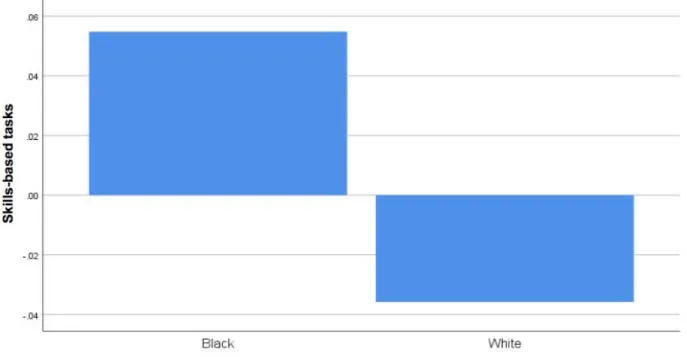
There was no statistically significant difference between participants tested by Black experimenters versus White experimenters in terms of participant age or undergraduate status (Table 1). In four cases, there was missing data for the social cognition tasks, and these participants were excluded from analyses. Table 1 displays the mean scores and standard deviations between groups across social cognition tasks and the perceived discrimination scale. Hypotheses 1 and 2.
Effect of Experimenter Race, Perceived Discrimination, and their Interaction on
Skills-Based Tasks
RACE-RELATED FACTORS AND SOCIAL COGNITION 17
A multiple regression analysis was conducted to examine performance on the bias-oriented tasks, namely the AIHQ-ambiguous blame subscale and the AIHQ-accidental blame subscale. The overall model fit for AIHQ-ambiguous blame score was not statistically significant, F(2, 41) = .854, p > .05, with an R2 of .04. Perceived discrimination did not
significantly predict AIHQ-ambiguous blame score (Beta = .09, t(43) = 0.57, ns), and
experimenter race also did not significantly predict AIHQ-ambiguous blame score (Beta = -.17, t(43) = -1.10, ns). The interaction term was also not significant, (Beta = .07, t(43) = 0.42, ns). The overall model fit for the AIHQ-accidental blame score was also not significant, F(2, 41) = 2.53, p > .05, with an R2 of .11, with no main effect for perceived discrimination (Beta = .18, t(43) = 1.23, ns) nor experimenter race (Beta = -.25, t(43) = -1.64, ns) on AIHQ-accidental blame score. The interaction term was also not a significant predictor of the AIHQ-accidental blame score, Beta = .01, t(43) = 0.08, ns.
In sum, experimenter race, perceived discrimination, and their interaction were not significant predictors of skills-based or bias-oriented social cognitive task performance. Hypotheses 3.
Mediation Effects of RSA on Social Cognitive Performance
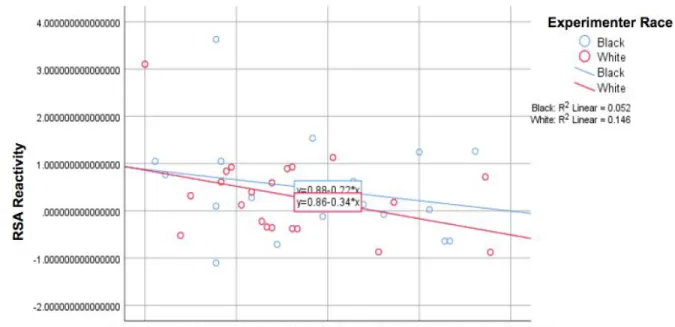
The third hypothesis explored the effects and interactions of physiological data, specifically whether a) participants with higher frequency of perceived discrimination would have lower baseline RSA, and b) RSA reactivity was a mediator between perceived
a. A simple linear regression was calcuated to predict baseline RSA based on level of perceived discrimination. No significant regression equation was found, F(1, 41)= 0.59, p > .05, with an R2 of .014 (see Figure 2).
b. To assess RSA reactivity as a mediator, first bivariate correlations were conducted between perceived discrimination, RSA reactivity, and each social cognitive task. Then three separate multiple linear regression analyses were conducted with perceived discrimination and RSA reactivity as predictors, and each social cognitive task score (skills-based factor score, AIHQ-ambiguous blame, AIHQ-accidental blame) as outcomes.
Skills-based factor score. First the skills-based factor score was assessed, and
there was no significant relationship between RSA reactivity during the skills-based tasks and perceived discrimination, r(45) = .025, p = .87. A relationship trended towards significance between the skills-based factor score and RSA reactivity during the skills-based tasks, r(45) = -.292, p = .06. However, the mediation analysis was not significant, R2=.056, F(2, 40) = 1.179, p > .05.
AIHQ-ambiguous blame score. There was no significant relationship between
RSA reactivity and AIHQ-ambiguous blame, r(45) = -.237, p = .14, or perceived discrimination and AIHQ-ambiguous blame, r(45) = .110, p = .48. The mediation analysis was also not significant, R2=.052, F(2, 38) = 0.982, p > .05.
AIHQ-accidental blame score. There was no significant relationship between
RACE-RELATED FACTORS AND SOCIAL COGNITION 19
AIHQ-accidental blame, r(45) = -.31, p = .05. However, the mediation analyses did not find RSA reactivity to be a significant mediator between perceived discrimination and AIHQ-accidental blame score, R2=.116, F(2, 38) = 2.351, p > .05.
Discussion
This study aimed to examine the extent to which race-related factors, framed within the Challenge and Threat Model, explained variations in social cognitive performance in healthy Black women. Across the analyses, there were no main effects nor interactive effects of experimenter race or perceived discrimination on social cognition performance across both skills-based and bias-oriented tasks. This study also examined physiological indicators, specifically baseline RSA and RSA reactivity as indices for threat responses. There was no significant relationship between level of perceived discrimination and baseline RSA, and RSA reactivity was not a signifcant mediator in the relationship between perceived discrimination and any measure of social cognitive performance. Thus, the Challenge and Threat model was not supported by the findings. This discussion will review potential reasons for the null findings, and suggest future directions for research focused on understanding racial variation in social
cognitive performance.
There are several potential reasons the Challenge and Threat model may not have been supported in the current study. First, the measures may not have captured factors most relevant to the social cognitive performance of Black individuals. The seminal Challenge and Threat paper (Mendes et al., 2002) includes an array of examples for what constitutes a demand (e.g.,
individual knowledge and abilities and external support). In our study, we examined only a few factors that prior research indicated may be salient in understanding cognitive performance - experimenter race and level of perceived discrimination (Nagendra et al., 2018; Richeson et al., 2005; Thames et al., 2013). Thus, our measures may not encapsulate the many variables that could have impacted the demand and resource evaluations that in turn lead to experience of challenge or threat in Black women.
Another shortcoming in the measures could be in the social cognitive tasks. A challenge or threat response is activated only when there is task engagement during a motivated
performance situation (Seery 2011). If participants did not feel motivated during the social cognitive tasks, or did not perceive the tasks as an important evaluation, then the Challenge and Threat model could not be applied. In previous studies where experimenter race and/or perceived discrimination was found to impact tasks performance, neurocognitive tasks were used for assessment (Richeson et al., 2005; Thames et al., 2013). Social cognitive measures may not have had the same salience or meaning to participants. Thus, neurocognition may be a more relevant measure to activate the challenge or threat response in future studies.
RACE-RELATED FACTORS AND SOCIAL COGNITION 21
protocol, thus simply assessing perceived discrimination and experimenter race may not have provided a nuanced application of Challenge vs. Threat in the current study. Moreover, the sample was relatively small as the study is still collecting data; thus, the analyses may have been underpowered.
A fourth potential explanation for the null findings was the possible priming of race-related cues. Advertisements for the study specifically asked for Black women, and the screening battery, administered before subjects came in for their session, also asked many
race-related questions (i.e. the perceived discrimination scale). Thus, participants may have had a heightened awareness of their racial identity when entering the lab setting, which could have activated stereotype threat and thus depleted cognitive performance (Nagendra et al., 2018). Alternatively, participants might have guessed the purpose of the study was related to race, and may have been less prone to responding to race-related cues in the session as a result.
symptoms, particularly depression (Catabay et al., 2019). Another study found that Black students who attend PWIs and held higher ratings of race-related stress also reported higher racial agency, or empowerment to engage in race-related social change, leading to higher feelings of interconnectedness with other Black students on campus (Bentley-Edwards & Chapman-Hilliard, 2015). Therefore, future studies should look at other race-related individual differences, such as resilience and racial agency, and how these individual factors interact with other contextual factors, such as the lab setting.
Another future study should examine neurocognitive tasks as an outcome instead of social cognitive tasks. Thames et al.’s (2013) study found important interacting effects of perceived discrimination and experimenter race on neurocognitive performance, and exploring physiological response as a mediator to this impaired performance would potentially support for the Challenge and Threat model. Common neurocognitive batteries test for aspects of memory, language, and reaction time, which are most likely closer to testing in school than the social cognitive battery is. Thus, the schema for testing may be more readily activated, which is more congruent with tasks proposed in the Challenge and Threat model.
RACE-RELATED FACTORS AND SOCIAL COGNITION 23
area has the potential to expand culturally competent treatment methods and provide a more comprehensive understanding of the intersection of race and schizophrenia, and how both of these combined factors may result in impaired functioning.
The purpose of this study was to evaluate how experimenter race and perceived
discrimination impacted social cognitive performance through the Challenge and Threat model, while utilizing physiological measures, namely RSA, to understand psychological and
physiological outcomes to a threat response. However, there were no significant findings across the hypotheses. Important limitations were discussed, and other race-related individual and contextual factors, such as racial identity and resiliency, were identified for future research. Regardless of the null findings, this study identifies racial disparities as a key gap in
References
American Psychiatric Association. (2013). Diagnostic and statistical manual of mental disorders (5th ed.). https://doi.org/10.1176/appi.books.9780890425596
Appelhans, B.M., Luecken, L.J. (2006). Heart rate variability as an index of regulated emotional responding. Review of General Psychology, 10(3), 229-240.
https://doi.org/10.1037/1089-2680.10.3.229
Auquier, P. , Lançon, C. , Rouillon, F. , Lader, M. and Holmes, C. (2006). Mortality in schizophrenia. Pharmacoepidemiology and Drug Safety, 15(2), 873-879.
https://doi.org/10.1002/pds.1325
Baillargeon, J., Binswanger, I.A., Penn, J.V., Williams, B.A., and Murray, O.J. (2009). Psychiatric disorders and repeat incarcerations: The revolving prison door. American
Journal of Psychiatry, 166(1), 103-109. doi:10.1176/appi.ajp.2008.08030416
Barnes, A. (2004). Race, schizophrenia, and admission to state psychiatric hospitals.
Administration and Policy in Mental Health and Mental Health Services Research, 31(3),
241-252. https://doi.org/10.1023/B:APIH.0000018832.73673.54
Barrio, C., Yamada, A.M., Hough, R.L., Hawthorne, W., Garcia, P., & Jeste, D.V. (2003). Ethnic disparities in use of public mental health case management services among patients with schizophrenia. Psychiatric Services, 54(9), 1264-1270.
https://doi.org/10.1176/appi.ps.54.9.1264
Bell, M., Tsang, H.W., Greig, T.C., & Bryson, G.J. (2009). Neurocognition, social cognition, perceived social discomfort, and vocational outcomes in schizophrenia. Schizophrenia
RACE-RELATED FACTORS AND SOCIAL COGNITION 25
Bentley-Edwards, K. L., & Chapman-Hilliard, C. (2015). Doing race in different places: Black racial cohesion on Black and White college campuses. Journal of Diversity in Higher
Education, 8(1), 43–60. https://doi.org/10.1037/a0038293
Bryson, G., Bell, M., & Lysaker, P. (1997). Affect recognition in schizophrenia: A function of global impairment or a specific cognitive deficit. Psychiatry Research 71(2), 105–113.
https://doi.org/10.1016/S0165-1781(97)00050-4
Buck, B. E., Pinkham, A. E., Harvey, P. D., & Penn, D. L. (2016). Revisiting the validity of measures of social cognitive bias in schizophrenia: Additional results from the Social Cognition Psychometric Evaluation (SCOPE) study. The British Journal of Clinical
Psychology, 55(4), 441–454. https://doi.org/10.1111/bjc.12113
Catabay, C. J., Stockman, J. K., Campbell, J.C., & Tsuyuki, K. (2019). Perceived stress and mental health: The mediating roles of social support and resilience among black women exposed to sexual violence. Journal of Affective Disorders, 239, 143-149.
https://doi.org/10.1016/j.jad.2019.08.037
Fett, A. K. J., Viechtbauer, W., Penn, D. L., van Os, J., & Krabbendam, L. (2011). The relationship between neurocognition and social cognition with functional outcomes in schizophrenia: A meta-analysis. Neuroscience & Biobehavioral Reviews, 35(3), 573-588.
https://doi.org/10.1016/j.neubiorev.2010.07.001
illness in a large public mental health system. American Journal of Psychiatry, 162(2), 270-376. https://doi.org/10.1176/appi.ajp.162.2.370
Friedman, B. (2007). An autonomic flexibility–neurovisceral integration model of anxiety and cardiac vagal tone. Biological Psychology, 74(2), 185-199.
https://doi.org/10.1016/j.biopsycho.2005.08.009
Green, M.F. (2019). Nonsocial and social cognition in schizophrenia: Current evidence and future directions. World Psychiatry, 18(2), 146-161. https://doi.org/10.1002/wps.20624 Green, M.F., Horan, W.P., & Lee, J. (2015). Social cognition in schizophrenia. Nature
Reviews.Neuroscience, 16(10), 620-631. https://doi.org/10.1038/nrn4005
Green, M.F., Penn, D.L., Bentall, R., Carpenter, W.T., Gaebel. W., Gur, R.C., Kring, A.M., Park, S., Silverstein, S.M., & Heinssen, R. (2008). Social cognition in schizophrenia: An
NIMH workshop on definitions, assessments, and research opportunities. Schizophrenia
Bulletin, 34(6), 1211-1220. https://doi.org/10.1093/schbul/sbm145
Halverson, T., Orleans-Pobee, M., Merritt, C., Sheeran, P., Felt, A., & Penn, D. (2019).
Pathways to functional outcomes in schizophrenia spectrum disorders: Meta-analysis of social cognitive and neurocognitive predictors. Neuroscience and Biobehavioral Reviews, 105, 212-219. https://doi.org/10.1016/j.neubiorev.2019.07.020
RACE-RELATED FACTORS AND SOCIAL COGNITION 27
Hennekens, C. H., Hennekens, A. R., Hollar, D., & Casey, D. E. (2005). Schizophrenia and increased risks of cardiovascular disease. American Heart Journal, 150(6), 1115–1121.
https://doi.org/10.1016/j.ahj.2005.02.007
Hill, L.K., Hoggard, L.S., Richmond, A.S., Gray, D.L., Williams, D.P., & Thayer, J.F. (2017). Examining the association between perceived discrimination and heart rate variability in African Americans. Cultural Diversity and Ethnic Minority Psychology, 23(1), 5-14.
https://doi.org/10.1037/cdp0000076
Keefe, R., Bilder, R., Harvey, P.D., Davis, S.M., Palmer, B.W., Gold, J.M … Lieberman, J.A.
(2006). Baseline Neurocognitive Deficits in the CATIE Schizophrenia Trial.
Neuropsychopharmacology, 31, 2033–2046. https://doi.org/10.1038/sj.npp.1301072
Kennedy, J. L. , Altar, C. A. , Taylor, D. L., Degtiar, I. & Hornberger, J. C. (2014). The social and economic burden of treatment-resistant schizophrenia. International Clinical
Psychopharmacology, 29(2), 63–76. DOI: 10.1097/YIC.0b013e32836508e6
Kohler, C.G., Turner, T.H., Bilker, W.B., Brensinger, C.M., Siegel, S.J., Kanes, S.J., … Gur, R.C., 2003. Facial emotion recognition in schizophrenia: intensity effects and error pattern. The American Journal of Psychiatry, 160, 1768–1774.
https://doi.org/10.1176/appi.ajp.160.10.1768
Kok, B.E. & Fredrickson, B.L. (2010). Upward spirals of the heart: Autonomic flexibility, as indexed by vagal tone, reciprocally and prospectively predicts positive emotions and social connectedness. Biological Psychology, 85(3), 432-436.
Laursen, T. M. , Munk-Olsen, T. & Vestergaard, M. (2012). Life expectancy and cardiovascular mortality in persons with schizophrenia. Current Opinion in Psychiatry, 25(2), 83–88. DOI: 10.1097/YCO.0b013e32835035ca
Marx, D. M. & Goff, P. A. (2005). Clearing the air: The effect of experimenter race on target’s test performance and subjective experience. The British Journal of Social Psychology, 44(4), 645–657. https://doi.org/10.1348/014466604X17948
Mendes, W. B., Blascovich, J., Lickel, B., & Hunter, S. (2002). Challenge and threat during social interactions with White and Black men. Personality and Social Psychology Bulletin, 28(7), 939-952.
Muhtadie, L., Koslov, K., Akinola, M., & Mendes, W.B. (2015). Vagal flexibility: A physiological predictor of social sensitivity. Journal of Personality and Social
Psychology, 109(1), 106-120. https://doi.org/10.1037/pspp0000016
Nagendra, A., Twery, B. L., Neblett, E. W., Mustafic, H., Jones, T. S., Gatewood, D., & Penn, D. L. (2018). Social cognition and African American men: The roles of perceived
discrimination and experimenter race on task performance. Psychiatry Research, 259, 21–26. https://doi.org/10.1016/j.psychres.2017.09.074
Neblett, E. W. and Roberts, S. O. (2013). Racial identity and discrimination. Psychophysiology, 50(10), 943-953.
Okruszek, Ł., Dolan, K., Lawrence, M., & Cella, M. (2017). The beat of social cognition: Exploring the role of heart rate variability as marker of mentalizing abilities. Social
Neuroscience, 12(5), 489–493. https://doi.org/10.1080/17470919.2016.1244113
RACE-RELATED FACTORS AND SOCIAL COGNITION 29
race, and sex on social cognitive performance in individuals with schizophrenia. The
Journal of Nervous and Mental Disease, 205(5), 346–352.
DOI:10.1097/NMD.0000000000000654
Pinkham, A. E., Penn, D.L., Green M. F., Buck, B., Healey, K., & Harvey, P. H (2014). The social cognition psychometric evaluation study: Results of the expert survey and RAND panel, Schizophrenia Bulletin, 40(4), 813–823. https://doi.org/10.1093/schbul/sbt081 Pinkham, A. E., Penn, D. L., Green, M. F., & Harvey, P. D. (2015). Social cognition
psychometric evaluation: Results of the initial psychometric study. Schizophrenia
Bulletin, 42(2), 494–504. https://doi.org/10.1093/schbul/sbv056
Pinkham, A.E., Sasson N.S., Calkins, M.E., Richard, J., Hughett, P., Gur, R.E., & Gur, R.C. (2008). The other-race effect in face processing among African American and Caucasian individuals with schizophrenia. American Journal of Psychiatry, 165(5), 639-45.
https://doi.org/10.1176/appi.ajp.2007.07101604
Olbert, C., Nagendra, A., & Buck, B. (2018). Meta-analysis of black vs. white racial disparity in schizophrenia diagnosis in the United States: Do structured assessments attenuate racial disparities? Journal of Abnormal Psychology, 127(1), 104-115.
https://doi.org/10.1037/abn0000309
Quintana, D. S., Guastella, A. J., Outhred, T., Hickie, I. B., & Kemp, A. H. (2012). Heart rate variability is associated with emotion recognition: Direct evidence for a relationship between the autonomic nervous system and social cognition. International Journal of
Richeson, J. A., Trawalter, S. & Shelton, J. N. (2005). African Americans’ implicit racial attitudes and the depletion of executive function after interracial interactions. Social
Cognition, 23(4), 336–352.
Rosenheck, R., Leslie, D., Keefe, R., McEvoy, J., Swartz, M., Perkins, D., Stroup, S. … Lieberman, J. (2006). Barriers to employment for people with schizophrenia. The
American Journal of Psychiatry, 163(3), 411-417.
https://doi.org/10.1176/appi.ajp.163.3.411
Salva, G.N., Vella, L., Armstrong, C.C., Penn, D.L., & Twamley, E.W. (2013). Deficits in domains of social cognition in schizophrenia: A meta-analysis of the empirical evidence.
Schizophrenia Bulletin, 39(5), 979-992. https://doi.org/10.1093/schbul/sbs080
Seery, M.D. (2011). Challenge and threat? Cardiovascular indexes of resilience and vulnerability to potential stress in humans. Neuroscience and Biobehavioral Reviews, 35(7),
1603-1610. https://doi.org/10.1016/j.neubiorev.2011.03.003
Snowden, L.R. (2001). Barriers to effective mental health services for African Americans.
Mental Health Services Research, 3(4), 181-187.
https://doi.org/10.1023/A:1013172913880
Thames, A. D., Hinkin, C. H., Byrd, D. A., Bilder, R. M., Duff, K. J., Mindt, M. R., & Streiff, V. (2013). Effects of stereotype threat, perceived discrimination, and examiner race on neuropsychological performance: Simple as black and white? Journal of the International
Neuropsychological Society, 19(5), 583-593.
RACE-RELATED FACTORS AND SOCIAL COGNITION 31
Tables
Table 1. Means and standard deviations for social cognitive measures, frequency of perceived discrimination, and physiological markers.
Measure Black Experimenter, M (SD) White Experimenter M (SD)
Demographics (Total N) 21 30
Age 22.00 (2.20) 21.26 (2.73)
Undergraduate (%) 61.9% 63.3%
Skills-based tasks 0.05 (.45) -0.04 (.80)
ER40 33.95 (2.68) 34.96 (2.63)
BLERT 17.70 (1.90) 17.70 (2.05)
Eyes 26.32 (2.47) 26.30 (3.13)
AIHQ-ambiguous blame 3.12 (0.62) 2.91 (0.62)
AIHQ-Accidental blame 2.69 (0.88) 2.25 (0.69)
Daily Life Experiences Frequency Subscale
Table 2. The descriptive statistics for heart rate, respiration rate, and respiratory sinus arrhythmia between same-race and cross-race groups.
Physiological marker Black Experimenter, M (SD) White Experimenter, M (SD)
Baseline RSA 6.48 (1.20) 6.23 (1.26)
Baseline HR 82.43 (10.33) 79.75 (12.42)
Baseline Respiration Rate 16.15 (3.11) 18.13 (2.75) RSA Reactivity
ER-40 0.22 (0.79) 0.19 (1.01)
Eyes -0.22 (0.97) 0.08 (1.05)
BLERT 0.13 (1.11) 0.16 (0.89)
AIHQ 0.69 (3.21) 0.24 (0.96)
HR Reactivity
ER-40 0.52 (3.57) 0.06 (5.15)
Eyes -0.36 (4.54) -0.59 (5.62)
BLERT 0.04 (5.45) -1.14 (6.82)
AIHQ -0.93 (4.97) -0.19 (5.01)
Respiration Rate Reactivity
ER-40 1.18 (3.97) -1.18 (3.71)
Eyes 1.73 (2.39) -1.17 (3.97)
BLERT -0.72 (4.12) -0.41 (4.72)
RACE-RELATED FACTORS AND SOCIAL COGNITION 33
Figures
Figure 1. Difference in composite skills-based tasks across same-race and cross-race groups.
RACE-RELATED FACTORS AND SOCIAL COGNITION 35
Appendix
RACE-RELATED FACTORS AND SOCIAL COGNITION 37