COLLECTION REVIEW
malERA: An updated research agenda for
characterising the reservoir and measuring
transmission in malaria elimination and
eradication
The malERA Refresh Consultative Panel on Characterising the Reservoir and Measuring Transmission*
¶Full listing of the members of the malERA Refresh Consultative Panel on Characterising the Reservoir and Measuring Transmission can be found in the Acknowledgements.
*[email protected];[email protected]
Abstract
This paper summarises key advances in defining the infectious reservoir for malaria and the measurement of transmission for research and programmatic use since the Malaria Eradi-cation Research Agenda (malERA) publiEradi-cation in 2011. Rapid and effective progress towards elimination requires an improved understanding of the sources of transmission as well as those at risk of infection. Characterising the transmission reservoir in different set-tings will enable the most appropriate choice, delivery, and evaluation of interventions. Since 2011, progress has been made in a number of areas. The extent of submicroscopic and asymptomatic infections is better understood, as are the biological parameters govern-ing transmission of sexual stage parasites. Limitations of existgovern-ing transmission measures have been documented, and proof-of-concept has been established for new innovative serological and molecular methods to better characterise transmission. Finally, there now exists a concerted effort towards the use of ensemble datasets across the spectrum of met-rics, from passive and active sources, to develop more accurate risk maps of transmission. These can be used to better target interventions and effectively monitor progress toward elimination. The success of interventions depends not only on the level of endemicity but also on how rapidly or recently an area has undergone changes in transmission. Improved understanding of the biology of mosquito–human and human–mosquito transmission is needed particularly in low-endemic settings, where heterogeneity of infection is pronounced and local vector ecology is variable. New and improved measures of transmission need to be operationally feasible for the malaria programmes. Outputs from these research priorities should allow the development of a set of approaches (applicable to both research and con-trol programmes) that address the unique challenges of measuring and monitoring transmis-sion in near-elimination settings and defining the absence of transmistransmis-sion.
a1111111111 a1111111111 a1111111111 a1111111111 a1111111111
OPEN ACCESS
Citation: The malERA Refresh Consultative Panel on Characterising the Reservoir and Measuring Transmission (2017) malERA: An updated research agenda for characterising the reservoir and measuring transmission in malaria elimination and eradication. PLoS Med 14(11): e1002452. https://doi.org/10.1371/journal.pmed.1002452
Published: November 30, 2017
Copyright:©2017 The malERA Consultative Panel on Characterising the Reservoir and Measuring Transmission. This is an open access article distributed under the terms of theCreative Commons Attribution License, which permits unrestricted use, distribution, and reproduction in any medium, provided the original author and source are credited.
Funding: MESA received a grant from the Bill & Melinda Gates Foundation (OPP1034591http:// www.malariaeradication.org/mesa-track/malaria-eradication-scientific-alliance-mesa). BM (Bill & Melinda Gates Foundation) was a member of this Panel.
Competing interests: I have read the journal’s policy and the authors of this manuscript have the following competing interests: JC receives funding from UNITAID. AMN is a member of the Editorial Board of PLOS Medicine.
Summary points
• Understanding the sources of transmission (the infectious reservoir) and those at risk of infection at the population level in order to inform programmatic decision-making can progress malaria elimination.
• There is considerable evidence for malaria infections at densities beneath the limit of conventional diagnostics. However, the contribution of these low-density infections to malaria transmission in different settings is not known.
• Characterising the spatial and temporal heterogeneity of the infectious reservoir becomes increasingly important as transmission declines if interventions are to be efficiently implemented to accelerate malaria elimination.
• The proportional contributions of low-density, asymptomatic, and symptomatic infec-tions will differ by malaria typology and will determine the programmatic approach required to reduce transmission.
• Plasmodium vivaxhypnozoites are undetectable with currently available diagnostics, representing a major barrier to both understanding the transmission reservoir for this parasite and its elimination.
• There is a need to standardise both existing transmission metrics and new metrics with greater sensitivity, particularly for their use in low-transmission settings.
Introduction
Transmission of malaria requires sexual-stage parasites, gametocytes, in humans to be taken up by femaleAnophelesmosquitoes when they feed. After a period of parasite development, mosquitoes can then infect humans. A break in this cycle at any point interrupts malaria trans-mission. Malaria control has historically focussed on the reduction of morbidity and mortality of the human host rather than on the interruption of transmission from human to mosquito. Understanding the variation in the relationship between infection (the presence of parasites in an individual or mosquito) and infectiousness (the ability to transmit parasites to a mosquito or human) at different transmission intensities and with different levels of intervention cover-age is increasingly recognised as critical in the pursuit of malaria elimination.
In 2011, one of the main conclusions of the Malaria Eradication Research Agenda (mal-ERA) process was the need to develop tools to measure transmission at low levels in elimina-tion contexts. This article summarizes progress made since 2011 and for the first time develops a research agenda addressing the reservoir of transmissible parasites and measuring transmis-sion [1,2]. Findings and recommendations presented here result from a systematic search of the literature and the deliberations of the 2015 malERA Refresh Consultative Panel on charac-terising the reservoir and measuring transmission, including specialists from field and imple-mentation science, entomology, epidemiology, and basic science.
Since the 2011 malERA process, research has ranged from illuminating the basic biology of the development of sexual-stage parasites in humans and mosquitoes to evaluating operational approaches targeting infectious individuals in endemic communities. Additionally, a harmo-nised set of definitions relevant to malaria transmission and elimination has been developed
and Health Surveys; DMFA, direct membrane feeding assay; ELISA, enzyme-linked immunosorbant assay; HLC, human landing collection; malERA, Malaria Eradication Research Agenda; MDA, mass drug administration; mFOI, molecular force of infection; MICS, Multiple Indicator Cluster Surveys; MIS, Malaria Indicator Surveys; MOI, multiplicity of infection; MSAT, mass screen and treat; NAAT, nucleic acid amplification test; RDT, rapid diagnostic test; RT-qPCR, reverse transcription qPCR; SCR, seroconversion rate.
(Box 1) [3]. However, there remains a need to further validate a ‘toolkit’ of metrics and associ-ated surveillance activities to characterise the infectious reservoir and measure malaria trans-mission that can be applied programmatically to direct and evaluate interventions and to quantify progress towards malaria elimination. There are multiple factors that contribute to malaria epidemiology including ecology, vectors, parasites, human biology and behaviour, and economic and health-system factors (seeBox 1), and these collectively make up a given ‘typol-ogy’ of malaria. The selection of appropriate surveillance activities and metrics from this toolkit will not only need to reflect variations in malaria ‘typology’ (Box 1) [3], but will need to be adapted as malaria transmission declines (Fig 1).
This paper discusses progress in the measurement and understanding of malaria transmis-sion, highlighting the different malaria typologies in which transmission occurs (Box 1). This differentiation between typologies is needed to determine where existing strategies and sys-tems can sufficiently achieve malaria elimination versus those where additional approaches or tools are required.
Research agenda for characterising the reservoir of infection
Detecting malaria: Infection versus transmission
Malaria infection and transmission can be detected and measured with a variety of metrics (Tables1and2). Their suitability and discriminatory power, however, can vary widely across settings and populations. To reliably confirm clinical malaria, a minimum diagnostic sensitiv-ity of 200 parasites/μL blood is required [6]. Microscopy and some rapid diagnostic tests (RDTs) meet this threshold [6]. In the absence of fever, some individuals will have parasitae-mia levels detectable by microscopy and RDTs. These asymptomatic infections are particularly common in areas of high transmission (i.e., above 25 clinical cases per week per 1,000 persons) [7], where high levels of human immunity allow older individuals to carry relatively large para-site burdens chronically [8]. Such individuals would be detected within mass screen and treat (MSAT) programmes using currently available diagnostics. However, through the use of molecular amplification methods, it is now clear that many individuals harbour low-density malaria infections beneath the limit of detection of both microscopy and RDTs [9]. Meta-anal-yses indicate that molecular methods detect up to twice as manyP.falciparuminfections as RDT or microscopy [10], and approximately 5 times as manyP.vivaxinfections [11,12]. This gap in sensitivity may be more pronounced when compared against ultra-sensitive molecular
Box 1. Terminology
Malaria typologies
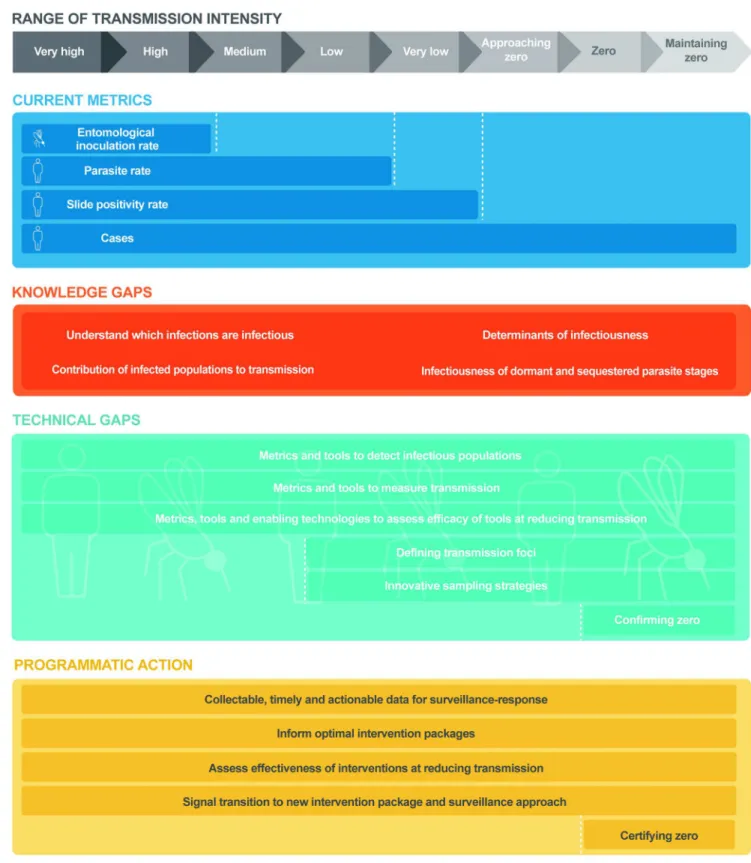
Fig 1. Research needs and programmatic applications in measuring malaria transmission across the transmission spectrum. Range of malaria transmission intensity (grey line) from very high intensity to postelimination settings. Current metrics (navy blue line) used for
routine measurement of malaria transmission at each level of transmission intensity. Knowledge gaps (orange line) in understanding the biology and epidemiology of malaria transmission and the infectious reservoir at all levels of transmission intensity. Technical gaps (light blue line) in the accurate measurement of transmission at each level of transmission intensity. Programmatic actions (yellow line) required for the interruption of transmission and the prevention of reintroduction at each level of transmission intensity.
methods [13]. Lack of sensitivity of diagnostic detection is more acute forP.vivaxinfections, which circulate at lower parasite densities hampering accurate estimates of true prevalence. There are also other unique challenges presented byP.vivaxthat make characterising its trans-mission reservoir problematic (Box 2) [14–18].
Diagnosis and treatment of clinical malaria is vital for disease control, particularly if this can be rapidly implemented to reduce the likelihood of gametocyte production. There is also a good public health rationale for identifying and treating ‘asymptomatic’ malaria detectable with microscopy or RDTs, as it is increasingly recognised that this is associated with ongoing morbidity (e.g., anaemia, increased susceptibility to bacterial infections, and cognitive func-tion; reviewed in [8]). If the aim is malaria elimination, the contribution of low-density infec-tions to transmission needs to be considered given that, where data are available, low-density infections represent a significant proportion of malaria infections and can be the majority in low-endemic areas [9,10,19,20].
While the countries that have achieved malaria elimination to date have done so largely without specific attempts to detect and treat low-density parasitaemia, these may not be repre-sentative of malaria typologies in higher-transmission settings. In many areas, the persistence of malaria can occur despite high coverage of vector control measures and the availability of effective treatment, suggesting that novel approaches are needed for both surveillance and interventions that will accelerate the elimination process [19,21]. Furthermore, studies have documented the failure of strategies to reduce clinical malaria incidence and transmission, such as MSAT, when the transmission reservoir is not adequately identified and targeted with the currently available field diagnostics [22].
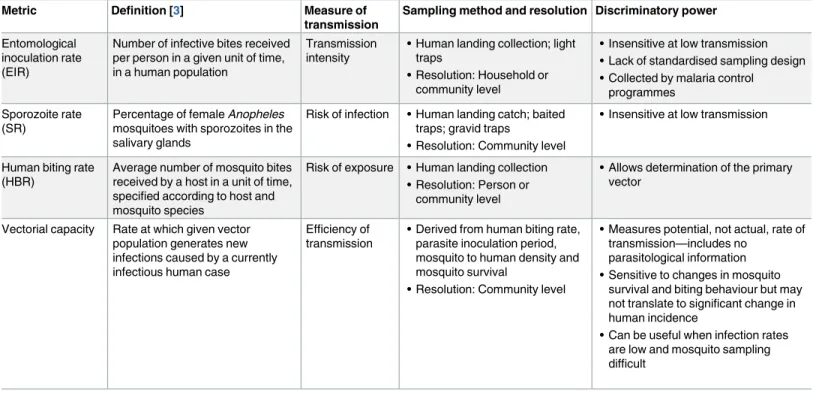
It follows that the cost-effectiveness of existing or novel surveillance methods and interven-tions in reducing malaria transmission cannot be predicted or evaluated unless the relative contribution to transmission of (1) clinical/symptomatic malaria, (2) asymptomatic Table 1. Summary of currently available entomological malaria transmission metrics.
Metric Definition [3] Measure of transmission
Sampling method and resolution Discriminatory power
Entomological inoculation rate (EIR)
Number of infective bites received per person in a given unit of time, in a human population
Transmission intensity
• Human landing collection; light traps
• Resolution: Household or community level
• Insensitive at low transmission • Lack of standardised sampling design • Collected by malaria control
programmes Sporozoite rate
(SR)
Percentage of female Anopheles mosquitoes with sporozoites in the salivary glands
Risk of infection • Human landing catch; baited traps; gravid traps
• Resolution: Community level
• Insensitive at low transmission
Human biting rate (HBR)
Average number of mosquito bites received by a host in a unit of time, specified according to host and mosquito species
Risk of exposure • Human landing collection • Resolution: Person or
community level
• Allows determination of the primary vector
Vectorial capacity Rate at which given vector population generates new infections caused by a currently infectious human case
Efficiency of transmission
• Derived from human biting rate, parasite inoculation period, mosquito to human density and mosquito survival
• Resolution: Community level
• Measures potential, not actual, rate of transmission—includes no
parasitological information • Sensitive to changes in mosquito
survival and biting behaviour but may not translate to significant change in human incidence
• Can be useful when infection rates are low and mosquito sampling difficult
parasitaemia (detectable by microscopy or RDT), and (3) low-density parasitaemia (not detect-able by microscopy or RDT) are estimated for a particular setting. With an increasingly diverse array of potential approaches for malaria elimination [18], but with limited human and finan-cial resources [23], characterising the contribution of low-density parasitaemia to transmission will help to focus elimination efforts.
Low-density parasitaemia and transmission
There are currently no field diagnostics with sufficient sensitivity to identify low-density sub-microscopic parasitaemia, though various approaches are under evaluation for performance and scalability (discussed in the malERA Refresh ‘Tools’ paper) [18]. However, even if all infected individuals could be identified, there is a need to understand who is infectious to mos-quitoes and for how long.
Understanding the contribution of low-density parasitaemia to the infectious reservoir for a given malaria typology is critical to determine the diagnostic sensitivity required. It will also affect how much effort a programme should commit to detecting and treating these infections and when and where this effort is best deployed. As noted above, the proportion of low-density parasitaemia increases as transmission declines [9,10,19,20,24]. Recent findings from Senegal also suggest that the efficiency of human-to-mosquito transmission increases with decreasing transmission intensity [25].
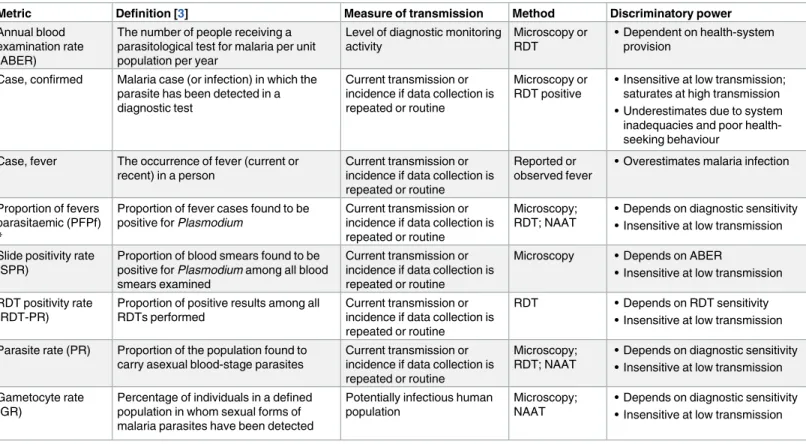
Table 2. Summary of currently available malaria transmission metrics in humans.
Metric Definition [3] Measure of transmission Method Discriminatory power
Annual blood examination rate (ABER)
The number of people receiving a parasitological test for malaria per unit population per year
Level of diagnostic monitoring activity
Microscopy or RDT
• Dependent on health-system provision
Case, confirmed Malaria case (or infection) in which the parasite has been detected in a diagnostic test
Current transmission or incidence if data collection is repeated or routine
Microscopy or RDT positive
• Insensitive at low transmission; saturates at high transmission • Underestimates due to system inadequacies and poor health-seeking behaviour
Case, fever The occurrence of fever (current or recent) in a person
Current transmission or incidence if data collection is repeated or routine
Reported or observed fever
• Overestimates malaria infection
Proportion of fevers parasitaemic (PFPf)
*
Proportion of fever cases found to be positive for Plasmodium
Current transmission or incidence if data collection is repeated or routine
Microscopy; RDT; NAAT
• Depends on diagnostic sensitivity • Insensitive at low transmission Slide positivity rate
(SPR)
Proportion of blood smears found to be positive for Plasmodium among all blood smears examined
Current transmission or incidence if data collection is repeated or routine
Microscopy • Depends on ABER
• Insensitive at low transmission RDT positivity rate
(RDT-PR)
Proportion of positive results among all RDTs performed
Current transmission or incidence if data collection is repeated or routine
RDT • Depends on RDT sensitivity • Insensitive at low transmission Parasite rate (PR) Proportion of the population found to
carry asexual blood-stage parasites
Current transmission or incidence if data collection is repeated or routine
Microscopy; RDT; NAAT
• Depends on diagnostic sensitivity • Insensitive at low transmission Gametocyte rate
(GR)
Percentage of individuals in a defined population in whom sexual forms of malaria parasites have been detected
Potentially infectious human population
Microscopy; NAAT
• Depends on diagnostic sensitivity • Insensitive at low transmission
*No WHO definition is available for this term.
Abbreviations: ABER, annual blood examination rate; GR, gametocyte rate; NAAT, nucleic acid amplification test; PFPf, proportion of fevers parasitaemic; PR, parasite rate; RDT, rapid diagnostic test; RDT-PR, RDT positivity rate; SPR, slide positivity rate.
Box 2. P. vivax and P. ovale
P.vivaxandP.ovalehave a dormant liver stage, the hypnozoite, which is undetectable by currently available diagnostic methods. Periodic reactivation of hypnozoites results in repeated blood-stage infection (relapses) occurring weeks, or even years, following the initial infection. As control efforts reduce the incidence ofP.falciparumcases,P.vivax
cases can remain relatively stable and become a greater proportion of malaria cases over-all [16].P.vivaxis refractory to traditional vector control methods: hypnozoites enable the parasite to evade conditions unfavourable to transmission and will survive in the host following schizonticidal anti-malarial therapy. Without new anti-hypnozoite drugs or vaccines that could be used safely across entire populations, theP.vivax/ovale trans-mission reservoir cannot be targeted, making elimination of these parasites challenging in any setting.
Key advances
Relapses drive transmission
• In children in Papua New Guinea, 4 of every 5P.vivaxinfections and 3 of every 5P.
ovaleinfections were caused by relapses [14].
• Both primary and relapseP.vivaxinfections generate gametocytes, which typically appear before clinical symptoms, and promote onward ‘silent’ transmission of the par-asite [15].
• Estimating transmission using the typical entomological measures is of limited rele-vance when clinical disease can emerge from an individual not recently infected by a mosquito bite.
Research needs
Detection of hypnozoites to inform targeted drug or vaccination strategies
• Access to existing anti-hypnozoite therapy needs to be expanded where possible in order to reduce the burden of disease and minimise the risk of human-to-mosquito transmission via relapse.
• However, several barriers to mass drug administration (MDA) forP.vivaxexist. The 8-aminoquinolines primaquine and tafenoquine are the only known anti-hypnozoite drugs. Both drugs are contraindicated in pregnancy and individuals with glucose-6-phosphate dehydrogenase deficiency [17,18]. Even if rapid, accurate point-of-care tests were available to exclude these individuals from treatment, a significant propor-tion of the populapropor-tion (typically>10%) will remain untreated.
• Without being able to identify hypnozoites, MSAT is of no practical value in reducing
Currently, the only way to measure human infectiousness is by feeding colony-reared mos-quitoes either on humans directly (direct feeding assay [DFA] [26,27]) or on infected human blood via a membrane (direct membrane feeding assay [DMFA] [28]). A number of studies have used these methods to estimate the contribution of low-density infections to malaria transmission [29–34]. For example, studies in Burkina Faso using DMFA found that 28.7% (25 out of 87) of infectious individuals were microscopy negative, causing 17.0% of mosquito infections [29]. Similarly, in Thailand, DFA studies found that 21% (13 out of 62) individuals submicroscopic for eitherP.falciparumorP.vivaxwere able to infect mosquitoes [34]. These preliminary studies suggest that surveillance systems could be modified in the future to detect submicroscopic infections and direct transmission reduction efforts. However, understanding the relationship between infectivity as measured in feeding assays and the infectivity in natural transmission settings to local mosquitoes is still a major research challenge. Furthermore, few empirical studies have quantified the proportion of the overall population that is both submi-croscopic and infectious, particularly in low-transmission settings (i.e., less than 8 clinical cases per week per 1,000 persons) [7]. This is needed to determine when and where treating low-density parasitaemia is critical for interrupting transmission and the diagnostic sensitivity required to target them. Mathematical models suggest that conventional diagnostics can detect 55% of the infectious reservoir, but with a 100-fold increase in sensitivity of detection level, i.e., from 200 to 2 parasites/μL of blood, up to 95% of infectious individuals could be identified [35]. This level of diagnostic sensitivity could transform our understanding of the malaria transmission reservoir, allowing the development and delivery of better strategies to disrupt transmission toward malaria elimination.
Detecting gametocytes
All malaria infections have the capacity to produce gametocytes. Therefore, in the context of community chemotherapy programmes, treating any individuals who test positive for asexual parasites is a realistic programme aim. However, research tools that measure gametocytaemia are essential to further our understanding of transmission biology and to define the popula-tions and individuals that drive transmission. Some studies have suggested that transmission efficiency may increase as malaria prevalence falls due to higher gametocyte densities. As the development of new transmission-blocking drugs and vaccines advances, understanding the factors that drive this transmission efficiency will be needed to determine in which settings interventions can be successfully trialled and/or implemented [25]. Although gametocytes can
• Compared toP.falciparum,P.vivaxandP.ovalepresent as much lower parasite densi-ties; therefore, determining the appropriate limit of detection for new diagnostics will be a major challenge.
Improve understanding of parasite-vector bionomics
be identified using microscopy, they often exist at low densities and may circulate only tran-siently in the blood. RDTs do not differentiate between gametocytes and asexual parasites. The limit of detection of microscopy is 8–16 gametocytes/μL of blood [30,31]. Predictably, molecu-lar methods are more sensitive, with 0.3 mature females/μL of blood detected with Pfs25 reverse transcription qPCR (qPCR) and 1.8 mature males/μL of blood with Pfs230p RT-qPCR [36]. As gametocyte densities are low, the increased sensitivity of molecular methods considerably increases gametocyte detection rates. For example, a recent study in Kenya found that Pfs25 RT-qPCR detected gametocytes in 44% of the population compared with only 2.6% detected by microscopy [37].
While there is an overall positive association between mosquito infection rates and gameto-cyte density, there is also evidence of infectiousness for individuals with very low gametogameto-cyte densities [27,38]. As the majority of malaria infections are submicroscopic, even if only a small proportion of these individuals are infectious, the contribution to the transmission reservoir is potentially significant enough to impact elimination programmes.
Where data are available, they suggest differences between high- and low-transmission set-tings in the gametocyte density needed for human infectivity to mosquitoes. In African popu-lations, submicroscopicP.falciparumgametocytaemia is common, and studies in Kenya have found that the majority of infectious children (43 out of 62) had submicroscopic gametocytae-mia [30,31]. In contrast, in Cambodia,falciparum-infected subjects with detectable gameto-cytes by microscopy were significantly more likely than gametocyte-negative individuals to infect mosquitoes, and those with microscopy-detectable gametocytaemia were the source of the majority of all mosquito infections [39].
Heterogeneity in the transmission reservoir
While data demonstrate an advance in our understanding of malaria transmission, they are limited and suggest the infectious reservoir differs across malaria typologies [24]. Most studies investigating human infectiousness have been conducted in high-transmission settings. There is a particular need for data from low-transmission and near-elimination settings, where tem-poral, spatial, and demographic heterogeneity in transmission can often be more pronounced. Longitudinal data characterising the transmission reservoir are also needed. These would not only allow more accurate assessments of the contributions of the different density infections but could also inform the sequence of intervention delivery needed to reduce transmission. Similarly, these data would inform the necessary intervention changes to most effectively tran-sition countries from high to low transmission and ultimately elimination [40]. A key consid-eration is to advise when malaria control measures should be reoriented following elimination without the risk of reintroduction, particularly in the context of declining human immunity to malaria and the potential for outbreaks.
As transmission declines and heterogeneity increases, programmes need to adjust in order to respond to increasingly rare clinical cases. The persistence of residual transmission requires more aggressive and/or novel strategies, and targeting these areas will be key to local elimina-tion. Significant progress has been made in approaches to identify transmission foci using a number of field-based, geo-spatial, and modelling approaches [41–53]. However, even where hotspots of malaria transmission can be identified, attempts to target these foci may fail against a background of low-level but widespread transmission [54]. Local implementation and high-coverage control interventions linked to surveillance information will be needed to adequately clear the reservoir at all levels of transmission.
interventions [56]. Longitudinal monitoring of resistance markers via sentinel surveillance sites could prove invaluable for tracking risk of rebound or reintroduction. However, there are currently no field-based diagnostic tests for drug resistance, and more detailed information may be needed on local drug-resistance patterns in asymptomatic/low-density infections, par-ticularly related to any changed infectiousness to mosquitoes.
Research agenda for measuring transmission
Improved and validated metrics of transmission would enable the optimal design of control programmes and surveillance systems needed for malaria elimination [23]. This would include the ability to better track progress, confirm cases and foci, and identify and contain reintro-duction of transmission, should it occur. Validated transmission metrics are also the key out-come to be measured in field trials evaluating the effectiveness of transmission-blocking interventions [18] and can be used to improve mathematical models assessing potential inter-vention combinations [7].
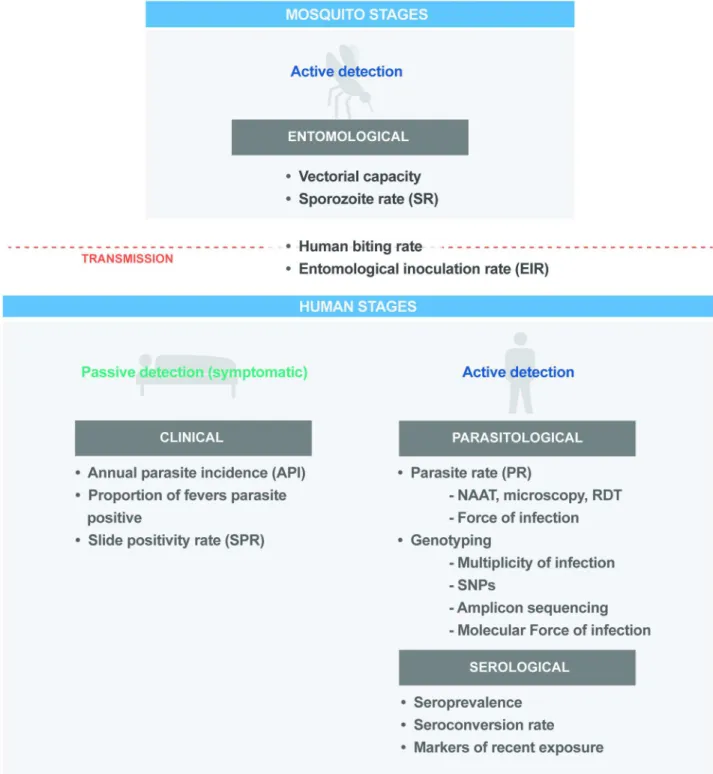
Measures of malaria transmission can be defined at different points in the transmission cycle (Fig 2). Since 2011, progress has been made in understanding the advantages and limita-tions of transmission metrics across epidemiological settings [57,58]. Further work is needed to better quantify the correlations between metrics, standardise their application for use in programmatic surveillance activities, and develop and validate new metrics. However, it is nec-essary that transmission metrics are reliable and reproducible on a consistent basis and can be assembled through existing national systems.
Entomological metrics
Between 30–40 species ofAnopheleshave been identified as vectors of human malaria, exhibit-ing varyexhibit-ing feedexhibit-ing behaviours and preferences, habitats, and ecologies. Within this complex-ity, there is a need to standardise current metrics and develop more efficient sampling techniques [57] (Table 1). Whilst developments in sampling methods have been made to eval-uate biting densities and infection rates [59–63], human landing collection (HLC) sampling remains the gold standard for providing epidemiologically relevant mosquito-to-human trans-mission metrics, despite inherent risks [64,65]. Alternative technologies to HLC are being tested that limit human exposure [66,67] and include traps with attractants that mimic a human host [68,69].
New approaches are particularly needed in settings where vector densities are low or het-erogeneous. For example, reexamination of vectorial capacity using mathematical modelling to simulate settings with different baseline epidemiological and entomological characteristics has led to new insights into the effective deployment of vector control measures [70]. Techno-logical advances in geolocation and mapping can precisely identify vector habitats that coin-cide with human activity and movement [71]. This information can be used to determine potential exposure points, enabling targeted sampling in these foci of transmission risk. Other innovative technologies include high-throughput technology, such as infrared spectrometry, to evaluate large samples of mosquitoes for vector age, species, and infection status [72–74], thus providing a measure of vector density and indicating the risk of malaria reintroduction. In this regard, as with parasite drug resistance, longitudinal monitoring of insecticide resis-tance via sentinel surveillance could prove invaluable.
Human metrics
programmes in tracking progress in the reduction of malaria cases and identifying outbreaks and epidemics (Table 2). These data are complemented with large-scale surveys, such as the Demographic and Health Surveys (DHS), the Malaria Indicator Surveys (MIS) and UNICEF Multiple Indicator Cluster Surveys (MICS). However, as transmission declines to low Fig 2. Key programmatic and research metrics across the malaria parasite transmission cycle. NAAT, nucleic acid amplification
test; RDT, rapid diagnostic test.
intensity, clinical cases become rare, slide and RDT positivity rates low, and transmission pat-terns increasingly heterogeneous.
To generate practical estimates of infection without excessive sampling, more sensitive diagnostics and/or combinations of diagnostic approaches are needed. While the utility of RDTs will need to be monitored in regions where deletions in the gene encoding HRP2 have been detected in the parasite population [75,76], research is currently underway to develop RDTs with detection thresholds corresponding to 10–20 parasites/μL or lower [77]. The development of highly sensitive nucleic acid–based tests for parasite detection [78,79], and hemozoin detection using nuclear magnetic resonance [80,81], is also ongoing and may be promising. While tests using molecular methods would increase the number of infections identified, their widespread deployment in low-transmission settings is probably not currently cost-effective for the identification of incident infections. Additionally, in recognition of het-erogeneity, approaches should shift from tracking national or regional progress in malaria control towards targeted sampling and community-based surveys characterising transmission risk in key population groups. Once elimination has been achieved, maintaining ‘zero’ trans-mission will depend on the health system’s ability to identify any emergent malaria cases, triggering case-based investigation to determine the origin (local or imported) and prevent onward transmission.
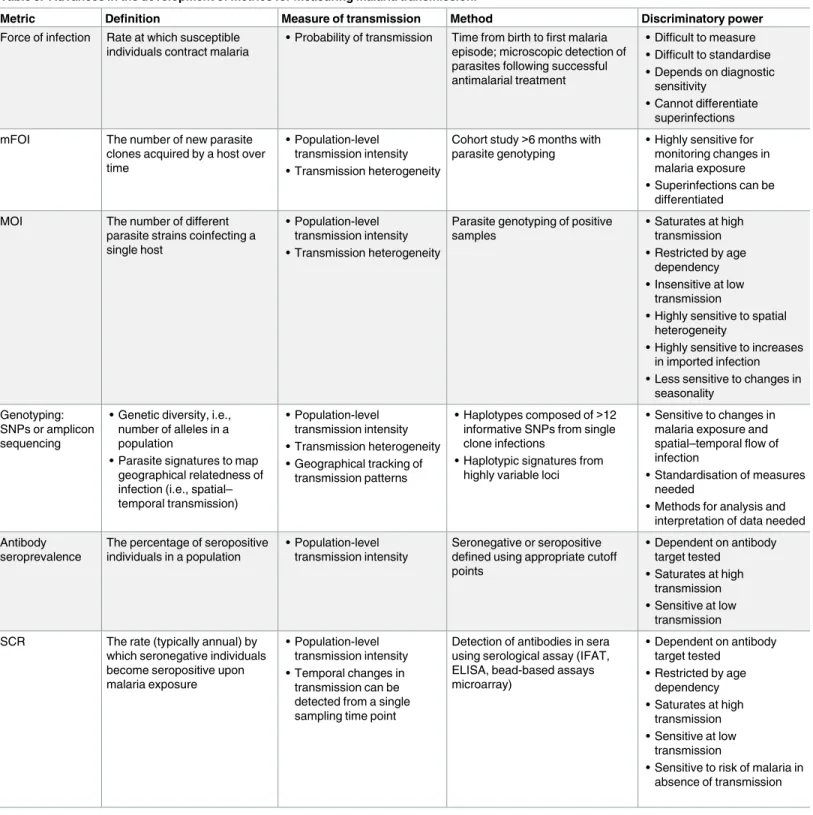
Metrics to understand transmission
Recent technical advances have produced a number of transmission metrics that are suitable for low-transmission settings (Table 3). Molecular force of infection (mFOI) and multiplicity of infection (MOI) both use parasite genotyping methods to assess the complexity of parasite infections [82]. mFOI can identify superinfected individuals that carry parasites from more than 1 infection, providing a more detailed measure of transmission compared to force of infection based on less sensitive methods (Table 2). Sequencing to determine parasite popula-tion structure can also be used to characterise transmission by measuring the genetic related-ness between infections in space and time. Other measures, such as allelic richrelated-ness, can indicate the level of genetic diversity, which is expected to decline as transmission declines [83,84]. Even more refined sequencing approaches might be capable of assigning parasites as imported or local for monitoring the origin of infections.
Table 3. Advances in the development of metrics for measuring malaria transmission.
Metric Definition Measure of transmission Method Discriminatory power
Force of infection Rate at which susceptible individuals contract malaria
• Probability of transmission Time from birth to first malaria episode; microscopic detection of parasites following successful antimalarial treatment
• Difficult to measure • Difficult to standardise • Depends on diagnostic
sensitivity
• Cannot differentiate superinfections mFOI The number of new parasite
clones acquired by a host over time
• Population-level transmission intensity • Transmission heterogeneity
Cohort study>6 months with parasite genotyping
• Highly sensitive for monitoring changes in malaria exposure • Superinfections can be
differentiated MOI The number of different
parasite strains coinfecting a single host
• Population-level transmission intensity • Transmission heterogeneity
Parasite genotyping of positive samples
• Saturates at high transmission • Restricted by age
dependency • Insensitive at low
transmission
• Highly sensitive to spatial heterogeneity
• Highly sensitive to increases in imported infection • Less sensitive to changes in
seasonality Genotyping:
SNPs or amplicon sequencing
• Genetic diversity, i.e., number of alleles in a population
• Parasite signatures to map geographical relatedness of infection (i.e., spatial– temporal transmission)
• Population-level transmission intensity • Transmission heterogeneity • Geographical tracking of
transmission patterns
• Haplotypes composed of>12 informative SNPs from single clone infections
• Haplotypic signatures from highly variable loci
• Sensitive to changes in malaria exposure and spatial–temporal flow of infection
• Standardisation of measures needed
• Methods for analysis and interpretation of data needed Antibody
seroprevalence
The percentage of seropositive individuals in a population
• Population-level transmission intensity
Seronegative or seropositive defined using appropriate cutoff points
• Dependent on antibody target tested
• Saturates at high transmission • Sensitive at low
transmission SCR The rate (typically annual) by
which seronegative individuals become seropositive upon malaria exposure
• Population-level transmission intensity • Temporal changes in
transmission can be detected from a single sampling time point
Detection of antibodies in sera using serological assay (IFAT, ELISA, bead-based assays microarray)
• Dependent on antibody target tested
• Restricted by age dependency • Saturates at high
transmission • Sensitive at low
transmission
• Sensitive to risk of malaria in absence of transmission
Abbreviations: ELISA, enzyme-linked immunosorbant assay; IFAT, Immunofluorescence Antibody Test; mFOI, molecular force of infection; MOI, multiplicity of infection; SCR, seroconversion rate.
For all these metrics, however, standardisation of methods is necessary, as well as a quanti-tative comparison to understand the relationship with existing and other new metrics. The development of operationally suitable platforms will ultimately be required to inform real-time or rapid response in programmatic settings. In relation to this, there needs to be a clearer understanding of what measures are needed to better define and monitor transmission, and what measures are useful for control programmes. New approaches to analyse metrics from different sources to improve estimates of transmission, or confirm its interruption, are needed. Looking to the veterinary world could be informative, where probability-based survey meth-ods such as “freedom from infection” are used for animal disease surveillance in the food and agriculture industry [110]. These methods are based on defining the probability that a popula-tion is free of infecpopula-tion, allowing operapopula-tional surveillance thresholds to be set based on the cho-sen sampling frame and the cho-sensitivity of available diagnostics. Adapting these strategies for use in malaria surveillance will require tailoring the methods for specific malaria transmission measures.
Multimetrics to characterise transmission in time and space
The increasing availability of spatial databases on parasite rate [111,112], serology, vectors [113], malaria genetic epidemiology [114], and human population movements [115–118], together with the increased flexibility and computational efficiency of mathematical and statis-tical modelling methods [119,120], have led to substantial advances in the spatial–temporal characterisation of malaria transmission intensity. To date, most of these methods have focused on a single metric of endemicity or have relied on parameters derived from small stud-ies. However, dynamic models are being developed that will capture the effect of human popu-lation movements, and could incorporate multimetric ensembles to allow self-consistent mapping across the entire spectrum of transmission settings [7]. For these technologies to achieve the greatest impact, they will need to be linked to and used by control programmes to inform operational decision-making in real time.
Summary
Considerable progress has been made not only in understanding the biology and epidemiology of malaria transmission but also in the development of new tools to more accurately quantify transmission; however, challenges remain andBox 3summarises this Panel’s research and development agenda. The foremost of these is an incomplete understanding of the infectious reservoir in low-transmission and elimination settings, particularly the relative infectiousness of (1) asymptomatic individuals and (2) susceptible vector species across a variety of malaria typologies. The spatial and temporal heterogeneity at which these factors interact will change as countries transition to lower transmission intensity.
The absolute and relative incidence of clinical and asymptomatic infections can vary widely between different low-transmission settings. Transmission can occur as focal outbreaks caused by human and vector migration. It can also persist for long periods despite aggressive control strategies or quickly rebound after reaching zero. These scenarios are caused by varying pat-terns of malaria risk across demographic groups, vectors, and parasite species in different ecological settings, which may not be easily captured by simple incidence and prevalence measures.
Box 3. Research and development agenda
Characterising the reservoir
Objective: Determine the relative contribution to transmission of symptomatic malaria, asymptomatic malaria detectable with microscopy or RDTs, and low-density infections detectable by molecular methods across different malaria typologies; data from low-transmission settings are particularly required.
Research goals
• Determine the kinetics of infectiousness of low-density parasitaemia.
• Determine the infectiousness of low-density gametocytaemia.
• Refine mosquito feeding assays (DMFA or DFA) of human infectivity to mosquitoes and validate these against natural infectivity to local vector species.
• Determine the required sensitivity of field-based diagnostics to identify malaria infec-tions contributing to transmission.
• Continue to develop field-based molecular and serological diagnostics with sensitivi-ties relevant for evaluation of infectious low-density parasitaemia and
gametocytaemia.
• Investigate non-invasive diagnostics of malaria infection and infectivity.
• Develop hypnozoite diagnostics predictive ofP.vivax/P.ovalerelapse and subse-quent infectivity.
• Develop cost-effective programmatic triggers and protocols for the optimal deploy-ment of transmission-based diagnostic tests and their incorporation within surveil-lance systems.
• Evaluate the cost-effectiveness of programmatic actions and interventions directed by transmission-based diagnostics.
• Characterise changes in the transmission reservoir as transmission declines.
• Conduct longitudinal studies in areas of declining transmission to investigate changes in the nature and distribution of the transmission reservoir.
• Evaluate which surveillance activities and metrics are most informative and cost-effective for programmatic goals.
• Develop operational methods to rapidly identify antimalarial drug-resistant parasites and insecticide-resistant vectors.
• Determine the relevance of spatial–temporal heterogeneity in the transmission reser-voir to the acceleration of elimination.
implemented. The same applies to the infectious reservoir. Whilst its characterisation across different transmission settings is important, translating this information into actionable pro-grammatic decisions will be key to achieving zero malaria transmission.
Acknowledgments
We dedicate this paper to the memory of Alan Magill. Before Alan passed away in 2015, he generously accepted to play an active role in this work. We remember his extraordinary com-mitment to defeat malaria.
The Malaria Eradication Research Agenda (malERA) Refresh Consultative Panel on Char-acterising the Reservoir and Measuring Transmission was chaired by Chris Drakeley, London School of Hygiene & Tropical Medicine (LSHTM, UK) and co-chaired by Abdisalan M. Noor
• Identify areas at risk for outbreaks and the reestablishment of malaria transmission following local elimination.
Measuring transmission
Objective: To develop a standardised and validated ‘toolkit’ of metrics and surveillance activities for characterising the infectious reservoir and measuring malaria transmission, which can be applied programmatically to direct interventions, evaluate interventions, and quantify progress towards malaria elimination.
Research goals
• Development of entomological as well as human measures and surveillance of transmission.
• Continue to develop alternatives to HLC sampling for entomological measures of transmission risk.
• Continued quantification of the relationships between different metrics of transmission.
• Develop validated metrics for use in low-transmission settings and in the absence of transmission.
• Continue to develop methods for evaluating transmission risk in low-transmission settings or in the absence of transmission.
• Evaluate multimetric combinations for the efficient integration and analysis of low-intensity and/or heterogeneous transmission.
• Evaluate the most cost-effective and informative metrics aligned to programmatic goals as transmission declines.
(KEMRI Wellcome Trust Research Programme, Nairobi, Kenya). The paper was written based on consultations during a malERA meeting held in London, UK on 14–15th December 2015. A systematic literature search was performed by Vittoria Lutje. Panel members reviewed sev-eral iterations of the manuscript to finalise it. Laurence Slutsker (PATH Malaria and the Neglected Tropical Diseases (NTD) Program, Seattle, WA, USA) reviewed and commented on a draft of the manuscript. Figures were designed by Rachel Papernick. Additional writing and editorial support was provided by Naomi Richardson of Magenta Communications Ltd and was funded by MESA Alliance.
Disclaimer: The authors alone are responsible for the views expressed in this publication
and they do not necessarily represent the decisions, policy or views of the World Health Orga-nization. MJH adds that the views expressed are those of the authors and do not necessarily reflect those of the US Centers for Disease Control and Prevention.
Members of the writing group met the ICMJE criteria for authorship and were:
Chris Drakeley (Chair), LSHTM, London, UK; Abdisalan M. Noor (Co-chair), WHO, Geneva, Switzerland; Nicole L. Achee, University of Notre Dame, USA; Teun Bousema, LSHTM, London, UK and Radboud University Nijmegen Medical Centre, the Netherlands; Ewan Cameron, Oxford Big Data Institute, Li Ka Shing Centre for Health Information and Discovery, University of Oxford, UK; Gonzalo Domingo, PATH, Diagnostics Program, Seattle, USA; Thomas P. Eisele, Center for Applied Malaria Research and Evaluation, Tulane School of Public Health and Tropical Medicine, New Orleans, USA; Ingrid Felger, Swiss Tropical and Public Health Institute, Basel, Switzerland and University of Basel, Switzerland; Peter Gething, Oxford Big Data Institute, Li Ka Shing Centre for Health Information and Discovery, Univer-sity of Oxford, UK; Bryan Greenhouse, UniverUniver-sity of California, San Francisco (UCSF), USA; Ivo Mueller, ISGlobal, Barcelona Ctr. Int. Health Res. (CRESIB), Hospital Clı´nic—Universitat de Barcelona, Barcelona, Spain, Institut Pasteur, Paris, France, and The Walter and Eliza Hall Institute of Medical Research (WEHI), Melbourne, Australia; Jetsumon Sattabongkot, Mahidol Vivax Research Unit, Faculty of Tropical Medicine, Mahidol University, Thailand; Regina Rabinovich, Harvard University T.H. Chan School of Public Health, Boston, USA and ISGlo-bal, Barcelona Ctr. Int. Health Res. (CRESIB), Hospital Clı´nic—Universitat de Barcelona, Bar-celona, Spain; Sarah Volkman, Harvard University T.H. Chan School of Public Health, Boston, USA; Lotus van den Hoogen, LSHTM, London, UK; Lindsey Wu, LSHTM, London, UK.
malERA Refresh: Characterising the Reservoir and Measuring Transmission Panel Members: Chris Drakeley (Chair), London School of Hygiene & Tropical Medicine (LSHTM),
Institute for Disease Modeling, Intellectual Ventures, Bellevue, WA, USA; Peter Gething, Oxford Big Data Institute, Li Ka Shing Centre for Health Information and Discovery, Univer-sity of Oxford, Oxford, UK; Iveth Gonzalez, FIND, Geneva, Switzerland; Bryan Greenhouse, UCSF, USA; Mary J. Hamel, Centers for Disease Control and Prevention (CDC), Atlanta, USA; Melissa Kapulu, KEMRI-Wellcome Trust Research Programme, Kilifi, Kenya and Cen-tre for Tropical Medicine and Global Health, Nuffield Department of Medicine, University of Oxford, Oxford, UK; Oue´draogo Andre´ Lin, Institute for Disease Modeling, Intellectual Ven-tures, Bellevue, WA, USA; Wendy Prudhomme O’Meara, Duke University and Duke Global Health Institute, Durham, NC, USA; Elfatih Mohamed Malik, Ministry of Health, Sudan; Alfredo Mayor, ISGlobal, Barcelona Ctr. Int. Health Res. (CRESIB), Hospital Clı´nic—Univer-sitat de Barcelona, Barcelona, Spain, Centro de Investigac¸ão em Sau´de de Manhic¸a (CISM), Maputo, Mozambique; Steve Meshnick, University of North Carolina (UNC) Gillings School of Global Public Health, USA; Bruno Moonen, BMGF, Seattle, USA; Ivo Mueller, ISGlobal, Barcelona Ctr. Int. Health Res. (CRESIB), Hospital Clı´nic—Universitat de Barcelona, Barce-lona, Spain, Institut Pasteur, Paris, France, and The Walter and Eliza Hall Institute of Medical Research (WEHI), Melbourne, Australia; Gao Qi, Jiangsu Institute of Parasitic Diseases, Wuxi, Jiangsu Province, People’s Republic of China; Jetsumon Sattabongkot Mahidol Vivax Research Unit, Faculty of Tropical Medicine, Mahidol University, Thailand; Andre M. Siqueira, Insti-tuto Nacional de Infectologia Evandro Chagas, Fiocruz, Brazil; Hannah Slater, Imperial Col-lege London, UK; Roger Tine, University Cheikh Anta DIOP, Department of Medical Parasitology, Senegal; Lucy Tusting, Oxford Big Data Institute, Li Ka Shing Centre for Health Information and Discovery, University of Oxford, UK; Sarah Volkman, Harvard University T. H. Chan School of Public Health, Boston, USA; Lotus van den Hoogen (Rapporteur), LSHTM, London, UK; Lindsey Wu (Rapporteur), LSHTM, London, UK.
References
1. malERA Consultative Group on Integration Strategies. A research agenda for malaria eradication: cross-cutting issues for eradication. PLoS Med. 2011; 8(1):e1000404.https://doi.org/10.1371/journal. pmed.1000404PMID:21283603
2. malERA Consultative Group on Monitoring ES. A research agenda for malaria eradication: monitoring, evaluation, and surveillance. PLoS Med. 2011; 8(1):e1000400.https://doi.org/10.1371/journal.pmed. 1000400PMID:21311581
3. World Health Organization. WHO malaria terminology Geneva: WHO; 2016.http://apps.who.int/iris/ bitstream/10665/208815/1/WHO_HTM_GMP_2016.6_eng.pdf?ua=1.
4. Schapira A, Boutsika K. Malaria ecotypes and stratification. Adv Parasitol. 2012; 78:97–167.https:// doi.org/10.1016/B978-0-12-394303-3.00001-3PMID:22520442
5. Na´jera J, Liese B, Hammer J. Malaria: new patterns and perspectives Washington, DC: The World Bank; 1992.http://documents.worldbank.org/curated/en/933151468740676854/pdf/multi-page.pdf.
6. World Health Organization. Malaria rapid diagnostic test performance Geneva: WHO; 2015.http:// apps.who.int/iris/bitstream/10665/204118/1/9789241510035_eng.pdf?ua=1.
7. The malERA Refresh Consultative Panel on Combination Interventions and Modelling. malERA: An updated research agenda for combination interventions and modelling in malaria elimination and erad-ication. PLoS Med. 2017; 14(11):e1002453.https://doi.org/10.1371/journal.pmed.1002453
8. Chen I, Clarke SE, Gosling R, Hamainza B, Killeen G, Magill A, et al. "Asymptomatic" malaria: A chronic and debilitating infection that should be treated. PLoS Med. 2016; 13(1):e1001942.https://doi. org/10.1371/journal.pmed.1001942PMID:26783752
9. Bousema T, Okell L, Felger I, Drakeley C. Asymptomatic malaria infections: detectability, transmissi-bility and public health relevance. Nat Rev Microbiol. 2014; 12(12):833–40.https://doi.org/10.1038/ nrmicro3364PMID:25329408
11. Cheng Q, Cunningham J, Gatton ML. Systematic review of sub-microscopic P. vivax infections: preva-lence and determining factors. PLoS Negl Trop Dis. 2015; 9(1):e3413.https://doi.org/10.1371/journal. pntd.0003413PMID:25569135
12. Moreira CM, Abo-Shehada M, Price RN, Drakeley CJ. A systematic review of sub-microscopic
Plasmo-dium vivax infection. Malar J. 2015; 14:360.https://doi.org/10.1186/s12936-015-0884-zPMID: 26390924
13. Imwong M, Hanchana S, Malleret B, Renia L, Day NP, Dondorp A, et al. High-throughput ultrasensitive molecular techniques for quantifying low-density malaria parasitemias. J Clin Microbiol. 2014; 52 (9):3303–9.https://doi.org/10.1128/JCM.01057-14PMID:24989601
14. Robinson LJ, Wampfler R, Betuela I, Karl S, White MT, Li Wai Suen CS, et al. Strategies for under-standing and reducing the Plasmodium vivax and Plasmodium ovale hypnozoite reservoir in Papua New Guinean children: a randomised placebo-controlled trial and mathematical model. PLoS Med. 2015; 12(10):e1001891.https://doi.org/10.1371/journal.pmed.1001891PMID:26505753
15. Douglas NM, Simpson JA, Phyo AP, Siswantoro H, Hasugian AR, Kenangalem E, et al. Gametocyte dynamics and the role of drugs in reducing the transmission potential of Plasmodium vivax. J Infect Dis. 2013; 208(5):801–12.https://doi.org/10.1093/infdis/jit261PMID:23766527
16. Anvikar AR, Shah N, Dhariwal AC, Sonal GS, Pradhan MM, Ghosh SK, et al. Epidemiology of
Plasmo-dium vivax malaria in India. Am J Trop Med Hyg. 2016.
17. Llanos-Cuentas A, Lacerda MV, Rueangweerayut R, Krudsood S, Gupta SK, Kochar SK, et al. Tafenoquine plus chloroquine for the treatment and relapse prevention of Plasmodium vivax malaria (DETECTIVE): a multicentre, double-blind, randomised, phase 2b dose-selection study. Lancet. 2014; 383(9922):1049–58.https://doi.org/10.1016/S0140-6736(13)62568-4PMID: 24360369
18. The malERA Refresh Consultative Panel on Tools for Malaria Elimination. malERA: An updated research agenda for diagnostics, drugs, vaccines, and vector control in malaria elimination and eradi-cation. PLoS Med. 2017; 14(11):e1002455.https://doi.org/10.1371/journal.pmed.1002455
19. Lindblade KA, Steinhardt L, Samuels A, Kachur SP, Slutsker L. The silent threat: asymptomatic para-sitemia and malaria transmission. Expert Rev Anti Infect Ther. 2013; 11(6):623–39.https://doi.org/10. 1586/eri.13.45PMID:23750733
20. Greenwood BM. Asymptomatic malaria infections—do they matter? Parasitol Today. 1987; 3(7):206– 14. PMID:15462957
21. World Health Organization. Global technical strategy for malaria 2016–2030 Geneva: WHO; 2015. http://apps.who.int/iris/bitstream/10665/176712/1/9789241564991_eng.pdf.
22. Tiono AB, Ouedraogo A, Ogutu B, Diarra A, Coulibaly S, Gansane A, et al. A controlled, parallel, cluster-randomized trial of community-wide screening and treatment of asymptomatic carriers of Plasmodium
falciparum in Burkina Faso. Malar J. 2013; 12:79.https://doi.org/10.1186/1475-2875-12-79PMID: 23442748
23. The malERA Refresh Consultative Panel on Health Systems and Policy Research. malERA: An updated research agenda for health systems and policy research in malaria elimination and eradica-tion. PLoS Med. 2017; 14(11):e1002454.https://doi.org/10.1371/journal.pmed.1002454
24. Lin JT, Saunders DL, Meshnick SR. The role of submicroscopic parasitemia in malaria transmission: what is the evidence? Trends Parasitol. 2014; 30(4):183–90.https://doi.org/10.1016/j.pt.2014.02.004 PMID:24642035
25. Churcher TS, Trape JF, Cohuet A. Human-to-mosquito transmission efficiency increases as malaria is controlled. Nat Commun. 2015; 6:6054.https://doi.org/10.1038/ncomms7054PMID:25597498
26. Bousema T, Dinglasan RR, Morlais I, Gouagna LC, van Warmerdam T, Awono-Ambene PH, et al. Mosquito feeding assays to determine the infectiousness of naturally infected Plasmodium falciparum gametocyte carriers. PLoS ONE. 2012; 7(8):e42821.https://doi.org/10.1371/journal.pone.0042821 PMID:22936993
27. Churcher TS, Bousema T, Walker M, Drakeley C, Schneider P, Ouedraogo AL, et al. Predicting mos-quito infection from Plasmodium falciparum gametocyte density and estimating the reservoir of infec-tion. Elife. 2013; 2:e00626.https://doi.org/10.7554/eLife.00626PMID:23705071
28. Oue´draogo AL, Guelbe´ogo WM, Cohuet A, Morlais I, King JG, Gonc¸alves BP, et al. A protocol for membrane feeding assays to determine the infectiousness of P. falciparum naturally infected individu-als to Anopheles gambiae. MWJ. 2013; 4(16):1–4.
30. Drakeley C, Sutherland C, Bousema JT, Sauerwein RW, Targett GA. The epidemiology of
Plasmo-dium falciparum gametocytes: weapons of mass dispersion. Trends Parasitol. 2006; 22(9):424–30.
https://doi.org/10.1016/j.pt.2006.07.001PMID:16846756
31. Schneider P, Bousema JT, Gouagna LC, Otieno S, van de Vegte-Bolmer M, Omar SA, et al. Submi-croscopic Plasmodium falciparum gametocyte densities frequently result in mosquito infection. Am J Trop Med Hyg. 2007; 76(3):470–4. PMID:17360869
32. Graves PM, Burkot TR, Carter R, Cattani JA, Lagog M, Parker J, et al. Measurement of malarial infec-tivity of human populations to mosquitoes in the Madang area, Papua, New Guinea. Parasitology. 1988; 96 (Pt 2):251–63.
33. Ouedraogo AL, Bousema T, Schneider P, de Vlas SJ, Ilboudo-Sanogo E, Cuzin-Ouattara N, et al. Substantial contribution of submicroscopical Plasmodium falciparum gametocyte carriage to the infec-tious reservoir in an area of seasonal transmission. PLoS ONE. 2009; 4(12):e8410.https://doi.org/10. 1371/journal.pone.0008410PMID:20027314
34. Pethleart A, Prajakwong S, Suwonkerd W, Corthong B, Webber R, Curtis C. Infectious reservoir of
Plasmodium infection in Mae Hong Son Province, north-west Thailand. Malar J. 2004; 3:34.https:// doi.org/10.1186/1475-2875-3-34PMID:15385050
35. Slater HC, Ross A, Ouedraogo AL, White LJ, Nguon C, Walker PG, et al. Assessing the impact of next-generation rapid diagnostic tests on Plasmodium falciparum malaria elimination strategies. Nature. 2015; 528(7580):S94–101.https://doi.org/10.1038/nature16040PMID:26633771
36. Schneider P, Reece SE, van Schaijk BC, Bousema T, Lanke KH, Meaden CS, et al. Quantification of female and male Plasmodium falciparum gametocytes by reverse transcriptase quantitative PCR. Mol Biochem Parasitol. 2015; 199(1–2):29–33.https://doi.org/10.1016/j.molbiopara.2015.03.006PMID: 25827756
37. Zhou Z, Mitchell RM, Kariuki S, Odero C, Otieno P, Otieno K, et al. Assessment of submicroscopic infections and gametocyte carriage of Plasmodium falciparum during peak malaria transmission sea-son in a community-based cross-sectional survey in western Kenya, 2012. Malar J. 2016; 15(1):421. https://doi.org/10.1186/s12936-016-1482-4PMID:27543112
38. Bousema T, Drakeley C. Epidemiology and infectivity of Plasmodium falciparum and Plasmodium
vivax gametocytes in relation to malaria control and elimination. Clin Microbiol Rev. 2011; 24(2):377–
410.https://doi.org/10.1128/CMR.00051-10PMID:21482730
39. Lin JT, Ubalee R, Lon C, Balasubramanian S, Kuntawunginn W, Rahman R, et al. Microscopic
Plas-modium falciparum gametocytemia and infectivity to mosquitoes in Cambodia. J Infect Dis. 2016; 213
(9):1491–4.https://doi.org/10.1093/infdis/jiv599PMID:26667316
40. Trape JF, Tall A, Sokhna C, Ly AB, Diagne N, Ndiath O, et al. The rise and fall of malaria in a West Afri-can rural community, Dielmo, Senegal, from 1990 to 2012: a 22 year longitudinal study. Lancet Infect Dis. 2014; 14(6):476–88.https://doi.org/10.1016/S1473-3099(14)70712-1PMID:24813159
41. Kangoye DT, Noor A, Midega J, Mwongeli J, Mkabili D, Mogeni P, et al. Malaria hotspots defined by clinical malaria, asymptomatic carriage, PCR and vector numbers in a low transmission area on the Kenyan Coast. Malar J. 2016; 15:213.https://doi.org/10.1186/s12936-016-1260-3PMID:27075879
42. Mwakalinga VM, Sartorius BK, Mlacha YP, Msellemu DF, Limwagu AJ, Mageni ZD, et al. Spatially aggregated clusters and scattered smaller loci of elevated malaria vector density and human infection prevalence in urban Dar es Salaam, Tanzania. Malar J. 2016; 15:135. https://doi.org/10.1186/s12936-016-1186-9PMID:26931372
43. Stresman GH, Baidjoe AY, Stevenson J, Grignard L, Odongo W, Owaga C, et al. Focal screening to identify the subpatent parasite reservoir in an area of low and heterogeneous transmission in the Kenya highlands. J Infect Dis. 2015; 212(11):1768–77.https://doi.org/10.1093/infdis/jiv302PMID:26019285
44. Bisanzio D, Mutuku F, LaBeaud AD, Mungai PL, Muinde J, Busaidy H, et al. Use of prospective hospi-tal surveillance data to define spatiotemporal heterogeneity of malaria risk in coashospi-tal Kenya. Malar J. 2015; 14:482.https://doi.org/10.1186/s12936-015-1006-7PMID:26625721
45. Ndiath MM, Cisse B, Ndiaye JL, Gomis JF, Bathiery O, Dia AT, et al. Application of geographically-weighted regression analysis to assess risk factors for malaria hotspots in Keur Soce health and demographic surveillance site. Malar J. 2015; 14:463.https://doi.org/10.1186/s12936-015-0976-9 PMID:26581562
46. Zhou G, Afrane YA, Malla S, Githeko AK, Yan G. Active case surveillance, passive case surveillance and asymptomatic malaria parasite screening illustrate different age distribution, spatial clustering and seasonality in western Kenya. Malar J. 2015; 14:41.https://doi.org/10.1186/s12936-015-0551-4 PMID:25627802
48. Ndiath M, Faye B, Cisse B, Ndiaye JL, Gomis JF, Dia AT, et al. Identifying malaria hotspots in Keur Soce health and demographic surveillance site in context of low transmission. Malar J. 2014; 13:453. https://doi.org/10.1186/1475-2875-13-453PMID:25418476
49. Bejon P, Williams TN, Nyundo C, Hay SI, Benz D, Gething PW, et al. A micro-epidemiological analysis of febrile malaria in Coastal Kenya showing hotspots within hotspots. Elife. 2014; 3:e02130.https:// doi.org/10.7554/eLife.02130PMID:24843017
50. Mosha JF, Sturrock HJ, Greenwood B, Sutherland CJ, Gadalla NB, Atwal S, et al. Hot spot or not: a comparison of spatial statistical methods to predict prospective malaria infections. Malar J. 2014; 13:53.https://doi.org/10.1186/1475-2875-13-53PMID:24517452
51. Davis M, von Cavallar S, Wyres KL, Reumann M, Sepulveda MJ, Rogers P. Spatio-temporal informa-tion and knowledge representainforma-tion of disease incidence and respective interveninforma-tion strategies. Stud Health Technol Inform. 2014; 205:1173–7. PMID:25160374
52. Yamana TK, Bomblies A, Laminou IM, Duchemin JB, Eltahir EA. Linking environmental variability to village-scale malaria transmission using a simple immunity model. Parasit Vectors. 2013; 6:226. https://doi.org/10.1186/1756-3305-6-226PMID:23919581
53. Valle D, Lima JM. Large-scale drivers of malaria and priority areas for prevention and control in the Brazilian Amazon region using a novel multi-pathogen geospatial model. Malar J. 2014; 13:443. https://doi.org/10.1186/1475-2875-13-443PMID:25412882
54. Bousema T, Stresman G, Baidjoe AY, Bradley J, Knight P, Stone W, et al. The impact of hotspot-tar-geted interventions on malaria transmission in rachuonyo south district in the estern Kenyan high-lands: A cluster-randomized controlled trial. PLoS Med. 2016; 13(4):e1001993.https://doi.org/10. 1371/journal.pmed.1001993PMID:27071072
55. Maude RJ, Pontavornpinyo W, Saralamba S, Aguas R, Yeung S, Dondorp AM, et al. The last man standing is the most resistant: eliminating artemisinin-resistant malaria in Cambodia. Malar J. 2009; 8:31.https://doi.org/10.1186/1475-2875-8-31PMID:19228438
56. The malERA Refresh Consultative Panel on Insecticide and Drug Resistance. malERA: An updated research agenda for insecticide and drug resistance in malaria elimination and eradication. PLoS Med. 2017; 14(11):e1002450.https://doi.org/10.1371/journal.pmed.1002450
57. Pinder M, Moorthy V, Mendis K, Brown G, on behalf of the WHO MALVAC committee. MALVAC 2010: Measures of efficacy of anti-malarial interventions against malaria transmission, 15–16 November 2010 in Geneva, Switzerland Geneva: WHO; 2010.http://www.who.int/immunization/research/ meetings_workshops/MALVAC_2010_meeting_report.pdf.
58. Tusting LS, Bousema T, Smith DL, Drakeley C. Measuring changes in Plasmodium falciparum trans-mission: precision, accuracy and costs of metrics. Adv Parasitol. 2014; 84:151–208.https://doi.org/10. 1016/B978-0-12-800099-1.00003-XPMID:24480314
59. Briet OJ, Huho BJ, Gimnig JE, Bayoh N, Seyoum A, Sikaala CH, et al. Applications and limitations of Centers for Disease Control and Prevention miniature light traps for measuring biting densities of Afri-can malaria vector populations: a pooled-analysis of 13 comparisons with human landing catches. Malar J. 2015; 14:247.https://doi.org/10.1186/s12936-015-0761-9PMID:26082036
60. Chaki PP, Mlacha Y, Msellemu D, Muhili A, Malishee AD, Mtema ZJ, et al. An affordable, quality-assured community-based system for high-resolution entomological surveillance of vector mosquitoes that reflects human malaria infection risk patterns. Malar J. 2012; 11:172.https://doi.org/10.1186/ 1475-2875-11-172PMID:22624853
61. Mathenge EM, Omweri GO, Irungu LW, Ndegwa PN, Walczak E, Smith TA, et al. Comparative field evaluation of the Mbita trap, the Centers for Disease Control light trap, and the human landing catch for sampling of malaria vectors in western Kenya. Am J Trop Med Hyg. 2004; 70(1):33–7. PMID: 14971695
62. Kilama M, Smith DL, Hutchinson R, Kigozi R, Yeka A, Lavoy G, et al. Estimating the annual entomo-logical inoculation rate for Plasmodium falciparum transmitted by Anopheles gambiae s.l. using three sampling methods in three sites in Uganda. Malar J. 2014; 13:111. https://doi.org/10.1186/1475-2875-13-111PMID:24656206
63. Wong J, Bayoh N, Olang G, Killeen GF, Hamel MJ, Vulule JM, et al. Standardizing operational vector sampling techniques for measuring malaria transmission intensity: evaluation of six mosquito collec-tion methods in western Kenya. Malar J. 2013; 12:143.https://doi.org/10.1186/1475-2875-12-143 PMID:23631641
64. Sikaala CH, Killeen GF, Chanda J, Chinula D, Miller JM, Russell TL, et al. Evaluation of alternative mosquito sampling methods for malaria vectors in Lowland South-East Zambia. Parasit Vectors. 2013; 6:91.https://doi.org/10.1186/1756-3305-6-91PMID:23570257
the essential parameters affecting transmission dynamics as effectively as human landing catches? A Review. Mem Inst Oswaldo Cruz. 2014; 109(5):685–705.https://doi.org/10.1590/0074-0276140134 PMID:25185008
66. Govella NJ, Maliti DF, Mlwale AT, Masallu JP, Mirzai N, Johnson PC, et al. An improved mosquito electrocuting trap that safely reproduces epidemiologically relevant metrics of mosquito human-feed-ing behaviours as determined by human landhuman-feed-ing catch. Malar J. 2016; 15:465.https://doi.org/10.1186/ s12936-016-1513-1PMID:27618941
67. Maliti DV, Govella NJ, Killeen GF, Mirzai N, Johnson PC, Kreppel K, et al. Development and evalua-tion of mosquito-electrocuting traps as alternatives to the human landing catch technique for sampling host-seeking malaria vectors. Malar J. 2015; 14:502.https://doi.org/10.1186/s12936-015-1025-4 PMID:26670881
68. Mweresa CK, Mukabana WR, Omusula P, Otieno B, Van Loon JJ, Takken W. Enhancing attraction of african malaria vectors to a synthetic odor blend. J Chem Ecol. 2016; 42(6):508–16.https://doi.org/10. 1007/s10886-016-0711-1PMID:27349651
69. Pombi M, Jacobs F, Verhulst NO, Caputo B, della Torre A, Takken W. Field evaluation of a novel syn-thetic odour blend and of the synergistic role of carbon dioxide for sampling host-seeking Aedes
albo-pictus adults in Rome, Italy. Parasit Vectors. 2014; 7:580.https://doi.org/10.1186/s13071-014-0580-9 PMID:25499569
70. Brady OJ, Godfray HC, Tatem AJ, Gething PW, Cohen JM, McKenzie FE, et al. Vectorial capacity and vector control: reconsidering sensitivity to parameters for malaria elimination. Trans R Soc Trop Med Hyg. 2016; 110(2):107–17.https://doi.org/10.1093/trstmh/trv113PMID:26822603
71. Dewald JR, Fuller DO, Muller GC, Beier JC. A novel method for mapping village-scale outdoor resting microhabitats of the primary African malaria vector, Anopheles gambiae. Malar J. 2016; 15(1):489. https://doi.org/10.1186/s12936-016-1534-9PMID:27659918
72. Sikulu M, Dowell KM, Hugo LE, Wirtz RA, Michel K, Peiris KH, et al. Evaluating RNAlater(R) as a pre-servative for using near-infrared spectroscopy to predict Anopheles gambiae age and species. Malar J. 2011; 10:186.https://doi.org/10.1186/1475-2875-10-186PMID:21740582
73. Mayagaya VS, Michel K, Benedict MQ, Killeen GF, Wirtz RA, Ferguson HM, et al. Non-destructive determination of age and species of Anopheles gambiae s.l. using near-infrared spectroscopy. Am J Trop Med Hyg. 2009; 81(4):622–30.https://doi.org/10.4269/ajtmh.2009.09-0192PMID: 19815877
74. Ntamatungiro AJ, Mayagaya VS, Rieben S, Moore SJ, Dowell FE, Maia MF. The influence of physio-logical status on age prediction of Anopheles arabiensis using near infra-red spectroscopy. Parasit Vectors. 2013; 6(1):298.https://doi.org/10.1186/1756-3305-6-298PMID:24499515
75. Amoah LE, Abankwa J, Oppong A. Plasmodium falciparum histidine rich protein-2 diversity and the implications for PfHRP 2: based malaria rapid diagnostic tests in Ghana. Malar J. 2016; 15:101. https://doi.org/10.1186/s12936-016-1159-zPMID:26891848
76. Murillo Solano C, Akinyi Okoth S, Abdallah JF, Pava Z, Dorado E, Incardona S, et al. Deletion of
Plas-modium falciparum histidine-rich protein 2 (pfhrp2) and histidine-rich protein 3 (pfhrp3) genes in
Colombian parasites. PLoS ONE. 2015; 10(7):e0131576.https://doi.org/10.1371/journal.pone. 0131576PMID:26151448
77. Tietje K, Hawkins K, Clerk C, Ebels K, McGray S, Crudder C, et al. The essential role of infection-detection technologies for malaria elimination and eradication. Trends Parasitol. 2014; 30(5):259–66. https://doi.org/10.1016/j.pt.2014.03.003PMID:24726857
78. Cordray MS, Richards-Kortum RR. Emerging nucleic acid-based tests for point-of-care detection of malaria. Am J Trop Med Hyg. 2012; 87(2):223–30.https://doi.org/10.4269/ajtmh.2012.11-0685PMID: 22855751
79. Hofmann N, Mwingira F, Shekalaghe S, Robinson LJ, Mueller I, Felger I. Ultra-sensitive detection of
Plasmodium falciparum by amplification of multi-copy subtelomeric targets. PLoS Med. 2015; 12(3):
e1001788.https://doi.org/10.1371/journal.pmed.1001788PMID:25734259
80. Kong TF, Ye W, Peng WK, Hou HW, Marcos, Preiser PR, et al. Enhancing malaria diagnosis through microfluidic cell enrichment and magnetic resonance relaxometry detection. Sci Rep. 2015; 5:11425. https://doi.org/10.1038/srep11425PMID:26081638
81. Peng WK, Kong TF, Ng CS, Chen L, Huang Y, Bhagat AA, et al. Micromagnetic resonance relaxome-try for rapid label-free malaria diagnosis. Nat Med. 2014; 20(9):1069–73.https://doi.org/10.1038/nm. 3622PMID:25173428