ESSAYS ON CREATIVE IDEATION AND NEW PRODUCT DESIGN
Tojin T. Eapen
A dissertation submitted to the faculty at the University of North Carolina at Chapel Hill in partial fulfillment of the requirements for the degree of Doctor of Philosophy in Business
Administration in the Kenan-Flagler Business School.
Chapel Hill
2020
Approved by: Rajdeep Grewal Barry Bayus
Jan-Benedict E.M. Steenkamp Michelle Rogan
ABSTRACT
Tojin T. Eapen: Essays on Creative Ideation and New Product Design (Under the direction of Rajdeep Grewal)
Creative ideation, i.e., the generation of novel ideas, represents the terminus-a-quo in the design and development of innovative products. In my dissertation essays, I examine two
approaches employed by firms for creative ideation, (1) channeled ideation, a closed approach, which involves applying replicable patterns or properties observed in historical innovations and (2) idea crowdsourcing, an open approach where firms invite crowds to contribute ideas to solve a specific challenge. In my studies, I clarify how firms can incorporate market-related
information in the channeled ideation process and examine how the selection of ideas in crowdsourcing challenges relates to local and global novelty.
In Essay 2, “Selection in Crowdsourced Ideation: Role of Local and Global Novelty,” I examine how the selection of ideas in crowdsourced challenges depends on the form of novelty – local or global. Firms often turn to idea crowdsourcing challenges to obtain novel ideas. Yet prior research cautions that ideators and seeker firms may not select novel ideas. To reexamine the links between idea novelty and selection, I propose a bi-faceted notion of idea novelty that may be local or global. Examining data on OpenIDEO, I find that the selection of novel ideas differs according to the selector, the form of novelty, and the challenge task structure. I also specify a predictive model that seeker firms can leverage when ideator selection metrics such as likes are unavailable.
ACKNOWLEDGEMENTS
I would like to express my gratitude to my dissertation advisor, Professor Rajdeep Grewal for his guidance and unwavering support during the past five years. In spite of the
numerous demands on his time, he has always found time to mentor me and provide feedback on my work. His deep thinking on research issues has challenged me to consider my assumptions with care, and has provided me with valuable mental models to emulate. His commitment to my success in the doctoral program was exemplary and I was truly fortunate to have him as a guide. I also want to thank my committee members: Professor Barry Bayus, for guiding me on the literature on innovation; Professor Jan-Benedict E.M. Steenkamp, who provided timely advice and encouragement at various stages; Professor Michelle Rogan, for introducing me to relevant concepts in organizational research; Professor Rebecca Slotegraaf for her helpful feedback on my research and presentations.
I would also like to thank other accomplished scholars who have helped shape my ideas, including Katrijn Gielens, Tarun Kushwaha, Sriram Venkataraman, Valarie Zeithaml, Rich Bettis, Jeffrey Edwards, Jim Bettman, and Christine Moorman. I am also grateful to my fellow students in the graduate program for their friendship. I also thank the staff at Kenan-Flagler, in particular Laura Howe, Kim Yates, and Erin Mitchell for their sincere support.
TABLE OF CONTENTS
LIST OF TABLES ... x
LIST OF FIGURES ... xi
CHAPTER 1 - INTRODUCTION ... 1
REFERENCES ... 5
CHAPTER 2 - ATTRIBUTE AUTO-DYNAMICS AND NEW PRODUCT IDEATION ... 8
Abstract ... 8
Introduction ... 9
Background ... 12
Data Analysis ... 16
Typology ... 20
Procedural Framework ... 26
Decision Making ... 30
Future Research ... 38
Conclusion ... 40
REFERENCES ... 48
CHAPTER 3 - SELECTION IN CROWDSOURCED IDEATION: ROLE OF LOCAL AND GLOBAL NOVELTY... 53
Abstract ... 53
Introduction ... 54
Literature Review ... 56
Conceptual Background ... 58
Data and Analysis ... 69
Predictive Model ... 82
Discussion ... 86
REFERENCES ... 105
APPENDICES ... 114
APPENDIX 1.1: LIST OF SHORTLISTED PATENTS ... 114
APPENDIX 1.2: ANALYSIS OF VEHICLE PATENTS ... 125
APPENDIX 1.3: TYPOLOGICAL CATEGORIES AND DIMENSIONS ... 129
APPENDIX 1.4: ANALYTIC APPROACH ... 130
APPENDIX 1.5: PATENT SEARCH KEYWORDS FOR AUTO-DYNAMICS ... 130
APPENDIX 2.1: SEMANTIC ANALYSIS OF IDEAS ... 131
APPENDIX 2.2: LIST OF CHALLENGES ... 134
APPENDIX 2.3: DIMENSIONS OF IDEA CREATIVITY ... 136
APPENDIX 2.4: DESCRIPTIVE ANALYISIS ... 137
APPENDIX 2.5: DOMAINS AND DIMENSIONS OF NOVELTY ... 143
APPENDIX 2.6: ROBUSTNESS ANALYSIS ... 147
APPENDIX 2.7: MARGINS ANALYSIS ... 150
LIST OF TABLES
Table 1: Dimensions and Typology of Attribute Auto-dynamics ... 44
Table 2: Procedural Framework for Ideation with Auto-Dynamics ... 45
Table 3: Illustrative Product Concepts: Smart Suit for Triathletes ... 46
Table 4: Illustrative Product Concepts: Smart Suit with Adaptive Display ... 46
Table 5: Utility for Different Need States and Product Attribute States for Smart Suit ... 47
Table 6: Summary of Relevant Literature on Selection of Novel Ideas ... 95
Table 7: Illustrative Ideas and Standardized Novelty Measures ... 96
Table 8: Correlation Table ... 96
Table 9: Role of Task Structure Definition... 98
Table 10: Gender and Experience Effects ... 99
Table 11: SUR and 3SLS Estimates ... 100
Table 12: Multi-level Mixed-Effects Models ... 101
Table 13: Random Effects GLS Model ... 102
Table 14: Order of Entry Effects ... 103
LIST OF FIGURES
Figure 1. Procedural Framework for Ideation... 43
Figure 2. Study Framework ... 89
Figure 3. Global Novelty and Semantic Distance ... 90
Figure 4. Illustration of OpenIDEO Phases ... 90
Figure 5. Illustrative Contribution on OpenIDEO ... 91
Figure 6. Focal Measures across Challenges ... 92
Figure 7. Focal Measures and Order of Entry... 93
CHAPTER 1 – INTRODUCTION
The appropriate use and efficient management of methods ideational methods and tools are essential for the success of new products (e.g., Cooper and Edgett 2008; Dahl and Moreau 2002; Lilien et al. 2002; Tauber 1972; Toubia 2006). Beyond idea generation, the success of the idea management also requires firms to select the right ideas (Beretta 2019; Rietzschel, Nijstad, and Stroebe 2019; Toubia and Florès 2007). Technological developments necessitate the adaptation of appropriate methods for ideation that takes into account emerging technical knowledge as well as market-related information such as the voice of the customer (Cooper and Edgett 2008; Hauser, Tellis, and Griffin; Kornish and Hutchinson-Krupat 2017; Gaimon 2008).
Broadly, it is considered that there are two potential sources of innovation, market-pull (or demand-pull) and technology-push (Di Stefano et al. 2012). Parallel to the above dual sources of innovation, we can identify two broad approaches to ideation. The first is a technology push approach exemplified by methods such as TRIZ (Altschuler 1985) and inventive templates for channeled identified by (Goldenberg, Mazursky, and Solomon 1999). Such approaches involve studying replicable patterns in past inventions to identify patterns that can be applied to new contexts. A second approach is a market-pull approach, where ideas convey the voice of the customer (e.g., Chang and Taylor 2016; Cooper and Edgett 2008). An exemplar of the market-pull approach is idea crowdsourcing, where a seeker-firm organizes idea challenges where crowds can submit new product ideas (e.g., Bayus 2014; Poetz and Schreier 2012)
replicable property similar to inventive templates (Goldenberg, Mazursky, and Solomon 1999) or TRIZ inventive principles (Savaransky 2000). The key contributions of this study are the
following. First, based on the analysis of US Patents, I formulate a typology of attribute auto-dynamics that can provide the basis for future examination of this property. Next, I offer a procedural framework that utilizes the above typology to identify new product ideas. I
demonstrate the application of this framework by using the example of smart textile clothing, an emerging product category (e.g., Cheng et al. 2017).
In Chapter 3, I examine the selection of ideas in idea crowdsourcing contests, a market-pull approach to generating ideas. The objective of our paper is to investigate the relationship between the novelty of ideas and selection in the context of idea crowdsourcing, where the number of ideas may be substantial. Our contributions in this are threefold – conceptual, methodological, and empirical.
First on the conceptual front, building on the cognitive science literature recognizes the difference in local and global perception (Kimchi 1992), I propose that novelty can take two forms – local and global, relative to the referential domain of knowledge a focal idea is compared to. I argue that the examination of idea selection in the context of crowdsourcing should involve an examination of both faces of novelty. I suggest that mixed findings regarding the relationship between novelty and outcome measures previous studies might stem from not recognizing the two-faced nature of novelty (Chan, Li, and Zhu 2018; Rietzschel, Nijstad, and Stroebe 2019). For example, the frequency-based approach commonly used in evaluating idea novelty is typically an evaluation of local novelty (e.g., Brown 2014).
method compares the co-occurrence of words in the idea to a high dimensional word embedding space trained on word co-occurrences in a global domain of information such as Wikipedia (Pennington, Socher, and Manning 2014). I propose that this is an improvement and
simplification over methods that use raw words or topics-based representation in evaluating creativity of ideas (e.g., Chan and Schunn 2015; Toubia and Netzer 2017).
Third, based on the analysis of OpenIDEO, I explain how the selection of idea differs based on the form of novelty as well as task structure definition (e.g., Moreau and Dahl 2005; Moreau and Engeset 2016; Newell and Simon 1972; Reitman 1974). I also examine how the selection of locally and globally novel ideas may depend on the selection metric (shortlisting, likes, winning) and order entry of ideas. Overall, I find there is an inverted ‘U’ relationship between shortlisting of ideas and global novelty of ideas, but find no evidence for a positive association between local novelty and shortlisting. Global novelty, however, is not associated with the probability of a contributed idea winning a challenge. I also find that interaction of local and global novelty with factors such as task structure definition, and order of entry plays a role in the selection of ideas.
The findings from our dissertation furnish implications both for theory and practice. On a theoretical front, our findings highlight the importance of considering both forms of novelty – local and global in examining idea selection. This distinction is critical in the case of
crowdsourcing contests, where the evaluation of ideas by seeker firms and other ideators may involve both an explicit comparison to other ideas in the same challenge (local domain), as well as an implicit comparison to other ideas outside the contest (global domain). Our findings imply that even though crowds perform better than experts at generating novel ideas (Poetz and
REFERENCES
Altschuler, Genrich (1985), Creativity as an Exact Science, New York: Gordon and Breach. Bayus, Barry L. (2013), “Crowdsourcing New Product Ideas over Time: An Analysis of the Dell
Ideastorm Community,” Management Science, 59 (1), 226–44.
Beretta, Michela (2019), “Idea selection in web‐enabled ideation systems,” Journal of Product Innovation Management, 36(1), 5-23.
Brown, David C. (2014), “Problems with the calculation of novelty metrics,” In Proceedings of the 6th Int. Conf. on Design Computing and Cognition.
Chan, Kimmy Wa, Stella Yiyan Li, and John Jianjun Zhu (2018), “Good to be novel? Understanding how idea feasibility affects idea adoption decision making in crowdsourcing,” Journal of Interactive Marketing, 43, 52-68.
Chan, Joel, and Christian D. Schunn (2015), “The importance of iteration in creative conceptual combination,” Cognition, 145, 104-115.
Chang, Woojung, and Steven A. Taylor. (2016), “The effectiveness of customer participation in new product development: A meta-analysis,” Journal of Marketing, 80(1), 47-64. Cheng, J., Zhou, B., Lukowicz, P., Seoane, F., Varga, M., Mehmann, A., Chabrecek, P.,
Gaschler, W., Goenner, K., Horter, H. and Schneegass, S. (2017), “Textile building blocks: Toward simple, modularized, and standardized smart textile,” Smart Textiles, pp. 303-331, Springer, Cham.
Cooper, Robert G., and Scott Edgett (2008), “Ideation for product innovation: What are the best methods,” PDMA Visions Magazine, 1(1), 12-17.
Dahl, Darren W., and Page Moreau (2002), “The influence and value of analogical thinking during new product ideation,” Journal of Marketing Research, 39(1), 47-60.
Dean, Douglas L., Jill Hender, Tom Rodgers, and Eric Santanen (2006), “Identifying good ideas: constructs and scales for idea evaluation,” Journal of Association for Information
Systems, 7(10), 646-699.
Di Stefano, Giada, Alfonso Gambardella, and Gianmario Verona (2012), “Technology push and demand pull perspectives in innovation studies: Current findings and future research directions,” Research Policy, 41(8), 1283-1295.
Goldenberg, Jacob, David Mazursky, Sorin Solomon (1999), “Toward identifying the inventive templates of new products: A channeled ideation approach,” Journal of Marketing Research, 36(2), 200–210.
Goldenberg, Jacob, Donald R. Lehmann, David Mazursky (2001), “The primacy of the idea itself as a predictor of new product success,” Management Science, 47(1), 69-84.
Hauser, John, Gerard J. Tellis, and Abbie Griffin (2006), “Research on innovation: A review and agenda for marketing science,” Marketing Science, 25(6), 687-717.
Kimchi, Ruth (1992), “Primacy of Wholistic Processing and Global/Local Paradigm: A Critical Review,” Psychological Bulletin, 112(1), 24-38.
Kohn, Nicholas W., and Steven M. Smith (2011), “Collaborative fixation: Effects of others' ideas on brainstorming,” Applied Cognitive Psychology, 25(3), 359-371.
Kornish, Laura J., and Jeremy Hutchison‐Krupat (2017), “Research on idea generation and selection: Implications for management of technology,” Production and Operations Management, 26(4), 633-651.
Lilien, Gary L., Pamela D. Morrison, Kathleen Searls, Mary Sonnack, and Eric von Hippel (2002), “Performance assessment of the lead user idea-generation process for new product development,” Management Science, 48(8), 1042-1059.
Moreau, C. Page, and Darren W. Dahl (2005), “Designing the solution: The impact of constraints on consumers' creativity,” Journal of Consumer Research, 32(1), 13-22.
Moreau, C. Page, and Marit Gundersen Engeset (2016), “The downstream consequences of problem-solving mindsets: How playing with LEGO influences creativity,” Journal of Marketing Research, 53(1), 18-30.
Navon, David (1977), “Forest Before Trees: The Precedence of Global Features in Visual Perception,” Cognitive Psychology, 9(3), 353-383.
Newell, Allen, and Herbert A. Simon (1972), Human Problem Solving, Englewood Cliffs, NJ: Prentice-Hall.
Poetz, Marion K., and Martin Schreier (2012), “The value of crowdsourcing: can users really compete with professionals in generating new product ideas?” Journal of Product Innovation Management, 29(2), 245-256.
Rietzschel, E. F., Nijstad, B. A., and Stroebe, W. (2019),“Why great ideas are often overlooked: a review and theoretical analysis of research on idea evaluation and selection,” in The Oxford Handbook of Group Creativity and Innovation, eds P. B. Paulus and B. A. Nijstad (New York, NY: Oxford University Press)
Savaransky, S. (2000), Engineering of Creativity, Boca Raton, FL, CRC Press.
Simon, Herbert A. (1973), “The structure of ill-structured problems,” Artifical Intelligence, 4, 181-201.
Tauber, Edward M. (1972), “Marketing Notes and Communications: Hit: Heuristic Ideation Technique—A Systematic Procedure for New Product Search,” Journal of Marketing, 36(1), 58-61.
Toubia, Olivier (2006), “Idea generation, creativity, and incentives,” Marketing Science, 25(5), 411-425.
Toubia, Olivier, and Laurent Florès (2007), “Adaptive idea screening using consumers."
Marketing Science, 26(3), 342-360.
Toubia, Olivier, and Oded Netzer (2017), “Idea Generation, Creativity, and Prototypicality,”
CHAPTER 2 - ATTRIBUTE AUTO-DYNAMICS AND NEW PRODUCT IDEATION Abstract
Introduction
Attribute auto-dynamics refers to a property of a product that enables it to adapt its attributes automatically (i.e., without consumer/user input) in response to changing conditions that might pertain to the customer, the product-system, or the external environment. A product attribute is a variable (Goldenberg, Mazursky, and Solomon 1999; Wilkie and Pessemier 1973), able to be measured on nominal (e.g., color), ordinal (e.g., comfort), interval (e.g., temperature), or ratio (e.g., length) scales, and auto-dynamics applies to all four types. Products imbued with attribute auto-dynamics in turn offer unique value, as the following examples suggest:1
Nike’s HyperAdapt 1.0 Self-Lacing Sneaker alters its lacing to match the contours of the wearer’s feet. The shoe promises to provide an “ultimate solution to individual
idiosyncrasies in lacing and tension preference.” Its attributes (lacing tension) adapt automatically to changing customer conditions (feet contours).
The Ember Coffee Mug keeps “your beverages at the perfect temperature from the first sip to the last drop.” The product adjusts its attributes (cup temperature) dynamically based on changing internal product-system conditions (coffee temperature).
Cabela’s ColorPhase line of camouflage clothing designed for hunters adapts its attributes (color and shading) based on changing environment conditions (terrain and temperature).
In the past, products that featured auto-dynamics were frequently visible in science fiction novels and movies;2 even if they were available in reality, they usually lacked technical or commercial viability. But recent technological, computing, and material science advances (e.g., inexpensive smart sensors, flex circuits, embedded software; Davis 2015) support the incorporation of auto-dynamics into relatively simple products, such as shoes and clothing, and highly complex, multifunctional products, such as aircraft. Thus, the wing surfaces on Boeing’s 787 Dreamliner
1See https://www.nike.com/us/en_us/c/innovation/hyperadapt; https://ember.com/;
https://www.cabelas.com/category/Cabelas-ColorPhase/396159480.uts (accessed June 2019).
2For example, the Nike HyperAdapt (U.S. Patent # 8046937) was inspired by the 1985 movie Back to the Future
(https://www.forbes.com/sites/simonogus/2018/12/28/nikes-self-lacing-hyperadapt-sneakers-are-returning-in-2019/,
(U.S. Patent # 7641152) adjust in flight, according to changing altitudes, to ensure a smoother journey. Auto-dynamics also offer great promise in emerging and innovative product categories, such as smart textiles, wearable devices, and consumer Internet-of-things products (e.g., Mackey et al. 2017; Piwek et al. 2016; Rowland et al. 2015).
Considering these increasing uses, studying auto-dynamics promises to establish some substantial managerial and research implications. On the managerial front, a profound
understanding of auto-dynamics can inform new product ideation processes. For example, firms might use auto-dynamics as a replicable structural pattern in innovative products to generate novel ideas in previously untapped contexts, similar to TRIZ principles and inventive templates3
(Altschuler 1985; Goldenberg, Mazursky, and Solomon 1999; Hauser, Tellis, and Griffin 2006). On the research front, we note three key avenues. First, we need a clearer view of
consumer evaluations and decision making for products that feature auto-dynamics, in contrast with products with static attributes. Product attributes respond automatically to changing conditions, which may be uncertain, so the value derived from such attributes may be latent to customers during their purchase decision process. When activated by changing customer, product-system, or environmental (CSE) conditions, attribute auto-dynamics could lead to positive expectation disconfirmations and thus post-usage customer satisfaction (Oliver 1977). Consider safety features as an example. Carmakers might not promote the availability of automatic emergency braking,4 in an effort to avoid overwhelming customers with too much
3TRIZ (Teoriya Resheniya Izobretatelskikh Zadatch, or theory of inventive problem solving) provides 40 inventive
principles for technological problem solving, derived from patent analyses (Altschuler 1985). An inventive template is an “identifiable, objectively verifiable, widely applied, and learnable” pattern found in new products (Goldenberg, Mazursky, and Solomon 1999, p. 200). According to Hauser, Tellis, and Griffin (2006), studying patterns such as TRIZ principles and inventive templates and their relation to customer needs constitutes a key research need at the intersection of innovation and marketing.
product complexity (Rust, Thompson, and Hamilton 2006). However, when activated, this feature may surprise and delight customers by keeping them safe (Oliver, Rust, and Varki 1997). Smart fashion products that generate surprising design patterns automatically, based on changing conditions, might positively disconfirm the expectations of both wearers and observers.5
Second, auto-dynamics offer opportunities for developing novel usage- or performance-based pricing models. If attribute auto-dynamics is latent during the purchase phase, the firm might leverage a static upfront price, then charge for variable consumption upon activation. The carmaker thus might install an automatic drowsy driver detection system onboard at no upfront cost, but then charge any customers (possibly a steep price) who fall asleep while driving and activate the system.
Third, research must address ethical and safety issues related to products with auto-dynamics, especially when users are unaware of changing conditions or the product adapts its attributes by overriding human inputs. For example, the Maneuvering Characteristics
Augmentation System, which incorporates auto-dynamics, has emerged as a probable cause of two fatal Boeing 737 MAX 8 crashes in October 2018 and March 2019.6
Because auto-dynamics is an important emerging property, facilitated by recent technological developments and distinct from extant constructs, it merits systematic study. In particular, we need conceptual frameworks to support systematic investigations of
auto-dynamics, as well as managerial decisions and continued research. Auto-dynamics are evident in innovative products and emerging product categories, so to derive a generalizable conceptual
5See https://www.businessoffashion.com/articles/intelligence/the-rise-of-smart-fashion (accessed June 2019).
6This type of attribute auto-dynamics is “activated without pilot input and commands nose down stabilizer to
framework, we need contextual insights into novel and emerging product concepts across many product categories. Therefore, we apply grounded theory (Ding 2014; Glaser and Strauss 1967), as a database-supported approach to theory development that emphasizes contexts and
interactions (Corbin and Strauss 2008). In turn, we analyze utility patents awarded by the U.S. Patent and Trademark Office (USPTO) during 2001–2017. By sampling more than 3000 patent abstracts and closely analyzing 273 shortlisted patents, we establish a typology of
auto-dynamics, with three main contributions to extant literature.
First, we confirm that auto-dynamics provides an efficient mapping structure, moving from changing conditions to product attribute states. The proposed typology of auto-dynamics comprises four types: contingent, distinctive, associative, and generative. We illustrate each type with ideal cases, drawn from USPTO utility patent data. Second, we detail a managerial
application for auto-dynamics and the typology for new product ideation. Consistent with an approach by Goldenberg, Mazursky, and Solomon (1999), we specify a procedural framework that firms can use to identify new product ideas by harnessing market-pull–relevant knowledge
about CSE conditions together with technology-push–relevant knowledge related to product
attributes. Third, we build on the notion of auto-dynamics and our proposed typology to suggest a framework for consumer decision making, and we draw implications for this framework by applying it to pricing strategies for products that contain auto-dynamics.
Background
and complex, multifunctional products such as aircraft (e.g., Boeing 787 Dreamliner). To study this emerging, increasingly prevalent, and influential property in innovative new products systematically and assess its relevance for consumer and managerial decisions, we build on previous theoretical and empirical research in marketing related to new products and product attributes that details the relationship between attributes and customer preferences and the role of attributes in product design.
Attributes and Customer Preferences
Marketing and consumer research often represents products as bundles of attributes (e.g., Chung and Rao 2003; Huber 1975; Wilkie and Pessemier 1973). Multi-attribute models typically assume that attributes are static and can satisfy customer needs; even if their importance can change over time (e.g., McAlister 1982; Mittal, Kumar, and Tsiros 1999), the attributes
themselves are assumed to remain stable and time-invariant. In contrast, attribute auto-dynamics imply that the product changes its attributes, in response to changing conditions, which
represents a clear advantage in relation to customer preferences for different types of attributes. It even is possible to classify attributes according to how they relate to consumer
stable, the consumer’s preference for products with attributes constructed close to this ideal point is predictable.
Changing Conditions and Shifting Ideal Points
In many plausible scenarios and changing conditions, the ideal point for a product attribute is not static though, and a consumer even might maintain multiple ideal points. When CSE conditions change, the appropriate ideal point also can shift over time, whether related to the single use of a product or longer-term changes over multiple uses. If the ideal point shifts over time, a product attribute constructed with a single ideal point will be unsatisfactory, a situation we refer to as the shifting ideal point problem. We examine such shifts in ideal points in terms of changing CSE conditions encountered by the customer.
Changing Customer Conditions. When customer conditions, such as physiology or health, change, the ideal points likely shift too. For example, upon receiving a diagnosis of presbyopia (age-related eye condition that affects the ability to focus), patients establish different ideal points for the focal length of their corrective lenses, depending on the object they need to view. Furthermore, customer preferences may change over time due to endogenous factors such as learning, habit formation, or addiction, so ideal points can shift over time.
Changing Environment Conditions. Ideal points may shift over time based on changing environmental conditions, whether related to the physical environment (e.g., weather), other related products, or human users. Exogenous factors such as fashion also can lead to shifting ideal points over time; people’s ideal points for a clothing aesthetic often depend on choices and preferences expressed by friends.
Therefore, to deal with shifting ideal points, firms have three options: (1) develop
multiple products with attributes at different ideal points, such as multiple eyeglasses with lenses of different focal lengths; (2) devise products that allow customers to modify the product
attributes manually to suit different ideal points, such as adjustable-focus glasses (U.S. Patent #3598479); or (3) incorporate attribute auto-dynamics into the products, such as eyeglasses developed by Deep Optics (www.deepoptics.com) that adjust the focal length automatically (U.S. Patent #10036901). In several scenarios though, the first two options cannot adequately address the shifting ideal point problem. First, the customer may be unaware of changing
conditions (e.g., physiological conditions of a drowsy driver). Second, changing conditions often materialize rapidly, making it inconvenient or even impossible for the customer to switch
between multiple products or adjust the attributes (e.g., changing environmental conditions outside an aircraft). In these cases, a product with attribute auto-dynamics likely offers the best solution to the shifting ideal point problem, because the adaptation process is automatic. Attributes in New Product Design
As a functional property, studying attribute auto-dynamics may help reveal optimal approaches to the design of innovative new products. Although attribute auto-dynamics, and its key
implications for marketing scholars and practitioners, relates to constructs explored in previous studies, it differs in notable ways, and we lack systematic insights into how firms can employ attribute auto-dynamics to design customer-focused new products and marketing strategies. Data Analysis
To understand consumer and managerial decision making in interaction with attribute auto-dynamics, we first establish a detailed conceptualization of the various forms and manners in which attribute auto-dynamics might be manifest. Because attribute auto-dynamics relate to products, and many products that incorporate attribute auto-dynamics are new and innovative, we examine patents for new products that feature attribute auto-dynamics in our effort to develop a data-grounded typology. Patent data (1) refer to new products across multiple categories, (2) specify customer needs satisfied by a new product, (3) provide technical details about product attributes and design, and (4) detail the interactions between customers and the product. The data we use include patents published by the USPTO between 2001 and 2017. We leverage the rich contextual information available in patents by applying a grounded theory approach (e.g., Ding 2014; Glaser and Strauss 1967).
Grounded Theory
Grounded theory provides a means to examine dynamic interactions among actors and their environment (Charmaz 2006; Corbin and Strauss 2008; Glaser and Strauss 1967). Its epistemological basis derives from pragmatism and symbolic interactionism (Corbin and Strauss 2008). In contrast with hypothetico-deductive models, in which hypothesis development
theory is developed and tested at the same time. It has informed research pertaining to marketing strategy (e.g., Gebhardt, Carpenter, and Sherry 2006; Noble and Mokwa 1999), consumer
behavior (Epp, Schau, and Price 2014; Fournier 1998), and new product development (Burchill and Fine 1997). Ding (2014) and Fischer and Otnes (2006) provide useful overviews of
grounded theory methods as applied in marketing.
Glaser and Strauss (1967) propose certain elements of grounded theory that subsequent research has challenged or expanded. For example, they present the method as consistent with a positivistic view of reality, yet scholars with interpretive views also have used grounded theory methods (Charmaz 2006). Similarly, Glaser and Strauss define grounded theory as an inductive approach, whereas other researchers argue it is epistemologically closer to “abduction,” a concept that denotes the creative production of novel hypotheses based on surprising evidence (Reichertz 2007). Glaser and Strauss also call for researchers to discard previous theory and review data without any biases, but subsequent scholars acknowledge the importance of incorporating previous knowledge (Suddaby 2006). Although primarily a qualitative
methodology, grounded theory also can encompass qualitative and quantitative data (Corbin and Strauss 2008), because as Glaser (2001, p. 145) acknowledges, “all is data.” Accordingly, some applications of grounded theory include both primary and secondary data (e.g., Andrews et al. 2012), derived from interviews, field observations, and archives. Grounded theorists also
emphasize the value of data richness (Charmaz 2006) to support its two central features, namely, theoretical sampling and constant comparative analyses.
Researchers sample data not according to specific groups of individuals or units of time but rather in terms of theoretical concepts and their dimensions (Corbin and Strauss 2008).
Constant Comparative Analyses. Grounded theory researchers collect and analyze data at the same time. Concepts provide the fundamental units of analysis. The first step is to identify concepts from data. Then the act of theorizing “commences with comprehending frequently minute episodes or interactions that are examined for broader patterns and processes”
(Deshpande 1983, p. 107). Concepts can be linked to form categories at a higher, more abstract level. Researchers constantly compare the concepts and categories, to one another and with new data, to reveal similarities and differences that might provide a basis for new concepts or
categories (Corbin and Strauss 2008).
Analysis of Attribute Auto-Dynamics using Grounded Theory
We apply grounded theory to understand attribute auto-dynamics, such that we (1) study recent patents to obtain insights into attribute auto-dynamics, (2) empirically derive a typology of attribute auto-dynamics, and (3) identify ideal types for comparison with emerging cases.
Data and Theoretical Sampling. Patents awarded by the USPTO are the primary data source. They are ideal for this study, because patents must describe (1) the need or problem faced by the customer/user, (2) vital functional and technical specificities of the product design, and (3) the interactions between the customer/user and the product. Initially, we randomly sampled utility patents published by the USPTO between 2001 and 2017, using keyword searches to sample additional cases that feature attribute auto-dynamics. We searched across product categories and obtained a sample of more than 3000 patents. We then created a shortlist of 273 patents for further analysis (Appendix 1.1 lists the specific shortlisted patents).7
Coding and Constant Comparative Analysis. Coding is the fundamental analytic
procedure for grounded theory (Corbin and Strauss 2008). From the initial sampling of patents, we determined that we should examine attribute auto-dynamics according to the interactions of three key elements: the customer (user), product-system, and environment. We employ open, axial, and selective coding to develop the categories (Charmaz 2006; Corbin and Strauss 2008).
First, with open coding, we analytically break down descriptive data in the patents into concepts; an abstract concept “must be developed in terms of its properties and dimensions of the phenomenon it represents, conditions which give rise to, the action/interaction by which it is expressed, and the consequences it produces” (Corbin and Strauss 1990, p. 7). Therefore, we examine three facets associated with each analyzed patent: (1) the conditions, which indicate the consumer need and how it emerges; (2) actions/interactions described in the patent; and (3) the consequences, or how the product resolves the consumer need. We accordingly identify and code different concepts according to these three facets, leading us to combine the concepts to form broader categories. While sampling new data, we compare the categories, to one another and with fresh data, to identify any new categories. The initial categorization revealed several categories and dimensions for classifying patents (see Appendix 1.3). We continued the open coding until we analyzed 273 patents, at which point we reached saturation, with no new
categories emerging from the data (Corbin and Strauss 2008). Second, the axial coding step links the categories together, while eliminating any categories that do not help distinguish or classify most cases (Corbin and Strauss 2008). We thus combine key categories to form core categories
(e.g., changing conditions, product attribute states) but drop others (e.g., degree of interaction between product and user). Third, in the selective coding step, we derive a unifying typological framework according to the two core categories that provide the basis for classifying most of the cases: changing conditions and product attribute states.
Empirical Typology and Ideal Types
Theoretical contributions achieved by studies that use grounded theory in marketing span four main areas: (1) identification of construct dimensions, (2) articulation of typologies, (3) conceptual frameworks, and (4) propositions (Fischer and Otnes 2006; Locke 2001).8 For studies that focus on a construct, as in our case, the first two contributions are more common (Fischer and Otnes 2006). Accordingly, we identified a two-dimensional taxonomy of varying customer needs (described in the next section), with four types of attribute auto-dynamics.After
developing the typology, we applied it to identify ideal types,9 as abstract ideals against which to compare new cases (Blalock 1969; Doty and Glick 1994; Perren and Kozinets 2018). We
identify four ideal types from the analyzed patents, one for each type of attribute auto-dynamics. Typology
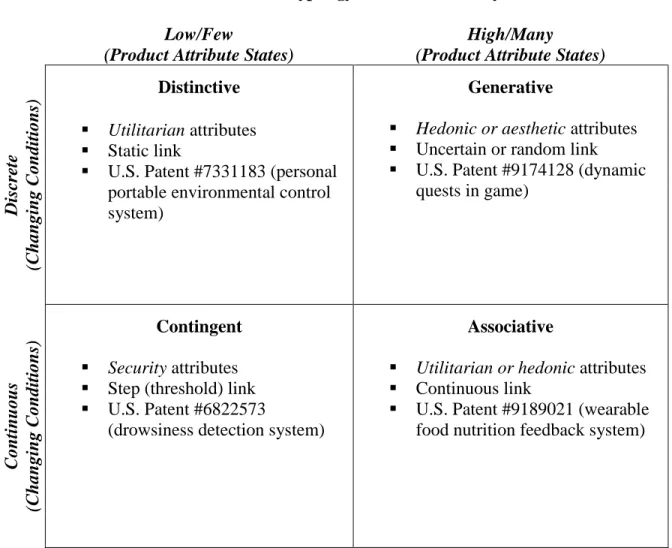
As we reveal subsequently in Figure 1, attribute auto-dynamics depends on how the changing conditions, whether discrete or continuous, map on to product attribute states (i.e., the distinct values that an attribute can take), which are few or many in number. These two
dimensions (changing conditions and product attribute states) produce the typology with four
8Fischer and Otnes (2006) classify grounded theory studies in marketing according to whether they (1) question the
nature of a new construct, (2) challenge the conceptualization of a well-known construct, (3) examine unrecognized facilitators or implications of a construct, or (4) consider the adequacy of previous conceptualizations of the facilitators or implications of a construct. Our study falls into the first category.
9An ideal type is “A hypothetical construct made up of the salient features or elements of a social phenomenon, or
auto-dynamics, which we illustrate by using the running example of a smart textile suit with dynamic attributes (Mackey et al. 2017). The smart textiles product category currently features multiple innovations in progress, seeking to leverage recent technological advances (Cherenack and van Pieterson 2012; Mackey et al 2017), and many of those innovations feature attribute auto-dynamics. By using this product category as a running example, we can identify realistic products across the four types, which appear in both consumer and business markets.
Furthermore, many opportunities remain to identify new product ideas for this product category, in diverse industries such as the military, healthcare, fashion, and sports (Gaddis 2014). For example, a dynamic temperature attribute might allow a suit to heat or cool automatically, based on changing CSE conditions—a realistic example, considering that existing smart textiles already can adapt fabric attributes such as temperature, color, and permeability.10 The four types of attribute auto-dynamics (see Table 1) are:
Contingent: Continuous changing conditions map onto a few product attribute states. A smart suit for use in hospitals could continuously monitor many physiological parameters for patients and change color from blue to red if they enter a critical state.
Distinctive: Discrete changing conditions map onto a few possible product attribute states. A smart suit for construction personnel might change automatically from red in bright light to fluorescent yellow in dark conditions.
Associative: Continuous changing conditions map onto many product attribute states. Smart camouflage wear for soldiers could change color continuously, according to changing environmental conditions.
Generative: Discrete changing conditions map onto many product attribute states. A smart fashion garment might generate a surprising, random design pattern using artificial
intelligence algorithms. Contingent Dynamics
In products with contingent dynamics, discrete changing conditions map onto a few product attribute states. For example, U.S. Patent #6822573 (drowsiness detection system),
assigned to Intelligent Mechatronic Systems Inc., acknowledges that risky drowsy driving behaviors reflect continuously changing conditions (e.g., physiological, road), such that
Each year numerous automotive accidents and fatalities occur as a result of sleepy individuals falling asleep while driving. It has been observed that these drivers exhibit certain physiological patterns that are predictable and detectible. The classic “head bobbing” motion, where the driver's head drops and then quickly pulls back upward is one of the patterns that is often exhibited when an individual is becoming drowsy while seated in an upright position. Additionally, a drop in heart rate may also indicate the presence of a drowsy driver.
In an effort to resolve this need by turning to contingent dynamics, the proposed system observes multiple continuously changing conditions and activates an appropriate product attribute state only after reaching a certain threshold of confidence. Formally,
The drowsiness detection system includes two drowsiness detection subsystems communicating with a control unit. Using sensory fusion, intelligent fuzzy algorithms, and the sensory data, the control unit determines the drowsiness state of the driver. The system non-intrusively monitors multiple characteristics of the driver which introduces redundancy and increases the confidence level of the system's drowsiness
determination…. If the driver is found to be drowsy, a signal is outputted from the control unit.
Contingent dynamics often arise in contingent, rare, and emergency conditions, in which it is beneficial for the product to adapt its attributes automatically, independent of the consumer. It typically appears in safety or security-related product attributes.
Distinctive Dynamics
In products with distinctive dynamics, discrete changing conditions map onto a few product attribute states. For example, U.S. Patent #7331183 (personal portable environmental control system), submitted by the U.S. Navy, describes two extreme conditions often
encountered by members of the military: very hot or very cold. Conventional static products cannot meet the users’ needs in changing conditions, such that
Military operations, as well as other similar operations, often require being in extreme environments that can be very cold or very hot. Personal environmental control systems may be very helpful to users in that they may increase comfort to the user as well as allow greater concentration on the mission. In extreme cold, added clothing may be too bulky or not adequate. In extreme heat there are few if any alternatives.
By integrating distinctive dynamics, the proposed activated product attribute state (heating or cooling) changes with the consumer condition (very hot, very cold), using:
… a personal portable environmental control system, which includes a thermoelectric device, two heat sinks, an exhaust fan for blowing ambient air across one of the heat sinks, and a blower for blowing ambient air across the other heat sink such that the blown air is conditioned (either heated or cooled). It is a feature of the present invention to provide conditioned air (cooled or heated) to personnel involved in varying temperature environments.
This example features two changing consumer conditions (very hot and very cold) that map onto two product attribute states (heating and cooling). Distinctive dynamics is typically associated with such utilitarian attributes.
multiple static products, especially if switching is difficult (e.g., for a construction worker atop a building, whose alternative vest remains at the ground level of the construction site).
Associative Dynamics
Products with associative dynamics feature continuously changing conditions that map onto a large number of product attribute states. The changing CSE conditions might pertain to locations, weather, products, consumer physiological states, or actions by others. Consider the constantly changing customer needs described by U.S. Patent #9189021 for a wearable food nutrition feedback system, assigned to Microsoft:
People are generally not aware of the nutritional information on food items they
consume. While people may have general knowledge of the food items, calorie content, ingredients, and the benefits and consequences of the food they are presented with, tracking consumption and nutritional information for each meal is tedious. Providing nutritional information is advantageous for people trying to watch their weight, people with allergy restrictions, or strict dietary needs.
Addressing these constantly changing conditions requires a feedback system with several product attribute states that provide continuous information about nutrition, food consumption, and social interactions. Therefore,
The feedback system includes a see-through, near-eye, head mounted display having a plurality of sensors detecting information in a field of view of the apparatus. Food items are detected in the field of view and various types of feedback are provided to the wearer of the device. Feedback can include warnings based on personal wearer needs, general nutrition information, food consumption tracking and social interactions. The system includes one or more processing devices in communication with display and the sensors which identify food items proximate to the apparatus, determine feedback information relevant to a wearer of the apparatus; and render feedback information in the display. As the name implies, associative dynamics product attributes change associatively, due to changes in consumer conditions, observed for both utilitarian and hedonic attributes.
color automatically. Multiple static products do not represent a viable alternative, because they require the user to monitor the changing situation and actively switch among static products, which would be inconvenient and likely unwieldy for soldiers with limited storage capacities. Generative Dynamics
For generative dynamics, discrete changing conditions map onto many possible product attribute states. Because there are more product attribute states than changing conditions, the link between conditions and product attribute states is typically uncertain, and the activated attribute state may be surprising to the consumer. Consumers typically are not aware of all the possible attributes that could correspond to the changing conditions, such as those described by U.S. Patent #9174128 (dynamic quests in game), assigned to Zynga. Game players recognize a few changing conditions, corresponding to their desire to play by engaging with certain challenges. But many more product attribute states (possible game challenges) are available that could address this same condition (desire to play a game), so:
Same games provide challenges to players, where the challenges entail the completion of one or more tasks within the game. As the player completes each challenge, the player receives rewards and new challenges are provided to continue the game...After a while, some experienced players may run out of challenges, causing these experienced players to leave the game. Additionally, some players may dislike some of the challenges offered by the game, causing these players to ignore these disliked challenges and continue looking for new challenges that are more appealing. However, creating challenges is a time consuming task that requires human intervention.
many product attribute states; Simon 1995), the proposed product can generate many product attribute states (new challenges):
… embodiments describe methods, computer programs, systems, and apparatus for creating computer-generated quests in a game. Embodiments provide the ability to generate a large number of quests (e.g., 80,000 or more) without a person having to create each quest manually. The quests may be generated on demand on a server and then propagated to the clients, or may be buffered in advance of the player needing the
assignment of a new quest.
The emphasis is on dynamically generating attributes automatically, to surprise the consumer. Even if the changes in condition are discrete (i.e., a game player wants to play a new challenge, after completing the prior one), many possible product attribute states (80,000 game challenges) can correspond to the player’s desire. This large number of possible product attribute states and smaller number of discrete changes conditions implies high uncertainty in the link between changing conditions and product attribute states, as well as surprising outcomes for consumers.
Generative dynamics accordingly are effective for satisfying consumers’ desires for novelty and variety, typically related to hedonic or aesthetic attributes. Consumers may become bored or dissatisfied with a particular product attribute state once they gain familiarity with its static attributes. For example, they grow dissatisfied with the same aesthetic design for clothing, prompting their desire for novel attribute states (e.g., Bianchi 2002; Hirschman 1980), which can be satisfied by a product that incorporates generative dynamics. Fashion-conscious users might want to wear a different clothing pattern every evening and thus would value a smart suit that can generate a surprising design pattern automatically, using artificial intelligence algorithms.11
Procedural Framework
11Artificial intelligence technology, such as generative adversarial networks, can facilitate the automatic generation
https://www.cnet.com/news/this-website-uses-ai-to-Because we observe auto-dynamics in novel products and emerging product categories, as an important managerial application, we seek to identify new product ideas with
auto-dynamics that firms might potentially develop and market. Goldenberg, Mazursky, and Solomon (1999) assert that a procedural framework can be valuable to firms, managers, and designers; accordingly, noting that auto-dynamics involves mapping among changing conditions (market knowledge) and adaptive product attributes (technological knowledge), we present a procedural idea-generation framework to combine elements of two contrasting paradigmatic approaches to new product ideation: market pull and technology push (e.g., Goldenberg, Lehmann, and Mazursky 2001; Kornish and Hutchison-Krupat 2017).
A market pull approach begins by identifying a market segment and examining or eliciting market knowledge that can spur new product ideas. For example, during a focus group, firms may obtain feedback from consumers regarding the drawbacks or unmet needs associated with existing products (e.g., Fern 1982; McQuarrie and McIntyre 1986). Such feedback can provide a basis for novel product ideas. In contrast, a technology push approach to ideation commences with a consideration of how existing products might be enhanced by exploiting technological knowledge, without explicit consideration of market knowledge. For example, inventive template-based ideation starts by discovering inventive patterns in other novel
products, then applies those patterns in new contexts to generate new product ideas (Goldenberg, Mazursky, and Solomon 1999; Hauser, Tellis, and Griffin 2006). Auto-dynamics entails
The first stage (market pull) in our procedural framework involves identifying a customer segment for the product category and changing CSE conditions that affect this customer
segment, garnered through market research, observational studies, focus groups, or surveys. The second stage (technology push) instead seeks to identify existing or new product attributes with potentially adaptive properties that the firm can develop. In a third, ideation stage, market pull and technology push knowledge combine to enable mapping the changing conditions together with one or more existing or new adaptive product attributes to generate ideas and ascertaining appropriate auto-dynamics in each case.
Market Pull Stage. Consider a sporting goods manufacturer, such as Under Armour, that wants to design a smart suit with auto-dynamics for athletes participating in triathlons. In the market pull stage of the proposed procedural framework, the firm engages in market research to learn about changing CSE conditions athletes encounter that create a need for the product:
Customer Conditions:
o The distance of the athlete relative to aid stations o The varying heart rate of the athlete
o Changes in body mass of the athlete over time
Product-System Conditions:
o Changing levels of moisture content in the fabric o Stretching of fabric during use
o Wear and tear of fabric over time
Environment Conditions:
o Passing competitors during the race
o Varying external light conditions over a three-hour race o Changing weather conditions during training
lactic acid in the body (Neufield et al. 2019).12 The athlete’s varying heart rate thus represents market pull–relevant knowledge in our procedural framework (Figure 1).
Technology Push Stage. Next, the firm identifies several possible existing or new product attributes that might possess adaptable properties. For the smart suit for triathletes, such product attributes may include fabric temperature, fabric texture, aesthetic design, and size. The
technology pull stage is independent of the market pull stage, executed without taking into account market pull–related information about changing conditions. However, the firm considers its existing or potential technological capabilities to narrow down options for smart suits with different adaptive attributes, such as its display, sound or music-playing capabilities, fabric texture, or temperature.
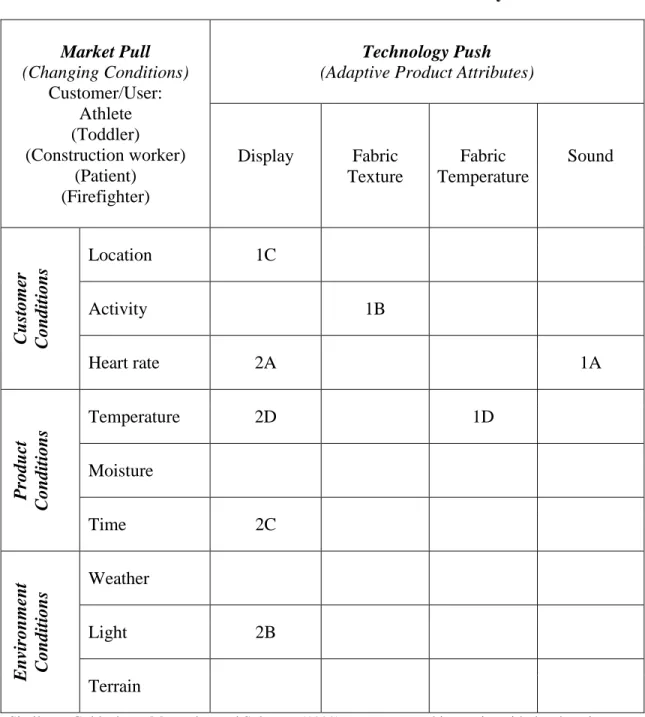
Ideation Stage. In this third stage, integrating market pull and technology push requires two steps: mapping and type identification (Figure 1). In the mapping step, the firm considers one or more possible mappings between conditions and product attributes to obtain a generic product concept. If there are 𝑚 changing conditions and 𝑛 adaptive attributes, 𝑚 × 𝑛 mappings are possible (Table 2). For example, if the firm maps a changing condition identified in the market pull stage (e.g., changing heart rate of the athlete) to the four adaptive attributes from the technology push phase, it would obtain four generic smart suit concepts that can adapt the
Display based on heart rate.
Sound or music played based on heart rate.
Temperature based on heart rate.
Fabric texture based on heart rate.
Next, the firm ascertains the appropriate type of auto-dynamics (i.e., contingent, distinctive, associative, or generative) to be incorporated to identify more specific product
12See
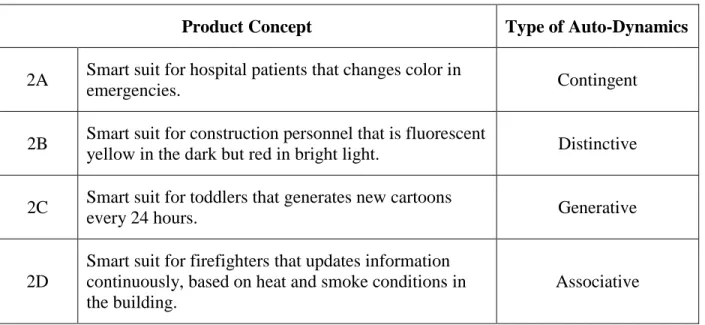
concepts. For example, the generic concept of a smart suit that adapts the sound or music played based on heart rate involves a continuous changing condition (heart rate), rather than a discrete one, so the auto-dynamics typology (Table 1) indicates that contingent or associative dynamics would be appropriate. The firm narrows its focus on two specific concepts with different auto-dynamics types: either a smart suit that buzzes when the athlete exceeds 90% of the maximum heart rate (contingent) or one that alters the music volume continuously based on the heart rate (associative). At the conclusion of this step, the firm may conclude that only the first concept is feasible and discard the second concept. In Table 3, we list four other illustrative concepts that may emerge from different mappings of changing conditions and adaptive attributes. A firm also might repeat the procedure for new market segments. In Table 4, we illustrate product concepts for different market segments: toddlers, construction workers, patients, and firefighters who encounter changing conditions that are unlike those of triathletes.
Decision Making
In this section, to illustrate how consumers make decisions about products with auto-dynamics, we again refer to our running example of a hypothetical smart textile suit with dynamic attributes. If it features a dynamic temperature attribute, this product would be able to heat or cool the fabric automatically, according to changing CSE conditions. We derive a
framework for consumer decision making for this product and thereby derive appropriate pricing strategies. Specifically, we represent the smart suit as vector 𝑋𝑡 of 𝑚 dynamic product attributes that take different values at different points in time t.13 Because the smart suit can heat or cool its fabric automatically, based on changing CSE conditions, 𝑚 = 2, and the two attributes are fabric
13Without loss of generality, non-dynamic (static) attributes can be included in 𝑋
cooling (𝑋𝐶) and fabric heating (𝑋𝐻). They are independent and activate separate heating and cooling elements, so they take binary values of 0 or 1 when these elements switch on or off in response to changing CSE conditions. The attribute vector is 𝑋𝑡 = [𝑥𝑡𝐶, 𝑥
𝑡𝐻]′. In turn, we define four product attribute states:
𝑺𝟏, where 𝑋𝑠=1,𝑡 = [1,0]′, and only the cooling element is active. This state activates when the consumer’s body temperature is higher than optimal.
𝑺𝟐, where 𝑋𝑠=2,𝑡 = [0,1]′, and only the heating element is active. This state activates when the consumer’s body temperature is lower than optimal.
𝑺𝟑, where 𝑋𝑠=3,𝑡 = [1,1]′, and both the cooling and heating elements are active. This situation arises when a part of the consumer’s body needs to be maintained at a cooler temperature, but another part needs a warmer temperature.
𝑺𝟒, where 𝑋𝑠=4,𝑡 = [0,0]′, and neither element is active, because the consumer’s body temperature is optimal.
That is, with two dynamic attributes (𝑚 = 2), the smart suit features four product attribute states (𝑆 = 4). In general, m dynamic attributes lead to S potential states, and we can represent the product attribute vector 𝑋𝑠,𝑡 at time t as 𝑋𝑠,𝑡∈ {𝑋1,𝑡, 𝑋2,𝑡… 𝑋𝑆,𝑡}.
For this smart suit, 𝑋𝑡= [𝑥𝑡𝐶, 𝑥𝑡𝐻]′, and the importance of the attributes varies over time, so we write the attribute importance vector as 𝛾𝑡 = [𝛾𝑡𝐶, 𝛾𝑡𝐻]. It varies with changing conditions; as an illustration, we conceptualize three conditions for the smart suit, such that 𝐾 = 3:
𝑲𝟏, running in hot temperature conditions, γ 𝑘=1,𝑡 = [1, −1]. The athlete encounters hot weather conditions while running and needs to be cooled down for optimum athletic performance. The importance weight is 1 for fabric cooling and −1 for fabric heating. The negative importance weight for fabric heating signals that the consumer would obtain a disutility if this attribute were present in this condition.
𝑲𝟐, cycling in mixed temperature conditions, γ 𝑘=2,𝑡 = [0.5,0.5]. This need state arises because part of the bicyclist’s body (legs) heats up and needs to be cooled down, but another part (torso) encounters cold, windy conditions and needs to be warmed up for optimum athletic performance. In this condition, the athlete expresses importance weights of . 5 for fabric cooling and . 5 for fabric heating.
are −1 for fabric cooling and 1 for fabric heating. The negative importance weight for fabric cooling highlights the disutility that would arise for the consumer if this attribute were present.
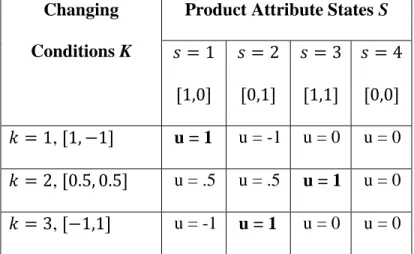
For the general case with 𝑚 attributes and 𝐾 conditions, the attribute importance vector is 𝛾𝑘,𝑡 = {𝛾1,𝑡, 𝛾2,𝑡… 𝛾𝐾,𝑡}. For the smart suit, we can combine product attribute states (𝑆 = 4) with customer conditions (𝐾 = 3) to define the utilityfor the customer at time t as 𝑢𝑠,𝑘,𝑡= 𝑋𝑠,𝑡γ 𝑘,𝑡, where 𝑋𝑠,𝑡γ 𝑘,𝑡 = 𝑥𝑠,𝑡𝐶 𝛾
𝑘,𝑡𝐶 + 𝑥𝑠,𝑡𝐻 𝛾𝑘,𝑡𝐻—that is, the utility a consumer with attribute importance vector γ 𝑘,𝑡 derives from the product with attribute vector 𝑋𝑠,𝑡 at time 𝑡. Table 5 lists the benefits of all potential combinations of product attribute states and conditions.
For a product with attribute auto-dynamics to provide the maximum consumer benefits, an appropriate association must exist between condition 𝐾 and product attribute states 𝑆 to maximize the corresponding utility for the consumer, 𝑋𝑠,𝑡γ 𝑘,𝑡. From Table 2, we see that for the smart suit to provide the highest benefit, it should map the following changing conditions to product attribute states: condition 𝐾1 maps to product attribute state 𝑆1, 𝐾2 maps to 𝑆3, and 𝐾3 maps to 𝑆2.
Purchase and Consumption Decisions
We use the utility specification for products with dynamic attributes to elucidate purchase and consumption decisions. For the general case, we consider a pricing scheme with a purchase price 𝑃0 and consumption payment at time t as 𝑃𝑡 (purchase price is the price at 𝑡 = 0, so
𝑃0). This pricing strategy resembles a standard two-part tariff scheme (Iyengar and Gupta 2009). Static pricing arises if 𝑃0 > 0 and P𝑡= 0, ∀ t > 0. If P𝑡|𝑡>0> 0, for a consumption decision at time t, the payment represents a disutility. For example, software may have several components, and consumers pay P𝑡 for the components they use in a given quarter, beyond the base
As is typical in dynamic decision-making studies (e.g., Gowrisankaran and Rysman 2012; Lee 2013), we anticipate that at the time of purchase (𝑡 = 0), a consumer considers both the instantaneous utility 𝑢0 and the expected utility obtained from future consumption 𝑢𝑡|𝑡>0. Instantaneous utility is:
(1) 𝑢0 = 𝑔0 (𝑋𝑠,𝑡=0γ 𝑘,𝑡=0, ψt=0) − 𝑃0,
where ψ𝑡=0 represents utility from non-product attribute contextual factors during purchase (e.g., store displays that provide utility, Bitner 1992; the presence of other consumers, Jacobs 2016), 𝑋𝑠,𝑡=0 is the product attribute vector, γ 𝑘,𝑡=0 is the consumer importance vector, 𝑃0 is the purchase price, and 𝑔0 (. ) is a theory-based link function at time 𝑡 = 0 for the purchase (typically, it is an identity link function, to attain a linear utility specification).
At any point in time 𝑡 > 0, 𝑐𝑡 can represent a consumer’s decision to consume the purchased product, such that c𝑡 = 1 if the consumer consumes and c𝑡= 0 otherwise. Consumer utility for such consumption is:
(2) 𝑢𝑡 = 𝑢𝑡|𝑡>0= 𝑐𝑡 [𝑔𝑡 (𝑋𝑠,𝑡γ 𝑘,𝑡, ψ𝑡) − 𝑃𝑡].
Note that we use 𝑔𝑡 as the link function, thereby allowing for the possibility that it could vary across consumption occasions. When making a purchase decision, a consumer maximizes the sum of purchase utility (𝑢0) and the current value of all potential future consumption utilities (𝑢𝑡|𝑡>0), subject to budget constraints. Thus, the consumer maximization problem (where δ is the discount factor) reduces to (Cogley and Sargent 2008):
Equation 4 thus signifies the dynamic decision problem faced by the consumer at time 𝑡. Pricing Strategy Archetypes for Attribute Auto-dynamics
From the preceding model, we identify potentially different pricing strategy archetypes that firms might deploy for products with various attribute auto-dynamics types (see Table 3 for examples). In a two-part scheme, a consumer can expect to pay a static purchase price 𝑃0at 𝑡 = 0, then make a payments 𝑃𝑡 during consumption at time 𝑡 > 0. The payment P𝑡 for consumption at 𝑡 > 0can change over time, which allows firms to devise strategies to charge different
payments for the same product at multiple potential consumption instances. We represent this generic two-part pricing strategy as:
(6) 𝑃𝑡∶= (
𝑃0 𝑖𝑓 𝑡 = 0
𝜑𝑡(𝑋𝑠,𝑡, 𝛾𝑘,𝑡, 𝜓𝑡, 𝑐𝑡, 𝑐𝑡−1… ) 𝑖𝑓 𝑡 > 0),
where 𝜑𝑡is the consumption payment function that depends on current and historical values of dynamic variables (described in the previous section), such as 𝑋𝑠,𝑡, the product attribute state; 𝛾𝑘,𝑡, the attribute importance vector; 𝜓𝑡, the contextual factors encountered by the consumer; and 𝑐𝑡, the level of consumption. For a product with attribute auto-dynamics, implementing such strategies requires the firm to have information about CSE conditions, so it must establish
Contingent Dynamics and Condition-Based Pricing
Contingent dynamics frequently involve applications that activate the dynamic attribute in rare or unexpected conditions. In such cases, consumers may not be willing to pay upfront, so firms might implement a dynamic pricing model, requiring consumption-related payment based on changing conditions reflected in the attribute importance vector 𝛾𝑘,𝑡. In this condition-based pricing strategy, the consumption payment function defined in Equation 6, 𝜑𝑡 ≔ 𝜑𝛾(𝛾𝑘,𝑡), depends on 𝛾𝑘,𝑡.
For example, when selling its drowsiness detection system, a carmaker could charge consumption payments based on the drowsiness of the driver or the road conditions, which are reflected in changes to the attribute importance vector 𝛾𝑘,𝑡.14 In some cases, the firm may be able to access consumers’ condition directly, such as by tracking physiological data using sensors embedded in the product. In other cases, it might rely on a proxy for the attribute importance vector 𝛾𝑘,𝑡, such as local weather or traffic conditions. With a condition-based pricing strategy for products with contingent dynamics, under certain predefined conditions, firms can set the consumption payment to a low fixed amount, which would be particularly appropriate in emergency or natural disaster contexts, in which consumers’ willingness to pay is high but charging a dynamic price based on changing conditions would be unethical.
Distinctive Dynamics and Attribute-Based Pricing
A firm selling a product with distinctive dynamics usually should charge a static, upfront purchase price, similar to the price for the comparable set of multiple static products. However, for some products, such as rental equipment or large purchases with maintenance contracts, a
14See https://www.nytimes.com/2017/03/16/automobiles/wheels/drowsy-driving-technology.html (accessed June
dynamic pricing strategy could include an upfront price and dynamic consumption payments based on the active product attribute state 𝑋𝑠,𝑡. For this attribute-based pricing strategy, the consumption payment function defined in Equation 6, 𝜑𝑡 ≔ 𝜑𝑋(𝑋𝑠,𝑡), depends on 𝑋𝑠,𝑡, that is, the product attribute state active at time 𝑡.
In the ideal type case of the portable environmental control system patented by the U.S. Navy, charges might reflect which product attribute state 𝑋𝑠,𝑡, heating or cooling, is active at time 𝑡. Attribute-based pricing requires a firm to monitor the active product attribute state constantly, which likely is appropriate if the cost of provisioning, maintaining, or servicing one of the attribute states is higher than the costs for the other states. A smart speaker such as Amazon’s Echo Dot with digital assistance15 (U.S. Patent #9633661) typically charges a higher
consumption payment for streaming copyrighted music than for providing local weather information, for example.
Associative Dynamics and Consumption-Based Pricing
Products with associative dynamics often involve both a physical hardware component and a software service maintained by the firm. For example, the GPS-based navigation system developed by TomTom for trucks relies on an in-vehicle physical device, but it also provides dynamic attributes for truck drivers, such as real-time routing based on each truck’s size, cargo, and speed.16 In providing this product, TomTom incurs costs to maintain the service component, and these costs depend on the level of consumption (usage) 𝑐𝑡of such services by the customer. Thus, TomTom may adopt a consumption-based pricing approach, for which the consumption