Some triangle centers associated with the circles
tangent to the excircles
Boris Odehnal
February 19, 2010
Abstract
We study those tritangent circles of the excirlces of a triangle which enclose exactly one excircle and touch the two others from the outside. It turns out that these three circles share exactly theSpiekerpoint. Moreover we show that these circles give rise to some triangles which are in perspective with the base triangle. The respective perspectors turn out to be new polynomial triangle centers.
1
Introduction
Let ∆ :={A, B, C}be a triangle in the Euclidean plane. Let Γi be the excircles with centersIi and radiiρi withi∈ {1,2,3}. We assume that Γ1lies opposite toA.
There are eight circles tangent to all three excircles: the side lines of ∆ (consid-ered as circles with infinitely large radius), theFeuerbachcircle (cf. [2, 4]), the
so-calledApolloniuscircle (enclosing all the three circles Γi, see for example
[3, 6, 9]) and three remaining circles which will in the following be denoted by Ki. Any circle Ki encloses a circle Γi and touches the remaining circles from the outside. Until now only their radii are known, see [1].
In the following we focus on the circlesKiand show that these circles share the
SpiekerpointX10. Further the triangle of contact points{K1,1, K2,2, K3,3}of
ΓiandKi is perspective to ∆. Surprisingly the triangle built by the centersMi of circlesKi is also perspective to ∆.
2
Main results
The problem of constructing the tritangent circles to three given circles is well studied. Applying the ideas ofM. Gergonne [5] to the three excircles Γi we
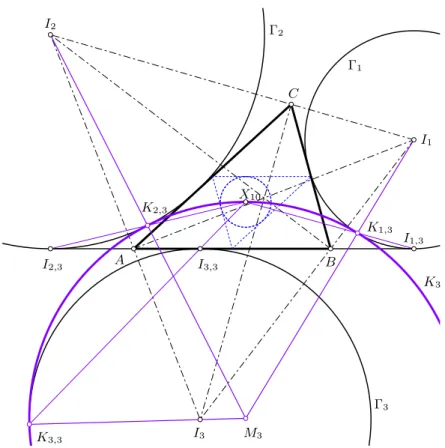
see that the construction of the tritangent circlesKj is linear. At first we find the contact pointsKi,jof ΓiwithKj(see Fig. 1): We project the contact points Ii,j of the i-th excircle with the j-th side1 of ∆ from the radical center of the excircles to thei-th excircle. The radical center of Γi is theSpiekerpoint, cf.
[8]. Knowing the contact points ofKi,jit is easy to find the centersMjofKj.
1
A B C X10 I1 I3 M3 Γ1 Γ3 I1,3 I2,3 I3,3 K1,3 K2,3 K3,3 K3
Figure 1: Linear construction of the tritangent circle enclosing Γ3. By simple and straight foreward computation following the construction of the contact pointsKi,j of either circleKi with the excircle Γj we can show:
Theorem 2.1
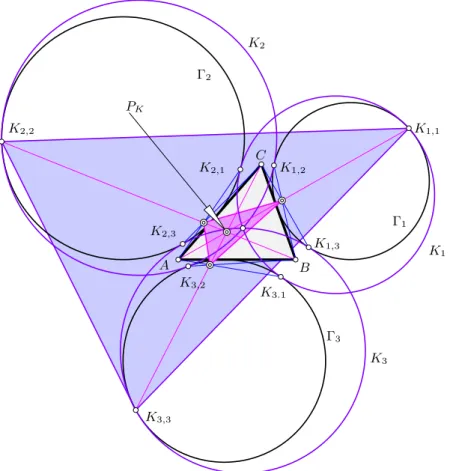
The triangle {K1,1, K2,2, K3,3} built by the contact points of Ki with the i-th excircleΓi is in perspective with∆, see Fig. 2. The perspector PK is has homo-geneous barycentrics PK= s−a a2 : s−b b2 : s−c c2 . (1)
Proof: We denote the contact points of Γiwith thej-th side of ∆ byIi,j. Their homogeneous barycentrics are
I1,1= ( 0 : s−b : s−c), I1,2= ( b−s : 0 : s), I1,3= ( c−s : s : 0), I2,1= ( 0 : a−s : s), I2,2= ( s−a : 0 : s−c), I2,3= ( s : c−s : 0), I3,1= ( 0 : c : a−s), I3,2= ( s : 0 : b−s), I3,3= ( s−a : s−b : 0), (2)
wherea=BC,b=CA,c=ABare the side lengths of ∆ ands= (a+b+c)/2 is the half of the perimeter. Note that Ki,j = [Ii,j, X10]∩Γj \Ii,j and the
Spiekerpoint is given by
K1,1 K2,1 K3.1 K1,2 K2,2 K3,2 K1,3 K2,3 K3,3 Γ1 Γ2 Γ3 K1 K2 K3 A B C PK
Figure 2: Two triangles in perspective with ∆: the triangle of contact points Ki,i, the centerPK from Th. 2.1, and the triangle mentioned in Th. 2.2.
cf. [7, 8]. In the following we use the abbreviationsba:=b+c,bb =a+c, and
b
c=a+b.
The equations of the incircles in terms of homogeneous barycentric coordinates can be written in the form xTBix = 0, where xT = (x0, x1, x2) is the vector collecting the homogeneous barycentric coordinates of a point X and Bi is a (regular) symmetric 3×3-matrix. The three coefficient matrices are
B1= 2 4 s2 s(s−c) s(s−b) s(s−c) (s−c)2 −(s−b)(s−c) s(s−b) −(s−b)(s−c) (s−b) 2 3 5, B2= 2 4 ( s−c)2 s(s−c) −(s−a)(s−c) s(s−c) s 2 s(s−a) −(s−a)(s−c) s(s−a) (s−a) 2 3 5, B3= 2 4 (s−b) 2 −(s−a)(s−b) s(s−b) −(s−a)(s−b) (s−a) 2 s(s−a) s(s−b) s(s−a) s 2 3 5. (3)
K1,2= ( −c 2 s(s−b) : bb 2 (s−b)(s−c) : (as+bc) 2 ), K1,3= ( −b2s(s−c) : (as+bc)2 : bc2(s−b)(s−c)), K2,1= ( ba2(s−a)(s−c) : −c 2 s(s−a) : (bs+ac) 2 ), K2,2= ( c2s(s−a) : −bb 2 (s−a)(s−c) : a 2 s(s−c)), K2,3= ( (bs+ac)2 : −a2s(s−c) : bc2(s−a)(s−c)), K3,1= ( ba2(s−a)(s−b) : (cs+ab) 2 : −b 2s (s−a)), K3,2= ( (cs+ab)2 : bb2(s−a)(s−c) : −a 2 s(s−b)), K3,3= ( b2s(s−a) : a 2 s(s−b) : −bc 2 (s−a)(s−b)). (4)
Now it is easily verified that the three vectorsA×K1,1,B×K2,2,, andC×K3,3 are linearly dependent und thus the respective lines meet in the point given in (1). Obviously the pointPK is a triangle center which is not listed in [7].
Moreover with the computations from the previous proof we can show:
Theorem 2.2
The lines [K1,1, A], [K1,2, B], [K1,3, C] are concurrent. The lines [K2,1, A],
[K2,2, B], [K2,3, C] are concurrent. The lines [K3,1, A], [K3,2, B],[K3,3, C] are concurrent.
Proof: Use Eq. (4) compute the barycentric coordinates of the lines and show the linear dependency.
Remark: The loci of concurrency of the three triplets of lines mentioned in Th. 2.2 are three points building a triangle which is itself in perspective with ∆. The pespector is the pointPK, cf. Fig. 2.
Theorem 2.3
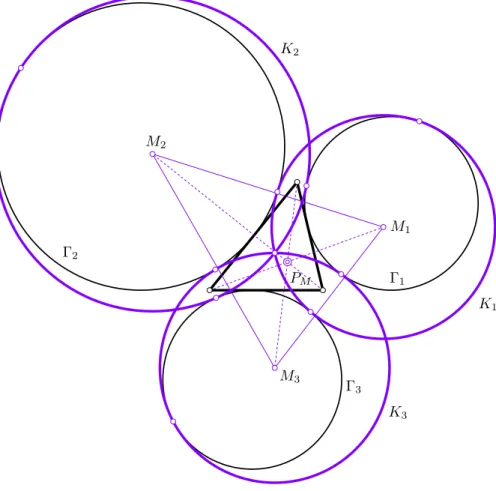
The triangle{M1, M2, M3}built by the centers of the circleK1,K2, andK3is in perspective with∆, see Fig. 3. The perspector is the pointPM with homogeneous barycentrics (α:β:γ), where
α= (a5+a4ba−a3(b−c)2−a2ba(b2+c2)−2abc(ba2−bc)−2bab2c2)−1. (5)
Proof: The centerM3of the tritangent circleK3(enclosing Γ3) is found as the meet of two straight lines
M3= [I1, K1,3]∩[I2, K2,3].
Analogously we find the remaining centers. Their barycentric coordinates are thus M1= (−2baa 4 −(3ba 2 −2bc)a 3 +ba(b2 +c2 )a2 +ba2 (b−c) 2 a−ba3 (b−c) 2 : : (ba2 +b2 )a3 +ba(2b2 +c2 )a2 +bac(b−c)(2b+c)a+ba 2 c2 (b−c) : : (ba2+c2)a3 +ba(b2 + 2c2 )a2 −bab(b−c)(b+ 2c)a−ba 2 b2(b−c)), M2= ((bb 2 +a2 )b3 +bb(2a2 +c2 )b2 +bbc(a−c)(2a+c)b+bb 2 c2 (a−c) : :−2bbb 4 −(3bb 2 −2ac)b 3 +bb(a2 +c2 )b2 +bb2 (a−c) 2 b−bb 3 (a−c) 2 : : (bb2 +c2 )b3 +bb(a2 + 2c2 )b2 −bba(a−c)(a+ 2c)b−bb 2 a2 (a−c)), M3= ((bc 2 +a2)c3 +bc(2a2 +b2)c2 +bcb(a−b)(2a+b)c+bc 2 b2(a−b) : : (bc2 +b2 )c3 +bc(a2 + 2b2 )c2 −bca(a−b)(a+ 2b)c−bc 2 a2 (a−b) : :−2bcc 4 −(3bc 2 −2ab)c 3 +bc(a2 +b2 )c2 +bc2 (a−b) 2 c−bc 3 (a−b) 2 ). (6)
Now the concurrency of the lines [M1, A], [M2, B], and [M3, C] is easily shown. The pointPM is a center and it is not listed in [7].
Γ1 Γ2 Γ3 K1 K2 K3 M1 M2 M3 PM
Figure 3: The three tritangent circles, the triangle of the respective centers, and the perspectorPM.
Theorem 2.4
The three tritangent circlesKienclosing thei-th excircle of∆ and touching the others from the exterior share exactly the Spiekerpoint X10 of ∆.
Proof: We switch to trilinear coordinates of points and use the formula for the disctance between two points given in terms of their respective actual trilinear coordinates (cf. [8, p. 31] and find the radiiRi of the tritangent circlesKi
b
aR1=bbR2=bcR3=s(ab+bc+ca)/4F−R, (7) where Ris the circumradius of ∆ and F is the area of ∆. Eq. (7) is a relation between the radii which is equivalent to those given in [1].
The equations of the circlesKi in terms of homogeneous barycentrics are deter-mined uniquely (up to a non-vanishing scalar) according to [8, p. 223] and can thus be written in the formxTCix= 0 with the following (regular) symmetric
C1= ba(c2 b −a 2 )−ab 2 b a(b2 −a 2 )−ac 2 b 4ba(s−a)(s−c) 2abas b 2abas 4ba(s−a)(s−b) , C2= " 4bb(s−b)(s−c) bb(c2 −b 2 )−a 2 b 2bbbs bb(c2 −b 2 )−a 2 b −2s(a 2 +c2 +bbb) bb(a2 −b2)−bc2 2bbbs bb(a2 −b 2 )−bc 2 4bb(s−a)(s−b) # , C3= " 4bc(s−b)(s−c) 2cbcs b c(b2 −c 2 )−a 2 c 2cbcs 4bc(s−a)(s−c) b c(a2 −c 2 )−b 2 c b c(b2 −c 2 )−a 2c b c(a2 −c 2 )−b 2 c −2s(a 2 +b2 +cbc) # . (8)
By substituting the barycentrics ofX10 into the equations ofKi we prove that theSpiekerpoint is a common point of the three circlesKi.
References
[1] A. Aeppli: Das Taktionsproblem vonApolloniusangewandt auf die vier Ber¨uhrungskreise eines Dreiecks.Elem. Math.13(1958), 25–30.
[2] C.B. Boyer: A History of Mathematics.J. Wiley, New York, 1968.
[3] N. Dergiades & J.C. Salazaar: Some triangle centers associated with the tritangent circles.Forum Geometricorum9(2009), 259–270.
[4] K.W. Feuerbach: Eigenschaften einiger merkw¨urdigen Punkte des ger-adlinigen Dreiecks und mehrerer durch sie bestimmten Figuren.PhD thesis, N¨urnberg, 1822.
[5] M. Gergonne: Recherche du cercle qui en touche trois autres sur une sph`ere.Ann. math. pures appl.4(1813–1814), 349–359.
[6] D. Grinberg & P. Yiu: The Apollonius circle as a Tucker circle.Forum
Geometricorum2(2002), 175–182.
[7] C. Kimberling: Encyclopedia of Triangle Centers. Available at:
http://faculty.evansville.edu/ck6/encyclopedia/ETC.html.
[8] C. Kimberling: Triangle centers and central triangles. Congressus
nu-merantium128, Utilitas Mathematica Publishing Inc., Winnipeg, 1998.
[9] M.R. Stevanovi´c: The Apollonius Circle and Related Triangle Centers.
Forum Geometricorum3(2003), 187–195.
Boris Odehnal
Vienna University of Technology
Institute of Discrete Mathematics and Geometry Wiedner Hauptstraße 8-10
A-1040 Wien, Austria