For more information visit
ato.gov.au
Company tax return
instructions
2013
To help you complete the company tax return
for 1 July 2012 – 30 June 2013
© AUSTRALIAN TAXATION OFFICE FOR THE
COMMONWEALTH OF AUSTRALIA, 2013
You are free to copy, adapt, modify, transmit and distribute this material as you wish (but not in any way that suggests the ATO or the Commonwealth endorses you or any of your services or products).
PUBLISHED BY Australian Taxation Office Canberra
May 2013 JS 25640
OUR COMMITMENT TO YOU
We are committed to providing you with accurate, consistent and clear information to help you understand your rights and entitlements and meet your obligations.
If you follow our information in this publication and it turns out to be incorrect, or it is misleading and you make a mistake as a result, we must still apply the law correctly. If that means you owe us money, we must ask you to pay it but we will not charge you a penalty. Also, if you acted reasonably and in good faith we will not charge you interest. If you make an honest mistake in trying to follow our information in this publication and you owe us money as a result, we will not charge you a penalty. However, we will ask you to pay the money, and we may also charge you interest. If correcting the mistake means we owe you money, we will pay it to you. We will also pay you any interest you are
entitled to.
If you feel that this publication does not fully cover your
circumstances, or you are unsure how it applies to you, you can seek further assistance from us.
We regularly revise our publications to take account of any changes to the law, so make sure that you have the latest information. If you are unsure, you can check for more recent information on our website at ato.gov.au or contact us. This publication was current at May 2013
CONTENTS
About these instructions iii Publications and services iii
INTRODUCTION III
What’s new? iii
SCHEDULES 1
Dividend and interest schedule 1 Capital gains tax (CGT) schedule 2Losses schedule 2
Consolidated groups losses schedule 3 Non-individual PAYG payment summary schedule 3 Reportable tax position (RTP) schedule 4 Research and development tax incentive schedule 4 International dealings schedule 4
GENERAL INFORMATION
5
Consolidation – taxing wholly owned groups
as single entities 5
Simplified imputation system 7 Cooperatives – option to frank dividends 8
debt and equity rules 8
Clubs, societies and associations 8 Corporate unit trusts and public trading trusts 8 Taxation of financial arrangements (TOFA) Rules 8 Foreign exchange gains and losses 9
General value shifting regime 9
Trans-tasman imputation 10 International taxation – treatment
of certain foreign hybrid entities 10
Information matching 10
Small business entities 10 Strata title bodies corporate 12 Record keeping requirements 12
Tax return 13
Amendment under self-assessment 14 Private ruling by the commissioner of taxation 14
Payment arrangements 15
Penalties, shortfall interest charges, general
interest charges 15
COMPLETING THE COMPANY TAX RETURN 16
PAGE 1 OF THE TAX RETURN
16
Tax file number (TFN) 16
Name of company 16
Australian business number (ABN) 16 Business address of main business 17
Final tax return 17
PAGE 2 OF THE TAX RETURN
17
Electronic funds transfer (EFT) 17 1 Ultimate and immediate holding company
name and ABN or country code 17 2 Description of main business activity 17
3 Status of company 18
4 Interposed entity election status 18 5 Taxation of financial arrangements (TOFA) 20
PAGE 3 OF THE TAX RETURN
20
6 Calculation of total profit or loss 20 Income 21
Participants in an FMIS 24
PAGE 4 OF THE TAX RETURN
27
Expenses 27
Total profit or loss 36
PAGE 5 OF THE TAX RETURN
36
7 Reconciliation to taxable income or loss 36
Add-back items 38
Subtraction items 42
PAGE 6 OF THE TAX RETURN
51
8 Financial and other information 51 Attributed foreign income 58 Taxation of financial arrangements (TOFA) 58
9 Capital allowances 59
PAGE 8 OF THE TAX RETURN
61
10 Small business entity Simplified depreciation 61 11 Consolidation deductions relating to rights
to future income, consumable stores and
work in progress 61
12 National rental affordability scheme tax offset 62
13 Losses information 63
14 Personal services income 65
15 Licensed clubs only 67
APPENDIXES
91
Appendix 1 Commercial debt forgiveness 91 Appendix 2 Capital works deductions 93 Appendix 3 Thin capitalisation 96 Appendix 4 Taxation treatment of pooleddevelopment funds and investors 96 Appendix 5 Infrastructure borrowings 97 Appendix 6 Uniform capital allowances 98 Appendix 7 Company tax rate 103 Appendix 8 Foreign and other jurisdictions codes 104 Appendix 9 Personal services income 106
Deductions 106
PAYMENT 109
How to pay 109
ABBREVIATIONS 110
TAXATION DETERMINATIONS, TAXATION
RULINGS AND PRACTICE STATEMENTS
111
PUBLICATIONS
112
INDEX
114
MORE INFORMATION
inside back coverWebsite inside back cover Publications inside back cover
Phone inside back cover
Other services inside back cover
PAGE 9 OF THE TAX RETURN
68
17 First home saver account (FHSA) providers only 68
18 Pooled development funds 69
19 Retirement savings accounts (RSAs) providers only 69
20 Foreign income tax offset 69
21 Research and development tax incentive 70
22 Internet trading 73
23 Reportable tax position 73 24 International related party dealings/transfer pricing 74 25 74
26 Overseas interests 74
27 Thin capitalisation 75 28 Transactions with specified countries 75 Calculation statement 75 Declarations 88 Tax agent’s declaration 88
Worksheet 2 88
ABOUT THESE INSTRUCTIONS
The Company tax return instructions 2013 will help you complete the Company tax return 2013 (NAT 0656). The instructions include:
n information about the schedules that companies might need to complete and attach to their tax returns n details of record-keeping requirements
n instructions about how to complete each label on the company tax return.
Text with a green background applies to consolidated and multiple entry consolidated (MEC) groups.
When we say ‘you’ or ‘your business’ in these instructions, we mean either you as a business entity (the company) that conducts a business, or you as the tax agent or public officer responsible for completing the tax return.
This publication is not a guide to income tax law. Ask for help from the Australian Taxation Office (ATO) or a recognised tax adviser if you feel that this publication does not fully cover your circumstances.
PUBLICATIONS AND SERVICES
To find out how to get a publication referred to in these instructions and for information about our other services, see the inside back cover.
INTRODUCTION
These instructions will help you complete the Company tax return 2013 (NAT 0656), the tax return for all companies,
including head companies of consolidated and MEC groups . These instructions contain a number of abbreviations for names and technical terms. Each term is spelt out the first time it is used. A list of abbreviations is on page 110.
WHAT’S NEW?
In 2012, we reviewed business income tax returns to obtain a better balance between the community’s cost of compliance and our information needs. The review explored the company, trust and partnership income tax returns and some associated schedules to identify opportunities to remove or refine the information collected. The review has resulted in the following changes that affect the Company tax return 2013:
The Personal services income schedule and the Capital allowances schedule have ceased. New information items relating to these areas are now included at item 14 and 9 in the return.
The Capital gains tax schedule has been redesigned and the former Z item 7 Did this CGT event relate to a forestry managed investment scheme interest that you held other than as an initial participant? has been replaced with M Have you applied an exemption or roll‑over?
The following information items from the company tax return 2012 are not on the Company tax return 2013: Is a payment due?
Is a refund due?
G item 7, Small business and general business tax break R item 8, Shareholder’s funds
S item 8, Tax spared foreign income tax offset F item 8, Balance of conduit foreign income G item 8, Conduit foreign income distributed during
income year
L item 8, Balance of unfranked non-portfolio dividend
account at year end
I item 8, Interest to financial institution exempt from
withholding under a DTA
Y Item 8, DTA country (code)
O Item 8, Section 128F/128FA exempt interest paid G, H and I item 9, Forestry managed investment
schemes ruling details
D, E and F item 11, Entrepreneurs tax offset R item 19, Gross income of RSAs
W item 19, Assessable contributions of RSAs T Item 19, Total deductions from RSAs S Item 19, Exempt income from RSAs
K Item 20, Landcare and water facility tax offset brought
forward from prior years
P item 29, Was the amount of foreign income tax paid
greater than $100,000 or was the amount of assessable foreign income greater than $500,000?
Dealings in registered emissions units under the Carbon pricing mechanism
The Clean Energy (Consequential Amendments) Act 2011 introduced Division 420 of the Income Tax Assessment Act 1997 (ITAA 1997). Broadly, this new division establishes a rolling balance treatment of registered emissions units (REU) for income tax with the following main features: n The cost of an REU is deductible.
n Any difference in the value of REUs held at the beginning of an income year and at the end of that year is reflected in taxable income, with
– any increase in value included in assessable income – any decrease in value allowed as a deduction.
In the standard case where banked units are valued at cost, the rolling balance method has the effect of deferring the economic benefit of the deduction for the cost of the REU until the sale or surrender of the unit.
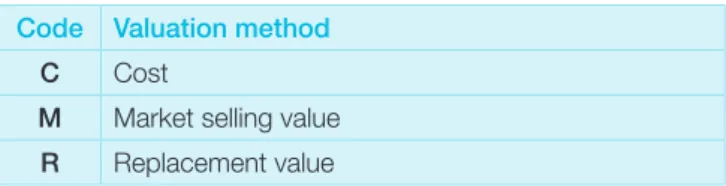
n A taxpayer can elect to value all REUs held at the end of an income year using the ‘first-in, first-out’ cost method, the actual cost method, or at market value.
n The valuation method chosen continues to apply but can be changed once at any time before the end of the 2014–15 income year after which a change will only be allowed after a method has been used for four years. n The proceeds of selling an REU are assessable income. n Special rules apply for ‘free carbon units’ issued under
the Jobs and competitiveness program or issued to coal-fired electricity generators.
n Where a taxpayer surrenders an REU for a purpose unrelated to producing assessable income, the
deduction for the cost is effectively reversed by including in assessable income an amount equal to the amount deducted for its acquisition.
n Expenditure incurred in establishing an offsets project under the Carbon farming initiative is not deductible under Division 420, but may be deductible under the other provisions of the income tax law.
n The amount of a unit shortfall charge is not deductible under the income tax law.
Conservation tillage refundable tax offset The Clean Energy (Consequential Amendments) Act 2011 also introduced Subdivision 385-J of the ITAA 1997 which provides a refundable tax offset for the cost of an eligible no-till seeder (‘eligible seeder’) used in conservation tillage farming practices. Qualifying primary producers may be entitled to a refundable tax offset of 15% of the cost of an eligible seeder. The refundable tax offset is only available for eligible seeders installed ready for use between 1 July 2012 and 30 June 2015.
Where eligible, the company will claim the offset in the Company tax return for the year.
For more information see Conservation tillage refundable tax offset from ato.gov.au/tillageoffset
Shipping reform tax incentives
The Tax Laws Amendment (Shipping Reform) Act 2012 introduced tax incentives for the shipping industry. Broadly, to access these incentives a company must first satisfy the qualifying conditions and hold a relevant certificate under the Shipping Reform (Tax Incentives) Act 2012, administered by the Department of Infrastructure and Transport. The tax incentives provide:
n An income tax exemption (ITE) for Australian operators of Australian registered eligible vessels for qualifying shipping income. An eligible vessel has a certificate obtained under Part 2 of the Shipping Reform (Tax Incentives) Act 2012. To access the ITE the certificate must also be a ‘shipping exempt income certificate’.
n Accelerated depreciation through a statutory capped effective life of 10 years for Australian owners of an eligible vessel.
n The ITE and the accelerated depreciation may be utilized sequentially but not concurrently by an owner operator of an eligible vessel.
n Rollover relief for balancing adjustment amounts for owners of Australian registered eligible vessels upon disposal of the vessel under certain circumstances. n A CGT exemption for certain sale proceeds of an eligible
vessel to the extent that vessel was used to produce shipping exempt income.
n A refundable tax offset for employers who employ eligible Australian seafarers.
n An exemption from royalty withholding tax for foreign owners of eligible vessels leased under a bareboat or demise charter to an Australian operator.
n A modified loss wastage rule to reduce a company’s tax losses at a slower rate where it has exempt income from qualifying shipping activities.
Company loss carry back
In the 2012 Budget, the government announced its intention to provide tax relief for companies by allowing them to carry-back tax losses so they receive a refund against tax previously paid.
At the time of publication these changes had not become law. For more information about the progress of this legislation go to ato.gov.au and search “carry back”.
Related party debt and Limited recourse debt The government announced in the 2012 Budget its intention to amend the law to provide a more consistent tax treatment for bad debts between related parties irrespective of whether they are members of a tax consolidated group. The measure will ensure that, where the debtor and creditor are related parties and a corresponding debt is terminated (written-off) or forgiven after 7.30pm on 8 May 2012, the creditor will be denied tax relief for the bad debt written off and the corresponding gain to the debtor will also not be taxed. This will impact on entities that are related parties but are not all wholly within the same tax consolidated group.
The limited recourse debt provisions will also be clarified. This will ensure tax deductions are not available for capital expenditure on assets that have been financed by limited recourse debt, to the extent that the taxpayer is not effectively at risk for the expenditure and does not make an economic loss.
At the time of publication these changes had not become law, however the Bill to amend the limited recourse debt provisions was before the parliament. For further information, go to ato.gov.au and search for Bad debt or Limited recourse debt.
Removal of the small business and general business tax break
The legislation covering the small business and general business tax break was temporary. It has expired and does not apply from the 2012–13 year onwards.
Removal of the Entrepreneurs tax offset (ETO) The Entrepreneurs tax offset (ETO) has been abolished. From 2012–13 the ETO cannot be claimed.
Small business concessions: changes to simpler depreciation rules
From the 2012–13 income year:
n the small business instant asset write-off threshold has increased from $1,000 to $6,500,
n small businesses can claim an accelerated initial deduction for motor vehicles,
n the long life small business pool and the general small business pool have been consolidated into a single pool to be written off at one rate.
Changes to consolidation tax cost setting and rights to future income rules
The tax law affecting consolidated groups was amended by Schedule 3 to the Tax Laws Amendment (2012 Measures No. 2) Act 2012 to modify the consolidation tax cost setting and rights to future income rules. The amendments were enacted so that the tax outcomes for consolidated groups and MEC groups are more consistent with the tax outcomes that arise when assets are acquired outside the consolidation regime.
The rules applying to an entity will depend on the time when the corporate acquisition took place. Different rules apply to acquisitions that took place before 12 May 2010 (the pre-rules), after 30 March 2011 (the prospective rules) and the intervening period (the interim rules).
Schedule 3 to the Tax Laws Amendment (2012 Measures No. 4) Act 2012 amended the interest on overpayment rules and shortfall interest and administrative penalty rules to ensure that:
n No interest is payable if an overpayment of income tax arises because of a claim for deduction under the pre-rules; and
n No shortfall interest or administrative penalty is payable if additional tax becomes payable because of an amendment to an assessment made under the pre-rules or the interim rules.
Head companies of consolidated groups and MEC groups (or any former subsidiaries) that apply the rules in Schedule 3 of Tax Laws Amendment (2012 Measures No. 2) Act 2012, to claim all or part of the tax cost setting amount of an asset in this income year, will need to also complete new item 11 Consolidation deductions relating to rights to future income, consumable stores and work in progress.
Research and development (R&D)
The R&D tax concession was replaced by the R&D tax incentive for years of income beginning on or after 1 July 2011. Last year these instructions were updated to reflect changes to the law for companies whose 2012 income year began on or after 1 July 2011. This year, two additional entries have been included to the Company tax return regarding the R&D tax incentive at item 21
(formerly item 22).
Information on the R&D tax incentive is at
ato.gov.au/randdtaxincentive
SCHEDULES
n Complete only one copy of the appropriate schedule. n Attach all completed schedules to the Company tax
return 2013 unless specified otherwise.
n If you lodge your tax return without all the required schedules, we may not consider it to have been lodged in the approved form. Unless you lodge all schedules by the due date, you may be charged a penalty for failure to lodge on time.
n Companies that were subsidiary members of consolidated or MEC groups during only part of the income year and that are lodging a company tax return for a period they were not a subsidiary member of any group (non-membership period) must complete all relevant schedules for the non-membership period if required by the following instructions. For information about reporting multiple non-membership periods during the year, see the Consolidation reference manual sheet C9-5-110.
DIVIDEND AND INTEREST SCHEDULE
Every company* must lodge a Dividend and interest schedule 2013 (NAT 8030) showing:
n the names, addresses, dates of birth, gender and tax file numbers (TFNs) or Australian Business Numbers (ABNs), where quoted, of all shareholders (including employee shareholders in a consolidated or MEC group) to whom dividends, or deemed dividends, have been paid during the income year ended 30 June 2013, this includes the amount of dividend paid to each shareholder and any franking credits for that amount. There are separate labels for unfranked dividends that are and are not declared to be conduit foreign income.*
Do not include:
n dividends paid under a demerger unless the head entity of the demerger group elected under subsection 44(2) of the ITAA 1936 to treat those dividends as assessable income, or
n dividends paid by one member to another within a consolidated or MEC group.
n the names, addresses, dates of birth, gender and TFNs or ABNs, where quoted, of all investors, other than those investors in the business of providing business or consumer finance, to whom interest of $1 or more was paid or credited during the income year ended 30 June 2013, and the amount of interest paid or credited to each person.
Include interest paid or credited by a subsidiary member of a consolidated or MEC group to an investor outside the group.
Do not include interest paid by one member to another within a consolidated or MEC group.
If a subsidiary member of a consolidated or MEC group must lodge a company tax return for any non-membership periods during the year of income, that company must also lodge a schedule showing the above details for dividends or interest paid during the non-membership periods. For more information about reporting multiple non-membership periods during the year, see the Consolidation reference manual, sheet C9-5-110.
* Annual investment income report
If subregulation 56(1) of the Income Tax Regulations 1936 (ITR 1936) requires a company to lodge an annual investment income report containing the above details, the company does not need to lodge a dividend and interest schedule. Lodging the schedule
You can lodge the schedule with the company tax return or under separate cover. However, you must lodge it by the due date for lodgment of the company tax return for companies whose income year ends on 30 June 2013. Companies with an approved substituted accounting period must lodge their schedule by 31 October 2013 or the due date for lodgment of their company tax return, whichever is later.
If you are lodging your schedule separately from your company tax return you will need to sign the schedule declaration.
CAPITAL GAINS TAX (CGT) SCHEDULE
Companies that have one or more CGT events during the income year must complete a Capital gains tax (CGT) schedule 2013 and attach it to the Company tax return 2013 if: n total current year capital gains are greater than $10,000, or n total current year capital losses are greater than $10,000.
The head company of a consolidated or MEC group must complete a Capital gains tax (CGT) schedule 2013 if the total current year capital gains or the total current year capital losses that it makes (as head company of the consolidated or MEC group and while not a member of a consolidated or MEC group) are greater than $10,000.
If a subsidiary member of a consolidated or MEC group must lodge a company tax return for any non-membership periods during the year of income, that company may also need to lodge a Capital gains tax (CGT) schedule 2013 for the non-membership periods. For information about reporting multiple non-membership periods during the year, see the Consolidation reference manual, sheet C9-5-110. Go to ato.gov.au and search for Guide to capital gains tax 2013 (NAT 4151). The publication will help you complete the CGT schedule. It includes:
n a capital gain or capital loss worksheet for calculating a capital gain or capital loss for each CGT event n a CGT summary worksheet for calculating a net capital
gain or net capital loss for the income year n the CGT schedule.
LOSSES SCHEDULE
Complete and attach a Losses schedule 2013 if your company does not need to submit a Consolidated groups losses schedule 2013 and satisfies one or more of the following tests:
n it has total tax losses and net capital losses carried forward to later income years greater than $100,000 n it can only utilise a tax loss or net capital loss in the
income year or a later income year if the same business test has been satisfied
n having passed the continuity of ownership test, it utilised tax losses and net capital losses totalling more than $100,000
n it has a changeover time that occurred after 1pm by legal time in the ACT on 11 November 1999 and determined that it has an unrealised net loss as defined in the provisions of Subdivision 165-CC of the ITAA 1997 n it is a life insurance company and has either a complying
superannuation/FHSA class tax loss or a complying superannuation/FHSA net capital loss carried forward to later income years greater than $100,000
n it has a foreign loss component of tax losses deducted in the 2012–13 income year or carried forward to later income years
n it has an interest in a CFC that has current year CFC losses greater than $100,000
n it has an interest in a CFC that has deducted or carried forward a loss to later income years greater than $100,000.
If the company is required to complete a Losses schedule 2013, transfer the totals of the amounts at Part A of the losses schedule to U and V item 13 on the Company tax return 2013. For more information, see Losses schedule instructions 2013 (NAT 4088).
If a company needs to complete a losses schedule under the above criteria, it may also need to complete a CGT schedule. For more information, see Guide to capital gains tax 2013.
If a subsidiary member of a consolidated or MEC group must lodge a company tax return for any non-membership periods during the year of income, that company may also need to lodge a Losses schedule 2013 for the non-membership periods. For information about reporting multiple non-membership periods during the year, see the Consolidation reference manual, sheet C9-5-110.
CONSOLIDATED GROUPS LOSSES SCHEDULE
A head company of a consolidated group or MEC group must complete a Consolidated groups losses schedule 2013 (NAT 7888) and lodge it with the Company tax return 2013 if any of the following apply:
n the total of the group’s tax losses and net capital losses carried forward to later income years is more than $100,000
n the total tax losses and net capital losses transferred from joining entities is more than $100,000
n the total of its utilised tax losses and net capital losses is greater than $100,000
n it has a foreign loss component of a tax loss deducted in the 2012–13 income year or carried forward to later income years
n it has an interest in a controlled foreign company (CFC) that has current year losses greater than $100,000 n it has an interest in a CFC that has deducted or carried
forward a loss to later income years greater than $100,000
n it is a life insurance company, or is treated as a life insurance company under subdivision 713-L of the ITAA 1997, and the total of complying superannuation/ FHSA class tax losses and complying superannuation/ FHSA net capital losses carried forward to later income years is greater than $100,000.
Transfer the totals of tax losses carried forward and net capital losses carried forward in Part A of the Consolidated groups losses schedule 2013 to U and
V item 13Losses information on the Company tax return 2013.
For more information, see Consolidated groups losses schedule instructions 2013 (NAT 7891).
If a head company needs to complete a Consolidated groups losses schedule, it might also need to complete a Capital gains tax (CGT) schedule 2013 (NAT 3423). For more information, see Guide to capital gains tax 2013 (NAT 4151).
NON-INDIVIDUAL PAYG PAYMENT SUMMARY SCHEDULE
Pay as you go (PAYG) withholding applies to several withholding events including:
n payments for a supply where no ABN is quoted n payments arising from investments where no TFN
or ABN is quoted
n certain payments to foreign residents described in the Taxation Administration Regulations 1976 (Regulations 44A – 44D have foreign resident withholding provisions). If the company has had an amount withheld from payments covered by PAYG withholding, the payer should have given the company a payment summary. A payer may issue a receipt, remittance advice or similar document in place of the approved form. If the company did not receive or has lost its copy of the payment summary, contact the payer responsible and request a signed photocopy of the payer’s copy.
Complete a Non-individual PAYG payment summary schedule 2013 (NAT 3422) if your company has an amount at:
n Income, A Gross payments where ABN not quoted item 6
n Income, B Gross payments subject to foreign
resident withholding item 6 (except where the amount is from partnership or trust distributions)
n H2 Credit for tax withheld – foreign resident
withholding in the Calculation statement
n H3 Credit for tax withheld where ABN is not quoted in the Calculation statement
Income subject to foreign resident withholding that has been included in a distribution received by the company from a partnership or trust is declared at Income,
D Gross distribution from partnerships item 6 or Income, E Gross distribution from trusts item 6. However, a Non-individual PAYG payment summary schedule 2013 is not required for these distributions because they do not have an associated payment summary.
Completing the Non-individual PAYG payment summary schedule 2013
Print the company’s TFN and name in the appropriate boxes at the top of the schedule.
From each PAYG payment summary – withholding where ABN not quoted (NAT 3283) and PAYG withholding from foreign residents – payment summary, record on the Non-individual PAYG payment summary schedule 2013: n the appropriate letter for your type of withholding; F for
foreign resident withholding, or N for withholding where an ABN is not quoted
n payer’s ABN (or withholding payer number) n total tax withheld
n gross payment n payer’s name.
When you have copied the details from all the payment summaries to the schedule, attach the schedule to the company tax return.
Do not attach copies of any payment summary to the company tax return; keep them with the company’s copy of the tax return. Keep a copy of the Non-individual PAYG payment summary schedule 2013 with the company’s tax records.
If a subsidiary member of a consolidated or MEC group must lodge a company tax return for any non-membership periods during the year of income, that company may also need to lodge a Non-individual PAYG payment summary schedule 2013 for the non-membership periods. For information about reporting multiple non-membership periods during the year, see the Consolidation reference manual, sheet C9-5-110.
REPORTABLE TAX POSITION (RTP) SCHEDULE
Companies we have notified in writing that they must lodge a Reportable tax position (RTP) schedule must complete a RTP schedule 2013 (NAT 74066) and attach it to the Company tax return 2013. Where you were notified of this requirement in writing, you must also select “yes” at Item
23 “Are you required to lodge a reportable tax position schedule?” on the Company tax return 2013.
A reportable tax position (RTP) is one or more of the following:
Category A: a position that is about as likely to be correct as incorrect or less likely to be correct than incorrect Category B: a position in respect of which uncertainty about taxes payable or recoverable is recognised and/or disclosed in the taxpayer’s financial statements or a related party’s financial statements
Category C: a reportable transaction or event.
For more information, see Reportable tax position schedule instructions 2013 at ato.gov.au/rtp
RESEARCH AND DEVELOPMENT TAX INCENTIVE SCHEDULE
All companies claiming a tax offset under the R&D tax incentive must complete the Research and development tax incentive schedule 2013 (NAT 73794) and attach it to the company tax return.
If you have a feedstock adjustment for the 2012–13 income year but are not claiming a tax offset under the R&D tax incentive, you are not required to complete the Research and development tax incentive schedule 2013. However, you will need to record your feedstock adjustment at B of item 7 and W of item 21 Company tax return 2013.
The schedule accompanies the Research and
development tax incentive schedule instructions 2013. This publication, and an online calculator, are available at ato.gov.au/randdtaxincentive.The online calculator is automated to self-calculate and provide guidance for correct completion of the schedule. A printed schedule provided by the calculator will be accepted for lodgment with an original tax return or an amendment request. If a subsidiary member of a consolidated or MEC group must lodge a company tax return for any non-membership periods during the year of income, that company may also need to lodge a Research and development tax incentive schedule 2013 for the non-membership periods. For information about reporting multiple non-membership periods during the year see the Consolidation reference manual, sheet C9-5-110.
How to lodge the R&D schedule
Lodge the Research and development tax incentive schedule 2013 with the appropriate company tax return. If you have requested an amendment
If your company has requested an amendment that includes changes to its R&D claim, you must complete an R&D schedule showing the amended figures. Send this schedule, with a letter requesting the amendment, to:
Australian Taxation Office PO Box 3004
PENRITH NSW 2740
INTERNATIONAL DEALINGS SCHEDULE
Where the relevant information is reported in the company tax return you must complete and attach an International dealings schedule 2013 (NAT 73345) to the company tax return. If a subsidiary member of a consolidated or MEC group must lodge a company tax return for any non-membership periods during the year of income, that company may also need to lodge an International dealings schedule 2013 for the non-membership periods. For information about reporting multiple non-membership periods during the year, see the Consolidation reference manual, sheet C9-5-110.
Thin capitalisation rules
If your company is subject to the thin capitalisation rules (See item 27 and appendix 3), you must complete and attach an International dealings schedule 2013 to the company tax return.
Go to ato.gov.au and search for International dealings schedule instructions 2013.
GENERAL INFORMATION
CONSOLIDATION – TAXING WHOLLY OWNED GROUPS AS SINGLE ENTITIESThe taxation of consolidated groups and MEC groups (that is, the taxing of wholly owned eligible companies, partnerships and trusts as if they are part of a single head company) was introduced on 1 July 2002. Consolidation may be an option for your business if the business structure includes a company that wholly owns one or more entities.
Go to ato.gov.au and search for Consolidation reference manual (NAT 6835); or go directly to
ato.gov.au/consolidation for the reference manual and other relevant publications.
If you are lodging a company tax return as a head company for a consolidated or MEC group, print X in the box at Z1 Consolidated head company item 3.
Printing X at Z1 at item 3 on the return does not
meet the requirement to notify the Commissioner that you have made a valid choice in writing to form a consolidated or MEC group.
Subsidiary member – non-membership period If the company is a subsidiary member of a consolidated or MEC group and is lodging a tax return because it had a period during the income year when it was not a member of a consolidated group (a non-membership period), print X in the box at Z2 Consolidated subsidiary member item 3.
If a subsidiary member of a consolidated or MEC group must lodge a company tax return for any non-membership periods during the year of income, the company must complete all relevant schedules for the non-membership periods.
For information about reporting multiple non-membership periods during the income year, see the Consolidation reference manual.
n If you completed Z2, do not complete the part-year details at the top of page 1 of the tax return unless the company has an approved substituted accounting period. Even though the company will include only the income and deductions properly attributable to all of the periods of non-membership during the year, the tax return is still regarded as being for the whole of the income year, that is, from 1 July to 30, June or equivalent substituted accounting period, and is lodged at the usual time.
n Do not complete the Final tax return box on page 1 of the tax return if membership of the consolidated or MEC group is the only basis on which the company will not be required to lodge future returns.
Key elements of the consolidation regime Choice to form a consolidated group or MEC group To form a consolidated group, a group must consist of an Australian resident head company and at least one other Australian resident entity (a company, trust or partnership) wholly owned by the head company.
A consolidated group comes into existence when a head company of a consolidatable group makes a choice in writing that it is forming a consolidated group from a particular date.
To form a MEC group, there must be a potential MEC group consisting of two or more eligible tier-1 companies of a top company. A MEC group comes into existence when the relevant eligible tier-1 companies of a potential MEC group make a choice in writing that they are forming a MEC group from a particular date. The choice must also include the appointment of the provisional head company (PHC) of the group by the eligible tier-1 companies. See the Consolidation reference manual for more information on MEC groups.
The choice to consolidate is optional, but once made is irrevocable.
If a head company of a consolidatable group chooses to consolidate on a specified date then, from that time, both the head company and all of its eligible wholly owned subsidiaries will be members of the consolidated group for income tax purposes. Similarly, where the eligible tier-1 companies of a potential MEC group choose to consolidate, all the eligible tier-1 companies and their eligible wholly owned subsidiaries will be members of the MEC group for income tax purposes.
The choice to consolidate must be made in writing no later than:
n the day on which the head company lodges its income tax return for the year in which the day specified in the choice occurs, or
n if a return is not required for that income year, the day it would otherwise have been due.
The period for making a choice in writing to consolidate cannot be changed. If the choice to consolidate is not made within the prescribed time, the group cannot be treated as consolidated for that income year. The Commissioner does not have the power to extend the time period for making the choice in writing. If more time is required to make a choice to consolidate, it is recommended that you ask us for an extension of time to lodge the relevant income tax return. The written choice to consolidate is not required to be given to the Commissioner. See the Consolidation reference manual, sheet C7-1-110 for more information on making a choice in writing.
Notifying the Commissioner of your choice
In addition to making a choice in writing to form a group, the head company of a consolidated group or MEC group must notify the Commissioner of Taxation of its choice to consolidate using the appropriate approved form. The appropriate notification must be lodged within the same time period as applies to making a choice to consolidate.
For a consolidated group, the head company needs to complete and lodge a Notification of formation of an income tax consolidated group form (NAT 6781). For a MEC group, the head company needs to complete and lodge a Notification of formation of a multiple entry consolidated (MEC) group form (NAT 7024).
Go to ato.gov.au/consolidation for information on completing the relevant notification forms.
If you cannot lodge your notification of formation within the required timeframe, you should contact us to discuss an extension of time to lodge your income tax return. Operating
n On consolidation, the head company of a consolidated or MEC group and all the subsidiary members are treated as a single entity for their income tax purposes, that is, each subsidiary member is treated as a part of the head company. The tax costs of assets of an entity joining a consolidated or MEC group (other than eligible tier-1 companies) which become assets of the head company under the single entity rule are reset in accordance with the tax cost setting rules.
n The consolidated or MEC group operates as a single entity for income tax purposes, with the head company lodging a single income tax return and then paying a single set of PAYG instalments for the group.
n A MEC group will have a provisional head company (PHC) during the course of the income year. The PHC at the end of the income year will be the head company for the whole income year or, where the MEC group came into existence during the income year, from the time the MEC group came into existence. If a PHC becomes ineligible to be the PHC, a choice to appoint a new PHC must be made in writing by all of the remaining eligible tier-1 companies and also notified to the Commissioner.
n A consequence of choosing to consolidate is that transactions that occur solely between members of the consolidated or MEC group will be disregarded for income tax purposes.
n If a subsidiary member of a consolidated or MEC group has a period or periods in its income year when it is not a subsidiary member (non-membership periods), it will need to lodge a tax return for that income year. However, the tax return will be based only on amounts properly attributable to the periods when the entity was not a subsidiary member of a consolidated or MEC group during the income year.
n The losses, franking credits, pre-commencement excess foreign income tax, conduit foreign income and attribution account surpluses of each subsidiary member can generally be transferred to, and used by, the head company of the consolidated or MEC group. n Carry-forward losses, franking balances,
pre-commencement excess foreign income tax and conduit foreign income transferred to the head company of the group remain with the head company when an entity leaves the group. Special rules apply regarding treatment of carry-forward losses transferred into the consolidated or MEC group.
n The consolidation regime does not affect a subsidiary member’s obligations in relation to other taxes such as goods and services tax (GST), fringe benefits tax (FBT), pay as you go (PAYG) withholding, minerals resource rent tax (MRRT) and petroleum resource rent tax (PRRT). There are separate consolidation rules for MRRT and PRRT purposes. Go to ato.gov.au for details on how to consolidate for MRRT and PRRT purposes.
n Certain corporate unit trusts and public trading trusts can be the head company of a consolidated group. Where a consolidated or MEC group includes one or more subsidiary members that are life insurance companies, special consolidation rules apply to take into account the particular taxation treatment of life insurance companies. Go to ato.gov.au and search for the Consolidation reference manual for more details. The head company of a consolidated or MEC group (or PHC where relevant) must, among other things: n pay the group’s PAYG instalments when it is issued with
a consolidated instalment rate after the lodgment by the head company of its first group tax return
n determine, report and make any balancing adjustments to meet the group’s annual income tax liabilities
n manage any ongoing income tax liabilities and supply income tax information to us when required
n notify us of any members that join or leave the group. Consolidated and MEC groups –
head company tax returns
The tax return disclosures are the head company’s principal means of communicating its consolidated group tax data to us. They are also used by the Commissioner to calculate the head company’s instalment rate. This data is useful in our role as administrator of Australia’s tax system as we and the Government evaluate and monitor the tax system for the benefit of the community.
As a result, we expect that all tax return label disclosures will reflect correct, or materially correct, consolidated amounts at each label. Such amounts do not take account of transactions that occur between members of the consolidated or MEC group and give effect to the single entity principle. Correct or materially correct consolidated amounts at each label will retain the structural integrity of the disclosures to enable consistent monitoring and analysis of taxpayer data.
In addition, the concept of materiality applies to the tax return labels affected by consolidation. However, the amounts at T Taxable income or loss item 7 and those labels in the Calculation statement on page 11 of the tax return must be correct, not just materially correct. In determining if the consolidated amounts are materially correct, we will be guided by the accounting standard on materiality; AASB 1031 Materiality.
We expect the completed consolidated tax return to be at least as relevant and as useful as other statutory financial reports.
It should be noted that we provided a concession (allowing aggregated data) for items 6, 7 and 8 of the head company’s 2005 consolidated company tax return. However, for later years, such as for the 2013 company tax return, correct or materially correct consolidated data for an Australian-resident group will be the only acceptable basis for making tax return disclosures label-by-label. Groups should have record-keeping, accounting and tax systems in place to ensure that materially correct consolidated data is available for the 2013 company tax return and for future years’ tax returns.
2013 schedules
Given that consolidation is about taxing wholly owned groups as single entities, a head company of a consolidated or MEC group must complete only one of each required schedule. Each required schedule will contain the information for the consolidated or MEC group.
SIMPLIFIED IMPUTATION SYSTEM
Broadly, the simplified imputation system has the following effects on the company tax return:
n A company that is paid a franked or unfranked distribution must include:
– the amount of the distribution at Income, H Total dividends item 6
– any attached franking credits at J Franking credits
item 7 (if the shares are not held at risk as required under the holding period and related payments rules, or if there is other manipulation of the imputation system, the franking credit is not included in assessable income at J and there is no entitlement to a franking tax offset) n The amount of franking credits included in
assessable income is allowed as a tax offset and claimed at C Non‑refundable non‑carry forward tax offsets in the Calculation statement
n Where the company has a franking deficit tax (FDT) liability, it can claim an FDT offset against its income tax liability. Some special rules apply to life insurance companies to ensure that an FDT liability can only be offset against that part of the company’s income tax liability that is attributable to shareholders. The amount of FDT liability that can be claimed as a tax offset is reduced in certain circumstances. See Franking deficit tax offset on page 82 and Franking account tax return and instructions 2013 (NAT 1382) for more information on how to calculate this amount. There are also special rules that apply to late balancing entities that elect to determine their FDT on a 30 June basis. For more information, go to ato.gov.au and search for the following fact sheets – Simplified imputation: franking deficit tax offset and Simplified imputation: FDT offset for late balancers. Other features of the simplified imputation system include: n the franking account operates on a tax-paid basis and is
also a rolling-balance account
n the period for determining a corporate tax entity’s FDT liability is aligned with its income year. However, certain late balancing entities can elect to have their liability determined on 30 June
n the franking period relates to the operation of the benchmark rule
n corporate tax entities can choose the extent to which they frank frankable distributions made within a franking period. This choice is subject to the benchmark rule, except for certain listed public companies
n the benchmark rule, while limiting streaming opportunities, provides some flexibility in allocating franking credits to frankable distributions. To comply with this rule, a corporate tax entity must ensure that all frankable distributions made within a franking period are franked to the same extent, which is the benchmark franking percentage. The benchmark franking percentage is equal to the franking percentage established for the first frankable distribution made in that franking period n a breach of the benchmark rule will not invalidate the
allocation made to the distribution. However, a penalty will be imposed on the corporate tax entity. The penalty is either:
– an over-franking tax (OFT) if the franking percentage for the distribution exceeds the benchmark franking percentage, or
– a franking debit to the franking account if the franking percentage for the distribution is less than the benchmark franking percentage
n the penalty is calculated by reference to the difference between the franking credits actually allocated and the benchmark franking percentage
n payment of OFT does not give rise to a franking credit in the franking account. If an entity is liable to pay OFT it must complete a Franking account tax return 2013 n under the disclosure rule, corporate tax entities must notify the Commissioner in the approved form if they have significantly varied their benchmark franking percentage between franking periods. This information is disclosed on the Franking account tax return 2013.
Franking account tax return
Corporate tax entities may be entitled to claim an FDT offset. In certain circumstances, the FDT offset reduction rule reduces the amount of FDT that can be offset against future income tax liabilities. See Franking deficit tax offset
on page 82 for more information.
As a result of these rules, the Franking account tax return 2013 requires you to complete C Offsetable portion of current year FDT.
Complete a franking account tax return for all Australian corporate tax entities (including head companies of consolidated or MEC groups, corporate limited
partnerships, corporate unit trusts and public trading trusts) and New Zealand franking companies that have:
n a liability to pay FDT n a liability to pay OFT, or
n an obligation to disclose information to the Commissioner in relation to their benchmark franking percentage. Lodge the franking account tax return separately from your company tax return. If you lodge your franking account tax return at the time your company tax return is due, your franking account tax return may be late and an interest charge may apply to any outstanding tax amounts. Your franking account tax return is generally due one month after the end of your income year. For more information on completing this tax return, see the Franking account tax return and instructions 2013.
COOPERATIVES – OPTION TO FRANK DIVIDENDS
Cooperative companies may frank distributions made to members from assessable income.
Cooperative companies that do not choose to frank distributions made to members are entitled to claim a deduction to the extent that a distribution of assessable income is not franked.
Go to ato.gov.au for more detailed information about simplified imputation, consolidation and the cooperatives measures.
DEBT AND EQUITY RULES
The debt and equity measures broadly operate to characterise certain interests as either debt or equity. For some tax law purposes, interests are treated in the same way as shares even though they are not shares in legal form. These interests are called ‘non-share equity interests’. They include some income securities, some stapled securities and certain related party ‘at call’ loans. Go to ato.gov.au
and search for the guide Debt and equity tests: guide to the debt and equity tests (NAT 4643). This guide provides an overview of the debt and equity rules and explains what a non-share equity interest is.
For an explanation of when and how the debt and equity measures apply to ‘at call’ loans made to a company, go to
ato.gov.au and search for Debt and equity tests: guide to ‘at call’ loans.
For the purposes of the imputation system, non-share equity interests are generally treated in the same way as shares that are not debt interests. Non-share dividends on these types of interests may be franked or unfranked. Write the amount of non-share dividend, whether franked or unfranked, and any amount of franking credit attached to the non-share dividend, at the appropriate place on the tax return as if it were for a share.
You cannot claim a deduction for a non-share dividend.
CLUBS, SOCIETIES AND ASSOCIATIONS
Taxable clubs, associations, societies and organisations are generally treated as companies. Such companies can be either non-profit or other taxable companies depending on the company’s constituent documents and purposes. Non-profit companies are subject to special tax rules, which are explained in the guide Mutuality and taxable income (NAT 73436), at ato.gov.au.
Non-profit companies that are resident and have taxable income of $416 or less do not have to lodge an income tax return, unless specifically requested.
Taxable non-profit organisations required to lodge an income tax return should go to ato.gov.au and search for Guide to company tax return for non-profit organisations 2013.
CORPORATE UNIT TRUSTS AND PUBLIC TRADING TRUSTS
Trustees of corporate unit trusts and public trading trusts are subject to the company tax arrangements and lodge company tax returns.
The trust loss legislation in Schedule 2F to the ITAA 1936 applies to these trusts.
Subdivision 713-C of the ITAA 1997 enables a corporate unit trust or public trading trust to be the head company of the consolidated group, if certain conditions are met. A corporate unit trust or public trading trust which is a head company of a consolidated group will be treated as a company for all income tax purposes including the treatment of losses.
TAXATION OF FINANCIAL ARRANGEMENTS (TOFA) RULES
The key provisions of the TOFA rules are found in Division 230 of the ITAA 1997, which generally provides for: n methods of taking into account gains and losses from
financial arrangements, being accruals and realisation, fair value, foreign exchange retranslation, hedging, and reliance on financial reports and balancing adjustment n the time when the gains and losses from financial
The TOFA rules will apply to the following entities: n authorised deposit-taking institutions, securitisation
vehicles and financial sector entities with an aggregated turnover of $20 million or more
n Superannuation entities, managed investment schemes or entities with a similar status to a managed investment scheme under foreign law relating to corporate regulation with assets of $100 million or more
n any other entity (excluding individuals) which satisfies one or more of the following
– an aggregated turnover of $100 million or more – assets of $300 million or more
– financial assets of $100 million or more. Once the TOFA rules apply to a company, they will continue to apply to that company, even if its aggregated turnover, value of assets or value of financial assets subsequently falls below the requisite threshold. A company that does not meet these requirements can elect to have the TOFA rules apply to it.
The aggregated turnover tests may mean that the TOFA rules will apply to companies that do not meet the turnover thresholds in their own right. Aggregated turnover includes the annual turnover of any entity a company is connected with, or any affiliate of the company, including overseas entities.
There are a number of elections availible to companies under the TOFA rules. Elections under the TOFA rules are irrevocable, and should be carefully considered before being made. For more information, go to ato.gov.au and search for Making elections under the TOFA rules and also Guide to the taxation of financial arrangements (TOFA) rules or go directly to ato.gov.au/tofa
FOREIGN EXCHANGE GAINS AND LOSSES
Under the foreign exchange (forex) measures contained in Division 775 and Subdivisions 960-C and 960-D of the ITAA 1997, forex gains and losses are generally brought to account as assessable income or allowable deductions, when realised. The forex measures cover both foreign currency denominated arrangements and, broadly, arrangements to be cash-settled in Australian currency with reference to a currency exchange rate. Forex gains and losses of a private or domestic nature, or in relation to exempt income or non-assessable non-exempt income, are generally not brought to account under the forex measures.
If a forex gain or loss is brought to account under the forex measures and under another provision of the tax law, it is generally assessable or deductible only under the forex measures. However, if a financial arrangement of a company is subject to the TOFA fules, forex gains and losses from the financial arrangement will generally be brought to account under those TOFA rules instead of the forex measures.
Additionally, forex gains and losses will generally not be assessable or deductible under the forex measures if they arise from certain acquisitions or disposals of capital assets, or acquisitions of depreciating assets, and the time between the acquisition or disposal and payment is no more than 12 months. Instead, any foreign exchange gain or loss is usually matched with or integrated into the tax treatment of the underlying asset.
The general translation rule requires all tax-relevant
amounts to be expressed in Australian currency, regardless of whether there is an actual conversion of that foreign currency into Australian dollars.
For most companies, the forex measures and general translation rule have applied from 1 July 2003. However, companies with certain early substituted accounting periods have been subject to these provisions from the first day of their 2004–05 income year.
The tax consequences of gains or losses on existing foreign currency assets, rights and obligations that were acquired or assumed before the commencement date are to be determined under the law as it was before these measures came into effect, unless:
n the company has made a transitional election that brings these under the forex measures, or
n there is an extension of an existing loan that brings the arrangement within these measures, for example, an extension by a new contract, or a variation to an existing contract.
See Forexmeasures for more information about these measures and how to calculate your foreign exchange realisation gains and losses.
GENERAL VALUE SHIFTING REGIME
Broadly, value shifting describes transactions and other arrangements that reduce the value of an asset and (usually) increase the value of another asset.
The general value shifting regime (GVSR) consists of direct value shifting (DVS) and indirect value shifting (IVS) rules that primarily affect equity and loan interests in companies and trusts. There is also a DVS rule dealing with non-depreciating assets over which a right has been created. There are different consequences for particular interests according to whether the interest is held on capital account, or as a revenue asset or trading stock.
Where the rules apply to a value shift there may be a deemed gain (but not a loss), adjustments to adjustable values (for example, cost bases), or adjustments to losses or gains on realisation of assets.
There are de minimis exceptions and exclusions that will minimise the cost of complying with the GVSR, particularly for small business. Entities dealing at arm’s length or on market value terms are generally excluded from the GVSR. For more information, go to ato.gov.au
TRANS-TASMAN IMPUTATION
The Trans-Tasman imputation measure allows a New Zealand resident company to choose to enter the Australian imputation system. This allows a New Zealand company to maintain an Australian franking account and to attach Australian franking credits to frankable distributions it pays from one month after the company makes an election. Australian shareholders of New Zealand companies may benefit from the Australian franking credits attached to distributions made by a New Zealand company that has elected into the Trans-Tasman imputation measure (referred to as a ‘New Zealand franking company’).
For more information on the Trans-Tasman imputation measure, go to ato.gov.au/businesses,then on the left of the page, click ‘Tax topics A–Z’ then click on ‘H–L’ and go to ‘International tax’, then click on ‘Trans-Tasman rules’.
INTERNATIONAL TAXATION – TREATMENT OF CERTAIN FOREIGN HYBRID ENTITIES
Broadly, foreign hybrids are certain foreign limited partnerships, foreign hybrid companies such as limited liability companies in the United States of America and other similar entities that are taxed on a partnership basis in their country of formation, that is, the overseas jurisdiction taxes the members on their share of the entity’s income. The entity itself is not taxed.
Under Division 830 of the ITAA 1997, foreign hybrids (as defined in section 830-5 of the ITAA 1997) are treated as partnerships, and not as companies, for Australian income tax purposes. Investors in these entities are treated for Australian tax purposes as having partnership interests. There are special rules in addition to those that normally apply to partnerships.
For more information about foreign hybrids, go to
ato.gov.au
INFORMATION MATCHING
We use information-matching technology to verify the correctness of tax returns, so you should ensure that all information is fully and correctly declared on the company tax return.
If possible, the company tax return should fully itemise all investment income, rather than including the income in gross business income or profit and loss statements. Failure to do so could result in the company receiving an income discrepancy query letter from us.
Ensure that the company has not quoted an individual’s TFN to a financial institution for any income it intends to declare in a company tax return, or vice versa.
In particular, we will check the following in the 2013 tax returns: n distributions from partnerships and trusts, including unit
trusts, see pages 22–4
n income and credits for withholding if an ABN has not been quoted against information provided to us by payers, see page 3
n total salary and wages paid against the PAYG withholding system, see page 57
n the amount of prior year losses claimed, which will be reconciled with the amounts of losses carried forward on tax returns of earlier years, see pages 46–51 n dividend and interest income, see page 26.
SMALL BUSINESS ENTITIES
A small business entity may be eligible for the following concessions:
n CGT 15-year asset exemption n CGT 50% active asset reduction n CGT retirement exemption n CGT rollover provisions
n simplified depreciation rules, see pages 31–5 n deduction of certain prepaid business expenses
immediately, see page 37
n simplified trading stock rules, see pages 52–3 n accounting for GST on a cash basis
n annual apportionment of GST input tax credits n payment of GST by quarterly instalments n FBT car parking exemption
n PAYG instalments based on GDP-adjusted notional tax. Some of these concessions have specific eligibility conditions that must also be satisfied.
For more information about small business entity concessions, go to ato.gov.au and search for Concessions for small business entities (NAT 71874); or go to ato.gov.au/SBconcessions or phone
13 28 66.
Also go to ato.gov.au/cgtsbconcessionstool to use the CGT Small Business Concessions Tool to determine whether an entity is eligible for the capital gains tax concessions for small business.
Eligibility
The company will be a small business entity if it is carrying on a business and has an aggregated turnover of less than $2 million.
Broadly, aggregated turnover is the company’s annual turnover plus the annual turnovers of any entities that are connected to or affiliated with it.
For more information on eligibility, go to
ato.gov.au and seach for Am I eligible for the small business entity concessions?
Calculating turnover
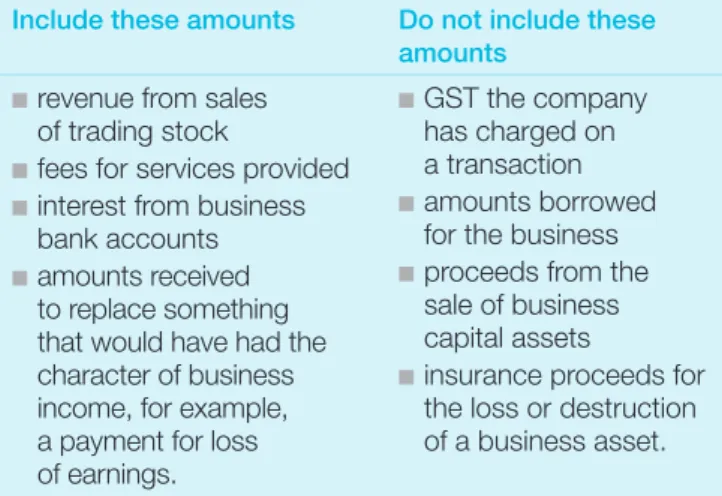
Turnover includes all ordinary income that the company earned in the ordinary course of business for the income year. Some examples of amounts included and not included in ordinary income are in table 1.
TABLE 1: Ordinary income
Include these amounts Do not include these
amounts
n revenue from sales of trading stock
n fees for services provided n interest from business
bank accounts n amounts received
to replace something that would have had the character of business income, for example, a payment for loss of earnings. n GST the company has charged on a transaction n amounts borrowed for the business n proceeds from the
sale of business capital assets
n insurance proceeds for the loss or destruction of a business asset.
There are special rules for calculating the annual turnover if the company has retail fuel sales or business dealings with associates that are not at market value.
For more information about calculating turnover, go to ato.gov.au or phone 13 28 66.
Aggregation rules
Special rules, called the aggregation rules, will determine who the company is connected to or affiliated with. These rules prevent larger businesses from structuring or restructuring their affairs to take advantage of the small business entity concessions.
An entity that is connected with the company or that is its affiliate is referred to as a relevant entity.
When calculating the company’s aggregated turnover, do not include:
n income from dealings between the company and a relevant entity
n income from dealings between any of the company’s relevant entities
n income from a relevant entity when it was not the company’s relevant entity.
For more information on the aggregation rules, see our publication Concessions for small business entities. If the company is not connected or affiliated with any other entities and its business turnover is less than $2 million, then the company is a small business entity.
Business operated for only part of the year If the company, or a relevant entity, carries on a business for only part of the income year, annual turnover must be worked out using a reasonable estimate of what the turnover would have been if the company, or relevant entity, had carried on a business for the whole of the income year.
Satisfying the aggregated turnover threshold There are three ways to satisfy the $2 million aggregated turnover requirement, but most businesses will only need to consider the first method.
Previous year turnover
If the company’s aggregated turnover for the previous income year was less than $2 million, it will be a small business entity for the current year. This is regardless of its estimated or actual aggregated turnover for the current year.
Estimate of current year turnover
If the company’s estimated aggregated turnover for the current income year is less than $2 million, it will be a small business entity for the current year.
If you are estimating the company’s turnover you need to assess whether it is more likely than not to have less than $2 million aggregated turnover as at the first day of the income year or, if it started a business part way through the year, as at the time the business started. You should estimate the company’s turnover based on the conditions you are aware of at the beginning of the income year or, if the business was started part way through the year, at the time the business started. Companies that began carrying on a business in the current year need to make a reasonable estimate of what their turnover would have been had the business been carried on for the entire year. This method cannot be used if the company’s aggregated turnover in each of the previous two income years was $2 million or more.
Actual current year turnover
If the company’s actual aggregated turnover is less than $2 million at the end of the income year, it will be a small business entity for that year.
This method is only needed if the first two tests cannot be met. If the company is a small business entity by means of this third method only, it cannot use the GST and PAYG concessions for that income year because those particular concessions must have been chosen earlier in the
income year.
Former simplified tax system taxpayers
There are transitional rules for former simplified tax system (STS) taxpayers that deal with the continued use of the STS accounting method (see page 21).
A special rule applies if the company is winding up a business this year that it previously carried on and it was an STS taxpayer in the income year it ceased business. For more information, see Concessions for small business entities.