Development of XML-based Standardized Software Database
Specifications and Operating Schema
Chang-Su Kim
1, Tae-Hak Ban
1and Hoe-Kyung Jung
1* 1PaiChai University, Doma2-Dong, SeoGu, DaeJeon, Korea
[email protected], [email protected], [email protected]
Abstract
Recently, the importance of software has been emphasized as the core capability of IT convergence due to the development of various information industries. The need to improve the utilization of excellent software resources through database is arising.
Therefore, the system database schema of XML-based software products required for registration, searching and sharing to utilize software products was designed in this thesis. And, the database method for software assets was designed and implemented for the management of XML-based software information system.
Keywords: Software Information, XML, XML Schema, XSLT, Data Mapping
1. Introduction
As the society becomes more information-oriented, the number of computers distributed increases, and the importance of computer-based processing of documents is highlighted. As computer-related technology advances, electronic processing of documents becomes essential, and thus electronic document processing systems such as word processor and electronic publication system are becoming more common [1-4].
In a variety of convergence environments, software is highlighted as a key capacity element of IT convergence. Therefore, the necessity to enhance the availability of excellent software resources by making the database is also highlighted [1].
Recently, the importance of software has been emphasized as the core capability of IT convergence due to the development of various information industries. The need to improve the utilization of excellent software resources through database is arising [1, 4, 6, 7].
To effectively manage text-centered data handled through software resources, it is necessary to convert them into hypermedia documents, called XML document, which can support more various types of characteristics and structural information [1, 3, 8].
This study aims to design and demonstrate an effective method to make a database for software resources in order to design and present an XML-based software information system schema, and develop a standard for software information system management [1].
Therefore, the system database schema of XML-based software products required for registration, searching and sharing to utilize software products was designed in this thesis. And, the database method for software assets was designed and implemented for the management of XML-based software information system [1].
The future study is expected to suggest plans to use this in a national scale by maximizing the values of software assets, and developing standardized databases and operation instructions [1].
*
2. Related Researches
2.1. The Concept of XML Schema
XML schema is also known as DTD, a standard to define the structure of XML. XML schema is used to describe the XML elements and attributes. XML schema basically consists of statements of attributes and element types, which include content models on the XML elements and attributes within an XML document. XML schema plays a similar role to that of DTD, but it provides more advanced functions than those of DTD [1].
This study designs the software information system schema in accord with XML Schema 1.1 of W3C [1, 9].
2.2. XSLT
XSLT is a document converting language to convert or reconstruct an XML document into another type of document [1, 10]. The process of how XSLT converts an XML document into the desired type of output can be divided into two sections as below: [1, 10]
Structural conversion: The structure of the input XML document involves conversion of data into a structure that reflects the desired output format.
Formatting: The structure of the input XML document becomes an output format such as HTML or PDF.
XSLT may specify the format of style documents or include the definitions of mapping rules among applied patterns. Recently, XSLT is used to generate certain XML documents from another type of XML documents of different structure. This system has been designed and implemented in reflection of such characteristics of XSLT [1, 10].
2.3. The Concept of Data Mapping
Mapping connects data elements with the same or similar meaning in two different structures. In addition, it may add another meaning if necessary to define the relation between the two structures [1, 10].
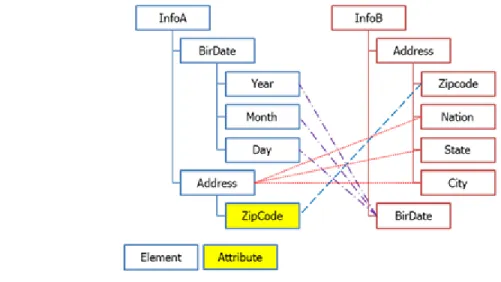
Figure 1 shows the structure of two documents through data mapping. The information of the two documents' structures includes the same contents but represent different structures at the same time. The BirthDate structure includes a child elements such as Year, Month, and Day in relation of n:1. Here, the mapping is applied to the single element, which is BirthDate. The address elements are separated in the relation of 1:n and then go through the mapping. In this example, Zipcode in the relation of 1:1 goes through the mapping with Zipcode expressed in elements [1, 3].
The system designed in this study has the ability to automatically generate XML documents in accord with the software information system XML schema, applies XSLT, and is used to convert XML documents that are valid for the schema.
3. Design
This chapter provides the description of database schema description language for software products that defines the database schema model to establish XML-based software product asset database. The target covered in this paper is the software product asset, and it is the schema which includes element technology created in the R&D performance, products created by combining engineering products and element technology, and various relevant materials required for service and R&D.
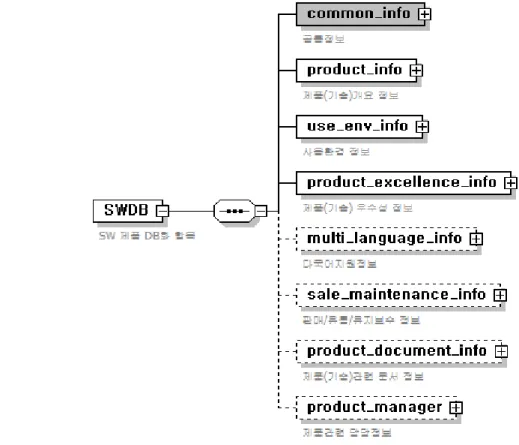
Figure 2. The Schema Structure of Software Product Asset Database XML schema which defines XML document structure and contents is used to define the standard schema for software database products. Figure 2 shows the top element structure that presents the whole structure of software product database schema.
The schema structure (SWDB) for establishing the software database consists of 8 elements. These 8 elements include common information (common_info), product information (product_info), user environment information (use_env_info), product excellence information (product_excellence_info), multi-language support information (multi_language_info), sales, distribution and maintenance information (sale_maintenance_info), product document information (product_document_info) and product manager information (product_manager elements), and these 8 elements are implemented in the sequence structure.
3.1. Definition of Common Information (common_info) Structure
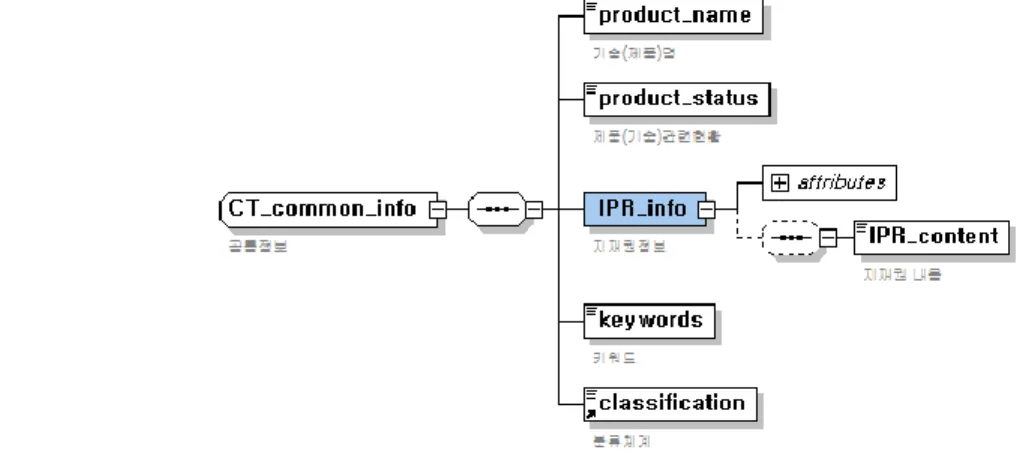
Common information is the general information for products to be registered, and it is classified into product names, keywords used for searching, and the item to specify the range. This structure consists of elements including technology(product) name (product_name), technology(product) status (product_status), Intellectual Property Right information (IPR_info), Keywords (keywords) and classification (classification) element in a sequential structure. Figure 3 shows the structure of the common_info.
Figure 3. The Structure of the Common Information
3.2. Definition of Product Information (product_info) Structure
Figure 4 shows the structure of the product information. Product information is classified into the functions, application areas and expected effects of the product in order to allow SW bank system users to confirm whether the product they search provides a proper function for the purpose of use or not. This structure consists of elements including main functions (main_functions), application areas (apply_area), expected effects (expect_effect), demo pictures (demo_pictures) and trial version information (trial_offers) in a sequential structure.
3.3. Definition of User Environment Information (use_env_info) Structure
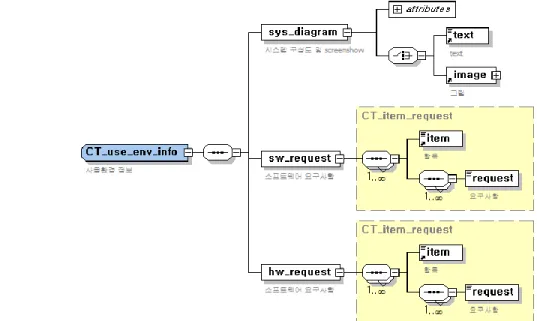
User Environment Information is the item which allows users to understand the system environment required for the use of product in advance, and it is classified into system diagram and screen shot as well as into software requirements and hardware requirements. This structure consists of elements including system diagram (sys_diagram), SW requirements (sw_request) and HW requirements (hw_request) in a sequential structure. Figure 5 shows the structure of the user environment information
Figure 5. The Structure of the User Environment Information
3.4. Definition of Product Excellence Information (product_excellence_info) Structure
Product excellence information allows users to check and compare the excellence of product with other products, and it is classified into main technologies applied to product (technology), main performance of product (technology), benchmarking data, application cases, applied products in connection, product (technology) certification information and award and press report details. This structure consists of main technologies applied to products (apply_main_tech), main performance of product (technology) (main_performance), benchmarking data (benchmarking_data), application cases (application_case), applied products in connection (connection_product), product (technology) certification information (product_cert), award and press report details(award_report) in a sequential structure. Figure 6 shows the structure of the product excellence information.
Figure 6. The Structure of the Product Excellence Information
3.5. Definition of Multi-language Support Information (multi_language_info) Structure
Multi-language support information allows user to understand the internationalization level of the product and it consists of elements including supported languages and localization support level. This structure consists of supported language (supply_language) and localization support level (supply_level) in a sequential structure. Figure 7 shows the structure of the multi-language support information.
Figure 7. The Structure of the Multi-language Support Information
3.6. Definition of Sales, Distribution and Maintenance Information (sale_maintenance_info) Structure
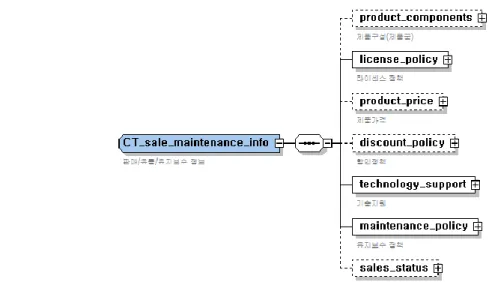
Sales, distribution and maintenance information is the sales information including product prices and license policies required for purchase and establishment of products, and it consists of items including license policy, product prices, discount policy and maintenance policy. This structure consists of product components (product_components), license policy (license_policy), product price (product_price), discount policy (discount_policy), technical support (technology_support), maintenance policy (maintenance_policy), and product (technology) sales status (sales_status) in a sequential structure. Figure 8 shows the structure of the sale, distribution and maintenance information.
The cardinality for license policy (license_policy), technical support (technology_support) and maintenance policy (maintenance_policy) is 1, and the cardinality for other elements is 0 at least and 1 at most. Product components have the substructure with classification element and text element for describing contents in a sequential structure, and the cardinality for all these elements is 0 at least and 1 at most.
Figure 8. The Structure of the Sale, Distribution and Maintenance Information
4. Implementation
In this section, we briefly illustrate and discuss the design and implementation method on how to automatically generate XML documents by using the designed software technology information schema. Through this, the standard for software information system management is presented as showed in Figure 5[1].
Figure 9. The Structure of the Client-server
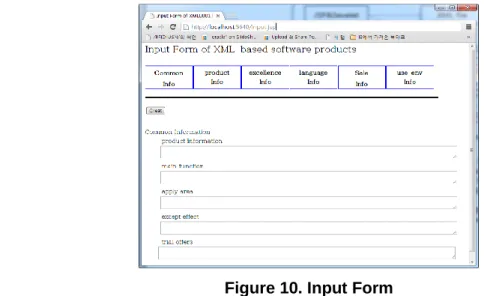
Spring manages the web server resources while Jersey converts Java Object into XML or XML to Object. TOMCAT is a web server for HTTP communication. Ajax delivers data to a web server and generates XML files by means of XML structure. Figure 6 shows the input form to automatically generate XML documents based on the information of the software technology information schema [1].
The original document is prepared according to the schema, the input XML and XSL documents are processed, and then the converted documents are shown through the browser [1].
Figure 10. Input Form
Figure 11 shows the XML document converted from the automatically generated XML document in application of XSLT based on the software technology information schema.
Figure 11. The Conversion of XML Document
5. Conclusion
Recently, various advance information in industry sectors address the importance of software's which is emphasized as a key capacity element of IT convergence in a diverse environments. Therefore, the necessity to enhance the availability of excellent software resources by making the database is also highlighted.
This study presented the standard for the XML-based software product database schema, which is necessary for registration, searching, and sharing of software products in order to make a database of the software product assets and share and transact them through a software bank.
This study includes the definition of the standard for the XML-based SW product DB schema in order to provide the guideline for schema definition. Specifically, it defines the common information to register software products, product overviews, basic conditions for
use, information of product excellence, multi-language support, sales /distribution /maintenance, product documentations, contact information, types and lengths, and so forth.
Lastly, the method to automatically generate XML documents by means of the designed software technology information schema is designed and implemented.
It is expected that this study presents a method to effectively make a database for software products, maximizes the values of software products, and contributes to developing a standardized database and operation instructions for it.
References
[1] C. S. Kim, M. K. In, K. C. Lee, S. Y. Lee and H. K. Jung, “The Design of XML-Based Software Information System Schema and Development of the Standard for Information Processing”, Future Information Communication Technology and Applications. LNEE 235, vol. 1, (2013), pp. 783-791.
[2] C. S. Kim and H. K, Jung, “XML-based EDI Document Processing System with Binary Format Mapping Rules”, Journal of Information and Communication Convergence Engineering, vol. 10, no. 3, (2012), pp. 258-263.
[3] C. S. Kim, S. K. You, Y. W. KIm, H. J. Kim and H. K, Jung, “Design of Presentation Language for Sensor Node Data Representation”, Journal of the Korea Institute of Information and Communication Engineering, vol. 16, no. 2, (2012), pp. 378-383.
[4] C. S. Kim and H. K. Jung, “XML-based EDI Document Processing System with Binary Format Mapping Rules”, Journal of Information and Communication Convergence Engineering, vol. 10, no. 3, (2012), pp. 258-263.
[5] Y. Liu, F. Wang, H. Deng, X Fu and K. Ji, “A Study on Modeling of Lightweight Scientific Workflow Systems Using XML Schema”, LNCS -Issue 7235, (2012), pp. 743-750.
[6] Y.-H. Chang, C.-C. Huang and P.-H. Chien, “Efficient grouping and ordering processing on XML data”, Journal Chinese Institute of Engineerings, vol. 35, Issue 6, (2012), pp. 697-709.
[7] Y. Peng, “The Study on Query Interface to XML-Based Multimedia Database”, Proceedings of the 2009 3rd International Conference on Teaching and Computational Science (WTCS 2009), vol. 117, (2012), pp. 203-210.
[8] Extensible Markup Language (XML) 1.0 (Fifth Edition), http://www.w3.org/TR/2008/REC-xml-20081126/. [9] XML Schema, http://www.w3.org/XML/Schema.
[10] The Extensible Stylesheet Language Family (XSL), http://www.w3.org/Style/XSL/.
Authors
Chang Su Kim, he received the B.S., M.S., and Ph.D. degrees from the Department of Computer Engineering of Paichai University, Korea, in 1996, 1998, and 2002, respectively. From 2005 to 2012, he worked for the Department of Internet at Chungwoon University as a professor. Since 2013, he has worked in the Department of Computer Engineering at Paichai University, where he now works as a professor. His current research interests include multimedia document architecture modeling, web 2.0, and the semantic web
Tae Hak Ban, he received the B.S degree from the Department of Computer Engineering of Paichai University, Korea in 2011, and he received the M.S degree from the Department of Computer Engineering of Paichai University, Korea in 2013. He is currently a Ph.D. in Department of Computer Engineering of Paichai University. His current research interests include multimedia information processing, multimedia communication, and ubiquitous computing.
Hoe Kyung Jung, he received the B.S degree in 1987 and Ph. D. degree in 1993 from the Department of Computer Engineering of Kwangwoon University, Korea. From 1994 to 2005, he worked for ETRI as a researcher. Since 1997, he has worked in the Department of Computer Engineering at Paichai University, where he now works as a professor. His current research interests include multimedia document architecture modeling, information processing, information retrieval, and databases.