IT Project Governance Manual
Version 1.1
A Mandatory Reference for ADS Chapter 577
New
Reference:
04/13/2010
Responsible
Office:
CIO
UNITED STATES AGENCY FOR
INTERNATIONAL DEVELOPMENT
(USAID)
I T P R O J E C T G O V E R N A N C E M A N U A L
V E R S I O N 1 . 1
OFFICE OF THE CHIEF INFORMATION
OFFICER (OCIO)
Table of Contents
1.
Executive Summary
... 3
1.1 Scope...4
1.2 Background ...4
1.3 Key Project Governance Principle ...5
2.
IT Project Governance
... 7
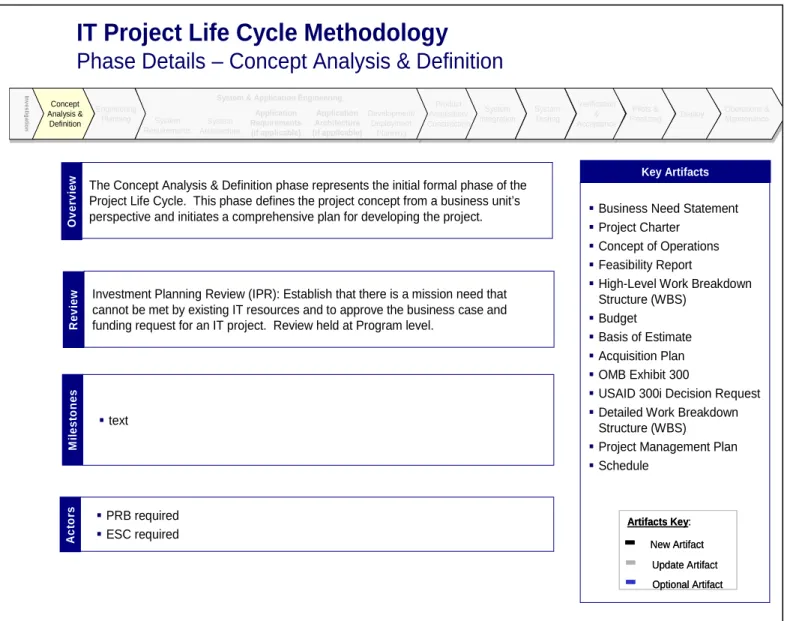
2.1 Phases ...8
2.2 Artifacts ...8
2.3 Phase Gate Reviews ...9
2.4 Tailoring Criteria and Guidelines ...12
2.5 Roles and Responsibilities ...13
3.
Project Management
... 18
3.1 Integration Management...18
3.2 Scope Management ...20
3.2.1 WBS Overview ...21
3.2.2 WBS Definition ...22
3.3 Time Management ...23
3.4 Cost Management ...24
3.5 Quality Management ...25
3.6 Human Resource Management ...26
3.7 Communications Management ...27
3.10 Earned Value Management ...30
3.10.1 Integrated Baseline Review (IBR) ...31
4.
Configuration Management
... 32
4.1.
Configuration Control Boards (CCB)
... 32
5.
Security Management
... 34
7. Resources and References ...36
APPENDIX A:
IT Project Life Cycle Diagrams ... 38
APPENDIX B:
Phase Descriptions ... 41
APPENDIX C:
Artifacts Matrix ... 58
APPENDIX D:
Checklists & Artifact Quality Factors... 67
APPENDIX E:
Phase Gate Materials... 91
APPENDIX F:
Phase Gate Review Organizational Responsibility ... 94
APPENDIX G:
Life Cycle Tailoring ... 95
APPENDIX H:
IT Project WBS ... 101
APPENDIX I:
IT Governance Project Definitions... 103
APPENDIX J:
IT Project WBS Template... 107
1.
Executive Summary
This manual establishes the processes and procedures that will be used to manage IT projects at
USAID. It states the basic IT Project Governance requirements for the Agency, including
system engineering, project management, and governance processes codified as the USAID “IT
Project Life Cycle Methodology (ITPLCM).” This manual provides for a formal, structured, and
integrated approach to managing Agency IT projects.
IT Project Governance emphasizes best practices and decision processes that enhance the
effectiveness of system development projects and the delivery of IT systems. It identifies a
methodical progression of best practice action items that are to be systematically and uniformly
performed throughout the life cycle of an IT project. This progression ensures that key decisions
made along the way result in effective systems that fully consider:
Enterprise direction, priorities, and business processes
Functional process, data, and information requirements
External U.S. Government laws, mandates, and audit requirements
Economic and technical constraints
Development and on-going operational risks
IT Project Governance incorporates project, configuration, security, and portfolio management
processes as well as complementary enterprise disciplines, including, but not limited to, Capital
Planning and Investment Control (CPIC), Enterprise Architecture (EA), and USAID’s
Automated Directives System’s (ADS) required policies and procedures. IT Project Governance
focuses on delivering IT systems that:
Meet or exceed customer needs and expectations
Work effectively and efficiently within the current and planned technical infrastructure
Offer production-quality reliability and performance
Are inexpensive to maintain and cost-effective to enhance
The strategic objectives for the IT Project Governance framework are as follows:
Predictably deliver consistent systems when promised and within cost estimates
Institutionalize policies, procedures, standards, and best practices
Facilitate cross-functional communication, coordination, and collaboration
Provide for on-going process improvement and a means to reflect “lessons learned”
USAID’s IT Project Governance framework includes strong control mechanisms at key decision
points in the ITPLCM. These control mechanisms allow for the timely identification and
resolution of critical issues affecting the success of a system development project through formal
deliverable review and acceptance, and phase gate reviews with go/no-go decisions.
Please see Appendix A, “IT Project Life Cycle Diagrams”, for diagrams describing the
ITPLCM.
1.1 Scope
The USAID IT Project Governance Manual
documents the ITPLCM, system engineering,
project management, and governance processes for IT system development and
implementation projects. This manual provides a practitioner with instructions and guidance
on how to progress successfully through the IT Project Life Cycle in compliance with
governance requirements.
IT Project Governance applies to all IT projects, including, but not limited to, software
development, commercial, off-the-shelf (COTS), third-party developed and hosted
applications, and infrastructure. A complete description of the processes and associated
documentation required to meet the Chief Information Security Officer (CISO) privacy and
security requirements appears in the document “Third-Party System Process and Procedures”
from the CISO Office. Compliance with IT Project Governance is mandatory, and all IT
projects, including software development, COTS and third-party systems, are subject to
compliance reviews and audits.
1.2 Background
USAID should fully utilize IT to:
Expedite processes, procedures, and program results
Provide 24/7 access to select processes and systems
Share information quickly
Gather program information to determine trends and improve mission performance
IT is an effective tool to help meet escalating demands in this global world of rapid change
and increasing mission scope, and increasingly leaders in both the public and private sector
rely on information systems and other pervasive information technologies to achieve results.
Federal e-Government legislative mandates also increase Agency IT demands.
Because of the proliferation of IT usage and escalating costs in the Federal Government, the
Administration and the Office of Management and Budget (OMB) have called for increased
accountability. The Capital Planning and Investment Control (CPIC) Process is OMB’s
mandate to Federal agencies to ensure positive returns on IT investments. Just as USAID
responds to the externally imposed OMB mandate for CPIC, USAID must establish internal
the way the Federal Government acquires and manages IT, utilizing performance-based
management principles for acquiring IT (i.e., planning major IT investments, enforcing
accountability for performance, using standards, and increasing incorporation of commercial
technology). The Clinger-Cohen Act also mandates the use of formal enterprise disciplines.
The ITPLCM is designed to support a traditional waterfall methodology (top to bottom
sequential software development process), but it can be tailored to support other development
methodologies and all types of IT projects. It introduces formal, structured, standardized
review, evaluation, and certification procedures for acceptance of IT project deliverables, and
movement through the phases of the IT Project Life Cycle.
Many IT enterprise disciplines are already established within USAID and M/CIO. The IT
Project Governance Manual provides one source for all requirements and guidance, including
references and links to existing enterprise and complementary processes.
1.3 Key Project Governance Principle
USAID’s IT Project Governance framework is based on the following key principles:
Consistency with accepted industry best practices and standards
Development and maintenance of comprehensive project documentation and
artifacts to plan, track, measure, and control the progress of each IT project
Accountability through work product and progress reviews at key decision points in
the IT Project Life Cycle
Clear, accurate, and thorough documentation of activity results and decisions
throughout the IT Project Life Cycle
Formal review, concurrence, certification, and acceptance of all project deliverables
by stakeholders across the Agency based on their predefined roles and
responsibilities
ITPLCM tailoring options for alternative development project work patterns to
ensure flexibility in responding quickly to meet immediate business needs
The IT Project Life Cycle, Project Work Breakdown Structure (WBS), and Project,
Configuration, Security, and Portfolio Management principles described in the
following sections
1.4 IT Project Life Cycle
USAID’s Project Life Cycle Methodology breaks down an IT project into manageable phases
that begin with investigation into a business or technical need or opportunity, and end with
operations and maintenance of the deployed system or products of the project. Phases
consist of activities and procedures based on industry best practices and Government
standards.
1.5 IT Project Work Breakdown Structure (WBS)
The WBS provides the foundation for defining work as it relates to project objectives. The
WBS also establishes the structure for managing the work to its completion. USAID has
defined standard WBS definitions which must be addressed during planning stages of all
projects to ensure that all necessary work for the entire project life cycle is identified, costed,
scheduled, and controlled. The WBS also provides the basis for establishing earned value
control accounts.
1.6 Project Management
USAID’s IT Project Governance framework incorporates project management guidelines for
initiation, planning, execution and control, and closing of an IT project, in accordance with
the Project Management Institute’s Project Management Book of Knowledge (PMBOK®).
Project management processes and artifacts are required to plan, establish, and maintain
control over project cost, scope, schedule, and quality.
1.7 Configuration Management
The ITPLCM is dependent on disciplined configuration management and change control.
The key elements are artifact management and baseline control, configuration management,
and change management governed by the Change Control Boards (CCB).
1.8 Security Management
The ITPLCM integrates security requirements as defined by the CISO. Projects must be
executed in compliance with security regulations to ensure applicable privacy, data, and
technical security. During the project planning stages, the systems and products to be
delivered by the project must be evaluated by the CISO to determine if certification and
accreditation (C&A) is required. All systems must have applicable security patches and
receive approval from the CISO prior to deployment on any USAID network.
1.9 Complementary Processes and Policies
Additional USAID policies and procedures may apply to IT projects as well. Project teams
must review these complementary processes and policies during the early planning stages of
a project, and periodically thereafter, to ensure compliance. These may include Capital
Planning and Investment Control (CPIC), Enterprise Architecture, FOIA and Records
Management, Section 508 of the Rehabilitation Act Amendments, and applicable ADS
policies. Projects must also abide by the approved software list and other data and network
standards, and any exception or change requests must be presented to the CIO and/or
Operations and Management Configuration Control Board (O&M CCB) for approval.
2.
IT Project Governance
USAID’s IT Project Governance framework will govern the management and execution of all
USAID projects. The framework promotes compliance with Federal guidance, provides a
common project management structure for all types of IT projects, and establishes a framework
for project risk and quality control. In particular, the IT Governance framework enforces
compliance with the ITPLCM.
The ITPLCM establishes the discipline of developing Agency-wide and smaller IT systems by
using a consistent and repeatable process that includes breaking down the system development
process into discreet, manageable phases. Phases consist of activities and procedures based on
industry best practices and Government standards.
Please see Appendix A, “IT Project Life Cycle Diagrams”, for diagrams depicting the
ITPLCM in totality.
The
IT Project Life Cycle Methodology
diagram shows that the methodology is comprised of
four key elements:
Capital Planning
Life Cycle Phases
Reviews
Milestones
The Life Cycle Phases and Reviews are the foundation of the methodology. The phases and
reviews directly relate to the milestones and capital planning phases. Please see sections 2.1
and 2.3 for more information about the phases and reviews.
The ITPLCM identifies the following key milestones:
Earned Value Milestones – Engineering and Performance Measurement Baselines.
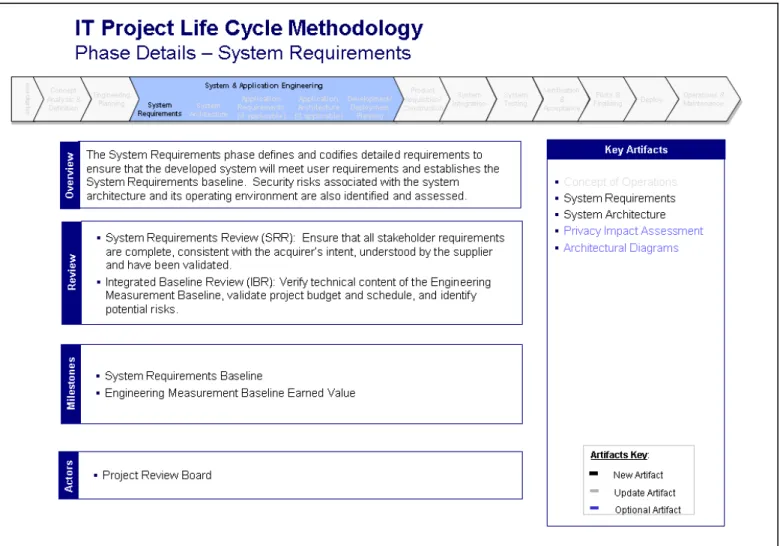
1. Engineering Measurement Baselines are high-level, suitable for reporting, and
contain planning packages.
2. Performance Measurement Baselines are detailed, required for Earned Value
Management (EVM) reporting, and are the baseline for cost and schedule
accountability
Project life cycle baseline milestones such as System Requirements, Architecture, etc.
are associated with key life cycle phases. Baseline changes should be controlled via
Configuration Control Board processes.
Cost estimate milestones provide expectations on the fidelity of cost estimating at key
points in the life cycle
In the IT Project Life Cycle Methodology, all elements are linked:
The performance baseline is set upon satisfactory completion of the Performance
Baseline Review (PBR)
The PBR marks the end of the System & Application Engineering Phase
OMB considers the setting of the performance baseline the end of the useful
planning segment, thus requiring an exhibit 300 baseline update, which is the
primary funding budgetary justification source for the Agency
Time is relative and cannot be determined from the chart
The time between the investigation phase and the beginning of system and
application engineering may take months or even years
The time between the planning and acquisition investment stages will be determined
by the project scope and type
The chart is not static. It is assumed that each project will tailor the number and relationships
among the phase gate reviews.
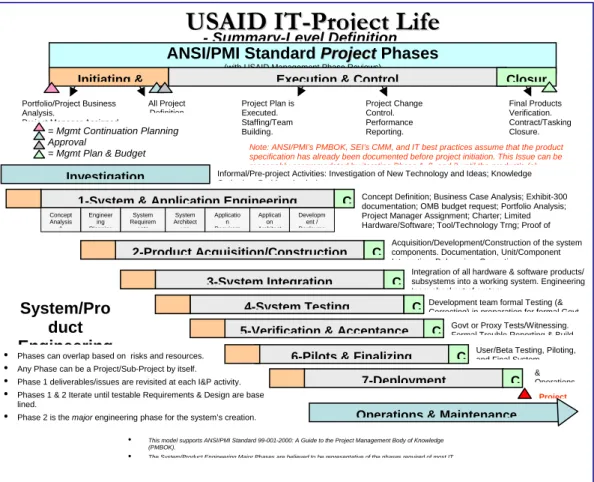
The
USAID IT Project Life Cycle Methodology
diagram depicts summary level definition of each
life cycle phase. Each life cycle phase contains activities for (1) Initiating & Planning; (2)
Execution & Control; and (3) Closure.
The
USAID Select-Control-Evaluate Framework diagram
demonstrates how the IT Project Life
Cycle Methodology supports capital planning and investment control processes and
requirements. The OMB exhibit 53 is designed to allow the review and evaluation of each
Agency’s IT spending in total and compares IT spending across the Federal Government. An
OMB exhibit 300 business case, the primary funding budgetary justification source for the
Agency, is completed for all major investments, whereas the exhibit 53 is merely a listing of all
investments
.2.1 Phases
USAID’s Project Life Cycle Methodology breaks down the project into manageable phases.
Phases consist of activities and procedures based on industry best practices and Government
standards. Each phase has defined artifact and review gates.
Descriptions, artifacts, reviews, and milestones of each IT Project Life Cycle Phase can be
found in Appendix A, “IT Project Life Cycle Diagrams”, and Appendix B, “Phase
Descriptions.”
2.2 Artifacts
applicable stakeholders, base lined, and placed under change control. Designated artifacts
are required by each phase gate review, as noted in the phase gate checklists. However, an
approved tailoring plan may enable consolidation of designated artifacts, or waiver of
non-applicable artifacts.
Appendix C provides an artifact matrix, showing standard required artifacts, their
descriptions, and the phases in which they should be created or updated. Appendix D
describes the quality factors for each artifact.
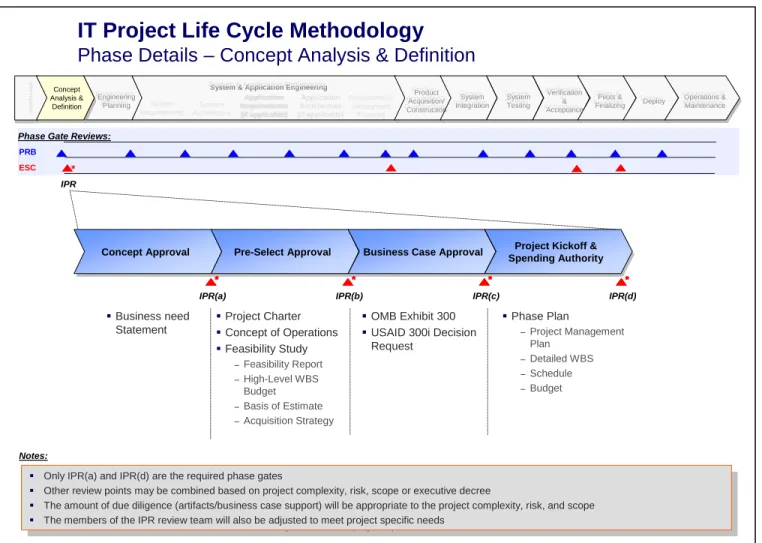
2.3 Phase Gate Reviews
Phase gate reviews are conducted to assess project status, quality, risks, and compliance
with requirements, and to ensure stakeholder acceptance and ownership. This process
helps determine if the project is ready to proceed to the next stage or phase. Projects
cannot continue beyond the current phase gate without full or conditional approval from
the applicable review board.
The most common phase gate review body is the Project Review Board (PRB). The PRB
consists of management level stakeholders, and should be established during the initial
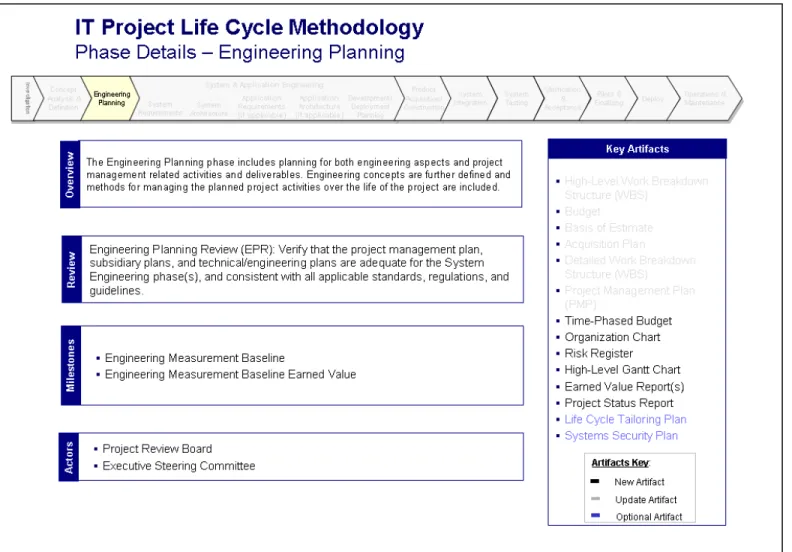
phases of the project (Concept Analysis & Definition, or Engineering Planning at the
latest) to conduct phase gate reviews. The Project Review Board (PRB):
Is comprised of senior stakeholders representing USAID IT functional,
governance, and customer areas
Makes stage gate and management decisions
Ensures project life cycle compliance
Each stakeholder PRB member should designate one or more technical team members to
review project deliverables and artifacts. These technical team members compose the
Engineering Review Team (ERT) and may approve artifacts or provide advice to the PRB
for stage gate decisions. PRB membership is project specific.
More information about the PRB can be found in section 2.5.4.
Projects that have high risk, cost, visibility, or strategic impact will also require a second
level of executive review via an Executive Steering Committee (ESC). The need for an
ESC will be determined by the CIO Chief Engineer, the CIO Budget & Capital Planning
Division, and/or the IT Steering Subcommittee (ITSS) during the Concept Analysis &
Definition phase, prior to an Investment Planning Review (IPR).
Reviews focus on both management and technical aspects of the projects. The entry and
exit checklists are closely linked with the artifact Quality Factors.
Management Aspects:
Evaluate the effectiveness of management approaches used by the project
Determine the status of plans and schedules
Technical Aspects:
Determine whether the product is suitable for intended use and conforms to its
specifications
Verify adherence to regulations, standards, guidelines, plans, and procedures
applicable to the project
Determine if the project/product is technically compatible with other initiatives and
feasible for integration into the USAID production environment
Phase gate reviews are defined at key points in the life cycle, typically at or near the end of
each life cycle phase. Each phase gate has a checklist of minimum criteria required to
conduct a review. The Project Manager (PM) must complete the entry portion of the
checklist and submit it to the PRB or the PRB’s designated facilitator in order to schedule the
review. Next, the phase gate meeting is held to assess the readiness of the project to proceed
to the next phase. PRB members are in attendance, and the PM conducts a presentation
describing the current status of the project, particularly in relation to the criteria for the
current phase gate and upcoming phase.
Each project review will lead to one of three possible results, based on a decision of the PRB:
Unconditional concurrence
.
The project can proceed to the next phase or stage
unconditionally
Conditional concurrence
.
The project can proceed to the next phase or stage,
however conditions have been noted, which must be addressed according to the
timeline defined
Non-concurrence
.
The project cannot proceed to the next phase or stage. Noted
issues must be addressed, and then the project review must be repeated.
Once a project review has been successfully approved by the PRB, the applicable phase
documents are base lined and transferred to change management control, unless otherwise
noted.
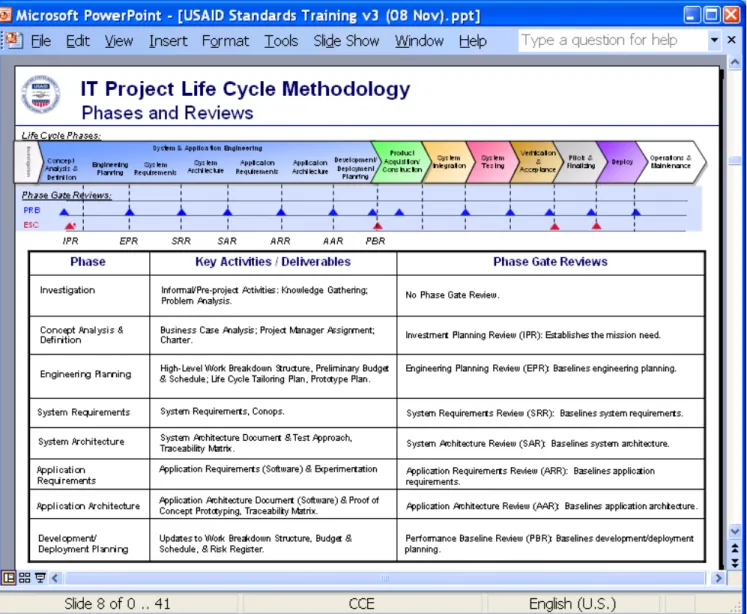
Figure 1 - IT Project Life Cycle Methodology (Phases and Reviews)
Figure 1 represents the IT Project Life Cycle Methodology Phases and Reviews. This figure is
comprised of System and Application Engineering phases listed at the top of the graphic. The
table has three columns. Column 1 identifies each phase. Column 2 describes a key activity and
deliverable associated with each phase. Column 3 enumerates the associated Phase Gate Review.
2.4 Tailoring Criteria and Guidelines
To provide flexibility in response to business needs, the ITPLCM may be tailored to create
an alternative work pattern that suits the needs of the system development project without
compromising the intent or integrity of the ITPLCM Process. A work pattern consists of the
entire set of activities, deliverables, and reviews required to develop the system. An
alternative work pattern is a subset of the full-sequential work pattern.
PMs should discuss tailoring with stakeholders early in the project (during the Engineering
Planning phase), and present a tailoring plan for approval to the OCIO Chief Engineer, the
Project Review Board (PRB), as well as the Executive Steering Committee (ESC), if
applicable. Tailoring requests to waive any standard artifacts or phase gate reviews will be
example, if spiral development is more appropriate to achieve the goals of the project than a
traditional waterfall model.
Once the tailoring plan is approved, a customized work pattern (which may be a subset or
alternative set of the full-sequential work pattern) is identified as the required minimum for
the system development project. Deliverables and/or reviews outside the initial subset may
be tailored, and the approved work pattern must be documented in the project management
plan (PMP) and subsidiary plans, as applicable. Following approval, the project must adhere
to the approved work pattern throughout the ITPLCM Process. Any subsequent deviation
from the approved work pattern must again be pre-approved by the project governance
authorities (PRB and OCIO Chief Engineer, as well as the ESC, if applicable.)
Please see Appendix G “Life Cycle Tailoring” for a diagram describing some typical
tailoring options, as follows:
Project 1 is considered a “Simple Project” – Small Web Application. The software used,
Dreamweaver, is well known and no hardware is required. In this example, the System
Requirements Review (SRR), System Architecture Review (SAR), Application
Requirements Review (ARR), and Application Architecture Review (AAR) phases are
combined into the Performance Baseline Review (PBR). Additionally, the
Detailed Design Review (DDR) and
TRR: Test Readiness Review (TRR) are combined into the
Verification Test Review (VTR). The simplicity based on project scope and risk lends itself to the reduced
number of formal reviews. Each project must still work internally to ensure that meets the
requirements of the phases being combined.
In the second example, Project 2 is a “COTS/Infrastructure project” – some reviews may not
be applicable, while others can be combined. Since this is a COTS project, the ARR and
AAR reviews are not applicable.
The last example, Project 3, is a large, complex project with multiple sub-projects and
deployments, and requires all reviews in order to control the heightened risk and complexity.
There are other examples of pilot and deployment sub-projects within a project (for example,
a multiple mission on-site deployment), or an incremental or spiral development project may
require key phases to be repeated. Both ideas (multiple deployments and alternative work
patterns) represent specific customization concepts that should be discussed and documented
early in the project.
2.5 Roles and Responsibilities
Throughout this manual, reference is made to specific roles that must be performed by
stakeholders at various times throughout the project life cycle. Stakeholders are people and
organizations that are in any way affected by the new product or service. Since the project
will rely on various stakeholders prior to developing the project plan where roles and
responsibilities are typically defined, it is important to understand the roles and
responsibilities early in the process.
Note: The specific roles and responsibilities for stakeholders and team members in
your project may vary from those identified below due to project size, scope,
complexity, and the organizational structure of the Agency/institution. Project
personnel, roles, and responsibilities should be documented in an Organization
Chart, and may also need to be defined in the Project Charter.
Project Team
The Project Team is the group that is responsible for planning and executing the project. It
consists of a Project Manager (PM) and a variable number of Project Team members who
execute their tasks according to the Project Schedule.
The PM is responsible for ensuring that the Project Team completes the project. The
PM develops the Project Plan with the team and manages the team’s performance of
project tasks. The PM is also responsible for securing acceptance and approval of
deliverables from the Project Sponsor and Stakeholders.
The Project Team Members are responsible for executing tasks and producing
deliverables as outlined in the Project Plan and directed by the PM, at whatever level
of effort or participation has been defined for them. On larger projects, some Project
Team members may serve as Project Team Leaders (see below).
The Project Team Leaders, sometimes called Business or Technical Team Leads,
have the same responsibilities as Team Members, but also assist the PM in providing
leadership for, and managing the team’s performance of, various tasks.
NOTE: Throughout this manual, when Project Team Members are listed as a
resource for a particular task, it should be assumed that Project Team Leaders are
included.
Project Sponsor
The Project Sponsor has a demonstrable interest in the outcome of the project and is
responsible for securing spending authority and resources for it. Ideally, the Project Sponsor
should have full authority to make all decisions necessary to assure the project’s completion,
including whether to increase the project scope and budget.
The Project Sponsor provides support for the PM, approves major deliverables, and signs off
on approvals to proceed to each succeeding project phase. The Project Sponsor may delegate
any of the above responsibilities to other personnel either on or outside the Project Team.
The Project Sponsor is commonly an active participant with project steering committees or
other types of larger management teams providing guidance and support to the PM. On
larger projects, there may be various levels and types of committees.
Customers
Customers comprise the business units that identified the need for the product or service the
project will develop. Customers can be at all levels of an organization. Since it is frequently
not feasible for all Customers to be directly involved in the project, the following roles are
identified:
Customer Representatives are members of the Customer community that are identified
and made available to the project for their subject matter expertise (sometimes called
subject matter experts or SMEs). Their responsibility is to accurately represent their
business units’ needs to the Project Team, and to validate the deliverables that describe
the product or service that the project will produce. Customer Representatives are also
expected to bring back to the Customer community information about the project.
Towards the end of the project, Customer Representatives will test the product or
service the project is developing, using and evaluating it while providing feedback to
the Project Team.
Customer Decision-Makers are those members of the Customer community who have
been designated to make project decisions on behalf of major business units that will
use, or will be affected by, the product or service the project will deliver. Customer
Decision-Makers are responsible for achieving a consensus of their business unit on
project issues and results and communicating it to the Project Team. They attend
project meetings as requested by the PM, review and approve process deliverables, and
provide subject matter expertise to the Project Team. On some projects, they may also
serve as Customer Representatives.
Vendors
Vendors are contracted to provide additional products or services the project will require and
may be members of the Project Team.
Users
Users include all the people that will use and benefit from the product or service that the
project is developing.
2.6 Joint Management Council (JMC)
The JMC prioritizes the joint management opportunities referenced in the Department of
State/USAID Strategic Plan, as well as any other proposed joint initiatives. The JMC guides
implementation, oversees execution of the resulting policies and programs, and works closely
with the Department of State/USAID Joint Policy Council to ensure that joint management
and policy issues are coordinated between agencies. Several working groups support the
JMC in its areas of focus – Human Resources, e-Government, Facilities, Security, and
Planning and Resources. Under e-Government, the JMC works to streamline the
Department’s and USAID’s existing infrastructure, coordinate IT planning, strengthen core
information management systems, and consolidate technical and operational support.
(
http://inside.usaid.gov/BTEC/archives/jmc_intro.html.
Note: This Web site is only
available to USAID intranet users
.)
2.7 Business Transformation Executive Committee (BTEC)
The BTEC provides Agency-wide leadership for initiatives and investments to transform
USAID business systems and organizational performance. The BTEC focuses on issues and
investment decisions related most closely to achieving the Agency’s mission. Additionally,
the BTEC designates, establishes, and monitors the portfolio of USAID IT investments
throughout their life cycle to ensure that they are acquired or developed within planned cost
and schedule objectives and that they produce expected benefits.
(
http://inside.usaid.gov/BTEC/
.
Note: This Web site is only available to USAID intranet
users
.)
2.8 IT Steering Subcommittee (ITSS)
The IT Steering Subcommittee will provide oversight to the Agency’s information
technology (IT) program, including maintaining and implementing the Agency’s approved
Capital Planning and Investment Control process as outlined in
ADS Chapter 577
, making
recommendations on Agency IT governance, and serving as the oversight authority to guide
information technology initiatives. (
http://inside.usaid.gov/BTEC/.
Note: This Web site is
only available to USAID intranet users.)
2.9 Project Review Board (PRB)
The Project Review Board is a management body that provides governance decisions during
the life cycle of projects at defined review decision points according to the USAID IT Project
Life Cycle Methodology or at other key decision points. The PRB should include all key
stakeholders in the project; therefore, some projects may have unique PRB membership. The
PRB membership should be established early in the project (no later than the Engineering
Planning Phase).
The PRB makes decisions on the suitability of a project to proceed beyond each review
decision point to the next stage or phase of the project. The PRB process is intended to
complement the Change Control Board process by ensuring early project alignment with
USAID standards and compatible integration into the USAID production environment.
2.10 Engineering Review Team (ERT)
The ERT consists of representatives from the Project Review Board (PRB), which may
include each key IT functional and governance area within USAID. These Engineering
Review Team representatives provide recommendations and technical advice to the Project
Review Board management body regarding project deliverables to help them make each
review decision.
2.11 CIO Advisory Board
The CIO Advisory Board manages new item requests, which are submitted to the OCIO via
the Item Tracker process. New requests are validated by the Business Consulting and Client
Services (BCCS) division and submitted for further analysis to the CIO Advisory Board.
The Advisory Board may request an additional Rough Order of Magnitude (ROM) (Part A),
a detailed Project Proposal (Part B), or completed Business Case (Part C) to fully evaluate
the new item request. If the new item requires funding, the request is submitted to the IT
Steering Subcommittee (ITSS) to be ranked and prioritized for funding.
3.
Project Management
This section describes the project management processes that are used throughout the project
life cycle.
3.1 Integration Management
The Project Management Institute’s Project Management Book of Knowledge (PMBOK®)
lists Project Integration Management as one of nine project management fields of
knowledge that ensures that all processes necessary for the successful completion of a
project’s objectives are properly integrated and coordinated. As a dynamic activity, project
integration management involves constant monitoring of these processes in order to balance
competing objectives to meet stakeholder needs and expectations.
Project Integration Management includes the following six process groups:
1.
Develop Project Charter
– A Project Charter formally authorizes and initiates the
project. It defines the objectives, identifies the Project Manager, and is a required
document prior to the start of any project.
2.
Develop the Project Management Plan
– The Project Management Plan includes all
subsidiary plans.
3.
Direct and Manage Project Execution
- Directing and Managing Project execution
coordinates all allocated resources to enable project completion.
4.
Monitor and Control Project Work
– Monitoring and Controlling Project work
measures the project’s progress and makes apparent any corrective or preventative
actions needed to ensure all project objectives are met. It provides the project team
with timely information needed to determine whether the project continues on track.
5.
Perform Integrated Change Control
– Integrated Change Control is the process by
which all change requests (scope, time, and cost) are properly evaluated, and changes
are authorized and continuously managed. An important result of this process is that
only approved changes are implemented while simultaneously providing a
mechanism to identify and revise the project’s baseline, as necessary.
6.
Close Project or Phase
– Closing the project means completing all project activities,
delivering the final project, turning over continual support to operations, and
obtaining client approval to formally close the project.
The following five process groups carry out the aforementioned process groups that
constitute the project’s life cycle:
Initiating
- The Initiating Process Group completes those processes necessary for
formally authorizing the beginning of a new project. The processes for developing
the Project Charter and the preliminary Project Scope Statement occur in the
Initiating Process Group.
Planning Process Group
- The Planning Process Group establishes the project
scope, creates the Project Management Plan, and identifies and schedules the
project’s activities.
Executing Process Group
– The Executing Process Group complete the work
outlined in the Project Management Plan to achieve the project's objectives. The
process for directing and managing project execution, which ensures that the Project
Management Plan is implemented properly, occurs in the Executing Process Group.
Monitoring and Controlling Process Group
- The Monitoring and Controlling
Process Group gathers, assesses, and distributes performance information and
analyzing measurements and trends to make continual process improvements. The
processes for monitoring and controlling project work and implementing integrated
change control occur in the Monitoring and Controlling Process Group.
Closing Process Group
– The Closing Process group carries out those processes
necessary for officially ending project activities and handing off the completed
product to others. This also includes closing a project that has been canceled.
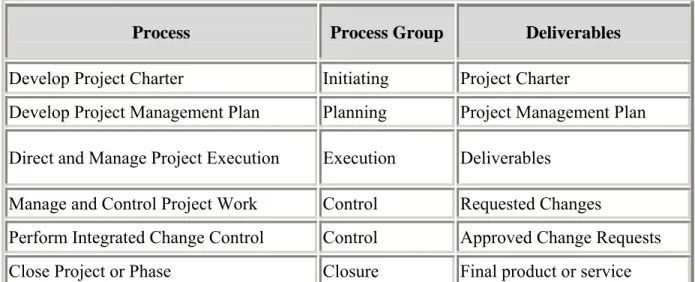
The following table describes how the Project Integration Processes relate to the five Life
Cycle Process Groups:
Process
Process Group
Deliverables
Develop Project Charter
Initiating Project
Charter
Develop Project Management Plan
Planning
Project Management Plan
Direct and Manage Project Execution Execution
Deliverables
Manage and Control Project Work
Control
Requested Changes
Perform Integrated Change Control
Control
Approved Change Requests
Close Project or Phase
Closure
Final product or service
Figure 2 represents the Project Integration Process table. The table is comprised of three
columns. Column 1 identifies each Project Integration Process. Column 2 lists the Life Cycle
Process Group associated with the listed processes. Column 3 describes the deliverables that will
accompany each process.
3.2 Scope Management
The Project Management Institute’s Project Management Book of Knowledge (PMBOK®)
lists Project Scope Management as one of nine project management fields of knowledge that
ensures that the project executes only the work required to successfully achieve its goals and
objectives. Its primary mission is to provide control mechanisms to prevent the project’s
scope from unnecessarily expanding beyond the boundaries established by the Project
Charter.
Project Scope Management includes the following five process groups:
1.
Collect Requirements
– The process of defining and documenting stakeholders’ needs
to meet project objectives.
2.
Define Scope
– The process for defining a formal statement to gain consensus and
commitment from all stakeholders regarding the products or services expected from the
project. It expands on the Project Charter by providing details on assumptions and
limitations regarding expected deliverables. The scope definition document prepares the
groundwork for the preparation of a Work Breakdown Structure (WBS).
3.
Create a WBS
– A WBS represents a hierarchical representation of the project’s
activities and products/services that serves to organize the work to be completed. It
breaks down large tasks into smaller tasks, thus making them easier to execute and
control.
4.
Verify Scope
– This is a formal acceptance of the scope and associated deliverables.
This process ensures that the project’s products or services coincide with the
requirements previously established.
5.
Control Scope
– A formal system is created through which all change requests and
corrective actions are processed and controlled. This system limits the impact of
unauthorized scope changes that may adversely affect the project baseline.
The following table describes how the Project Scope Management Processes relate the
appropriate Life Cycle Process Groups:
Process
Process
Group
Deliverables
Collect
Requirements
Planning
Requirements Documentation, Requirements
Management Plan
Define Scope
Planning
Project Scope Statement
Create a WBS
Planning
WBS, WBS Dictionary
Verify Scope
Control
Acceptance of Deliverables
Control Scope
Control
Change Requests
Figure 3 - Project Scope Management Processes
Figure 3 represents a Life Cycle Process Groups table. The table is comprised of three Columns.
Column 1 identifies each Project Scope Management process. Column 2 lists the Life Cycle
Process Group. Column 3 is a description of the deliverable that will accompany each process.
3.2.1 WBS Overview
The PMI PMBOK defines a Work Breakdown Structure (WBS) as “A deliverable-oriented
grouping of project elements that organizes and defines the total work scope of the project.
Each descending level represents an increasingly detailed definition of the project work.”
Projects must utilize the standard USAID IT Project WBS definitions as defined in section
3.2.
The WBS provides the foundation for defining project work as it relates to project objectives.
The WBS also establishes the structure for managing the work to its completion. Benefits of
a well defined WBS on a project include:
Facilitates thorough planning to ensure project objectives are decomposed into
products (deliverables)
Provides a foundation for defining work related to project objectives
Establishes structure for managing work to completion
Serves as an effective communication tool for the PM and the stakeholders
Facilitates the association of cost and schedule to specific products (deliverables)
The WBS should be developed by comparing the “As Is” and “To Be” states, and then
identifying all work elements necessary to achieve the “To Be” state as defined by the project
scope and goals.
Key notes about the WBS:
The purpose of the WBS is to identify all project deliverables, product components and
subcomponents, and life cycle phase processes and artifacts
The WBS is NOT a schedule. A schedule is a logical sequencing of activities, which is
prepared using the WBS as one of several inputs
The lower WBS elements provide appropriate focus for scope, schedule development,
cost estimating, and resource allocation
The WBS is a logical hierarchical representation of all the work products (work
packages) necessary to accomplish the project scope, documented in graphical and/or
outline format
Work Package – Project work below the WBS elements. Contributes either in whole or
part to the completion of a Control Account (deliverable of some sort)
Control Account - A management control point within the WBS where the integration of
scope, cost, and schedule takes place, and where the measurement of performance occurs
Planning Package – A logical aggregation of work, normally a long-term effort, that can
be identified and budgeted in early baseline planning, but is not yet defined into work
packages
WBS Dictionary - Defines each element of the WBS and the activities, resources, time,
and costs associated with each WBS work package
3.2.2 WBS Definition
Standard USAID WBS definitions have been established to help ensure that no critical
elements are omitted from the WBS, and consistency between projects at the higher levels of
the WBS is maintained for optimal management performance metrics.
Please see Appendix H, “IT Project WBS”, for more information about the standard WBS definitions.
3.2.3 WBS Guidelines and Examples
3.3 Time Management
Project Time Management is another project management field of knowledge that includes
the processes required to ensure the timely completion of a project.
Project Time Management includes the following six process groups. Most of the activities
associated with Project Time Management are completed in the Planning Process Group:
1.
Define Activities
– Activity definition is a part of the planning process group. It
identifies the specific schedule activities that need to be performed to produce the
project deliverables and elements of the WBS.
2.
Sequence Activities
– Activity sequencing, also a part of the planning process group,
details the chronological relationships among the defined activities.
3.
Estimate Activity Resources
– Activity resource estimating calculates the type and
amount of resources required for each scheduled activity.
4.
Estimate Activity Durations
–Activity duration estimating calculates the time
needed to complete a scheduled activity.
5.
Develop Schedule
– Schedule development involves reviewing the activity
sequences, duration, and resource requirements to create the Project Schedule. It is a
key component of the planning process group.
6.
Control Schedule
– Schedule control manages changes to the project schedule and is
a part of the monitoring and controlling process groups.
A detailed schedule should be maintained, as well as a one page summary GANTT chart
summarizing the high level milestones.
The following table describes how the Project Time Management Processes relate the
appropriate Life Cycle Process Groups:
Process
Process
Group
Deliverables
Define Activities
Planning
Activity List, Milestone list
Sequence Activities
Planning
Project Schedule network diagrams
Estimate Activity
Resources
Planning
Activity resource requirements,
Resource breakdown structure
Estimate Activity
Durations
Planning
Activity duration estimates,
Activity attributes (updates)
Develop Schedule
Planning
Project Schedule, one page GANTT
Chart
Control Schedule
Control
Performance measurements,
Requested changes
Figure 4 - Project Time Management ProcessesFigure 4 represents a Project Time Management Processes table. The table is comprised of three
columns. Column 1 identifies each Project Scope Management process. Column 2 lists the Life
Cycle Process Group. Column three is a description of the deliverable that will accompany each
process.
3.4 Cost Management
The project management knowledge area of Project Cost Management might be defined as
the management of all processes necessary in planning, estimating, and controlling costs so
that the project can be finalized within the approved budget limits. Every project has the
ideal goal of completing its objectives on time and within budget, so it is imperative that the
project budget be realistic in its estimation of the project costs.
The basic principles pertaining to Project Cost Management are:
1.
Tangible costs
or
benefits
are those costs or benefits that an organization can
measure in any currency or monetary terms.
2.
Intangible costs
or
benefits
are costs or benefits that are difficult to measure in
monetary terms.
3.
Direct costs
are costs that can be directly related to producing the products and
services of the project.
4.
Indirect costs
are costs that are not directly related to the products or services of the
project, but are indirectly related to performing the project.
5.
Sunk cost
is money that has been spent in the past. When deciding what projects to
invest in or continue, you should
not
include sunk costs.
Project Cost Management includes three process groups:
1.
Estimate Costs
: The development of an approximation or estimate of the costs of the
resources needed to complete a project. The cost estimate should be based on the
completed WBS, and refined in the early stages of the project life cycle. Please see
the “Cost Estimating Guidance” in Appendix H, “IT Project WBS”, for more
information.
2.
Determine Budget
: The allocation of the overall cost estimate to individual work
items to establish a baseline for measuring performance.
3.
Control Costs
: The change control process for the project budget.
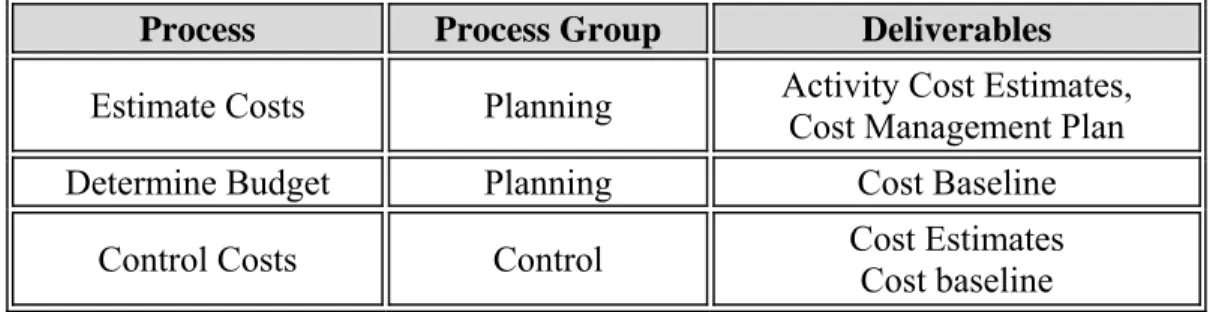
The following table describes how the Project Cost Management Processes relate to the
specific Life Cycle Process Groups:
Process
Process Group
Deliverables
Estimate Costs
Planning
Activity Cost Estimates,
Cost Management Plan
Determine Budget
Planning
Cost Baseline
Control Costs
Control
Cost Estimates
Cost baseline
Figure 5 - Project Cost Management ProcessesFigure 5 represents a Project Cost Management Processes table. The table is comprised of three
columns. Column 1 identifies each Project Cost Management process. Column 2 lists the Life
Cycle Process Group. Column 3 is a description of the deliverable that will accompany each
process.
3.5 Quality Management
The Project Quality Management knowledge area ensures that the project complies with
established quality standards so that the project is given the support it needs for successful
completion. Quality Management may include adequate training for the project team,
checklists to ensure work consistency, audits, inspections, etc.
The basic processes associated with Project Quality Management are:
1.
Plan Quality –
Involves evaluating project deliverables to determine if they comply
with the stated quality standards and identifying ways to eliminate causes of
unsatisfactory results. The responsibility of identifying and providing quality
standards rests with the PMs and team.
2.
Perform Quality Assurance
– A planned and systematic set of activities to ensure
that variances in processes are clearly identified and assessed.
3.
Perform Quality Control –
Involves evaluating project deliverables to determine if
they comply with the stated quality standards and identifying ways to eliminate
causes of unsatisfactory results that occur throughout the project.
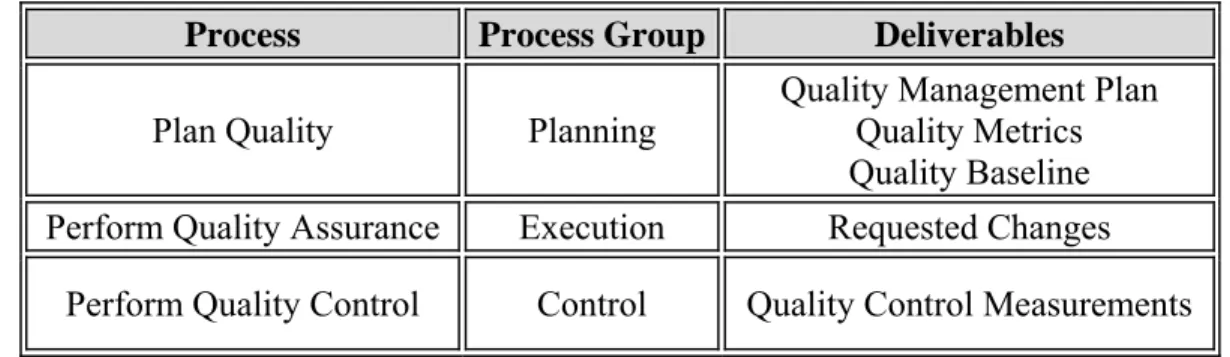
The following table describes how the Project Quality Management Processes relate to
specific Life Cycle Process Groups:
Process
Process Group
Deliverables
Plan Quality
Planning
Quality Management Plan
Quality Metrics
Quality Baseline
Perform Quality Assurance
Execution Requested
Changes
Perform Quality Control
Control
Quality Control Measurements
Figure 6 - Project Quality Management ProcessesFigure 6 represents a Project Quality Management Processes table. The table is comprised of
three columns. Column 1 identifies each Project Quality Management Process. Column 2 lists
the Life Cycle Process Group. Column 3 is a description of the deliverable that will accompany
each process.
3.6 Human Resource Management
The Project Human Resource Management knowledge area includes the processes that
organize, manage, and lead the project team (PMBOK v4). The basic processes associated
with Project Human Resource Management are:
1.
Develop Human Resource Plan –
This process normally starts with a review of
preliminary resource requirements for the project activities.
2.
Acquire Project Team –
In this process, human resource availability is confirmed
and the team necessary for completing the project assignments is assembled.
3.
Develop Project Team –
This involves continuously evaluating the team’s
performance, and making improvements as needed. This includes adding or
subtracting the appropriate personnel, identifying personal conflicts, etc.
4.
Manage Project Team –
The
process of tracking team member performance,
providing appropriate feedback, resolving problems, and ensuring proper team
cohesion.
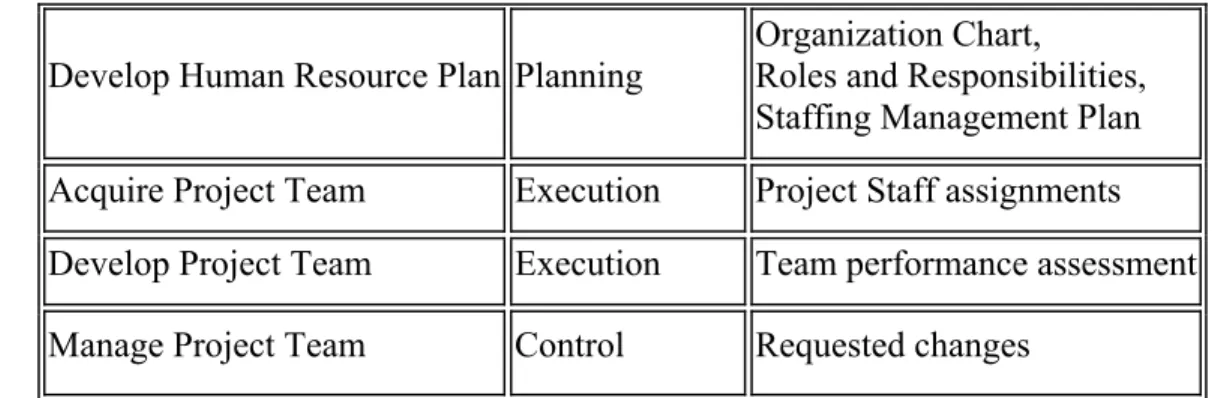
The following table describes how the Project Resource Management Processes relate to the
specific Life Cycle Process Groups and their respective deliverables:
Develop Human Resource Plan Planning
Organization Chart,
Roles and Responsibilities,
Staffing Management Plan
Acquire Project Team
Execution
Project Staff assignments
Develop Project Team
Execution
Team performance assessment
Manage Project Team
Control
Requested changes
Figure 7 - Project Resource Management Process
Figure 7 represents a Project Resource Management Process table. The table is comprised of
three columns. Column 1 identifies each Project Resource Management Process. Column 2 lists
the Life Cycle Process Group. Column 3 is a description of the Deliverable that will accompany
each process.
3.7 Communications Management
The Project Communications Management knowledge area includes the processes required
to ensure timely and appropriate generation, collection, dissemination, storage, and
ultimately, disposition of project information. Depending upon the size and complexity of
the project, communications management may be informal or highly sophisticated.
Regardless of formality, a Communications Plan should be incorporated into the overall
project plan and reviewed regularly. A communications plan would typically address the
following:
The type (description) of communication – status meetings, status reports,
presentations, memos, newsletters, meeting notes, etc.
To whom the communication will be given – senior management, team members, the
project sponsor, other stakeholders, etc.
The facilitator of the communication – the PM is the facilitator for most
communications
The frequency of the communication – daily, weekly, monthly, etc.
How the communication will be stored and what records retention requirements apply
Project Status ReportingIt is the responsibility of the IT Project Manager to ensure timely and accurate reporting.
Managers of projects of interest (any project that the CIO would like to track) must report
to the CIO on a monthly basis. Reports should clearly and concisely indicate how the
project is progressing according to the approved plan. A standardized project reporting
template should be used. A designated eRoom should be created to store historical
information.
3.7.1 Integrated Project Teams (IPT)
Integrated Project Teams (IPTs) are tasked with the day-to-day oversight of systems
under development. IPTs may be formed for a single project, for a group of projects, or
for an entire program. The primary members of an IPT are the Project Sponsor and the
PM. They select the remainder of the IPT. IPTs are structured to oversee the
development activities of systems across the entire life cycle. Their main responsibilities
include:
Review ongoing system development activities to ensure that their status,
progress, and outlook are satisfactory and consistent with project plans
Identify deficiencies in project development, develop corrective actions, and
monitor their execution
Provide recommendations to support their decision to continue, reduce, or
terminate system development activities
Conduct periodic reviews of project status, control, performance, risk, and
outlook
Establish and execute the necessary project controls to manage requirements, risk,
cost, schedule, and technical baselines, and performance outcomes
The IPT is to be chartered and staffed as early in the project initiation phase as possible.
IPTs will function in a spirit of teamwork with participants empowered and authorized, to
the maximum extent possible, to make commitments for the organization or the
functional area they represent.
An IPT Charter should:
Contain a clear mission statement, including the specific purpose and objectives
of the IPT
Provide recognition of the purpose of the IPT in a larger context
Identify the product, process, or service to be provided
Identify IPT membership, including all the cross-functional disciplines necessary
to achieve the objectives of the IPT and to produce the product, complete the process,
or provide the service
Consider any need for training of IPT members, particularly those new to the IPT
process
Address membership performance objectives that characterize high-performance
IPTs
Address product ownership and membership accountability and responsibility
Address the use of metrics as a means of creating and maintaining team focus
Provide for membership coordination and communication
Be approved by appropriate authority
Provide for its own periodic review for adequacy, currency, or rescission
A charter may:
Provide for performance feedback to cross-functional members’ supervisors
Provide recognition that team composition may change over time, while
maintaining a necessary core composition
Provide for a member recognition program that characterizes high-performance
IPTs
3.8 Risk Management
Risk Management, as it relates to IT Risk Management at USAID, is the responsibility of the
Office of the Chief Engineer. The OCIO has developed a standardized set of risk procedures
to facilitate this process. The Risk Management Plan includes:
Standard procedures to support the identification and assessment of risks
Standard procedures to support the development of mitigation/contingency plans
Standard procedures to monitor and report risk status
Measures for determining when actions are required for risk management
The Risk Management Manual (RMM) addresses the Agency need to institutionalize the risk
management process at the project, program, and enterprise levels. The RMM serves as a
directional document for program and Project Managers, as well as for task leads involved in
managing projects. It is a guiding document for how OCIO manages project and
organizational risks.
Risk management does not guarantee elimination of all risks. However, effective
management increases the likelihood of project success. The Manual was developed using
the methodologies of the Institute of Electronics and Electrical Engineers (IEEE) Std
1058-1998 for Software Project Management Plans, ANSI/PMI 99-001-2000 A Guide to the
Project Management Body of Knowledge (PMBOK Guide), and the Capability Maturity
Model Integration (CMMI) for Systems/Software Engineering.
3.9 Procurement Management
The CIO is responsible for guiding the Agency’s use of information technology (IT) and for
managing the Agency’s IT resources. It is the policy of the OCIO when acquiring IT
solutions to integrate project management, financial management, acquisition management,
and quality oversight processes into cohesive programmatic goals. Contract Management
Services (CMS) and Budget & Capital Investment Planning (BCIP) oversee the business and
information management (IM) activities for the OCIO. Some of those activities include:
Managing the acquisition process of the Agency’s IT in accordance with the Federal
Acquisition Regulations
Administering the formulation and execution of the OCIO annual appropriation
Providing financial management for the OCIO's business lines and enterprise IT
contracts