MASTER’S
STUDENT HANDBOOK
Counseling Program
2
University of North Texas at Dallas
Counseling Program
Welcome
Welcome to the Counseling Program at the University of North Texas at Dallas! Our goal is to help you become
a
multi-culturally competent counselor and a change agent who promotes wellness in children, adults, families,
schools, and communities locally and worldwide. We are committed to your success!
This document is based on the University of North Texas Master’s in Counseling Handbook. It is designed to provide you, the master’s level student, with a comprehensive overview of the Counseling Program, the UNT Dallas policies and procedures, and your rights and responsibilities. If you have questions about our Program, chances are you can find clear and thorough answers within the following pages. Please review the document carefully, keep it readily accessible, and consult it often. If you have questions after consulting the handbook, you may contact your assigned faculty advisor OR the UNT Dallas Program Coordinator of the Counseling Program, Dr. Cyndi Matthews at [email protected]/ This document serves as a supplement to the UNT Dallas Graduate Catalog, the Counseling Program Practicum Handbook, and the Counseling Program Internship Manual. It is your responsibility as student or prospective student to become familiar with the contents of the Graduate Catalog (available online at www.unt.edu/catsched) under which you will be entering graduate work and with the contents of this Master’s Student Handbook.
To confirm that you have read this handbook and have understood the responsibilities, policies, and procedures outlined herein, please sign the Agreement Contract at the end of this handbook and submit it to your COUN 5710 instructor or advisor for inclusion in your student file.
This Handbook is updated once per year and is available online, along with a number of other resources at
http://dallas.unt.edu/academics/graduate/med-counseling
and on the UNT Dallas Counseling Program webpage on
Blackboard.
Best wishes in your personal and professional pursuits!
Cyndi Matthews, PhD, LPC-S, NCC
Program Coordinator, Clinic Director, and Professor University of North Texas Dallas
3
Table of Contents
INTRODUCTION TO THE COUNSELING PROGRAM
Mission & Vision……….
6
Professional Counseling ...
7
UNTD Organizational Chart and Affiliations ...
8
Master’s Degree Tracks………..
9
Master’s-Level Non-Degree Tracks ...
10
UNTD Accreditation……… ...
11
Services of the Counseling Program ...
12
Counseling Program Faculty ...
13
Administrative Appointments ………..…...
14
BEGINNING A MASTER’S DEGREE TRACK
Provisional and Full Admission ...
15
COUN 5680 End of Course Student Evaluation ...
16
Professional Counseling Performance Evaluation ...
17
Personal Characteristics Checklist ... ………...
19
Recommended Courses for First Semester of Enrollment ...
21
Degree Tracks of Study ...
22
School Counseling ……… ...
23
Clinical Mental Health Counseling ...……….. ……… .
24
Long-Term Enrollment Planning ...
26
Recommended course sequence by track ...
27
Course Prerequisites……….. ...
28
Elective Options ...
28
Counseling Program Course Offerings by Semester – Dallas…...
29
Degree Plan Completion ...
30
Sample degree plans by track ...
31
Degree plan changes ...
35
BEGINNING A NON-DEGREE TRACK
Admission ...
36
School Counselor Certification...
38
School Counselor Certification Completion Plan ...
39
Professional Counselor Licensure Completion Plan ...
40
Licensure Professional Counselor Completion Plan ...
41
POLICIES AND PROCEDURES
UNT Dallas Student Policies ...
43
Non-Discrimination Policy Regarding Persons with Disabilities ...
43
Ethical/Legal Awareness ...
44
Diversity Awareness ...
44
4
Information and Technology...
44
Endorsement Policy ...
45
Required Counseling Experiences ...
46
Individual Counseling ...
46
Basic and Advanced Counseling Skills………. ..
47
Group Counseling ...
47
Dress and Conduct ...
48
Academic Policies ...
49
Progress to Degree ...
49
Course Sequence & Registration ...
49
Requirements for Completion of COUN 5710 ……….. ..
49
Satisfactory Progress Policy ...
50
Incompletes...
50
American Psychological Association Publication Style ...
50
Professional Journal Access ...
51
Academic Integrity & Academic Misconduct…… ...……….… ...
52
Identification of a Guiding Counseling Theory ...
53
Advisor Assignment ...
53
Grievance and Grade Appeals Process ...……….…… ...
54
Student Retention Policy ...
55
Procedures for Reviewing Student’s Professional Competency...
56
Student’s Professional Competency Report and Requirements Form ...
57
Personal Characteristics Checklist Form ...
59
Student’s Professional Competency Progress Report Form ...
61
Student Evaluation of Courses and Instruction ...
62
CLINICAL INSTRUCTION
Statement of Liability Awareness ...
63
Timeline for Clinical Coursework ...
64
Skills Required for Successful Completion of the Program ...
65
Professional Counseling Performance Evaluation (PCPE) Practicum ...
66
PCPE Internship – Community Counseling Candidate……….
68
PCPE Internship – School Counselor Candidate ……… ...
71
PERSONAL & PROFESSIONAL CONSIDERATIONS
Possible Effects on Students’ Personal Lives ………..… ..
74
Tips for Success: Academic ...
74
Tips for Success: Personal ...
75
Professional Counseling Organizations ...……… ...
76
Graduate Counseling Student Organization ...
78
COMPREHENSIVE EXAMINATION
Policies & Procedures ...……… ...
79
5
GRADUATION AND BEYOND
Applying for Graduation ...
81
Employment Opportunities for Graduates ...
81
Requirements for Licensure and Certification ...
81
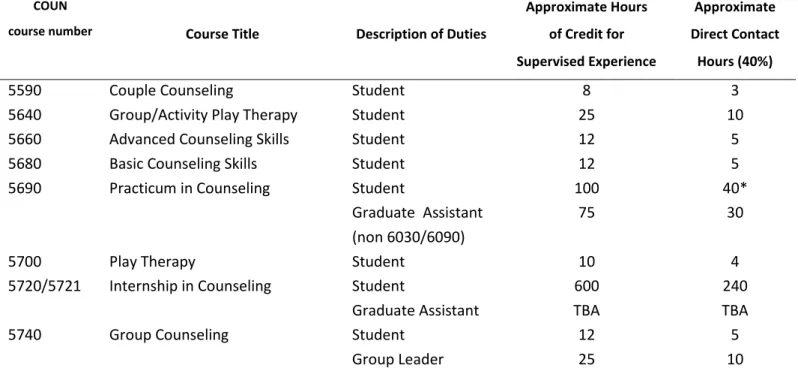
Supervised Clinical Experience Credit ...
83
Table of Credit for Supervised Experience BY Counseling Program Course ...
84
Advanced Counseling Skills Courses Taken Prior to COUN 5690 ...…………..…… ...
85
Master’s Practicum Clinical Experience Log ...
87
Public School Counselor Certification in Texas ...
89
Licensed Mental Health Professionals in Texas ...
90
Helpful Licensure and Certification Resources………. ...
92
Post Graduation Considerations ...
93
6
Introduction to the Counseling Program
Mission
The University of North Texas at Dallas (UNTD) Counseling Program promotes human development through education, research, and service that advance the profession of, and scholarship in, counseling.
Through education, the Program develops multi-culturally competent counselors with an applied social justice emphasis who benefit children, adults, families, schools, and communities locally and world wide Through research, the Program creates, applies, and disseminates innovative knowledge, especially in the
area of counseling for holistic wellness with at-risk and diverse populations.
Through service, the Program enhances the local community through consultation and counseling services and provides leadership within the counseling profession.
Vision
The UNTD Counseling Program seeks local, state, regional, national, and international prominence as a collaborative and transformative community engaged in exemplary research, education, and service that benefit the profession of
7
Professional Counseling
The Counseling Program at the University of North Texas at Dallas (UNTD) prepares counseling professionals for one or more of a variety of work settings, such as the school or university, community agency, church, private practice, or business and industry. Professional training is offered at the master’s level.
The Program exists within the larger context of the counseling profession. Counseling has been defined many ways, and most recently, delegates representing 29 professional counseling associations reached consensus on the following definition of professional counseling:
“Counseling is a professional relationship that empowers diverse individuals, families, and groups to accomplish mental health, wellness, education, and career goals” (20/20 A Vision for the Future of Counseling, 2010). The following quotes illustrate the depth and diversity of our counseling profession:
Counseling is a relatively short-term, interpersonal, theory-based (and research-based) professional activity guided by ethical and legal standards that focuses on helping persons who are basically psychologically healthy to resolve developmental and situational problems. The counseling activity itself is a process that evolves through distinct stages. Personal, social, vocational, and educational matters are all areas of concern, and therefore, the profession comprises a number of subspecialties. A practitioner must complete a required course of study on either the
master’s or doctoral level to be licensed or certified as a professional counselor. Counselors should possess personal qualities of maturity, empathy, and warmth. (Gladding, 1992, pp. 8-9)
The American Counseling Association (2012) defined counselors as follows:
o School Counselors, referred to as “guidance counselors” in the past, have a Master’s degree in counseling and help every student improve academic achievement, personal and social development, and career planning. o Licensed Professional Counselors (LPCs) are master’s-degreed mental health service providers, trained to work
with individuals, families, and groups in treating mental, behavioral, and emotional problems and disorders.
The counseling profession involves “role statements, codes of ethics, accreditation guidelines, competency standards, licensure, certification, and other standards of excellence” (VanZandt, 1990, p.243). The UNTD Counseling Program strives to uphold and advance the counseling profession. As you will learn throughout your time with UNTD’s Counseling Program, we believe a strong professional identity is key to your success.
8
UNTD Organizational Chart & Affiliations
In addition to its place in the profession of counseling, the UNTD Counseling Program exists also within the larger context of the university. The university is administered by the President. Academic programs at UNT are administered by the Provost / Vice President for Academic Affairs and are housed in three divisions. The Department of Human Services is administered by the department chair and is comprised of three academic programs. The Counseling Program is administered by the program coordinator who is also a counseling faculty member.
Academic Organizational Chart
President
Provost
Dean of Education )
Counseling Program Coordinator
-Dr. Cyndi Matthews (Graduate Level)
Human Services (Undergraduate)
Child Development and Family Studies (Undergraduate) Chair of Human Services
(Dr. Constance Lacy)
Dean of Arts & Sciences
Dean of Business
9
Master’s Degree Tracks
UNT Dallas offers two types of Master’s degrees for individuals who are seeking to become counseling professionals. •The Master of education (MEd) in Counseling is a 48 hour degree for certified teachers with two years of experience who are interested in school counseling. School counseling students can pursue a track in either Elementary School Counseling or Secondary School Counseling.
•The Master of Science (MS) in Counseling is a 60 hour degree for people with a Bachelor’s degree in any field who are interested in Clinical Mental Health Counseling. Clinical Mental Health Counseling (CMHC)students can pursue a track in either Children & Adolescents OR Adults. Students must identify which track they desire and complete a Degree Plan form by the end of their first semester of enrollment in the program. The faculty will endorse graduates only for the track(s) that the graduate has completed.
MEd in Counseling: School Counseling Tracks in Elementary or Secondary
These 48-semester-hour tracks prepare students to become school counselors in P-12 school settings. The elementary and secondary school counseling tracks differ in some course requirements to appropriately reflect differences in the functions of counselors at the two school levels. These program areas meet the educational requirement for
Certification as a School Counselor in Texas; however, candidates must also have 2 years of teaching experience as teacher of record (not as a substitute teacher) and pass the TExES-Counselor examination to be eligible for School Counseling Certification in Texas. Although the state issues only one type of counseling certificate for Pre K-12, the Counseling Program will endorse the student only for the track (elementary or secondary) that she/he completed. The Elementary and Secondary school counseling tracks are accredited by the Texas Education Agency (TEA) as school counseling programs.
With one additional course (COUN 5480 Diagnosis and Treatment), these elementary and secondary school counseling tracks currently will also meet the educational requirement for Licensure as a Professional Counselor (LPC) in Texas. However, in 2016, the Texas Department of Health is changing the LPC requirements to a 60 hour Master’s degree. Students who begin their Master’s degree prior to 2016 may be “grandfathered” in with a 48 hour Master’s degree with the additional COUN 5480 course.
MS in Counseling: Clinical Mental Health Counseling Tracks in Child or Adult
These 60-semseter-hour tracks prepare students for counseling positions in various community agencies such as mental health centers, private counseling agencies, drug abuse centers, centers for counseling the elderly, child protective services, child counseling clinics, family counseling centers, pastoral counseling settings, business and industry. The track provides the opportunity to counsel a broad range of clientele. This track meets academic specifications for Texas licensure as a Licensed Professional Counselor (LPC). Students interested in counseling children and adolescents should pursue the child track. Students interested in counseling adults, couples, and families should pursue the adult track.
10
Master’s Level Non-Degree Tracks
Individuals who already hold a master’s degree in professional counseling may pursue one of the following non-degree tracks:
School Counselor Certification
Individuals who already hold a master's degree in counseling and are certified teachers with two years of teaching experience may pursue the elementary or secondary school counseling certification deficiency track. By the time the student completes the required coursework, (s)he must also have two years of teaching experience in an accredited school and pass the TExES school counselor test to become certified as a public school counselor in Texas. Individuals seeking certification in other states are urged to contact the relevant state(s) because their requirements may differ. Although Texas issues only one type of counseling certificate for P-12, the Counseling Program will endorse a graduate only for the track (elementary or secondary) that he or she he has completed. Students pursuing this track must have a completed the School Counseling Certification Plan prior to enrollment in the first counseling (prefix COUN) course. The form is available from the professor over School Counseling.
Professional Counselor Licensure Endorsement
Individuals who already hold a master's degree in counseling but who do not meet all requirements for Licensure as a Professional Counselor in Texas may pursue the Professional Counselor Licensure Endorsement track. This track requires participants to meet the substantial equivalent of all current requirements of the Texas Department of Health. Students pursuing this track must have a completed a Licensed Professional Counselor Completion Plan prior to enrollment in the first counseling (prefix COUN) course. The plan is available from Dr. Jennifer Baggerly at
11
UNT-Dallas Accreditation
As a result of Governor Perry’s action on May 27, 2009, UNT Dallas became a stand-alone academic institution – a separate university from UNT at Denton in the overarching UNT System in 2010.
All degrees granted from UNT Dallas will be granted by an accredited university.
In 2013, UNT Dallas became separately accredited by the Southern Association of Colleges and Schools, Commission on Colleges (SACS COC).
UNT Dallas confers its own degrees.
The UNT Dallas school counseling program is accredited under the Texas Education Agency.
The Texas Department of Health does not require accreditation of a school, beyond SACS COC, to meet the educational requirements to become a Licensed Professional Counselor.
Although the UNT Denton counseling program is accredited by CACREP, the Council for the Accreditation of Counseling and Related Educational Programs, the UNT Dallas is NOT a CACREP-accredited program as yet. We are in the process of working towards CACREP accreditation.
Students should be reassured by the following information:
UNTD counseling students will still meet the educational requirements to become either a Certified School Counselor or a Licensed Professional Counselor in the state of Texas and most other states.
Only 54% of Master’s counseling programs in the United States are CACREP accredited. Thus, non-CACREP programs continue to produce viable counselors.
UNTD counseling graduates have been able to obtain employment in the school counseling and community counseling fields.
Students’ clinical skill and networking ability, rather than CACREP accreditation, are most likely the biggest determining factors in obtaining employment.
Students’ clinical experience and skill as well as motivation in obtaining goals, rather than CACREP accreditation, are most likely the biggest determining factors in being accepted into doctoral programs.
12
Services of the UNT Dallas Counseling Program
UNT Dallas Community Counseling Clinic (UNT Dallas CCC)
The UNTD CCC offers individual counseling for clients of all ages as well as couple, family, and group counseling. Low cost counseling services are provided by counselors-in-training under the supervision of counseling faculty, using state-of-the-art audiovisual technology.
Service Learning in Schools and Community Agencies
In various courses, professors may arrange for students to engage in service learning activities within local schools and community agencies. For example, past play therapy students have provided play therapy for children at Kahn Elementary School and various counseling students have provided treatment at Nexus substance abuse treatment center.
13
Counseling Program Faculty
A full time faculty member’s job typically consists of three parts: teaching, research and professional activity, and service to the university and community. A counselor educator typically enters the field as an Assistant Professor. After an established length and quality of work, the Assistant Professor is promoted to Associate. After a further length and quality of work, the Professor is promoted to Full Professor.
NAME, DEGREE, POSITION DEGREE FROM TEACHING AREAS RESEARCH INTERESTS/
SPECIALTY AREAS Jennifer Baggerly, Ph.D.
Assistant Professor University of North Texas
Play therapy, Theories, Assessment, Clinical Practice, adolescent counseling
Play therapy, trauma interventions, school counselor
effectiveness, diversity, social justice
Yu-Fen Lin, Ph.D.
Assistant Professor Sam Houston State University
Group, Multicultural, Couples, Community, Clinical Practice
Multicultural
interventions, couples counseling, counselor education, social justice Cyndi Matthews, Ph.D.
Program Coordinator, Clinic Director, Counseling Lecturer
Texas A&M University - Commerce
Practicum, Human Development, Career, Ethics, Sexuality, Crisis Management, Clinical Practice
Spirituality, social justice, multicultural interventions, diversity, couples and family counseling Trigg Even, Ph.D.
Professor of Practice School Counselor
Texas A&M University - Commerce School Counseling, Internship, Clinical Practice, Research, Statistics
School Counseling, Adolescents, Ethics, CACREP, Self-efficacy, research
Dean Aslinia, Ph.D.
Counseling Lecturer Texas A&M University - Commerce
Marriage and Family, Couples Counseling, Clinical Practice, Human Sexuality
Human Sexuality, Couples and Family, Ethics, Crisis
Counseling Adjuncts: Dr. Greg Shirley Dr. Amy McCortney
14
AY 2014 – 2015 Administrative Appointments
UNT Dallas
Chair of Human Services Dr. Constance Lacy
Program Coordinator of Counseling Program Dr. Cyndi Matthews
School Counseling Coordinator Dr. Trigg Even
Internship Coordinator Dr. Yu-Fen Lin
Clinic Director, Practicum Coordinator Dr. Cyndi Matthews
15
BEGINNING A MASTER’S DEGREE
PROVISIONAL AND FULL ADMISSION
The Master’s Degree in Counseling is for students who do not yet have a Master’s Degree or who are seeking a second master’s.
Applicants seeking admission to the Counseling Program should be aware that Texas State Boards for certification and licensure, as well as credentialing boards of other states and professional organizations, run criminal history checks on all applicants for licensure or certification. In Texas, certification is required to counsel in the public school; licensure is required to counsel outside the public school or religious setting. The applicant with a criminal background who seeks professional credentials should contact the appropriate Board prior to enrollment in the program to determine eligibility for certification and/or licensure.
Admission to the Counseling Program is provisional until the following conditions are met:
1. The student has a signed “Understanding and Acknowledgement” form on file in the Counseling Program office by the end of the first semester of enrollment in the Counseling Program.
2. The student’s signed degree plan is on file in the Counseling Program office by the end of the first semester of enrollment in the Counseling Program.
NOTE: For items 1 & 2 above, it is the student’s responsibility to ensure that the required documents are on file by the deadline. Failure to the meet this requirement can result in the student being dropped from further Counseling Program coursework.
3. The student’s progress is evaluated by the counseling instructor and faculty upon the student’s
completion of COUN 5680. If the instructor does not request a conference with the student, the student may request a conference with the instructor regarding the evaluation. The two primary evaluation forms appear on the following pages. Forms pertaining to the ongoing assessment of student competency appear later in the Handbook in the Policies and Procedures section under Student Retention.
For the initial evaluation, the student’s progress is evaluated on the basis of the demonstration of adequate subject matter knowledge and the personal characteristics and interpersonal skills required for counseling. After the progress review, the counseling faculty either recommends that the student continue or reserves the right to withdraw the student from the program. Following this initial evaluation the student will be routinely evaluated throughout the program on the criteria of knowledge, personal characteristics, interpersonal skills, and counseling skills to determine if progress is adequate, if remedial work is needed, or if the student should discontinue the program.
16
COUNSELING PROGRAM
UNIVERSITY OF NORTH TEXAS AT DALLAS
COUN 5680 End of Course Student Evaluation
Student’s Name: ID#
Semester:
Fall Spring Summer I Summer II (Year: )
Student DID complete the course with credit and grade .
DID NOT complete the course: I WP WF
A student not completing the course is still subject to the following instructor evaluations:
I have no major reservations about this student at this point. I see no reason why the student should not continue in the Counseling Program.
I have some reservations about this student. My reservations are indicated on the Competency Report and Requirements Form and the Personality Characteristics Checklist (attached).
I have major reservations about this student. My reservations are indicated on the Competency Report and Requirements Form and the Personality Characteristics Checklist (attached).
Instructor Signature: Date:
ADDITIONAL COMMENTS:
c:\My Documents\Masters\Handbook 2002 fall.wpd Revised 7/5/02
17
Professional Counseling Performance Evaluation
Student: Semester/Year:
Faculty: Course Number:
Rating Scale
N - Not required and/or No opportunity to observe
0 - Does not meet criteria expected for student’s level of preparation and experience
1 - Minimally or inconsistently meets criteria expected for student’s level of preparation and experience 2 - Consistently meets criteria expected for student’s level of preparation and experience
3 - Exceeds criteria expected for student’s level of preparation and experience
Counseling Skills and Abilities
1. The student demonstrates the ability to establish relationships in such a manner that a therapeutic working alliance can be created
N 0 1 2 3 2. The student demonstrates therapeutic communication skills including:
a. Creating appropriate structure - setting the boundaries of the helping frame and maintaining boundaries throughout the work such as setting parameters for meeting time and place, maintaining the time limits etc.
N 0 1 2 3
b. Understanding content – understanding the primary elements of the client's story N 0 1 2 3 c. Understanding context – understanding the uniqueness of the story elements and their underlying
meanings
N 0 1 2 3 d. Responding to feelings - identifying client affect and addressing those feelings in a therapeutic manner N 0 1 2 3 e. Congruence - genuineness; external behavior consistent with internal affect N 0 1 2 3 f. Establishing and communicating empathy - taking the perspective of the client without over identifying and
communicating this experience to the client
N 0 1 2 3 g. Non-verbal communication - demonstrates effective use of head, eyes, hands, feet, posture voice attire etc. N 0 1 2 3
h. Immediacy - staying in the here and now N 0 1 2 3
i. Timing - responding at the optimal moment N 0 1 2 3
j. Intentionality - responding with a clear understanding of the therapist's therapeutic intention N 0 1 2 3 k. Self-disclosure - skillful and carefully-considered for a specific therapeutic purpose N 0 1 2 3 3. The student demonstrates awareness of power differences in the therapeutic relationship and manages these
differences therapeutically
N 0 1 2 3 4. The student collaborates with the client to establish clear therapeutic goals N 0 1 2 3
5. The student facilitates movement toward client goals N 0 1 2 3
6. The student demonstrates the capacity to match appropriate interventions to the presenting clinical profile in a theoretically consistent manner
N 0 1 2 3
7. The student creates a safe clinical environment N 0 1 2 3
8. The student demonstrates analysis and resolution of ethical dilemmas N 0 1 2 3
Professional Responsibility
1. The student conducts self in an ethical manner so as to promote confidence in the counseling profession N 0 1 2 3 2. The student relates to peers, professors, and others in a manner consistent with stated professional standards N 0 1 2 3 3. The student demonstrates sensitivity to real and ascribed differences in power between themselves and others,
and does not exploit or mislead other people during or after professional relationships
N 0 1 2 3 4. The student demonstrates application of legal requirements relevant to counseling training and practice N 0 1 2 3
Competence
1. The student recognizes the boundaries of her/his particular competencies and the limitations of her/his expertise N 0 1 2 3 2. The student takes responsibility for compensating for her/his deficiencies N 0 1 2 3 3. The student takes responsibility for assuring client welfare when encountering the boundaries of her/his expertise N 0 1 2 3 4. The student provides only those services and applies only those techniques for which she/he is qualified by
education, training and experience
N 0 1 2 3 5. The student demonstrates basic cognitive, affective, sensory, and motor capacities to respond therapeutically to
clients
18
Professional Counseling Performance Evaluation (cont)
Student: Semester/Year:
Faculty: Course Number:
Maturity
1. The student demonstrates appropriate self-control (such as anger control, impulse control) in interpersonal relationships with faculty, peers, and clients
N 0 1 2 3 2. The student demonstrates honesty, fairness, and respect for others N 0 1 2 3 3. The student demonstrates an awareness of his/her own belief systems, values, needs and limitations and the
effect of these on his/her work
N 0 1 2 3 4. The student demonstrates the ability to receive, integrate and utilize feedback from peers, teachers and
supervisors
N 0 1 2 3 5. The student exhibits appropriate levels of self-assurance, confidence, and trust in own ability N 0 1 2 3 6. The student follows professionally recognized conflict resolution processes, seeking to informally address the issue
first with the individuals with whom the conflict exists
N 0 1 2 3
Integrity
1. The student refrains from making statements which are false, misleading or deceptive N 0 1 2 3 2. The student avoids improper and potentially harmful dual relationships N 0 1 2 3 3. The student respects the fundamental rights, dignity and worth of all people N 0 1 2 3 4. The student respects the rights of individuals to privacy, confidentiality, and choices regarding self- determination
and autonomy
N 0 1 2 3 5. The student respects cultural, individual, and role differences, including those due to age, gender, race, ethnicity,
national origin, religion, sexual orientation, disability, language, and socioeconomic status.
N 0 1 2 3
Comments:
Created by the Southwest Texas State University Counseling Program Faculty. Adapted by UNT Dallas Counseling Program.
19
Counseling Program
University of North Texas at Dallas
Personal Characteristics Checklist
Student Name: _______________________________
Student ID: _______________________
Instructor Name:_______________________________ Date:____________
Problematic Behavior Demonstrated (1) Target Behavior Not Yet Demonstrated (2) Target Behavior Demonstrated but not Consistent (3) Target Behavior Consistently Demonstrated (4)
Rating and Comments
1. Disregards others’ feelings and perspectives either verbally or nonverbally
Empathic and understanding in both verbal and nonverbal behavior
2. Insincere, duplicitous, or condescending either verbally or nonverbally
Genuine in both verbal and nonverbal behavior
3. Overly critical, judgmental, or pushes own values either verbally or nonverbally
Accepting of others and others’ values in both verbal and nonverbal behavior
4. Rude or unpleasant expression of feelings and ideas
Respectfully expresses feelings and ideas in meaningful ways 5. Defensive or
unyielding to others
Willing to consider others’ feedback with open mindedness 6. Intolerant of ambiguity
or overly anxious in uncertain situations
Tolerates ambiguity both verbally and nonverbally. 7. Demanding or
impatient verbal and non-verbal behavior
Exhibits a high degree of patience
8. Emotional
deregulation, easily threatened, overly anxious or angry, or consistently flat affect
Demonstrates emotional stability, personal security, strength, and confidence
9. Inability to maintain appropriate eye contract and appropriate facial expressions
Demonstrates
appropriate eye contact and appropriate facial expressions
10. Inability to maintain appropriate voice tone, volume, and rate
Demonstrates
appropriate voice tone, volume, and rate 11. Inability to maintain
open posture and minimal fidgeting
Demonstrates open posture and minimal fidgeting
12. Dress is unprofessional for the setting and grooming is unkempt
Demonstrates
professional dress and grooming for the setting
20
13. Demonstrates
denigration or potential harm to self or
unwillingness to understand own experiences, feelings, and thoughts Demonstrate self-acceptance and self-understanding
14. Unwillingness to communicate personal and professional limitations and does not refer clients as appropriate
Clearly communicates personal and
professional limitations and refers clients as appropriate
15. Unwillingness to initiate
problem-solving through logic and intelligent inquiry
Demonstrates problem solving through the use of logic and intelligent inquiry
16. Demonstrates
disrespectful verbal or nonverbal behavior or indifference toward people due to their race, ethnicity,
religion, gender, sexual orientation, disability, country of origin, or veteran status
Demonstrates respectful verbal and nonverbal behavior and concern for all people regardless of their race, ethnicity, religion, gender, sexual orientation, disability, country of origin, or veteran status 17. Dishonest or deceptive
behavior and communication with unwillingness to accept personal responsibility
Honest behavior and communication with willingness to accept personal responsibility 18. Neglects or
intentionally fails to follow professional ethics of the American Counseling
Association.
Follows professional ethics of the American Counseling Association
19. Unclear or irrational verbal or written communication/numer ous grammatical errors
Clear and rational verbal and written
communication with proper grammar 20. Unhealthy or illegal
behavior including alcohol abuse or substance abuse or criminal activity while enrolled in program.
Healthy and legal behavior with no incidents of alcohol or substance abuse or criminal activity while enrolled in program.
Scoring: If a counseling applicant scores a “1” in any of the 20 items, then they will not be admitted to the program. If a student scores a “1” in any of the 20 items at any time, then a remediation plan meeting must be developed and documented with the student. Prior to practicum, a student must score a “3” or “4” in all areas.
21
RECOMMENDED COURSES FOR FIRST SEMESTER OF ENROLLMENT
Counseling Program applicants receive word of their admission status typically within three weeks of the Orientation and Interviews. Those provisionally admitted into the Counseling Program register during regular registration. In subsequent semesters, continuing students will have the opportunity to register during early registration. Consult the relevant online version of the Schedule of Classes for specific registration information and instructions. For the most current schedule of classes go to http://dallas.unt.edu/registrar The Program Coordinator, Dr. Cyndi Matthews, serves as interim advisor for new students until a permanent advisor is assigned.Students provisionally admitted have a guaranteed seat in COUN 5710 and 5680. Part time students take these two classes the first semester. Full time students take an additional third class, as determined by the Program Coordinator, Dr. Matthews.
In COUN 5710 each student is assigned an advisor, develops a degree plan, and receives information about the
Counseling Program and counseling profession. Students transferring credit to substitute for COUN 5710 must contact the Chair of the as soon as they receive notice of provisional admission. The Program Coordinator or a designated Professor will assist the student in the development of a degree plan and in meeting program requirements completed by other students during COUN 5710.
For long-term enrollment planning, please refer to the chart(s) entitled “Recommended Course Sequence by Track in Counseling Program” and/or “Counseling Program Course Offerings by Semester”.
22
DEGREE TRACKS OF STUDY
School Counseling: Elementary or Secondary
The School Counseling tracks are designed to prepare persons for work in private and public school settings to promote the academic, career, and personal/social development of pre-Kindergarten-12th grade students. The philosophical orientation toward school counseling is founded upon the belief in democratic values, the worth and dignity of each individual, personal uniqueness and value, and the freedom of the individual to be self-determined within a context of responsibility to others. Primary and secondary education is enhanced through the delivery of a school-based
comprehensive developmental guidance program designed to address the developmental, environmental, social, multicultural, academic and career needs of children and adolescents. Professional school counselors who respond to the individual and group needs of students through an intentionally designed school counseling program provide children and adolescents with attitudes and skills necessary for problem-solving, future planning, and relational living. Objectives: School counseling candidates must demonstrate knowledge and skills in all Student Learning Outcomes identified with the CACREP standards for school counseling program areas. In particular, the UNTD Counseling Program faculty is committed to ensuring that school counseling candidates are able to:
1. Demonstrate mastery of core counseling knowledge necessary for school counselor certification in Texas. 2. Through a process of personal and professional reflection, identify a guiding theory of counseling that will serve
as a foundation for practicing one’s theory within a school setting.
3. Utilize individual and small group interventions to counsel children and adolescents from diverse backgrounds for a variety of presenting problems and developmental issues.
4. Develop and maintain effective, culturally responsive counseling relationships with students, faculty and staff. 5. Recognize one’s strengths and limitations through participation in counseling supervision and professional
development activities.
6. Develop, implement, manage, and evaluate comprehensive, developmental school counseling programs that are responsive to the needs of diverse individuals, groups, and classrooms through counseling, coordination,
consultation, large group guidance and program management.
7. Develop school counseling practices that promote student academic success and increase post-secondary planning, activities and efforts.
8. Demonstrate leadership abilities that highlight the professional school counselor as a system change agent to enhance the learning environment.
9. Develop assessment, evaluation, and referral strategies designed to identify and respond to students experiencing crisis, addiction, abuse, trauma, mental health problems, or educational problems.
10. Perform administrative and professional responsibilities while adhering to ethical guidelines necessary for success as a professional school counselor.
For greater detail regarding program expectations, see criteria listed on the PCPE Internship–SC Candidate located later in this Handbook.
23
School Counseling Track Design
48 hour MEd in Counseling
Elementary
Common Core Track-Specific
COUN 5710 Counseling Theories COUN 5680 Basic Counseling Skills
COUN 5100 Professional Orientation and Ethical Practice EPSY 5050 Educational Research & Evaluation
COUN 5670 Dev Processes and Strategies COUN 5765 Appraisal in Counseling COUN 5470 Career Development
COUN 5790 Counseling Culturally Diverse Clients COUN 5660 Advanced Counseling Skills
COUN 5740 Group Counseling COUN 5690 Practicum in Counseling COUN 5720 Internship in Counseling I COUN 5721 Internship in Counseling II
COUN 5461 Professional School Counseling COUN 5700 Introduction to Play Therapy COUN 5640 Group Play Therapy
Secondary
Common Core Track-Specific
COUN 5710 Counseling Theories COUN 5680 Basic Counseling Skills
COUN 5100 Professional Orientation and Ethical Practice EPSY 5050 Educational Research & Evaluation
COUN 5670 Dev Processes and Strategies COUN 5765 Appraisal in Counseling COUN 5470 Career Development
COUN 5790 Counseling Culturally Diverse Clients COUN 5660 Advanced Counseling Skills
COUN 5740 Group Counseling COUN 5690 Practicum in Counseling COUN 5720 Internship in Counseling I COUN 5721 Internship in Counseling II
COUN 5461 Professional School Counseling COUN 5200 Counseling Adolescents
Elective (select one)
COUN 5610 Drug & Addiction Counseling COUN 5580 Family Counseling
COUN 5500 Human Sexuality
Texas Licensure (LPC) Alert
If you anticipate pursuing the Texas LPC, you must enroll in COUN 5480 Diagnosis and Treatment prior to graduation. Texas School Counselor Certification Alert
Two years teaching experience as teacher of record (not as a substitute) and passing grade on TExES Counselor are required for certification. Students are eligible to take the TExES examination after successfully completing COUN 5461 Professional School Counseling and beginning COUN 5690 Practicum in Counseling.
24
Clinical Mental Health Counseling: Adult or Child
The Clinical Mental Health Counseling (CMHC) tracks are designed to prepare persons for work in private and public agencies where the primary focus is on the mental health concerns of their clients. The philosophical orientation is founded upon the belief in democratic values, the worth and dignity of each individual, personal uniqueness and value, and the freedom of the individual to be self-determined within a context of responsibility to others. Individuals live in a social world. Within the context of that world, all individuals attempt to find their place, be involved, feel worthwhile, be useful, and enhance self-esteem. This striving is manifest in the attempt of individuals to solve the basic problems of living, occupation, relationships, and community living. Stress and crisis are frequently experienced in attempting to solve these problems.
Objectives: CMHC candidates must demonstrate knowledge and skill in all Student Learning Outcomes identified within the CACREP standards for clinical mental health counseling program areas. In particular, the UNTD Counseling Program faculty is committed to ensuring that CMHC candidates are able to:
1. Demonstrate mastery of core counseling knowledge necessary for licensure in Texas and throughout the United States.
2. Through a process of personal and professional reflection, identify a guiding theory of counseling that will serve as a foundation for counseling in mental health settings.
3. Develop and maintain effective, culturally responsive counseling relationships across the lifespan.
4. Recognize one’s strengths and limitations through participation in counseling supervision and professional development.
5. Develop, manage, and evaluate mental health services and programs responsive to the needs of vulnerable populations.
6. Provide community counseling and social justice advocacy services for clients at risk due to crisis, disaster, trauma, addiction, and/or co-occurring mental disorders.
7. Perform administrative and professional responsibilities necessary for success as a professional counselor. For greater detail regarding program expectations, see criteria listed on the PCPE Internship– Clinical Mental Health Counseling Candidate located later in this Handbook.
25
Clinical Mental Health Counseling Track Design
60 hour MS in Counseling
Child
Common Core Track-Specific
COUN 5710 Counseling Theories COUN 5680 Basic Counseling Skills
COUN 5100 Professional Orientation & Ethical Practice EPSY 5050 Educational Research & Evaluation
COUN 5670 Dev Processes and Strategies COUN 5765 Appraisal in Counseling COUN 5470 Career Development
COUN 5790 Counseling Culturally Diverse Clients COUN 5660 Advanced Counseling Skills
COUN 5740 Group Counseling COUN 5690 Practicum in Counseling COUN 5720 Internship in Counseling I COUN 5721 Internship in Counseling II
COUN 5300D Systems, Leadership, Program CMHC COUN 5480D Diagnosis and Treatment
COUN 5610 Drug & Addiction Counseling COUN 5490 Crisis Intervention Counseling COUN 5500 Human Sexuality in Counseling COUN 5700D Introduction to Play Therapy Electives (select 1)
COUN 5200D Counseling Adolescents COUN 5640D Group Play Therapy
Other electives as offered (please meet with your advisor)
Adult
Common Core Track-Specific
COUN 5710 Counseling Theories COUN 5680 Basic Counseling Skills
COUN 5100 Professional Orientation & Ethical Practice EPSY 5050 Educational Research & Evaluation
COUN 5670 Dev Processes and Strategies COUN 5765 Appraisal in Counseling COUN 5470 Career Development
COUN 5790 Counseling Culturally Diverse Clients COUN 5660 Advanced Counseling Skills
COUN 5740 Group Counseling COUN 5690 Practicum in Counseling COUN 5720 Internship in Counseling I COUN 5721 Internship in Counseling II
COUN 5300D Systems, Leadership, Program CMHC COUN 5480D Diagnosis and Treatment
COUN 5610 Drug & Addiction Counseling COUN 5490 Crisis Intervention Counseling COUN 5500 Human Sexuality in Counseling Electives (select 2)
COUN 5200D Counseling Adolescents COUN 5580D Family Counseling COUN 5590D Couples Counseling
COUN 5900D Advanced Couples Counseling Other electives as offered (please meet with your advisor)
Texas Licensure (LPC)
26
Long-Term Enrollment Planning
The following listing of courses constitutes the required course sequence for some Counseling Program courses and the recommended course sequence for others. The student should keep in mind the following rules/guidelines:
Because of sequences described in the following pages, the Counseling Program requires a minimum of six semesters of enrollment.
At times, limited course availability may call for some adjustments to the recommended sequence. In any case, the student is responsible for knowing and meeting all course prerequisites as printed in the Graduate Catalog and
Counseling Program Handbook. Failure to meet prerequisites may result in the student being administratively dropped from the course.
The Counseling Program faculty defines satisfactory progress as completing all COUN-prefix courses with a grade of B or higher. In Didactic courses (lecture type course), students have unlimited attempts to earn a grade of B or higher. In the clinical course sequence (beginning, advanced, practicum, internship), each course must be completed with a grade of B or higher before enrollment in the next course. If a student takes any clinical course twice without achieving a grade of B or higher, continuation in the Counseling Program is by successful grade appeal only.
Students pursuing the elementary school counseling or community-child tracks must take COUN 5700 Introduction to Play Therapy prior to COUN 5690 Practicum. In addition, COUN 5690 Practicum students wishing to see specific client populations (e.g., couples, parents, families, etc.) should take the related course (e.g., COUN 5590 Couple Counseling, COUN 5580 Family Counseling, etc.) prior to COUN 5690 Practicum. Students may take COUN 5740 Group or specialty track courses (COUN 5300, 5770, 5600, 5750) concurrently with COUN 5690 Practicum.
Assuming the internship does not require the elective, a MEd student may not take more than one elective along with COUN 5720 Internship I.
COUN 5720 and 5721 must be taken in subsequent semesters. Only in the most extenuating of circumstances may a student appeal to take them concurrently. To appeal, the student must submit a justification along with supporting documentation regarding clinical readiness (e.g., statements from advisor, practicum instructor, internship instructor, and site supervisor) to the Clinical Experiences Committee by midterm the semester prior to the desired internship. In no cases will students be allowed to take COUN 5720 and 5721 concurrently in summer.
Course offerings vary by semester. To assist students in long-term planning, the Counseling Program Course Offerings by Semester appears among the following pages.
27
RECOMMENDED COURSE SEQUENCE BY TRACK IN COUNSELING PROGRAM
Any Order Within #
Course
School
(48) Community (60)
Required
Progra
m # Title Elem* Sec* Child Adult
1st sem COUN 5710 Counseling Theories X X X X
1st sem COUN 5680 Basic Counseling Skills X X X X
#2 COUN 5100
Counseling Professional Orientation and
Ethical Practice x X x X
#2 EPSY 5050 Educational Research & Evaluation X X X X
#2 COUN 5670
Dev Processes and Strategies (prereq to
5765) X X X X
#2 COUN 5470
Career Development and Information
Resources X X X X
#2 COUN 5790 Counseling Culturally Diverse Clients X X X X
#2 COUN 5461 Professional School Counseling X X
#3 COUN 5480 Diagnosis and Treatment Rec Rec X X
#3 COUN 5765 Appraisal in Counseling X X X X
#3 COUN 5200 Counseling Adolescents X Elective
#3 COUN 5700 Introduction to Play Therapy X X
#4 COUN 5640 Group Play Therapy X Elective
#4 COUN 5590 Couples Counseling Elective
#4 COUN 5580 Family Counseling Elective Elective
#4 COUN 5610 Drug & Addiction Counseling Elective x x
#4 COUN 5490 Crisis Intervention Counseling x X
#4 COUN 5500 Human Sexuality in Counseling x X
#4 COUN 5300
Systems, Leadership, Program Dev in
CMHC x X
Sem. Before 5690 COUN 5660
Advanced Counseling Skills (prereq. to
5740) X X X X
Before or with 5690 COUN 5740
Group Counseling Theories and
Procedures X X X X
Sem. Before 5720 COUN 5690 Practicum in Counseling X X X X
Sem. Before 5721 COUN 5720 Internship in Counseling I X X X X
Last sem. COUN 5721 Internship in Counseling II X X X X
During internship
CPCE Comprehensive exam for all
students X X x x
During internship
TExES exam for all school counseling
28
Course Prerequisites
In accordance with the UNTD Graduate Catalog,
ALL Counseling courses have COUN 5680 and
COUN 5710
as prerequisites. Additional prerequisites for particular courses are as follows:Course Prerequisites
5765 Appraisal in Counseling COUN 5100, COUN 5670, EPSY 5050 (5480 preferred) 5660 Advanced Counseling Skills COUN 5710, 5680, and 12 additional COUN hours 5740 Group Counseling Theories and Procedures COUN 5660
5690 Practicum in Counseling Application; COUN 5680, 5710, 5470, 5670, 5790, 5480 (if applies), 5730/5760, 5660; EPSY 5050; COUN 5290/5460/5750; COUN 5700/5200 (if applies); necessary electives.
5720 Internship in Counseling I Application; all remaining degree plan work except final elective (MEd students) or two final electives (MS students)
5721 Internship in Counseling II Application; all remaining degree plan work (MEd students) or all but final elective (MS students)
5700 Introduction to Play Therapy COUN 5670
5640 Group Play Therapy COUN 5670, 5700, 5740
Prerequisites & Full-Time Enrollment
Students who wish to maintain half- or full-time enrollment throughout the program must schedule carefully in order to meet prerequisites while distributing coursework.
Courses that may be taken with COUN 5690 Practicum include COUN 5740
Second track-specific course (e.g., COUN 5300, 5770, 5600, or 5780) COUN 5610 or 5490
Electives not essential for practicum
Courses that may be taken with COUN 5720 Internship I include Final elective if not essential for internship (MEd students) COUN 5610 or 5490 (CMHC-Child students)
Elective (MS students)
Courses that may be taken with COUN 5721 Internship II include Final elective if not essential for internship
29
Counseling Course Offerings by Semester
COUN Title Fall Spr Sum
COMMON CORE
5680 Basic Counseling Skills X X
5710 Counseling Theories X X
5100 Counseling Professional Orientation & Ethical Practice x x
5050 Educational Research X 10W
5470 Career Development and Info Resources X 10W
5670 Developmental Processes and Strategies X X X
5790 Counseling Culturally Diverse Clients X 10W
5765 Appraisal in Counseling X X 10W
5660 Advanced Counseling Skills X X 10W
5740 Group Counseling Theories and Procedures X 10W
5690 Practicum in Counseling X X 10W
5720 Internship in Counseling I X X 10W
5721 Internship in Counseling II X X 10W
TRACK-SPECIFIC
5461 Professional School Counseling X
5480 Diagnosis and Treatment X X
5300 Systems, Leadership, Program CMHC X
5610 Drug and Addiction Counseling 5W1
5490 Crisis Intervention Counseling X(2016) 10W (2016)
5500 Human Sexuality in Counseling X (2015) X (2017) 10W (2016)
ELECTIVES/APPLIED
5700 Introduction to Play Therapy X
5640 Group Play/Activity Therapy X
5200 Counseling Adolescents X
5580 Family Counseling X
5590 Couple Counseling X
30
Degree Plan Completion
Admission for students seeking the master’s degree is provisional until the student’s signed degree plan is on file in the Counseling Program office by the end of the first semester of enrollment in the Counseling Program and COUN 5710 and COUN 5680 are completed satisfactorily. (See “Beginning a Master’s Degree Track” for additional requirements.) Students complete and submit their degree plans in COUN 5710. Students transferring course work in lieu of COUN 5710 must contact the Chair of the department prior to the first semester of enrollment to complete a degree plan and other requirements. Degree plans must be approved by the student’s assigned advisor and Counseling Program coordinator to be complete. It is the student’s
responsibility to ensure that the signed degree plan is complete, signed, and on file in the Graduate School by the deadline. Failure to meet this requirement will result in being dropped from further Counseling Program coursework.
1. Degree plans are only for students seeking MEd or MS degrees. Students in non-degree tracks complete the course plan relevant to their track (see BEGINNING A NON-DEGREE TRACK section).
2. In COUN 5710, the instructor will assist the student in identifying the track the student wishes to pursue. 3. The instructor will make advisor assignments early in the semester.
4. At the direction of the COUN 5710 instructor and using information from this Handbook, the student will complete a degree plan. The instructor may or may not require the student to contact his/her advisor during the process of degree plan completion.
5. Submit a typed final copy of the degree plan to the COUN 5710 instructor by the date announced by the instructor. If the degree plan is not completed, the student will receive a grade of “I” in COUN 5710. 6. Students are to complete the degree plan according to the following guidelines:
a. Download a template of the degree plan for your designated track from the Counseling Program Resources webpage.
b. The student’s advisor is the Major Professor; list his or her name in the form of “Dr. Jane Doe.”
c. Course titles too long to fit on the line may be abbreviated in any meaningful way. List courses in the order they appear on the sample. Additional coursework beyond the minimum requirements is not to be listed on the degree plan.
d. Leave the “Date” and “Grade” columns blank.
e. Students have seven (7) years to complete a MEd and MS. The clock starts with the semester of the earliest course listed on the degree plan, whether that course was completed at UNT or transferred from another institution. List the “Date of first master’s course” as a semester and year (e.g., Fall 2011). Add the appropriate number of years, and list that semester and year on the “Date (Semester/Year) by which degree must be completed” line (e.g., Fall 2018).
f. If deficiencies are indicated on the GAB (Graduate Application Blank) and/or a letter from the graduate school, check with the counseling advisor. Unless the student is in the school certification track, the deficiencies can usually be waived.
g. The Graduate School allows for the transfer of up to 12 semester hours to be applied to the UNT master’s degree. These graduate level courses may be from another school or from another master’s degree. However, the time limit of 7 years to complete the degree begins with the earliest course listed on the degree plan. Transferring a course you took five years ago leaves you only two years to complete the program! Transfer credit must be approved by your advisor.
7. The degree plan is a legal agreement with UNT for fulfilling requirements to receive a degree. Take the time to make an accurate and complete degree plan. If you have questions about this degree plan process, please confer with your COUN 5710 instructor or your advisor.
31
Sample
Schedules are as follows:
Fall 2015 Start Part Time 48 hour School Counseling (2 Classes a Semester)
Fall
2015
Spring
2016
Sum
2016
Fall 2016 Spring
2017
Sum
2017
Fall 2017 Spring
2018
COUN 5680Basic Counseling Skills
EPSY 5050 Ed Research COUN 5760 Appraisal in Counseling COUN 5100 Counseling Professional Orientation and Ethical Practice COUN 5660 Advanced Counseling COUN 5690 Practicum COUN 5720 Internship COUN 5721 Internship COUN 5710 Counseling Theories COUN 5670 Development Processes COUN 5790 Diversity COUN 5200 Counseling Adolescents Or COUN 5700
Intro to PT
COUN 5470 Career COUN 5740 Group Counseling COUN 5461 Professional School Counseling COUN 5580 Family Counseling Or COUN 5640 Group PT
Pink for Elementary; Blue for Secondary
Fall 2015 Part Time (2 Classes a Semester): 60 hour Clinical Mental Health
Fall
2015
Spring
2016
Sum
2016
Fall
2016
Spring
2017
Sum
2017
Fall
2017
Spring
2018
Sum
2018
Fall
2018
COUN 5680 Basic Counseling Skills EPSY 5050 Ed Research COUN 5470 Career COUN 5480 DX & TXCOUN 5765 Appraisal in Counseling COUN 5610 Drug and Addiction COUN 5740 Group Counseling COUN 5690 Practicum COUN 5720 Internship COUN 5721 Internship COUN 5710 Counseling Theories COUN 5100 Counseling Profession-al Orientation & Ethical Practice COUN 5790 Diversity COUN 5670 Developme ntal Process COUN 5200 Counseling Adolescent s Or COUN 5700
Intro to PT Or Couples Counseling COUN 5490 Crisis Interven- tion for Counseling COUN 5660 Advanced Counseling COUN 5580 Family Counseling Or COUN 5640 Group PT COUN 5500 Human Sexuality in Counsel- ing COUN 5300 Counsel- ing in Commun- ity
32
Fall 2015 Full Time (3 Classes a Semester): 60 hour Clinical Mental Health
Fall 2015
Spring
2016
Summer
2016
Fall 2016
Spring
2017
Summer
2017
Fall 2017
COUN 5680 Basic Counseling Skills COUN 5790 Diversity COUN 5610 Drug and Addiction Counseling for Counselors COUN 5740 Group Counseling COUN 5470 Career COUN 5500 Human Sexuality in Counseling COUN 5720 Internship COUN 5710 Counseling Theories COUN 5100 Counseling Professional Orientation and Ethical Practice COUN 5765 Appraisal in Counseling COUN 5200 Counseling Adolescents Or COUN 5700Intro to PT
Or Couples Counseling COUN 5690 Practicum COUN 5490 Crisis Intervention for Counseling COUN 5300 Counseling in Community COUN 5670 Development Processes COUN 5480 DX & TX (DSM)
EPSY 5050 Ed Research COUN 5660 Advanced Counseling COUN 5580 Family Counseling Or COUN 5640 Group PT COUN 5720 Internship
33
Spring 2016 Start Part Time 48 hour School Counseling (2 Classes a Semester)
Spring
2016
Summer
2016
Fall 2016
Spring
2017
Summer
2017
Fall 2017
Spring
2018
COUN 5680 Basic Counseling Skills COUN 5670 Development Processes COUN 5100 Professional Orientation and Ethics COUN 5660 Advanced Counseling COUN 5690 Practicum COUN 5720 Internship COUN 5721 Internship COUN 5710 Counseling Theories COUN 5470 Career COUN 5200 Counseling Adolescents Or COUN 5700Intro to PT
COUN 5765 Appraisal in Counseling COUN 5740 Group Counseling COUN 5461 Professional School Counseling COUN 5580 Family Counseling Or COUN 5640 Group PT EPSY 5050 Ed
Research
COUN 5790 Diversity
Pink for Elementary;
Blue for Secondary
Spring 2016 Part Time (2 Classes a Semester): 60 hour Clinical Mental Health
Spring
2016
Summer
2016
Fall
2016
Spring
2017
Sum
2017
Fall
2017
Spring
2018
Sum
2018
Fall 2018
Spring
2019
COUN 5680 Basic Counseli ng Skills EPSY 5050 Ed Research COUN 5100 Professio nal Orientati on and Ethical Practice COUN 5765 Apprai sal in Couns eling COUN 5610 Drug and Addiction Counselin g COUN 5490 Crisis Intervent ion for Counseli ng COUN 5580 Family Counselin g Or COUN 5640 Group PT COUN 5690 Practicu m COUN 5720 Internship I COUN 5721 Internship II COUN 5710 Counsel-ing Theories COUN 5670 Developmen tal Processes COUN 5480 DX & TXCOUN 5790 Diversi ty COUN 5470 Career COUN 5200 Counseln g Adolscen ts Or COUN 5700 Intro to PT Or Couples Counseli ng COUN 5660 Advanced Counselng COUN 5740 Group Counseln g COUN 5300 Counselng in Comm COUN 5500 Human Sexuality in Counselng
34 Blue = Adult track, Pink = Child track,
Spring 2016 Full Time (3 Classes a Semester): 60 hour Clinical Mental Health
Spring
2016
Summer
2016
Fall 2016
Spring
2017
Summer
2017
Fall 2017
Spring
2018
COUN 5680 Basic Counseling Skills EPSY 5050 Ed Research COUN 5765 Appraisal in Counseling COUN 5470 Career COUN 5610 Drug and Addiction Counseling for Counselors COUN 5720 Internship COUN 5720 Internship COUN 5710 Counseling Theories COUN 5480 Dx and TxCOUN 5200 Counseling Adolescents
Or COUN 5700
Intro to PT Or Couples Counseling COUN 5580 Family Counseling Or COUN 5640 Group PT COUN 5690 Practicum COUN 5300 Counseling in Community COUN 5500 Human Sexuality in Counseling COUN 5100 Counseling Professional Orientation and Ethical Practice COUN 5670 Development Processes COUN 5790 Diversity COUN 5660 Advanced Counseling COUN 5740 Group Counseling COUN 5490 Crisis Intervention for Counseling Blue = Adult track, Pink = Child track,
35
Degree Plan Changes
Change in Course(s)
For degree-seeking students, application for graduation will be approved only if all courses, as listed on the filed degree plan or on filed degree plan changes, have been completed. Thus, it is very important that you have an accurate degree plan on file. Changing your plan is easy
1. Obtain and complete a “Master’s Degree Plan Change and/or Committee Composition Change Form” from the Blackboard program webpage.
2. Submit the completed form with a note that includes your current phone number and/or email address to the Program coordinator, Dr. Cyndi Matthews
3. If your advisor has no questions, (s)he will sign, date, file the form in your file, and route it for all remaining approvals. If your advisor has questions or concerns, he or she will contact you to discuss and modify is necessary.
4. Allow two weeks, then check with the program chair to make sure the signed form is in your file. This form constitutes your permission to take the course.
NOTE: Advisors and administrators have the right to decline degree plan change requests. To ensure the course will count toward your degree, you must process a degree plan change prior to taking the course.