The Informatica Solution
for Improper Payments
Reducing Improper Payments and Improving Fiscal Accountability
for Government Agencies
WHITE P
This document contains Confidential, Proprietary and Trade Secret Information (“Confidential Information”) of Informatica Corporation and may not be copied, distributed, duplicated, or otherwise reproduced in any manner without the prior written consent of Informatica.
While every attempt has been made to ensure that the information in this document is accurate and complete, some typographical errors or technical inaccuracies may exist. Informatica does not accept responsibility for any kind of loss resulting from the use of information contained in this document. The information contained in this document is subject to change without notice.
The incorporation of the product attributes discussed in these materials into any release or upgrade of any Informatica software product—as well as the timing of any such release or upgrade—is at the sole discretion of Informatica.
Protected by one or more of the following U.S. Patents: 6,032,158; 5,794,246; 6,014,670; 6,339,775; 6,044,374; 6,208,990; 6,208,990; 6,850,947; 6,895,471; or by the following pending U.S. Patents: 09/644,280; 10/966,046; 10/727,700.
White Paper
Table of Contents
Executive Summary . . . . 2
The Challenges of Stopping Improper Payments . . . . 3
Implementing a Preventative Control Methodology . . . 3
Eliminating Waste, Fraud, and Abuse . . . 4
Ensuring Transparency. . . 4
The Need for a Comprehensive Solution . . . . 4
Ensuring Data Is Error-Free . . . 5
Detecting Fraud by Proactively Identifying Risks, Anomalies, and
Unusual Activities . . . 6
Delivering Unprecedented Insight and Transparency . . . 6
Establishing a Data Governance Plan and Leveraging Data Effectively and
Efficiently Across the Organization . . . 6
The Informatica Solution for Improper Payments . . . . 7
Integrate All Sources of Data for Better Insight and Accuracy . . . 8
Discover Relationships and Gain a Holistic View of Entities . . . 8
Improve Data Quality, Accuracy, and Decision Making . . . 8
Alert Data Analysts of Potential Errors and Fraud . . . 8
2
Executive Summary
Government agencies at all levels—local, state, and federal—must be outstanding stewards of their limited resources, especially during this period of economic uncertainty, budget deficits, high unemployment, and greater demand for public assistance programs. The need to eradicate improper payments is imperative. Improper payments erode the integrity of government programs, waste taxpayer dollars, and compromise citizens’ trust in government. Improper payments occur for many reasons, including:
• Inadequate record keeping
• Inaccurate eligibility determinations
• Inadvertent processing errors
• Lack of timely and reliable information and documentation
• Fraud
This white paper describes the challenges that government agencies face in stemming massive financial losses resulting from improper payments, high error rates, waste, fraud, and abuse and meeting the increasing need for more government transparency and accountability. It explains how the Informatica® solution for improper payments can help government agencies:
• Reduce improper payments
• Eliminate waste, fraud, and abuse
• Provide accurate reporting and compliance information
The Challenges of Stopping Improper Payments
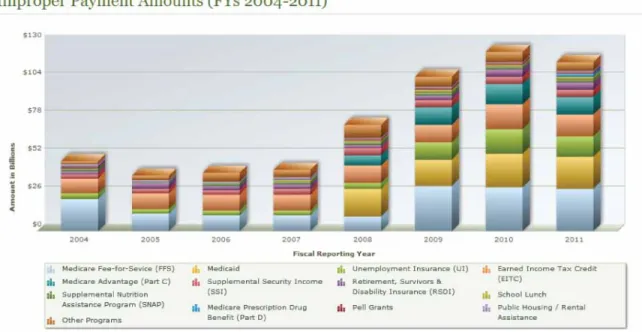
The United States federal government has taken steps to address the problem of improper payments by passing the Improper Payments Elimination and Recovery Act of 2010 (IPERA, Public Law 111-204). In FY2011, federal agencies reported a government-wide improper payment rate of 4.69 percent. Although this is a sharp decrease from 2010’s rate of 5.3 percent, it still represents a stunning total of approximately $115 billion (see Figure 1).
Figure 1: Improper payments cause massive financial loss—$115 billion in FY2011 alone.
Government organizations face many challenges in reducing improper payments and preventing them altogether. The primary challenges include:
• Putting preventative controls in place to curb high error rates
• Eliminating waste, fraud, and abuse
• Addressing the need for enhanced government transparency and accountability
Implementing a Preventative Control Methodology
Government organizations are shifting from a loss recovery philosophy to a more effective preventative control model. Through early detection, organizations can stop improper payments before they are disbursed and expend fewer resources on recovery efforts. But payments data is fragmented across more disparate systems and agencies than ever before. With more data, there are more errors and variations in the identity information associated with records. Upfront data integration and sharing can help government organizations to more accurately process payments, detect potential errors, resolve data problems that often result in over-or underpayments, and identify areas for improvement.
4
Eliminating Waste, Fraud, and Abuse
United States federal government payments to individuals and other entities exceed two trillion dollars per year. Given this massive volume, fraud is difficult to detect. Government agencies need to identify unusual patterns or correlate claims to uncover fraud attempts. They need robust tools that support payment activities while monitoring, detecting, and alerting business analysts to potential errors or fraud. Payment trending provides valuable insight into payment spikes or other anomalies.
Ensuring Transparency
Established in 2011 by Executive Order, the Government Accountability and Transparency Board requires government organizations to collect and display government spending data, ensure the reliability of that data, and broaden the deployment of fraud detection technologies. Access to timely and accurate data, regardless of source or owner, can provide unprecedented insight into government efficiency and effectiveness while bolstering public confidence.
The Need for a Comprehensive Solution
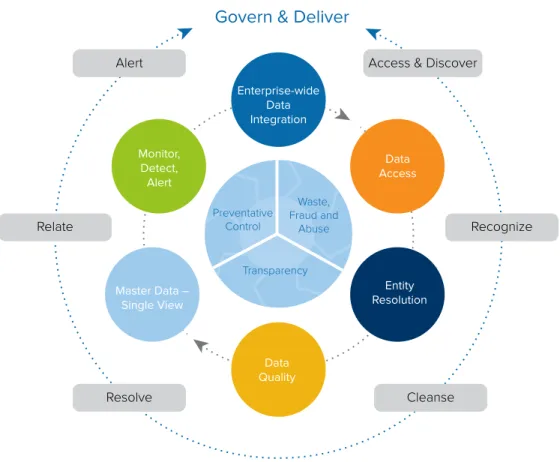
Government agencies need a comprehensive solution to reduce improper payments—one that sets up preventative control; prevents waste, fraud, and abuse; and ensures transparency (see Figure 2). This comprehensive solution should:
• Ensure that all data is error-free by accessing, discovering, and cleansing all data
• Detect fraud by recognizing and resolving risks and anomalies, and identifying unusual activities found in the data
• Deliver unprecedented insight into and transparency of all data by relating like data and setting up alerts for potential errors or fraud
• Prevent future improper payments by establishing a data governance plan and delivering and using data across the organization
Govern & Deliver
Access & Discover
Recognize Entity Resolution Cleanse Data Quality Resolve
Master Data – Single View Relate Monitor, Detect, Alert Data Access Alert Enterprise-wide Data Integration Preventative Control Waste, Fraud and Abuse Transparency
Figure 2: Government organizations need a comprehensive solution to eliminate and prevent improper payments.
Ensuring Data Is Error-Free
Access: Obtain data from disparate data sources and applications, regardless of format or data type . Data is scattered across multiple systems within and across agencies. To prevent improper payments, government agencies need to be able to unobtrusively access all data to create a 360-degree view of programs, individuals, and families as well as complicated relationships among these entities.
Discover: Profile data quality and structure to uncover duplications, errors, and inconsistencies . Data fragmentation, duplication, and inaccuracies plague government agencies. Data quality is essential to good decision making, accurate eligibility determination, and payment trending.
Cleanse: Resolve errors and inconsistencies before they occur . With accurate, timely, and complete data, government agencies make fewer mistakes in terms of program participation, better determine program eligibility, and ensure that only proper payments are made.
6
Detecting Fraud by Proactively Identifying Risks, Anomalies, and Unusual Activities
Recognize: Rapidly match and accurately identify duplicates . Data formats, quality, validity, trustworthiness, and completeness vary greatly across systems. The ability to identify duplicates and confirm identity is critical to quickly detecting and resolving payment errors and eradicating fraudulent claims.Resolve: Merge duplicates to create a trusted, single version of the truth . Golden records enable government organizations to seamlessly integrate, evaluate, and access data from multiple data sources to determine the most reliable, accurate, timely, and comprehensive master file across individuals, programs, providers, employees, or other primary person or subject areas.
Delivering Unprecedented Insight and Transparency
Relate: Reveal relationships, patterns, associations, program participation, provide information, and relevant hierarchies . Government organizations need to create a comprehensive view of clients, providers, payees, and programs. Entity linking, relationship resolution, and identity matching enable agencies to sort and mine relevant data across disparate systems to create a single view.
Alert: Correlate data that could indicate error or fraud . Government agencies need to apply user-defined analytical rules to expose hidden, distributed, and meaningful event patterns in payment transaction data. These rules trigger a stop on the payment for review by an analyst.
Establishing a Data Governance Plan and Leveraging Data Effectively and
Efficiently Across the Organization
Govern: Create, consume, manage, and monitor master data . Data governance is an organizational strategy and methodology for documenting and implementing business rules and controls around valuable data. It is a duty to maintain full and accurate records and keep those records confidential, secure, and accurate.
Deliver: Synchronize trusted master data to downstream applications and data warehouses . By delivering accurate, timely, and aggregated data to program owners, policy makers, and data analysts and data scientists, government organizations gain a comprehensive and trusted view into total costs, program effectiveness, and outcomes measurement.
The Informatica Solution for Improper Payments
Informatica offers a comprehensive solution to address the most common problems that plague agencies and result in massive financial loss—including high error rates, waste, fraud, and abuse. The Informatica solution for improper payments meets all the challenges involved in reducing improper payments and provides greater government transparency and accountability.
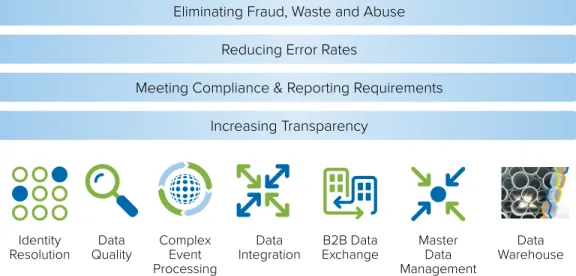
Reducing improper payments is a critical part of government organizations’ efforts to meet fiscal improvement goals. The Informatica solution for improper payments uniquely provides operational insight, enables the discovery of non-obvious relationships, and promotes accountability and fiscal responsibility (see Figure 3).
Identity
Resolution QualityData ComplexEvent Processing
Data
Integration ExchangeB2B Data MasterData Management
Data Warehouse
Eliminating Fraud, Waste and Abuse
Reducing Error Rates
Meeting Compliance & Reporting Requirements
Increasing Transparency
Figure 3: The Informatica solution for improper payments uniquely provides operational insight, enables the discovery of non-obvious relationships, and promotes accountability and fiscal responsibility.
This comprehensive solution is based on products within Informatica’s industry-leading data integration platform.
8
Integrate All Sources of Data for Better Insight and Accuracy
The solution includes Informatica PowerCenter® and Informatica PowerExchange®. These scalable, high-performance enterprise data integration products access and integrate data from virtually any business system, in any format, and deliver that data throughout the organization at any speed. It also includes Informatica B2B Data Exchange, which extracts data from any file, document, or message—regardless of format, complexity, or size—and transforms it into a usable form. This product supports any-to-any data format transformations for structured, semistructured, and unstructured data—all while complying with the multiple standards that govern those formats.
Discover Relationships and Gain a Holistic View of Entities
The solution includes Informatica MDM, which is flexible, business model-driven master data management (MDM) software to address the unique business requirements of the government. Informatica MDM’s proven multidomain approach provides a single, consolidated, and reliable view of business-critical data—such as individuals and organizations, events, and other key domains—as well as the relationships between data. With
Informatica Identity Resolution, government organizations can search and match entity data to manage risk, detect fraud, and ensure compliance.
Improve Data Quality, Accuracy, and Decision Making
The solution includes Informatica Data Quality, which cleanses all data for all applications and enables government organizations to monitor and maintain its clean state. This product ensures authoritative and trustworthy data quality for all stakeholders, projects, and data domains and for all projects and business applications. By improving the quality of data, government organizations can more easily identify fraudulent activity, suspicious patterns, and potential errors and make better decisions regarding eligibility.
Alert Data Analysts of Potential Errors and Fraud
The solution includes Informatica RulePoint and Informatica Proactive Monitoring from the Informatica complex event processing product family. These products empower government organizations to quickly set up, detect, and analyze the information they need to ensure the action they take is timely and relevant. Even if the payment clears this first test, examination of the payment event compared to other known events could detect error or fraud. Duplicate invoices against different vendor codes, company codes, purchase orders, or payable systems are detected. Duplicates with small changes to invoice numbers, completely different invoice numbers, differing payment amounts, or differing currencies can be detected and flagged for review.
Conclusion
Government agencies need to reduce error rates and detect fraudulent activities before payments are made. This isn’t easy. Payments data is fragmented across more disparate systems and agencies than ever before. With more data, there is more error and variation in the identity information associated with records. And fraudulent activities and capabilities have become pervasive and sophisticated.
Government organizations need a comprehensive solution to address the complex challenges of reducing improper payments. The Informatica solution for improper payments meets all these challenges and provides greater government transparency and accountability. The solution is based on Informatica’s industry-leading data integration platform.
The Informatica solution prevents errors and improper payments by:
• Delivering operational intelligence used to correlate events across the enterprise
• Stratifying numeric values to identify unusual values (e.g., excessively high or low values)
• Joining different data sources to identify inappropriately matching values such as names, addresses, and account numbers in disparate systems
The solution enables government organizations to reduce waste, fraud, and abuse by:
• Providing right-time response to end users across multiple channels when suspicious activities or errors are detected
• Discovering non-obvious relationships and resolving identities through advanced matching, linking, and searching capabilities
• Calculating statistical parameters to identify outlying transactions that could indicate fraud
• Classifying data to find patterns and associations of groups of data elements
The Informatica solution also increases transparency within government organizations by:
• Promoting accountability and providing information to citizens about what government is doing
• Enhancing the government’s effectiveness and improving the quality of decisions
• Ensuring reporting and accountability compliance
LEARN MORE
Learn more about the Informatica Platform. Visit us at www. informatica.com or call +1 650-385-5000 (1-800-653-3871 in the U.S.). Connect with Informatica at http://www.facebook.com/ InformaticaCorporation, http:// www.linkedin.com/company/ informatica and http://twitter.com/ InformaticaCorp.
ABOUT INFORMATICA
Informatica Corporation (NASDAQ: INFA) is the world’s number one independent provider of data integration software. Organizations around the world rely on
Informatica for maximizing return on data to drive their top business imperatives. Worldwide, over 4,630 enterprises depend on Informatica to fully leverage their information assets residing on premise, in the cloud, and across social networks.
Worldwide Headquarters, 100 Cardinal Way, Redwood City, CA 94063, USA phone: 650.385.5000 fax: 650.385.5500 toll-free in the US: 1.800.653.3871 informatica.com linkedin.com/company/informatica twitter.com/InformaticaCorp
© 2012 Informatica Corporation. All rights reserved. Printed in the U.S.A. Informatica, the Informatica logo, and The Data Integration Company are trademarks or registered trademarks of Informatica Corporation in the United States and in jurisdictions throughout the world. All other company and product names may be trade names or trademarks of their respective owners.