HP
Web Jetadmin
Security
Security
in HP Web Jetadmin
Overview
HP Web Jetadmin is a powerful web-based software utility for installing, configuring, and managing network-connected devices. Since it can install and configure devices, it must be able to secure itself against unwanted access. Not only can it secure itself against unwanted users, it can also secure the devices it manages against unwanted access. Securing devices is important for many reasons:
• reduces printer down time
• reduces helpdesk calls
• minimizes troubleshooting visits
• minimizes consumable usage Fortunately, HP Web Jetadmin offers several levels of authentication and privacy to secure devices and itself against unwanted access.
Preventing Access to HP Web
Jetadmin
HP Web Jetadmin is a web-based tool that can be installed on one machine and accessed from any other machine within the intranet via an ordinary browser. Since it has the power to install and configure devices, security against unwanted users is typically desired. External Access
A firewall serves to protect the internal network from external access. Therefore, a firewall could be the first defense mechanism to keep unwanted internet users from
browsing to an installation of HP Web Jetadmin.
Internal Access
HP Web Jetadmin offers the following types of security to ensure only desired users within the intranet have access to an installation of HP Web Jetadmin:
• HTTP Port
• Access List
• User Profiles HTTP Port
To keep unwanted users within the intranet from browsing to an installation of HP Web Jetadmin, the HTTP port number can be changed by selecting HTTP (Web) under the General Settings folder in the Navigation tree (see Figure 1).
HP Web Jetadmin defaults to using port 8000 in order to not conflict with any other web service on the machine that may be using the typical port 80. However, the port number can be changed by the administrator in order to keep unwanted users from having the ability to browse to the installation of HP Web Jetadmin.
Access List
HP Web Jetadmin provides an access list to control which IP addresses (individual or range) or host names can have access to an installation of HP Web Jetadmin. The access list can be configured by selecting HTTP (Web) under the General Settings folder in the Navigation tree (see Figure 1). As a precaution to prevent losing access to HP Web Jetadmin entirely, a web browser running on the machine where HP Web Jetadmin is installed can always access it regardless of how the access list is configured.
A list of individuals who can access HP Web Jetadmin can be created, as well as a list of individuals who cannot access HP Web Jetadmin. The access list can be enabled as Allow then deny or Deny then allow with
HP
Web Jetadmin
Security
the latter always taking precedence. For example, if Allow then deny is selected, and the same IP address appears in both the allow and deny lists, the IP address will be denied because that would be the last action performed on the lists.
User Profiles
User profiles are a widely used form of security that HP Web Jetadmin offers to keep unwanted users from gaining access to an installation of HP Web Jetadmin. User profiles can control who has access to an installation of HP Web Jetadmin and what parts of HP Web Jetadmin are available to users under a particular profile. Features can be hidden from certain user profiles and enabled for others.
Passwords are assigned to the profiles to provide authentication against unwanted access. In addition to unique profile passwords created by HP Web Jetadmin, Microsoft Windows domain passwords can be associated to profiles. With this technique, HP Web Jetadmin prompts users for their Windows domain user name and password before allowing access to a particular profile.
Windows domain authentication simplifies the following tasks:
• User account administration: there is no longer a need to maintain a specific profile for each user in order to ensure separate passwords.
• Login procedure for users: users are not required to learn a new password, they merely use their existing Windows domain user name and password.
There are two user profiles defined by default in HP Web Jetadmin:
• Admin - can view and configure all available items.
• User - can view most items, but cannot configure settings unless configured to do so.
The User profile can be edited at will, but only the password can be changed on the Admin profile. Also, there is no limit to the number of new profiles that can be created. As an extra precaution, whether installing HP Web Jetadmin as a new version or upgrading over a previous version, the installer will prompt for passwords to be set on any existing profiles whereby passwords have not been previously set (see Figure 3). Figure 2
HP
Web Jetadmin
Security
The HP Web Jetadmin Navigation tree will display which profile is currently in use by viewing Current Profile Settings under the General Settings folder (see Figure 2). To log in under a different profile, click Select Current Profile and enter the proper
credentials.
Each profile can be edited to define which features are made available to users logging in under a particular profile. For example, a Helpdesk profile could be created that allows for editing of groups and editing of devices, but does not allow editing of HP Web Jetadmin configuration settings or device installation.
Preventing Printer
Configurations
While an installation of HP Web Jetadmin contains several methods for securing itself against unwanted access, there is still a possibility that devices can be configured with other installations of HP Web Jetadmin or other SNMP utilities
Therefore, setting security on the devices themselves becomes an important form of security to restrict unwanted access to a networked device. Users can access devices in a variety of methods, but setting security at the device level is effective no matter which technique is used to access the device.
For example, configuration of a device can be accomplished through a variety of utilities including:
• HP Web Jetadmin
• HP Jetadmin
• HP Install Network Printer Wizard
• Telnet
• Embedded Web Server
• Any SNMP utility With all of these avenues for potentially changing device configuration, setting security at the device level is the surest way of eliminating access to the device. Fortunately, there are several security mechanisms that can be enabled on
the device to address all of these various forms of access.
HP Web Jetadmin provides multiple methods for securing devices against unwanted access including:
• upgrade the HP Jetdirect firmware to the highest level
• disable all unused protocols
• specify an administrator password
• specify an SNMP Set Community name
• lock the control panel
• disable print paths
• disable various network access paths
• secure the printer disk Upgrade HP Jetdirect Firmware As HP Jetdirect firmware is enhanced or revised, performance and security issues are proactively addressed. Always keep the firmware on the HP device at the latest revision level to ensure maximum security. HP Web Jetadmin provides the ability to upgrade HP Jetdirect firmware either individually or in batches (see Figure 4).
Disable Unused Protocols An unused protocol could be considered a back door for
unauthorized use and configuration. Disabling unused protocols also helps to minimize network traffic. Once a protocol is disabled, no activity is allowed on that protocol. Therefore, printing and management applications that utilize a disabled protocol will no longer function correctly. HP Web Jetadmin provides the ability to disable protocols either individually or in batches (see Figure 5).
Set Administrator Password An administrator password can be created on a printer to deter unwanted configurations of the printer. Older HP Jetdirect firmware Figure 4
HP
Web Jetadmin
Security
allowed for configuring several passwords including:
• HP Jetdirect password
• Printer EWS password
• Telnet password
Depending upon the HP Jetdirect device and the revision of the Jetdirect firmware, these passwords may be the same or different. For newer HP Jetdirect firmware, such as 22.xx.xx or greater, all three passwords are synched up so that setting one sets them all. The administrator password can be set by selecting Configuration, Security while viewing the Status page of a device in HP Web Jetadmin (see Figure 6). It can also be set when browsing directly to the printer IP address or through a telnet session to the printer. Once set, any attempts at device modification through any of the following utilities will require knowledge of the password:
• HP Web Jetadmin
• HP Jetadmin
• HP Install Network Printer Wizard
• HP Jetdirect Embedded Web Server
• Printer Embedded Web Server
• Telnet
The administrator password will only prevent configuration through HP utilities such as those listed above because they are the only ones to check for the presence of this password.
Selecting Configuration while viewing a group of devices or the list of all devices is a quick and easy way to assign consistent device passwords to more than one device at the same time.
HP Web Jetadmin can cache the administrator password after it is initially entered for the rest of the web browser session to avoid having to enter the same password multiple times.
SNMP Set Community Name HP Web Jetadmin allows for setting the SNMP Set Community Name which is used to prevent unauthorized changes to devices via SNMP. This option can be set on individual devices by selecting Configuration, Security while viewing a single device (see Figure 6), or it can be set in batches by selecting Configuration while viewing a group of devices or the list of all devices (see Figure 5). Only the users that have knowledge of the Set Community Name can make changes via SNMP. Any SNMP utility, not just HP utilities such as HP Web Jetadmin, must contain this Set Community Name before parameter modification can be performed. The Set Community Name parameter can have a maximum length of 32 characters.
Figure 5
HP
Web Jetadmin
Security
The Set Community Name can be synched up with the other administrator passwords in HP Jetdirect firmware versions 22.x.x or greater.
Preventing Printing to Devices
In addition to providing additional security methods to prevent against unwanted device configuration, HP Web Jetadmin also provides security against unwanted printing access. For example, printing can occur to printers using the following techniques, among others:
• HP Standard Port Monitor
• HP Jetdirect Port
• Microsoft Standard Port Monitor
• LPD
• FTP
• IPP
Fortunately, security methods exist in HP Web Jetadmin that can prevent unwanted printing from users utilizing
these various printing techniques, an will soon appear in HP Web Jetadmin. Access Control List
An access control list (or host access list) is used to specify the IP addresses that are allowed access to the device. The list supports up to 10 entries. If the list is empty, then any system is allowed access. By default, host systems with HTTP connections, such as Web browser or Internet Printing Protocol connections, are allowed access regardless of access control list entries. This allows hosts to access the device when Proxy Servers or Network Address Translators are used. However, unfiltered access by HTTP hosts may be disabled by clearing the Allow Web Server (HTTP) access checkbox (see Figure 7). CAUTION: The ability to
communicate with the device may be lost if the system is not properly specified in the list, or access through HTTP is disabled. If communications with the device is lost, restoring network settings to factory-default values may be required.
HP Web Jetadmin allows for adding or removing addresses from the Access Control List by selecting Configure, Network when viewing a Status page for a single device (see Figure 7).
Disable Unused Services Additional techniques for either configuring a device or printing to a device can be disabled HP Web Jetadmin) to provide even more security against unwanted device access.
The following techniques can be enabled/disabled:
• Service Location Protocol (SLP) - used for IP Multicast discovery
• Telnet - used for device configuration
• Port 9100 - used by Microsoft port monitors such as the HP TCP/IP Standard Port Monitor, HP Jetdirect Port Monitor, Microsoft Standard Port Monitor
• File Transfer Protocol (FTP) – used for configuration and printing
• Line Printer Daemon (LPD) – used for printing
• Internet Printing Protocol (IPP) – used for printing
Encryption
Assigning passwords can keep unwanted users from accessing HP Web Jetadmin and/or printers. Fortunately, password encryption is possible in HP Web Jetadmin to secure the passwords.
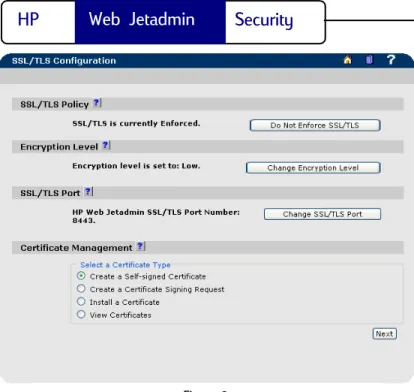
Secure Sockets layer (SSL) Secure Sockets Layer (SSL) communication is supported for secure communication between the web browser and the HP Web Jetadmin installation. This optional SSL access encrypts all
communication between the web browser and the HP Web Jetadmin host machine using HTTPS instead of HTTP. This prevents persons from Figure 7
HP
Web Jetadmin
Security
intercepting information and learning sensitive information such as passwords. SSL communication is based on a digital certificate that can originate from two sources: self-signed and third-party Certificate Authority (CA). A self-signed certificate is issued by HP Web Jetadmin itself. Alternately, HP Web Jetadmin can request a certificate from a third-party CA such as Verisign (see Figure 8). HTTPS
HTTPS can also be enabled for the Jetdirect device to configure whether the device will require Secure HTTP (HTTPS) only, or allow both HTTPS and standard HTTP, for browser-based management (see Figure 9). Secure Hyper Text Transfer Protocol (HTTPS) provides secure, encrypted management communications between the embedded Web server on the device and a Web browser. If non-secure communications (HTTP) are used with a device that is
configured to require HTTPS only, the browser will be redirected to use HTTPS. Automatic redirection of the browser for HTTPS may be
transparent depending on the
browser's capabilities. If both HTTPS and HTTP are allowed, the browser communications will be routed to the device's HTTPS or standard HTTP port as appropriate.
SNMPv3
HP Web Jetadmin uses SNMPv1 to retrieve information pertaining to devices, but can also use SNMPv3 for configuring parameters on SNMPv3 capable HP Jetdirect devices. SNMPv3 allows the communication
between the HP Jetdirect device and HP Web Jetadmin to be encrypted and authenticated to eliminate interception and alteration. HP Web Jetadmin can be used to enable SNMPv3 on multiple devices simultaneously. When HP Web Jetadmin enables SNMPv3 on a device, it enforces read/write capabilities for SNMPv3, but leaves read access open for SNMPv1 to enable discovery by management tools such as itself. Write access will be blocked under SNMPv1. If an administrator were to enable SNMPv3 through the embedded web server of the device, and disabled read and write access via SNMPv1, HP Web Jetadmin could not discover the device and hence could not manage it.
Secure File Erase
The final discussion regarding security revolves around ensuring that all file erase operations are performed securely.
Secure File Erase Modes
The Disk Erase Mode feature in recent HP LaserJet firmware enables administrators to configure the disk file system to erase the data in files as they are deleted (see Figure 10).
Figure 9 Figure 8
HP
Web Jetadmin
Security
Secure File Erase Modes determine the behavior of a secure storage erase operation and the erase operation that a printer automatically performs to make space available on a hard disk drive for incoming print jobs. The erase operations are designed to add available space to a device’s hard disk drive and to prevent
unauthorized users from accessing confidential information from a device’s hard disk drive or other erasable storage device.
Three levels of erasure are supported: 1) Non-Secure Fast Erase: erases the
file system references to operations, such as completed print jobs. By erasing the references, space on the hard disk drive is made available. Data is retained on disk until overwritten due to freed up status. This is the fastest erase mode and the default mode.
2) Secure Fast Erase: erases the file system references to file
operations and provides one layer of masking to hide data stored on the hard disk drive or other erasable storage devices.
information is overwritten with identical character pattern. This is slower than non-secure erase, but all data is over written.
3) Secure Sanitizing Erase: erases the file system references to operations and provides multiple layers of masking to hide data stored on the hard disk drive or other erasable storage devices. It is a secure, repetitive algorithm used to overwrite all file information and remove any
residual data persistence. This causes a significant performance impact.
To securely erase a disk, a file system password is required. HP Web Jetadmin provides an interface to initially configure or change the file system password. As with any PML object configured through an SNMP SET, an SNMP SET Community Name can be applied to the device, or an HP Jetdirect password, in order to deter unwanted access or changing of the password.
Secure Storage Erase
Secure Storage Erase (wipe disk) erases the file system references to operations and provides multiple layers of masking to hide data stored on the hard disk drive or other erasable storage devices. It entirely erases storage media in a device using the file erase mode described above. Media include hard disks and compact flash. HP Web Jetadmin provides an interface that will allow the immediate or scheduled
execution of the operation in batch or single device mode (see Figure 11). File System Password
A password used to protect the configuration of the secure file erase modes and file system external access and to protect the execution of wipe disk. HP Web Jetadmin will allow for initially configuring and changing the password in both batch Figure 10
HP
Web Jetadmin
Security
and single device configuration. File System External Access Access control for external PJL, PML, PostScript, and NFS requests to read or write to the file system are also provided by HP Web Jetadmin. An interface is provided for
enabling/disabling access to the file system for each of these mechanisms (see Figure 10). The user will be required to supply the file system password to configure access.
Summary
Unwanted changes in device configuration can make setting security a priority. Fortunately, HP Web Jetadmin offers multiple levels of security to provide LAN
administrators the control needed to customize and protect device management on their networks. Not only can it secure itself against unwanted users, it can also secure the devices themselves against unwanted access through any utility.
See Appendix A for a table of typical device access points and how HP Web Jetadmin can provide security against those access points.
Copyright October, 2004
Microsoft, Windows, and Windows NT/2000/XP are registered trademarks of Microsoft Corporation in the USA, and other countries. All other brand and product names are trademarks or registered trademarks of their respective companies. The information contained in this document is subject to change without notice. HP makes no warranty of any kind with respect to this information. HP specifically disclaims the implied warranty of merchantability and fitness for a particular purpose. HP shall not be liable for any direct, indirect, incidental, consequential, or other damage alleged in conjunction with the furnishing or use of this information.
HP
Web Jetadmin
Security
Appendix A
Security Method DescriptionDevice password HP Web Jetadmin checks for the presence of a device password before allowing configuration or firmware updates to occur.
Set Community Name An HP Jetdirect device will not allow SNMP SET REQ commands (which HP Web Jetadmin uses for device configuration) without this password.
Access Control List Specifies the IP addresses that are allowed access to the device
Disable telnet access Telnet access, used for HP Jetdirect device configuration, can be disabled.
Disable unused protocols Disabling unused protocols, such as IPX/SPX, can keep unwanted device configurations from occurring through SNMP utilities.
Disable PJL access Disables PJL access to the printer file system only. PJL in print jobs is still accepted.
Disable NFS access Disables NFS access to the printer file system. The Device Storage Manager plug-in requires NFS for management of fonts, forms, macros, and stored jobs.
Disable PML access Disables PML access to the printer file system. Regular PML objects over SNMP are still accepted. Disable Postscript Disables Postscript access to the printer file system.
File system password Required to set secure file erase modes, securely erase storage, disable file system access. Secure file erase modes Determines the behavior of a secure storage erase operation and the erase operation that a printer
automatically performs to make space available on a hard disk
Secure storage erase Entirely erases storage media in a device using the file erase modes described above. SSL (Web Jetadmin) Encrypts the communication between client and HP Web Jetadmin server using HTTPS. HTTPS (device) Encrypts the communication between client and HP Jetdirect device interface.
SNMPv3 Encrypts all SNMP SET REQUESTS to the HP Jetdirect device.
Disable Port 9100 printing Port 9100 printing, which HP TCP/IP Standard Port Monitor utilizes by default to send print jobs, can be disabled.
Disable LPD printing LPD, which can be enabled (LPR) as a print method under the HP Standard TCP/IP Port Monitor, can be disabled.
Disable FTP printing FTP (file transfer protocol) printing can be disabled.
Disable IPP printing Internet Printing Protocol, or printing directly from the web, available as a separate utility from HP for Microsoft Windows NT, and available by default under Microsoft Windows 2000, can be disabled.