ECONOMIC DEVELOPMENT
The City of Decatur has been very successful at economic development over the past decade. The importance of municipally supported economic development is to maintain an employment base and minimize poverty so that local revenues can adequately fund services and schools. The City Commission and the Downtown Development Authority, working with long-standing goals, a widely supported town center plan, and a growing market demand, has created a vibrant downtown shopping and entertainment district where ten years ago there was a plethora of vacancies. Successful commercial revitalization has also occurred in Oakhurst Village and the College Avenue Corridor.
The purpose of the economic development element is to provide a snapshot of Decatur’s economy today through the use of standard statistical inventory tools, to offer an assessment of the current economy in Decatur, and to provide a vision and goals that will successfully propel the City of Decatur’s economy into the next decade.
Inventory
Economic BaseIn general, the City of Decatur is characterized by relatively low unemployment and relatively high household income. In 2000, the median household income for Decatur was $47,935. This amount is higher than both state ($42,433) and national ($41,994) median household income for 2000. Nearly 20% of households earned $100,000 or more (18.9%). As of 2000, 7% of families lived at or below the poverty level in Decatur. For Georgia overall, 9.9% of families lived at or below the poverty level in 2000.
Since its creation, Decatur has been the county seat for DeKalb County, Georgia. As such, it is not surprising that DeKalb County Government activities lead the list of major employers in Decatur. Major employers include:
• DeKalb County Government • Emory University (satellite offices)
• The U.S. Department of Health and Human Services –
Centers for Disease Control and Prevention (CDC) (satellite offices) • Agnes Scott College (education)
• The City Schools of Decatur (education)
• Allied Systems (automotive distributor and transporter)
Most of these employers contribute to Decatur’s share of management, professional, and related occupations. The strength of the employers listed above has contributed to a commercial vacancy rate that was less than 10% in early 2005. The reduction in vacancy is approximately 10% since 1995.
The inventory of the economic base continues with information on the employment, personal income, and average wages.
Employment by Economic Sector
A key element of community evaluation for economic development is industry mix. Determining what types of employment exist helps to determine the strength of the overall tax base. For this reason, industry sectors are evaluated over time in order to identify trends.
From 1970 to 2000, Decatur increased its employment by over 3,900 jobs. Significant factors in employment history during this period include an increase in government employment of nearly 10% and an increase of over 1,400 services sector jobs between 1990 and 2000. These increases reflect a strong employment presence of DeKalb County government offices in downtown Decatur and satellite offices from both Emory University and the U.S. Department of Health and Human Services-Centers for Disease Control and Prevention (CDC).
During this same period, the finance, insurance, real estate employment (FIRE) sector rose by 64% from 1980 to 1990 and then dropped 62% from 1990 to 2000. Employment losses in Decatur for FIRE are significant because increases in this high wage employment sector took place at both the state and national levels during the same period. Between 1990 and 2000, Georgia experienced a 24.7% increase. Between 1995 and 2004, the average annual employment for this sector increased by nearly 18%.
There was also a large percentage reduction in wholesale trade employment from 1990 to 2000 (49%), but the decline in employment is consistent with county (2%) and state (5.6%) percentage declines as well. The Georgia Department of Labor reported that contributing factors for the decline in this sector include technological advances, office automation, and foreign competition.
A pattern of fluctuation for employment in transportation, communications, and utilities as well as the construction sector is also apparent during the 1970 to 2000 period. However, these combined employment sectors accounted for about 18% of jobs in 1970 and only about 7% of jobs in 2000, demonstrating a reduction in goods producing employment to service producing employment. Retail trade employment remained stable over the period despite an overall increase in employment. The number of jobs in retail from 1980 to 1990 mirrors population loss in the City overall. Despite population increases between 1990 and 2000, retail employment did not rebound with the population increase, but remained stable. It is important to note that the increases in retail employment from successful downtown revitalization are not reflected in 2000 census
information.
The following table provides Decatur employment history since 1970. Table 3.1 – City of Decatur Employment by Sector 1970-2000
Employment Sector 1970 1980 1990 2000
Agriculture 28 15 22 0
Construction 556 362 554 292
Manufacturing 462 303 394 366
Transportation,
Communications, and Utilities 938 349 282 539
Wholesale Trade 242 305 306 118
Retail Trade 1,110 936 946 973
Finance, Insurance, Real
Estate 865 884 1,418 538
Services 2,163 3,532 4,267 5,674
Sub-Total - Private 6,364 6,686 8,119 8,500
Government 1,784 2,700 3,278 3,579
Total 8,148 9,386 11,467 12,079
Source: City of Decatur
U.S. Census Bureau, Census 2000
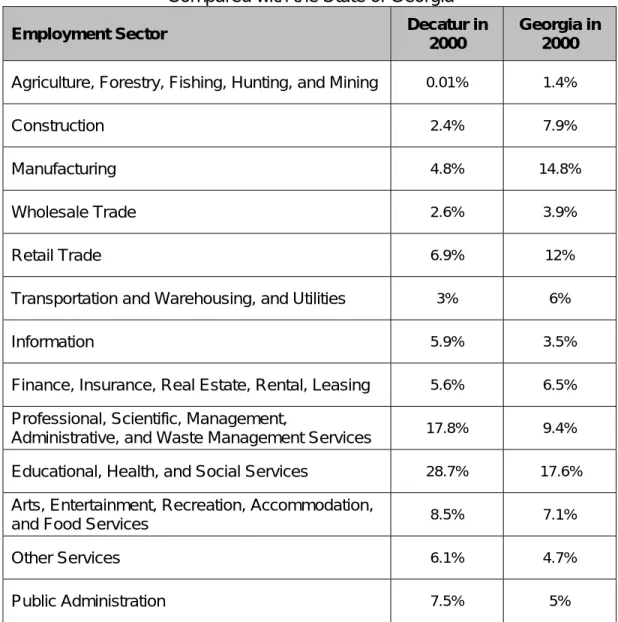
The review of industries can also be evaluated in comparison with the entire state. For 2000, comparisons between the City of Decatur and the State of Georgia regarding employment by sector demonstrate five (5) significant differences. Most importantly, Decatur held 8% more professional, scientific, management, administrative, and waste management service jobs than the overall state percentage in 2000. In addition, Decatur held 11% more educational, health, and social services jobs than the overall state percentage in 2000.
Decatur had few jobs in others areas. In 2000, the city contained 5% less construction jobs than the overall state percentage. Decatur also contained 10% less manufacturing jobs and 5% less retail trade jobs than the overall state percentage.
These and all employment sector comparisons between Decatur and the State of Georgia are provided below.
Table 3.2 –Decatur Employment by Sector as Compared with the State of Georgia
Employment Sector Decatur in
2000
Georgia in 2000
Agriculture, Forestry, Fishing, Hunting, and Mining 0.01% 1.4%
Construction 2.4% 7.9%
Manufacturing 4.8% 14.8%
Wholesale Trade 2.6% 3.9%
Retail Trade 6.9% 12%
Transportation and Warehousing, and Utilities 3% 6%
Information 5.9% 3.5%
Finance, Insurance, Real Estate, Rental, Leasing 5.6% 6.5%
Professional, Scientific, Management,
Administrative, and Waste Management Services 17.8% 9.4% Educational, Health, and Social Services 28.7% 17.6%
Arts, Entertainment, Recreation, Accommodation,
and Food Services 8.5% 7.1%
Other Services 6.1% 4.7%
Public Administration 7.5% 5%
Source: US. Census Bureau, Census 2000
Average Wages
Average weekly wages provide an overview of the quality of jobs in a community. The Georgia Department of Labor provides wage data at the county level. County level data from 2003 showed that DeKalb County average weekly wages of $801 were higher than the state average of $704, comparable to the Cobb County average of $805 and the Gwinnett County average of $786, but were lower than the Fulton County average of $960.
Table 3.3 – Average Weekly Wages for Selected Industry Sectors in 2003
DeKalb County Industry 2003 Average Weekly Wages Agriculture $313 Construction $827 Manufacturing $924 Transportation and Warehousing $695 Wholesale Trade $1,124 Retail Trade $491
Finance and Insurance $1,129
Real Estate and Rental and
Leasing $689
Services (general) $770
Sub-Total - Private $786
Government $883 Source: Georgia Department of Labor
Since Decatur has a greater share of management, professional, and related occupations, average weekly wages would most likely be higher for Decatur than for DeKalb County as a whole. However, the average weekly wage level for Fulton County indicates that some high wage jobs which Decatur residents might occupy are located in the employment centers of Downtown Atlanta, Midtown Atlanta, and Buckhead Atlanta in Fulton County.
Personal Income by Type
For 2000, the predominate income type for Decatur residents was aggregate wage or salary income (78%). This income type refers to total money earnings received for work performed as an employee during the past 12-month period. It includes wages, salary, Armed Forces pay, commissions, tips, piece rate
payments, and cash bonuses earned before deductions were made for taxes, bonds, pensions, and union dues. While the share of income in the category of aggregate wage or salary income for households increased by 7.3% since 1990, the share of income coming from wages or salaries was the same as the state in 2000. The share of income from interest, dividends, or net rental income decreased from 11.2% to 6.8% during the same period. The reduction means that Decatur residents obtained less of their income from interest on savings or bonds, dividends from stock holdings or memberships in associations, net income from rental property to others and receipts from boarders or lodgers, net royalties, or periodic payments from estates or trust funds than they did in 1990. To a lesser degree, the share of income from social security also decreased. These findings and all comparisons between 1990 and 2000 are provided below in tables showing income type by percentage and income type by dollars.
Table 3.4 – City of Decatur Personal Income by Type
Category 1990 2000
Aggregate wage or salary income for households 70.5% 77.8%
Aggregate other types of income for households 1.1% 1.2%
Aggregate self employment income for households 6.4% 6.0%
Aggregate interest, dividends, or net rental income 11.2% 6.8%
Aggregate social security income for households 6.1% 3.5%
Aggregate public assistance income for households 0.8% 0.5%
Aggregate retirement income for households 3.9% 4.1%
Total Income 100.0% 100.0%
Source: Georgia DCA
Personal income is also provided by dollars. The increase in total income for Decatur is consistent with the increase in total income for the State at 94% and 95% respectively.
Table 3.5 – City of Decatur Personal Income by Type in Dollars
Category 1990 2000
Aggregate wage or salary income for households 190,887,549 408,033,200
Aggregate other types of income for households 3,095,089 6,263,000
Aggregate self employment income for households 17,239,454 31,332,800
Aggregate interest, dividends, or net rental income 30,360,824 35,821,700
Aggregate social security income for households 16,510,095 18,412,800
Aggregate public assistance income for households 2,216,466 2,596,200
Aggregate retirement income for households 10,532,321 21,707,600
Total Income 270,841,798 524,167,300
Source: Georgia DCA
Since Decatur has a greater share of management, professional, and related occupations, average weekly wages would most likely be higher for Decatur than for DeKalb County in general. However, the average for Fulton County indicates that some high wage jobs that Decatur residents might occupy are located in the Downtown Atlanta, Midtown Atlanta, and Buckhead Atlanta employment centers.
Labor Force Characteristics
Labor force characteristics explain the economic condition of the community’s residents. The comprehensive plan explores this topic by reviewing employment by occupation, unemployment, and commuting patterns. Each topic contributes to a picture of the Decatur labor force.
Employment by Occupation
The review of labor force characteristics begins with a review of the occupations or types of jobs that are held by residents. The Census Bureau states that employment occupation is the set of activities or tasks that employees are paid to perform. Employees that perform essentially the same tasks are in the same occupation, whether or not they are in the same industry.
Decatur indicates that the City’s residents hold a larger share of management, professional, and related occupations (59.5%) than state (32.7%) and national percentages (33.6%). The other major difference is in the production, transportation, and material moving occupations. At 3.5%, Decatur had much less employment in this sector than state and national levels. For service occupations and sales and office occupations, Decatur had a very similar share as compared to state and national figures.
Table 3.6 – Employment by Occupation in 2000 Decatur, State of Georgia, and the United States
Employment by Occupation Decatur Georgia U.S.
Management, Professional, and Related
Occupations 59.5% 32.7% 33.6%
Service Occupations 11.7% 13.4% 14.9%
Sales and Office Occupations 21.7% 26.8% 26.7%
Farming, Fishing, and Forestry Occupations 0% 0.6% 0.7%
Construction, Extraction, and Maintenance
Occupations 3.6% 10.8% 9.4%
Production, Transportation, and Material Moving
Occupations 3.5% 15.7% 14.6%
Source: U.S. Bureau of the Census, Census 2000
Employment Status
The following section provides employment status information beginning with a comparison with state and national percentages.
Table 3.7 – Employment Status by Percentage in 1980-2000 Decatur, State of Georgia, and the United States
Government Unemployment Rate in 1980 Unemployment Rate in 1990 Unemployment Rate in 2000 Decatur 5.1%* 5.8% 4.1% Georgia 6.4% 5.4% 3.6% U.S. 7.1% 5.5% 3.7%
Source: U.S. Census Bureau City of Decatur
* (overall DeKalb County unemployment rate)
Table 3.8 illustrates that Decatur unemployment declined from 5.8% in 1990 to 4.1% in 2000. In 2005, the Georgia Department of Labor estimated that the Decatur unemployment rate reduced further to 3%. The estimated rate of unemployment in Decatur is slightly less than the current State estimated rate of unemployment of 5%.
The following table provides past unemployment rates compared to surrounding counties, the state, and the U.S.
Table 3.8 – Unemployment Rates in Neighboring Areas 1985-2000
Neighboring Areas 1990 2000 2005* Decatur 5.8% 4.1% 3% Clayton n/a 3.9% 5.8% DeKalb County 5.0% 3.9% 5.5% Fulton County 5.9% 6.0% 5.6% Gwinnett County 4.3% 2.4% 4.2%
Henry County n/a 1.9% 4.5%
Rockdale County n/a 2.8% 5.3%
Georgia 5.4% 3.7% 5%
U.S. 5.5% 3.7% 5.2%
Source: U.S. Census Bureau, 2000 Census Georgia DCA
*Georgia Department of Labor, 2005 estimate only
Commuting Patterns
Commuting patterns describe where and how residents get to their place of employment. The implications for commuting include residents’ time, congestion, and overall economic conditions of the community. In Decatur, the implications for commuting also concern the balance between jobs and housing for residents and the utilization of transit resources.
As of 2000, roughly 80% of the Decatur workforce commuted outside the City for employment. Residents spent an average of 26.2 minutes commuting to work. The amount of time was slightly less than the state average of 27.7 minutes.
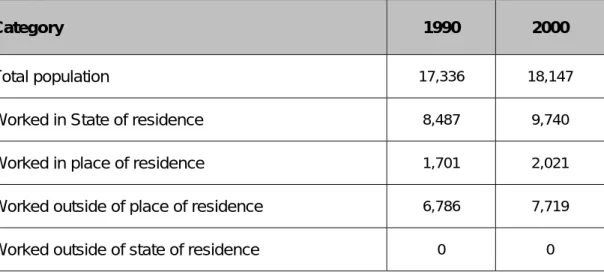
As provided in the table below, only about 21% of Decatur’s workforce held work in Decatur. In comparison, census information in 2000 indicated that 44% of the DeKalb County workforce held work within DeKalb County. Recently, Decatur residents have expressed interest in more employment opportunities within the City. If appropriate jobs for Decatur’s workforce are not added to the City, then existing commuting patters will continue. These patterns are generally derived from census information showing that roughly 36% of the DeKalb County workforce that did not work in the County commuted to jobs in Fulton County and roughly another 10% commuted to jobs in Gwinnett County.
Table 3.9 – City of Decatur Labor Force by Place of Work in 2000
Category 1990 2000
Total population 17,336 18,147
Worked in State of residence 8,487 9,740
Worked in place of residence 1,701 2,021
Worked outside of place of residence 6,786 7,719
Worked outside of state of residence 0 0 Source: U.S. Census Bureau (SF1)
Furthermore, 2000 census information indicated that the primary mode of transportation for Decatur commuters was the single occupant vehicle (driving a car, truck or van alone). More than 72% commuted in this way despite the presence of three heavy rail stations. The next highest mode of commuting was public transportation, including taxicab (10.2%). Carpooling accounted for 5.6% of the workforce. Almost 5% worked at home.
Local Economic Development Opportunities and Resources
In order to take advantage of economic development opportunities, a local government must have a firm understanding of existing and potential development issues. A local community must also harness all available resources and organizational strengths of the community. The economic development section of this plan continues by describing the unique qualities for business in Decatur and how the City has organized its resources for continued economic development in the City.
Special or Unique Economic Activities
Decatur holds an enviable position in the metropolitan region. The City has renewed its mixed-use neighborhood centers, taken advantage of major public
transportation, and remains close to critical employers in nearby counties and in DeKalb County.
Specifically, strong neighborhood centers are prized in Decatur. The City has promoted the potential of its existing centers as a cornerstone of its economic development efforts. The City actively promotes and protects its three business districts and has begun to realize the benefits of revitalization. In 2005, the City characterized these three areas as follows:
Downtown Decatur Business District
Centered around the historic DeKalb County courthouse and the courthouse lawn, the downtown business district includes over 15 blocks of commercial, office, retail and restaurant options. Located north of the railroad tracks, the downtown business district is anchored on the western edge by the Decatur Post Office and on the eastern edge by the Ice House Loft project. The downtown district includes a collection of several office buildings, housing, commercial, medical, and legal services, a small hotel, and retail and restaurant district featuring over 45 restaurant selections and over 40 retailers, as well as a growing number of high-density residential developments. From the historic square to the West Ponce de Leon Corridor to the Old Depot District to the East Howard Avenue area, these various smaller districts are linked by a network of walkable streets.
Oakhurst Business District
The Oakhurst Business District, commonly known as Oakhurst Village, is centered around the intersection of East Lake Drive and Oakview Road and is easily accessible from the downtown business district via South McDonough Street. The Oakhurst Village once served as the commercial center of the City of Oakhurst before it was annexed into the City of Decatur in the 1920s. The Oakhurst Village serves as the heart of the Oakhurst residential neighborhood and includes a collection of restaurants and retailers adjacent to the historic Scottish Rite Hospital building. Listed on the National Register of Historic Places, the Historic Scottish Rite Hospital has been renovated to include an art gallery, commercial office space, and a small housing complex operated by the Shepherd Center. The Oakhurst Village is surrounded by some of the City’s historic neighborhoods.
College Avenue Corridor
The College Avenue Corridor includes a collection of distinct neighborhood commercial districts that extend along College Avenue; the area offers everything from small gourmet restaurants to neighborhood pizza, corner pubs and more traditional retail. The eastern edge of the corridor is currently being developed as a new mixed-use residential neighborhood with local retail and restaurant opportunities according to
the Avondale Livable Centers Initiative plan (LCI) and the City of Decatur Strategic Plan.
Though the economic benefits of these three business districts have not been quantified by City of Decatur, a private analysis conducted for the City of Decatur in 2003 revealed that there are more than 955 businesses and 9,820 employees within a one (1) mile radius of downtown Decatur.
Secondly, the City of Decatur is home to three MARTA rail stations. Over the past ten years, the City has taken steps to promote economic development and housing opportunities at the Decatur Station and at the Avondale station. The City continues to maximize transit-oriented development opportunities.
In 2005, the City of Decatur will benefit from a major renovation to the Decatur MARTA rail station in the center of the downtown area. The goal of the renovation is to remove many of the visual and physical barriers that the current station entrance imposes on the area. The project will benefit Decatur businesses because it will improve the quality of the public space near the MARTA entrance. Improvements for pedestrians will make shopping in this area much easier and pleasant. The redevelopment was funded by a federal grant that amounted to 80% of the project cost. The City of Decatur provided the remaining amount. Depending on the start date, the project is expected to be completed in 2006.
Lastly, proximity to major education and research-oriented institutions is a special quality for Decatur. As stated previously, the City of Decatur has benefited from satellite office uses from nearby educational and research employers in the Clifton Corridor. The opportunity to continue or expand office uses from these employers is unique for Decatur.
Local Economic Development Resources
Decatur Downtown Development Authority and Decatur Development Authority The primary business resource in Decatur is the Decatur Downtown Development Authority (DDA). The Mission Statement of the Downtown Development Authority is to assure the long-term economic stability of downtown Decatur by maintaining the small town character of the district and supporting values that assure Decatur is a great place to live, work, play, invest and do business.
The DDA also includes the Citywide Development Authority. Both authorities share a board and staff. Its programs are based in the City of Decatur Community & Economic Development Department.
The Decatur Downtown Development Authority (DDA) was founded in 1982 to implement the Decatur Town Center Plan and to provide day-to-day
management of the downtown development program. The Decatur Town Center Plan was an important visionary document that set the stage for the success of the downtown that the City enjoys today.
The DDA maintains a work program for development, recruiting, and business retention. Over the past few years the DDA has been actively engaged in specific project sites. Some of the most significant recent activities include design, zoning, and marketing assistance for proposed developments at 201 West Ponce de Leon, 101 Ponce Plaza and 335 West Ponce de Leon Avenue. For the Oakhurst area, the DDA continues to pursue redevelopment options for the Big H property. Targeted advertising and special events in the Oakhurst Business District have received both financial and staff support from the DDA.
The DDA works to assist businesses in a variety of ways. In order to offset disruption by the MARTA Plaza Redevelopment Project, the DDA implemented a marketing and public relations strategy for businesses that will be affected by the project. The DDA has also developed a plan for the East College Avenue district including an inventory of property ownership, consideration of redevelopment alternatives, and assessment of funding needs. The DDA has also attempted to identify grant funding for North McDonough, East Trinity, and East Howard streetscape improvements, as well as streetscape improvements in Oakhurst Village. In order to sustain small businesses, the DDA has developed a strategy to encourage diversified and local owner occupied retail uses.
For redevelopment opportunities, the DDA has pursued projects at 315 West Ponce de Leon, the 233 East Trinity block, the 500 block of Church Street and the Bank of America site. The DDA has also worked with DeKalb County to identify the best opportunities for the Calloway Building block so that demolition of the existing structure might result in a new mixed-use redevelopment of the five-acre site.
For the Avondale/Decatur Livable Centers Initiative Area, the DDA has supported activities to get the project started and directed tenant prospects to the East Decatur Station project area. In addition, the DDA has focused on annexation issues related to redevelopment opportunities east of the project area.
For business recruitment, the DDA generally markets Decatur as an active “Live, Work, Play” community in an urban setting with small town roots. The organization maintains regular communication with commercial property owners and leasing agents to stay current on available space and route business prospects effectively. The DDA has also concentrated efforts to recruit retail/restaurants and other desirable businesses based on marketing studies. For business retention, the DDA regularly updates marketing materials for restaurants and retailers including materials for special events such as the July 4th Sidewalk Sale and the Terrific Thursday Holiday events. The organization
also supports existing retailers on parking issues, public safety, signage and similar program areas to assure a healthy business environment. Technical and financial support is provided to a variety of festivals and special events sponsored by other Decatur community groups to market Decatur.
Other current and future activities of the DDA are included in the Short Term Work Program of this plan.
An important aspect of the DDA and its achievements is its guiding principles. In addition to the mission statement and ongoing work program, the Downtown Development Authority utilizes the National Trust for Historic Preservation's National Main Street Approach to revitalization. The Main Street Approach is based on four main principals: organization, promotion, design, and economic restructuring. Ongoing organizational activities help to build long-term stability. Promotion enables the business district to advertise its strengths collectively. Implementing visual improvements and promoting quality design enhances the physical environment of the business district. Economic restructuring enables the business district to increase competitiveness, identify opportunities, and attempt recruiting.
Since 1980, the success of the Main Street Approach nationwide has resulted in more than $18.3 billion in total public and private reinvestment in physical improvements, a net gain of 60,577 businesses, and a net gain in jobs of over 244,000. Since Decatur utilized the Main Street Approach, downtown revitalization in Decatur is part of this overall success.
Decatur Business Association
The purpose of the Decatur Business Association (DBA) is to advocate for business interests in the City and to promote the City of Decatur as a “unique thriving, small-town experience in metro Atlanta.” The DBA is a membership organization that includes businesses, professionals, financial institutions, arts groups, associated agencies and organizations and private individuals.
Young Professionals of Decatur
The Young Professionals of Decatur is a civic organization created to strengthen the careers, business and volunteer opportunities for young professionals in and around the City of Decatur. The organization works to promote networking among members, educate members on current business topics and political initiatives, and encourage civic involvement.
Oakhurst Business Association
The Oakhurst Business Association advocates for businesses including restaurants, art galleries, hair salons and barbershops, dry cleaners and a wide variety of other retailers in the Oakhurst Village, promoting them as “part of what makes the Oakhurst neighborhood a vibrant and charming place, and what
others far and wide have discovered ... a small town atmosphere with big city service.”
South Decatur Community Development Corporation (SDCDC)
The South Decatur Community Development Corporation (SDCDC) was incorporated as a non-profit organization in 1994 to address some specific concerns of South Decatur residents. The organization received a major boost when the City of Decatur donated the commercial building at 350 Mead Road to the SDCDC in 1998. The organization sold the building, which is now occupied by several businesses. Sales proceeds are now invested with the income available to reinvest for the betterment of the South Decatur community. The SDCDC mission is to have a positive, measurable impact on the economic and cultural development of the South Decatur Community.
Economic Development Programs and Tools
The Decatur Development Authority (DDA) staff provides assistance to the Decatur Business Association (DBA) through a contract for services. The relationship between the DDA and the DBA was established in order to bridge the interests of the City and the business community.
With the exception of limited density bonuses for affordable housing, the City does not provide economic development incentives to developers, property owners, or zoning applicants. In past years, the Downtown Development Authority had been involved in some financing activities for economic development. However, the City of Decatur, through the DDA, attempts to make the development process work more smoothly for developers, property owners, and zoning applicants whose projects reflect adopted community goals.
Georgia Power Company
Through the Community & Economic Development Department, the City of Decatur receives occasional economic development assistance from Georgia Power. The company’s Community and Economic Development organization provides assistance to communities in order to build their economic development attractiveness. Assistance includes leadership, strategy building, infrastructure, and marketing consultation services. In addition, Georgia Power also helps new and existing companies expand in Georgia through leadership, technology, targeted research and data management tools.
Atlanta Regional Commission
The Atlanta Regional Commission (ARC) provides economic development assistance primarily in the form of its Livable Centers Initiative (LCI) grant program along with project implementation funding for qualifying study areas. The purpose of the program is to encourage livability in the region’s activity and employment centers by providing grants to communities that are working to enhance livability and mobility for their residents. Decatur’s Avondale MARTA Station received an LCI grant in 2002 and created a master plan to guide the
area’s future development.
Georgia Department of Community Affairs
The Georgia Department of community Affairs (DCA) offers many programs to encourage economic development in the State’s municipalities. DCA provides community development block grants which can be used for a variety of uses. In addition, DCA also has programs that provide loans for cities in order to foster economic development as well as tax breaks for corporations and low-income housing.
Education and Training Opportunities
Since the City of Decatur does not provide job training, the residents and businesses in the City may utilize the DeKalb Workforce Center, Inc. (DWC). Located on Church Street in Decatur, the DWC administers employment and workforce development for DeKalb County.
The Decatur Focus is a monthly newsletter in the City of Decatur. The purpose of the newsletter is to promote the city and encourage the exchange of information among residents, business owners, and the school system. The Decatur Focus is a joint publication of the City of Decatur, the Decatur Downtown Development Authority, and the Decatur Business Association. The circulation of the Decatur Focus is approximately 10,000. The newsletter is mailed to all households in the City of Decatur, all of the city’s business and professional license holders, and all members of the Decatur Business Association. Other copies of the newsletter are provided through the City’s marketing packets as handouts available on the City’s website and mailed upon request.
Assessment of Economic Development Issues, Trends and
Opportunities
The assessment of economic development issues, trends, and opportunities begins with a review of the future of employment in Decatur.
Table 3.10 – Decatur Employment by Sector 2000 to 2030 Year 2000 2010 2020 2030 Construction 292 227 292 362 Manufacturing 366 402 490 575 Transportation, Communications, Utilities 539 778 1,021 1,234 Wholesale Trade 118 41 27 27 Retail 973 1,279 1,859 2,571
Finance, Insurance, Real Estate 538 189 107 91
Services 5,674 6,406 6,913 7,313
Government 3,579 3,590 3,777 4,031
Totals: 12,079 12,912 14,486 16,204 Source: Atlanta Regional Commission
Table 3.11 – Increase or Decrease in Employment by Sector 2000-2030 Year 2000-2010 2010-2020 2000-2030 Construction -65 65 70 Manufacturing 36 88 85 Transportation, Communications, Utilities 239 243 213 Wholesale Trade -77 -14 0 Retail 306 580 712
Finance, Insurance, Real Estate -349 -82 -16
Services 732 507 400
Government 11 187 254
Source: Atlanta Regional Commission
The future of employment in Decatur over the next 25 years is marked by forecasts for large increases in services employment. The result will be an increase of 1,639 jobs from 5,674 jobs to 7,313 jobs by 2030. Growth in office needs for two major service employers, Emory University and the U.S. Department of Health and Human Services – Centers for Disease Control and Prevention (CDC), is expected during the 20 year planning period of the comprehensive plan.
For retail trade employment, the result will be an increase of 1,598 jobs from 973 jobs to 2,571 jobs by 2030. The 30-year forecast also calls for large decreases in the total number for wholesale trade jobs resulting in a loss of 91 jobs by 2030. For finance, insurance, and real estate employment, the City of Decatur is expected to lose 447 jobs by 2030. It is important to note that in 2030, forecasts indicate that 70% of all jobs (11,344) will be in the government or services sectors.
For the 13-county Atlanta Region, 2030 employment forecasts are roughly similar to forecasts for Decatur. The largest employment increases will be in the trade employment (basic wholesale trade, local wholesale trade, retail trade) and services employment (health, legal, educational, etc). As stated previously, these increases are also expected in Decatur with the exception of employment losses in wholesale trade. A second difference between the 2030 regional forecast and the 2030 Decatur forecast concerns employment in the area of finance, insurance and real estate employment (FIRE). Where the regional
forecast indicates modest increases, the forecast for Decatur indicates employment losses.
Points of Assessment
The City of Decatur recognizes that major employment growth will be in services and retail trade. The City should continue to accommodate these employers in order to maintain strength in these areas.
The City of Decatur recognizes the potential for employment losses in the area of wholesale trade and finance, insurance and real estate (FIRE). Unless recruiting addresses these forecasted losses, other communities will likely benefit from having more of these types of jobs than Decatur.
The City of Decatur has had considerable success in building a live-work-play environment across the city. In order to build on this goal, the City of Decatur recognizes that many residents would like to work in the City. To increase the availability of desirable employment for Decatur residents, the City of Decatur should tailor economic development activities and recruiting for specific employment areas.
Since the City of Decatur has had success in satellite offices in the downtown area, efforts should be maintained to capture future employment growth areas in the services sector. Some of this employment includes the type of work that is prevalent in the Clifton Road/Haygood Drive intersection of DeKalb County. Some of the most significant employers in the corridor include the American Cancer Society National Headquarters, Children’s Healthcare of Atlanta at Egleston, Emory University Hospital, Emory Clinic, Veterans Administration Medical Center and Regional Office, and the Wesley Woods Center. Though Decatur already has a large share (60%) of management, professional, and related occupations, regional employment growth forecasts for 2030 show that health services, legal services, educational services, social services and membership organizations, and business and personal services employment areas are expected to be particularly strong. Continued recruiting and business development for employers in these areas could represent the type of employment that Decatur residents desire. Economic activities should focus on the current and anticipated needs of these employers as well as the locational advantages that Decatur might provide.
Economic Development Community Vision and Goals
Economic Development Community VisionThe economic development community vision is to promote business activity that reflects the diversity of the people, the “Live-Work-Play” environment of the City, and a strong desire for balance between large and small-scale business.
Economic Development Community Goals
Economic development community goals for Decatur reflect new desires for economic development and ongoing efforts that the community would like to continue.
• Continue marketing and public relations strategy designed to position Decatur as an active “Live, Work, Play” community in an urban setting with small town roots.
• To encourage the City and the Downtown Development Authority to continuously update an annual work program of activities.
• Promote existing small businesses throughout the City.
• Encourage mid-rise residential development on commercially-zoned properties in downtown Decatur.
• Cultivate a wide variety of retail in the downtown area by encouraging and recruiting both small locally owned businesses and larger nationally recognized businesses.
• Continue to market downtown Decatur as an ideal office location especially for satellite office needs from the Clifton Corridor.
• Sustain the Downtown Development Authority and its work program in the following areas: general development, the Oakhurst area activities, the Avondale LCI area activities, business retention, and business recruiting.