Program Modification Proposal Bachelor of Science in Civil Engineering
South Carolina State University
Summary
South Carolina State University (SCSU) requests approval to transition the B.S. in Civil Engineering Technology into a B.S. in Civil Engineering, to be implemented in Fall 2016. The proposed program is to be offered through traditional instruction. The South Carolina Code of Laws currently contains a provision which states that the Category B licensure for Professional Engineers for which engineering technology graduates are currently eligible will cease to exist as of July 1, 2020. As a result, graduates of Engineering Technology programs will no longer be able to become licensed as Professional Engineers. South Carolina State University is
modifying its program so that graduates remain eligible for licensure. The following chart outlines the stages of review for the proposal; the Advisory Committee on Academic Programs (ACAP) voted to recommend approval of the proposal. The full program proposal and
supplemental material about student recruitment are attached.
Stages of Consideration Date Comments
Program Modification Proposal Received
5/1/15 Not Applicable
ACAP Consideration 6/11/15 University representatives explained the need for the proposed program. The representative from Orangeburg-Calhoun Technical College expressed support for the proposed program. The representative from USC requested additional data/information to support the claim that the proposed program will recruit from a different pool of students than the existing civil engineering programs in the state. SCSU representatives stated that the University mainly recruits minority students and agreed to provide additional information about student recruitment.
Comments and suggestions from CHE staff sent to the institution
6/15/15 Staff requested the proposal be revised to:
• Clarify that the existing Civil Engineering Technology program is transitioning to a Civil Engineering program and explain the overall transition or phase-out plan of the existing program.
• Separate the program objectives from the need/reasons to change the program from Civil Engineering Technology to Civil Engineering.
Stages of Consideration Date Comments
• Present a stronger justification of the need for the program.
• Connect and explain the examples used to support the modification.
• Provide a context for the chart showing the enrollment in the civil engineering technology program.
• Include information to support the statement made at the ACAP meeting about the program being one that will help grow enrollment at the University.
• Provide evidence to support the claim that the University attracts a different pool of students than the other institutions that offer civil engineering programs in the state.
Revised Program Proposal Received
6/24/15 The revised proposal and additional
supplemental material provided satisfactorily addressed all of the requested revisions.
Recommendation
The staff recommends that the Committee on Academic Affairs and Licensing commend favorably to the Commission the program modification to transition the B.S. in Civil Engineering Technology into a B.S. in Civil Engineering, to be implemented in Fall 2016.
Name of Institution
South Carolina State University
Name of Program (include concentrations, options, and tracks)
Civil Engineering
Program Designation
Associate’s Degree Master’s Degree Bachelor’s Degree: 4 Year Specialist
Bachelor’s Degree: 5 Year Doctoral Degree: Research/Scholarship (e.g., Ph.D. and DMA) Doctoral Degree: Professional Practice (e.g., Ed.D., D.N.P., J.D., Pharm.D., and M.D.)
Does the program qualify for supplemental Palmetto Fellows and LIFE Scholarship awards? Yes
No
Proposed Date of Implementation CIP Code
Fall 2016 150612
Delivery Site(s) Traditional
Delivery Mode
Traditional/face-to-face* Distance Education
*select if less than 50% online 100% online
Blended (more than 50% online) Other distance education
Program Contact Information (name, title, telephone number, and email address) Dr. Kenneth Lewis, Dean
College of Science, Mathematics, Engineering & Technology 803-536-8860; [email protected]
Department of Civil & Mechanical
and Nuclear Engineering: September 03, 2014 Dean (CSMET): September 03, 2014 Dean, Library & Information Services: September 04, 2014 Registrar: September 09, 2014 Provost’s Office: September 18, 2014 Educational Policies Council: September 25, 2014
Faculty Senate: October 7, 2014
President: October 14, 2014
Board of Trustees: December 4, 2014
Background Information
Provide a detailed description of the proposed modification, including its nature and purpose and centrality to institutional mission. (1500 characters)
South Carolina State University (SCSU) requests approval of a Bachelor of Science degree in Civil Engineering (BSCE). The objective of this proposal is to modify the existing ABET-accredited Civil Engineering Technology (CET) program at SCSU to Civil Engineering (CE) and to offer a BSCE to students at SCSU. In this modification, a total of 21 semester hours are removed from the current CET curriculum and a total of 24 semester hours of new courses are added.
With the need to expand our civil engineering infrastructure (roads, bridges, utilities, buildings, etc.) in order to accommodate the growing population both at the state and national levels as well as maintain our deteriorating infrastructure, the need for civil engineers and civil engineering technologists could not be higher. The proposed Civil Engineering program is designed to contribute to the amelioration of the shortage of qualified civil engineers and thus satisfy the quest for licensure of many civil engineering technologists in the State who find the current pathway to professional licensure difficult.
The mission of the College of Science, Mathematics, Engineering and Technology (CSMET) is to “…produce scientists, mathematicians, engineers and engineering technologists who are highly skilled, competent, and well prepared to enter professional careers in the public and private sector and to pursue degrees beyond the baccalaureate level in professional or graduate school”. The mission of SCSU is to prepare “highly skilled, competent, economically and socially aware graduates to enable them to work and live productively in a dynamic, global society.”
The proposed program does not duplicate any of the existing programs currently offered by the university. The curriculum for the proposed CE program shares a common foundation with mathematics, chemistry, physics, and common engineering subjects.
The CE program is expected to be put into place in the fall of 2016. At that time all incoming students will be placed in the BSCE program and none will be allowed into the BSCET program as it will be in the process of phasing out. Students who are Juniors and Seniors in the BSCET program will graduate in that program; however, if they choose too, they will be allowed to change to the BSCE program. It will be fully explained to them that if they choose to change to the BSCE program that they may have to extend their time at SCSU. Students who are
freshmen or sophomores in the BSCET program at that time will be transferred to the BSCE program. The existing BSCET program will be closed by the end of the 2018/2019 year.
List the objectives of the modified program. (1500 characters)
The objectives of this proposed program are:
1. To provide students with opportunities to become licensed as Professional Engineers (PE) in the state of South Carolina. After June 2020, a provision in the South Carolina state law regarding professional licensure of engineers will become effective that will prohibit B.S. Engineering Technology graduates from becoming licensed as Professional Engineers in this state, unless they receive an ABET-EAC accredited degree.
2. To provide students with enhanced employment opportunities after graduation, both inside and outside of South Carolina.
3. To address the persistent demand for Civil Engineering graduates.
4. To provide continuing education opportunities for locally employed engineering graduates with the necessary education to prepare them for post graduate education (that insist on EAC of ABET accredited undergraduate degrees) in civil engineering or related fields.
5. To provide the technical manpower to the region, especially of minorities.
The CE program is scheduled to begin in the fall of 2016. The proposed program will admit only students who have the necessary prerequisites to meet the challenge of a rigorous program.
Assessment of Need
Provide an assessment of the need for the program modification for the institution, the state, the region, and beyond, if applicable. (1500 characters)
Civil Engineers have an incredibly diverse range of career options. Career opportunities can be found in many areas such as the geotechnical field, transportation, geomatics, structures, construction, water resources, environmental studies, site civil design, etc. Graduates from the Civil Engineering program at South Carolina State University will be qualified to meet the needs of the local as well as national civil engineering firms, municipalities, counties, state and federal governments. Moreover, as part of a Historically Black College or University (HBCU), this program would contribute to addressing issues of diversity in the Civil Engineering community while continuing to foster excellence in education for both the minority and majority populations of the State of South Carolina. The CET program has been accredited by ABET/ETAC since 1983 and SCSU is the only public HBCU in the state that offers an accredited Bachelor of Science degree in Civil Engineering Technology (BSCET). Demands placed on CE professions have increased dramatically as the need for construction of new as well as maintenance and rehabilitation of infrastructure have increased.
There is a shortage of engineers nationally and in South Carolina. South Carolina State University, with its deep roots in the African-American community, is certain to attract and nurture to graduation young people who would otherwise not have considered a career in engineering. It is highly probable that SCSU will attract federal and foundation support not available to other universities in the state of South Carolina. The national Bureau of Labor Statistics projects 53,700 new jobs for Civil Engineers between 2012 and 2022 and a job growth rate of about 20% nationally for all engineers. This is higher than the average for all engineering disciplines. The growth rate and demand for Civil Engineers in South Carolina is higher because of the influx of new as well as maintenance and rehabilitation of infrastructure such as bridges, roads, and other civil engineering projects. A diverse work force is demanded in the profession, and some civil engineering entities will not hire Engineering Technology graduates at all especially in South Carolina.
The projected percentage change for Civil Engineering employment is 20% nationally. In addition, according to “recruiter.com”, the overall outlook for civil engineer careers has been positive since 2004. Vacancies for this career have increased by 14.16% nationwide in that time, with an average growth of 2.36% per year. Demand for civil engineers is expected to go up, with an expected 96,780 new jobs filled by 2018. This represents an annual increase of 4.86% over the next few years.
In recent years, Civil Engineers have the highest job vacancies and job growth rate in the State of South Carolina is 18.7%, and is ranked #7 in the nation (source: recruiter.com).
After June 2020, a provision in South Carolina state law regarding professional licensure of engineers will become effective that will prohibit Engineering Technology graduates from becoming licensed as Professional Engineers in this state. This implies that any Engineering Technology major who graduated with a B.S. degree after 2012 cannot ever become licensed as a PE in this state with just that degree. This change in policy will greatly disenfranchise CET graduates who are often equally qualified and deserving of being able to earn a professional engineering license as their CE graduate contemporaries. The CET program at SCSU has a history of producing high quality engineering professionals who are a credit to their organizations and to the engineering profession. It is imperative that the modification of the existing CET program at SCSU to an CE program be allowed so that future high quality
engineering professionals who are graduates will have a fair opportunity to attain professional advancement and professional licensure if they so desire.
The proposed modification is expected to create an increase in enrollment. South Carolina State University’s internal data strongly shows that the university will experience increased enrollment in engineering disciplines as shown in the existing Nuclear Engineering program at SCSU. The table below shows how the Nuclear Engineering Program at SCSU increased its enrollment between 2008 and 2012 even as the overall university’s enrollment decreased during that time.
As explained in additional supplementary Targeted Pools for Recruiting Students to Engineering Programs at South Carolina State University (attached), one of the major arguments made by “legacy” students and native African American South Carolina students who would otherwise attend South Carolina State is that a full Engineering program (other than Nuclear) did not exist at this university. With the recent approval to offer Industrial Engineering, the inclusion of a Civil Engineering program at South Carolina State will undoubtedly reverse the trend of native students seeking to major in Engineering from selecting North Carolina A & T, Florida A & M, and Tuskegee Universities. African American students opting to attend these out-of-state schools generally do not desire to attend either Clemson or South Carolina, even though they may have been recruited and/or admitted to these schools. Thus, South Carolina State University would now provide the in-state alternative for such students. In recent experience, this amounts to 2-3 well-qualified students per year from Orangeburg-Wilkinson High School alone.
The diagram below shows the increase in enrollment for the Civil Engineering Technology Program after an announcement was made that there was a plan to offer Civil Engineering at SCSU.
Considering the low enrollment at SCSU, in general, the increase should be looked at percentage wise. From 45 students to 68, the percentage increase is 51%. The enrollment increase is indeed 23 students that translate to 51%. The decrease as shown in the diagram is due to the “Changes in administration” and the publicity of the whole school in general.
Both the Nuclear and Civil Engineering Technology Programs enrollment examples indicate a clear student demand and interest in engineering at this university. The implementation of the Civil Engineering program at SCSU should create the same trend in enrollment increases.
The alignment of academic training with current and predicted market demands in the areas related to this discipline will attract many high performing students that are interested in pursuing careers in science and mathematics. This increase in enrollment should be visible in both the number of in-state students as well the number of out-of-state students.
Will the proposed modification impact any existing programs and services at the institution? Yes
No
If yes, explain. (1000 characters)
46 45 52 65 64 68 68 58 52 0 10 20 30 40 50 60 70 80 2005 2006 2007 2008 2009 2010 2011 2012 2013 College of Science, Mathematics and Engineering Technology
Civil and Mechanical Engineering Technology Enrollment Trend Fall Semesters
Nuclear Engr. receives ABET-EAC Accreditation;
Civil Engineering. is
planned to be next Changes in
administration; no activity
List of Similar Programs in South Carolina
Program Name Institution Similarities Differences
Civil Engineering Clemson University
Both universities offer the same program.
1(1) Geographic distance between the two
institutions indicates that they serve different regions of the state.
(2) SCSU’s emphasis on minority recruitment
Civil Engineering USC
Both universities offer the same program.
1(1) SCSU’s emphasis on minority
recruitment
Civil Engineering Citadel
Both universities offer the same program.
1(1) SCSU’s emphasis on minority
recruitment
(2) Distinctly different recruitment & different student populations
1While SCSU recruits and serves all students, as an HBCU, its student body is
predominantly African American. The University serves a different geographical region when compared to Clemson University, and does not compete for students with USC or the Citadel even though all three universities are within one and one-half hours away from each other. Further, the great need for civil engineers in the state and nation as noted in the data from the Bureau of Labor Statistics, indicates that the state’s public higher education institutions need to produce many graduates to fill the civil engineering needs that currently exist and those that will exist in the future.
Please see additional supplementary Targeted Pools for Recruiting Students to Engineering Programs at South Carolina State University (attached).
Description of the Program Projected New Enrollment
Year Fall Spring Summer
Headcount Credit Hours Headcount Credit Hours Headcount Credit Hours
2015-2016 5 75 5 75 0 0 2016-2017 10 150 10 150 0 0 2017-2018 15 225 15 225 0 0 2018-2019 20 300 20 300 0 0 2019-2020 21 315 21 315 0 0 Curriculum
Attach a curriculum sheet identifying the courses required for the program.
Curriculum Changes
Note: Complete this table only if there are changes to the curriculum. Courses Eliminated from Program Courses Added to Program
M 152 Pre-Calculus (3 cr) 1PSC 202 – Physical Geology (3 cr)
CS 150 – Computer Technology (3 cr) 1M 237 – Calculus III (3 cr)
M 250 – Linear Algebra (3 cr) 1M 403 – Differential Equations (3 cr)
CET 312 – Route Surveying (3 cr) 1CET 318 – GPS & Control Survey. (3 cr)
CET 412 – Codes & Regulations (3 cr) 1CET 428 – Hydrology & Drainage (3 cr)
CET 420 – Water & Sewage (3 cr) 1CET 419 – Foundation Engineering (3 cr)
Open Elective (3 cr) 1CET 424 – Elements of GIS (3 cr)
1TRP 530 – Transportation Planning (3 cr)
Faculty
Provide a brief explanation of any additional institutional changes in faculty and/or administrative assignment that may result from implementing the proposed program modification. (1000
characters)
The existing faculty of the current CET program at SCSU will be used to implement the program modification for the CE program.
Faculty Rank Degrees
Associate Professor PhD Civil Engineering: GeoMatics & Geotechnical M.A.Sc. Civil Engineering
B.Sc. Civil Engineering
Associate Professor PhD Civil Engineering: Geotechnical M.Sc. Civil Engineering
B.Sc. Civil Engineering
Assistant Professor PhD Civil Engineering: Structural M.Sc. Civil Engineering
B.Sc. Civil Engineering
Assistant Professor PhD Civil Engineering: Transportation M.Sc. Civil Engineering
B.Sc. Civil Engineering
Resources
Identify any new library/learning resources, new instructional equipment, and new facilities or modifications to existing facilities needed to support the modified program. (2000 characters) There are no additional requirements on the physical plant since there is adequate space and facilities to support the Civil Engineering program in its current location in Engineering & Computer Science Complex. The $4,000 annually designated for library as shown in the Financial Support table is needed keep abreast of new publications in the field.
Financial Support
Estimated New Costs by Year
Category 1st 2nd 3rd 4th 5th Total
Program Administration
Faculty and Staff Salaries (Overload or Adjunct)
Graduate Assistants
Equipment
Facilities
Supplies and Materials 3,000 3,000 3,000 3,000 3,000 15,000
Library Resources 4,000 4,000 4,000 4,000 4,000 20,000 Other* Total 7,000 7,000 7,000 7,000 7,000 35,000 Sources of Financing Category 1st 2nd 3rd 4th 5th Total Tuition Funding 50,440 100,880 151,320 201,760 211,848 716,248 Program-Specific Fees
State Funding (i.e., Special State Appropriation)* Reallocation of Existing Funds* Federal Funding* Other Funding* Total
Budget Justification
Provide a brief explanation for the other new costs and any special sources of financing (state funding, reallocation of existing funds, federal funding, or other funding) identified in the Financial Support table. (1000 characters)
Note: Institutions need to complete this budget justification only if any other new costs, state funding, reallocation of existing funds, federal funding, or other funding are included in the Financial Support table.
The existing faculty, staff, and infrastructure of the current BSCET program at SCSU will be used to implement the new BSCE program. There will be no required additional costs in terms of faculty, buildings, or other resources in order to create the new BSCE program at SCSU. The funds for supplies and upkeep of library resources have been included in the budget to ensure that the program keeps abreast of trends in the field.
Evaluation and Assessment
Will any the proposed modification impact the way the program is evaluated and assessed? Yes
No
If yes, explain. (1000 characters)
Will the proposed modification affect or result in program-specific accreditation? Yes
No
If yes, explain; if the modification will result in the program seeking program-specific accreditation, provide the institution’s plans to seek accreditation, including the expected timeline for accreditation. (500 characters)
The current program has been and is currently accredited by the Engineering Technology Accreditation Commission (ETAC) of ABET. After the modification is implemented, the accrediting body will switch from ETAC of ABET to Engineering Accreditation Commission (EAC) of ABET. ABET accreditation will be pursued. The BSCE program is expected to be EAC of ABET accredited within four years of CHE approval.
Will the proposed modification affect or lead to licensure or certification? Yes
No
If yes, explain how the program will prepare students for licensure or certification. (500 characters)
In South Carolina, graduates of an ABET EAC accredited program may apply for licensure from the State Board of Professional Engineers and Land Surveyors. The graduates do this by first taking the Fundamentals of Engineering exam (FE) either during their last semester before graduating or very shortly after. Then they work in the field for a minimum of four years and apply to take the Professional Engineering (PE) exam. After successful completion of these requirements they may become licensed as Professional Engineers. The engineering
department at SCSU is planning on creating a series of workshops which will aid the students in passing the FE exam.
Teacher or School Professional Preparation Programs
Is the proposed modified program a teacher or school professional preparation program? Yes
No
If yes, complete the following components.
Area of Certification
Attach a document addressing the South Carolina Department of Education Requirements and SPA or Other National Specialized and/or Professional Association Standards.
Targeted Pools
for
Recruiting Students
to
Engineering Programs
at
South Carolina State University
CHE-ACAP Responses
Considerations of the applicant pool that will be targeted by South Carolina State University in
implementing a Civil Engineering program can be seen based on the Nuclear Engineering program data below. Nuclear Engineering is the lone active engineering program at South Carolina State University at this time (the B.S. in industrial Engineering is scheduled for implementation in Fall 2015). Based on data from this program, as shown below, it is clear that a key targeted applicant pool is females, with emphasis on African American females. These young women are primarily drawn from the immediate service area of the university and from surrounding states, particularly Georgia. Approximately nine percent (9%) of South Carolina State’s female Nuclear Engineering graduates are white. A second major targeted group consists of African Americans in the immediate service area of the university (i.e. Orangeburg and nearby counties); and a third targeted group is “legacy” students, i.e. those students whose relatives, teachers, or friends have previously attended this university, and have
inspired/encouraged them to attend this institution.
The proposed Civil Engineering program at South Carolina State University will continue to target females, especially African Americans. It will also target “legacy” students, and those capable African American students seeking to earn an Engineering degree but who desire to study Engineering at an HBCU rather that at Clemson University or at the University of South Carolina. Typically, such students elect to attend North Carolina A &T or Florida A & M. We have lost many high performing graduates from Orangeburg-Wilkinson High school to these institutions because we do not currently offer full Engineering programs (other than Nuclear Engineering). A review of the three highest ranked Civil Engineering Technology graduates in the class of 2015 illustrates this point well: Hirut Kollech , who lives with a North Carolina family, chose South Carolina State because a member of her host family attended here; Deondre Glover, an Orangeburg native with very high test scores and class rank, chose to stay close to home; and Deja Jackson, a South Carolinian from the low country who scored in excess of 1200 (M/V) on the SAT, was heavily recruited by Clemson, but preferred the size, social climate, and
opportunity to play multiple sports at South Carolina State.
Rationale for Targeting Females
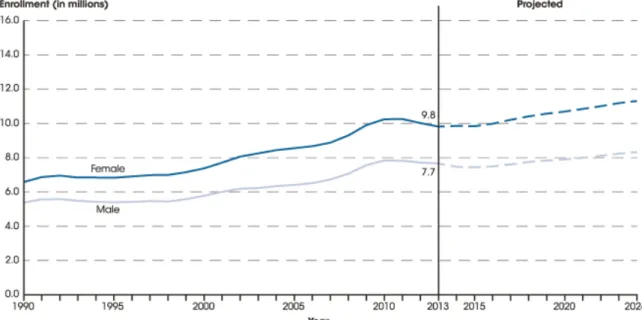
Females make up more than half of the US population, more than half of the college and university population (see Figure 1), but have (only recently) accounted for about 19.1% of all students receiving Engineering degrees in the United States in 2014 (“Engineering by the Numbers”, by Brian L. Yoder, ASEE website at www.asee.org/colleges). If the United States is to remain competitive globally, this nation must now utilize every segment of its population to buttress its Engineering ranks. Women of all ethnic and racial groups now comprise the largest segment of the population. This demographic must be targeted for the sake of preserving this country’s place in the world technologically. Importantly, the focus must be on recruiting women specifically into Engineering disciplines.
In a recent paper by Randal S. Olson of the University of Pennsylvania, he cites that most STEM majors
Technology disciplines. This is borne out by just looking at the ASEE graduation rate data by Yoder, previously cited.
Figure 1. Actual and projected undergraduate enrollment in degree-granting postsecondary institutions, by sex: Fall 1990–2024
NOTE: Data include unclassified undergraduate students. Data through 1995 are for institutions of higher education, while later data are for degree-granting institutions. Degree-granting institutions grant
associate's or higher degrees and participate in Title IV federal financial aid programs. The degree-granting classification is very similar to the earlier higher education classification, but it includes more 2-year colleges and excludes a few higher education institutions that did not grant degrees. Projections are based on data through 2013. Some data have been revised from previously published figures.
SOURCE: U.S. Department of Education, National Center for Education Statistics, Integrated
Postsecondary Education Data System (IPEDS), "Fall Enrollment Survey" (IPEDS-EF:90-99); IPEDS Spring 2001 through Spring 2014, Enrollment component. See Digest of Education Statistics 2014, table 303.70.
Based on information obtained from the WEB pages of Clemson University and University of South Carolina Colleges of Engineering, each school enrolls about 23% females in their respective colleges of Engineering. However from its lone Engineering program, South Carolina State University has
graduated over 43% females in its classes since 2006, and about one third of these continue on to advanced degree programs in Engineering. Photos 1 and 2 below show the two largest graduating classes in Nuclear Engineering to date. In the class of May 2011, one third of the graduates (including the top graduate) were females; in the class of May, 2014, two thirds of the class were females, three of whom graduated with highest honors.
Photo1. SC State Nuclear Engineering Graduating Class, May 2011.
Class composition: five African American males, three African American females. One female is from Atlanta, one is from Maryland, and the third is from Orangeburg, S.C.
Photo 2. SC State Nuclear Engineering Graduating May, 2014
Class Composition: 6 African American Females, 2 foreign nationals, 1 African American Male. 3 of these females are from the state of Georgia, 2 from South Carolina, 1 from North Carolina.
The chart below shows the overall percentage of female and male graduates since the Nuclear Engineering program produced its first graduate in 2006. Males did not outnumber Females until the class of 2015.
A deliberate effort is made by the Nuclear Engineering program to recruit women with high math aptitudes into the Nuclear Engineering program, and this same effort will be made to recruit women into the Civil Engineering program. In fact, in recent years, the top performing students in the Civil Engineering Technology program have been females (2006, 2008, 2010, 2011, 2014).
The chart below shows the relative percentages of in-state female Nuclear Engineering graduates to those from out-of state. The largest out-of-state group of female graduates is from the state of Georgia (4), mainly from the Augusta area. SC State participates in Augusta’s CSRA College Night event every year. This major recruiting event typically draws 6000-8000 high school seniors and juniors, and has been fertile ground for garnering very strong students. The second largest out-of-state group is from the state of North Carolina (2). SC State has a yearly presence at the Campus Connections pre-college program, which is held in late summer in Charlotte, North Carolina.
43% 57%
Graduates of the Nuclear Eningeering
Program 2006-2015
Female Male
Recruiting “Legacy” Students and African American Students from South Carolina Who Are Choosing to Study at NC A & T, FAMU, or Tuskegee University over South Carolina Universities
One of the major arguments made by “legacy” students and native African American South Carolina students who would otherwise attend South Carolina State is that a full Engineering program (other than Nuclear) did not exist at this university. With the recent approval to offer Industrial Engineering, the inclusion of a Civil Engineering program at South Carolina State will undoubtedly reverse the trend of native students seeking to major in Engineering from selecting North Carolina A & T, Florida A & M, and Tuskegee Universities. African American students opting to attend these out-of-state schools generally do not desire to attend either Clemson or South Carolina, even though they may have been recruited and/or admitted to these schools. Thus, South Carolina State University would now provide the in-state alternative for such students. In recent experience, this amounts to 1-2 well-qualified students per year from Orangeburg-Wilkinson High School alone.