Page 1
IOLAN+,
IOLAN+ Rack &
IOLAN+ 102/104
User guide
Part number: 5500054-19Date: 29 April 2004
Navigating around this manual
Using this on-line manual. See page 5.
Fast Contents. See page 7.
Contents. See page 8.
The menu interface. See page 125.
Index. See page 224.
Page 2
Copyright statement
This document must not be reproduced in any way whatsoever, either printed or electronically, without the consent of:
Perle Systems Europe Limited, 3, Wintersells Road,
Byfleet, Surrey KT14 7LF, UK
Perle reserves the right to make changes without further notice, to any products to improve reliability, function or design.
Specialix, the Specialix logo, IOLAN+, IOLAN+ Rack, IOLAN+ 102/104, JETSTREAM, JETSTREAM4000, JETSTREAM8500 and LANSTREAM2000 are trademarks of Perle Systems Limited.
Microsoft, Windows 95, Windows 98, Windows NT, Windows 2000 and Internet Explorer are trademarks of Microsoft Corporation.
Netscape is a trademark of Netscape Communications Corporation.
Solaris is a registered trademark of Sun Microsystems, Inc. in the USA and other countries. Perle Systems Limited, 30 April 2004.
Page 3
FCC Note
The products described in this manual have been found to comply with the limits for a Class A digital device, pursuant to Part 15 of the FCC rules. These limits are designed to provide reasonable protection against harmful interference when the equipment is operated in a commercial environment. This equipment generates, uses and can radiate radio frequency energy and, if not installed and used in accordance with the instructions in this Guide, may cause harmful interference to radio communications. Operation of this equipment in a residential area is likely to cause harmful interference, in which case the user will be required to correct the interference at his/her own expense.
EN 55022: 1998, Class A Note
Warning: This is a Class A product. In a domestic environment this product may cause radio interference in which case the user may be required to take adequate measures.
IOLAN+, IOLAN+ Rack & IOLAN+ 102/104 User guide Purpose of this manual
Page 4 IOLAN+, IOLAN+ Rack & IOLAN+ 102/104 User guide
About this manual
Purpose of this manual
This manual tells you how to install, configure and use the Perle IOLAN+ communications servers.
Who this manual is for
This manual is aimed at users who want to connect serial devices directly to LANs and WANs. This manual requires a working knowledge of using personal computers and associated operating systems, as well as experience in installing host cards and peripherals.
IOLAN+, IOLAN+ Rack & IOLAN+ 102/104 User guide Using this on-line manual
Page 5
Using this on-line manual
The following is a brief guide to using this manual on-line.
Document navigation
This manual features document navigation hypertext buttons in the header area as shown in the next picture;
Hypertext jumps
You can also navigate around this manual by clicking on any cross reference or text in blue for example, Hypertext jumps.
Jump to Using this on-line manual
Jump to Index
Jump to menu guide
Jump to previous location
Jump to front of current chapter
Jump to Contents
Jump to Fast contents
Note
The Fast Contents, Contents and Index entries are all hypertext jumps into this manual.
Page 6
Revision history
Date Part number Description
July 2001 5500054-10 Initial re-branded release of manual. October 2001 5500054-11 Minor update for Vmodem. April 2002 5500054-12 Update for 10/100 Ethernet support. June 2002 5500054-13 Updated RS422 pinout information.
August 2002 5500054-14 Removed reset switch in manual content and changed reset procedures. September 2002 5500054-15 Minor changes to software and diagnostics sections from “T” release software. October 2002 5500054-16 Added note regarding legacy reset procedures.
October 2003 5500054-17 Added cable ordering information as standard Perle accessory. November 2003 5500054-18 Added UDP supporting documentation.
Page 7
Fast Contents
A
BOUTTHISMANUAL...4
R
EVISIONHISTORY...6
F
ASTC
ONTENTS...7
C
ONTENTS...8
C
HAPTER1 I
NTRODUCTION...26
C
HAPTER2 I
NSTALLATION...36
C
HAPTER3 T
ERMINALSONMUTLI-
USERSYSTEMS...54
C
HAPTER4 S
ETTINGUPDIAL-
INMODEMPORTS...62
C
HAPTER5 M
ODEMAUTHENTICATIONANDLOGGING...70
C
HAPTER6 D
IALOUTMODEMPORTSSETUP...79
C
HAPTER7 V
MODEM(V
IRTUALMODEM) ...89
C
HAPTER8 P
RINTING...98
C
HAPTER9 O
THERDEVICESSETUP...114
C
HAPTER10 T
HEMENUINTERFACE...125
A
PPENDIXA C
OMMANDL
INEI
NTERFACE...160
A
PPENDIXB RS-422 IOLAN+ ...173
A
PPENDIXC 48V DC IOLAN+ R
ACK...178
A
PPENDIXD T
ROUBLESHOOTING...185
A
PPENDIXE C
ABLING...204
A
PPENDIXF C
ONTACTINGP
ERLE...217
Page 8
Contents
A
BOUT
THIS
MANUAL
... 4
Purpose of this manual ...4
Who this manual is for ...4
Using this on-line manual ...5
Document navigation ...5
Hypertext jumps ...5
R
EVISION
HISTORY
... 6
F
AST
C
ONTENTS
... 7
Page 9
C
HAPTER
1 I
NTRODUCTION
26
About the IOLAN+ ...27
IOLAN+ Features ...29
Hardware ...29
Software ...30
Security ...31
Hardware Overview ...32
Hardware description for IOLAN+ ...32
Hardware description for IOLAN+ Rack ...33
Hardware description for IOLAN+ 102/104 ...34
RS-232/RS-422 ...35
Page 10
C
HAPTER
2 I
NSTALLATION
36
Connecting to your Network ...37
10BASE-T (twisted pair) ...37
10BASE2 (Thin Ethernet) ...37
AUI port...37
10/100BASE-T ...37
Switching on IOLAN+ ...38
Communicating via ARP ...39
Communicating via a Terminal or PC ...40
The Menu System ...41
Connections Menu ...43
Administration Menu ...44
Server Configuration Menu ...46
Port Setup Menu and Beyond...48
Tips ...50
Copy Command ...50
Connecting via BOOTP (for Unix systems only) ...50
Saving and downloading configurations ...52
Domain Name Server (DNS) ...53
Reassigning IOLAN+ to a New Network ...53
Page 11
C
HAPTER
3 T
ERMINALS
ON
MUTLI
-
USER
SYSTEMS
54
Introduction ...55
Terminal Port Configuration ...56
Host Table Setup ...58
Making a Connection ...59
Tips ...61
Connecting via ‘fixed ttys’ ...61
Multisessions on terminals/PCs ...61
Page 12
C
HAPTER
4 S
ETTING
UP
DIAL
-
IN
MODEM
PORTS
62
Introduction ...63
Dial-in Port ...64
The host ...66
The modem ...67
Client login ...68
Tips ...69
Domain Name Server (DNS) ...69
WINS Server ...69
MOTD ...69
Page 13
C
HAPTER
5 M
ODEM
AUTHENTICATION
AND
LOGGING
70
Introduction ...71
User authentication/logging ...72
The host ...75
Basic authentication...75
User services authentication...75
Logging ...77
Page 14
C
HAPTER
6 D
IALOUT
MODEM
PORTS
SETUP
79
Introduction ...80
Configuration ...81
The host ...82
For dial-out connections on Unix ...82
For dial-out connections on Windows ® systems ...82
Routing ...83
Remote Access Systems ...84
Dial-out PAP Authentication...86
Remote site devices ...87
Page 15
C
HAPTER
7 V
MODEM
(V
IRTUAL
MODEM
)
89
About Vmodem (Virtual modem) ...90
Configuring ports to use Vmodem ...91
Configuring ports to use Vmodem in Normal Mode ...91
Making a Call using Vmodem in Normal Mode ... 93
Disconnecting a Call in Vmodem Normal Mode ... 93
Configuring Vmodem to use Dial on DTR mode...94
Making a Call using Vmodem in Dial on DTR Mode ... 95
Disconnecting a Call in Vmodem Dial on DTR Mode ... 95
Setting/Modifying up Vmodem responses ...96
Page 16
C
HAPTER
8 P
RINTING
98
Introduction ...99
Using ioland ...100
Configuration...101
The Host ...102
Using LPD ...103
Configuration...103
Accessing the Printer ...105
LPD printing from DOS/Windows ® ...106
LPD Printing from BSD Unix and Linux ...107
LPD Printing from SYS V Unix...108
LPD printing from AIX ...108
LPD printing from HP/UX ...108
Using RCP ...109
Configuration...109
The Host ...110
Using RCP with Unix System V line printer spoolers...111
RCP printing on a spooler system based on BSD Unix ...112
Page 17
C
HAPTER
9 O
THER
DEVICES
SETUP
114
Introduction ...115
Reverse Telnet Port Configuration ...116
The Host ...117
Perle IOLAND Utility ...118
Mandatory arguments ...119
Optional arguments...120
Example daemon configuration file...123
Page 18
C
HAPTER
10 T
HE
MENU
INTERFACE
125
Introduction to menu commands ...126
Toggle fields ...126
Fast keys...127
Connections menu ...128
Port setup menu ...130
Hardware ...131
User ...132
Flow control...133
IP address...134
Options...135
Keys ...136
Access ...137
Administration menu ...139
Extra statistics screens ... 140
Access menu ...141
Remote access sites...142
Remote site devices...144
Authentication/Logging ...146
Change password options ...148
Gateway menu ...149
Host Address menu ...150
Kill command ...150
Lines menu ...151
Access ...152
Flow control...152
Hardware ...152
Network connections...153
Options...153
Terminal ...154
Port menu ...154
Quit command ...154
Reboot command ...154
Server configuration menu ...155
Statistics screens ...158
Page 19
A
PPENDIX
A C
OMMAND
L
INE
I
NTERFACE
160
Introduction ...161
Using the CLI ...162
System administration ...163
Basic configuration ...164
Command descriptions ...165
arp...165
clear ...165
connect ...165
copy ...166
dial ...166
disconnect ...166
exit ...166
facreset ...166
gateway...166
help ...167
host ...167
kill...167
lock...167
logout ...167
prov ...167
reboot...168
resume ...168
rlogin ...168
save ...168
set ...169
set admin ...169
set menu ...169
set modem ...169
set term ...169
set port ...170
set port [number] ... 170
set port [number] [access, flow, hardware, options, tcp, user] ... 170
set server ... 170
set slip [IP address] ... 170
set ppp [IP address] ... 170
set password [admin] or [login] ... 170
Page 20 show ports ... 171 show lines ... 171 show statistics ... 171
su ...171
telnet ...171
test ...172
Page 21
A
PPENDIX
B RS-422 IOLAN+
173
Introduction ...174
Hardware Changes ...174
Connectors and Indicators ...174
RS-422 Serial Port Connections ...175
Software changes ...176
LED Error Codes ...177
Page 22
A
PPENDIX
C 48V DC IOLAN+ R
ACK
178
Introduction ...179
Installing the IOLAN+ Rack 48V DC ...180
Installation...180
Electrical Supply Details ...180
Safety Earth ...181
Fusing ...181
Electrical Safety Guidelines ...182
Connecting up your IOLAN+ Rack ...183
Disconnecting your IOLAN+ Rack ...184
Page 23
A
PPENDIX
D T
ROUBLESHOOTING
185
Introduction ...186
Terminals/PC Problems ...187
Printer Problems ...189
Modem problems ...191
IOLAN+ Still Does Not Communicate ...192
Resetting Your IOLAN+ ...193
Using the IOLAN+ Statistics screens ...194
ETH/TTY/GATEWAY...194
IP/ICMP/UDP ...195
TCP...195
Users...195
Framed Link Status ...196
Netstat...197
Gateway...197
SLIP ...197
Clear counters...197
Restore counters...198
Port Status ...198
Line status...198
LPD Status ...199
PPP Status...199
Using SNMP ...199
Diagnostics ...200
Entering the Diagnostic Menu...200
Self-test...200
Monitor ...200
Download ...201
Ethernet Interface ... 201Reset...202
Reset all settings ... 202 Reset password ... 202 Reset IP address ... 202 Reset product name ... 202 Reset Ethernet address ... 202 Quit ... 202
Page 24
A
PPENDIX
E C
ABLING
204
Introduction ...205
Serial port connectors on the IOLAN+ unit ...206
Serial port connector guide ...206
RS232 DB25 female DTE ...206
RS232 RJ45 DTE socket ...207
RS422 RJ45 DTE socket ...208
Standard modem cables ...209
IOLAN+ DB25 DTE to Modem DB25 DCE ...209
Cable diagram ... 209 Connector pinout table ... 209IOLAN+ Rack and IOLAN+ 102/104 RS232 RJ45 DTE to Modem DB25 DCE
210
Cable diagram ... 210 Connector pinout table ... 210
Standard Terminal/PC cables ...211
IOLAN+ DB25 DTE to Terminal DB25 DTE ...211
Cable diagram ... 211 Connector pinout table ... 211IOLAN+ DB25 DTE to PC DB9 DTE...212
Cable diagram ... 212 Connector pinout table ... 212
IOLAN+ Rack and IOLAN+ 102/104 RJ45 DTE to Terminal DB25 DTE...213
Cable diagram ... 213 Connector pinout table ... 213IOLAN+ Rack and IOLAN+ 102/104 RJ45 DTE to PC DB9 DTE ...214
Cable diagram ... 214 Connector pinout table ... 214Printer cables with hardware flow control ...215
IOLAN+ DB25 DTE to Printer DB25 DTE ...215
Cable diagram ... 215 Connector pinout table ... 215IOLAN+ Rack and IOLAN+ 102/104 RJ45 male to printer DB25 DTE ...216
Cable diagram ... 216 Connector pinout table ... 216
Page 25
A
PPENDIX
F C
ONTACTING
P
ERLE
217
Making a technical support query ...218
Who to contact ...218
Information needed when making a query...219
Making a support query via the Perle web page...220
Repair procedure ...221
Website RMA (Return Material Authorisation) Form...221
Feedback about this manual ...222
Contacting Perle technical support ...223
IOLAN+, IOLAN+ Rack & IOLAN+ 102/104 User guide
Page 26
Chapter 1 Introduction IOLAN+, IOLAN+ Rack & IOLAN+ 102/104
User guide
Chapter 1 Introduction
You need to read this chapter if you want to...
You need to read this chapter if you want an overview of the IOLAN+ product. This chapter provides introductory information about the Perle IOLAN+, its associated components, software and configuration utilities.
This chapter includes the following sections; • About the IOLAN+on page27
• IOLAN+ Featureson page29 • Hardware Overviewon page32
• Hardware description for IOLAN+on page32 • Hardware description for IOLAN+ Rackon page33 • Hardware description for IOLAN+ 102/104on page34 • RS-232/RS-422on page35
IOLAN+, IOLAN+ Rack & IOLAN+ 102/104 User guide About the IOLAN+
Page 27
Chapter 1 Introduction
About the IOLAN+
The IOLAN+ is a unique Ethernet TCP/IP communications / terminal server allowing serial devices to be connected directly to LANs and WANs. The 2, 4, 8 or 16 serial ports enable IOLAN+ to connect to a wide range of devices including:
• Modems for remote access and Internet access
• ISDN adapters for branch remote access and Internet access • Terminals for multi-user Unix systems
• PCs using terminal emulation or SLIP/PPP • All types of serial printers
• Data acquisition equipment (manufacturing, laboratory, etc.) • Retail point-of-sale equipment (bar coding, registers, etc.)
The performance and flexibility of IOLAN+ allows you to use a wide range of high speed devices in complex application environments. These operating systems include: • Windows ® 95/98
• Windows NT ® • Citrix Winframe • SCO Unix & Gemini • IBM AIX
• Sunsoft Solaris
• Hewlett Packard HP-UX • Data General DG/UX
IOLAN+, IOLAN+ Rack & IOLAN+ 102/104 User guide About the IOLAN+
Page 28
Chapter 1 Introduction
This configuration diagram shows many of the features available on the
IOLAN+ communications server:
NET1 32 4
IOLAN+, IOLAN+ Rack & IOLAN+ 102/104 User guide IOLAN+ Features
Page 29
Chapter 1 Introduction
IOLAN+
Features
IOLAN+ is a TCP/IP communications server with 2, 4, 8 or 16, RS-232 or RS-422 ports for making serial network connections. It attaches to your TCP/IP network and allows serial devices such as modems, terminals and printers to access the network.
Hardware
The IOLAN+ hardware features include:
• 2, 4, 8 or 16 serial lines, fully configurable with port speeds up to 115.2 kbps. • RJ45 connectors on IOLAN+ and IOLAN+ 102/104 or DB25 connectors on IOLAN+. • Full modem control using DTR, DSR, CTS, RTS and DCD.
• FLASH memory for downloading firmware releases.
• IOLAN+ 102/104 has 10BASE-T or 10/100BASE-T interfaces.
• IOLAN+ and IOLAN+ Rack have either autosensing 10BASE-T / 10BASE2 / AUI or 10/ 100BASE-T interfaces.
• Auto sensing power supply; 110-250V AC (48-60V DC option available on IOLAN+). • LEDs for diagnostic testing.
• Self-test on power-up.
IOLAN+, IOLAN+ Rack & IOLAN+ 102/104 User guide IOLAN+ Features
Page 30
Chapter 1 Introduction
Software
The IOLAN+ software features include:
• Support for TCP/IP and UDP protocols including telnet and rlogin. • Remote access support including PPP, SLIP and CSLIP.
• Printer support via lpd, rcp, and Perle utilities. • Modem support via PPP and Perle utilities.
• Perle utilities provide ‘fixed tty’ support for Unix systems.
• A window oriented menu interface with pop-up menus and on screen help (command line also available).
• ARP or BOOTP for network based setup.
• Dynamic statistics displays and line status reporting for fast problem diagnosis. • Multi screens on terminals.
• Full support of SNMP MIBs, allowing remote configuration via SNMP as well as statistics gathering.
• Interoperability with IP routing through gateway tables. • Domain Name Server support.
• WINS support for Windows ® environments. • Port configuration copy and save functions.
IOLAN+, IOLAN+ Rack & IOLAN+ 102/104 User guide IOLAN+ Features
Page 31
Chapter 1 Introduction
Security
The IOLAN+ security features include: • Supervisory and port password. • Port locking.
• Authentication with PAP support. • Per user access level assignment. • Service logging.
• Logging facility for audit and billing. • Modem auto reset.
IOLAN+, IOLAN+ Rack & IOLAN+ 102/104 User guide Hardware Overview
Page 32
Chapter 1 Introduction
Hardware Overview
The following table and diagrams describe the units:
Model
Hardware description for IOLAN+
Model Type No. Ports Connector Interface
IOLAN+ 102/104 Table Top 2,4 RJ45 RS-232,
RS-422
IOLAN+ Table Top 8,16 DB25 RS232
IOLAN+ Rack Rack Mount 4, 8, 16 RJ45 RS-232,
RS-422
Main power switch
Serial ports
Power input socket
Power indicator 10/100 BASE T socket
100 BASE T Link/Activity
IOLAN+, IOLAN+ Rack & IOLAN+ 102/104 User guide Hardware description for IOLAN+ Rack
Page 33
Chapter 1 Introduction
Hardware description for IOLAN+ Rack
I O
Main power switch
Serial ports Power input socket
10/100 BASE T socket Port activity indicator POWER
10 BASE T 100 BASE T ACTIVITY
IOLAN+, IOLAN+ Rack & IOLAN+ 102/104 User guide Hardware description for IOLAN+ 102/104
Page 34
Chapter 1 Introduction
Hardware description for IOLAN+ 102/104
Serial ports
Port activity indicators
10/100 BASE-T socket Network indicator
Power input socket Power indicator
IOLAN+, IOLAN+ Rack & IOLAN+ 102/104 User guide RS-232/RS-422
Page 35
Chapter 1 Introduction
RS-232/RS-422
Functionally, the difference between RS-232 and RS-422 versions is the absence of support for hardware flow control lines (RTS and CTS) and modem control lines (DSR, DTR and DCD) in the RS-422 version. The performance and support for 115.2k baud are unaffected by the different serial ports. RS-422 uses differential signalling and is capable of handling longer distance due to superior noise immunity when installed with suitable cabling.
Software description
The IOLAN+ comes with the Perle CD. This CD contains the latest ‘released’ firmware and the redirector software for Unix systems called ioland. The firmware is a backup copy and generally not used. The ioland software is used for setting up printers and dial-out modems on Unix. The IOLAN+ uses TFTP for downloading new firmware. tftpd is included with Unix systems such as SCO, AIX and HP-UX but disabled by default. Consult your Unix manual on this subject. On Windows ® , tftpd is not provided at this time (see our web site for a shareware tftpd program www.perle.com).
IOLAN+, IOLAN+ Rack & IOLAN+ 102/104 User guide
Page 36
Chapter 2 Installation IOLAN+, IOLAN+ Rack & IOLAN+ 102/104
User guide
Chapter 2 Installation
You need to read this chapter if you want to...
You need to read this chapter if you want information about installing your IOLAN+ product. This chapter provides information about installing the Perle IOLAN+ including connecting to your network, configuring communications as well as information on the menu system and general tips.
This chapter includes the following sections; • Connecting to your Networkon page37 • Switching on IOLAN+on page38 • Communicating via ARPon page39
• Communicating via a Terminal or PCon page40 • The Menu Systemon page41
IOLAN+, IOLAN+ Rack & IOLAN+ 102/104 User guide Connecting to your Network
Page 37
Chapter 2 Installation
Connecting to your Network
First connect IOLAN+ to a network then begin configuring the unit for your application. Additional information on configuring modems and printers follows.
IOLAN+ and IOLAN+ Rack connect to your ethernet network via one of the following (depending on your hardware model):
• Auto-sensing 10BASE-T (twisted pair) • Auto-sensing 10BASE2 (thin) • Auto-sensing AUI
• 10/100BASET
IOLAN+ 102/104 connect using either: • 10BASE-T (twisted pair)
• 10/100BASE-T
10BASE-T (twisted pair)
Attach the RJ connector from a hub directly to IOLAN+ twisted pair port.
10BASE2 (Thin Ethernet)
Attach a BNC T connector directly to IOLAN+. If your IOLAN+ is the termination point for the cable you need to add a terminator. Always ensure that each segment of the thin Ethernet cable is at least 0.5m in length. The maximum length for a thin Ethernet cable is 185 metres.
AUI port
The AUI connector allows an external transceiver to be connected. This allows a number of different interfaces to connect including 10BASE5 (or thick) and fibre optic transceivers. Attach the RJ45 connector from a hub directly to the IOLAN+ port.
10/100BASE-T
IOLAN+, IOLAN+ Rack & IOLAN+ 102/104 User guide Switching on IOLAN+
Page 38
Chapter 2 Installation
Switching on IOLAN+
The IOLAN+ power supply accepts input voltages in the range 110 to 240V AC, allowing it to be used world-wide. The IOLAN+ 102/104 has an external power supply unit.
After you connect your LAN interface, you can power up the unit. The green power indicator at the side (or front for rack and 102/104 units) should be lit. If the unit fails to power up with the green power indicator lit, disconnect the unit and contact your dealer for help.
The IOLAN+ firmware may be compressed, and this takes a short time to decompress before running.
During this phase the network LEDs will light alternately to indicate that decompression is in progress.
The green Ethernet indicators show the active connections. It remains lit and blinks when LAN traffic is active.
If your unit has 10BASE-T, 10BASE2 and AUI connectors, then the green ethernet indicators show the active connection. The indicators remain lit and blink when LAN traffic is active. If you have an IOLAN+ Rack unit with 10/100BASE-T, then the Ethernet indicators will light green to indicate either 10Mbit or 100Mbit link, and the Activity light flickers to indicate LAN traffic.
If you have an IOLAN+ or IOLAN+102/104 with 10/100BASE-T, then the Ethernet will light green to indicate a 100Mbit link, and orange to indicate a 10Mbit link. The LED will flicker to show LAN traffic.
You are now ready to begin communicating with your IOLAN+. You can connect to IOLAN+ in different ways: via a terminal or PC on port 1, or using ARP or BOOTP. Using ARP is the preferred method for both Windows ® and Unix, however a terminal or PC attached to port 1 is often used.
BOOTP setup is for Unix users only. Choose the appropriate method for your application. Third party BOOTP packages are available for Windows ®
Note:
IOLAN+, IOLAN+ Rack & IOLAN+ 102/104 User guide Communicating via ARP
Page 39
Chapter 2 Installation
Communicating via ARP
IOLAN+ supports the ‘Address Resolution Protocol’ (ARP). It allows you to temporarily connect to your IOLAN+ to assign a permanent IP address. If you prefer to use a terminal or PC attached to IOLAN+, skip to the next section.
To do this proceed as follows;
1. From a local Unix host, type the following:
arp -s a.b.c.d aa:bb:cc:dd:ee:ff
(where a.b.c.d is the IP address you want for IOLAN+, and aa:bb:cc:dd:ee:ff is the Ethernet address of IOLAN+, found on the bottom of the unit itself).
2. On a Windows ® NT/98 system, the arp command is slightly different (using dashes instead of colons):
arp -s a.b.c.d aa-bb-cc-dd-ee-ff
3. Whether you use Unix or Windows ® to run arp, you are now ready to telnet to IOLAN+. Here is the sequence to use:
arp -s 192.168.209.8 00:80:d4:00:33:4e telnet 192.168.209.8
password> local>
4. At the password prompt, press the Enter key since this is not set yet. The IP address still needs to be configured on the unit (ARP has only allowed you to connect to the unit so far).
You can now skip the next section and go straight to The Menu Systemon page41 Note
If there are any errors, recheck both the IP and Ethernet addresses you keyed in (this is the most common error here). See Appendix D Troubleshooting for more information on problems.
IOLAN+, IOLAN+ Rack & IOLAN+ 102/104 User guide Communicating via a Terminal or PC
Page 40
Chapter 2 Installation
Communicating via a Terminal or PC
You can connect to IOLAN+ using a terminal or PC (with a terminal emulation package such as Hyperterm).
1. Connect a terminal or your PC to port 1. The IOLAN+ serial ports are DTE type RS-232 ports. When connecting a terminal/ PC directly (without modems), the RS-232 signals need to be crossed over (‘null modem’ cable). See Appendix E Cabling for pinout information.
2. For a terminal/PC to communicate with a server, set it to the following: 9.6 kbps, eight data bits, one stop bit, software flow control, no parity.
After powering up IOLAN+, you are prompted to enter a ‘Local login:>‘. 3. You can just hit any character and at this point (the character is required).
The next prompt displayed is local>, which is the Command Line Interface (CLI) prompt.
You can now move to The Menu System. See The Menu Systemon page41. Note
If there are any problems, check the cable you are using (this is the most common error). Port 1 is configured to provide error messages should any problems occur. See Appendix D Troubleshooting for more information on problems.
IOLAN+, IOLAN+ Rack & IOLAN+ 102/104 User guide The Menu System
Page 41
Chapter 2 Installation
The Menu System
You should now be at the Command Line Interface (CLI) of the IOLAN+ as designated by the local> prompt. If you would like to continue in CLI mode refer to Appendix A Command Line Interface, but we recommend the menu system.
1. Set the terminal emulation type and begin using the menus. The following are the terminal options:
ansi, dumb, vt100, wyse50, wyse60, tvi925, ibm3151, vt320, falco50, hp700
2. The default setting is ‘dumb’. To set the menu interface to your emulation simply type set term with your option.
Example:
local> set term ansi
3. To switch from the command line interface to the menu interface, at the local> prompt enter:
set menu
Note
IOLAN+, IOLAN+ Rack & IOLAN+ 102/104 User guide The Menu System
Page 42
Chapter 2 Installation
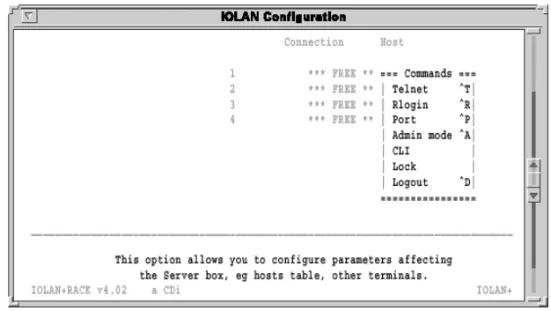
The Connections Menu should now be displayed.
This menu displays the current state of the four possible connections. There are no active connections.
The firmware version of IOLAN+ is located on the lower left hand portion. The wording ‘REMOTE-ADMIN’ in the upper right signifies you are remotely telneted into IOLAN+ (and will read ‘Terminal: 1’ if you are using a terminal/PC into port 1.)
The keys used to move about in the menus depend on the terminal emulation you are using. The arrow keys should all work. The TAB key is very important for moving between fields. Backspace and DEL should work, but depend on the emulation.
ESC (the escape key) will move you back one menu.
An accelerator key can be used to jump to an option within a menu and is the first letter of the option.
Note
If there is a problem with your emulation, you can try a different emulation mode. See Appendix D Troubleshootingfor more information.
IOLAN+, IOLAN+ Rack & IOLAN+ 102/104 User guide The Menu System
Page 43
Chapter 2 Installation
Connections Menu
Select connection '1’ on the Connections Menu and press the Enter key. The Commands pop-up menu is displayed. There are a number of options available from this menu.
Before communication across the network can be established the IOLAN+ must be assigned a network IP address. This is accessed through the Administration Menu.
Select the Admin mode field and press the Enter key.
Note
If you are telneted into IOLAN+, the telnet, rlogin and port options do not appear on the Commands pop-up menu.
IOLAN+, IOLAN+ Rack & IOLAN+ 102/104 User guide The Menu System
Page 44
Chapter 2 Installation
Administration Menu
The top level Administration Menu appears as follows:
1. Select the Password field and press the Enter key. Use the factory default password here: this is iolan (no caps).
The Administration Menu is redisplayed, it now has some extra fields (access, change, kill, reboot, trap).
Note:
This password level will time-out in four minutes if there is no activity. This is for security reasons and will take you back to Administration Menu (view level).
IOLAN+, IOLAN+ Rack & IOLAN+ 102/104 User guide The Menu System
Page 45
Chapter 2 Installation
2. Select the server entry and press the Enter key. This takes you into the Server Configuration Menu.
IOLAN+, IOLAN+ Rack & IOLAN+ 102/104 User guide The Menu System
Page 46
Chapter 2 Installation
Server Configuration Menu
There are a number of fields in the Server Configuration menu which are explained in Chapter 10 The menu interface. At this point proceed as follows;
1. Give the IOLAN+ an IP address and a name.
2. The important fields that you need to fill in are as follows:
Name: In the example above the communications server name has been set to IOLAN. It is a good idea for the IOLAN+ name entered here to match the name entered in the host machine’s domain name server.
IP Address: This address must be set to a value that is consistent with the network the IOLAN+ is on.
3. Having filled in the fields press the Enter key. This brings the Commands pop-up menu as shown in the next picture.
Note
For more information about domain name servers, consult your operating system manuals.
Note
The Ethernet address is factory set. This address is uniquely assigned to the IOLAN+ and MUST NOT be changed.
IOLAN+, IOLAN+ Rack & IOLAN+ 102/104 User guide The Menu System
Page 47
Chapter 2 Installation
4. Select the Save & Exit field and press the Enter key. Other options are Quit & Exit, which does not save the changes before exiting this menu, Values, which will display the optional values for this field if available, and Cancel, which will take you back to this screen for more editing.
5. You have now set up the unit with a new IP address. This should be confirmed with the message:
IP CHANGED—PLEASE REBOOT
6. Reboot the communications server to activate the new IP address using the reboot command. The IP address and/or subnet mask are the only parameters that when changed necessitate rebooting.
IOLAN+, IOLAN+ Rack & IOLAN+ 102/104 User guide The Menu System
Page 48
Chapter 2 Installation
Port Setup Menu and Beyond
Your communications server is now ready to configure for terminals on multi-user systems or modems, printers and other devices. The next sections deal with each of these.
If you’ve got a good feel for the menu system, you should proceed to the section appropriate for your application.
If you’d like a full review of the menu system refer to section 9, The Menu Interface later in this guide. For more information about the Command Line mode, consult Appendix A Command Line Interface.
All of the procedures are based around the Port Setup Menu. This is accessed through the Administration Menu (password level). Remember, that if you are not in the password level, you can only view the information, not change it.
Here is the Port Setup Menu:
This menu allows the user to set up all the parameters associated with a port. The
administrator can alter the set-up of any port on the communications server while a user can only alter the set-up for their own port.
IOLAN+, IOLAN+ Rack & IOLAN+ 102/104 User guide The Menu System
Page 49
Chapter 2 Installation
This menu is divided into the following sections:
If you’re ready to install terminals, printers and modems, proceed to the appropriate section. For a good review, go to Chapter 10 The menu interface.
Menu option Description
Hardware Defines port type and is used for setting up the hardware configuration of the modem, terminal, printer or PC session. This section is always used.
User Defines various user parameters such as name and terminal type. Most fields are used in this section.
Flow Control Defines the various flow control options used by IOLAN+. This section is always used.
IP Addresses Deals with remote access via PPP/SLIP sessions.
Options Deals mainly with the telnet options. This section is the least used. Keys Defines the various accelerator keys that IOLAN+ responds to and can
be used for convenience.
Access Controls the type of the connection made from this port. This is the most important section in defining a port.
IOLAN+, IOLAN+ Rack & IOLAN+ 102/104 User guide Tips Page 50 Chapter 2 Installation
Tips
Copy Command
IOLAN+ has a copy command that allows you to copy the setup of one port to another. You will need to get to the CLI (from the Connection menu) and use the following syntax.
Connecting via BOOTP (for Unix systems only)
IOLAN+ supports BOOTP which allows the communications server to dynamically configure itself on startup. Upon startup IOLAN+ sends four BOOTP broadcast requests if it has no IP address. This broadcast request packet contains the Ethernet address of your unit.
The request is received by all hosts on the network and is checked against a file to find a match. This data base file will normally be /etc/bootptab and will be of the following format:
# bootptab description iolan:ht=ethernet:ha=0080d400024e:\ :hd=/tftp:\ :bf=iolan.DL:\ :ip=192.168.209.8: Where:
ht is the type of network
ha is the Ethernet address on back of IOLAN+
hd is the home directory for specifying IOLAN+ firmware (optional) Note:
To get back to the menu system once in the CLI, type set menu at the command line.
local> su password>
ADMIN:local> copy 1 2 3 4 5 ADMIN:local> set menu
The commands above would copy the configuration of port number 1 to ports 2, 3, 4 and 5 (and return you to the menu system).
IOLAN+, IOLAN+ Rack & IOLAN+ 102/104 User guide Tips
Page 51
Chapter 2 Installation
bf is the name of IOLAN+ firmware (optional)
ip is the IP address you want to use
You can now move back to The Menu System in this chapter. Note
This BOOTP implementation is a subset and not a full implementation of the RFC.
Note
The most common error is bad information in the /etc/bootptab file (recheck it). See Appendix D Troubleshooting for more information.
IOLAN+, IOLAN+ Rack & IOLAN+ 102/104 User guide Tips
Page 52
Chapter 2 Installation
Saving and downloading configurations
It is possible to save the configuration of your IOLAN+. This is convenient for loading multiple communications servers with the same setup. It is also advisable as a backup method. If the boot file name has the extension “.cfg” (eg iolan.cfg), it will be loaded as a configuration file rather than a boot file.
This allows the administrator to configure one IOLAN+, save its configuration and automatically configure subsequent units via bootp.
Should the configuration of your IOLAN+ ever be corrupted because of user error or damage, it is an advantage to have the configuration stored somewhere for easy re-installation.
This can be achieved by uploading the configuration of the unit to a host on the network. To do this, enter the Communications Server Menu from the Administration Menu. Select the Init file entry of this menu.
Set this to the full pathname of the file in which you wish to store the configuration. Set Boot host to the host machine you wish the file to reside within and save these entries.
Boot host: rockvegas (or ip address) Init file: /tftp/term_serv.cfg
Log onto the host machine in the normal manner and create the file you have specified in the IOLAN+ menu, this could be as shown in the next picture:
touch term_serv.cfg
Note
This file must exist with the correct read/write permissions before you can write to it.This can be accomplished by pressing the Enter key and selecting the CLI option in the pop up menu. At the iolan> prompt, use the CLI as the administrator by typing:
su
and enter the password and type: save config
This uploads the communications server port configurations to the host in a format that can be downloaded at a later date.
Note
This does not save any of the settings configured in the Server Configuration Menu, including the IP address, language, name, subnet mask, etc.
IOLAN+, IOLAN+ Rack & IOLAN+ 102/104 User guide Tips
Page 53
Chapter 2 Installation
IOLAN+ will now automatically download this configuration on reboot. Remember that whenever you change a setting on the unit, it will be overwritten the next time the unit is rebooted unless the new configuration is saved.
Domain Name Server (DNS)
IOLAN+ can be configured to take advantage of your network’s Domain Name Server (DNS). This is done from the server in the Administration Menu by keying in the IP address of your DNS in the Name server field. Fill in the Domain name field as well.
Reassigning IOLAN+ to a New Network
If you need to attach IOLAN+ to a different network with a new IP address, it is possible to reset it to factory default condition using the following procedure:
1. Connect your IOLAN+ unit to the new network.
2. Power on the unit, and connect to a CLI using a serial terminal. 3. At the command prompt, type the following:
Local> su Password>
ADMIN:Local> facreset
Do you really want to do this (y/n) [n] ? y Performing factory reset ...
The IOLAN+ unit will now reboot and begin sending BOOTP request packet on the new network.
This procedure is useful for factory defaulting units which cannot be reached via TCP/IP. This includes reassigning a programmed unit to a network to which the previously assigned IP address does not belong.
Updating IOLAN+ Firmware
Firmware can be downloaded across the network using tftp protocol if the host machine and file name are set in the boot host and boot file entries of the server menu. These entries are checked at start up and if they have been configured, the relevant file will be downloaded.
Note:
IOLAN+, IOLAN+ Rack & IOLAN+ 102/104 User guide
Page 54
Chapter 3 Terminals on mutli-user systems IOLAN+, IOLAN+ Rack & IOLAN+ 102/104
User guide
Chapter 3 Terminals on mutli-user systems
You need to read this chapter if you want to...
You need to read this chapter if you want information on setting up a terminal for use with your IOLAN+ product.
This chapter provides information on how to setup a terminal, and other tips such as the concept of ‘fixed ttys’, multiscreens, the copy command, TERM features, etc.
This chapter includes the following sections; • Introductionon page55
• Terminal Port Configurationon page56 • Host Table Setupon page58
• Making a Connectionon page59 • Tipson page61
IOLAN+, IOLAN+ Rack & IOLAN+ 102/104 User guide Introduction
Page 55
Chapter 3 Terminals on mutli-user systems
Introduction
IOLAN+ is used extensively for connecting terminals, printers and modems on multi-user Unix systems, especially in retail applications. These Unix systems include SCO Unix, IBM AIX, HP-UX, Data General’s DG/UX, etc. This chapter deals with terminals and/or PCs using emulation packages (such as Hyperterm).
In many applications, the users need to be ‘direct connected’ to a specific Unix host so that they see the login prompt automatically. This is helpful in securing your system, or in environments where the users need to be in one application only.
This chapter will show how to setup a terminal, and other tips such as the concept of ‘fixed ttys’, multi screens, the copy command, TERM features, etc. Consult Appendix E Cabling, for information on wiring your terminal.
Remember to use the TAB key to bounce between fields, and if you get the Commands exit menu by mistake, use Cancel to return to editing this menu.
IOLAN+, IOLAN+ Rack & IOLAN+ 102/104 User guide Terminal Port Configuration
Page 56
Chapter 3 Terminals on mutli-user systems
Terminal Port Configuration
This is the setup for making a terminal connect to a designated Unix host login prompt automatically.
The following fields are important:
Menu
option Description
Access Set this field to Local. This tells the terminal server port to listen for data on the RS-232 side.
Mode With this field set to telnet, the port will operate in telnet mode (or raw for rlogin). Most systems will use telnet.
Connection Set this field to Initiated and the port will establish a TCP/IP connection to a specified host only after receiving a <CR> on the RS-232 port. If you set this field to none, then the user of this port will see the menu system when the terminal is powered on.
Host Use this field to define which host computer you want the port to automatically connect to when using Initiated connections. Use the host’s IP address or if you setup the Host Address Menu, you can use a name.
IOLAN+, IOLAN+ Rack & IOLAN+ 102/104 User guide Terminal Port Configuration
Page 57
Chapter 3 Terminals on mutli-user systems
Remote Port This corresponds to Telnet service on the remote host and must be set to the standard 23 (or 513 for rlogin).
Monitor DSR You can set this field to Yes if you wire the terminal’s DTR signal pin 20 (DB25) to the IOLAN+'s DSR signal pin 3 on the RJ45 connector ( see Appendix E Cabling for DB25 pin assignments). When you turn the terminal off, it will reset the IOLAN+ port, which tells the Unix host to kill the user’s processes.
Menu
IOLAN+, IOLAN+ Rack & IOLAN+ 102/104 User guide Host Table Setup
Page 58
Chapter 3 Terminals on mutli-user systems
Host Table Setup
In order for IOLAN+ to connect easily to machines on the network it must know the IP addresses of the other computers. IOLAN+ can have its own internal table of IP addresses set up in the host table. This is a ‘local’ naming system only. IOLAN+ can also use the name server utility of your Unix system (consult your Unix system manual and Tipson page61). The Host Address Menu is accessed from the Administration Menu by selecting the host entry. The host table can contain up to 10 addresses. Each entry consists of a host name and its corresponding IP address.
You can fill in an entry (both the name and the IP Address) for your host machines and then save the values by pressing the Enter key.
IOLAN+, IOLAN+ Rack & IOLAN+ 102/104 User guide Making a Connection
Page 59
Chapter 3 Terminals on mutli-user systems
Making a Connection
If you are using initiated connections, you will not see the IOLAN+ menus. Instead, you see the login prompt of the host you assigned in the host field of the Port Setup Menu.
However, if your connection field is set to None, the Connections Menu appears. You are now ready to make connections. From the Connections Menu press the Enter key on a *** FREE *** session to display the Commands menu. Select the Telnet field and press the Enter key.
This produces a pop-up menu allowing the choice of the host machines that are configured in the host table. To select a host, move the cursor down to the required name then press the Enter key. At this point the unit attempts to make a connection across the network to the indicated host using the telnet protocol.
If it succeeds, the host machine’s login prompt is displayed. There may be an error in the configuration if the connection cannot be established.
While in session to the host machine, you can return to the communications server by using a hot key. This is user-defined, but defaults to ^]. Press this key and the Connections Menu is displayed. To resume your connection select the host session you were on (notice that the
Note
At this point, check the host table again for correct entries, then check the network connection and host machine you’re connecting to.
IOLAN+, IOLAN+ Rack & IOLAN+ 102/104 User guide Making a Connection
Page 60
Chapter 3 Terminals on mutli-user systems
name of the host is now displayed where *** FREE *** was). Press the Enter key to bring up the Connection pop-up menu, then select the Resume Connection option.
When logging out of your session the connection is automatically closed. Note
If the ^] did not work, you might have a conflict with that character sequence and should check the Keys section of this port.
IOLAN+, IOLAN+ Rack & IOLAN+ 102/104 User guide Tips
Page 61
Chapter 3 Terminals on mutli-user systems
Tips
Connecting via ‘fixed ttys’
IOLAN+ has the ability to create a ‘fixed tty’ under Unix. This is helpful for older or secure Unix applications that require a fixed location for each terminal. Consult Chapter 9 Other devices setup.
Multisessions on terminals/PCs
IOLAN+ is capable of supporting multiple sessions. This allows the user to connect to all four *** FREE *** sessions with different hosts and move between them using the ^] hot key. You can also key through the screens by setting the session key (that is, If set to ^A you would bounce through the screens with a ^A1, ^A2, ^A3, ^A4.). If you are using a terminal that supports video pages such as the Wyse 60, the screens will be refreshed if you set the video pages field on the Port Menu to the number of pages supported by your terminal (for Wyse 60 = 3).
The TERM field The TERM field in the Port Setup Menu can be used to pass the terminal type information to the host. The terminal type field is local to the IOLAN+ but will be passed to the host.
The TERM field can override the information being sent to the host about the type of terminal. This allows you to customise information being passed to the host. For example, a user could encode the physical location into this field (that is, tty16) and then extract that at the host end to determine which port the user has logged in on (that is, port 16).
Gateway Tables
When the host and IOLAN+ are connected via a gateway router, a connection is not possible until the gateway table has been updated with the IP address of the local gateway machine. See Gateway Menuon page149 in Chapter 10 The menu interface.
IOLAN+, IOLAN+ Rack & IOLAN+ 102/104 User guide
Page 62
Chapter 4 Setting up dial-in modem ports IOLAN+, IOLAN+ Rack & IOLAN+ 102/104
User guide
Chapter 4 Setting up dial-in modem ports
You need to read this chapter if you want to...
You need to read this chapter if you want information on creating dial-in connections with your IOLAN+ product.
This chapter provides information on the configuration necessary to create dial-in
connections. It includes the most simple connection such as a dial-in Unix connection, The setting up PPP ports which is how Windows ® systems dial-in (as well as Unix).
This chapter includes the following sections; • Introductionon page63
• Dial-in Porton page64 • The hoston page66 • The modemon page67 • Client loginon page68 • Tipson page69.
IOLAN+, IOLAN+ Rack & IOLAN+ 102/104 User guide Introduction
Page 63
Chapter 4 Setting up dial-in modem ports
Introduction
This chapter will review the configuration necessary to create dial-in connections. It will start with the most simple connection such as a dial-in Unix connection. The chapter then moves into setting up PPP ports which is how Windows ® systems dial-in (as well as Unix). This is very important if you are an Internet Service Provider (ISP) or a corporate site providing remote access or Internet/Intranet access.
IOLAN+ can make a very good dial-in solution for ISPs and corporate users alike by using its remote access facilities.
This chapter goes hand-in-hand with Chapter 5 Modem authentication and logging.
Note
In many of the modem examples, we are using PPP. You can use SLIP and CSLIP in those applications requiring these legacy modes.
IOLAN+, IOLAN+ Rack & IOLAN+ 102/104 User guide Dial-in Port
Page 64
Chapter 4 Setting up dial-in modem ports
Dial-in Port
The following is the port configuration for a dial-in connection, including PPP.
The following fields are important:
Option Description
Monitor DCD With this flag set to Yes, IOLAN+ will monitor Data Carrier Detect (DCD) - pin 8 - from the modem. As soon as your modem answers a call and establishes a carrier signal, the modem raises DCD. The terminal server will then establish a telnet/rlogin connection to a specified host. When the modem hangs up, DCD goes low and the terminal server port resets. This will also drop the connection to the host.
TERM This field is the TERM environment variable.Whatever you type in here will be passed to the host as the TERM variable when a telnet connection is established and the user logs in.
Flow Ctrl The modem and terminal server port should be configured to use Hardware (RTS/CTS) flow control. This will be especially important if you are using SLIP.
IOLAN+, IOLAN+ Rack & IOLAN+ 102/104 User guide Dial-in Port
Page 65
Chapter 4 Setting up dial-in modem ports
Dst: This field contains the IP address the dial-in user will borrow for the PPP session. If you are using a straight forward dial-in connection for Unix, this is not required.
Mask If using PPP, SLIP or CSLIP, this is the subnet mask that controls the range of IP addresses accessible from the port and must correspond with your network. (If used for terminals, this is not needed.)
Secure This field is set to Yes to force the call-in user to use the Dst IP address. (su is not available in this mode.) If the Secure flag is set, the dial-in user will not be able to obtain administrative privileges. This also applies to local terminals.
Access Set this field to Dynamic. This sets the port of the terminal server to listen for data on both the RS-232 side and the network side. If only used for dial-in, set to Local and it will only listen on the RS-232 side.
Connection With the connection set to Dedicated, the port will automatically connect to a specified host when not doing PPP (DCD goes high on the modem).
Host When not doing PPP, this field defines which host computer you want the port to automatically connect to. Use the host’s IP address. You can also define the host in the terminal server’s Host Table and just use the name.
Remote port
This corresponds to the Login (for example, rlogin) service on the remote host and must be 513 (or 23 for Telnet).
Local port The inetd process running on the terminal server for this port is listening for TCP/IP connections on TCP port 10006.
IOLAN+, IOLAN+ Rack & IOLAN+ 102/104 User guide The host
Page 66
Chapter 4 Setting up dial-in modem ports
The host
Make sure you have setup a valid user account for authentication on the designated authentication host. See Chapter 5 Modem authentication and logging.
IOLAN+, IOLAN+ Rack & IOLAN+ 102/104 User guide The modem
Page 67
Chapter 4 Setting up dial-in modem ports
The modem
You will need to configure the modem using a configuration string. To do this, go to the Remote Site Devices screen (via the Access section of the Administrative Menu). Select the UNUSED ENTRY that corresponds to the port with the modem attached (that is, third one down is port 3, etc.). You can set the type (for example, name) and the Modem Config to the required configuration string (for example, ate0s0=1&w). All other fields are default.
You will now need to kill this port (from the Administration Menu or CLI) to activate the changes and configure the modem.
The configuration string will be sent to the modem after each call, keeping the modem in sync with IOLAN+.
IOLAN+, IOLAN+ Rack & IOLAN+ 102/104 User guide Client login
Page 68
Chapter 4 Setting up dial-in modem ports
Client login
When the caller connects, you may want to send out a welcome message of some sort. After the user gets this message, you want him/her to enter a login and password then connect to the Host for a shell account.
Or, if it is a PPP user, they will simply start sending PPP packets at the login prompt (for example, Windows ® 95/98) and use PAP for authentication. Optionally, the dial-in user can place a P, S or C (all caps) in front of the user name at the Login prompt (this starts the corresponding protocol after successful authentication).
Welcome to the Internet site
login: Cflint
password:
Host authentication succeeded.
My IP Address is : 204.17.209.7
Your IP Address is : 204.17.209.210
The Subnet Mask is : 255.255.255.0
With this example, IOLAN+ is now in CSLIP mode, so put your PC into CSLIP mode as well. Your dialer script will have to parse out the My/Your addresses from the above message. ‘Your IP Address’ will be the address of the PC that is calling in, and ‘My IP Address’ can be the PC’s default gateway. The above procedure works for SLIP and PPP as well. However, PPP will not display the ‘My IP...’ message because the IP addresses are negotiated automatically in the IPCP layer.
With the Connection field on the Port Setup Menu set to Dedicated, if you do not specify a P, S or C in front of the user name, you will be authenticated and then connected to the host. This will leave you at a shell prompt on the Authentication host. A caller will never see IOLAN+. If Connection is set to None, you will be left at the CLI prompt (for example, IOLAN> ).
IOLAN+, IOLAN+ Rack & IOLAN+ 102/104 User guide Tips
Page 69
Chapter 4 Setting up dial-in modem ports
Tips
Domain Name Server (DNS)
IOLAN+ can be configured to take advantage of your network’s Domain Name Server (DNS). This is important for ISPs. From the Administration Menu select server and key in the IP address of your DNS in the Name server field. You could fill in the Domain name field as well.
WINS Server
If you have a local NT server running WINS and you want dial-in clients to take advantage of that, put the IP address of the NT server in the WINS server field of the Server Configuration screen.
MOTD
A Message of the Day (MOTD) can be displayed before login. This is setup from the Server Configuration menu using MOTD and Boot host fields.
Gateway notes
If you have a router on your local network, make sure you enter this into the IOLAN+ Gateway Menu.
Note
The Windows ® 95/98 client obtains the WINS address by setting 'Use DHCP for WINS resolution'.
IOLAN+, IOLAN+ Rack & IOLAN+ 102/104 User guide
Page 70
Chapter 5 Modem authentication and logging IOLAN+, IOLAN+ Rack & IOLAN+ 102/104
User guide
Chapter 5 Modem authentication and logging
You need to read this chapter if you want to...
You need to read this chapter if you want information on modem authentication and logging for your IOLAN+ unit.
This chapter contains information providing authentication support to validate users connecting to the serial port, and updating a host log file on connection states. This chapter includes the following sections;
• Introductionon page71
• User authentication/loggingon page72 • The hoston page75
• Loggingon page77 • Tipson page78