R E V I E W A R T I C L E
Medication-related osteonecrosis of the jaw
D. Rosella, P. Papi, R. Giardino, F. Bizzarri, L. Piccoli, G. Pompa
Department of Oral and Maxillo-Facial Sciences, Sapienza University of Rome, Rome, Italy
Abstract
In 2014, the nomenclature of bisphosphonate-related osteonecrosis of the jaw (BRONJ)
was changed in medication-related osteonecrosis of the jaw (MRONJ) to include
osteonecrosis of the jaw caused by non-bisphosphonates (BPs) drugs. MRONJs are a
rare drug adverse reaction associated with BPs and other antiresorptive (denosumab)
and antiangiogenetic therapies. MRONJ pathophysiology is not completely elucidated,
and three risk factors should be considered: Local factors, underlying disease and kind
of medication. MRONJ aff
ects considerably patient’s quality of life, so it is important
to know pathology and risk factor in order to prevent or treat immediately the disease.
Various BRONJ staging systems are used by clinicians: In 2006 Ruggero
at al.
proposed
a clinical staging system with three diff
erent levels based on signs and symthoms; in 2009
American Association of Oral and Maxillofacial Surgeons implemented it with Stage 0.
Marx in 2007 was the only one who divided the stages on the basis of the lesion’s size.
Bedogni in 2012 proposed a clinical-radiological staging system. The aim of this review
is to summarize the current diagnosis, prevention and treatment strategies.
Keywords:
Bisphosphonate-related osteonecrosis of the jaw, medication-related
osteonecrosis of the jaw, osteoporosis
Correspondence
Dr. Piero Papi, Department of Oral and Maxillo-Facial Sciences, Sapienza University of Rome, Via Caserta 6, 00161, Rome, Italy. Phone: 00393934360087. E-mail: papi.piero@ gmail.com
Received 26 October 2015; Accepted 28 November 2015
doi: 10.15713/ins.ijcdmr.94
How to cite the article:
D. Rosella, P. Papi, R. Giardino, F. Bizzarri, L. Piccoli, G. Pompa, “Medication-related osteonecrosis of the jaw,” Int J Contemp Dent Med Rev, vol. 2015, Article ID: 011115, 2015. doi: 10.15713/ins.ijcdmr.94
Introduction
In 2014, the American Association of Oral and Maxillofacial
Surgeons (AAOMS) changed the nomenclature of
bisphosphonate-related osteonecrosis of the jaw (BRONJ)
into medication-related osteonecrosis of the jaw (MRONJ),
to accommodate the growing number of osteonecrosis
cases involving the maxilla and mandible associated with
other antiresorptive (denosumab) and antiangiogenetic
therapies.
[1]MRONJ aff
ects considerably patient’s quality of life,
so it’s important to know pathology and risk factor in order to
prevent or treat immediately the disease. The aim of this review is
to represent the current knowledge about MRONJ: Prevention,
diagnosis and treatment strategies.
Related Medications and Risk Factors
Two pharmacological agents are involved in the ONJ process:
Both antiresorptive (Bisphosphonates [BPs] and RANK-L
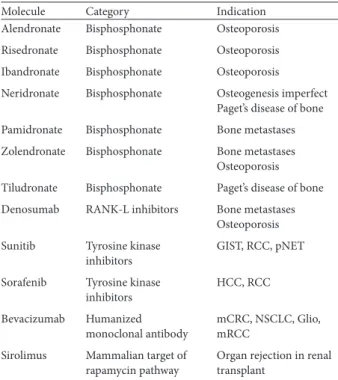
inhibitors) and antiangiogenetic drugs (Table 1, Table 2).
Antiresorptive
BPs can be classi
fi
ed into aminobisphosphonates (NBPs) and
non-aminobisphosphonates (non-NBPs) on the basis of an
amino functional group presence, NBPs are the one involved in
the osteonecrosis of the jaw.
NBPs can be administrated orally or as intravenous (IV) drugs:
• IV BPs are used in the management of cancer-related
conditions, including hypercalcemia of malignancy,
skeletal-related events associated with bone metastases of solid tumor
such as breast cancer, prostate cancer, and lung cancer and
for multiple myeloma.
[2-14]• Oral BPs are prescribed for osteoporosis,
[15,16]osteopenia
[17]or other less common conditions (Paget’s disease and
osteogenesis imperfect).
[18,19]• RANK ligand inhibitor (denosumab) is an antiresorptive
medication used in patients affected by osteoporosis
or metastatic bone disease, which inhibits osteoclast
function, decreases bone resorption and increases bone
density.
[20,21]Antiangiogenetic
A class of drugs, which interferes with the formation of new
blood vessels, is blocking the angiogenesis signaling cascade.
microtrauma, altereted bone remodeling, or oversuppression
of bone resorption, angiogenesis inhibition, soft tissue
BPs toxicity, a peculiar biofilm of the oral cavity, terminal
vascularization of the mandible, suppression of immunity or
Vitamin D deficiency.
[23,27-36]Three risk factors should be considered: Local factors,
underlying disease and kind of medication.
Age, sex, use of alcohol and tobacco are all individual risk
factors that may be associated with other systemic factors or
concurrent pathologies such as diabetes, rheumatoid arthritis,
dialysis, anemia, hypocalcemia, immunosuppression, and
osteomalacia. Local risk factors include microtrauma, oral surgery,
removable prosthesis, anatomic conditions such as tori and oral
implantology. Medication-related risk factors, which should be
considered, are the molecule, the way of administration and
the length of therapy. To explain disease frequency, we have to
consider two criterions: Therapeutic indications (osteoporosis/
osteopenia and malignancy) and type of medication (BP and
non-BP). Exposition to zolendronate in cancer patients leads to
ONJ risk 50-100 times higher than cancer patients treated with
placebo. Even if the ONJ risk is similar in patients treated by
denosumab, it’s important to underline a substantial diff
erence
between BRONJ and denosumab-related osteonecrosis of the
jaw (DRONJ). BRONJ occurs after a mean administration
of 33 months (IV in cancer patients) or 48 months (OS in
osteporotic patients). DRONJ occurs early after treatment,
independently of the number of previous administrations.
Hence, ONJ risk after use of RANK-L inhibitors decreases
monthly, while for bisphosphonate drugs remains stable for
years. The risk of BRONJ is directly related to the duration of
the therapy and total amount of the medications.
[37-39]MRONJ pathophysiology is not completely
elucidated.
[23-26]Its unique localization to the jaws may be
explained by several hypothesis: Inflammation or infection,
Table 1: MRONJ related medications
Molecule Category Indication Alendronate Bisphosphonate Osteoporosis
Risedronate Bisphosphonate Osteoporosis
Ibandronate Bisphosphonate Osteoporosis
Neridronate Bisphosphonate Osteogenesis imperfect Paget’s disease of bone
Pamidronate Bisphosphonate Bone metastases
Zolendronate Bisphosphonate Bone metastases Osteoporosis
Tiludronate Bisphosphonate Paget’s disease of bone
Denosumab RANK-L inhibitors Bone metastases Osteoporosis
Sunitib Tyrosine kinase inhibitors
GIST, RCC, pNET
Sorafenib Tyrosine kinase inhibitors
HCC, RCC
Bevacizumab Humanized monoclonal antibody
mCRC, NSCLC, Glio, mRCC
Sirolimus Mammalian target of rapamycin pathway
Organ rejection in renal transplant
GIST: Gastrointestinal stromal tumor, RCC: Renal cell carcinoma; pNET: Pancreatic neuroendocrine tumor, HCC: Hepatocellular carcinoma, mCRC: Metastatic colorectal carcinoma, NSCLC: Non-squamous non-small cell lung carcinoma, Glio: Glioblastoma, mRCC: Metastatic renal cell carcinoma, MRONJ: Medication-related osteonecrosis of the jaw
(Cond..)
Stage Marx 2007[49] Ruggiero et al.[2] Bedogni[36] At risk
category
No apparent exposed/ necrotic bone in patients who have been treated with either oral or IV bisphosphonates
Stage 0 Subclinical damage, microscopically represented by beginner hypocellularity osteoclast apoptosis and decrease of endosteal osteoblast
Nonspecifi c clinical fi ndings and symptoms such as jawpain or osteosclerosis but no clinical evidence of exposed bone
Stage 1 A: Painless exposed bone <1 cm
B: Painless exposed bone >1 cm
Exposed/necrotic bone in patients who are asymptomatic and who have no evidence of infection
Focal BRONJ
Clinical signs and symptoms: bone exposure; sudden dental mobility; nonhealing postextraction socket; mucosal fi stula; swelling; abscess formation; trismus; gross mandibular deformity; and/or hypoesthesia/paraesthesia of the lips CT fi nding: increased bone density limited to the alveolar bone region (trabecular thickening and/or focal osteosclerosis), with or without the following signs: markedly thickened and sclerotic lamina dura; persisting alveolar socket; and/or cortical disruption:
1a: Asymptomatic
Table 3: Prevention strategies Cancer patients before starting IV medical treatment
Asymptomatic cancer patients receiving IV medical treatment
Osteoporotic patients before starting oral medical treatment
Osteoporotic patients receiving oral medical treatment
Inadequate dentures should be modifi ed, rebased or replaced. Patients should achieve a proper oral hygiene and be instructed to report any pain, swelling or exposed bone. If allowed by systemic conditions, initiation of antiresorptive or antiangiogenetic therapy should be delayed until oral health is stable or, at least, until the extraction site has mucosalized (2-3 weeks) or until an adequate osseous healing
A good oral hygiene is essential to prevent dental infections that may require dentoalveolar surgery. Indeed, every invasive procedure that involves bone injury should be avoided. Non-restorable teeth should be treated by removal of the crown and endodontic treatment of the remaining roots. Dental implants placement should be avoided
Starting treatment, patients should be educated to the risk of MRONJ. Th e importance of oral hygiene and dental health should be underlined
(1) Patients treated with oral-NBP for less than 4 years without risk factors
No modifi cation or delay of surgery is necessary (2) Patients treated with oral-NBP for less than
4 years and corticosteroids or antiangiogenetic drugs concurrently
Th e prescriber should be contacted to evaluate a drug holiday for at least 2 months before oral surgery
(3) Patients treated with oral-NBP for more than 4 years
Th e prescriber should be contacted to evaluate a drug holiday for at least 2 months before oral surgery
IV: Intravenous
Defi nition and Staging Systems
According to the last de
fi
nition by AAOMS in 2014, Patients are
aff
ected by MRONJ if all the following clinical manifestations are
demonstrated:
1. Current or previous therapy with antiresorptive or
antiangiogenetic drugs;
[2]2. No patient history of radiation therapy or manifest metastatic
disease to the jaw;
3. Exposed bone or presence of an intraoral or extraoral
fi
stula
in the maxillofacial region persisting for more than 8 weeks.
However, there is no unanimous consensus on point three,
because the exposed necrotic bone in the oral cavity is just one
of the possible manifestations of BRONJ and it is not found in
all patients.
In 2012, the Italian Society for Maxillofacial Surgery and the
Italian Society of Oral Pathology and Medicine proposed a new
de
fi
nition:
[37]“BRONJ is an adverse drug reaction described as
the progressive destruction and death of bone that aff
ects the
mandible or maxilla of patients exposed to the treatment with
nitrogen-containing BPs, in the absence of a previous radiation
treatment.” Only 76% of BRONJ were diagnosed based on
the AAOMS de
fi
nition: Up to a quarter of patients with
osteonecrosis of the jaw associated with antiresorptive agents
remain undiagnosed.
Various BRONJ staging systems are used by clinicians: In
2006 Ruggero
et al.
[33]proposed a clinical staging system with
three diff
erent levels based on signs and symthoms; in 2009,
AAOMS implemented it with Stage 0.
[2]Marx
[35]in 2007 was the
Stage Marx 2007[49] Ruggiero et al.[2] Bedogni[36]Stage 2 A: Painful and infected single exposed bone <2 cm B: Painful and infected single exposed bone >2 cm
Exposed/necrotic bone associated with infection as evidenced by pain and erythema in the region of the exposed bone with or without purulent drainage
Diff use BRONJ
Clinical signs and symptoms: the same as Stage 1 CT fi ndings: increased bone density extended to the basal bone (diff use osteosclerosis), with or without the following signs: prominence of the inferior alveolar nerve canal; periosteal reaction; sinusitis; sequestra formation; and/or oroantral fi stula: 1a: Asymptomatic
1b: Symptomatic (pain and purulent discharge)
Stage 3 A: Multiple exposed bone areas without clinical fi ndings of osteolysis, orocutaneous fi stula, or pathological fractures
B: Exposed bone >3 cm or with clinical fi ndings of osteolysis, or orocutaneous fi stula, or pathological fractures
Exposed/necrotic bone in patients with pain, infection, and one or more of the following: pathologic fracture, extraoral fi stula, or osteolysis extending to the inferior border or sinus fl oor
Complicated BRONJ
Th e same as Stage 2, with one or more of the following: clinical signs and symptoms: extraoral fi stula; displaced mandibular stumps; nasal leakage of fl uids
CT fi ndings: Osteosclerosis of adjacent bones (zygoma, hard palate); pathologic mandibular fracture; and/or osteolysis extending to the sinus fl oor
BRONJ: Bisphosphonate-related osteonecrosis of the jaw, AAOMS: American Association of Oral and Maxillofacial Surgeons, SICMF: Italian Society for Maxillofacial Surgery, SIPMO: Italian Society of Oral Pathology and Medicine, IV: Intravenous, CT: Computed tomography
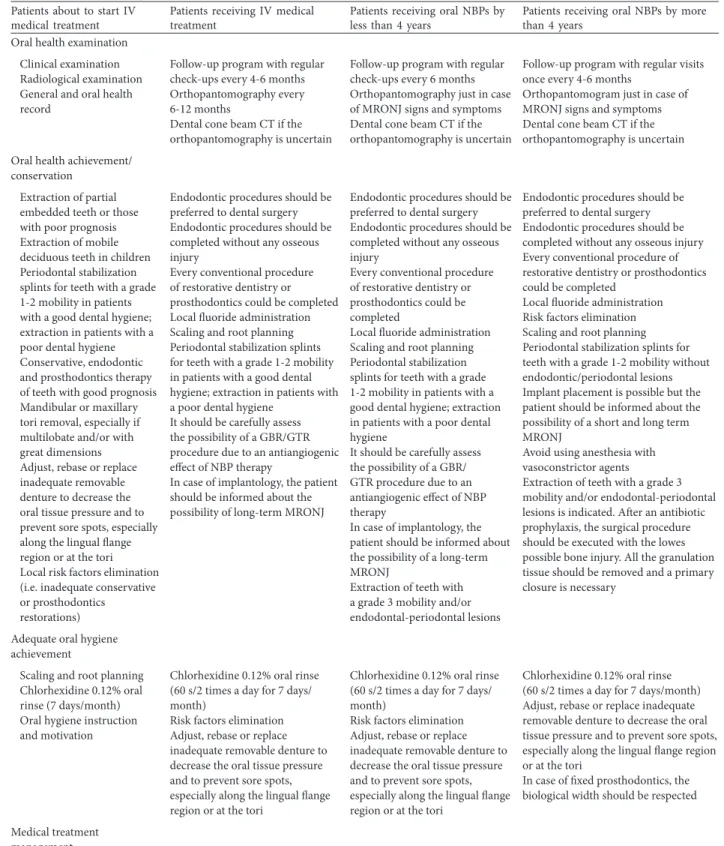
Patients about to start IV medical treatment
Patients receiving IV medical treatment
Patients receiving oral NBPs by less than 4 years
Patients receiving oral NBPs by more than 4 years
Oral health examination
Clinical examination Radiological examination General and oral health record
Follow-up program with regular check-ups every 4-6 months Orthopantomography every 6-12 months
Dental cone beam CT if the orthopantomography is uncertain
Follow-up program with regular check-ups every 6 months Orthopantomography just in case of MRONJ signs and symptoms Dental cone beam CT if the orthopantomography is uncertain
Follow-up program with regular visits once every 4-6 months
Orthopantomogram just in case of MRONJ signs and symptoms Dental cone beam CT if the orthopantomography is uncertain
Oral health achievement/ conservation
Extraction of partial embedded teeth or those with poor prognosis Extraction of mobile deciduous teeth in children Periodontal stabilization splints for teeth with a grade 1-2 mobility in patients with a good dental hygiene; extraction in patients with a poor dental hygiene Conservative, endodontic and prosthodontics therapy of teeth with good prognosis Mandibular or maxillary tori removal, especially if multilobate and/or with great dimensions Adjust, rebase or replace inadequate removable denture to decrease the oral tissue pressure and to prevent sore spots, especially along the lingual fl ange region or at the tori Local risk factors elimination (i.e. inadequate conservative or prosthodontics
restorations)
Endodontic procedures should be preferred to dental surgery Endodontic procedures should be completed without any osseous injury
Every conventional procedure of restorative dentistry or prosthodontics could be completed Local fl uoride administration Scaling and root planning Periodontal stabilization splints for teeth with a grade 1-2 mobility in patients with a good dental hygiene; extraction in patients with a poor dental hygiene
It should be carefully assess the possibility of a GBR/GTR procedure due to an antiangiogenic eff ect of NBP therapy
In case of implantology, the patient should be informed about the possibility of long-term MRONJ
Endodontic procedures should be preferred to dental surgery Endodontic procedures should be completed without any osseous injury
Every conventional procedure of restorative dentistry or prosthodontics could be completed
Local fl uoride administration Scaling and root planning Periodontal stabilization splints for teeth with a grade 1-2 mobility in patients with a good dental hygiene; extraction in patients with a poor dental hygiene
It should be carefully assess the possibility of a GBR/ GTR procedure due to an antiangiogenic eff ect of NBP therapy
In case of implantology, the patient should be informed about the possibility of a long-term MRONJ
Extraction of teeth with a grade 3 mobility and/or endodontal-periodontal lesions
Endodontic procedures should be preferred to dental surgery Endodontic procedures should be completed without any osseous injury Every conventional procedure of restorative dentistry or prosthodontics could be completed
Local fl uoride administration Risk factors elimination Scaling and root planning Periodontal stabilization splints for teeth with a grade 1-2 mobility without endodontic/periodontal lesions Implant placement is possible but the patient should be informed about the possibility of a short and long term MRONJ
Avoid using anesthesia with vasoconstrictor agents
Extraction of teeth with a grade 3 mobility and/or endodontal-periodontal lesions is indicated. Aft er an antibiotic prophylaxis, the surgical procedure should be executed with the lowes possible bone injury. All the granulation tissue should be removed and a primary closure is necessary
Adequate oral hygiene achievement
Scaling and root planning Chlorhexidine 0.12% oral rinse (7 days/month) Oral hygiene instruction and motivation
Chlorhexidine 0.12% oral rinse (60 s/2 times a day for 7 days/ month)
Risk factors elimination Adjust, rebase or replace inadequate removable denture to decrease the oral tissue pressure and to prevent sore spots, especially along the lingual fl ange region or at the tori
Chlorhexidine 0.12% oral rinse (60 s/2 times a day for 7 days/ month)
Risk factors elimination Adjust, rebase or replace inadequate removable denture to decrease the oral tissue pressure and to prevent sore spots, especially along the lingual fl ange region or at the tori
Chlorhexidine 0.12% oral rinse (60 s/2 times a day for 7 days/month) Adjust, rebase or replace inadequate removable denture to decrease the oral tissue pressure and to prevent sore spots, especially along the lingual fl ange region or at the tori
In case of fi xed prosthodontics, the biological width should be respected
Medical treatment management
Table 4: Treatment strategies
only one who divided the stages on the basis of the lesion’s size.
Bedogni
et al
.
[37]in 2012 proposed a clinical-radiological staging
system.
Prevention of MRONJ
Dental screenings and adequate treatment are fundamental in
order to reduce ONJ risk in patients under antiresorptive or
antiangiogenetic therapy, or before starting the administration
[Table 3].
The risk of ONJ increases when the duration of therapy
exceeded 4 years. However, the risk of MRONJ in patients
treated with oral BPs is lower compared to subjects treated with
IV medications.
Conclusions
Treatment of ONJs is a demanding challenge for clinicians
and an eff
ective and appropriate MRONJ therapy is still to be
decided, its strategies are described in Table 4.
The choice between a conservative treatment and surgery is
not easy, and it should be made on a case by case basis. However,
the initial approach should be as conservative as possible .
References
1. Ruggiero SL, Dodson TB, Fantasia J, Goodday R, Aghaloo T, Mehrotra B, et al. American Association of Oral and Maxillofacial surgeons position paper on medication-related
osteonecrosis of the jaw--2014 update. J Oral Maxillofac Surg 2014;72:1938-56.
2. Ruggiero SL, Dodson TB, Assael LA, Landesberg R, Marx RE, Mehrotra B. American Association of Oral and Maxillofacial Surgeons. American Association of Oral and Maxillofacial Surgeons position paper on bisphosphonate-related osteonecrosis of the jaws--2009 update. J Oral Maxillofac Surg 2009;67:2-12.
3. Nussbaum SR, Younger J, Vandepol CJ, Gagel RF, Zubler MA, Chapman R, et al. Single-dose intravenous therapy with pamidronate for the treatment of hypercalcemia of malignancy: Comparison of 30-, 60-, and 90-mg dosages. Am J Med 1993;95:297-304.
4. Major P, Lortholary A, Hon J, Abdi E, Mills G, Menssen HD, et al. Zoledronic acid is superior to pamidronate in the treatment of hypercalcemia of malignancy: A pooled analysis of two randomized, controlled clinical trials. J Clin Oncol 2001;19:558-67.
5. Hortobagyi GN, Th eriault RL, Porter L, Blayney D, Lipton A, Sinoff C, et al. Effi cacy of pamidronate in reducing skeletal complications in patients with breast cancer and lytic bone metastases. Protocol 19 Aredia Breast Cancer Study Group. N Engl J Med 1996;335:1785-91.
6. Hortobagyi GN, Th eriault RL, Lipton A, Porter L, Blayney D, Sinoff C, et al. Long-term prevention of skeletal complications of metastatic breast cancer with pamidronate. Protocol 19 Aredia Breast Cancer Study Group. J Clin Oncol 1998;16:2038-44. 7. Hillner BE, Ingle JN, Chlebowski RT, Gralow J, Yee GC,
Janjan NA, et al. American Society of Clinical Oncology 2003 update on the role of bisphosphonates and bone health issues in women with breast cancer. J Clin Oncol 2003;21:4042-57. 8. Saad F, Gleason DM, Murray R, Tchekmedyian S, Venner P, Patients about to start IV
medical treatment
Patients receiving IV medical treatment
Patients receiving oral NBPs by less than 4 years
Patients receiving oral NBPs by more than 4 years
Instruction for avoiding every elective dental procedure or invasive surgery that involve direct osseous injury during the medical treatment and, at least, the fi rst 5 years aft er the medical treatment Periodic
clinical-radiological follow-up, the frequency of which is based on the way of medical administration, the number of risk factors and oral health status of patient
Oral hygiene instruction and motivation
Informative and educational documents
Instruction to quickly report every signs and symptoms Periodic clinical-radiological follow-up
Before starting any procedure that involves bone, patient should be informed of the potential risk of MRONJ
Oral hygiene instruction and motivation
Informative and educational documents
Instruction to quickly report every signs and symptoms Obtain the informed consent Periodic clinical-radiological follow-up, the frequency of which is based on the way of medical administration, the number of risk factors and oral health status of patient Before starting any procedure that involves bone, patient should be informed of the potential risk of MRONJ
Oral hygiene instruction and motivation
Informative and educational documents
Instruction to quickly report every signs and symptoms
Obtain the informed consent Instruction to avoid any osseous surgical procedures during and aft er the therapy
Periodic clinical-radiological follow-up, the frequency of which is based on the way of medical administration, the number of risk factors and oral health status of the patient. It should be continued for at least 5 years aft er the termination of the medical administration Before starting any procedure that involves bone, patient should be informed of the potential risk of MRONJ
MRONJ: Medication-related osteonecrosis of the jaw, GBR: Guided bone regeneration, GTR: Guided tissue regenerative, NBP: Aminobisphosphonates, CT: Computed tomography, IV: Intravenous
Lacombe L, et al. A randomized, placebo-controlled trial of zoledronic acid in patients with hormone-refractory metastatic prostate carcinoma. J Natl Cancer Inst 2002;94:1458-68. 9. Saad F, Gleason DM, Murray R, Tchekmedyian S, Venner P,
Lacombe L, et al. Long-term effi cacy of zoledronic acid for the prevention of skeletal complications in patients with metastatic hormone-refractory prostate cancer. J Natl Cancer Inst 2004;96:879-82.
10. Rosen LS, Gordon D, Tchekmedyian NS, Yanagihara R, Hirsh V, Krzakowski M, et al. Long-term effi cacy and safety of zoledronic acid in the treatment of skeletal metastases in patients with nonsmall cell lung carcinoma and other solid tumors: A randomized, Phase III, double-blind, placebo-controlled trial. Cancer 2004;100:2613-21.
11. Berenson JR, Lichtenstein A, Porter L, Dimopoulos MA, Bordoni R, George S, et al. Effi cacy of pamidronate in reducing skeletal events in patients with advanced multiple myeloma. Myeloma Aredia Study Group. N Engl J Med 1996;334:488-93. 12. Berenson JR, Lichtenstein A, Porter L, Dimopoulos MA,
Bordoni R, George S, et al. Long-term pamidronate treatment of advanced multiple myeloma patients reduces skeletal events. Myeloma Aredia Study Group. J Clin Oncol 1998;16:593-602. 13. Rosen LS, Gordon D, Kaminski M, Howell A, Belch A, Mackey J,
et al. Zoledronic acid versus pamidronate in the treatment of skeletal metastases in patients with breast cancer or osteolytic lesions of multiple myeloma: A phase III, double-blind, comparative trial. Cancer J 2001;7:377-87.
14. Berenson JR, Hillner BE, Kyle RA, Anderson K, Lipton A, Yee GC, et al. American Society of Clinical Oncology clinical practice guidelines: Th e role of bisphosphonates in multiple myeloma. J Clin Oncol 2002;20:3719-36.
15. Watts NB. Bisphosphonate treatment of osteoporosis. Clin Geriatr Med 2003;19:395-414.
16. Delmas PD. Th e use of bisphosphonates in the treatment of osteoporosis. Curr Opin Rheumatol 2005;17:462-6.
17. Lazarou, J, Pomeranz, BH, Corey PN. Physicians’ Desk Reference. 57th ed. Montvale, NJ: Medical Economics; 2003. 18. Delmas PD, Meunier PJ. Th e management of Paget’s disease of
bone. N Engl J Med 1997;336:558-66.
19. Letocha AD, Cintas HL, Troendle JF, Reynolds JC, Cann CE, Chernoff EJ, et al. Controlled trial of pamidronate in children with types III and IV osteogenesis imperfecta confi rms vertebral gains but not short-term functional improvement. J Bone Miner Res 2005;20:977-86.
20. Delmas PD. Clinical potential of RANKL inhibition for the management of postmenopausal osteoporosis and other metabolic bone diseases. J Clin Densitom 2008;11:325-38. 21. Fizazi K, Carducci M, Smith M, Damião R, Brown J, Karsh L,
et al. Denosumab versus. zoledronic acid for treatment of bone metastases in men with castration-resistant prostate cancer: A randomised, double-blind study. Lancet 2011;377:813-22. 22. Tenore G, Palaia G, Gaimari G, Brugnoletti O, Bove L, Lo
Giudice R, et al. Medication-related osteonecrosis of the jaws (MRONJ): Etiological update. Senses Sci 2014;1:147-52. 23. Reid IR, Bolland MJ, Grey AB. Is bisphosphonate-associated
osteonecrosis of the jaw caused by soft tissue toxicity? Bone 2007;41:318-20.
24. Allen MR, Burr DB. Th e pathogenesis of bisphosphonate-related osteonecrosis of the jaw: So many hypotheses, so few data. J Oral Maxillofac Surg 2009;67:61-70.
25. Landesberg R, Woo V, Cremers S, Cozin M, Marolt D, Vunjak-Novakovic G, et al. Potential pathophysiological mechanisms in osteonecrosis of the jaw. Ann N Y Acad Sci 2011;1218:62-79. 26. Yamashita J, McCauley LK. Antiresorptives and osteonecrosis of
the jaw. J Evid Based Dent Pract 2012;12:233-47.
27. Bamias A, Kastritis E, Bamia C, Moulopoulos LA, Melakopoulos I, Bozas G, et al. Osteonecrosis of the jaw in cancer aft er treatment with bisphosphonates: Incidence and risk factors. J Clin Oncol 2005;23:8580-7.
28. Hokugo A, Christensen R, Chung EM, Sung EC, Felsenfeld AL, Sayre JW, et al. Increased prevalence of bisphosphonate-related osteonecrosis of the jaw with vitamin D defi ciency in rats. J Bone Miner Res 2010;25:1337-49.
29. Mortensen M, Lawson W, Montazem A. Osteonecrosis of the jaw associated with bisphosphonate use: Presentation of seven cases and literature review. Laryngoscope 2007;117:30-4. 30. Sonis ST, Watkins BA, Lyng GD, Lerman MA, Anderson KC.
Bony changes in the jaws of rats treated with zoledronic acid and dexamethasone before dental extractions mimic bisphosphonate-related osteonecrosis in cancer patients. Oral Oncol 2009;45:164-72.
31. Mehrotra B, Ruggiero S. Bisphosphonate complications including osteonecrosis of the jaw. Hematology Am Soc Hematol Educ Program 2006:356-60, 515.
32. Ruggiero SL, Fantasia J, Carlson E. Bisphosphonate-related osteonecrosis of the jaw: Background and guidelines for diagnosis, staging and management. Oral Surg Oral Med Oral Pathol Oral Radiol Endod 2006;102:433-41.
33. Wood J, Bonjean K, Ruetz S, Bellahcène A, Devy L, Foidart JM, et al. Novel antiangiogenic eff ects of the bisphosphonate compound zoledronic acid. J Pharmacol Exp Th er 2002;302:1055-61.
34. Kos M, Junka A, Smutnicka D, Bartoszewicz M, Kurzynowski T, Gluza K. Pamidronate enhances bacterial adhesion to bone hydroxyapatite. Another puzzle in the pathology of bisphosphonate-related osteonecrosis of the jaw? J Oral Maxillofac Surg 2013;71:1010-6.
35. Marx RE. Oral and Intravenous Bisphosphonate-Induced Osteonecrosis of the Jaw. Chicago, Ill, USA: Quintessence; 2007. 36. Bedogni A, Fusco V, Agrillo A, Campisi G. Learning from
experience. Proposal of a refi ned defi nition and staging system for bisphosphonate-related osteonecrosis of the jaw (BRONJ). Oral Dis 2012;18:621-3.
37. Fedele S, Bedogni G, Scoletta M, Favia G, Colella G, Agrillo A, et al. Up to a quarter of patients with osteonecrosis of the jaw associated with antiresorptive agents remain undiagnosed. Br J Oral Maxillofac Surg 2015;53:13-7.
38. Pompa G, Bignozzi I, Cristalli MP, Quaranta A, Di Carlo S. Bisphosphonates and Osteonecrosis of the jaw: Th e oral surgeon’s perspective. Eur J Infl amm 2012;10:11-23.