POSITION IMPROVEMENT STRATEGY FOR BALINESE
TOURISM HUMAN RESOURCES TO MANAGER
LEVEL IN RATED HOTELS IN BALI
Prof. Sulistyawati Udayana University
Abstract
Creating superior Indonesian tourism requires that it be managed by tourism human resources who are qualified and professional in their field. Pitana (2011) stated that Indonesian tourism human resources are of sufficient quality. On the other hand, Pangestu (2012) asserted that although national tourism has shown growth with increasing competitiveness rankings, yet Indonesian tourism is still inferior when compared to neighboring countries. Bali, as a quickly growing tourist region, has become a magnet for job seekers from other provinces, even foreigners. This, of course, is an ironic matter for local human resources in terms of competing to occupy managerial positions. Problems taken up were: 1) what are the obstacles faced by Balinese tourism human resources in order to be able to occupy manager positions at rated hotels in Bali, and 2) how is the strategy for increasing the number of Balinese tourism human resource manager positions at rated hotels in Bali. This research aimed to produce a model strategy for improving the position of Balinese tourism human resources to the level of manager at rated hotels in Bali. An exploratory sequential mixed method with qualitative to quantitative data was used through interviews with fourteen informants who are managers at rated hotels in Sanur, Nusa Dua, and Kuta and tourism practitioners and academics as well as questionnaires. Data analysis applied competence theory (Spencer & Spencer, 1993), hegemony theory (Gramsci, 1971), and motivation theory (Clelland, 1976). The research results show six informants stated that the number of Balinese tourism human resources who occupy manager positions is still low. Meanwhile, eight informants stated the opposite. The results of the research analysis are: 1) the cause of Balinese tourism human resources not being selected for manager positions are: (a) underestimation of Balinese tourism human resources; (b) low competitiveness; (c) politicization of positions; (d) adat (customary) commitments; and (e) lack of mobility. And, 2) a strategy to increase positions can be carried out by: (a) providing opportunities for achievement; (b) creating a cooperative atmosphere; and (c) providing opportunities for status improvement.
Keywords: Balinese tourism human resources, Strategy, Manager, Hospitality, Tourism, Research
Introduction
Act No. 10of 2009 concerning Tourism defines tourism as a wide range of tourist activities that are supported by a wide range of facilities and services provided by the public, employers, and national and provincial governments. Based on this understanding of tourism, service is an essential matter in the tourism industry and is one of the tourists’ demands. Pitana and Diarta (2009: 72) assert that human resources are one of the vital components in the development of tourism because practically every stage of tourism elements requires human resources to set it in motion.
On the other hand, Pangestu (2012) asserted that although national tourism has shown quite encouraging growth with increasing competitiveness rankings, Indonesian tourism is still inferior when compared to neighboring countries such as Singapore, Malaysia and Thailand (Politik Indonesia, 2012). The low competitiveness of Indonesian tourism human resources is also noted by Irwansyah (2011: 1). He points out that the current development of the tourism sector in Indonesia is facing fundamental problems caused by the low competitiveness of Indonesian tourism human resources which can be seen from the limited human resources, both in terms of quantity and quality.
The issue of the ASEAN Economic Community (Masyarakat Ekonomi ASEAN (MEA), must also be anticipated as foreign workers will be free to enter Indonesia. This influx of foreign workers to Indonesia means that opportunities will be narrowed for employment of Indonesian tourism human resources working in the tourism industry. So, to compensate for these developments, Indonesia must be capable of producing high quality, skilled, and professional human resources. From a national perspective, Bali is the primary gateway for tourism economic activities in Indonesia. The rapid development of tourism in Bali has become a magnet for job seekers not only from local human resources, but also from outside of Bali and even foreign human resources who have their eyes on strategic positions. A greater challenge right before the eyes is the MEA.
Based on the results of research conducted by Putra et al (2013: 5), of the 13,844 local Balinese human resources working in the tourism field, only 1.79% occupy manager positions (senior managers, middle managers, and first-line managers). Of the 1,693 human resources from outside of Bali working in the tourism field, about 9.21% occupy manager positions (senior managers, middle managers, and first-line managers). Of the 80 foreign human resources working in the tourism field, about 70% occupy manager positions (senior managers, middle managers, and first-line managers). This data shows that the percentage of local Balinese human resources occupying manager positions is very low in comparison to human resources from outside of Bali – especially in comparison to foreign human resources.
Balinese human resources, as the local residents, must be involved as active participants in the tourism industry because they are considered as those with the greatest understanding of the natural surroundings and local culture.
Statement of the Problem
Based on the description of the background issues mentioned above, hence the two main points proposed are as follows.
1) What are the obstacles faced by Balinese tourism human resources for being able to occupy manager positions at rated hotels in Bali?
2) How is the strategy for increasing the number of Balinese tourism human resources to manager positions at rated hotels in Bali?
Research Objectives
The research objectives can be divided into a general objective and a special objective, as follows:
General Objective
The general objective of this research was to produce a strategy model for improving the position of Balinese tourism human resources to the level of managers at ranked hotels in Bali.
Specific Objective
The specific objectives hoped to be achieved in this study were to:
1) Analyze the obstacles faced by the Balinese tourism human resources for being able to occupy manager positions in rated hotels in Bali. 2) Analyze the strategy for increasing the number of Balinese tourism
human resources to manager positions at rated hotels in Bali Literature Review
Position Improvement Strategy
Strategy originates from the Greek word strategos which means a way or tactic for winning something. Bryson (2001: 189–190) explains that a strategy can be viewed as a pattern of goals, policies, program actions, decisions, or allocation of resources. Next, ‘improvement’ means progress. In general, improvement is an attempt to increase the degree, level, and quality as well as quantity. Based on such an understanding, the meaning of ‘position improvement strategy’ in this research is an effort made to change the position to a higher level.
Balinese Tourism Human Resources
Balinese tourism human resources is limited to those of the Bali Hindu faith in order to find a link betweenadat(traditional customs) and the quality of Balinese tourism human resources.
Hotel Manager
A manager is someone who works via other people by coordinating activities in order to achieve an organization’s goals. In a traditional organization structure (Robbins and Coulter, 1999: 217), managers are classified as senior managers, middle managers, or first-line managers. A hotel manager in the area of hospitality is the person who manages the daily operations of the hotel management. A hotel manager is responsible for the efficient and profitable operations for the company (Rozadika, 2013). Based on this understanding of a hotel manager, in this study a hotel manager is the person who manages the day-to-day operations in hotel management and consists of senior managers, middle managers, and first-line managers.
Rated Hotels in Bali
Based on the Regulation of the Minister of Tourism and Creative Economy of the Republic of Indonesia PM.53/HM.001/MPEK/2013 on Hotel Business Standards Article 1 paragraph (8), a rated hotel is a hotel that fulfills the criteria for a classification assessment as a one, two, three, four, or five-star hotel. Categorization of a hotel class is carried out by a standardized hotel business assessment, which is an evaluation based on basic requirements termed absolute criteria and provisional criteria. Article 1 paragraph (16) states that the absolute criteria is the main prerequisite covering all aspects of the products, services, and management of a hotel business which is determined by the Minister and must be fulfilled by hotel businesses in order to be certified.
So, what is meant by a position improvement strategy for Bali Hindu tourism human resources to manager level in rated hotels in Bali, is an effort that can be carried out for making an improvement of the potential of Bali Hindu people working in tourism businesses, especially in the hospitality field, in order to achieve success in their work so as to potentially occupy the highest positions in rated hotels in the Bali tourism regions consisting of Kuta, Nusa Dua and Sanur.
Competence Theory (Spencer, 1993)
A simple fundamental understanding of competence is an ability or skill (Syah, 2000: 229). Spencer (1993: 9–11) says that there are five types of competency characteristics, which are: (a) motives; (b) traits; (c) self-concept; (d) knowledge, and (e) skills. Spencer describes the characteristics of each competency, as follows:
(a) Motives: The things a person consistently thinks about or wants that cause action. Motives drive, direct, and select behavior toward certain actions or goals and away from others, for example the need of achievement.
their tendencies. A person’s character may reflect confidence, self-control, and fortitude or hardiness.
(c) Self concept: a person’s attitudes, values, or self-image. According to Sidle (2007: 19–25) there are four properties that most, but not all, successful leaders possess, which are: intelligence, maturity and breadth, achievement drive, and integrity.
(d) Knowledge: information a person has in specific content areas. Knowledge is a complex competency and includes information seeking and technical expertise.
(e) Skill: the ability to perform a certain physical or mental task. This includes analytical thinking and conceptual thinking.
Spencer’s Competence Theory can be used to discuss the two issues in the problem formulation which are about the obstacles faced by Balinese tourism human resources for being able to occupy manager positions at rated hotels in Bali and about the strategy for increasing the number of Balinese tourism human resources to manager positions at rated hotels in Bali. These two issues can thus be looked at from motives, traits, self-concept, knowledge, and skills.
Motivation Theory (McClelland, 1976 in Robbins, 2001)
Motivation originates from the Latin word movere meaning an impulse, desire, cause, or reason for someone to do something. McClelland (1976) put forth Achievement Motivation Theory which is that human beings essentially have an ability to excel beyond the abilities of others (Robbins, 2001: 173). This theory contains an assumption that the need for achievement differs and is distinguishable from other needs. According to McCelland, there are three types of human needs, namely the need for achievement, need for power, and need for affiliation. Thus, McClelland’s Motivation Theory can be used to discuss the second issue in the problem formulation about the strategy for increasing the number of Balinese tourism human resources to manager positions at rated hotels in Bali.
Hegemony Theory (Gramsci, 1971)
The theory about hegemony put forth by Antonio Gramsci (1971: 244) is essentially an attempt to lead people towards evaluating and scrutinizing social problems within a specified framework. Hegemony Theory stresses moral consciousness. According to Gramsci, hegemony is a topic of intellectual and moral leadership and typically has a positive nuance. In Balinese social life, for example, there isswadharma (carrying out obligations) as a member of a unified Desa Pakraman (traditional customs village). Each Desa Pakraman has awig-awig (regulations) which are absolute or must be followed by each Balinese person as members of their respective social communities and bound by adat istiadat (customs and manners). Sanctions for violations againstawig-awig are of a customary or religious nature, such as: verbal warning, kesepekang (exclusion), dismissal from a position or fines.
or volunteer work) and on the other hand must work with time dictated by the hotel or other business. Absence from ngayah activities can lead to customary fines or social sanctions, yet diligent ngayah can lead to being penalized in the workplace due to absenteeism. Based on this phenomenon, the Hegemony Theory can be used as a blade to address the obstacles faced by Balinese tourism human resources in their attempts to occupy manager positions in rated hotels in Bali and for tourism in Bali now and in the future.
Conceptual Framework
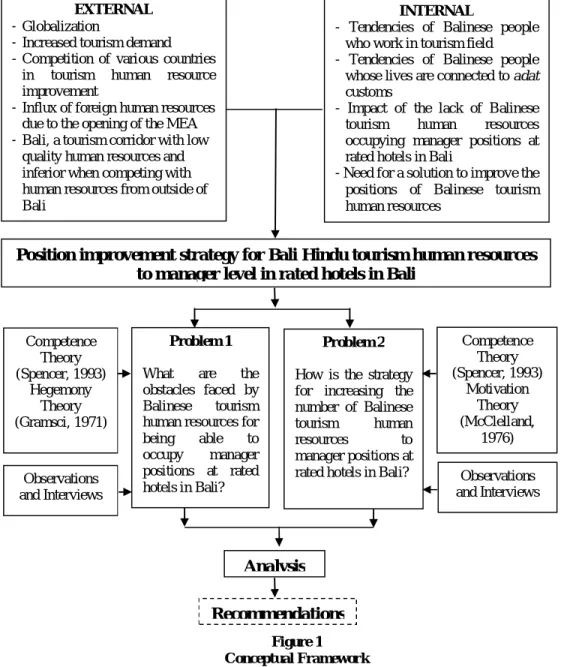
The following chart clarifies the research model.
Figure 1 Conceptual Framework
INTERNAL
- Tendencies of Balinese people who work in tourism field - Tendencies of Balinese people
whose lives are connected toadat
customs
- Impact of the lack of Balinese tourism human resources occupying manager positions at rated hotels in Bali
- Need for a solution to improve the positions of Balinese tourism human resources
EXTERNAL - Globalization
- Increased tourism demand - Competition of various countries
in tourism human resource improvement
- Influx of foreign human resources due to the opening of the MEA - Bali, a tourism corridor with low
quality human resources and inferior when competing with human resources from outside of Bali
Position improvement strategy for Bali Hindu tourism human resources to manager level in rated hotels in Bali
Recommendations Analysis Problem 1
What are the obstacles faced by Balinese tourism human resources for being able to occupy manager positions at rated hotels in Bali?
Problem 2
Methodology Research Method
This study used a descriptive interpretative approach. According to Umar (2008: 21), the descriptive method is one that aims to describe the nature of something that is ongoing at the time of the research and examines the causes of a particular symptom. Suryabrata (2003: 19) explains that descriptive research aims to make an illustration in a systematic, factual and accurate way from facts and properties of the population or a particular region.
Research Locations
In this study, the focus is on locations in the well-known tourist areas of Bali, which are the Sanur tourist area located in Denpasar as well as Kuta and Nusa Dua located in the Badung regency. The choice of these three locations is based on the characteristic tourist regions visited by many tourists, resulting in a development in the tourism field that is quite specific. Sanur was selected as a tourism region with beautiful sand beaches. Kuta is an area that has become a main surfer destination due to its beautiful beaches and famous waves. Just like Sanur, the strategic location of Kuta makes it a dense and growing tourist area. Meanwhile, Nusa Dua is a tourist area with white sand beaches, rated hotels, and rapid tourism development.
Method of Data Collection
The type of data used in this study is qualitative. Based on the sources, the data can be divided into primary data and secondary data. The primary data was obtained from observations and interviews with informants to obtain information that supports the research. Informants were interviewed such as hotel managers, hotel owners and tourism experts who have indepth knowledge about the development of tourism in Bali. Secondary data was primary data which had been further processed and presented by the primary data collectors or others, for example, in the form of texts or tables. This data, whether from documents, articles and journals, was used to support the primary data information.
Results and Discussion
Analysis of the obstacles faced by the Balinese tourism human resources for being able to occupy manager positions in rated hotels in Bali.
Obstacles faced by Balinese tourism human resources can be seen in the following descriptions:
Underestimation of Balinese tourism human resources’ competency
“In general, people, businesses or hotel executives have underestimated Balinese tourism human resources. They are considered incapable or incompetent. This is what causes the low number of Balinese tourism human resources who occupy manager positions in rated hotels in Bali.”
(Interview with Redianis, 11 May 2015) Unlike the case with the research results of Bawa et al (2001), several sources interviewed expressed different opinions related to Balinese tourism human resources’ competency. The following are some statements from sources such as Suasti as the Human Resources Manager (HRM) of The Haven Seminyak Hotel; Darta as HRM of the Santika Siligita Nusa Dua; and Yogi Artini as the Assistant HRM of the Ritz Carlton Nusa Dua:
“Currently, Balinese tourism human resources have already begun to advance and have already started to become competitive in the world of tourism. This can be seen from the number of Balinese tourism human resources who have occupied manager positions in a variety of rated hotels in Bali. Moreover, some have already successfully occupied General Manager positions.”
(Interview of Suasti, 13 May 2015) “Many experts have stated that the number of Balinese tourism human resources who occupy manager level positions is low because firstly research is conducted. Now Balinese have already begun to advance. Tourism schools in Bali have also begun to be good and graduated many managers.”
(Interview of Darta, 20 May 2015) “Now it can be said that the number of Balinese tourism human resources who occupy manager positions at rated hotels in Bali is already in balance with the number from outside of Bali as well as foreigners. Moreover, there is even a tendency that there well be an increasing number Balinese who occupy manager positions. This is because Balinese tourism human resources are now open minded and thinking more broadly, which is different from before when they generally just nodded alone or said nggih (yes). Now they have begun to think more broadly about things to come.”
tourism human resources. Table 1 describes the opinions of fourteen sources related to the advantages of human resources from outside of Bali or foreign human resources.
Table 1
Advantages of Tourism Human Resources From Outside of Bali or Foreigners Compared to Balinese Tourism Human Resources
No Hotel Informant Explanation
1 Rama Garden Hotel, Kuta (3-star) Ni Luh Redianis Competence same, only more confident and dare to debate more than Balinese tourism human resources.
2
The 101 Legian, Kuta (3-star) Dewi Mas Provide hotel image and able to provide international services
3 Amaris Hotel Legian, Kuta (4-star)
Gede Cristiawan More courage to receive challenges than Balinese tourism human resources
4 The Haven Seminyak, Kuta (4-star) Ketut Suasti More committed than Balinese tourism human resources
5 Souverign Tuban (4-star) Wayan Nawa Human resources from outside of Bali are coarser but more logical
6 White Rose, Kuta (4-star) I Made Sudarna Highly motivated and more likely to comply with Standard Operational Procedures than Balinese tourism human resources 7 Grand Ina, Kuta (4-star) Agung Wibawa The only surplus is their foreign
language skills; the rest is the same as local human resources
8 Keraton Jimbaran, Kuta (4-star) Kesawa Putra Have good knowledge and ability to overcome problems, good language skills and discipline in compared to Balinese tourism human resources
9 Santika Siligita, Nusa Dua (3-star) Putu Darta Can be used for hotel image 10 Amartera Villa, Nusa Dua (4-star) Made Alit Willing to be assigned anywhere,
have a good information accent and an independent spirit compared to Balinese tourism human resources
11 Grand Aston, Nusa Dua (5-star) I Ketut Subadra Can be used for hotel image 12 Ritz Carlton, Nusa Dua (5-star) Yogi Artini Have something more advanced
from their country such that it can be studied by the company 13 Griya Santrian, Sanur (3-star) Wayan Tamiarta Able to make an investment or
make the hotel develop; have good language skills, have a vision and mission
14 Mercure Resort, Sanur (4-star) Adhi Wistawan Foreign human resources or from outside of Bali have a strong ability to compete
Balinese and Indonesian people have a mindset that Balinese tourism human resources lack competence. Yet, according to the fourteen sources, Balinese tourism human resources have equal and even sometimes superior competence compared to human resources from outside of Bali or foreigners. The advantages of those from outside of Bali or foreigners is that they dare to debate, are more likely to comply with Standard Operational Procedures, and are able to make an investment or make the hotel develop because they already have experience in international networks and have good language skills.
Politicization of Positions
The existence of international chain hotels is very well known in Bali as their presence is regarded as capable of boosting Bali as a destination through the provision of international standard accommodations. According to Chair of the Association of Indonesian Hotel and Restaurant (PHRI) Badung branch, Rai Surya Wijaya, usually those chain hotels’ top managers must be foreign human resources as it is already an agreement or contract between the owner with the management. So, maybe that is one of the obstacles causing the low number of Balinese tourism human resources occupying manager positions in rated hotels in Bali, especially in 5-star hotels. The same matter was expressed by the Chair of the PHRI Bali branchOka Artha Ardhana Sukawati as follows:
“In 4-star and 5-star level hotels, Balinese tourism human resources are rarely placed at the manager level; moreover almost none are in the general manager position. If a Balinese tourism human resource does become a general manager, that would only be in a hotel in the national network such as the Putri Bali, Bali Beach, or Patra Rajasa hotels. Meanwhile in the international networks such as the Bulgary, Ritz Carlton, and Hyatt hotels, usually who is designated as the general manager is a person in the international network which is a foreign human resource.”
Link to adat (traditional customs)
Chair of the PHRI Bali branchOka Artha Ardhana Sukawati revealed that:
“The lack of Balinese tourism human resources chosen for manager level positions at rated hotels in Bali is caused by the lack of opportunities given to them. In fact, there are hotels in Kuta that clearly and openly say they do not want to use or recruit Balinese tourism human resources for working at their hotels because there is an image that they are incompetent due to being interrupted byadat(traditional customs).”
(Interview ofOka Artha Ardhana Sukawati 26 June 2015) Winata (2014: 6) expressed that the adat istiadat (customs and manners) in Bali are a causal factor for Balinese tourism human resources’ lack of commitment. Balinese society is very strong in maintaining and obeying theadat istiadat inspired by Hinduism. Adherence to the Balinese culture’s adat (traditional customs) can be seen in daily life in the family and in the societal life which is in the Desa Pakraman (traditional customs village). Balinese society considersadat and culture as very important and that it may not be abandoned. It is not wrong if there is an issue circulating that Balinese tourism human resources are second-positioned by companies because they are viewed as often taking leave or absent due toadat affairs.
When examined more deeply, the Balinese have a passion to maintain the existence of their culture by participating inadat (traditional customs) activities such asngayah(sosio-religious charitable donation or volunteer work).Ngayah is one of the energies of culture that has been internalized in the lives of Balinese society such that a very close relationship has been established between Balinese society with adat customary and religious activities to a level that cannot be ignored. But the spirit for this ngayah is sometimes seen as a burden for some Balinese people as it causes an inability to balance work and adat obligations. This inability is also because Balinese society is undergoing a transition period from a traditional way of life towards development that stems from a modern nature including the advent of tourism. However, an appropriate management strategy has not yet been created to balance the needs of adat to those of jobs. Furthermore, previously, conservatives were still very rigid with regards to adat customs which made it difficult to synergize with the needs of the times.
An Improvement Strategy For Balinese Tourism Human Resources So as to Be able to Occupy Manager Positions in Rated Hotels in Bali
There are various strategies that can be used as an effort to improve the positions of Balinese tourism human resources so as to be able to occupy manager positions at rated hotels in Bali. One such strategy is that of motivation. A person’s behavior begins with a particular encouragement or motivation. People who have high motivation will be spurred to work harder and more vigorously because they see work as not just a source of income but rather as way to develop themselves and to serve others. Based on the Motivation Theory presented by McClelland (1976), there are three types of human needs, namely the need for achievement, need for power, and need for affiliation.
The results of interviews with fourteen informants – who are Balinese tourism human resources working in rated hotels in Bali in Sanur, Nusa Dua and Kuta – show that the motivation to work is to meet the needs of achievement. By this, an effort that can be made so that Balinese tourism human resources are able to occupy manager positions at rated hotels in Bali, is a strategy that gives motivation to excel as follows.
First is self-motivation. Balinese tourism human resources should be continuously motivated to develop themselves, have extensive knowledge, and continuously hone their abilities. They should always try to improve their capabilities; look for good mentors for the betterment of themselves; and regularly attend seminars held by specific communities. Also self-motivate so as not to be afraid to go abroad by giving many examples of Balinese who have done so and are already successful. With all its consequences, they must dare to distance themselves from theiradat(traditional customs) environment, if it inhibits them, in order to advance. They need to manage their time well during their productive years and pursue their careers as high as possible. Also use their youth years to study and to seek new experiences. When they feel satisfied with that period, then, return to theiradat(traditional customs). By this they will be able to balance their lives. Self-motivation of Balinese tourism human resources is so that they can feel confident and more assertive in seizing the opportunities for existing positions. By boldly demonstrating their abilities, they should be able to determine the vision and mission of their work, thereby growing a professional integrity in their work and obtaining the hoped for results.
Third is motivation by the government. This includes establishing affordable tourism schools and improving the quality of existing schools as well as the quality of the lecturers. Students and teachers should be provided opportunities for training abroad. The government should also open up opportunities for Balinese tourism human resources to have careers in hotels. Also, establish regulations that benefit local tourism human resources such as standard labor certifications and limitations on foreigners working in the tourism sector. The government needs to update information on all layers of the tourism industry and embrace various levels of the tourism industry for attending trainings and seminars. Also, promote competitions in the field of tourism.
Fourthly is motivation from tourism education institutions. Motivation needs to be embedded about the need to acquire new knowledge for self-development by reading, attending trainings, entrepreneurship seminars or formal education. Educational institutions should hold job fairs in order to put government instructions into practice so that they not only generate Balinese tourism human resources who are professional, but also graduates who are not a burden for society or the government. Job fairs help the government to provide job opportunities and help graduates from Indonesian institutions of higher education to obtain employment opportunities. By this, people, especially investors, can have faith in the quality of graduates in Indonesia, particularly in Bali, who are capable of occupying important positions in a company.
Lastly is motivation from the adat (traditional customs) communities and leaders that do not inhibit citizens who want a career. Traditional adat leaders should adapt themselves to changes and not force-feed society withadat. Rather, the power of traditional leaders should be one of establishing good communications with thekrama ‘citizens’.
Conclusions
There are various causes or obstacles faced by Balinese tourism human resources for being able to occupy manager positions at rated hotels in Bali. In summary these are: 1) underestimation of Balinese tourism human resources’ competency; 2) human resources from outside of Bali or foreigners who are considered more superior to Balinese tourism human resources; 3) politicization of positions; 4) Balinese tourism human resources’ link to adat (traditional customs); and 5) Balinese tourism human resources’ lack of mobility.
References
Bawa, et al. (2001).Studi Keunggulan SDM Bali di Bidang Pariwisata. Denpasar: Universitas Udayana.
Bryson, John M. (2001). Perencanaan Strategis bagi Organisasi Sosial. Edisi Bahasa Indonesia. Yogyakarta: Pustaka Pelajar Offset.
Gramsci, Antonio. (1976). Selections form the Prison Notebook, edited and translated by Quintin Hoare & Goffrey Nowell Smith. London: Lawrence and Wishart.
Irwansyah. (2011). Pengembangan SDM Indonesia di Bidang Pariwisata. Semarang: Sekolah Tinggi Ilmu Ekonomi Pariwisata Indonesia.
Marshall, Patricia. (2003). Mengapa beberapa orang lebih sukses dari yang lainnya? Manusia dan kompetensi paduan praktisi untuk keunggulan bersaing. Boulter, Muray Dalziel and Jackie Hill (eds). Alih Bahasa. Bern. Hidayat. Jakarta: Penerbit PT Bhuana Ilmu Populer
Peraturan Menteri Pariwisata dan Ekonomi Kreatif Republik Indonesia Nomor PM.53/HM.001/MPEK/2013 tentang Standar Usaha Hotel.
Pitana, I Gede and Diarta, I Ketut S. (2009). Pengantar Ilmu Pariwisata. Yogyakarta: Penerbit Andi.
Politik Indonesia. (2012). “Daya Saing Pariwisata Indonesia Naik ke Peringkat
74”. http://www.
politikindonesia.com/m/index.php?ctn=1&k=ekonomi&i=30294 (Accessed 3 December 2014).
Putra, Nusantini Primayanthi. (2013). Tantangan Daya Saing Sumber Daya Manusia Masyarakat Bali dalam Menduduki Jabatan Top Management di Sektor Pariwisata. Denpasar: Program Pasca Sarjana Kajian Pariwisata Universitas Udayana.
Ramdani, Dadan. (2013). Pengaruh Vacationscape Terhadap Keputusan Berkunjung ke Kota Bandung. Bandung: Universitas Pendidikan Indonesia.
Robbins and Coulter. (1999). Manajemen. Edisi ke-enam. Jakarta: PT. Prenhallindo.
Robbins, Stephen P. (2001). Organizational Behavior, 9th Ed. Upper Saddle River New Jersey: Prentice Hall International.
Rozadika, Muhammad. (2013). “Tugas General Manajer Hotel”. http://www.belajarhotel.blogspot.
com/2013/06/tugas-general-manager-hotel.html (Accessed 3 December 2014).
Spencer, Lyle M. and Spencer, Signe M. (1993). Competence Work: Model for Superior Performance. New York: John Wiley and Sons, Inc.
Suryabrata, Sumadi. (2003). Metodologi Penelitian. Jakarta: PT. Raja Grafindo Persada.
Syah, Muhibbin. (2000). Psikologi Pendidikan dengan Pendekatan Baru. Bandung: PT Remaja Rosdakarya.
Umar, Husein. (2008). Metodologi Penelitian untuk Skripsi dan Tesis Bisnis. Jakarta: Penerbit Rajawali Pers.
Winata, Angga. (2014).Kualitas Sumber Daya Manusia Bali dalam Industri Pariwisata. Denpasar: Program Studi Diploma IV Pariwisata Universitas Udayana.