A Routing Framework for Video Traffic in Wireless Multihop
Network
A.K.G.Dhana Lakshmi1, T.Sivarama Krishna2 1M.Tech Scholar,2Assistant Professor
1,2Department of Computer Science & Engineering,
BVC Institute of Technology & Science, Batlapalem, Amalapuram, AP, India.
Abstract—
Wireless mobile adhoc networks are comprised of coordinating mobile nodes that needn't bother with any supporting framework or concentrated access point. Notwithstanding challenges postured by wireless networks to mixed media communication, the inborn qualities of mobile impromptu networks make interactive media communication more troublesome as ways are regularly broken, interface limits change and the nodes more often than not have tight power limitations. Much work has been done to improve singular layers in the system convention stack to address these difficulties. As of late different research bunches have proposed changes in view of cross-layer plans, where improvements are not made locally but rather together finished various layers. Our work investigates the purposes behind utilizing cross layer plans and examines both the favorable circumstances and exchange offs of such outlines. We investigate how distinctive parts of the system layer stack might be influenced because of such strategies. We display a study of various cross-layer procedures that have been proposed. Many testing issues in cross-layer plans are yet to be settled. In the review we propose a general system that encourages communication and streamlining over the whole
systems administration convention stack to
investigate cross-layer outlines. We additionally distinguish a couple of different ranges for future work.
Index Terms— video distortion, distortion minimization, routing protocol.
I. Introduction
Broadband and wireless communication frameworks in these days are more powerful and omnipresent than they used to be before [2]. In everyday life we watch wireless communications occurring in mobile
and wireless neighborhood. This communication is watched just in the last two gadgets i.e. a base station and a wireless end framework. Multihop wireless networks have one or many middle of the road nodes which autonomously impart among themselves along the course and send or get bundles utilizing wireless
connections. Multihop networks can perform
fiasco recuperation, dry spell hit territories, and so on to encourage mission administration by government organizations and NGO's has come as a would like to individuals in trouble. Under such outrageous situations keeping up a decent nature of the video which is exchanged is requesting from the client's prospect. The nature of video sent over wireless system is affected by: 1) the utilization of pressure procedures amid which commotion or bending is included at the source and 2) both, mistakes entering in wireless channel and altering additionally causes contortion in video [4]. Transmission misfortunes can avoided by utilizing distinctive levels of encoding depicted in video encoding guidelines like MPEG-4 [7] or H.264/AVC [8]. I-write, P-sort and Btype outlines are gatherings of edge sorts which are characterized in these encoding guidelines. In the event of I-write outlines information is encoded autonomously. If there should arise an occurrence of P-sort and B-sort outlines encoding is performed in light of the information encoded inside different casings. Application-level execution of video transmissions can be determined utilizing Group of Pictures (GoP) which considers the coordinating of casing misfortunes into a mutilation metric [4]. Directing is the frequently disregarded basic usefulness which influences the conclusion to-end video quality. There is a relationship between's misfortunes on the connections that constitute courses from a source hub to a goal hub however most directing conventions which are intended for wireless multihop networks are application particular. Once in a while, few connections can turn out to be vigorously stacked with movement which brings about video twisting and keeping in mind that different connections are less used as system.
II. Related Work
The plenty of suggestions from the
institutionalization bodies with respect to the encoding and transmission of video demonstrates the essentialness of video communications. Distinctive methodologies exist in dealing with such an encoding and transmission. The Multiple Description Coding (MDC) strategy pieces the underlying video cut into various sub streams called depictions. The depictions are transmitted on the system over disjoint ways. These depictions are comparable as in any of them is adequate for the interpreting procedure to be effective; however the quality enhances with the quantity of decoded sub streams. Layered Coding (LC) produces a base layer and numerous
P-outlines. None of these endeavors considers the effect of steering on video bending. There have additionally been investigations on the execution of video transmissions more than 4G wireless networks that have been intended to help high QoS for media applications. In an appraisal of the as of late characterized video coding plan (H.264/SVC) is performed over mobile WiMAX. Measurements, for example, the PSNR and the MOS are utilized to speak to the nature of experience saw by the end-client.
III. Video Streaming Issues
Rather than steering activity over a system comprising of interconnected switches, MANETs depend on every taking an interest hub to go up against the errand of directing and sending peer movement. This is notwithstanding delivering and expending their own activity. The hubs can move subjectively. Subsequently, finding and keeping up ideal courses is a focal test to MANETs, in light of the fact that the hub versatility can make joins break and re-build up subjectively. For this reason, entire scopes of directing conventions have been created [7, 8]. Research on MANET steering conventions for the most part concentrates on finding the briefest ways regarding the quantity of jumps. Be that as it may, performing video gushing over MANETs presents an entire scope of extra difficulties because of the strict transfer speed and defer prerequisites. Beginning issues happen as we move video spilling from the wired onto the remote medium, as remote connections by and large have substantially higher blunder rates and unusually time changing attributes. The most huge difficulties by and by happen as we endeavor to stream crosswise over Multihop remote systems with portable hubs, because of the issue of finding and supporting solid ways. Besides, MANET's qualities and properties differ essentially in writing, e.g., situations shift in size, thickness and connection attributes. One purpose behind this is the expansive scope of situations in which they are sent. Along these lines, specialists regularly concentrate on
various difficulties in their work toward
acknowledging video gushing over MANETs [1, 3].
Remote medium
Working [1]on a remote medium, MANETs are powerless to the customary issues with remote interchanges. Remote transmissions are defenseless to different transmission blunders, caused by
obstruction from other electrical hardware, multi-way blurring, or impacting transmissions by different hubs. Recouping from such mistakes may require retransmission of information. This prompts an expansion in postponement and jitter, affecting the nature of the mixed media stream. Every hub has a constrained transmission run. This range is reliant upon many components, for example, the remote transmission convention, reception apparatuses measure, vitality utilize, deterrents and climate conditions. This restricted range implies that information must be steered through a few different hubs to achieve the goal. Each bounce includes preparing postponement and builds the likelihood of bringing bottleneck into the system way. For each jump, there is additionally the additional plausibility of a transmission mistake happening, which includes deferral and builds jitter [9].
Topology changes
The hub portability prompts constant changes in topology, which implies that courses might be shaped and broken quickly. At the point when a course breaks, the revelation of another course will in all probability present deferrals, which will influence the nature of a continuous media stream. What's more, the topology change may present new bottleneck interfaces in the system way, prompting a lessening in transfer speed. In the most pessimistic scenario, parts of the system may even separate such that there is no course starting with one a player in the system then onto the next. This is known as apportioning. On the off chance that source and goal hubs end up in independent parcels, the media stream will be broken [1, 3]. Discoveries in [10] recommend that course shakiness caused by connect flag varieties actuated by portability, is of huge concern, influencing both bundle drop proportion and jitter.
occurrence of live gushing [3].End-toend parcel
misfortune rates are likewise fundamentally
expanded in multi bounce remote systems, where each errorprone remote connection adds to the general bundle misfortune likelihood.
Another test presented with various bounces is the expanded obstruction between adjacent connections, as laid out in [1, 2]. Here, it is demonstrated that if the interdeparture time of interactive media parcels is lower than the conclusion to-end postpone on the way, consequent bundles seek the channel media and may impact. Furthermore, there are likewise contending hubs from partitioned, yet near to ways [3]. The nearness of impedance is unmistakable in Fig. 1, delineating a MANET illustration comprising of eight hubs. The figure demonstrates the system topology now and again t1 and t2. Here, the camcorder S1 sends a live video stream to the accepting PDA R1 over a solitary course, while in the meantime the sight and sound server S2 streams put away interactive media substance to the portable PC R2 crosswise over two disjoint ways. The hazy areas encompassing every hub speak to their remote transmission run. Darker regions show that both intra-and interpath obstruction happens amid spilling of a few synchronous streams over a similar MANET.
Fig. 1 Example of streaming scenario over a MANET [3]
In such ranges, every individual hub encounters a diminished data transmission, higher parcel drop rates and expanded transmission delays because of the required retransmissions. In Multihop systems, ideal steering is a major test. The directing convention ought to guarantee that every session is furnished with a course fulfilling its QoS prerequisites (e.g., data transfer capacity, postponement and jitter). Moreover, the directing convention ought to dodge arrange clog by stack adjusting between courses keeping in mind the end goal to use the assets ideally. Many existing steering
conventions utilize single measurements for each conclusion to-end course and select the course that as per the metric computation offers the best esteem. For video gushing through Multihop systems, a solitary basic metric may not be adequate to meet the QoS necessities of the session. For instance from the situation in Fig. 1, we see that regarding accomplishing the least conceivable jump tally, the best course at time t1 from S1 to R1 experiences the hubs B and C. Notwithstanding, the extensive connection remove amongst S1 and B may bring about an unsuitable data transmission limit. Subsequently, for this situation the ideal course experiences An as it better agrees to the QoS prerequisites of the stream, by accommodating case a higher bandwidth[3,12].
Asset requirements
The gadgets [1] taking an interest in a MANET will prevalently be little gadgets, which suggest restricted handling force, memory and capacity limit. Being little cell phones, they will regularly be battery controlled, which implies vitality utilization must be kept at least. Remote correspondence will regularly mean restricted data transmission, and as said, the nature of remote interchanges implies that this transfer speed is shared by all gadgets in the encompassing territory. Also, an expansion in arrange movement puts extra load on the hubs in the system, which thusly expands vitality utilization. It is along these lines imperative to keep arrange movement overhead at the very least.
Absence of settled framework
The absence of a settled framework [1] requires that hubs work as switches in the system. This can present substantial bottlenecks, if a great deal of obligation is alloted to a hub with exceptionally constrained assets.
V. Proposed Work
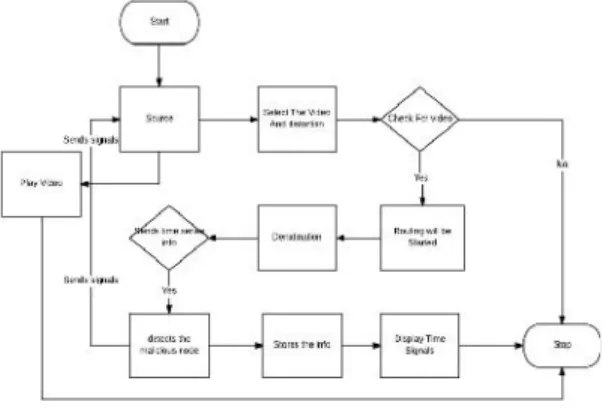
to the goal relies upon the places of the unrecoverable video outlines (basically alluded to as casings) in the GOP, at that jump. The fundamental donation is that build a scientific model to portray the dynamic conduct of the procedure that depicts the advancement of edge misfortunes in the GOP (rather than simply concentrating on a system quality metric, for example, the parcel misfortune likelihood) as video is conveyed on a conclusion to-end way. Speak to how the decision of way for a conclusion to-end stream influences the execution of a stream regarding video contortion. This model is constructed in light of a multilayer approach.
Fig. Proposed Architecture diagram
VI. Conclusion and Future Work
Video Streaming is recently very important research area in the MANETS. In This paper we provides a classification and specification of the issues involved in video streaming over MANETs and the techniques proposed to tackle them. We seeing as most solutions are based on cross-layer design, we give an overview and analysis of the combinations of layers and the exchanged parameters that are generally used. This survey is shows that general, currently existing techniques begin dynamicity and stringent resource constraints by mutually optimizing transmission parameters at various layers of the protocol stack. Stringent constraint in resources, high amount of dynamicity and frequently occurring transmission and path errors make MANETs a challenging environment over to realize video streaming. Frequent path and transmission errors are handled by adding redundancy by utilizing redundant network routes. To select most advantageous transmission parameters, it seems extensively accepted that cross-layer parameter exchanges are essential. Our analysis unveils that 65% of the surveyed solution are utilize cross layering of some sort. Typically, the application
layer adapts the video stream bit rate according to path characteristics obtained at the network layer. on the other hand, the network layer discovers routes with end-to-end characteristics that best suit the requirements of the video stream. It is beneficial to combine MDC with multiple routes. Congestion is no longer handled entirely at the transport layer, primarily because rate adaptation should be handled by a flexible video codec. Our survey concludes few
papers include enough information for the
experiments to be repeatable. Experimental results are often difficult or impossible to compare, due to the high variability of experiment parameter values. There are still certain problems, which are up till now properly addressed. In MANETs, however, the probability of the existence of such a path may be low at any given point in time. Furthermore, mobility can cause this connectivity to disappear and appear frequently and unpredictably. More research is required to provide delay-tolerant streaming solutions for MANETs incorporating the above-mentioned mechanisms. In general, realizing video streaming over MANETs, there already exist many different types of techniques to handle video streaming issues in MANETs. Until now, there are many unsolved issue are addressed in future research.
References
[1] A.Bovik, The Essential Guide to Video Processing.NewYork,NY,USA:Academics,2009.
[2] “PhysMo:Video motion analysis,” [Online].
Available:http://physmo.sourceforge.net
[3] C.A.Poynton,A Technical Introduction to Digital Video. New York, NY, USA:Wiley, 1996.
[4] University of California, Riverside,CA,USA,
“Wireless networking research testbed,” 2011
[Online].
Avaliable:http;//networks.cs.ucr.edu/testbed/
[5] “A Forge.NET,” [Online]. Available:
http://www.aforgenet.com/framework/features/motio n_detection/_2.0.html
[6] D. Li and J. Pan, “Performance evaluation of
video streaming over multi-hop wireless networks,”
IEEE Trans. Wireless Commun, vol.9, n0. 1,pp. 338-347, Jan, 2010.
[7] ISO/IEC JTC1/SC29/WG11,”ISO/IEC 14496
Available:http://mpeg.chiariglione.org/standards/mpe g-4/mpeg-4.htm
[8] T.Wiegand, G.J. Sullivan, G.Bjontegaard, and A. Luthra, “Overview of the H.264/AVC video coding standards,” IEEE Trans. Circuits Syst. Video
Technol., vol.13, no. 7,pp. 560-576, Jul, 2003.
[9] D. S. J. D. Couto, D. Aguayo, J. Bicket, and R.
Morris, “A high-throughput path metric for multi-hop wireless routing,” in Proc. 9thMobiCom, San Diego,
CA, USA, Sep2003.
[10] J. M. Boyee,”Packet loss resilient transmission of MPEG video over the internet,”Signal Process.,
Image Commun., vol. 15, no. 1-2, pp. 7-24, Sep. 1999.
Authors
A.K.G. DHANA LAKSHMI is
pursing M.TECH (CSE) in the
Department of Computer Science and Engineering from BVC Institute of Technology & Science, Batlapalem, Amalapuram, AP, India.
T. SIVARAMA KRISHNA is working as Assistant Professor in Department of Computer Science &
Engineering, BVC Institute of
![Fig. 1 Example of streaming scenario over a MANET [3]](https://thumb-us.123doks.com/thumbv2/123dok_us/8101703.2147322/4.918.116.318.633.786/fig-example-streaming-scenario-manet.webp)