Explication Search Results From Huge Amount Of
Published Data
1Ms. V.Rupa,2Mr. S.Babu
Dept of CSE AVS Engineering College, Venkatachalam, S.P.S.R.Nellore (DT)
Abstract:
The Internet presents a huge amount of useful information which is usually formatted for its users, which makes it difficult to extract relevant data from various sources. Therefore, the availability of robust, flexible Information Extraction (IE) systems that transform the Web pages into program-friendly structures such as a relational database will become a great necessity. Search result record (SRR) is the result page obtained from web database (WDB) and these records are used to display the result for each query. Each SRR contain multiple data units which need to be label semantically for machine process able. In this paper we present the automatic annotation approach which involve three phases to annotate and display the result. In first phase the data units in result record are identified and aligned to different groups such that the data in same group have the same semantics. . This approach is highly effective. From the annotated search result, frequently used websites are identified by using apriority Algorithm which involve pattern mining. In this paper, we present an automatic annotation approach that first aligns the data units on a result page into different groups such that the data in the same group have the same semantic. And then we assign labels to each of this group.
I Introduction:
The Web has become the preferred medium for many database applications, such as
e-commerce and digital libraries. These applications store information in huge
databases that user’s access, query, and update
through the Web. Database-driven Web sites have their own interfaces and access forms for creating HTML pages on the fly. Web database technologies define the way that these
Forms can connect to and retrieve data from Database servers [3] the number of database-driven Websites is increasing exponentially, and each site is creating pages dynamically—pages that are hard for
concepts. We then design different basic annotator to annotate data units of each aligned group. These different basic annotator results are combined to determine appropriate label for each data unit groups. Finally the annotator wrapper is generated for the corresponding WDBs which is used to annotate new SRRs retrieved for different queries. We propose a clustering-based shifting technique to align data units into different groups so that the data units inside the same group have the same semantic. Instead of using only the DOM tree or other HTML tag tree structures of the SRRs to align the data units (like most current methods do), our approach also considers other important features shared among data units, such as their data types (DT), data contents (DC), presentation styles (PS), and adjacency (AD) information. Given a set of SRRs that have been extracted from a result page returned from a WDB, our automatic annotation solution consists of three phases as illustrated in Fig. 1. Let dji denote the data unit belonging to the ith SRR of concept j. The SRRs on a result page can be represented in a table format (Fig. 1a) with each row representing an SRR. Phase 1 is the alignment phase. In this phase, we first identify all data units in the SRRs and then organize them into different groups with each group corresponding to a different concept (e.g., all titles are grouped together). Fig. 1b shows the result of this phase with each column containing data units of the same concept across all SRRs. Grouping data units of the same semantic can help identify the common patterns and features among these data units. These common features are the basis of our annotators. In Phase 2 (the annotation phase), we introduce multiple basic annotators with each exploiting one type of features. Every basic annotator is used to produce a label for the units within their group holistically, and to
determine the most appropriate label. This paper has the following contributions: 1. While most existing approaches simply assign
labels to each HTML text node, we thoroughly analyze the relationships between text nodes and data units. We perform data unit level annotation.
2. We propose a clustering-based shifting technique to align data units into different
groups so that the data units inside the same group have the same semantic. Instead of using only the DOM tree or other HTML tag tree structures of the SRRs to align the data units (like most current methods do), our approach also considers other important features shared among data units, such as their data types (DT), data contents (DC), presentation styles (PS), and adjacency (AD) information.
Fig. 1. Illustration of our three-phase annotation solution.
We utilize the integrated interface schema (IIS) over multiple WDBs in the same domain to enhance data unit annotation. To the best of our knowledge, we are the first to utilize IIS for annotating SRRs.
3. We employ six basic annotators; each annotator can independently assign labels to data units based on certain features of the data units. We also employ a probabilistic model to combine the results from different annotators into a single label. This model is highly flexible so that the existing basic annotators may be modified and new annotators may be added easily without affecting the operation of other annotators.
efficiently annotating the SRRs retrieved from the same WDB with new queries.
II.RELATED WORK
Web information extraction and annotation is an active area in recent years. Many system like wrapper induction system are rely on human [6],[11] to generate the wrapper on the marked data of the sample page. These systems can achieve high extraction accuracy because of some supervised training and learning process. But it performs poor scalability for the application that need to extract information from large number of web source.
Embley et al [10] utilize ontology and other heuristics to automatically extract data in multiple records and label them. But ontology for different domain needs to be constructed manually. Arasu et al [1] describe about extracting structured data from the web page. In which structured template is used to extract the information from the web page. To extract information from the unstructured page structured template pages are used. The human input is absence here so that the occurrence of error is limited and time consuming. But it does not suitable for large database also it does not say about crawling, indexing and providing support to querying structure pages in web. Information is lost when naive key word indexing and searching is used.
J.Madhavan et al [2] define about deep web crawl in which content hidden behind HTML form which is obtained by form submission with valid input values. These inputs are text inputs. Here an algorithm ISIT is used to select input values for text search input that accept keywords. Here informative test is used to evaluate query template for combination of the form input. It increases the accessibility of deep web content for search engine users. Dependencies between values in different input of a form are not considering. No
annotation technique is used.
Now a day there are thousands of search engines were available in the web. But there is a demand to generate automatic tool (wrapper) to extract the selected result records from the HTML result page of search engine .Clement et al [] deals with the dynamic content of automatic extraction of select result records. Here the section extraction is focused which automatically extract all the dynamic section from search result page. Static and semi dynamic content are used to find the boundaries of different dynamic sections and it addresses the issue of correctly differentiating sections and the records. But it does not do any automatic annotation technique.
E-commerce search engine (ESE) is used by the user to search and compare products from multiple web sites. H. He et al [4] proposed an E-commerce Meta search engine (EMSE) is built fully automatically. It has many components. Here, the focus is on the interface integration step of the E-Meta base project. WISE integrator is used to do interface integration step automatically. Hence the WISE integrators also contain the interface extraction component. A comprehensive solution to the search interface integration problem. Fully automated using only general (i.e., domain-independent) knowledge while most existing works employ manual or semi-automatic techniques. Solves a rarely addressed issue. More semantic relationships are needed for attribute matching and value merging. There is a need for human integrators to involve in integration process.
heuristic-based automatic data annotation for web databases is provided. Information discovery problem is not defined. Simply labels are assigned to attributes of Tables. Y.Lu [5] describe about annotating the structured data of the deep web. It is similar to our method where in this paper they describe about four relationships between text node and data units but only two of them are briefly explained where in our method other two relationships also explained. Here we use clustering shift algorithm for one to nothing relationship where Y.Lu et al use pure clustering algorithm. Anyhow no frequent used web page in the annotated group is used for efficient output. Crescenzi,V Efficient Techniques for Effective Wrapper Induction everal studies have recently concentrated on the generation of wrappers for extracting data from Web data sources. The ROADRUNNER system aims at automating the tedious and expensive process of writing wrappers in an unsupervised, domain-independent, and scalable manner. The system is based on a grammar inference algorithm, called MATCH, which has been designed in a sound theoretical framework. However, in its original definition MATCH lacks in expressivity; that is, in many cases when MATCH runs over real-life Web pages, it is not able to produce a solution. In this paper we address the challenging issue of developing techniques that allow us to build upon MATCH an effective and efficient system, without renouncing to the original formal background. First, we analyze the main limitations of MATCH; then we illustrate the techniques we have developed to overcome such limitations. Finally we report on the results of some experiments, that show the efficacy of the introduced techniques and demonstrate the improvements of the overall system.
III. Proposed System:
In this paper, we consider how to automatically assign labels to the data units within the SRRs returned from WDBs. Given a set of SRRs that have been extracted from a result page returned from a WDB, our automatic annotation solution consists of five annotators:
• Table Annotator (TA)
• Query-Based Annotator (QA)
• Schema Value Annotator (SA)
• Frequency-Based Annotator (FA)
• In-Text Prefix/Suffix Annotator (IA)
• Common Knowledge Annotator (CA)
IV.Performance Evaluation
The proposed system performance is evaluated on the basis of two factors that is precision and Recall. The precision and recall is calculated for performance of alignment and performance of annotation. The precision for performance of alignment is as follows.
Table 1 represent the performance calculation for alignment in which the average value for precision and recall is about 98%. And for each domain it is more than 96%.
Domain Alignment Precision Recall Book 98.4 97.3 Game 98.7 98.0 Music 99.0 99.1 Average 98.7 98.1
Table 1 Performance of Alignment
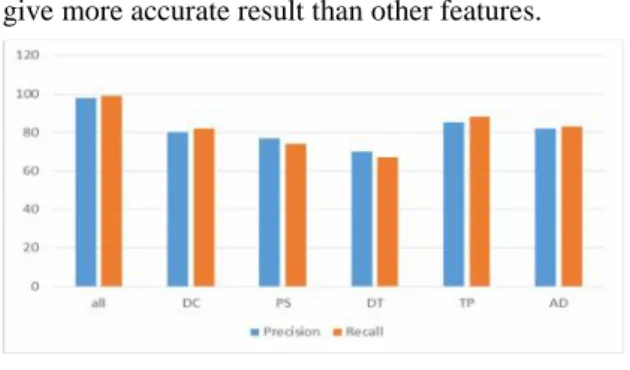
means while calculating individually tag path give more accurate result than other features.
Fig 3. Performance of Alignment Features The basic formula used to calculate precision and recall for annotation is as follows
The table 2 shows the Performance of annotation face in which the average precision and recall is nearly 97%. And for each domain it results more than 95%.
Domain Annotation Precision Recall Book 97.4 96.3 Game 97.7 97.0 Music 97.0 97.7 Average 97.3 97.0
Table 2 Performance of Annotation
The performance of the basic annotator are compared and shown in the fig 4. The evaluation shows the combination of all Annotators give the most accurate result than finding each one individually. Comparing others table annotator gives nearly an accurate result.
Fig 4. Performance of Basic Annotator
V.Conclusion
For the automatic annotation problem, a multi annotator approach is proposed which automatically construct an annotation wrapper for annotating the search result records retrieved from any given web database. In this approach six basic annotators were used and a probabilistic method to combine these basic annotators. Each annotator exploits one type of features for annotation. Each annotator results are useful and combination if these annotator are capable of generating high quality annotation. One of our main features is while annotating the results retrieved from the web database, it utilize both LIS of the web and the IIS of the multiple web databases in the same domain. IIS is used to reduce the local interface schema, inadequacy problem and the inconsistent label problem. In automatic aligned problem accurate alignment is critical to achieving holistic and accurate annotation. But by using a clustering based shifting method we obtain automatically obtainable features. This method is capable of handling variety of relationship between HTML nodes and data units such as one-to-one, one-to-many,
many-to-one, one-to-nothing. By creating
annotation wrapper makes the annotation
easy for the new queries for the same WDB
without performing alignment and
annotation phase again. Using wrapper the
annotation become efficient for even a new
queries. Here we also use the frequent item
set retrieval to know the result set which is
more in annotator group. It is also used to
list down the trusted sites in the data base.
References
[1] S. Handschuh, S. Staab, and R. Volz,
“OnDeep Annotation,” Proc.12th Int’l Conf.
World Wide Web (WWW), 2003.
11th Int’l Conf. World Wide Web (WWW), 2003.
[3]B. He and K. Chang, “Statistical Schema Matching Across Web Query Interfaces,” Proc.
SIGMOD Int’l Conf. Management of Data,
2003.
[4]H. He, W. Meng, C. Yu, and Z. Wu,
“Automatic Integration of Web Search
Interfaces with WISE Integrator,” VLDB J.,
vol. 13, no. 3, pp. 256-273, Sept. 2004. [5]H. He, W. Meng, C. Yu, and Z. Wu,
“Constructing Interface Schemas for Search
Interfaces of Web Databases,” Proc. Web
Information Systems Eng. (WISE) Conf., 2005.
[6].J. Heflin and J. Hendler, “Searching the Web with SHOE,” Proc. AAAI Workshop,
2000.
[7]L. Kaufman and P. Rousseeuw, Finding Groups in Data: An Introduction to Cluster Analysis. John Wiley & Sons, 1990.
[8] N. Krushmerick, D. Weld, and R.
Doorenbos, “Wrapper Induction for
InformationExtraction,” Proc. Int’l Joint Conf.
Artificial Intelligence (IJCAI), 1997.
[9] J. Lee, “Analyses of Multiple Evidence Combination,” Proc. 20th Ann. Int’l ACM
SIGIR Conf. Research and Development in Information Retrieval, 1997.
[10]L. Liu, C. Pu, and W. Han, “XWRAP: An XML-Enabled Wrapper Construction System
for Web Information Sources,” Proc. IEEE
16th Int’l Conf. Data Eng. (ICDE), 2001.
Ms.Velugoti Rupa was born in Andhra
Pradesh, India. She received the B.Tech degree in Computer Science Engineering from JNT University, Anantapur in 2011 and pursuing M.Tech degree in Computer Science Engineering from JNT University, Anantapur. She completed her B.Tech degree in P.B.R. Visvodaya Institute of Science and Technology and M.Tech degree in AVS College of Engineering and Technology, Venkatachalam, Andhra Pradesh.