214
PRODUCTIVITY AND PROFITABILITY OF MAIZE AND SORGHUM
CROPS IN NATURAL CONDITIONS FROM SOUTH AREA
PARTAL ELENA1, PARASCHIVU MIRELA2, OLTENACU CĂTĂLIN VIOREL3, PARASCHIVU MARIUS4
1 National Agricultural Research and Development Institute Fundulea
2
Agricultural Research and Development Station Simnic 3
University of Agronomic Science and Veterinary Medicine Bucuresti 4
University of Craiova, Agriculture and Horticulture Faculty
Key words: maize, sorghum, yield, productivity, profitability
ABSTRACT
Profitability is one of the most important economic parameters taken into account when it carries out an economic activity. The aim of the paper was to establishment maize and grain sorghum productivity and profitability under the influence of tillage methods on different fertilizing levels in the conditions of Ialomiţa County. Economic efficiency was evaluated using specific economic indicators (production cost, net profit and net profit rate) in terms to establish which of two crops performs better. Considering specific climatic regime sorghum showed a better tolerance than maize for water stress and high temperatures so could be further expanded in areas frequently haunted by drought. In dry years sorghum showed profit rate of 145% (Fundulea 21) comparatively with maize (127%-Partizan) in the same technological conditions. Replacing maize with sorghum is proportional to the intensity and frequent droughts in areas targeted to be cultivated.
INTRODUCTION
Previous studies carried out have revealed the influence of crop technology, fertilizing and crop rotation on maize and sorghum yield (Sin et al., 1986, Cristea et al., 2004, Dragomir, 2005, Axinte et al., 2005). Sorghum is a viable economic alternative especially for the areas frequently affected by drought (Uaiene, 2004, Schittenhelm et al., 2011). Generally, tillage and fertilization represent important technological measures especially for dry areas (Erdelyi, 1990). Application of increased amounts of fertilizers in order to obtain higher yields is subject of the effects on soil traits and economic effects caused by the rising cost of fertilizers (Partal and Zaharia, 2008). Therefore, economic efficiency is expressed as yield value reported to resources value used to obtain it. Economic efficiency is assessment on the entire system in terms of production factors and for a proper evaluation it is based on a budget of income and expenses that each farmer drafted it before to establish a crop structure. Previous studies have done in terms of economic efficiency for different maize and sorghum inbred lines and hybrids and for different management systems (Franzlubbers and Francis, 1995, Chaudhry et al., 2005). Thus, the aim of the paper was to establishment maize and grain sorghum productivity and profitability under the influence of tillage methods in different fertilizing treatments in the conditions of Ialomiţa County.
MATERIAL AND METHODS
215
Factor A (tillage): a1- autumn plow, a2- spring plow, a3- disk Factor B (fertilizing level): b1- unfertilized, b2- N120P70 Factor C (hybrid): maize hybrids c1-Partizan and c2-Opal; sorghum hybrids c1-Fundulea 21 and c2- Fundulea 32. The results were interpreted by analysis of variance. Climatic conditions of the experiment
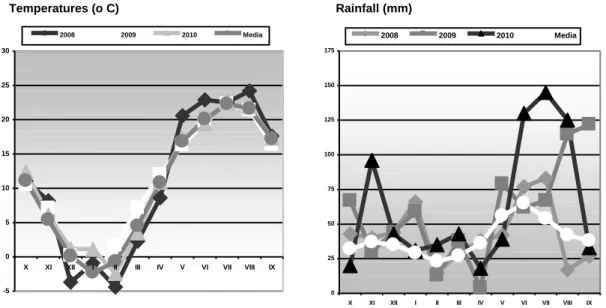
Of the three experimental years, 2008 was a droughty one characterized by an uneven distribution of rainfall amount (515 mm), 2009 year was a normal one and 2010 year could be considered as a rainy one due to rainfall amount of 740 mm. In terms of air temperatures only in May, June and august these were significantly above annual mean (Fig.1 ). Variation of climatic elements from year to year beside technological measures applied influenced development stages for both maize and sorghum crops.
Fig. 1 – Air temperatures and rainfalls recorded to Marculesti Station during 2008-2010
RESULTS AND DISCUSSION
The differences in grain yield between hybrids increased with the intensity of drought stress (Betrán et al., 2003) and applied technology.
The maize hybrids response both to tillage and nitrogen-phosphorus fertilization was influence by yearly climatic variation.
The highest grain yield increases was realized by the hybrid Partizan. Tillage influenced maize yielding capacity leading to 94 q/ha when plowing was done in autumn while the yield decreased when plowing was done in spring to 73 q/ha or disking was applied (62 q/ha) (Fig.2).
According with climatic specific conditions from growing area maize can achieve 80 q/ha when crop is fertilized with N120P70 (a.s.kg/ha). Grain yields were strongly related with nitrogen fertilization treatments (Zorita 2000). Significant yield increases were obtained for maize when plowing was done in autumn and crop was fertilized with N120P70 beside specific climatic conditions. However, the interaction of yearly climatic variation with hybrid yielding potential and drought tolerance appeared to be a greater determinant of maize yield than tillage, which is according with previous research (Wilhelm et al., 1987, Erdelyi, 1990, Mehdi et al., 1999).
Temperatures (o C)
-5 0 5 10 15 20 25 30
X XI XII I II III IV V VI VII VIII IX
2008 2009 2010 Media
Rainfall (mm)
0 25 50 75 100 125 150 175
X XI XII I II III IV V VI VII VIII IX
216
Fig. 2 – The influence of tillage to grain yield depending on maize hybrid and fertilizing treatment
Grain yield tended to be higher when crop management included Fundulea 21 hybrid, N120P70 fertilizing treatment and tillage (plowing) realized in autumn (49 a/ha), than when tillage was done in spring (38 q/ha). For disking and N120P70 fertilizing treatment the highest grain yield was recorded also by Fundulea 21 (36 q/ha) comparatively with Fundulea 32 (28 q/ha). (Fig.3). Previous findings show that sorghum yields tended to be lower with no-tillage or reduced tillage comparatively with conventional system (Franzluebbers et al., 1995, Sainju et al., 2006).
Fig. 3 – The influence of tillage to grain yield depending on sorghum hybrid and fertilizing treatment
Crop management systems need to be designed to maintain economic profitability, while conserving external energy resources and farming in an environmentally responsible manner (Franzlubbers and Francis, 1995).
Considering grain yields recorded for both maize and sorghum crops according with technological measures applied and yearly climatic variation, economic indicators used showed which was the most profitable crop under natural conditions from Ialomita county. Thus, in 2008 year, a droughty one, the highest profit values have been recorded by sorghum crop. Sorghum hybrid Fundulea 21 has made a profit of 2300 RON/ha (N120P70 and plowed in autumn) comparatively with Partizan maize hybrid which in the same technological conditions has made a profit of 3900 RON/ha. On sorghum the profit rate
0 10 20 30 40 50 60 70 80 90 100
p
ro
d
u
ct
io
n
q
/h
a
a1 a2 a3
b1c1 b1c2 b2c1 b2c2
0 5 10 15 20 25 30 35 40 45 50
pr
od
uc
ti
on
q/ha
a1 a2 a3
217
recorded higher values between 102-186% comparatively with maize where profit rate ranged from 15-23%.
In 2009, a normal year in terms of climatic regime, profit and profit rate recorded closed values for both sorghum and maize crops.
Thus, the highest profit was recorded for sorghum by Fundulea 21 hybrid (N120P70 and plowed in autumn) with 3250 RON/ha and for maize by Opal hybrid (N120P70 and plowed in autumn) with 3450 RON/ha.
For sorghum the profit rate ranged between 131-240% (Fundulea 21) and 86-133% (Fundulea 32), while for maize profit rate ranged between 141-181% (Opal) and 165-191% (Partizan).
In 2010, a rainy year, the highest profit values were recorded by maize comparatively with sorghum. For both maize hybrids the profit was closed in the same technological conditions (N120P70 and plowed in autumn), respectively 3620 RON/ha (Partizan) and 3600 RON/ha (Opal).
The lowest profit was recorded by Opal on unfertilized plot and plowed in spring (1750 RON/ha). For sorghum, in the same technological conditions, the profit was 1650 RON/ha for Fundulea 21 and 340 RON/ha for Fundulea 32.
The profit rate ranged between 96-184% for maize hybrids, while for sorghum hybrids it ranged between -6-92% depending on experimental variant.
The profit rate recorded for maize was 127% for Partizan and 116% for Opal in the conditions of plowing in autumn and fertilizing treatment with N120P70, while for sorghum the profit rate was 145% for Fundulea 21 and 91% for Fundulea 32 in the same technological conditions (Fig.4).
The profit rate showed a higher return for all tillage systems with N120P70 fertilizing treatment, providing that regardless tillage system is necessary to apply fertilizers.
However, sorghum is more profitable crop in dry land conditions and low-yielding years in which growers may be more economically vulnerable, while maize is more profitable in rainfall conditions, which is according with previous findings (Franzlubbers and Francis, 1995, Damelash et al. 2003, Hatibu et al., 2003, Sinclair et al. 2005). Is realized also a diversification of crops structure that can assure greater stability of grain crops under climate changes and dry land expansion.
0 50 100 150 200
A1B1 A1B2 A2B1 A2B2 A3B1 A3B2
variant profit rate%
Partizan Opal Fundulea 21 Fundulea 32
218
CONCLUSIONS
For maize crop soil tillage (plowing in autumn) resulted in a better use of fertilizing treatment (N120P70) leading to very significant yield increases comparatively with other tillage options. The highest profit values were recorded for the variants plowed in autumn or worked with disk beside to N120P70 fertilizing treatment. Maize crop profitability is increased in rainfall conditions, while in dry years are losses especially for variants with minimum tillage and no fertilizing.
For sorghum crop the highest profitability were recorded for the variant were plot was plowed in autumn, fertilized with N120P70 and used the hybrid Fundulea 21. Sorghum crop is more profitable than maize especially in dry years which suggests that sorghum may be a proper alternative for dry areas. Comparing these crops profitability it was observed that it depends by yearly climatic variation, cropping technology (tillage and fertilizing regime) and the tolerance of cultivar to drought stress. Because sorghum shows higher tolerance to drought this crop is recommended to be extended in areas frequently affected by drought. Replacement of maize with sorghum is recommended to be made according to drought frequency and intensity in areas targeted to be cultivated.
BIBLIOGRAPHY
Axinte, S., Axinte, M., Agafiţei, A., Axinte, L., Neştian, I. – 2005, Lucrări ştiinţifice, seria Agronomie, USAMV Iaşi, vol. 48.
Chaudhry, G.N., and al., - 2005, Comparison of some advanced lines of Sorghum bicolor L. Moench for green fodder dry matter yields and morpho-economic parameters. J. Agric. Res., vol. 44 (3):1-8
Cristea, M., Căbulea, I., Sarca, T. - 2004. Porumbul – Studiul monografic. Ed. Academiei
Române.
Damelash A.A. - 2003. Improved production technology and efficiency of smallholders farmers in Ethiopia. Extended parametric and non-parametric approaches to production efficiency analysis. PhD Thesis (Agricultural Economics), University of Pretoria, Pretoria, South Africa.
Dragomir, N. – 2005, Pajisti si plante furajere. Tehnologii de cultivare. Ed. Eurobit,Timisoara
Erdelyi, S. et al. – 1990, Producerea şi conservarea furajelor. Tipo. Agronomia Cluj – Napoca.
Franzluebbers, A.J. and Francis, A.J. - 1995. Energy output: input ratio of maize and sorghum management systems in eastern Nebraska. Agriculture, Ecosystems & Environment 53, p.271-278.
Franzluebbers, A.J., Hons, F.M., Saladio, V.A. - 1995. Sorghum, wheat and soybean production as affected by long-term tillage, crop sequence and N fertilization. Plant and Soil 1, p.55-65.
Hatibu, N., Young, M.D.B., Growing, J.W., Mahoo, H.F., Mzirai, O.B. - 2003. Developing improved dryland cropping systems for maize in semi-aris Tanzania. Part 1: Experimental evidence for the benefits of rainwater harvesting. Experimental Agriculture, 39, p.279-292.
Mehdi, B.B., Madramootoo, C.A., Mehuys, G.R. - 1999. Yield and nitrogen content of corn under different tiillage practices. Agronomy J. 91, p.631-636.
Partal, Elena, Zaharia, G.-V., 2008 – Rezultate privind efectele fertilizării la principalele
culturi de câmp. An. INCDA Fundulea, vol. LXXIV:111-118.
Sainju, U.M., Whitehead, W.F., Singh, B.P., Wang, S. - 2006. Tillage, cover crops and nitrogen fertilization effects on soil nitrogen and cotton and sorghum yields. European J. of Agronomy 4, p.372-382.
219
Sin, G., Ioniţa, S., Drăghicioiu ,V., Bondarev, I., Nicolae, H., Boruga, I. - 1986.
Posibilităţi de reducere a lucrărilor solului pentru culturile de grâu, porumb şi floarea soarelui. Probleme de agrofitotehnie teoretică şi aplicată, nr.3.
Sinclair, T. R., Hammer G. L., Van Oosterom, E.J. - 2005. Potential yield and water use efficiency benefits in sorghum from limited maximum transpiration rate. Functional Plant Biology 32, p.945-952.
Uaiene, Rafael N., M.S. - Purdue University, December, 2004. Maize and Sorghum Technologies and the Effects of Marketing Strategies on Farmers’ Income in Mozambique. Major Professor: John H. Sanders, College of Agriculture – Doctoral Thesis.
Wilhelm W.W., Scepers J.S., Mielke L.M., Doran J.W., Ellis J.R., Stroup W.W. -1987.
Dryland maize development and yield resulting from tillage and nitrogen fertilization practices. Soil and Tillage Res. 10, p.167-179.