133
Semiconductor Thermal Neutron Detector
Toru Aoki
1,3, Aki Miyake
2,3, Takayuki Nakano
2, Akifumi Koike
1,3,
Hisashi Morii
2, and Hidenori Mimura
11. Research Institute of Electronics, Shizuoka University, Hamamatsu, Shizuoka 432-8011, Japan 2. Facauty of Engineering, Shizuoka University, Hamamatsu, Shizuoka 432-8011, Japan
3. ANSeeN Inc., 3-5-1 Jyohoku, Naka-ku, Hamamatsu, Shizuoka 432-8561, Japan
*e-mail: [email protected]
Abstract
The CdTe and GaN detector with a Gd converter have been developed and investigated as a neutron detector for neutron imaging. The fabricated Gd/CdTe detector with the 25 mm thick Gd was designed on the basis of simulation results of thermal neutron detection efficiency and spatial resolution. The Gd/CdTe detector shows the detection of neutron capture gamma ray emission in the 155Gd(n, g)156Gd, 157Gd(n, g)158Gd and 113Cd(n, g)114Cd reactions and characteristic X-ray emissions due to conversion-electrons generated inside the Gd film. The observed efficient thermal neutron detection with the Gd/CdTe detector shows its promise in neutron radiography application. Moreover, a BGaN detector has also investigated to separate neutron signal from gamma-ray clearly.
Abstrak
Detektor Neutron Termal Semikonduktor. Detektor CdTe dan GaN dengan konverter Gd telah dikembangkan dan
diteliti sebagai detektor neutron yang digunakan dalam pencitraan neutron. Detektor Gd/CdTe yang dibuat dengan Gd setebal 25 mm itu dirancang berdasarkan hasil simulasi efisiensi pendeteksian dan resolusi spasial neutron termal. Detektor Gd/CdTe menunjukkan adanya pendeteksian neutron yang menangkap emisi sinar gamma dalam reaksi-reaksi 155Gd(n, g)156Gd, 157Gd(n, g)158Gd, dan 113Cd(n, g)114Cd dan emisi sinar-X yang khas sebagai akibat dari dihasilkannya
elektron-elektron konversi dalam film Gd. Dalam aplikasi radiografi neutron, pendeteksian dengan detektor Gd/CdTe yang efisien terhadap neutron termal yang diteliti merupakan temuan yang menjanjikan. Selain itu, diselidiki juga bahwa detektor BGaN dapat memisahkan sinyal neutron dan sinar gamma dengan jelas.
Keywords: detector, neutron, semiconductor, thermal
1. Introduction
Recently, the inspection equipment using the transparency of radiation has been fabricated in various fields. X-ray and γ-ray have been used in these equipments, such as x-ray CT and baggage inspection equipment at the airport. However, X-ray and γ-ray are low permeability for the heavy elements, and are unsuitable for the inspection equipment of the metal products. The neutron is noticed as a new radiation source, because the permeability of neutron is high for the heavy elements, and the fabrication of neutron semiconductor detector is expected. Neutron imaging has attracted much of attention as a nondestructive testing method for scientific, technical, security and other applications [1-2]. In this technique, an image is
9]. However, they are sensitive to both neutron and gamma ray. Also gamma rays are usually produced by neutron generating processes. Detected gamma rays cause deterioration of the neutron image. Consequently, techniques for neutron and gamma ray discrimination are required to obtain a clear neutron image.
We have reported that a CdTe semiconductor detector for gamma ray imaging has high sensitivity, good energy and spatial resolution at room temperature operation [10-11]. CdTe has also been investigated as a thermal neutron detector, because this semiconductor contains 133Cd, which has a large thermal neutron capture cross-section and emits prompt gamma rays [4, 8-9]. The CdTe detector detects these prompt gamma rays as the thermal neutron capture events. To extract neutron events, the prompt gamma rays are distinguished from background gamma rays using difference in energy. High energy resolution is required to achieve good neutron/gamma ray discrimination. For the CdTe detector, high energy resolution can be obtained by applying high electric field to the detector. Therefore, it is suggested that a thin CdTe detector, which can operate at high electric fields is suitable for neutron imaging. However, the use of the thin CdTe detector causes a reduction in neutron capture efficiency and gamma ray detection efficiency due to the reduction of the thickness of CdTe containing 113Cd. Moreover, the typical energies of emitted gamma rays are higher than detectable photon energies of CdTe. Therefore, we propose to use Gadolinium (Gd) as a converter material to capture neutrons and then emit gamma rays. Gd has very large thermal neutron capture cross-section (48770 barns), i.e. 20 times more than that of Cd, and energies of prompt gamma rays generated in the following (n, g) reactions are suitable to be detected by a CdTe detector. Thus, a thin CdTe detector with the Gd converter is supposed to provide good neutron/gamma ray discrimination and higher thermal neutron detection efficiency than just a CdTe detector.
On the other hand, we have aimed at the achievement of the new neutron imaging device by compound semiconductor with B converter. We have suggested a neutron detector by using (n, α) reaction, which is generated by B atom. The wide band gap semiconductor GaN, which has less γ-ray sensitivity, is selected to distinguish neutron form background γ-ray. For these reasons, we try to fabricate a neutron semiconductor detector by using BGaN. In this work, BGaN was grown by metal organic vapor phase epitaxy (MOVPE) using the precursors; trimethylgallium (TMG), triethylboron (TEB) and NH3 for the Ga, B and N, respectively. GaN and BGaN were grown at 1070°C on a Al2O3(0001) substrate. The structure consist is Au/GaN/Al2O3, or Au/BGaN/GaN/Al2O3. The Au electrode was attached by vacuum vapor deposition apparatus. The BGaN samples were evaluated by
scanning electron microscopy (SEM) and electric prove micro analyzer (EPMA), and I-V measurement with α-ray irradiation.
2. Methods
The Gd/CdTe detector was prepared by pasting a Gd film on the top of the CdTe detector. The M–p–n structured CdTe detector with dimension of 4 mm x 4 mm x 0.5 mm was fabricated using (111) orientated p-like CdTe wafer (ACRORAD, Co.). The indium-doped n-CdTe layer was formed by the laser-induced doping procedure [10]. Indium and gold electrodes were deposited by vacuum evaporation, and a Gd film was pasted on the gold electrode using a silver paste. The detector shows rectification property of the diode and was confirmed by current–voltage (I–V) measurement.
We used following isotopes for the measurement of gamma ray spectra: 241Am and 57Co as gamma ray sources, and 252Cf with the activity of 1.74 MBq as a neutron source. 252Cf was surrounded by a polyethylene moderator to provide thermal neutrons. Pb and Sn shields were inserted between the neutron source and detector in order to decrease intensity of background gamma rays emitted directly by 252Cf. The thicknesses of Pb and Sn were 27 and 7 mm, respectively. The Gd/CdTe detector was operated at a reverse bias of 200 V. The measuring system consists of a charge sensitive type pre-amplifier (Clear-Pulse 5102) and a pulse height analyzer (SEICO EG&G MCA7600) and the shaping time was set at 0.5 ms.
Calculations of interaction of neutrons with the Gd converter have been carried out using the GEANT4 simulation codes with GEANT4 neutron data library 3.13, which comes largely from the ENDF/B-VI cross-section library, photon evaporation 2.0 data base, which comes from the Evaluated Nuclear Structure Data File (ENSDF) and Geant4 low-energy electromagnetic models based on Livermore library [12-13]. The energy of the thermal neutron is 25 meV.
3. Results and Discussion
Gd converter thickness. The Gd converter thickness of
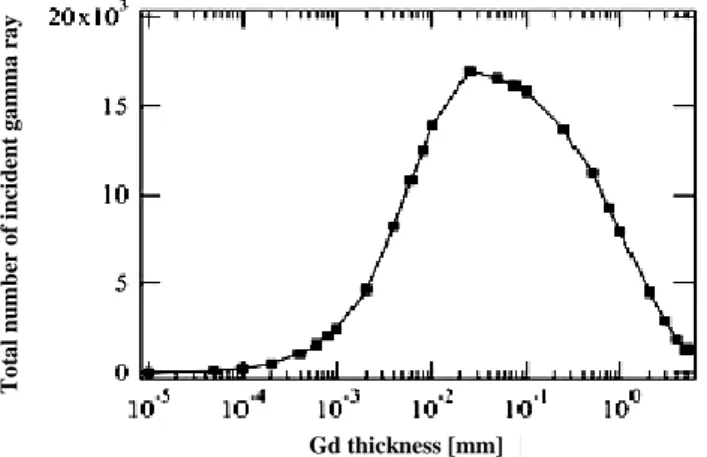
the index of neutron detection and was shown in Figure 1. Maximum number of incident gamma ray on the detector was obtained when the Gd thickness was 25 mm. It suggests that the highest neutron detection efficiency is achieved by a CdTe detector with the 25 mm thick Gd converter. The spatial resolution is deteriorated by increasing Gd thickness because the incident area of prompt gamma rays on the detector spreads with increasing Gd thickness. To investigate the spatial resolution, the incident area of the prompt gamma ray on the detector with various Gd thicknesses was estimated by simulation. 10,000 thermal neutrons hit the center of Gd surface vertically and the prompt gamma rays incident on the detector was counted. The FWHM of spread width at the 25 mm thick Gd was 50 mm. This value is enough to the CdTe detector for imaging because the pixel size of a commercial CdTe imaging device is 100 mm. Thus, we used 25 mm thick Gd film as a convertor in the fabrication of the Gd/CdTe detectors.
Figure 1. Total Numbers of Incident Gamma-rays on the Detector as a Function of Gd Thickness
Figure 2. The Gamma-ray Energy Spectrum Obtained from two Spectra of 241Am and 57Co Radioisotopes Measured with the Gd/CdTe Detector
Energy resolution. To confirm the ability of neutron/
gamma ray discrimination, we investigated the energy resolution of the fabricated Gd/CdTe detector with the Gd thickness of 25 mm. Figure 2 shows the resultant gamma ray spectrum obtained from two spectra of 241Am and 57Co measured by the detector. The energy
resolution was calculated in terms of FWHM. The peaks Am at 59.5 keV and Co at 122.1 keV are derived from 241Am and 57Co, and the FWHM of the peaks is 3.4 and
3.7 keV, respectively. For a 252Cf isotope, that has usually been used as a neutron source for neutron radiography, the spectrum of gamma rays emitted from sponta¬neous fission is broad and the typical energies of gamma rays emitted from alpha decay are 43.4, 100, 154.5 and 206.9 keV [14]. The energies of gamma rays generated by capturing neutron in 155Gd and 157Gd are 80, 89, 182 and 199 keV. The difference in energies between prompt gamma rays from Gd converter and background gamma rays from 252Cf neutron source is larger than the energy resolution of the detector. Therefore, the Gd/CdTe detector can achieve good neutron/gamma ray discrimination.
Neutron detection. To verify the suitability of
Gd/CdTe as a neutron detector, we carried out the observation of neutron capture events by measurement of neutron source with the fabricated Gd/CdTe detector. Figure 3 shows the gamma ray spectrum obtained with e Gd/CdTe detector from neutrons and gamma rays of 252Cf. The peaks at 80 and 182 keV (solid squares)
correspond to gamma rays emitted in the 157Gd(n, g)158Gd reaction and the peaks of 89 and 199 keV (solid squares) correspond to gamma rays emitted in the 155Gd(n, g)156Gd reaction. The 4 peaks obtained are the evidence that the Gd/CdTe detector detected gamma rays from neutron captured by Gd. Moreover, the large peaks at 43 and 49 keV (open squares) correspond to the characteristic X-rays emitted by interaction between Gd and conversion electrons generated by neutron capture.
Figure 3. The Gammaray Energy Spectrum Obtained from Neutron Capture Detected with the Gd/CdTe Detector Using a 252Cf Radioisotope
Gd thickness [mm]
Energy [keV] Energy [keV]
T
o
ta
l
n
u
m
b
er
o
f
in
ci
d
en
t
g
a
m
m
a
r
a
y
C
o
u
n
ts
C
o
u
n
Thermal neutrons, which come into the lateral and back-surface by 113Cd contained in the CdTe detector because 25 mm thick Gd absorbs most of the incident thermal neutrons. The observed peaks indicate that the Gd/CdTe detector detected the neutrons capture events in the Gd converter and the CdTe detector. The observed broad spectrum consists of gamma ray emitted from 252Cf and Compton scattering. Consequently, the neutron information can be obtained by separating sharp peaks from broad spectrum. The results confirm that the Gd/CdTe detector can detect the neutron capture events and separate it from the background gamma ray events.
BGaN detector. The dependence of the pressure on the
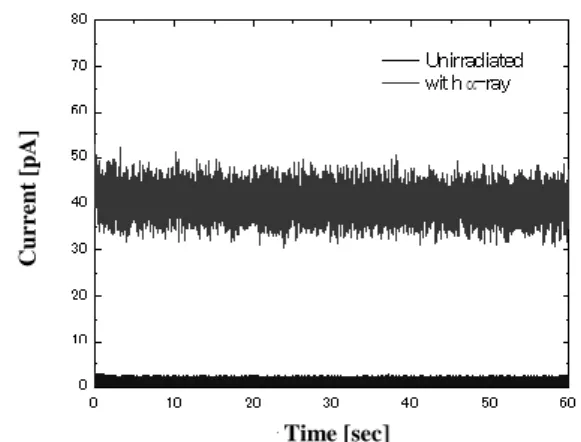
surface morphology of the BGaN is investigated. Figure 1 shows SEM images of the BGaN samples grown at the pressure of 150 Torr and 300 Torr. The sample with smooth surface is fabricated at low pressure, as shown in Figure 4 (a), which phenomena is also discovered as growth of BN samples. It is considered that the reaction of B atom is suppressed and the migration of B atom on the surface is promoted at low pressure. In order to detect the neutron using (n, α) reaction, the detection sensitivity of GaN for α-ray is studied. The IVt characteristic of the double Schottky structure GaN on applied voltage was measured by irradiating with the α-ray from americium (Am). Figure 2 shows the IVt measurement result. In Figure 5, the current is detected
Figure 4. The SEM Images of the BGaN Samples: (a) Grown at 150 Torr (b) Grown at 300 Torr
Figure 5. I-t Characteristic of the GaN Dependency of Irradiation with α-ray
Figure 6. I-t Characteristic of the BGaN Dependency of Irradiation with α-ray
as irradiating with the α-ray, while no current is detected as no irradiating with the α-ray. The result of detection sensitivity of α-ray of the GaN reveals that the neutron detector sing BGaN could detect α-ray resulting from Boron by neutron irradiation. The detection sensitivity of BGaN for α-ray is also investigated. The measurement of the IVt characteristic of the BGaN is similar to that of the GaN. Figure 3 shows the IVt measurement result of the BGaN sample grown at the pressure of 150 Torr. In Figure 3, the current is detected as irradiating with the α-ray, while no current is detected as no irradiating with the α-ray. Additionally, the IVt characteristic of the BGaN is measured by irradiating with the γ-ray. By irradiating with the g-ray, the current does not flow (is not dectected). These results indicate that the BGaN has the sensitivity for the α-ray, and γ-ray is not detected. BGaN is expected as the material which detects only the neutron, because γ-ray which arises from the neutron source is not detected. Therefore, these results indicate that the neutron detector of BGaN using (n, α) reaction can be expected as a new neutron detection material.
4. Conclusions
We have developed the thin CdTe detector with Gd converter as a thermal neutron detector having good neutron/gamma ray discrimination for neutron imaging devices. The simulation results demonstrated that the Gd thickness of 25 mm provides the highest detection efficiency and good spectral resolution equivalent to the commercial CdTe gamma ray imaging detector. The energy resolution of the fabricated Gd/CdTe detector is less than 4 ke V, which is enough for gamma ray discrimination. The sharp peaks attributable to neutron events were clearly observed by measurement of 252Cf neutron source and these peaks can be separated from background gamma rays. The results that are obtained are promising and show that the Gd/CdTe detectors
(a) (b)
Time [sec]
C
u
rr
en
t
[p
A
]
Time [sec]
C
u
rr
en
t
[p
A
provide clear neutron imaging with good resolution and they can be used for neutron radiography. GaN are good material for this purpose because its low gamma-ray sensitivity and good detection property for α-rays. We found high possibility in BGaN films for neutron detector.
References
[1] A.J. Peurrung, Nucl. Instr. Meth. Phys. Res. A. 443 (2000) 400.
[2] H. Sakaguchi, Y. Satake, K. Hatakeyama, S. Fujine, K. Yoneda, M. Matsubayashi, T. Esaka, J. Alloys Compd. 354 (2003) 208.
[3] J.B. Czirr, G.M. MacGillivray, R.R. MacGillivray, P.J. Seddon, Nucl. Instr. Meth. Phys. Res. A. 424 (1999) 15.
[4] D.S. McGregor, J.T. Lindsay, R.W. Olsen, Nucl. Instr. Meth. Phys. Res. A. 381 (1996) 498.
[5] J. Jakubek, T. Holy, E. Lehmann, S. Pospisil, J. Uher, J. Uher, J. Vacik, D. Vavrik, Nucl. Instr. Meth. Phys. Res. A. 560 (2006) 143.
[6] J. Jakubek, G. Mettiver, M.C. Montesi, S. Pospisil, P. Russo, J. Vacik, Nucl. Instr. Meth. Phys. Res. A. 563 (2006) 238.
[7] D.S. McGregor, M.D. Hamming, Y.H. Yang, H.K. Gersh, R.T. Klann, Nucl. Instr. Meth. Phys. Res. A. 500 (2003) 272.
[8] A.G. Vradii, M.I. Krapivin, L.V. Maslova, O.A. Matveev, A.Kh, Khusainov, V.K. Shashurin, Atomnaya Energiya. 42 (1977) 58 (translated). [9] M. Fasasi, M. Jung, P. Siffert, C. Teissier, Radiat.
Prot. Dosim. 23 (1988) 429.
[10] V.A. Gnatyuk, T. Aoki, Y. Hatanaka, O.I. Vlasenko, Phys. Status. Solidi. C 3 (2006) 1221. [11] T. Aoki, H. Morii, T. Nakashima, Y. Takahashi, G.
Ohashi, Y. Tomita, Y. Neo, H. Mimura, Proc. SPIE. 7008 (2008) 70080R.
[12] J. Sulkimo, M. Takahata, S. Tanaka, E. Tcherniaev, E.S. Tehrani, M. Tropeano, P. Truscott, H. Uno, L. Urban, P. Urban, M. Verderi, A. Walkden, W. Wander, H. Weber, J.P. Wellisch, T. Wenaus, D.C. Williams, D. Wright, T. Yamada, H. Yoshida, D. Zschiesche, Nucl. Instr. Meth. Phys. Res. A. 506 (2003) 250.
[13] R.B. Firestone, H.D. Choi, R.M. Lindstrom, G.L. Molnar, S.F. Mughabghab, R. Paviotti-Corcuera, Z. Revay, A. Trkov, C. Zhou, V. Zerkin, Database of Prompt Gamma Rays from Slow Neutron Capture for Elemental Analysis, Pap/Cdr edition, Intl. Atomic Energy Agency, Vienna, 2007, p.251. [14] H.R. Bowman, S.G. Thompson, J.O. Rasmussen,