Model-Based Speech Signal Coding Using Optimized
Temporal Decomposition for Storage
and Broadcasting Applications
Chandranath R. N. Athaudage
ARC Special Research Center for Ultra-Broadband Information Networks (CUBIN), Department of Electrical and Electronic Engineering, The University of Melbourne, Victoria 3010, Australia
Email:[email protected]
Alan B. Bradley
Institution of Engineers Australia, North Melbourne, Victoria 3051, Australia Email:[email protected]
Margaret Lech
School of Electrical and Computer System Engineering, Royal Melbourne Institute of Technology (RMIT) University, Melbourne, Victoria 3001, Australia
Email:[email protected]
Received 27 May 2002 and in revised form 17 March 2003
A dynamic programming-based optimization strategy for a temporal decomposition (TD) model of speech and its application to low-rate speech coding in storage and broadcasting is presented. In previous work with the spectral stability-based event localizing (SBEL) TD algorithm, the event localization was performed based on a spectral stability criterion. Although this approach gave reasonably good results, there was no assurance on the optimality of the event locations. In the present work, we have optimized the event localizing task using a dynamic programming-based optimization strategy. Simulation results show that an improved TD model accuracy can be achieved. A methodology of incorporating the optimized TD algorithm within the standard MELP speech coder for the efficient compression of speech spectral information is also presented. The performance evaluation results revealed that the proposed speech coding scheme achieves 50%–60% compression of speech spectral information with negligible degradation in the decoded speech quality.
Keywords and phrases:temporal decomposition, speech coding, spectral parameters, dynamic programming, quantization.
1. INTRODUCTION
While practical issues such as delay, complexity, and fixed rate of encoding are important for speech coding applica-tions in telecommunicaapplica-tions, they can be significantly re-laxed for speech storage applications such as store-forward messaging and broadcasting systems. In this context, it is desirable to know what optimal compression performance is achievable if associated constraints are relaxed. Various techniques for compressing speech information exploiting the delay domain, for applications where delay does not need to be strictly constrained (in contrast to full-duplex conversational communication), are found in the literature [1,2,3,4, 5]. However, only very few have addressed the issue from an optimization perspective. Specifically, tempo-ral decomposition (TD) [6,7, 8,9, 10,11], which is very
effective in representing the temporal structure of speech and for removing temporal redundancies, has not been given ad-equate treatment for optimal performance to be achieved. Such an optimized TD (OTD) algorithm would be useful for speech coding applications such as voice store-forward mes-saging systems, and multimedia voice-output systems, and for broadcasting via the internet. Not only would it be use-ful for speech coding in its own right, but research in this direction would lead to a better understanding of the struc-tural properties of the speech signal and the development of improved speech models which, in turn, would result in im-provement in audio processing systems in general.
(event targets) and an associated set of interpolation func-tions (event funcfunc-tions). TD can also be considered as an effective technique of decorrelating the inherent interframe correlations present in any frame-based parametric represen-tation of speech. TD model parameters are normally eval-uated over a buffered block of speech parameter frames, with the block size generally limited by the computational complexity of the TD analysis process over long blocks. Let yi(n) be theith speech parameter at thenth frame location. The speech parameters can be any suitable parametric rep-resentation of the speech spectrum such as reflection coeffi -cients, log area ratios, and line spectral frequencies (LSFs). It is assumed that the parameters have been evaluated at close enough frame intervals to represent accurately even the fastest of speech transitions. The indexivaries from 1 toI, whereIis the total number of parameters per frame. The in-dexnvaries from 1 toN, wheren = 1 andn =N are the indices of the first and last frames of the speech parameter block buffered for TD analysis. In the TD model of speech, each speech parameter trajectory,yi(n), is described as
ˆ yi(n)=
K
k=1
aikφk(n), 1≤n≤N,1≤i≤I, (1)
where ˆyi(n) is the approximation of yi(n) produced by the TD model. The variable φk(n) is the amplitude of the kth event function at the frame locationnandaikis the contri-bution of thekth event function to theith speech parame-ter. The valueKis the total number of speech events within the speech block with frame indices 1 ≤n ≤N. It should be noted that the event functionsφk(n)’s are common to all speech parameter trajectories (yi(n), 1≤i≤I) and therefore provide a compact and approximate representation, that is, a model, of speech. Equation (1) can be expressed in vector notation as
ˆ
y(n)= K
k=1
akφk(n), 1≤n≤N, (2)
where
ak=
a1k a2k · · · aIk T
,
ˆ
y(n)=yˆ1(n) ˆy2(n) · · · yˆI(n) T
,
y(n)=y1(n) y2(n) · · · yI(n) T
,
(3)
whereakis thekth event target vector, and ˆy(n) is the approx-imation ofy(n), thenth speech parameter vector, produced by the TD model of speech. Note thatφk(n) remains a scalar since it is common to each of the individual parameter tra-jectories. In matrix notation, (2) can be written as
ˆ
Y=AΦ, Yˆ ∈RI×N,A∈RI×K,Φ∈RK×N, (4)
where thekth column of matrixAcontains thekth event tar-get vector,ak, and thenth column of the matrix ˆY (approxi-mation ofY) contains thenth speech parameter frame, ˆy(n),
produced by the TD model. MatrixYcontains the original speech parameter block. In the matrixΦ, thekth row con-tains the kth event function,φk(n). It is assumed that the functionsφk(n)s are ordered with respect to their locations in time. That is, the function φk+1(n) occurs later than the
function φk(n). Eachφk(n) is supposed to correspond to a particular speech event. Since a speech event lasts for a short time (temporal), eachφk(n) should be nonzero only over a small range ofn. Event function overlapping normally oc-curs between close by events in time, while events that are far apart in time have no overlapping at all. These characteris-tics ensure the matrixΦto be a sparse matrix with number of nonzero terms in thenth column indicating the number of event functions overlapping at thenth frame location [6]. Thus, significant coding gains can be achieved by encoding the information in the matricesAandΦinstead of the orig-inal speech parameter matrixY[6,11,12].
The results of the spectral stability-based event localiz-ing (SBEL) TD [9,10] and Atal’s original algorithm [6] for TD analysis show that event function overlapping beyond two adjacent event functions occurs very rarely, although in the generalized TD model overlapping is allowed to any ex-tent. Taking this into account, the proposed modified model of TD imposes a natural limit to the length of the event functions. We have shown that better performance can be achieved through optimization of the modified TD model. In previous TD algorithms such as SBEL TD [9,10] and Atal’s original algorithm [6], event locations are determined using heuristic assumptions. In contrast, the proposed OTD anal-ysis technique makes no a priori assumptions on event lo-cations. All TD components are evaluated based on error-minimizing criteria, using a joint optimization procedure. Mixed excitation LPC vocoder model used in the standard MELP coder was used as the baseline parametric representa-tion of the speech signal. Applicarepresenta-tion of OTD for efficient compression of MELP spectral parameters is also investi-gated with TD parameter quantization issues and effective coupling between TD analysis and parameter quantization stages. We propose a new OTD-based LPC vocoder with de-tail coder performance evaluation, both in terms of objective and subjective measures.
This paper is organized as follows.Section 2introduces the modified TD model. An optimal TD parameter evalu-ation strategy based on the modified TD model is presented inSection 3.Section 4gives numerical results with OTD. The details of the proposed OTD-based vocoder and its perfor-mance evaluation results are reported in Sections 5and6, respectively. The concluding remarks are given inSection 7.
2. MODIFIED TD MODEL OF SPEECH
The proposed modified TD model of speech restricts the event function overlapping to only two adjacent event func-tions as shown inFigure 1. This modified model of TD can be described as
ˆ
nk nk+1 Time index (n) φk+1(n) ak+1
ak φk(n)
Figure1: Modified temporal decomposition model of speech. The speech parameter segment nk ≤ n < nk+1 is represented by a
weighted sum (with weightsφk(n) andφk+1(n) forming the event
functions) of the two vectorsak andak+1 (event targets). Vertical
lines depict the speech parameter vector sequence.
wherenkandnk+1are the locations of thekth and (k+ 1)th
events, respectively. All speech parameter frames between the consecutive event locationsnkandnk+1are described by
these two events. Equivalently, the modified TD model can be expressed as
ˆ
y(n)= K
k=1
akφk(n), 1≤n≤N, (6)
whereφk(n)=0 forn < nk−1andn≥nk+1. In the modified
TD model, each event function is allowed to be nonzero only in the region between the centers of the proceeding and suc-ceeding events. This eliminates the computational overhead associated with achieving the time-limited property of events in the previous TD algorithms [6,9,10].
The modified TD model can be considered as a hybrid between the original TD concept [6] and the speech segment representation techniques proposed in [1]. In [1], a speech parameter segment between two locationsnkandnk+1is
sim-ply represented by a constant vector (centroid of the seg-ment) or by a first-order (linear) approximation. A constant vector approximation of the form
ˆ
y(n)= nk+1−1
n=nk
y(n)
nk+1−nk
, fornk≤n < nk+1, (7)
provides a single vector representation for a whole speech segment. However, this representation requires the segments to be short in length in order to achieve a good speech pa-rameter representation accuracy. A linear approximation of the form ˆy(n) = na+brequires two vectors (aandb) to represent a segment of speech parameters. This segment rep-resentation technique captures the linearly varying speech segments well and is similar to the linear interpolation tech-nique report in [13]. The proposed modified model of TD in (5) provides a further extension to speech segment rep-resentation, where each speech parameter vectory(n) is de-scribed as the weighted sum of two vectorsak andak+1, for
nk ≤ n < nk+1. The weightsφk(n) andφk+1(n) for thenth
speech parameter frame form the event functions of the tra-ditional TD model [6]. It is shown that the simplicity of the proposed modified TD model allows the optimal evaluation of the model parameters, thus resulting in an improved mod-elling accuracy.
Speech parameter sequence
Parameter buffering
Buffered block of speech parameters
TD analysis
TD parameters
Figure2: Buffering of speech parameters into blocks is a prepro-cessing stage required for TD analysis. TD analysis is performed on block-by-block basis with TD parameters calculated for each block separately and independently.
1 n1 n2 nk N
Block
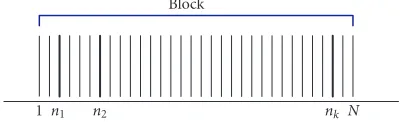
Figure3: A block of speech parameter vectors,{y(n)|1≤n≤N}, buffered for TD analysis.
3. OPTIMAL ANALYSIS STRATEGY
This section describes the details of the optimization proce-dure involved with the evaluation of the TD model parame-ters based on the proposed modified model of TD described inSection 2.
3.1. Speech parameter buffering
TD is a speech analysis modelling technique, which can take advantage of the relaxation in the delay constraint for speech signal coding. TD generally requires speech parameters to be buffered over long blocks for processing, as shown in Figure 2. Although the block length is not fundamentally limited by the speech storage application under considera-tion, the computational complexity associated with process-ing long speech parameter blocks imposes a practical limit on the block size,N. The total set of speech parameters,y(n), where 1 ≤ n ≤ N, buffered for TD analysis is termed a
block(seeFigures 3). The series of speech parameters,y(n), where nk ≤ n < nk+1, is termed asegment. TD analysis is
normally performed on ablock-by-blockbasis, and for each block, the event locations, event targets, and event functions are optimally evaluated. For optimal performance, a buff er-ing technique with overlapper-ing blocks is required to ensure a smooth transition of events at the block boundaries. Sections 3.2through3.5give the details of the proposed optimization strategy for asingle blockanalysis. Details of the overlapping buffering technique for improved performance are given in Section 3.6.
3.2. Event function evaluation
{n1, n2, . . . , nK}, for the events, event functions are deter-mined using an analytical optimization procedure. Since the modified TD model of speech considered for optimization places an inherent limit on event function length, the event functions can be evaluated in a piece-wise manner. In other words, the parts of event functions between the centers of consecutive events can be calculated separately as described below. The remainder of this section describes the computa-tional details of this optimum event function evaluation task. Assume the locations nk and nk+1 of two consecutive
events are known. Then, the right half of thekth event func-tion and the left half of the (k+ 1)th event function can be optimally evaluated by usingak=y(nk) andak+1=y(nk+1)
asinitial approximationsfor the event targets. The initial ap-proximations of event targets are later on iteratively refined as described inSection 3.5. The reconstruction error,E(n), for thenth speech parameter frame is given by
E(n)=y(n)−yˆ(n)2
E(n), for each spectral parameter, y(n), in a segment can be evaluated by using (5) and (6). Total accumulated error, Eseg(nk, nk+1), for asegmentbecomes rameter block, 1 ≤n ≤N, the total accumulated error for the block can be calculated as
Eblock parameter block, 1≤n≤N, should be specifically analyzed taking into account the fact that these two segments are de-scribed by only one event, that is, first andKth events, respec-tively. This is achieved by introducing two dummy events lo-cated atn0=0 andnK+1=N+ 1, with target vectorsa0and aK+1 set to zero, in the process of evaluatingEseg(1, n1) and
Eseg(nK, N), respectively.
3.3. Optimization of event localization task
The previous subsection described the computational pro-cedure for evaluating the optimum event functions,{φ1(n),
φ2(n), . . . , φK(n)}, and the corresponding accumulated modelling error for a block of speech parameters, Eblock(n1, n2, . . . , nK), for a given candidate set of event locations, {n1, n2, . . . , nK}. The procedure relies on the initial approximation of {y(n1),y(n2), . . . ,y(nK)} for the event target set {a1,a2, . . . ,aK}.Section 3.4 will describe a method of refining this initial approximation of the event target set to obtain an optimum result in terms of the speech parameter reconstruction accuracy of the TD model. With the above knowledge, the optimum event localizing task could be formulated as follows. Given a block of speech parameter frames,y(n), where 1≤n≤N, and the number of events, K, allocated to the block (this determines the resolution,event/s, of the TD analysis), we need to find the optimum locations of the events,{n∗1, n∗2, . . . , n∗K}, such that Eblock(n1, n2, . . . , nK) is minimized, wherenk ∈ {1,2, . . . , N} for 1 ≤ k ≤ K andn1 < n2 < · · · < nK. The minimum accumulated error for a block can be given as
E∗block=Eblock
n∗1, n∗2, . . . , n∗K
. (12)
It should be noted thatE∗blockversusK/N describes the
rate-distortion performanceof the TD model.
3.4. Dynamic programming formulation
A dynamic programming-based solution [14] for the opti-mumevent localizingtask can be formulated as follows. We defineD(nk) as the accumulated error from the first frame of the parameter block up to thekth event location,nk,
Dnk
The minimum of the accumulated error,E∗block, can be
calcu-lated using the followingrecursive formula: Dnk
ing optimum event locations can be found using
nk−1=arg min
namic programming formulation. For a full search assuring the global optimum, the search rangeRk−1will be the
inter-val betweennk−2andnk:
Eseg(nk−1, nk)
D(nk−1)
1 nk−1 nk N
D(nk)
Figure4: Dynamic programming formulation.
ofD(n1) for all possiblen1can be calculated. Substitution of
k=2 in (15) gives
be calculated for all possible n1andn2 combinations. This
procedure (Viterbi algorithm [15]) can be repeated to ob-tainD(nk) sequentially fork=1,2, . . . , K+ 1. The final step withk=K+ 1 givesD(nK+1)=Eblock(n1, n2, . . . , nK) and the corresponding optimal locations forn1, n2, . . . , nK (as given by (14)). Also, by decreasing the search rangeRk−1in (17), a
desired performance versus computational cost trade-offcan be achieved for the event localizing task. However, results re-ported in this paper are based on full search range, thus guar-antee the optimum event locations.
3.5. Refinement of event targets
The optimization procedure described in Sections 3.2 through3.4determines the optimum set of event functions, {φ1(n), φ2(n), . . . , φK(n)}, and the optimum set of event lo-cations, {n1, n2, . . . , nK}, based on the initial approxima-tion of {y(n1),y(n2), . . . ,y(nK)}, for the event target set, {a1,a2, . . . ,aK}. We refine the initial set of event target to fur-ther improve the modelling accuracy of the TD model. Event target vectors, ak’s, can be refined by reevaluating them to minimize the reconstruction error for the speech parameters. This refinement process is based on the set of event functions determined inSection 3.4. Consider the modelling errorEi, for theith speech parameter trajectory within a block, given by eter vector,y(n), and the event target vector,ak, respectively. The partial derivative ofEiwith respect toari can be calcu-lated as
First frame of the next block
Block 3 Block 2
Block 1 Last target of the present block
Figure5: The block overlapping technique.
Therefore, setting the above partial derivative to zero, we ob-tain K simultaneous equations withK unknowns, which can be solved to determine the elements of the event target vectors, aki’s. This refined set of event targets can be iteratively used to further optimize the event functions and event locations using the dynamic programming formulation described in Section 3.4.
3.6. Overlapping buffering technique
If no overlapping is allowed between adjacent blocks, spec-tral error will tend to be relatively high for the frames near the block boundaries. This is due to the fact that first and last seg-ments, 1≤n≤n1andnK ≤n≤N, are only described by a single event target instead of two, as described inSection 3.2. The block overlapping technique effectively overcomes this problem by forcing each transmitted block to start and end at an event location. During analysis, the block lengthNis kept fixed. Overlapping is introduced so that the location of the first frame of the next block coincides with the location of the last event of the present block, as shown inFigure 5. This makes each transmitted block length slightly less than N, but their starting and end frames now coincide with an event location. Block length N determines the algorithmic delay introduced in analyzing continuous speech.
4. NUMERICAL RESULTS WITH OTD
4.1. Speech data and performance measure
A speech data set consisting of 16 phonetically diverse sen-tences from the TIMIT1speech database was used to evaluate
the modelling performance of OTD. MELP [16] spectral pa-rameters, that is, LSFs, calculated at 22.5-millisecond frame intervals were used as the speech parameters for TD analysis.
1The TIMIT acoustic-phonetic continuous speech corpus has been
The block size was set toN=20 frames (450 milliseconds). The number of iterations was set to 5 as further iteration only achieves negligible (less than 0.01 dB) improvement in TD model accuracy. Spectral distortion (SD) [13] was used as the objective performance measure. The spectral distortion, Dn, for thenth frame is defined in dB as
Dn
=
1 2π
π
−π 10 log
Sn
ejω−10 logSˆnejω2dωdB, (22)
whereSn(ejω) and ˆSn(ejω) are the LPC power spectra corre-sponding to the original spectral parametersy(n) and the TD model (i.e., reconstructed) spectral parameters ˆy(n), respec-tively.
4.2. Performance evaluation
One important feature of the OTD algorithm is its ability to freely select an arbitrary number of events per block, that is, average number of events per second (event rate). This was not the case in previous TD algorithms [9,10,11], where the number of events was limited by constraints such as spectral stability. Average event rate, also called the TD resolution, determines the reconstruction error (distortion) of the TD model. The event rate,erate, can be given as
erate=
K N
×frate, (23)
where frateis the base frame rate of the speech parameters.
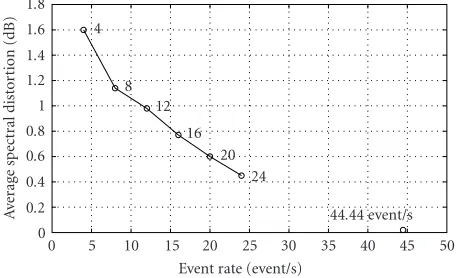
Lower distortion can be expected for higher TD resolution and vice versa. But higher resolution implies a lower com-pression efficiency from an application point of view. This rate-distortion characteristic of the OTD algorithm is quite important for coding applications, and simulations were car-ried out to determine it. Average SD was evaluated for the event rates of 4, 8, 12, 16, 20, and 24 event/s.Figure 6shows an example of event functions obtained for a block of speech. Figure 7shows the average SD versus event rate graph. The base frame rate point, that is, 44.4 frame/s, is also shown for reference. The significance of the frame rate is that if the event rate is made equal to the frame rate (in this case 44.44 event/s), theoretically the average SD should become zero. This is the maximum possible TD resolution and cor-responds to a situation where all event functions become unit impulses spaced at frame intervals and event target values ex-actly equal the original spectral parameter frames. As can be seen, an average event rate of more than 12 event/s is required if the OTD model is to achieve an SD less than 1 dB. It should be noted that at this stage, TD parameters are unquantized, and therefore, only modelling error accounts for the average SD.
4.3. Performance comparison with SBEL-TD
In SBEL-TD algorithm [10], event localization is performed based on the a priori assumption of spectral stability and
Frame number (n)
30 35 40 45 50 55 60
φk
(
n
)
0 0.5 1 1.5
Speech waveform
Figure 6: Bottom: an example of event functions obtained for a block of spectral parameters. Triangles indicate the event locations. Top: the corresponding speech waveform.
Event rate (event/s)
0 5 10 15 20 25 30 35 40 45 50
A
ver
age
spect
ra
l
d
ist
o
rt
ion
(dB)
0 0.2 0.4 0.6 0.8 1 1.2 1.4 1.6 1.8
44.44 event/s 24
20 16 12 8 4
Figure7: Average SD (dB) versus TD resolution (event/s) charac-teristic of the OTD algorithm. Average SD was evaluated for the event rates of 4, 8, 12, 16, 20, and 24 event/s. The base frame rate point, that is, 44.4 frame/s, is also shown for reference.
does not guarantee the optimal event locations. Also, SBEL-TD incorporates an adaptive iterative technique to achieve the temporal nature (short duration of existence) of the event functions. In contrast, the OTD algorithm uses the modified model of TD (temporal nature of the event functions is an inherent property of the model) and also uses the optimum locations for the events. In this section, the objective perfor-mance of the OTD algorithm is compared with that of the SBEL-TD algorithm [10] in terms of speech parameter mod-elling accuracy.
Table1: Average SD (dB) and the percentage number of outliers for the SBEL-TD and OTD algorithms evaluated over the same speech data set. Event rate is set approximately to 12 event/s in both cases.
Algorithm Average SD (dB) ≤2 dB 2–4 dB >4 dB
SBEL-TD 1.82 72% 25% 3%
OTD 0.98 97% 3% 0%
seen from the results inTable 1, the OTD algorithm achieved a significant improvement in terms of the speech parameter modelling accuracy. Also, the percentage number of outlier frames has been reduced significantly in the OTD case. These improvements of the OTD algorithm are critically important for speech coding applications. As reported in [12], SBEL-TD fails to realize good-quality synthesized speech because the TD parameter quantization error increases the postquan-tized average SD and the number of outliers to unacceptable levels. With a significant improvement in speech parameter modelling accuracy, OTD has a greater margin to accommo-date the TD parameter quantization error, resulting in good-quality synthesized speech in coding applications. Sections 5and6give the details of the proposed OTD-based speech coding scheme and the coder performance evaluation, re-spectively.
5. PROPOSED TD-BASED LPC VOCODER
5.1. Coder schematics
The mixed excitation LPC model [17] incorporated by the MELP coding standard [16] achieves good-quality synthe-sized speech at the bit rate of 2.4 kbit/s. The coder is based on a parametric model of speech operating at 22.5-millisecond speech frames. The MELP model parameters can be broadly categorized into the two groups of
(1) excitation parameters that model the excitation, that is, LPC residual, to the LPC synthesis filter and consist of Fourier magnitudes, gain, pitch, bandpass voicing strengths, and aperiodic flag;
(2) spectral parameters that represent the LPC filter coef-ficients and consist of the 10th-order LSFs.
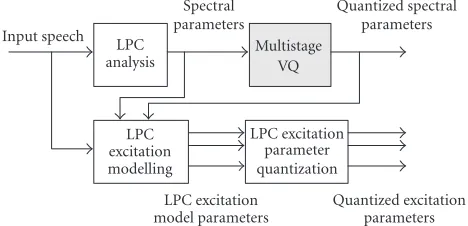
With the above classification of MELP parameters, the MELP encoder can be represented as shown inFigure 8. The proposed OTD-based LPC vocoder uses the LPC excitation modelling and parameter quantization stages of the MELP coder, but uses block-based (i.e., delayed) OTD analysis and OTD parameter quantization for the spectral parameter en-coding instead of the multistage vector quantization (MSVQ) [15] stage of the standard MELP coder. This proposed speech encoding scheme is shown inFigure 9. The underlying con-cept of the speech coder shown inFigure 9is that it exploits the short-term redundancies (interframe and intraframe cor-relations) present in the spectral parameter frame sequence (line spectral frequencies), using TD modelling, for efficient encoding of spectral information at very low bit rates. The
LPC excitation model parameters
Quantized excitation parameters LPC
excitation modelling
LPC excitation parameter quantization Input speech LPC
analysis
Spectral parameters
Multistage VQ
Quantized spectral parameters
Figure8: Standard MELP speech encoder block diagram.
LPC excitation model parameters
Quantized excitation parameters LPC
excitation modelling
LPC excitation parameter quantization Input speech LPC
analysis
Spectral parameters
TD modelling and quantization
Quantized spectral parameters
Figure9: Proposed speech encoder block diagram.
OTD algorithm was incorporated. The frame-based MSVQ stage ofFigure 8only accounts for the redundancies present within spectral frames (intraframe correlations), while the TD analysis quantization stage ofFigure 9accounts for both interframe and intraframe redundancies present in spectral parameter sequence, and therefore, is capable of achieving significantly higher compression ratios. It should be noted that the concept of TD can be used to exploit the short-term redundancies present in some of the LPC excitation parame-ters also using block mode TD analysis. However, some pre-liminary results of applying OTD to LPC excitation parame-ters showed that the achievable coding gain is not significant compared to that for the LPC spectral parameters.
Vector quantization
Quantized targets Refined
targets Refinement
of targets Event
targets Optimized
TD analysis LSF block
Parameter buffering Spectral
parameter sequence
LSF’s
Block overlapping Event
functions
Vector
quantization Quantizedfunctions
Figure10: Proposed spectral parameter encoding scheme based on the OTD. For improved performance, coupling between the TD analysis and the quantization stage is incorporated.
refined using the quantized version of the event functions in order to optimize the overall performance of the TD analysis and TD parameter quantization stages.
5.2. OTD parameter quantization 5.2.1. Event function quantization
One choice for quantization of the event function set, {φ1,φ2, . . . ,φK}, for each block is to use vector quantiza-tion (VQ) [15] on individual event funcquantiza-tions, φk’s, in or-der to exploit any dependencies in event function shapes. However, the event functions are of variable length (φk ex-tending from nk−1 to nk+1) and therefore require
normal-ization to a fixed length before VQ. Investigations showed that the process of normalization-denormalization itself in-troduces a considerable error which gets added to the quan-tization error. Therefore, we incorporated a frame-based 2-dimensional VQ for event functions which proved to be sim-ple and effective. This was possible only because the mod-ified TD model allows only two event functions to overlap at any frame location. Vectors φk(n) φk+1(n)
were quan-tized individually. The distribution of the 2-dimensional vec-tor points of φk(n) φk+1(n)
showed significant clustering, and this dependency was effectively exploited through the frame-level VQ of the event functions. Sixty-two phonetically diverse sentences from TIMIT database resulting in 8428 LSF frames were used as the training set to generate the code books of sizes 5, 6, 7, 8, and 9 bit using the LBGk-means algorithm [15].
5.2.2. Event target quantization
Quantization of the event target set,{a1,a2, . . . ,aK}, for each
block was performed by vector quantizing each target vec-tor,ak, separately. Event targets are 10-dimensional LSFs, but they differ from the original LSFs due to the iterative refine-ment of the event targets incorporated in the TD analysis stage. VQ code books of sizes 6, 7, 8, and 9 bit were generated using the same training data set described in Section 5.2.1 using the LBGk-means algorithm [15].
6. CODER PERFORMANCE EVALUATION
6.1. Objective quality evaluation
Spectral parameters can be synthesized from thequantized
event targets, ˆak’s, and quantized event functions, ˆφk’s, for each speech block as
ˆˆ
y(n)= K
k=1
ˆ
akφˆk(n), 1≤n≤N, (24)
where ˆˆy(n) is thenth synthesized spectral parameter vector at the decoder, synthesized using thequantized TD param-eters. Note that double-hat notation is used here for spec-tral parameters as the single-hat notation is already used in (5) to denote the spectral parameters synthesized using theunquantizedTD parameters. The average error between the original spectral parameters,y(n)’s, and the synthesized spectral parameters, ˆˆy(n)’s, calculated in terms of average SD (dB) was used to evaluate the objective quality of the coder. The final bit rate requirement for spectral parameters of the proposed compression scheme can be expressed in number of bit per frame as
B=n1+n2K
N +n3 K
N bit/frame, (25)
wheren1andn2are the sizes (in bit) of the code books for
the event function quantization and event target quantiza-tion, respectively. The parameter n3denotes the number of
bit required to code each event location within a given block. For the chosen block size (N=20) and the number of events per block (K = 5), the maximum possible segment length (nk+1 −nk) is 16. Therefore, the event location informa-tion can be losslessly coded using differential encoding with n3=4.
6.1.1. Results of evaluation
Bit rate for spectral parameter coding (bit/frame)
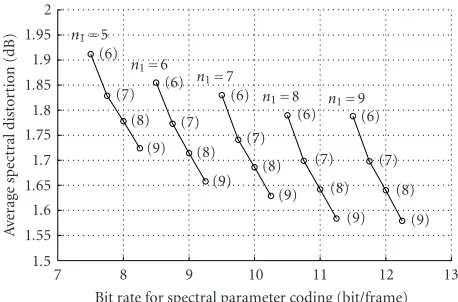
Figure 11: Average SD against bit rate for the proposed speech coder with coupledTD analysis and TD parameter quantization stages. Code-book size for event target quantization,n2, is depicted
as (n2).
Table2: SD analysis results for the standard MELP coder and the proposed OTD-based speech coder operating at the TD parameter quantization resolutions ofn1=7 andn2=9.
Coder (bit/frame) SD (dB) <2 dB 2–4 dB >4 dB
MELP (25) 1.22 91% 9% 0%
Proposed (10.25) 1.62 80% 20% 0%
from the speech data set used for VQ code book training in Section 5.2. The SD between the original spectral parameters and the reconstructed spectral parameters from the quan-tized TD parameters (given in (24)) was used as the objective performance measure. This SD was evaluated for different combinations of the event function and event target code-book sizes. The event location quantization resolution was fixed atn3=4 bit.Figure 11shows the average SD (dB) for
differentn1andn2against the bit rateB.
6.1.2. Performance comparison
Figure 11 shows the average SD (dB) against the bit rate requirement for spectral parameter encoding in bit/frame. Standard MELP coder uses 25 bit/frame for the spectral pa-rameters (line spectral frequencies). In order to compare the rate-distortion performances of the proposed delay domain speech coder and the standard MELP coder, the SD analysis was performed for the standard MELP coder also using the same speech data set.Table 2shows the results of this analy-sis. For comparison, the SD analysis results obtained for the proposed coder with TD parameter quantization resolutions ofn1=7 andn2=9 are also shown inTable 2.
In comparison to the 25 bit/frame of the standard MELP coder, the proposed coder operating at n1 = 7 andn2 =9
results in a bit rate of 10.25 bit/frame. This signifies over 50% compression of bit rate required for spectral information at the expense of 0.4 dB of objective quality (spectral distortion) and 450 milliseconds of algorithmic coder delay.
Table3: Six operating bit rates of the proposed speech coder se-lected for subjective performance evaluation.
Rate Bit/frame n1(bit) n2(bit) Average SD (dB)
R1 12.25 9 9 1.579 dB
6.2. Subjective quality evaluation
In order to back up the objective performance evaluation re-sults, and to further verify the efficiency and the applicability of the proposed speech coder design, subjective performance evaluation was carried out in terms of listening tests. The 5-point degradation category rating (DCR) scale [18] was uti-lized as the measure to compare the subjective quality of the proposed coder to that of the standard MELP coder.
6.2.1. Experimental design
Six different operating bit rates of the proposed speech coder with coupling between TD analysis and TD parameter quan-tization stages (Figure 10) were selected for subjective evalu-ation.Table 3gives the 6 selected operating bit rates together with the corresponding quantization code-book sizes for the TD parameters and the objective quality evaluation result. It should be noted that the speech coder operating points given inTable 3have the best rate-distortion advantage within the grid of TD parameter quantizer resolutions (Figure 11), and are therefore selected for the subjective evaluation.
Sixteen nonexpert listeners were recruited for the listen-ing test on volunteer basis. Each listener was asked to lis-ten to 30 pairs of speech senlis-tences (stimuli), and to rate the degradation perceived in speech quality when comparing the second stimulus to the first in each pair. In each pair, the first stimulus contained speech synthesized using the stan-dard MELP coder and the second stimulus contained speech synthesized using the proposed speech coder. The six diff er-ent operating bit rates given inTable 3of the proposed coder, each with 5 pairs of sentences (including one null pair) per listener, were evaluated. Therefore, a total of 30 (6×5) pairs of speech stimuli per listener were used. The null pairs contain-ing the identical speech samples as the first and the second stimuli were included to monitor any bias in the one-sided DCR scale used.
6.3. Results and analysis
The 30 pairs of speech stimuli consisting of 5 pairs of sen-tences (including 1 null pair) from each of the 6 operating bit rates of the proposed speech coder were presented to the 16 listeners. Therefore, a total of 64 (16×4) votes (DCRs) were obtained for each of the 6 operating bit rates,R1toR6.
Table4: Degradation category rating (DCR) results obtained for the 6 operating bit rates of the proposed speech coder.
Rate Compression ratio
No. of DCR votes
DMOS
5 4 3 2 1
R1 51% 31 23 10 0 0 4.33
R2 54% 21 34 9 0 0 4.19
R3 59% 22 28 14 0 0 4.13
R4 63% 20 32 9 3 0 4.08
R5 67% 16 21 25 2 0 3.80
R6 70% 7 22 28 7 0 3.45
the degradation was measured in comparison to the subjec-tive quality of the standard MELP coder. Degradation mean opinion score (DMOS) was calculated as the weighted aver-age of the listener ratings, where the weighting is the DCR values (1–5). As can be seen from the DMOSs inTable 4, the proposed speech coder achieves a DMOS of over 4 for the op-erating bit rates ofR1toR4. This corresponds to a
compres-sion ratio of 51% to 63%. Therefore, the proposed speech coder achieves over 50% compression of the bit rate required for spectral encoding at a negligible degradation (in between not perceivable or perceivable but not annoying distortion levels) of the subjective quality of the synthesized speech. DMOS drops below 4 for the bit rates ofR5andR6,
suggest-ing that on average the degradation in the subjective quality of synthesized speech becomes perceivable and annoying for compression ratios over 63%.
7. CONCLUSIONS
We have proposed a dynamic programming-based optimiza-tion strategy for a modified TD model of speech. Optimum event localization, model accuracy control through TD res-olution, and overlapping speech parameter buffering tech-nique for continuous speech analysis can be highlighted as the main features of the proposed method. Improved objec-tive performance in terms of modelling accuracy has been achieved compared to the SBEL-TD algorithm, where the event localization is based on the a priori assumption of spec-tral stability. A speech coding scheme was proposed, based on the OTD algorithm and associated VQ-based TD param-eter quantization techniques. The MELP model was used as the baseline parametric model of speech with OTD being in-corporated for efficient compression of the spectral param-eter information. Performance evaluation of the proposed speech coding scheme was carried out in detail. Objective performance evaluation was performed in terms of log SD (dB), while the subjective performance evaluation was per-formed in terms of DMOS calculated using DCR votes. The DCR listening test was performed in comparison to the qual-ity of the standard MELP synthesized speech. These evalua-tion results showed that the proposed speech coder achieves 50%–60% compression of the bit rate requirement for spec-tral parameter encoding for a little degradation (in between
not perceivable and perceivable but not annoying distortion levels) of the subjective quality of decoded speech. The pro-posed speech coder would find useful applications in voice store-forward messaging systems, multimedia voice output systems, and broadcasting.
ACKNOWLEDGMENTS
The authors would like to thank the members of the Cen-ter for Advanced Technology in Telecommunications and the School of Electrical and Computer Systems Engineering, RMIT University, who took part in the listening test.
REFERENCES
[1] T. Svendsen, “Segmental quantization of speech spectral in-formation,” inProc. IEEE Int. Conf. Acoustics, Speech, Signal Processing (ICASSP ’94), vol. 1, pp. I517–I520, Adelaide, Aus-tralia, April 1994.
[2] D. J. Mudugamuwa and A. B. Bradley, “Optimal transform for segmented parametric speech coding,” in Proc. IEEE Int. Conf. Acoustics, Speech, Signal Processing (ICASSP ’98), vol. 1, pp. 53–56, Seatle, Wash, USA, May 1998.
[3] D. J. Mudugamuwa and A. B. Bradley, “Adaptive transforma-tion for segmented parametric speech coding,” inProc. 5th In-ternational Conf. on Spoken Language Processing (ICSLP ’98), pp. 515–518, Sydney, Australia, November–December 1998. [4] A. N. Lemma, W. B. Kleijn, and E. F. Deprettere, “LPC
quan-tization using wavelet based temporal decomposition of the LSF,” inProc. 5th European Conference on Speech Communica-tion and Technology (Eurospeech ’97), pp. 1259–1262, Rhodes, Greece, September 1997.
[5] Y. Shiraki and M. Honda, “LPC speech coding based on variable-length segment quantization,”IEEE Trans. Acoustics, Speech, and Signal Processing, vol. 36, no. 9, pp. 1437–1444, 1988.
[6] B. S. Atal, “Efficient coding of LPC parameters by tempo-ral decomposition,” inProc. IEEE Int. Conf. Acoustics, Speech, Signal Processing (ICASSP ’83), pp. 81–84, Boston, Mass, USA, April 1983.
[7] S. M. Marcus and R. A. J. M. Van-Lieshout, “Temporal de-composition of speech,” IPO Annual Progress Report, vol. 19, pp. 26–31, 1984.
[8] A. M. L. Van Dijk-Kappers and S. M. Marcus, “Temporal de-composition of speech,”Speech Communication, vol. 8, no. 2, pp. 125–135, 1989.
[9] A. C. R. Nandasena and M. Akagi, “Spectral stability based event localizing temporal decomposition,” in Proc. IEEE Int. Conf. Acoustics, Speech, Signal Processing (ICASSP ’98), pp. 957–960, Seattle, Wash, USA, May 1998.
[10] A. C. R. Nandasena, P. C. Nguyen, and M. Akagi, “Spec-tral stability based event localizing temporal decomposition,” Computer Speech and Language, vol. 15, no. 4, pp. 381–401, 2001.
[11] S. Ghaemmaghami and M. Deriche, “A new approach to very low-rate speech coding using temporal decomposition,” inProc. IEEE Int. Conf. Acoustics, Speech, Signal Processing (ICASSP ’96), pp. 224–227, Atlanta, Ga, USA, May 1996. [12] A. C. R. Nandasena, “A new approach to temporal
[13] K. K. Paliwal, “Interpolation properties of linear prediction parametric representations,” inProc. 4th European Conference on Speech Communication and Technology (Eurospeech ’95), pp. 1029–1032, Madrid, Spain, September 1995.
[14] D. P. Bertsekas, Dynamic Programming and Optimal Control, vol. 1 ofOptimization and Computation Series, Athena Scien-tific, Belmont, Mass, USA, 2nd edition, 2000.
[15] A. Gersho and R. M. Gray, Vector Quantization and Signal Compression, vol. 159 ofKluwer International Series in Engi-neering and Computer Science, Kluwer Academic, Dordrecht, The Netherlands, 1992.
[16] L. M. Supplee, R. P. Cohn, J. S. Collura, and A. V. McCree, “MELP: The new federal standard at 2400 bps,” inProc. IEEE Int. Conf. Acoustics, Speech, Signal Processing (ICASSP ’97), pp. 1591–1594, Munich, Germany, April 1997.
[17] A. V. McCree and T. P. Barnwell, “A mixed excitation LPC vocoder model for low bit rate speech coding,” IEEE Trans. Speech, and Audio Processing, vol. 3, no. 4, pp. 242–250, 1995. [18] P. Kroon, “Evaluation of speech coders,” inSpeech Coding and Synthesis, pp. 467–494, Elsevier Science, Sara Burgerhart-straat, Amsterdam, The Netherlands, 1995.
Chandranath R. N. Athaudagewas born in Sri Lanka in 1965. He received the B.S. de-gree in electronic and telecommunication engineering with first-class honours from University of Moratuwa, Sri Lanka in 1991, and the M.S. degree in information science from Japan Advanced Institute of Science and Technology (JAIST) in 1997. He re-ceived his Ph.D. degree in electrical engi-neering from Royal Melbourne Institute of
Technology (RMIT), Australia, in 2001. Dr. Athaudage received a Japanese Government Fellowship during his graduate studies and an Academic Excellence Award from JAIST in 1997. During 1993– 1994 he was an Assistant Lecturer at University of Moratuwa, and during 1999–2000 a Lecturer at RMIT, where he taught undergrad-uate and gradundergrad-uate courses in digital signal processing and commu-nication theory and systems. He has been a member of IEEE since 1995. Since 2001, he has been a Research Fellow at the Australian Research Council Special Research Centre for Ultra-Broadband In-formation Networks, University of Melbourne, Australia. His re-search interests include speech signal processing, multimedia com-munications, multicarrier systems, channel estimation, and syn-chronization for broadband wireless systems.
Alan B. Bradley received his M.S. degree in engineering from Monash University in 1972. In 1973, he joined RMIT University and completed a 29-year career holding the positions of Lecturer, Senior Lecturer, Prin-cipal Lecturer, Head of Department, and Associate Dean. In 1991, he became a Pro-fessor of signal processing at RMIT Univer-sity. His research interests have been in the field of signal processing with specific
em-phasis on speech coding, speech processing, and speaker recog-nition. Earlier research was focused on the control of time and frequency-domain aliasing cancellation in filter bank structures with application to speech coding. More recently, attention has been turned to two-dimensional time-frequency analysis structures and approaches to exploiting longer-term temporal redundancies in very low data rate speech coding. Alan Bradley retired from
RMIT University in 2002 and was granted the title of Professor Emeritus. He is now Manager Accreditation for The Institution of Engineers Australia, and responsible for engineering education program accreditation in Australian universities. Professor Bradley is a member of IEEE as well as a Fellow of The Institution of Engi-neers Australia.
Margaret Lech received her M.S. degree in applied physics from the Maria Curie-Sklodowska University (UMCS), Poland in 1982. This was followed by Diploma degree in biomedical engineering in 1985 from the Warsaw Institute of Technology and Ph.D. degree in electrical engineering from The University of Melbourne in 1993. From 1982 to 1987, Dr. Lech was working at The Institute of Physics, UMCS conducting